Opening Everything:
Considerations for African Institutions
        Michelle Willmers and Laura Czerniewicz
                       CC-BY-SA
The history of scholarship and the
  evolutionary progress of open
       academic principles
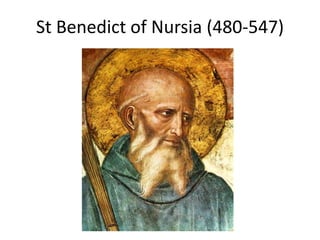
St Benedict of Nursia (480-547)
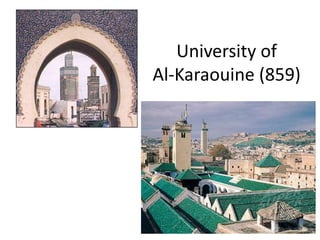
University of
Al-Karaouine (859)
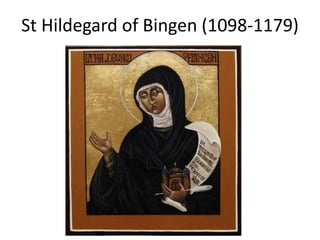
St Hildegard of Bingen (1098-1179)
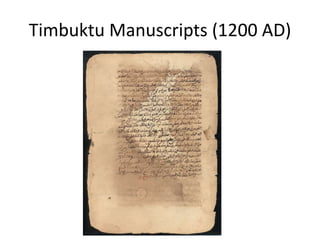
Timbuktu Manuscripts (1200 AD)
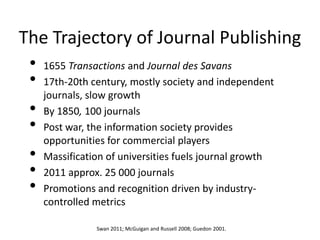
The Trajectory of Journal Publishing
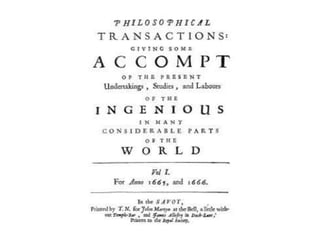
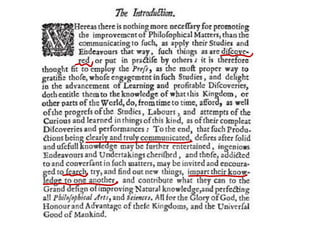
 • 1655 Transactions and Journal des Savans
 • 17th-20th century, mostly society and independent
   journals, slow growth
 • By 1850, 100 journals
 • Post war, the information society provides
   opportunities for commercial players
 • Massification of universities fuels journal growth
 • 2011 approx. 25 000 journals
 • Promotions and recognition driven by industry-
    controlled metrics

               Swan 2011; McGuigan and Russell 2008; Guedon 2001.
Countervailing forces -
scholarship goes digital
A Brief History of Open Everything
              (so far)
Budapest Open Access Initiative
                            (2001)
An old tradition and a new technology have converged to make
    possible an unprecedented public good. The old tradition is
   the willingness of scientists and scholars to publish the fruits
    of their research in scholarly journals without payment, for
  the sake of inquiry and knowledge. The new technology is the
     internet. The public good they make possible is the world-
      wide electronic distribution of the peer-reviewed journal
  literature and completely free and unrestricted access to it by
   all scientists, scholars, teachers, students, and other curious
        minds. Removing access barriers to this literature will
    accelerate research, enrich education, share the learning of
    the rich with the poor and the poor with the rich, make this
     literature as useful as it can be, and lay the foundation for
   uniting humanity in a common intellectual conversation and
                         quest for knowledge.
Open Access Publishing
Gold Route
- Primary publication in open-access journals.
- 7 070 journals (DOAJ 2011)
Green Route
- Self-archiving of scholarly content in open access
   repositories prior to, in parallel with, or after
   publication.
- 2085 repositories worldwide (DOAR 2011)
http://poeticeconomics.blogspot.com/2011/09/dramatic-growth-of-open-access.html
Free!
Who Pays?
Rise of new business models:
  ‘freemium’ and value-add
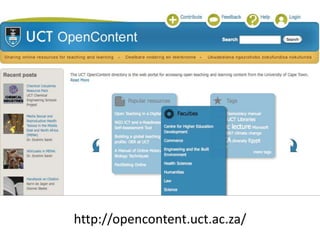
http://opencontent.uct.ac.za/
Open Research
• Replicable (transparency - method)
• Reusable (results free for re-use and
  appropriation)
• Replayable (tools available for appropriation)
• Collaborative
• Interdisciplinary
• Granular
• Immediacy factor
• Suited to addressing socio-economic imperatives
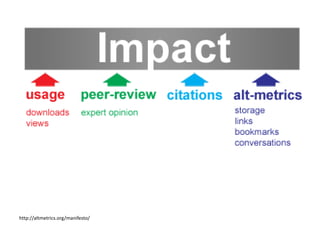
http://altmetrics.org/manifesto/
“Open access advocates might centre their
vision on integrating open access with a new
 type of digital and global infrastructure that
       includes all results in real time …
  Therefore, the question that policy makers
 should be making is how to articulate open
    access as an essential part of the new
    infrastructure that merits institutional
                  investment.”
     Chris Armbruster, Implementing Open Access (2010)
How do we participate
  (as contributors)?
Factors and considerations for
      African universities
African HE at a glance
    Current est. 1 billion population
    Lowest tertiary enrolment rate in the world at 5%
        Compared to OECD targets of 50-60% and ‘Asian tiger economies’
        of 30-40%
    Numbers of tertiary enrolments more than tripled in 20
    years, imposing great strain
    -- 1985 (800,000 enrolments) to 2002 (3 million)
    200 public universities in Sub-Saharan Africa (UK alone with 60
    million population has 126 universities and over 1 million
    enrolments)
    Private tertiary providers emerging to fill demand gap and over-
    burden in public sector
    Absence of quality systems in many countries/lack of linkage
    between quality and national funding

Materu, P., (2007), “Higher education quality assurance in sub-Saharan Africa: status, challenges, opportunities and promising
practices”, A Report for the World Bank: Washington.
African Research Participation
• Africa home to only 2.3% of world’s researchers
• 169 researchers per one million inhabitants
• Apart from having the lowest density of researchers in the
world, investment in research and development in Africa
stands at 0.9%
• Excluding South Africa, intensity in research and
development in Sub-Saharan Africa is 0.3%
•Mamdani (2011): Corrosive culture of consultancy

      “The culture of consultancy has radically changed
postgraduate education and research as consultants presume
    that research is all about finding answers to problems
                      defined by a client.”
                         Mamdani (2011)
                        http://tinyurl.com/6czxv6e
1. Enabling Environment
• Policy, regulation and infrastructure (national and
  institutional).
• National support for OA and acknowledgement that
  communication crucial part of research.
• Structures and business models to enable (e.g. channels
  for payment of OA publication fees).
• Support for changing models of scholarly communication
  (e.g. support for exploring Web 2.0 professional
  application).
• Protection and control of IP in digital environment
  through exploration of alternative licensing options
  suitable to public domain (e.g. Creative Commons).
2. e-Infrastructure
• Investment in curation
  - Data centres
  - Repositories
• Investment in systems and processes to track impact
• Balanced local and regional perspective
• Harmonised regional collaborative approach
  - Grid services
  - Bandwidth
3. Re-asserting Academics’ Agency /
 The Rise of the Global Networked Scholar
• Clear articulation of individual academics’ rights in
  sharing content.
• Examination of repository deposit routes and clear
  articulation of expectation around author
  contribution (coupled with investigation to see
  where breakdown occurs).
• Tracking and evaluation of funder’s requirements in
  line with institutional policy around OA.
• Focus on authors as users (in addition to depositors).

Armbuster C (2010) Implementing Open Access: Policy Case Studies. Max Planck Digital Library
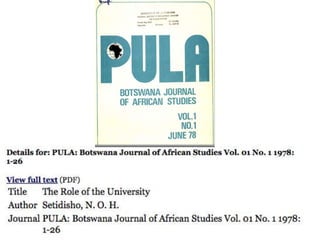
Setidisho NOH (1978) The Role of the University in a Developing Country.
Pula: Journal of African Studies 1(1): 3
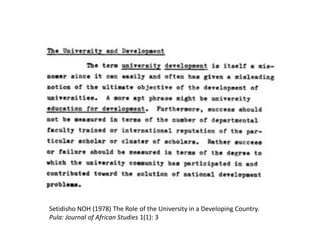
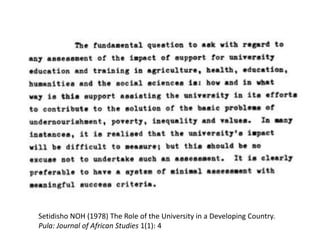
Setidisho NOH (1978) The Role of the University in a Developing Country.
Pula: Journal of African Studies 1(1): 4
michelle.willmers@uct.ac.za
http://www.scaprogramme.org.za/

Opening Everything

  • 1.
    Opening Everything: Considerations forAfrican Institutions Michelle Willmers and Laura Czerniewicz CC-BY-SA
  • 2.
    The history ofscholarship and the evolutionary progress of open academic principles
  • 3.
    St Benedict ofNursia (480-547)
  • 4.
  • 5.
    St Hildegard ofBingen (1098-1179)
  • 6.
  • 9.
    The Trajectory ofJournal Publishing • 1655 Transactions and Journal des Savans • 17th-20th century, mostly society and independent journals, slow growth • By 1850, 100 journals • Post war, the information society provides opportunities for commercial players • Massification of universities fuels journal growth • 2011 approx. 25 000 journals • Promotions and recognition driven by industry- controlled metrics Swan 2011; McGuigan and Russell 2008; Guedon 2001.
  • 10.
  • 14.
    A Brief Historyof Open Everything (so far)
  • 17.
    Budapest Open AccessInitiative (2001) An old tradition and a new technology have converged to make possible an unprecedented public good. The old tradition is the willingness of scientists and scholars to publish the fruits of their research in scholarly journals without payment, for the sake of inquiry and knowledge. The new technology is the internet. The public good they make possible is the world- wide electronic distribution of the peer-reviewed journal literature and completely free and unrestricted access to it by all scientists, scholars, teachers, students, and other curious minds. Removing access barriers to this literature will accelerate research, enrich education, share the learning of the rich with the poor and the poor with the rich, make this literature as useful as it can be, and lay the foundation for uniting humanity in a common intellectual conversation and quest for knowledge.
  • 18.
    Open Access Publishing GoldRoute - Primary publication in open-access journals. - 7 070 journals (DOAJ 2011) Green Route - Self-archiving of scholarly content in open access repositories prior to, in parallel with, or after publication. - 2085 repositories worldwide (DOAR 2011) http://poeticeconomics.blogspot.com/2011/09/dramatic-growth-of-open-access.html
  • 19.
  • 20.
    Who Pays? Rise ofnew business models: ‘freemium’ and value-add
  • 23.
  • 25.
    Open Research • Replicable(transparency - method) • Reusable (results free for re-use and appropriation) • Replayable (tools available for appropriation) • Collaborative • Interdisciplinary • Granular • Immediacy factor • Suited to addressing socio-economic imperatives
  • 28.
  • 29.
    “Open access advocatesmight centre their vision on integrating open access with a new type of digital and global infrastructure that includes all results in real time … Therefore, the question that policy makers should be making is how to articulate open access as an essential part of the new infrastructure that merits institutional investment.” Chris Armbruster, Implementing Open Access (2010)
  • 30.
    How do weparticipate (as contributors)? Factors and considerations for African universities
  • 31.
    African HE ata glance Current est. 1 billion population Lowest tertiary enrolment rate in the world at 5% Compared to OECD targets of 50-60% and ‘Asian tiger economies’ of 30-40% Numbers of tertiary enrolments more than tripled in 20 years, imposing great strain -- 1985 (800,000 enrolments) to 2002 (3 million) 200 public universities in Sub-Saharan Africa (UK alone with 60 million population has 126 universities and over 1 million enrolments) Private tertiary providers emerging to fill demand gap and over- burden in public sector Absence of quality systems in many countries/lack of linkage between quality and national funding Materu, P., (2007), “Higher education quality assurance in sub-Saharan Africa: status, challenges, opportunities and promising practices”, A Report for the World Bank: Washington.
  • 32.
    African Research Participation •Africa home to only 2.3% of world’s researchers • 169 researchers per one million inhabitants • Apart from having the lowest density of researchers in the world, investment in research and development in Africa stands at 0.9% • Excluding South Africa, intensity in research and development in Sub-Saharan Africa is 0.3% •Mamdani (2011): Corrosive culture of consultancy “The culture of consultancy has radically changed postgraduate education and research as consultants presume that research is all about finding answers to problems defined by a client.” Mamdani (2011) http://tinyurl.com/6czxv6e
  • 33.
    1. Enabling Environment •Policy, regulation and infrastructure (national and institutional). • National support for OA and acknowledgement that communication crucial part of research. • Structures and business models to enable (e.g. channels for payment of OA publication fees). • Support for changing models of scholarly communication (e.g. support for exploring Web 2.0 professional application). • Protection and control of IP in digital environment through exploration of alternative licensing options suitable to public domain (e.g. Creative Commons).
  • 34.
    2. e-Infrastructure • Investmentin curation - Data centres - Repositories • Investment in systems and processes to track impact • Balanced local and regional perspective • Harmonised regional collaborative approach - Grid services - Bandwidth
  • 35.
    3. Re-asserting Academics’Agency / The Rise of the Global Networked Scholar • Clear articulation of individual academics’ rights in sharing content. • Examination of repository deposit routes and clear articulation of expectation around author contribution (coupled with investigation to see where breakdown occurs). • Tracking and evaluation of funder’s requirements in line with institutional policy around OA. • Focus on authors as users (in addition to depositors). Armbuster C (2010) Implementing Open Access: Policy Case Studies. Max Planck Digital Library
  • 37.
    Setidisho NOH (1978)The Role of the University in a Developing Country. Pula: Journal of African Studies 1(1): 3
  • 38.
    Setidisho NOH (1978)The Role of the University in a Developing Country. Pula: Journal of African Studies 1(1): 4
  • 39.

Editor's Notes

  • #4 Father of Western monasticism. Advocates of removal of property and monastic lifestyle. Focus on immersion in reflection and reading gives birth to earliest form of Western scholarship (for the purpose of the glory of God).
  • #5 Established 859 as spiritual and educational centre of Muslim world when Al-Fihri family migrated from Tunisia and joined migrant community. Sisters Fatima and Mariam inheritance led to establishment in order to serve community. Today exists as one of the oldest universities in the world.
  • #6 Seer and prophet whose ill health led to utilisation of plants for therapeutic purpose. Could not read or write, but visions recorded by spiritual director and Church granted permission to share. Despite illiteracy entered into considerable correspondence across Europe helping physical/spiritual ailment. “The labours of knowledge must have public benefit.”
  • #7 As many as 18 000 manuscripts, many from ancient libraries, are now housed in the Ahmed Baba Centre, named after the famous 15th century Timbuktu scholar, Ahmed Baba. he Timbuktu Manuscripts - or Mali Manuscripts - reams of written manuscripts dating as far back as the 13th century, are ancient Arabic texts that hark back to the Malian city of Timbuktu's glorious past, when it existed 500 years ago as a gold trading port and centre for academics and scholars of religion, literature and science.The manuscripts provide a written testimony to the skill of African scientists, in astronomy, mathematics, chemistry, medicine and climatology in the Middle Ages. Discourse and commentary on manuscripts dating centuries later indicate an African scholarship system that existed independent of European scholarship. [Note glossary space around text for commentary.]
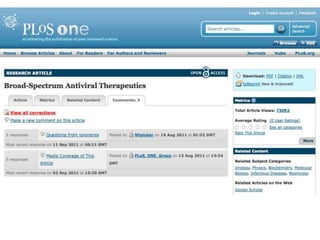
  • #13 “Comments” view of article. Note ‘View all corrections’. Transparency in process key.
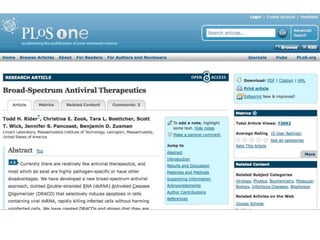
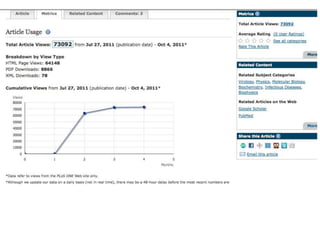
  • #14 “Metrics” view of article.
  • #16 Open Source acknowledge as “Father” of the open movement, with birth in the 1950s/60s. Software produced by academics and shared as other knowledge was at the time. Source code originally distributed with hardware for self-modification until rise of software industry in late 1960s. ‘Request for Comments’ initiative to develop telecomms network protocol in 1960s led to birth of the internet in 1969.
  • #20 “Free as in information, not as in beer.”
  • #22 OER origins in the 1990s and formalised as movement in early 2000s. Encourages open sharing of teaching and learning content with appropriate licensing mechanisms for sharing, translation, remixing of content.
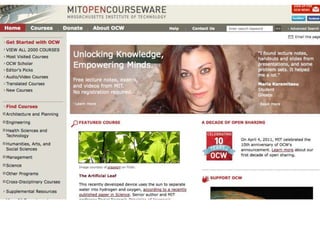
  • #23 MIT OpenCourseWare as most well-known example. Offers full courses (currently 2000 available).
  • #24 Portal for accessing OER from the University of Cape Town. This directory more granular approach and includes content from full textbooks to slide presentations and simulations. Launched February 2010. Currently 148 resources (October 2011).
  • #25 Open Research exploring space beyond the journal article and more dynamic system of open exchange of “research objects”. Promotes expansive, collaborative approach, which has had particular success in making progress in biomedical sciences, astronomy. Most notably, led to identification of biomarkers for alzheimers.
  • #26 A few commonly acknowledge characteristics.
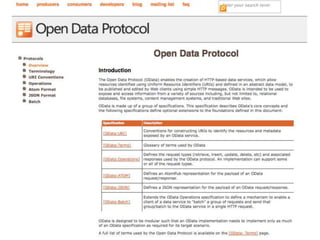
  • #27 Open research heavily contingent on open data practice.
  • #28 Significant challenges and barriers to sharing open data, particularly around metadata and curation considerations. Various large-scale organisations working at global interoperability of systems and standards.
  • #29 Open, technologically-driven practice leads to a new, expanded conception of impact.
  • #30 Open access as one of many considerations. Infrastructure requires institutional investment.
  • #32 Important to consider realities of African HE environment for foundational understanding of context in which open practice takes place for African universities. Particularly significant is teaching focus (up to new millenium), resource challenges and low number of researching academics.
  • #34 Based on evidence gathered and observations of Scholarly Communication in Africa Programme and OpenUCT initiative. Outputs forthcoming.
  • #35 Based on evidence gathered and observations of Scholarly Communication in Africa Programme and OpenUCT initiative. Outputs forthcoming.
  • #36 Based on evidence gathered and observations of Scholarly Communication in Africa Programme and OpenUCT initiative. Outputs forthcoming.
  • #37 Return to original thinking around “The Role of the University in a Developing Country” by Prof Setidisho, University of Botswana Rector, 1978.
  • #38 Imperative: Address development issues.