



How Open Access can
strategically benefit
African Universities
Paper presented at the Biomed Central
Open Access in Africa Conference
Kenyatta University, Nairobi
10-11 November 2010
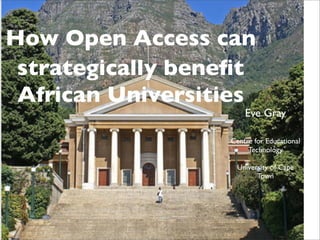
How Open Access can
strategically benefit
African Universities
Eve Gray
Centre for Educational
Technology
University of Cape
Town
The view of a publisher
... from Africa...
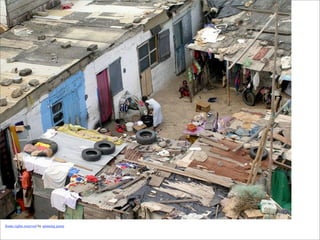
Some rights reserved by spinning jenny
In essence, what is being defined as ‘knowledge society’
means two different things to the developed world and
the African continent.The former are the producers
and the latter are the consumers of knowledge, which
seriously undermines the fostering of the multicultural
nature of Higher Education, as virtually all partnerships
are one-sided.This is not only negative for the African
continent, but it also deprives global higher education
of access to the indigenous knowledge of Africa, and it
deprives Africans of the opportunity to develop their
indigenous knowledge system and strengthen their
relationship to western and eastern knowledge
systems.
Blade Nzimande, Minister of Higher Education and Training, South Africa
ʻHow could the application of knowledge end
poverty and hunger in Africa? How could higher
education empower women and promote gender
equity? How can knowledge be considered in the
African context to address child mortality and
improve maternal health?ʼ
Nahas Angula, Namibian Prime Minister, UNESCO 29th Conference on
Higher Education, 2009
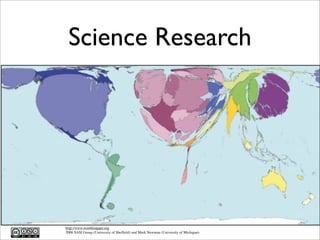
Science Research
http://www.worldmapper.org
2006 SASI Group (University of Sheffield) and Mark Newman (University of Michigan).
Is the problem what is being
produced, or what is being
measured?
We measure impact factors
and citations in a highly
competitive and exclusionary
system
..and pay less attention to
the publications that
emerge from development-
focused research
It is not that our policy-
makers do not see the
problem...
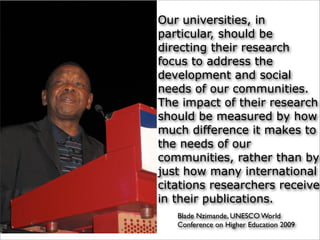
Blade Nzimande, UNESCO World
Conference on Higher Education 2009
Our universities, in
particular, should be
directing their research
focus to address the
development and social
needs of our communities.
The impact of their research
should be measured by how
much difference it makes to
the needs of our
communities, rather than by
just how many international
citations researchers receive
in their publications.
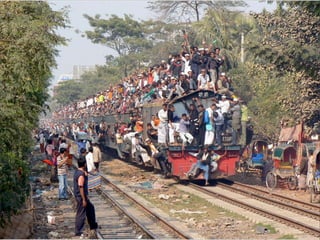
But we are stuck in a
free rider mentality...
in which higher
education does not see
publication as its
responsibility.
The result is tunnel
vision
http://www.flickr.com/photos/adactio/ CC attribution licence
which ignores all but a
small segment of the
publishing ecosystem..
the formal publishing
that does not work
very well for us...
Open
access is an
answer
Text
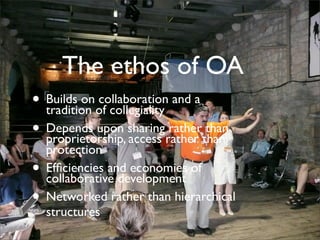
• Builds on collaboration and a
tradition of collegiality
• Depends upon sharing rather than
proprietorship, access rather than
protection
• Efficiencies and economies of
collaborative development
• Networked rather than hierarchical
structures
The ethos of OA
overcoming distribution
and access barriers
and working across
the whole ecosystem
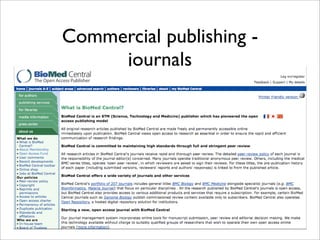
Commercial publishing -
journals
offers citation impact,
global prestige, access,
reach...
and freedom to reuse
content for ‘translation’
of research...
Text
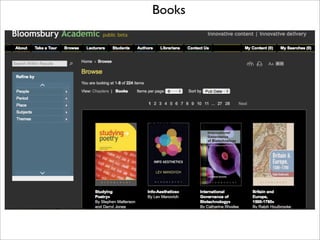
Books
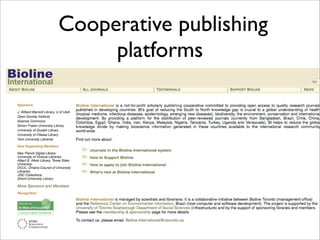
Cooperative publishing
platforms
help reduce the South
to North knowledge
gap
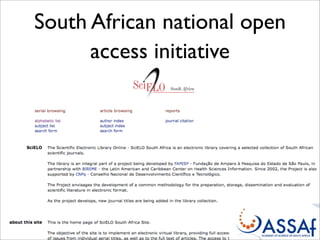
South African national open
access initiative
and building the quality
and accessibility of
national journals...
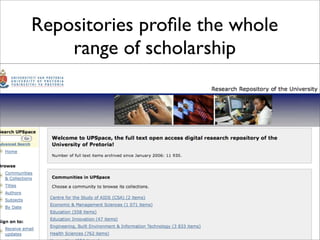
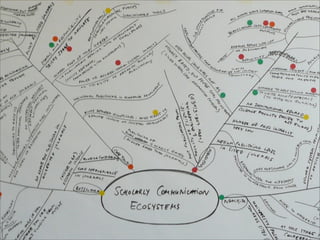
Repositories profile the whole
range of scholarship
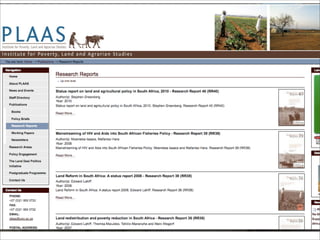
African research centres
produce research that
addresses vital
development needs
and release their
communications for
open access.
The question is how to build a
scholarly communication policy
environment that addresses
the whole ecosystem.
Eve Gray
Honorary Research Associate
Centre for Educational Technology
University of Cape Town
http://www.gray-area.co.za
http://www.http://www.sca2kafrica.org/
http://www.cet.uct.ac.za

Open Access in the Developing World

  • 1.
    How Open Accesscan strategically benefit African Universities Paper presented at the Biomed Central Open Access in Africa Conference Kenyatta University, Nairobi 10-11 November 2010
  • 2.
    How Open Accesscan strategically benefit African Universities Eve Gray Centre for Educational Technology University of Cape Town
  • 3.
    The view ofa publisher
  • 4.
  • 5.
    Some rights reservedby spinning jenny
  • 6.
    In essence, whatis being defined as ‘knowledge society’ means two different things to the developed world and the African continent.The former are the producers and the latter are the consumers of knowledge, which seriously undermines the fostering of the multicultural nature of Higher Education, as virtually all partnerships are one-sided.This is not only negative for the African continent, but it also deprives global higher education of access to the indigenous knowledge of Africa, and it deprives Africans of the opportunity to develop their indigenous knowledge system and strengthen their relationship to western and eastern knowledge systems. Blade Nzimande, Minister of Higher Education and Training, South Africa
  • 7.
    ʻHow could theapplication of knowledge end poverty and hunger in Africa? How could higher education empower women and promote gender equity? How can knowledge be considered in the African context to address child mortality and improve maternal health?ʼ Nahas Angula, Namibian Prime Minister, UNESCO 29th Conference on Higher Education, 2009
  • 8.
    Science Research http://www.worldmapper.org 2006 SASIGroup (University of Sheffield) and Mark Newman (University of Michigan).
  • 9.
    Is the problemwhat is being produced, or what is being measured?
  • 11.
    We measure impactfactors and citations in a highly competitive and exclusionary system
  • 12.
    ..and pay lessattention to the publications that emerge from development- focused research
  • 14.
    It is notthat our policy- makers do not see the problem...
  • 15.
    Blade Nzimande, UNESCOWorld Conference on Higher Education 2009 Our universities, in particular, should be directing their research focus to address the development and social needs of our communities. The impact of their research should be measured by how much difference it makes to the needs of our communities, rather than by just how many international citations researchers receive in their publications.
  • 16.
    But we arestuck in a free rider mentality...
  • 18.
    in which higher educationdoes not see publication as its responsibility.
  • 19.
    The result istunnel vision
  • 20.
  • 21.
    which ignores allbut a small segment of the publishing ecosystem..
  • 22.
    the formal publishing thatdoes not work very well for us...
  • 24.
  • 25.
    Text • Builds oncollaboration and a tradition of collegiality • Depends upon sharing rather than proprietorship, access rather than protection • Efficiencies and economies of collaborative development • Networked rather than hierarchical structures The ethos of OA
  • 26.
  • 28.
    and working across thewhole ecosystem
  • 29.
  • 30.
    offers citation impact, globalprestige, access, reach...
  • 31.
    and freedom toreuse content for ‘translation’ of research...
  • 32.
  • 33.
  • 34.
    help reduce theSouth to North knowledge gap
  • 35.
    South African nationalopen access initiative
  • 36.
    and building thequality and accessibility of national journals...
  • 37.
    Repositories profile thewhole range of scholarship
  • 38.
    African research centres produceresearch that addresses vital development needs
  • 40.
  • 41.
    The question ishow to build a scholarly communication policy environment that addresses the whole ecosystem.
  • 43.
    Eve Gray Honorary ResearchAssociate Centre for Educational Technology University of Cape Town http://www.gray-area.co.za http://www.http://www.sca2kafrica.org/ http://www.cet.uct.ac.za