The Open Access
Continuum:
Open Research and Altmetrics
Michelle Willmers
Scholarly Communication in Africa Programme
CC-BY-SA
Open Access

Green Route
- Self-archiving of scholarly content prior to, in
  parallel with, or after publication
- 2085 repositories worldwide (DOAR 2011)

Gold Route
- Primary publication in open-access journals
- 7 070 journals (DOAJ 2011)
But it’s not only about journal articles.
There is an abundance of information online.
The internet has changed the way we consume
information. No longer single source (journal,
book). This changes how we locate, verify and
measure new information.
“Rather than finding information, it is the
filtering of relevant information that is hard
to do on the internet.”
(David Weinberg)
“Open access to this knowledge is critical if it is to
        be shared between individuals and groups.
             But sharing alone is not enough.
       Knowledge only becomes useful when we can
distinguish between relevant and less relevant information,
      when we can discuss aspects of the information,
       when we can annotate and improve on ideas,
            when we can devise new approaches
                 and collaborate online.”
                      (Olijhoek 2012)
Open Research
•   Replicable (transparency - method)
•   Reusable (results free for re-use and appropriation)
•   Replayable (tools available for appropriation)
•   Collaborative
•   Interdisciplinary
•   Granular
•   Immediacy factor
•   Suited to addressing socio-economic imperatives and collaborative
    breakthrough
Traditional Scholarship
•   Relatively contained disciplinary context.
•   Relatively clear scholarly community.
•   Relatively clear boundaries.
•   Particular points of engagement.
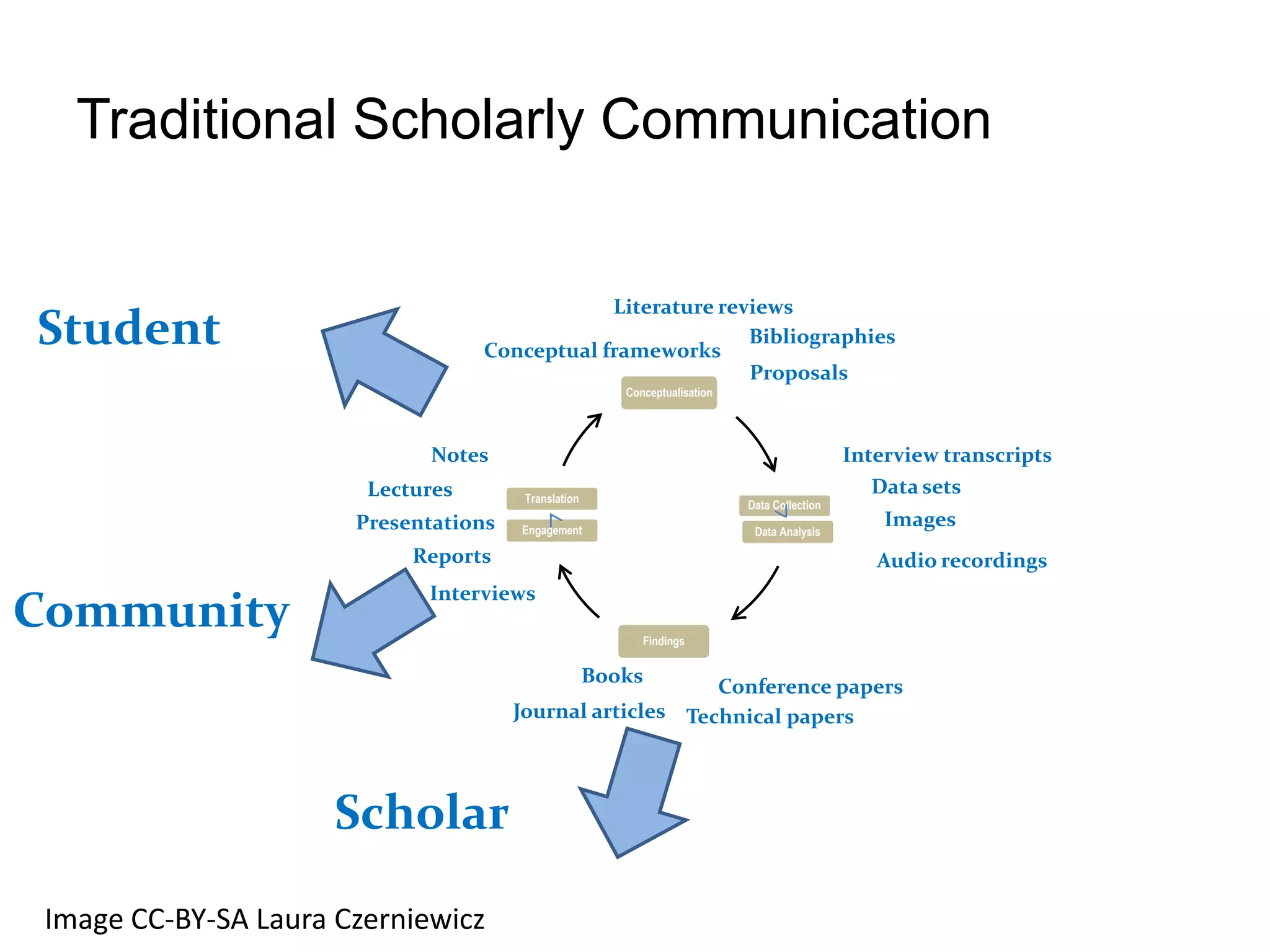
Traditional Scholarly Communication


                                               Literature reviews
Student                            Conceptual frameworks
                                                             Bibliographies
                                                             Proposals
                                                         Conceptualisation


                              Notes                                                            Interview transcripts
                        Lectures        Translation
                                                                                                  Data sets
                                                                             Data Collection
                       Presentations   Engagement                             Data Analysis
                                                                                                   Images
                            Reports                                                               Audio recordings
                             Interviews
Community                                                   Findings


                                                      Books
                                                           Conference papers
                                       Journal articles Technical papers


                      Scholar

 Image CC-BY-SA Laura Czerniewicz
Scholarship 2.0
• New ways of describing content (and looking for it). Metadata as passport to
  participation.
• New ways of tracking usage.
• Aggregation crucial.
• Blogging and social networking as mechanisms for research and collaboration.
• Outputs of social web become part of the scholarly record.
• Rise of the global networked scholar.
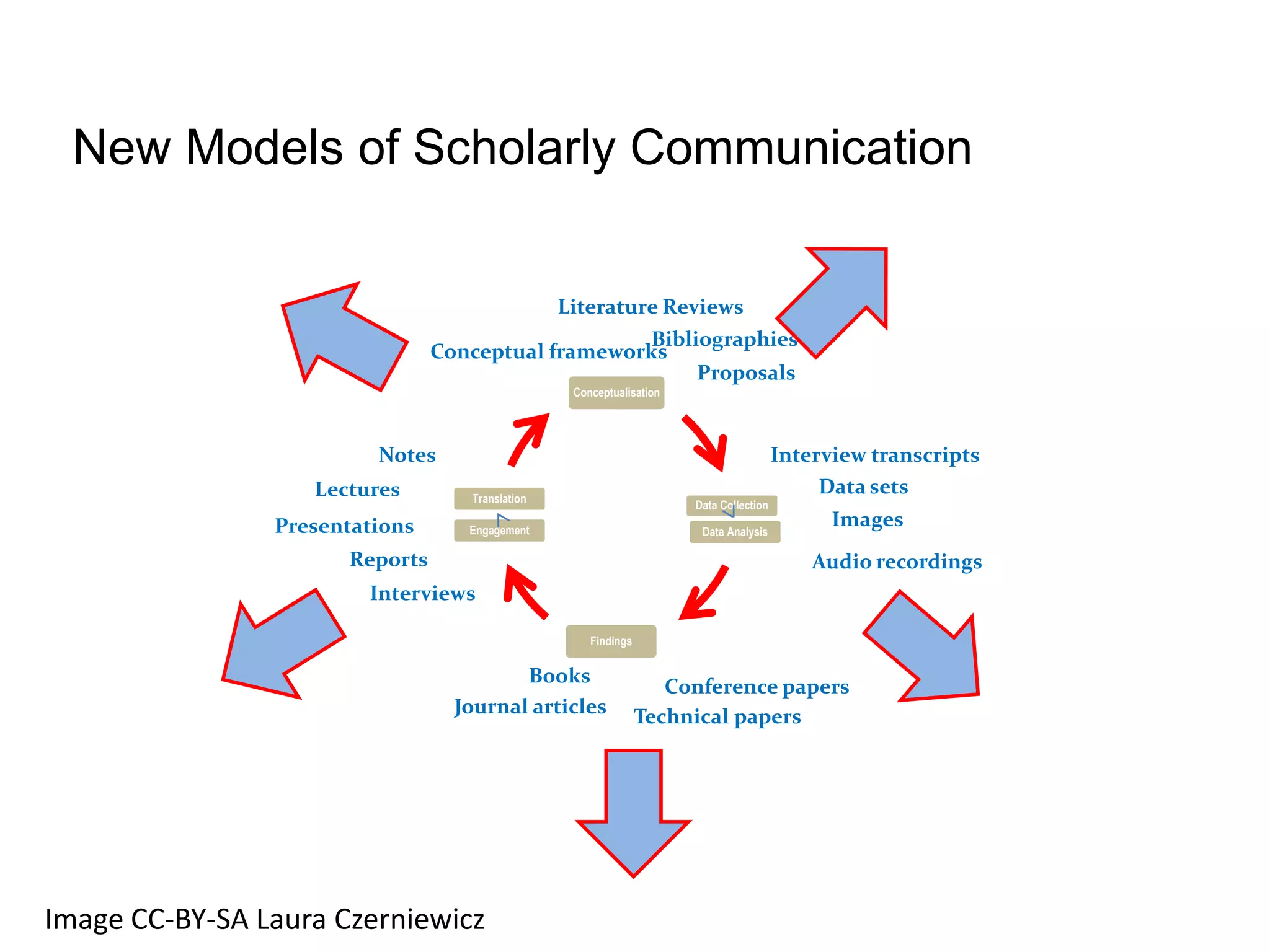
New Models of Scholarly Communication


                                                 Literature Reviews
                                                    Bibliographies
                                Conceptual frameworks
                                                         Proposals
                                                  Conceptualisation


                         Notes                                                          Interview transcripts
                   Lectures        Translation
                                                                                             Data sets
                                                                      Data Collection
                Presentations      Engagement                          Data Analysis
                                                                                              Images
                      Reports                                                               Audio recordings
                        Interviews

                                                     Findings


                                         Books
                                                                   Conference papers
                                  Journal articles              Technical papers


Image CC-BY-SA Laura Czerniewicz
New questions arise…

• What about peer review and quality control?
• What does this mean for how we measure and reward research? (What
  does this mean for the notion of ‘impact’?)
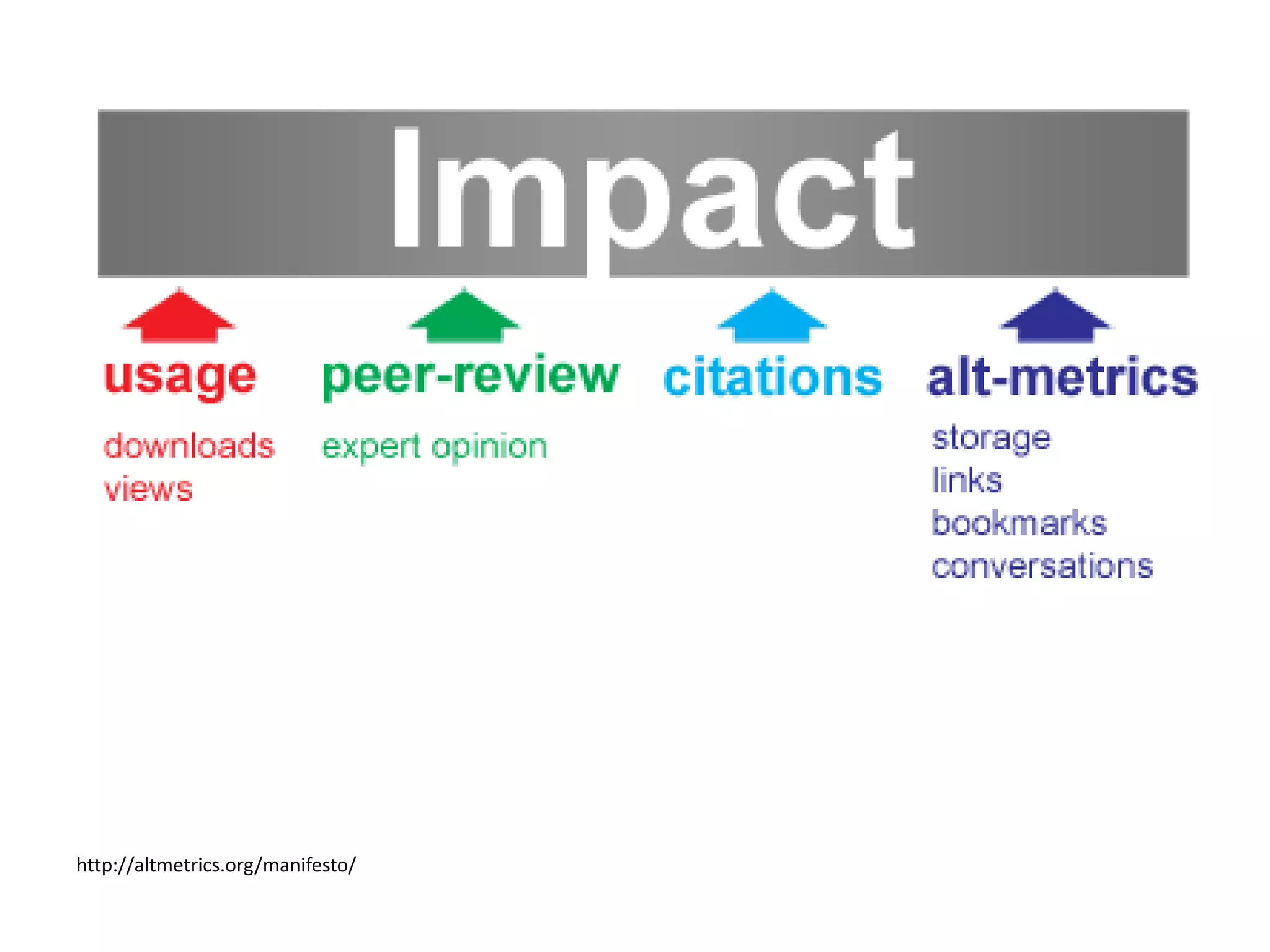
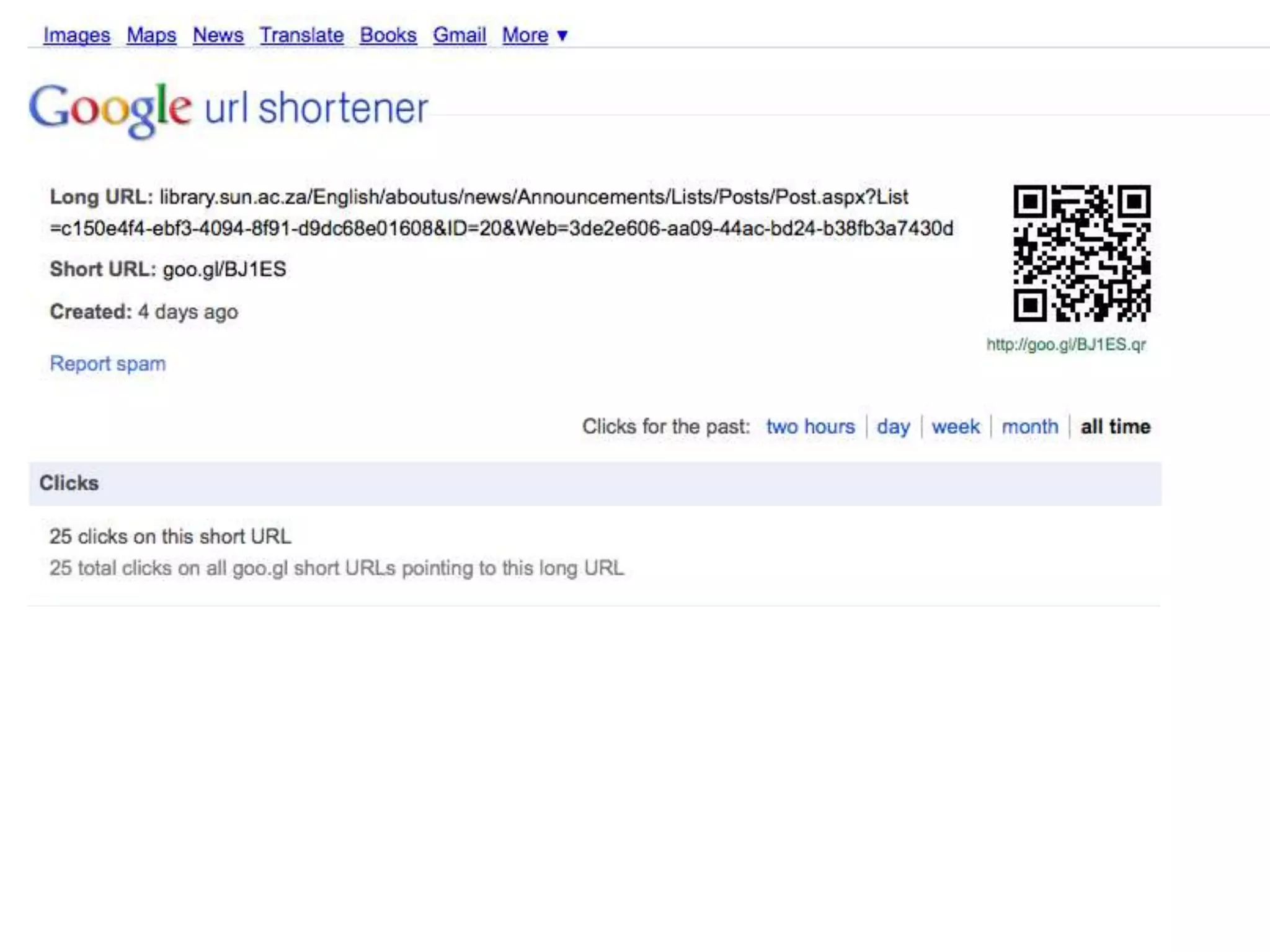
http://altmetrics.org/manifesto/
Bibliometrics mined impact on the first
scholarly Web.
Altmetrics mines impact on the next one.
Jason Priem
Altmetrics
1. Conventional outputs >
unconventional measures
(Cameron Neylon)


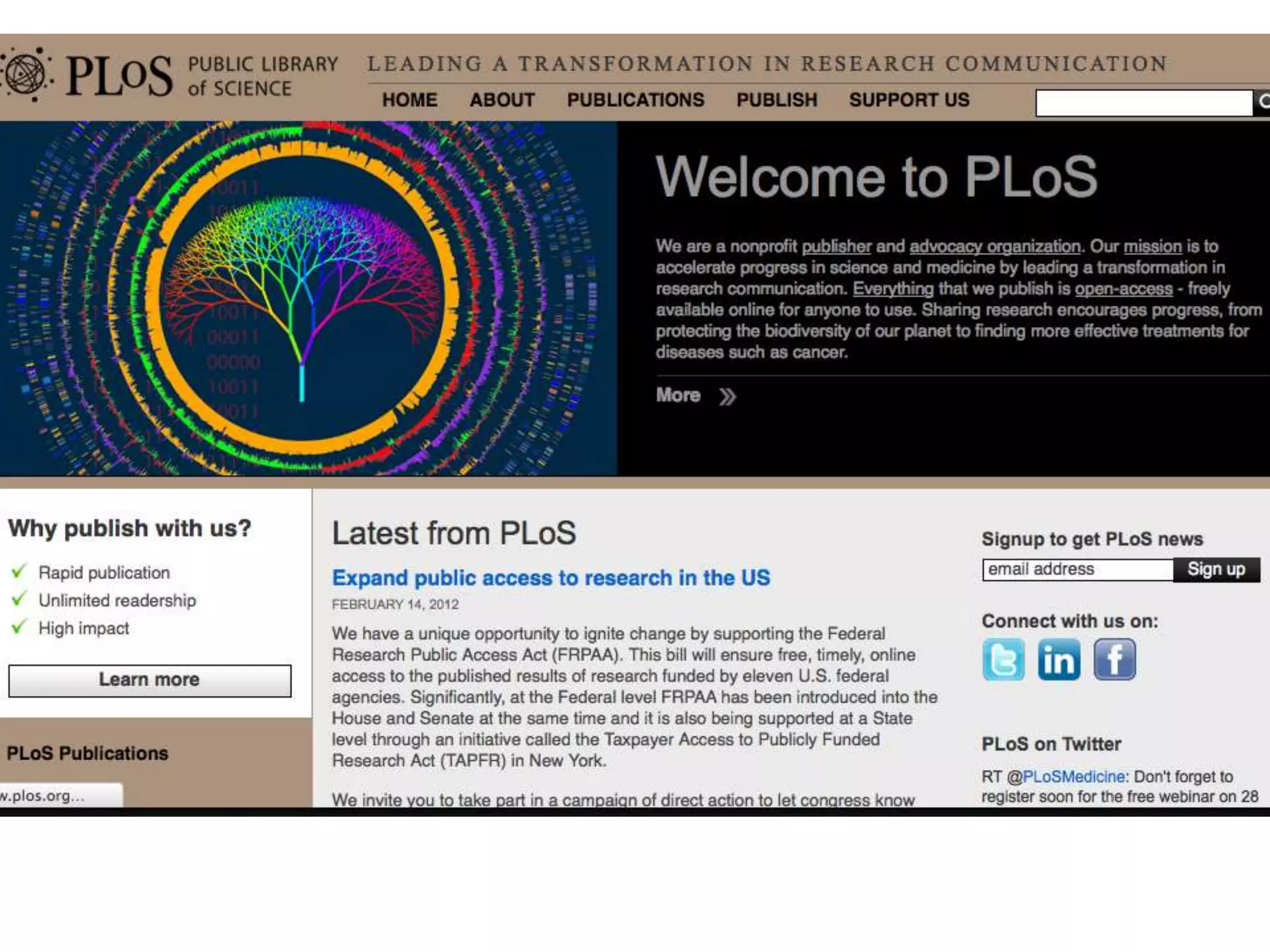
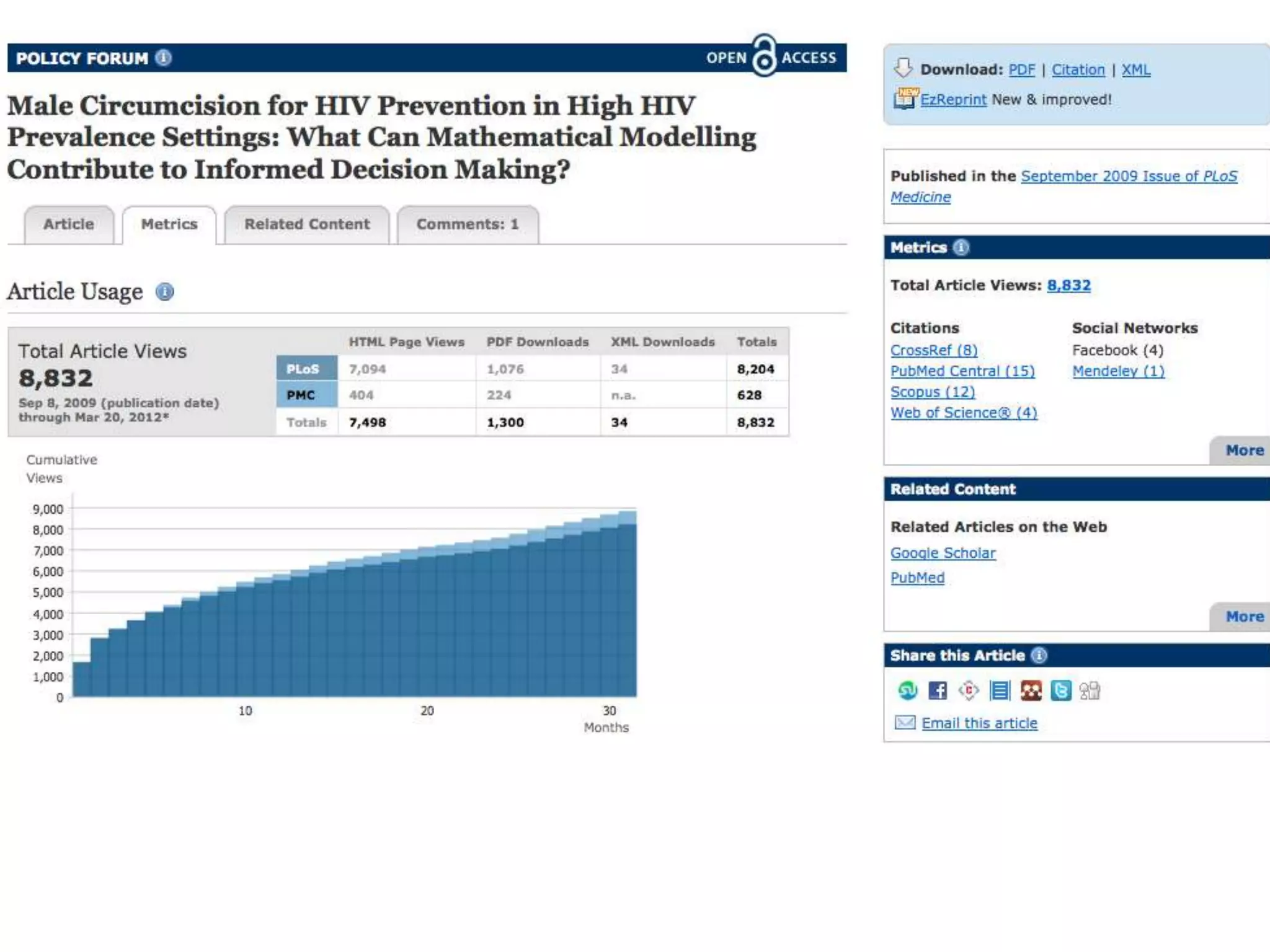
The decoupled journal
Altmetrics
2. Unconventional outputs >
conventional measures
(Cameron Neylon)


The social web
The social web and science

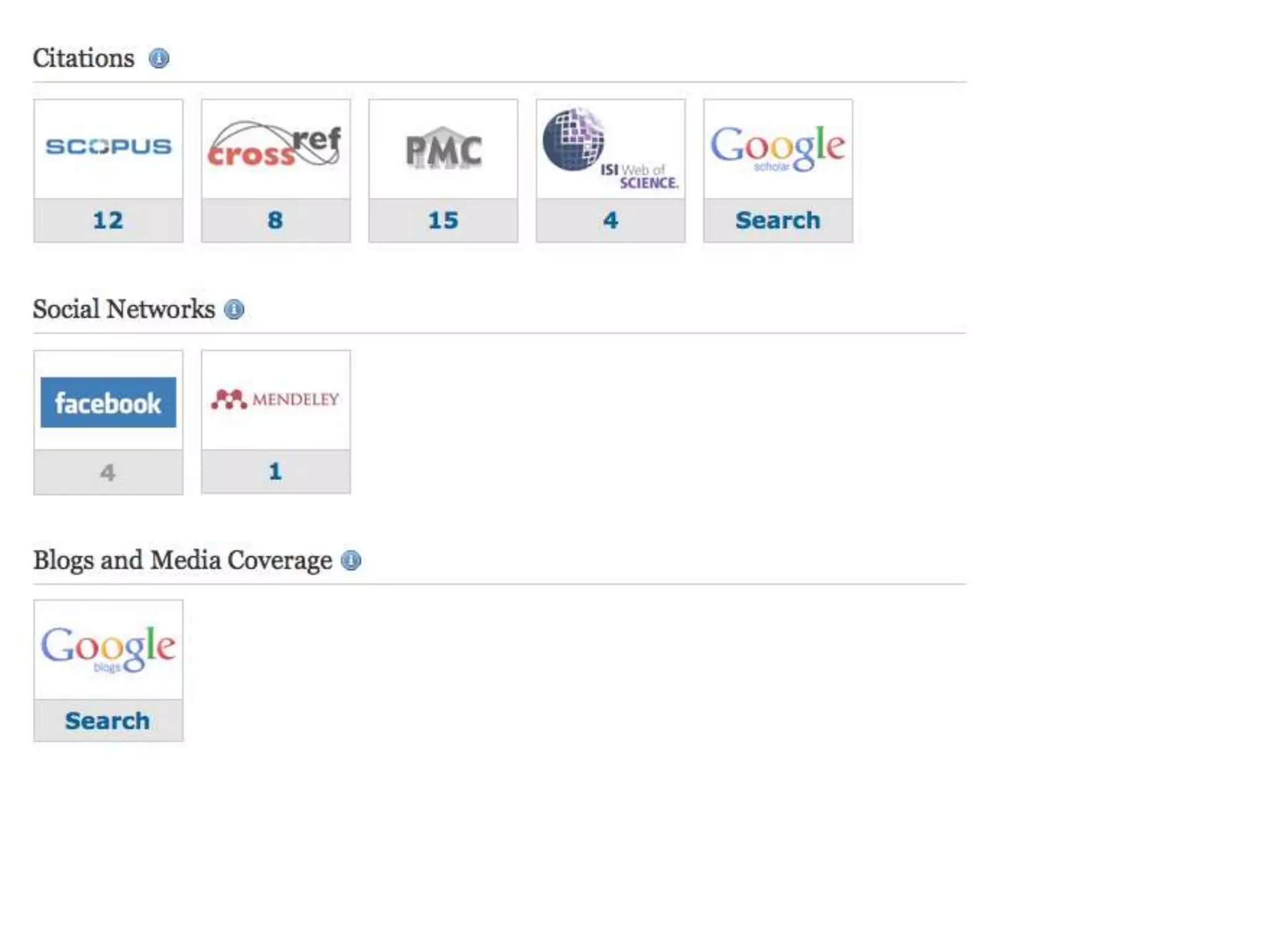
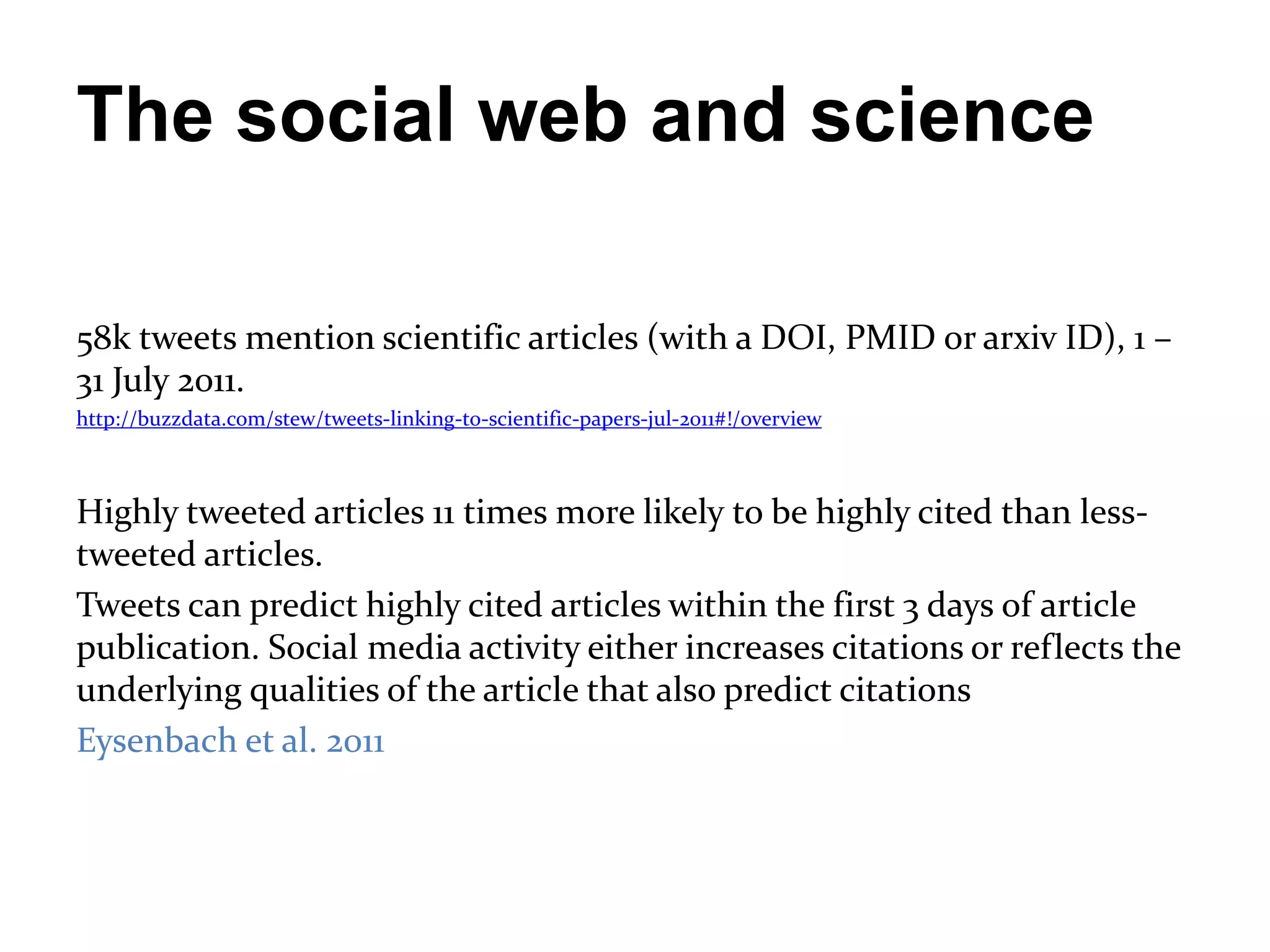
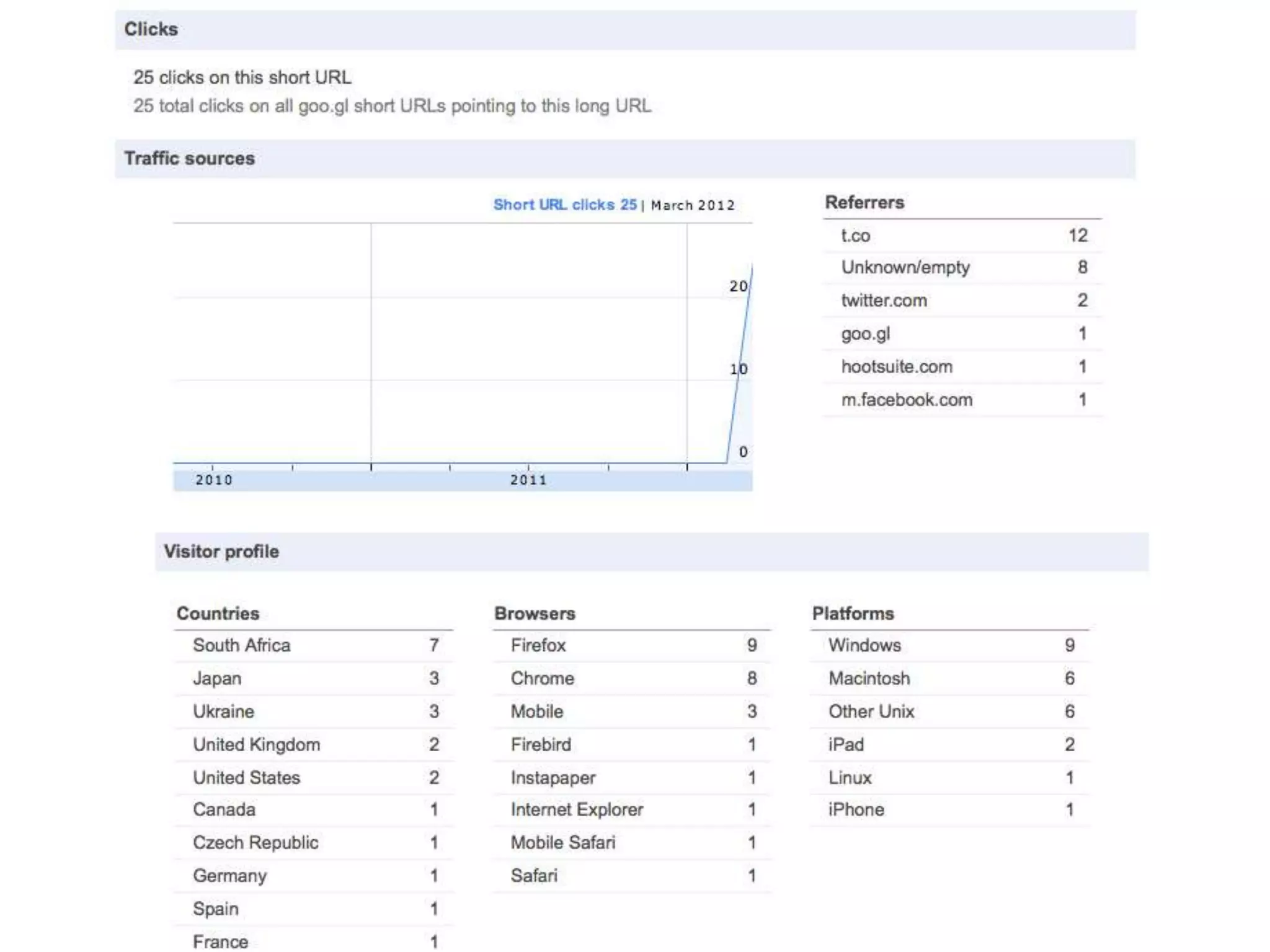
58k tweets mention scientific articles (with a DOI, PMID or arxiv ID), 1 –
31 July 2011.
http://buzzdata.com/stew/tweets-linking-to-scientific-papers-jul-2011#!/overview


Highly tweeted articles 11 times more likely to be highly cited than less-
tweeted articles.
Tweets can predict highly cited articles within the first 3 days of article
publication. Social media activity either increases citations or reflects the
underlying qualities of the article that also predict citations
Eysenbach et al. 2011
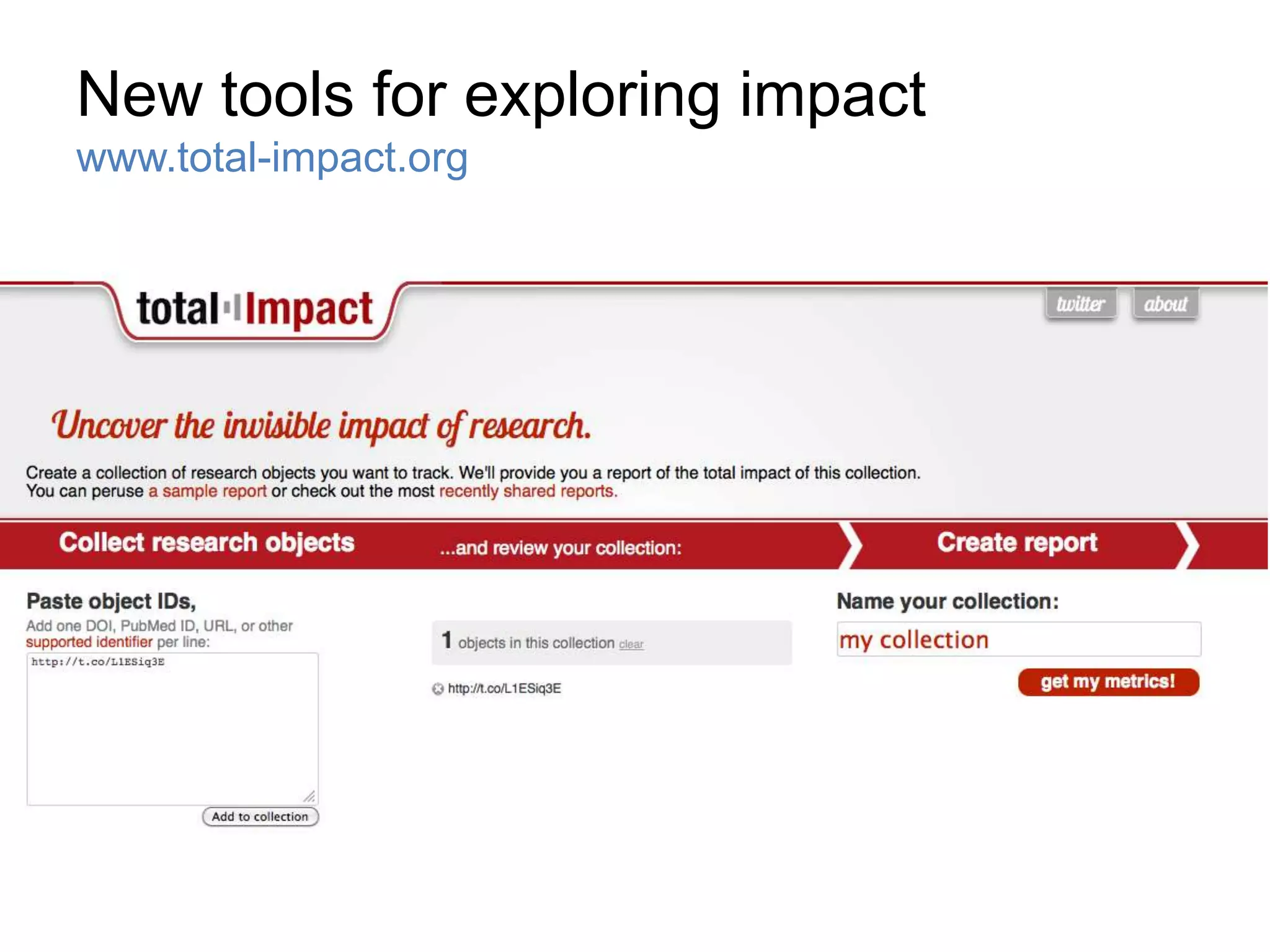
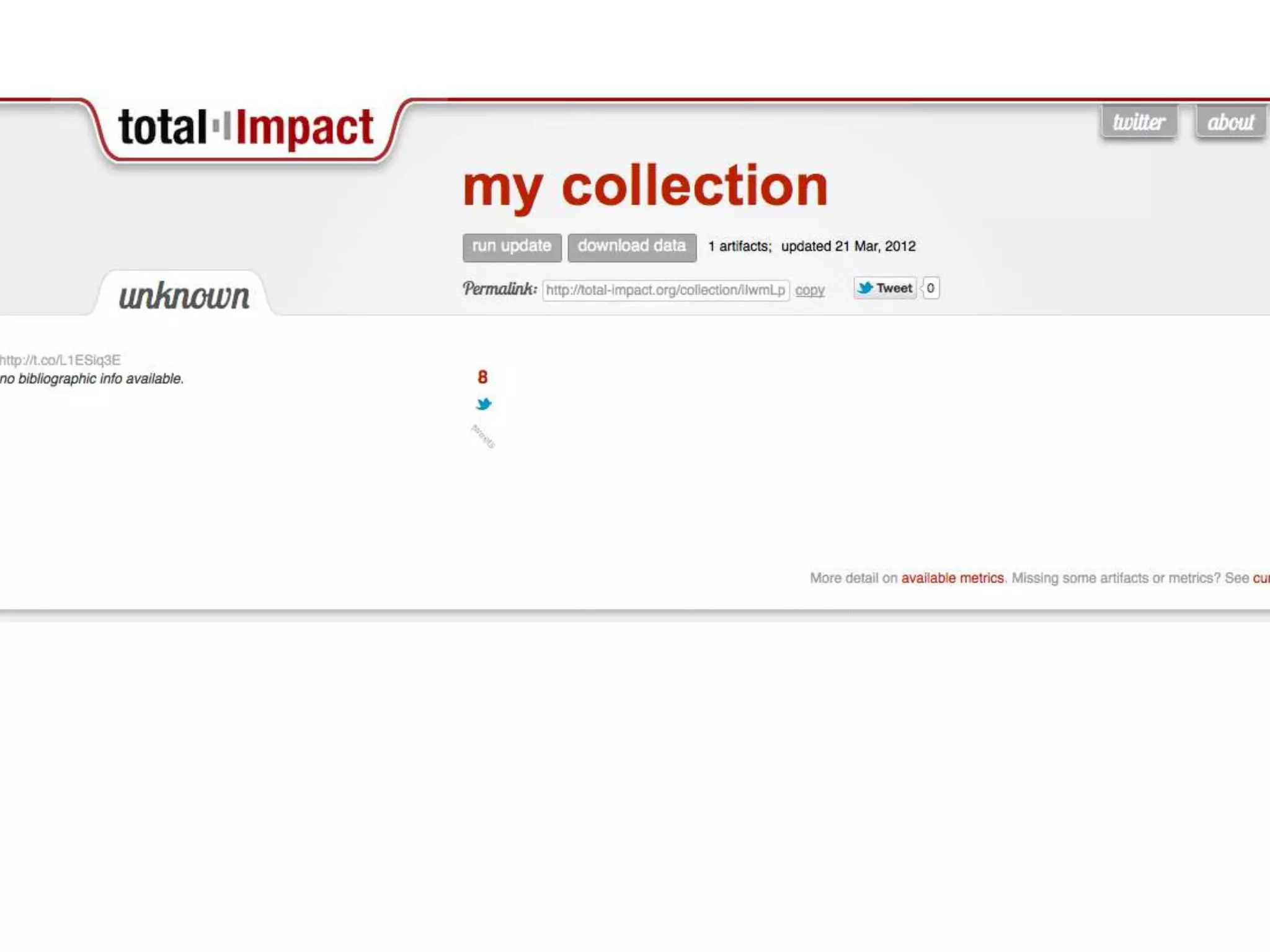
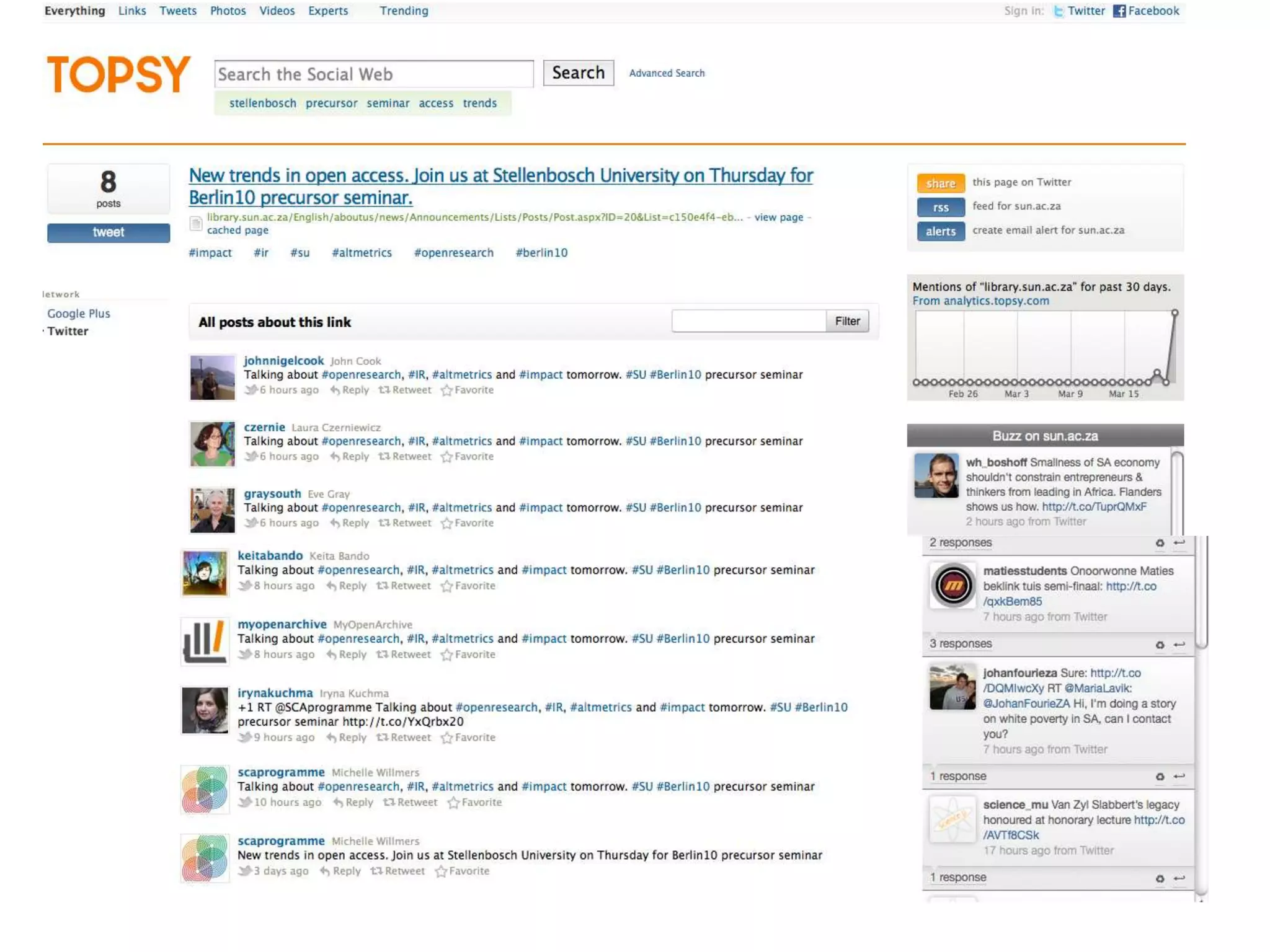
New tools for exploring impact
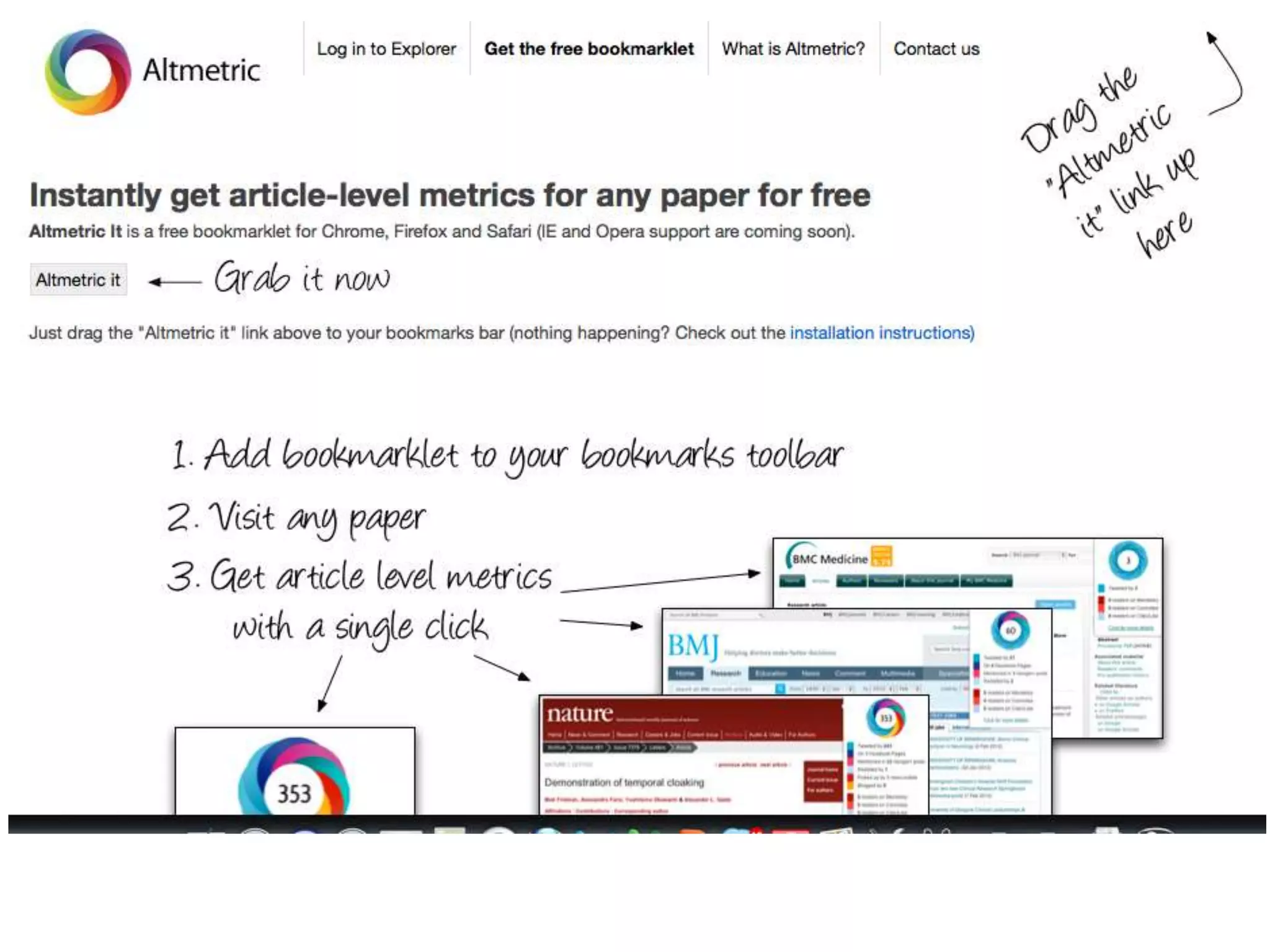
www.total-impact.org
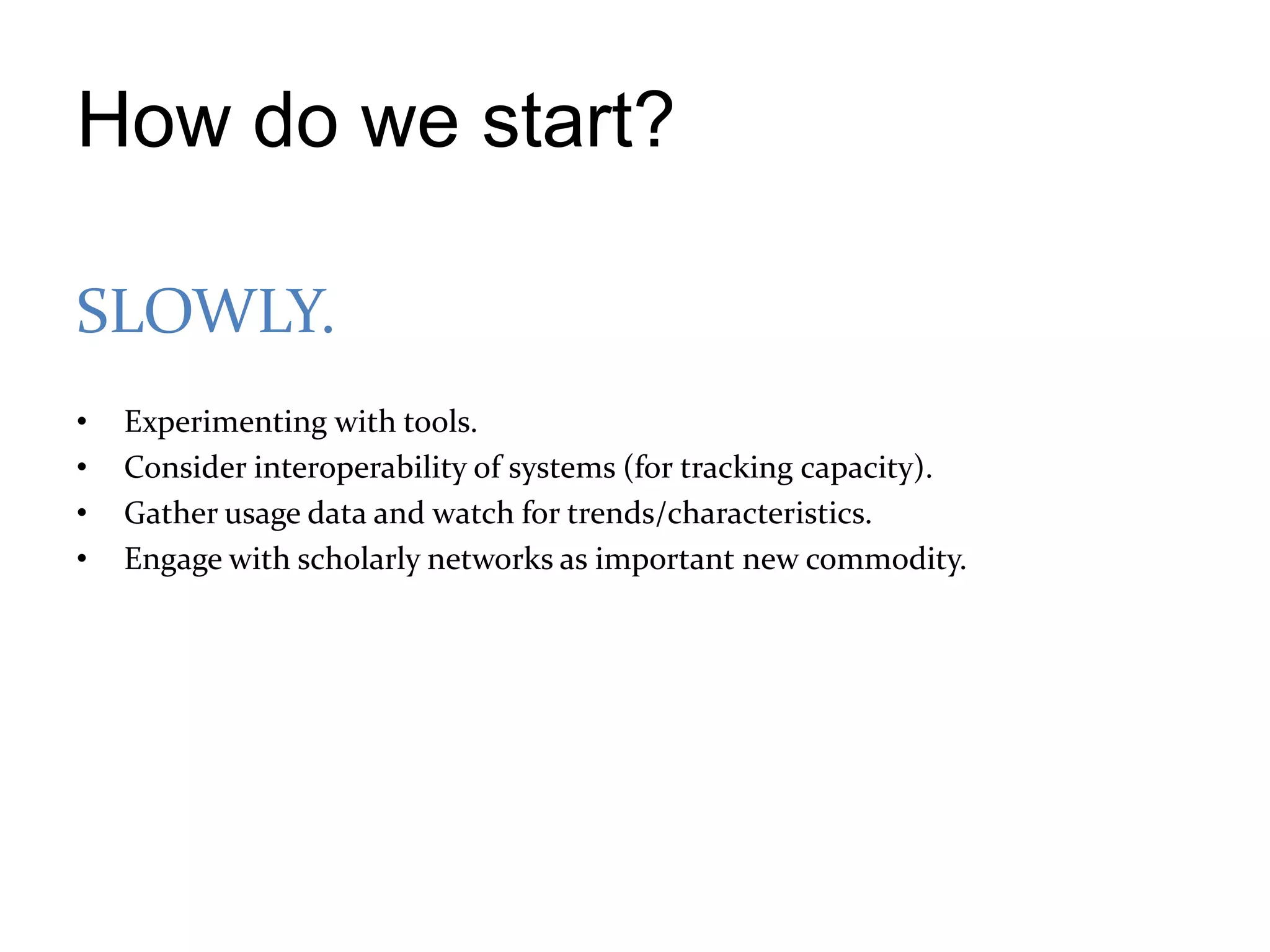
How do we start?

SLOWLY.
•   Experimenting with tools.
•   Consider interoperability of systems (for tracking capacity).
•   Gather usage data and watch for trends/characteristics.
•   Engage with scholarly networks as important new commodity.
Conclusion:
towards Expanded Open Access

•   Transparency in methodology, observation and collection of data.
•   Public availability and re-usability of data.
•   Public accessibility of scientific communication.
•   Using web-based tools to facilitate scientific collaboration.
•   Encouraging practices such as publishing open research, campaigning for
    open access, encouraging scientists to practice open notebook science, and
    generally making it easier to publish and communicate scientific knowledge.
References
Czerniewicz C & Willmers M (2012) Open Education: Exploring Open in Higher
Education. Presentation delivered at University of Cape Town Open Education
Week 2012.
Olijhoek T (2012) Scientific social networks are the future of science.
http://access.okfn.org/2012/03/20/scientific-social-networks-are-the-future-of-
science/ [Posted 20 March 2012]
Priem J (2012) Toward a Second Revolution: altmetrics, total-impact, and the
decoupled journal. Presented at Purdue University, 14 February 2012.
https://docs.google.com/present/view?id=ddfg787c_362f465q2g5
Weinberg D (2012) http://www.toobigtoknow.com/

Open Access Continuum - Stellenbosch University

  • 1.
    The Open Access Continuum: OpenResearch and Altmetrics Michelle Willmers Scholarly Communication in Africa Programme CC-BY-SA
  • 3.
    Open Access Green Route -Self-archiving of scholarly content prior to, in parallel with, or after publication - 2085 repositories worldwide (DOAR 2011) Gold Route - Primary publication in open-access journals - 7 070 journals (DOAJ 2011)
  • 4.
    But it’s notonly about journal articles. There is an abundance of information online. The internet has changed the way we consume information. No longer single source (journal, book). This changes how we locate, verify and measure new information. “Rather than finding information, it is the filtering of relevant information that is hard to do on the internet.” (David Weinberg)
  • 5.
    “Open access tothis knowledge is critical if it is to be shared between individuals and groups. But sharing alone is not enough. Knowledge only becomes useful when we can distinguish between relevant and less relevant information, when we can discuss aspects of the information, when we can annotate and improve on ideas, when we can devise new approaches and collaborate online.” (Olijhoek 2012)
  • 7.
    Open Research • Replicable (transparency - method) • Reusable (results free for re-use and appropriation) • Replayable (tools available for appropriation) • Collaborative • Interdisciplinary • Granular • Immediacy factor • Suited to addressing socio-economic imperatives and collaborative breakthrough
  • 10.
    Traditional Scholarship • Relatively contained disciplinary context. • Relatively clear scholarly community. • Relatively clear boundaries. • Particular points of engagement.
  • 11.
    Traditional Scholarly Communication Literature reviews Student Conceptual frameworks Bibliographies Proposals Conceptualisation Notes Interview transcripts Lectures Translation Data sets Data Collection Presentations Engagement Data Analysis Images Reports Audio recordings Interviews Community Findings Books Conference papers Journal articles Technical papers Scholar Image CC-BY-SA Laura Czerniewicz
  • 12.
    Scholarship 2.0 • Newways of describing content (and looking for it). Metadata as passport to participation. • New ways of tracking usage. • Aggregation crucial. • Blogging and social networking as mechanisms for research and collaboration. • Outputs of social web become part of the scholarly record. • Rise of the global networked scholar.
  • 13.
    New Models ofScholarly Communication Literature Reviews Bibliographies Conceptual frameworks Proposals Conceptualisation Notes Interview transcripts Lectures Translation Data sets Data Collection Presentations Engagement Data Analysis Images Reports Audio recordings Interviews Findings Books Conference papers Journal articles Technical papers Image CC-BY-SA Laura Czerniewicz
  • 14.
    New questions arise… •What about peer review and quality control? • What does this mean for how we measure and reward research? (What does this mean for the notion of ‘impact’?)
  • 15.
  • 17.
    Bibliometrics mined impacton the first scholarly Web. Altmetrics mines impact on the next one. Jason Priem
  • 18.
    Altmetrics 1. Conventional outputs> unconventional measures (Cameron Neylon) The decoupled journal
  • 24.
    Altmetrics 2. Unconventional outputs> conventional measures (Cameron Neylon) The social web
  • 25.
    The social weband science 58k tweets mention scientific articles (with a DOI, PMID or arxiv ID), 1 – 31 July 2011. http://buzzdata.com/stew/tweets-linking-to-scientific-papers-jul-2011#!/overview Highly tweeted articles 11 times more likely to be highly cited than less- tweeted articles. Tweets can predict highly cited articles within the first 3 days of article publication. Social media activity either increases citations or reflects the underlying qualities of the article that also predict citations Eysenbach et al. 2011
  • 26.
    New tools forexploring impact www.total-impact.org
  • 31.
    How do westart? SLOWLY. • Experimenting with tools. • Consider interoperability of systems (for tracking capacity). • Gather usage data and watch for trends/characteristics. • Engage with scholarly networks as important new commodity.
  • 32.
    Conclusion: towards Expanded OpenAccess • Transparency in methodology, observation and collection of data. • Public availability and re-usability of data. • Public accessibility of scientific communication. • Using web-based tools to facilitate scientific collaboration. • Encouraging practices such as publishing open research, campaigning for open access, encouraging scientists to practice open notebook science, and generally making it easier to publish and communicate scientific knowledge.
  • 33.
    References Czerniewicz C &Willmers M (2012) Open Education: Exploring Open in Higher Education. Presentation delivered at University of Cape Town Open Education Week 2012. Olijhoek T (2012) Scientific social networks are the future of science. http://access.okfn.org/2012/03/20/scientific-social-networks-are-the-future-of- science/ [Posted 20 March 2012] Priem J (2012) Toward a Second Revolution: altmetrics, total-impact, and the decoupled journal. Presented at Purdue University, 14 February 2012. https://docs.google.com/present/view?id=ddfg787c_362f465q2g5 Weinberg D (2012) http://www.toobigtoknow.com/

Editor's Notes

  • #4 Gold Route- Primary publication in open-access journals.- 7 070 journals (DOAJ 2011)Green Route- Self-archiving of scholarly content in open access repositories prior to, in parallel with, or after publication.2085 repositories worldwide (DOAR 2011)
  • #5 Weinberg (2012) http://www.toobigtoknow.com/
  • #6 Scientific social networks are the future of sciencePosted on March 20, 2012 by Tom Olijhoekhttp://access.okfn.org/2012/03/20/scientific-social-networks-are-the-future-of-science/
  • #7 Open Research exploring space beyond the journal article and more dynamic system of open exchange of “research objects”. Promotes expansive, collaborative approach, which has had particular success in making progress in biomedical sciences, astronomy. Most notably, led to identification of biomarkers for alzheimers.
  • #8 A few commonly acknowledge characteristics.
  • #9 Open research heavily contingent on open data practice.
  • #10 Significant challenges and barriers to sharing open data, particularly around metadata and curation considerations. Various large-scale organisations working at global interoperability of systems and standards.
  • #14 The whole PROCESS becomes open and shareableEvery step is opened upAudiences all along the way
  • #16 Open, technologically-driven practice leads to a new, expanded conception of impact.
  • #26 1. http://buzzdata.com/stew/tweets-linking-to-scientific-papers-jul-2011#!/overview2. http://www.jmir.org/2011/4/e123/
  • #33 http://www.openscience.org/blog/?p=269