Integrated information management
       for University research


Patricia Liebetrau
April 2012
University of Botswana
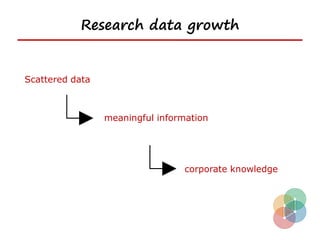
Research data growth


Scattered data


                 meaningful information


                                  corporate knowledge
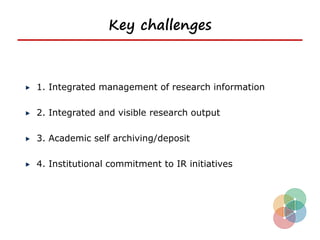
Key challenges


1. Integrated management of research information

2. Integrated and visible research output

3. Academic self archiving/deposit

4. Institutional commitment to IR initiatives
Key challenges


1. Integrated management of research information

2. Academic self archiving/deposit

3. Integrated and visible research output

4. Institutional commitment to IR initiatives
Research information

Grant applications
Research income
Research projects
Publications
Researchers
Postgraduates
Funding bodies
External collaborations
Research activity information


Data
  Persons – biographical information and profiles
  Publications – including full-text
  Projects – funding, costing, status

Silo information systems on campus
  Student
  Researchers
  Academics
  Finance administration
  Research Office
CRIS

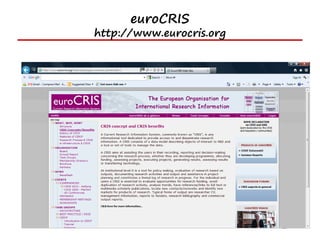
Current Research Information Systems (CRIS)


     A Current Research Information System,
     commonly known as "CRIS", is any information
     tool dedicated to provide access to and
     disseminate research information
     (www.eurocris.org)
euroCRIS
http://www.eurocris.org
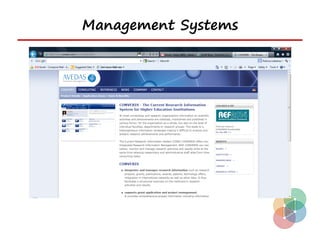
Management Systems
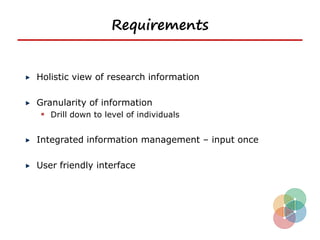
Requirements


Holistic view of research information

Granularity of information
  Drill down to level of individuals

Integrated information management – input once

User friendly interface
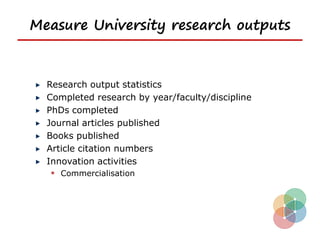
Measure University research outputs


  Research output statistics
  Completed research by year/faculty/discipline
  PhDs completed
  Journal articles published
  Books published
  Article citation numbers
  Innovation activities
    Commercialisation
Key challenges


1. Integrated management of research information

2. Integrated and visible research output

3. Academic self archiving/deposit

4. Institutional commitment to IR initiatives
Research output made visible

Research output from academic staff
  Academic research papers
  Research data sets
  Journal articles
  Conference papers
  Research project reports
  Policy briefs


Research output from students
  Theses and dissertations
  Research data sets
Websites and webpages

UB web site

Departmental web page/ website

Individual academic web page /website
  All research activities
  All research output
  Contact information

Library website

UBRISA website
Academic web pages


University template

University branding

                      = increased Web exposure

                      = increased corporate knowledge
Institutional repository

“A university-based institutional repository is a set of services
   that a university offers to the members of its community
   for the management and dissemination of digital materials
   created by the institution and its community members.

It is most essentially an organisational commitment to the
    stewardship of these digital materials, including long-term
    preservation where appropriate, as well as organisation
    and access or distribution.”

Clifford A. Lynch. Institutional Repositories: Essential Infrastructure for
     Scholarship in the Digital Age ARL, no. 226 (February 2003): 1-7.
Important elements of IRs


Institutionally defined

Scholarly and research purposes

Cumulative and perpetual

Open and interoperable
Strategic importance of IRs


Facilitate access to University wide research
Disseminate and publicise public funded research
Facilitate new forms of scholarly communication
Measure of research output
e-Research
Many levels of repositories


Institutional repository
  Research output from an individual institutions

National repository
  Research output from several individual institutions

International repository
  Research output from several national repositories
OpenDOAR
http://www.opendoar.org/
Push and pull

Information push
  Dissemination – websites, social media tools
  Social media for scholarly purposes


Information pull
  OpenDoar
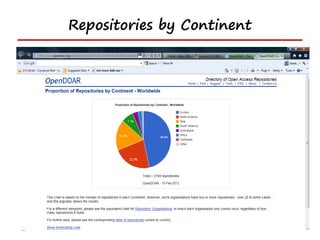
Repositories by Continent
UB published journals


Open Journal Systems (OJS)

Articles linked via metadata to the IR

Open access to the full text
Key challenges


1. Integrated management of research information

2. Integrated and visible research output

3. Academic self archiving/deposit

4. Institutional commitment to IR initiatives
Academic self-archiving


Remove barriers to deposit

Deposit once only

Accredited and non-accredited research output

Motivation
Key challenges


1. Integrated management of research information

2. Integrated and visible research output

3. Academic self archiving/deposit

4. Institutional commitment to IR initiatives
Resources


Human resources
  New skills
  New posts
    • Programmer
    • Systems administrator
    • Metadata librarian
    • Scholarly Communications Librarian
    • Academic Research Librarian

Financial resources
  Upgraded IT infrastructure
  Conference attendance
Advocacy


Champions

Target audience

Media options

Covering the costs
This work was carried out with the aid of a grant from the
International Development Research Centre, Ottawa, Canada

Integrated Information Management for Libraries

  • 1.
    Integrated information management for University research Patricia Liebetrau April 2012 University of Botswana
  • 2.
    Research data growth Scattereddata meaningful information corporate knowledge
  • 3.
    Key challenges 1. Integratedmanagement of research information 2. Integrated and visible research output 3. Academic self archiving/deposit 4. Institutional commitment to IR initiatives
  • 4.
    Key challenges 1. Integratedmanagement of research information 2. Academic self archiving/deposit 3. Integrated and visible research output 4. Institutional commitment to IR initiatives
  • 5.
    Research information Grant applications Researchincome Research projects Publications Researchers Postgraduates Funding bodies External collaborations
  • 6.
    Research activity information Data  Persons – biographical information and profiles  Publications – including full-text  Projects – funding, costing, status Silo information systems on campus  Student  Researchers  Academics  Finance administration  Research Office
  • 7.
    CRIS Current Research InformationSystems (CRIS) A Current Research Information System, commonly known as "CRIS", is any information tool dedicated to provide access to and disseminate research information (www.eurocris.org)
  • 8.
  • 9.
  • 10.
    Requirements Holistic view ofresearch information Granularity of information  Drill down to level of individuals Integrated information management – input once User friendly interface
  • 11.
    Measure University researchoutputs Research output statistics Completed research by year/faculty/discipline PhDs completed Journal articles published Books published Article citation numbers Innovation activities  Commercialisation
  • 12.
    Key challenges 1. Integratedmanagement of research information 2. Integrated and visible research output 3. Academic self archiving/deposit 4. Institutional commitment to IR initiatives
  • 13.
    Research output madevisible Research output from academic staff  Academic research papers  Research data sets  Journal articles  Conference papers  Research project reports  Policy briefs Research output from students  Theses and dissertations  Research data sets
  • 14.
    Websites and webpages UBweb site Departmental web page/ website Individual academic web page /website  All research activities  All research output  Contact information Library website UBRISA website
  • 15.
    Academic web pages Universitytemplate University branding = increased Web exposure = increased corporate knowledge
  • 16.
    Institutional repository “A university-basedinstitutional repository is a set of services that a university offers to the members of its community for the management and dissemination of digital materials created by the institution and its community members. It is most essentially an organisational commitment to the stewardship of these digital materials, including long-term preservation where appropriate, as well as organisation and access or distribution.” Clifford A. Lynch. Institutional Repositories: Essential Infrastructure for Scholarship in the Digital Age ARL, no. 226 (February 2003): 1-7.
  • 17.
    Important elements ofIRs Institutionally defined Scholarly and research purposes Cumulative and perpetual Open and interoperable
  • 18.
    Strategic importance ofIRs Facilitate access to University wide research Disseminate and publicise public funded research Facilitate new forms of scholarly communication Measure of research output e-Research
  • 19.
    Many levels ofrepositories Institutional repository  Research output from an individual institutions National repository  Research output from several individual institutions International repository  Research output from several national repositories
  • 20.
  • 21.
    Push and pull Informationpush  Dissemination – websites, social media tools  Social media for scholarly purposes Information pull  OpenDoar
  • 22.
  • 23.
    UB published journals OpenJournal Systems (OJS) Articles linked via metadata to the IR Open access to the full text
  • 24.
    Key challenges 1. Integratedmanagement of research information 2. Integrated and visible research output 3. Academic self archiving/deposit 4. Institutional commitment to IR initiatives
  • 25.
    Academic self-archiving Remove barriersto deposit Deposit once only Accredited and non-accredited research output Motivation
  • 26.
    Key challenges 1. Integratedmanagement of research information 2. Integrated and visible research output 3. Academic self archiving/deposit 4. Institutional commitment to IR initiatives
  • 27.
    Resources Human resources New skills  New posts • Programmer • Systems administrator • Metadata librarian • Scholarly Communications Librarian • Academic Research Librarian Financial resources  Upgraded IT infrastructure  Conference attendance
  • 28.
  • 29.
    This work wascarried out with the aid of a grant from the International Development Research Centre, Ottawa, Canada