Open Access and the
Evolving Scholarly
Communication
Environment
Iryna Kuchma
Open Access Programme manager
OASCIR project final workshop, Faculty of Science,
University of Khartoum, 17th of November 2011

www.eifl.net                              Attribution 3.0 Unported
Removing barriers
 to knowledge
 sharing

EIFL-OA: open access
EIFL-OA
 achievements
• 410+ OA repositories & 2,600+ OA journals in
  EIFL partner countries
• OA policies have been adopted by 24 institutions
  in the EIFL network
• 65 awareness raising, advocacy and capacity
  building events and workshops in 2003-2011 in
  33 countries with participants from over 50
  countries
Why OA?
“Restrictive access policies drastically
 reduces readership of electronic
 research journal articles. OA provides
 an environment within which literature
 and scholarly research articles are
 made freely accessible online without
 license restrictions and without
 charging users subscription or access
 fees…
Why OA? (2)
“OA is a vital means of dissemination of
  information which is crucial for national
  development and in achieving MDGs, given
  the crucial role that information plays in
  achieving social, economic, cultural and
  political development.”
Professor Frank Youngman, DVC, University of
                                 Botswana
Open access (OA)

OA for researchers: increased visibility, usage
 and impact for their work;
OA for research institutions: publicises institutes’
 research strengths, providing maximum return
 on investment; complete record of the research
 output in easily accessible form, new tools to
 manage institution's impact;
OA (2)

OA for publishers: increased readership and
 citations, visibility and impact, the best possible
 dissemination service for research;
OA for libraries: partnerships with scientists and
 research managers to set up OA repositories, to
 curate research data and to develop OA policies,
 with scholarly publishers they publish OA journals
 and books, and with educators – produce OERs.
OA journals

Use a funding model that does not charge
 readers or their institutions for access.
Users can read, download, copy,
 distribute, print, search, or link to the
 full texts of the journal articles.
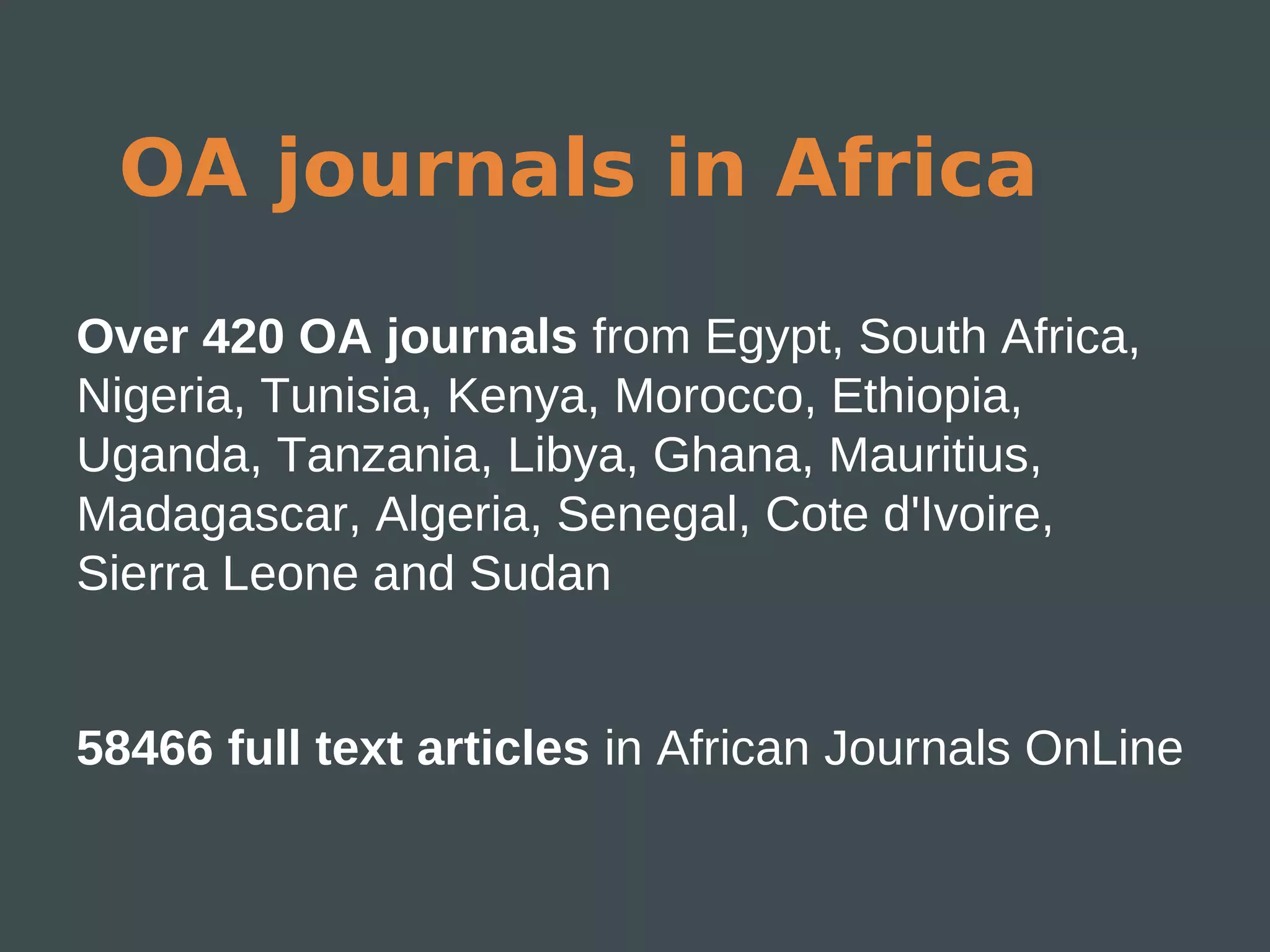
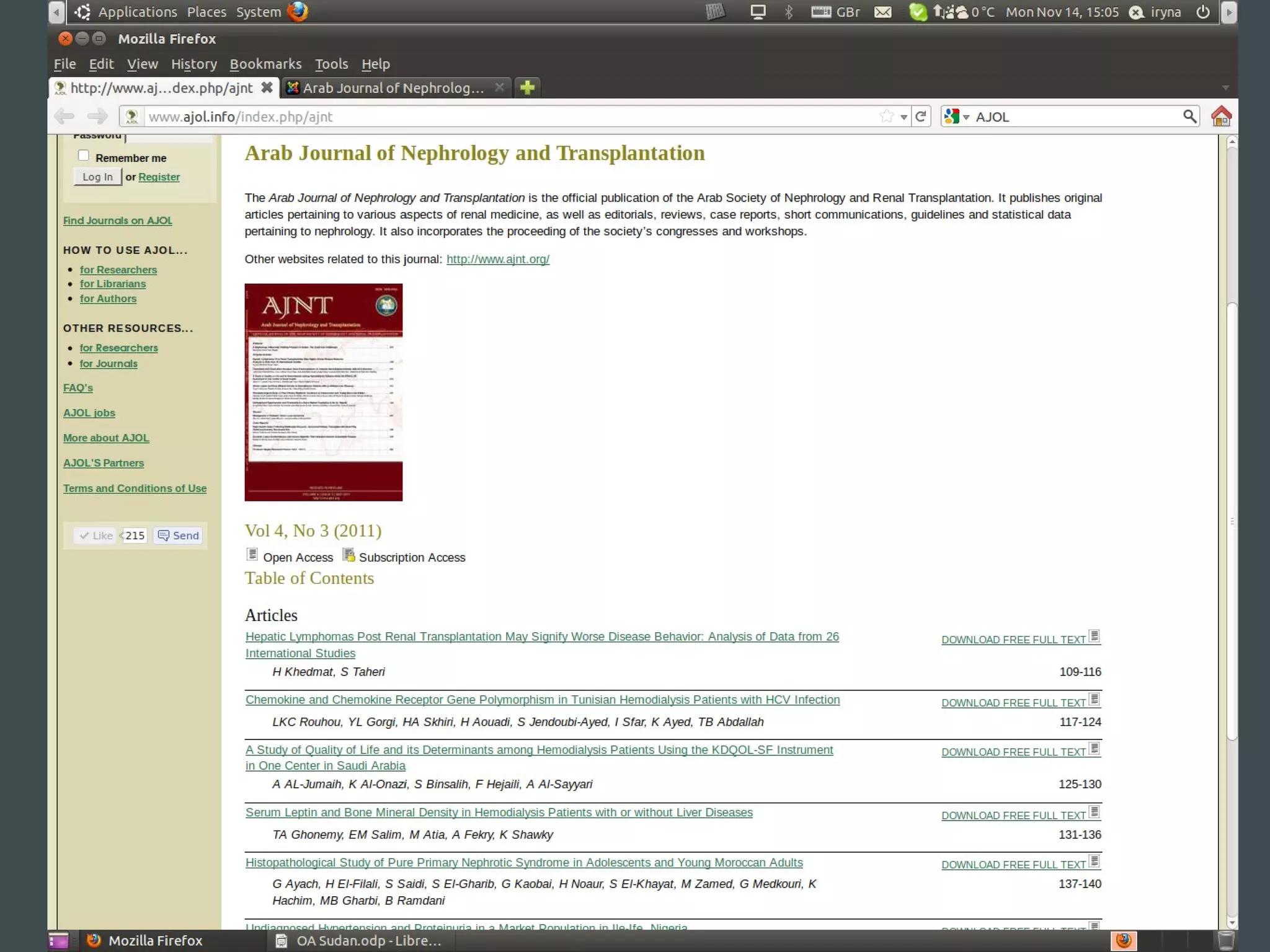
OA journals in Africa
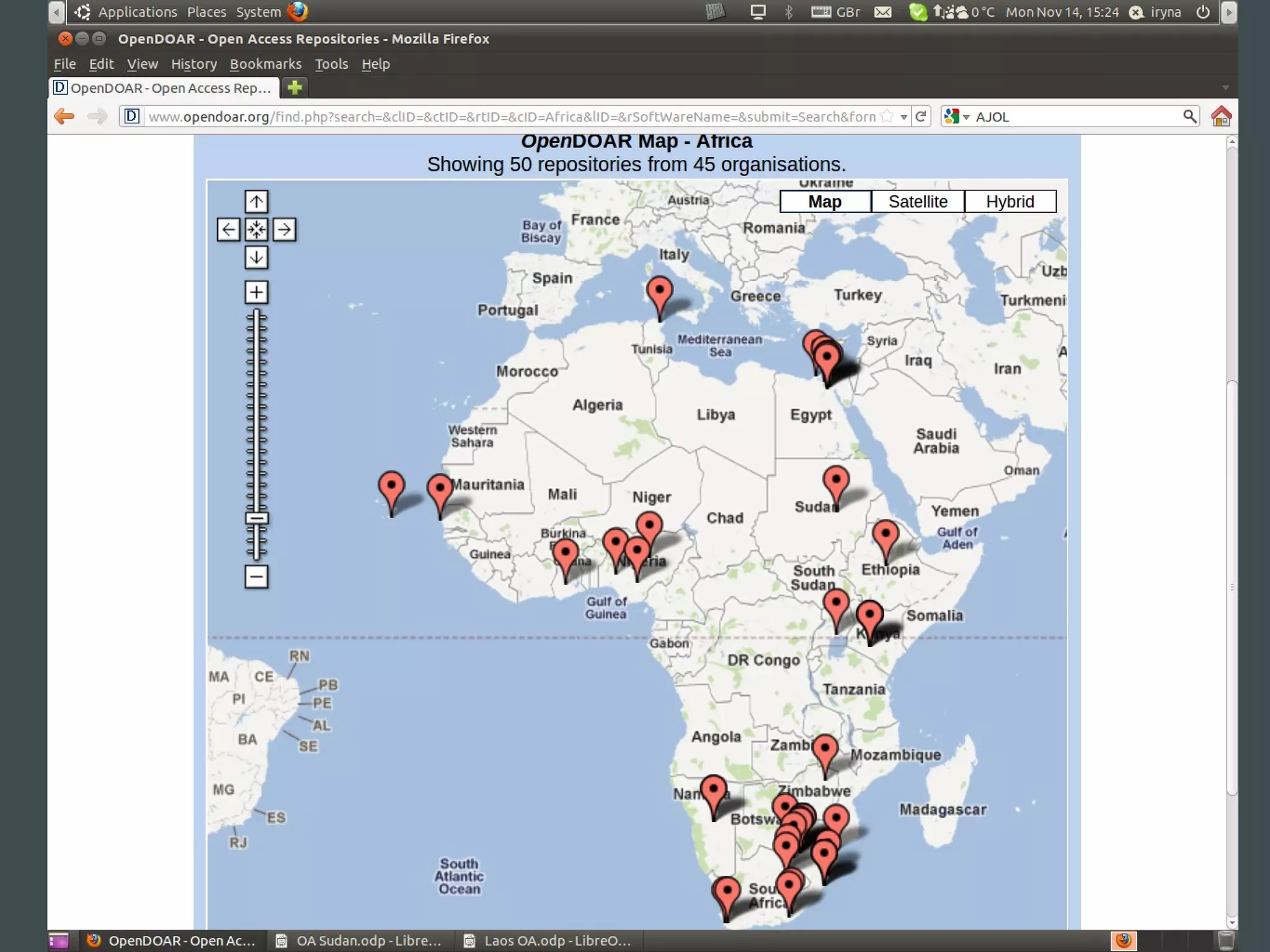
Over 420 OA journals from Egypt, South Africa,
Nigeria, Tunisia, Kenya, Morocco, Ethiopia,
Uganda, Tanzania, Libya, Ghana, Mauritius,
Madagascar, Algeria, Senegal, Cote d'Ivoire,
Sierra Leone and Sudan


58466 full text articles in African Journals OnLine
OA repositories

Contain research outputs
Institutional or thematic
Interoperable (OAI-PMH)
Commons metadata protocol allows web
applications (text and data mining)
OA repositories
Visibility, access, and preservation were the
  most important motivations cited by
  participating institutions to establish a
  repository.
Other motivations included the need to evaluate
 researchers and departments, and as a
 response to requests from faculty.
(A survey “Open Repository Development in Developing and Transition
  countries” conducted by EIFL and the University of Kansas Libraries)
OA repositories (2)

Publicize an institute’s research
 strengths, providing maximum return on
 research investment.
Provide an administrative tool for
 institutions.
OA repositories (3)

Increase impact and usage of institute's
  research, providing new contacts and
  research partnerships for authors.
Provide usage statistics showing global
 interest and value of institutional
 research.
Open access
 repositories (4)
FOSS to set up, free technical support.
Low installation and maintenance costs,
 quick to set up and gain benefits.
Institutions can mandate OA, speeding
  development.
U of K objectives
To provide modern educational and research
  environments that will enable students and
  researchers to face current challenges and to
  focus on knowledge as a principle driving
  force for development.
To reach international levels in standards,
  contents and practices while maintaining local
  values and culture.
U of K objectives
 (2)
To keep up with the development and the
  new innovations that occur in the different
  fields of knowledge as well as to take the
  initiatives in innovation and creativity.
To satisfy the increasing demand for
  excellence in higher education and to
  ensure the latest quality technology in all
  its outputs.
U of K objectives
 (3)
To promote libraries, laboratories and other teaching
  facilities to the latest technical standards and
  maintain their position as a place for interaction
  between the different components of the university.
To employ information and communication
  technology to improve University performance
  with respect to education, research, capacity building,
  and skills polishing.
OA advocacy
EIFL provided financial support to five
 projects in Africa: national and
 institutional open access advocacy
 campaigns to reach out to research
 communities in Botswana, Ghana,
 Malawi, Sudan and Zimbabwe
OA advocacy in
Botswana
Advocacy for Open Access to
 Researchers/Deans/Graduate
 Students/Editors/Policy
 Makers/Educators/Library
 Professionals a project of Botswana
 Library Consortium and University of
 Botswana
OA advocacy in
Ghana
Open Access Institutional Repositories
 Advocacy Campaign a project of the
 Consortium of Academic and Research
 Libraries in Ghana c/o Kwame Nkrumah
 University of Science and Technology,
 Kumasi, in partnership with Association
 of African Universities
OA advocacy in
Ghana (2)
“Africa cannot attain sustainable
  development without access to
  knowledge and knowledge sharing,”
  stated professor Olugbemiro Jegede,
  Secretary General of the Association of
  African Universities at a recent
  workshop "Harnessing and
  Disseminating Research Information as
  a key to the Development of
  Knowledge-based Economies in Africa"
OA advocacy in
Malawi
Awareness Campaign for Kamuzu
 College of Nursing Library /
 University of Malawi Research
 Repository, a project of Kamuzu
 College of Nursing Library / University of
 Malawi in partnership with the National
 Commission for Science and
 Technology (NCST)
OA advocacy in
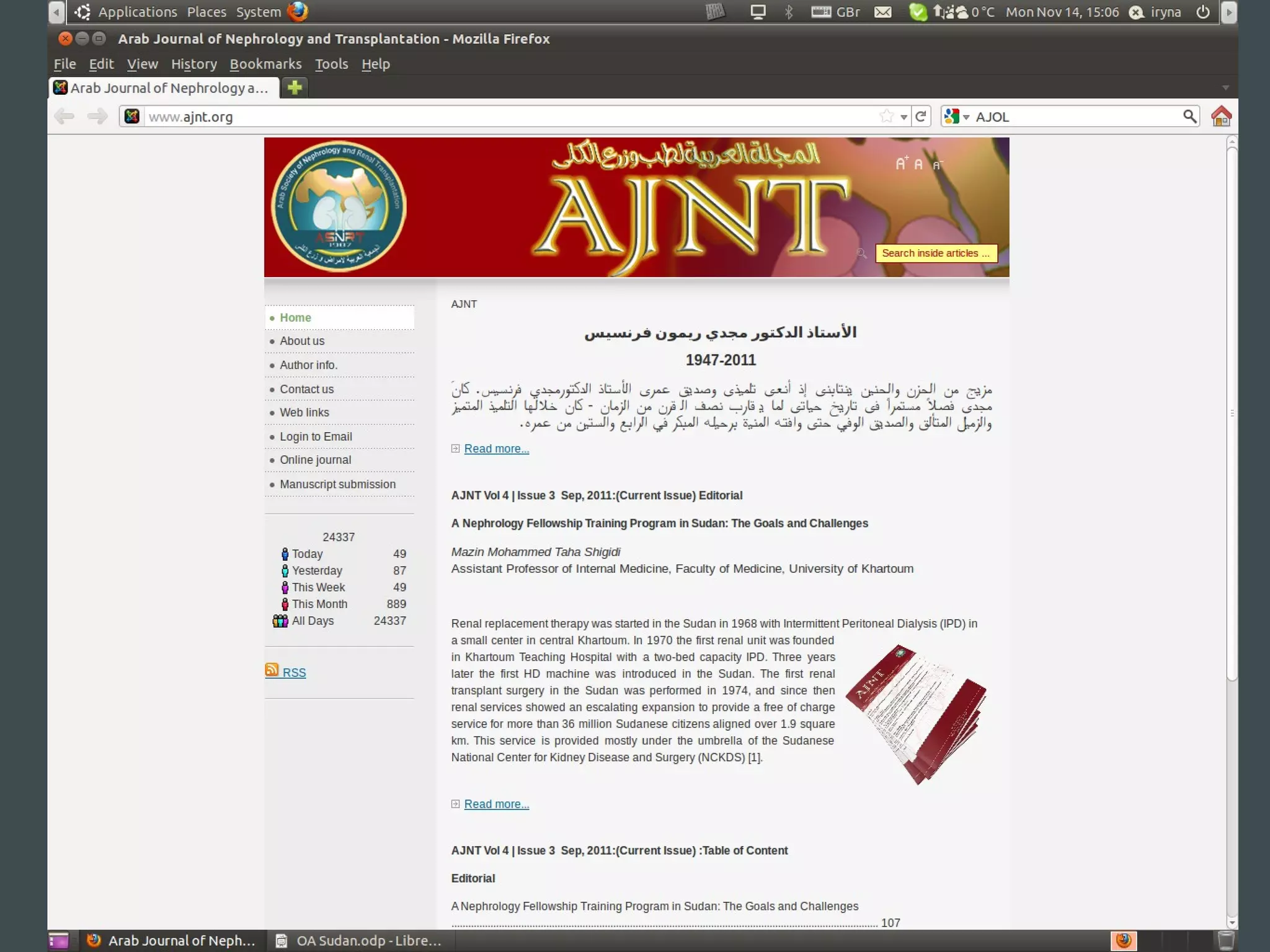
Sudan
Open Access awareness-raising
 campaign among researchers at the
 Faculty of Science, University of
 Khartoum (UofK) implemented by the
 Faculty of Science, University of
 Khartoum Library with the partner:
 GrandIR, CB, travel support provided by
 Carlos III University Madrid
OA advocacy in
Zimbabwe
University of Zimbabwe 2011 Open
 Access Advocacy Campaign
 implemented by The University of
 Zimbabwe library.
Effective faculty based advocacy and
 trainings to research administrators.
ETDs will be OA, a task force has been
 created to define processes & advance
 operational issues related to OA Policy.
OA advocacy
results
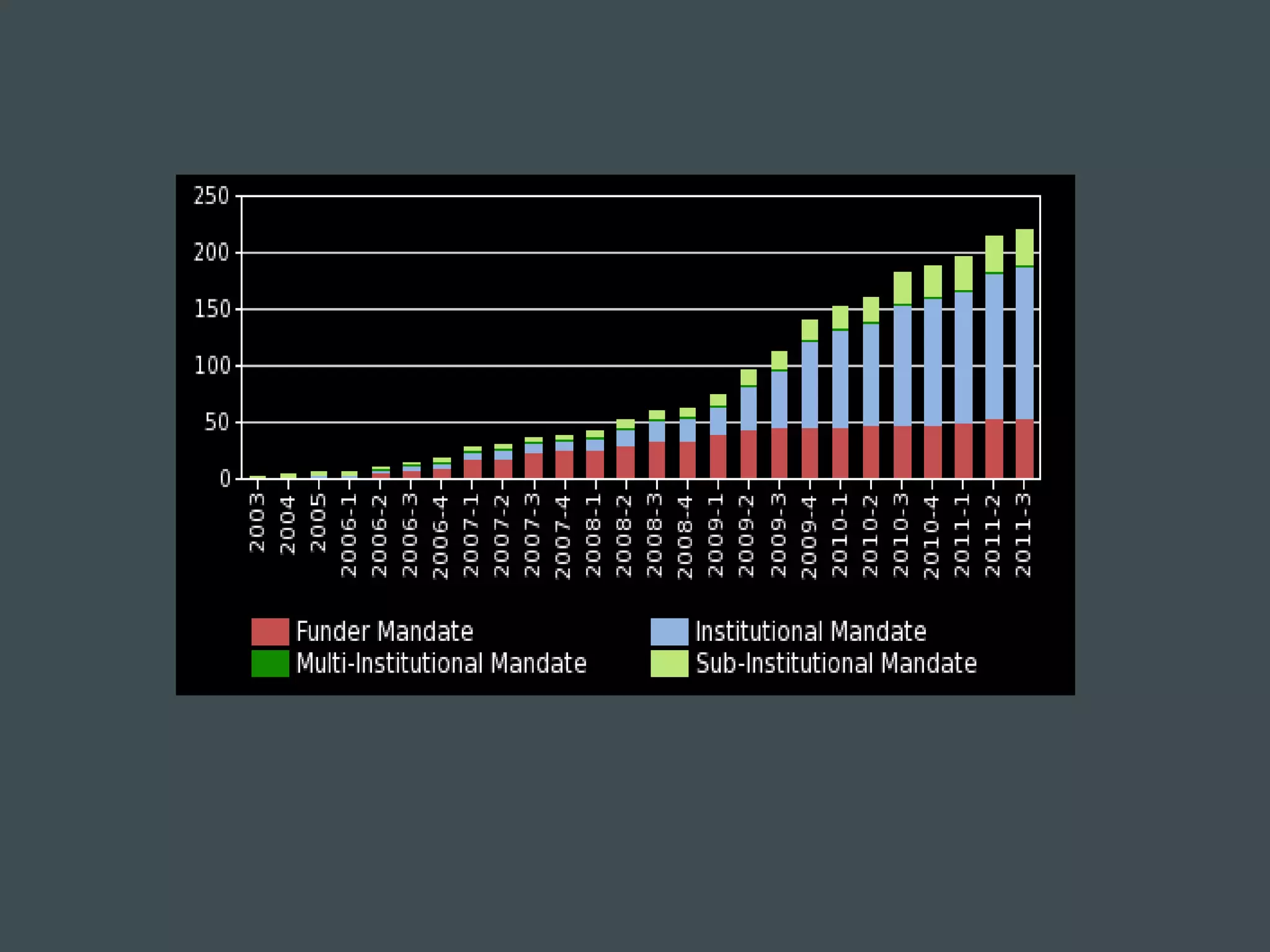
Open access policies (mandates) ensure
 that research funded by institutions is
 made freely available.
Such policies have been adopted by
 Strathmore University in Kenya,
 Covenant University in Nigeria,
 University of Pretoria and University of
 Johannesburg in South Africa.
UP Open Scholarship
 Programme
1. Theses and dissertations are available online
and OA based on a policy of mandatory
submission

2. Research and conference papers are available
online and OA and researchers actively contribute
based on a policy of mandatory submission

3. Researchers and students actively use OA
material
UP Open Scholarship
  Programme (2)
4. Researchers publish in available OA journals
and the institution has policy and financial support
in place for that
5. Researchers actively manage the copyright of
their publications, inter alia with addenda to their
contracts or using Creative Commons contracts,
and the necessary policy exists
6. Publications from the institution's
press/publishing house are available in OA based
on policy
UP Open Scholarship
  Programme (3)
7. The institution publishes its own online OA
journals OR provides infrastructure and support for
members of its community who are involved with
society publishing

8. Dissemination forms part of its publication
strategies.
Open licenses
International Livestock Research Institute (ILRI)
adopted a proposal for the institute to use an
‘open’ license for its published outputs.
The aim is to encourage maximum uptake and re-
use of ILRI’s research.
Under this proposal, ILRI retains copyright over
each output. It also explicitly encourages wide
non-commercial re-use of each output, subject to
full attribution of ILRI and the author(s), and use of
an equally open license for any derivative output.
Setting up shared
  repositories
REPOSITÓRIO SABER: www.saber.ac.mz; 6 institutions:
Centro de Formação Jurídica e Judiciária
Instituto Superior de Ciências e Tecnologia de
Moçambique
Universidade Eduardo Mondlane
Universidade Pedagógica
Universidade Politécnica
Universidade São Tomás de Moçambique
Why OA?
“Access to relevant and timely information is
  critical to support the University’s mission of
  teaching, learning, research and the
  managerial functions of the University. Access
  to information is also an essential condition
  for the economic and social development of
  the country. Open access will enhance access
  to local content and this goal can only be
  achieved through collaborative efforts.”
  Professor Kamau Ngamau, Dean Faculty of Agriculture, JKUAT
Why OA? (2)
“One of the key pillars of the University of
  Botswana new strategic plan “Strategy for
  excellence” is “Research Intensification”. OA
  will help the University of Botswana,
  Government, and research institutions to
  achieve this pillar by ensuring online
  accessibility to public funded research output
  that can be freely shared by everyone, enhance
  research quality, and improve visibility of the
  institution and the nation globally. ” Prof. Frank
  Youngman, DVC, University of Botswana
Is OA on the
  agenda at the AU?
Is the issue of Open Access to information through
   libraries part of business for the African Union
   (AU) when it comes to assessing countries’
   performance under the African Peer Review
   Mechanisms (APRM)?
(Matseliso M. (Tseli) Moshoeshoe-Chadzingwa, National University of
  Lesotho, EIFL country coordinator in Lesotho and EIFL Advisory
  Board member)
UNESCO-ASSAf-EIFL
 OA workshop
Recommendations:
Capacity building: OA publishing and OA
 repositories, copyright management
Advocacy campaigns for regulatory policy
 frameworks – Require open access to
 publicly funded research – explore
 possibilities of OA mandates
CODIST II
“OA technologies could benefit Africa”
(pre-event of the Second Session of the
Committee on Development Information (CODIST
II): the workshop “Promoting Innovation
Development and Diffusion in Africa through
OA Publishing”, in May 2011 at the Economic
Commission for Africa (ECA).

Delegates examined ways to improve knowledge
sharing in Africa and to remove existing barriers.
CODIST II (2)
Participants recommended that Member States
should adopt appropriate OA policies and that
the ECA should take the leadership in these
activities.
“OA is a new way of publishing and of sharing
information in the 21st century. Everyone has a
role to play in knowledge development and
content sharing and everyone can make an
impact”, said Irene Onyancha, ECA’s Chief
Librarian.
The SOAP survey
11 EIFL partner countries: Bulgaria, China, Egypt,
Nigeria, Poland, Russia, Serbia, Slovenia, South
Africa, Thailand and Ukraine
About 86% of researchers are convinced that OA
publishing is beneficial to their research field
directly improving the way scientific community
work and providing the benefits outside the
scientific community – public good benefits.
The SOAP survey
(2)
About 63% of researchers published OA
 articles.
Top five factors when making choices about
 publishing in a journal: prestige
 (prestige/perceived quality of the journal),
 journal impact factor, speed of publication of
 the journal, importance for career
 (importance of the journal for academic
 promotion, tenure or assessment), and
 relevance of the journal for the community.
The SOAP survey
 (3)
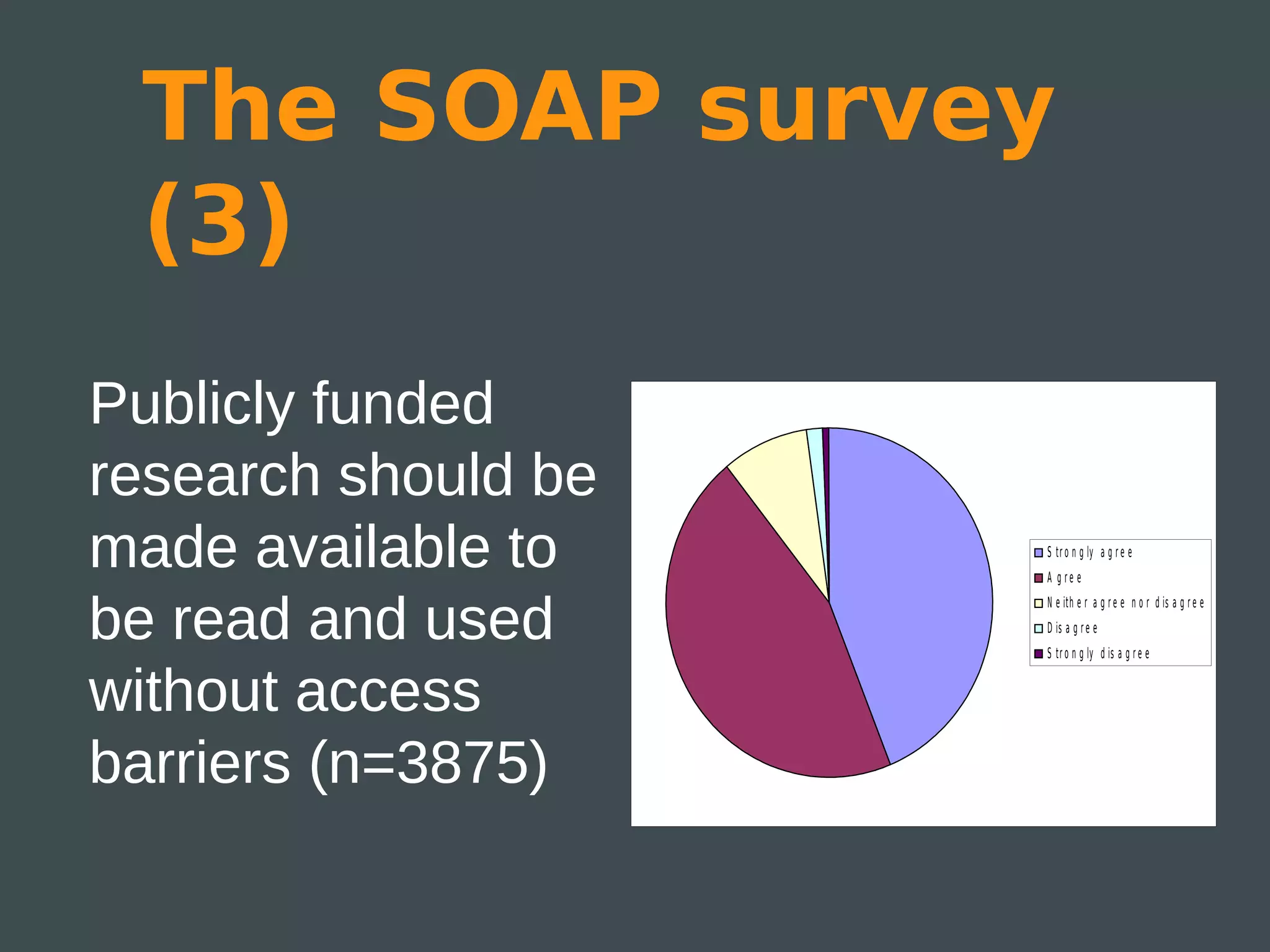
Publicly funded
research should be
made available to    S tr o n g ly a g r e e
                     A g re e


be read and used
                     N e ith e r a g r e e n o r d is a g r e e
                     D is a g r e e
                     S tr o n g ly d is a g r e e


without access
barriers (n=3875)
The SOAP survey
  (4)
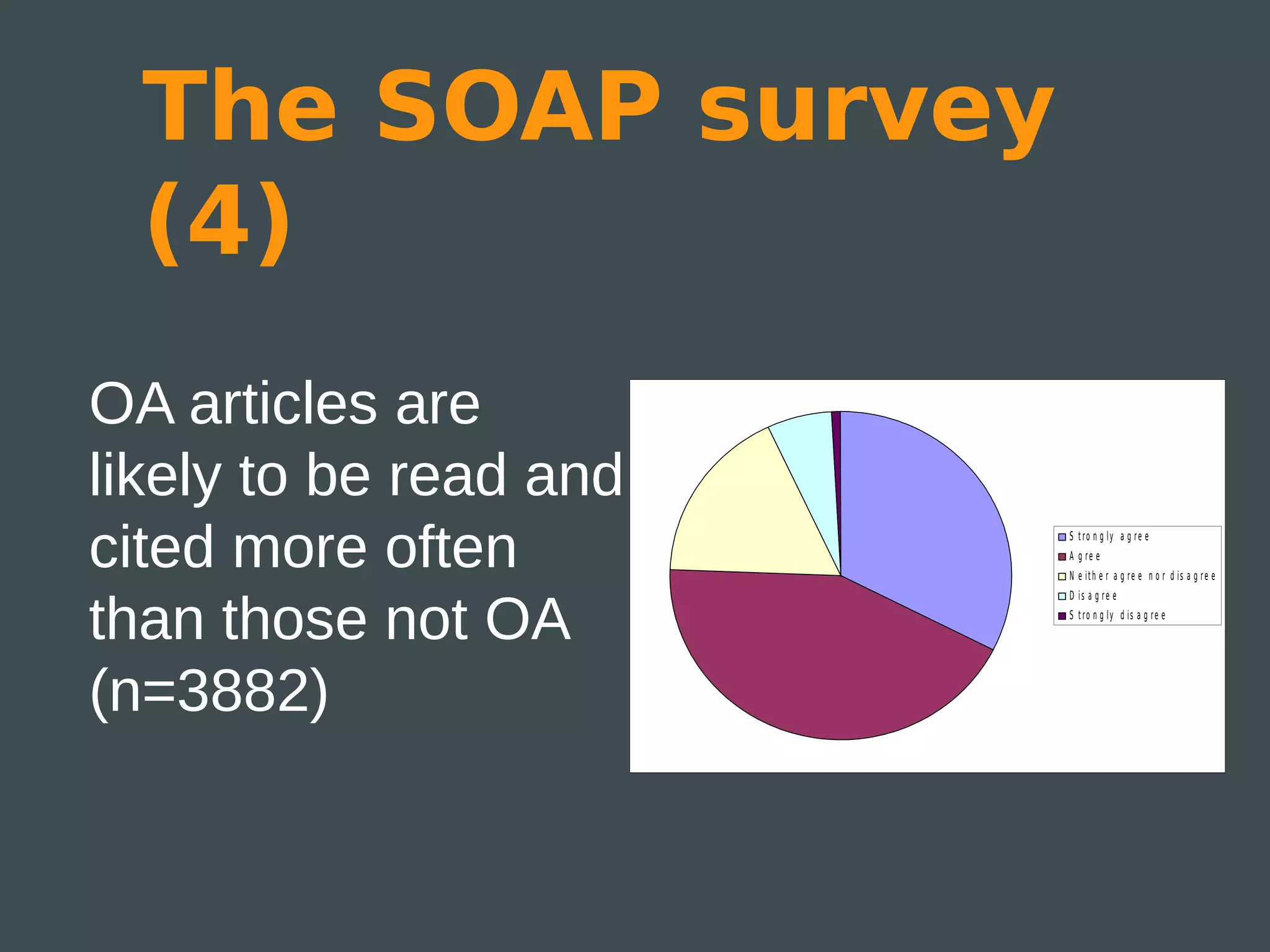
OA articles are
likely to be read and
cited more often        S t ro n g ly a g re e
                        A g re e
                        N e i t h e r a g r e e n o r d is a g r e e


than those not OA
                        D is a g re e
                        S t r o n g l y d is a g r e e


(n=3882)
The SOAP survey
  (5)
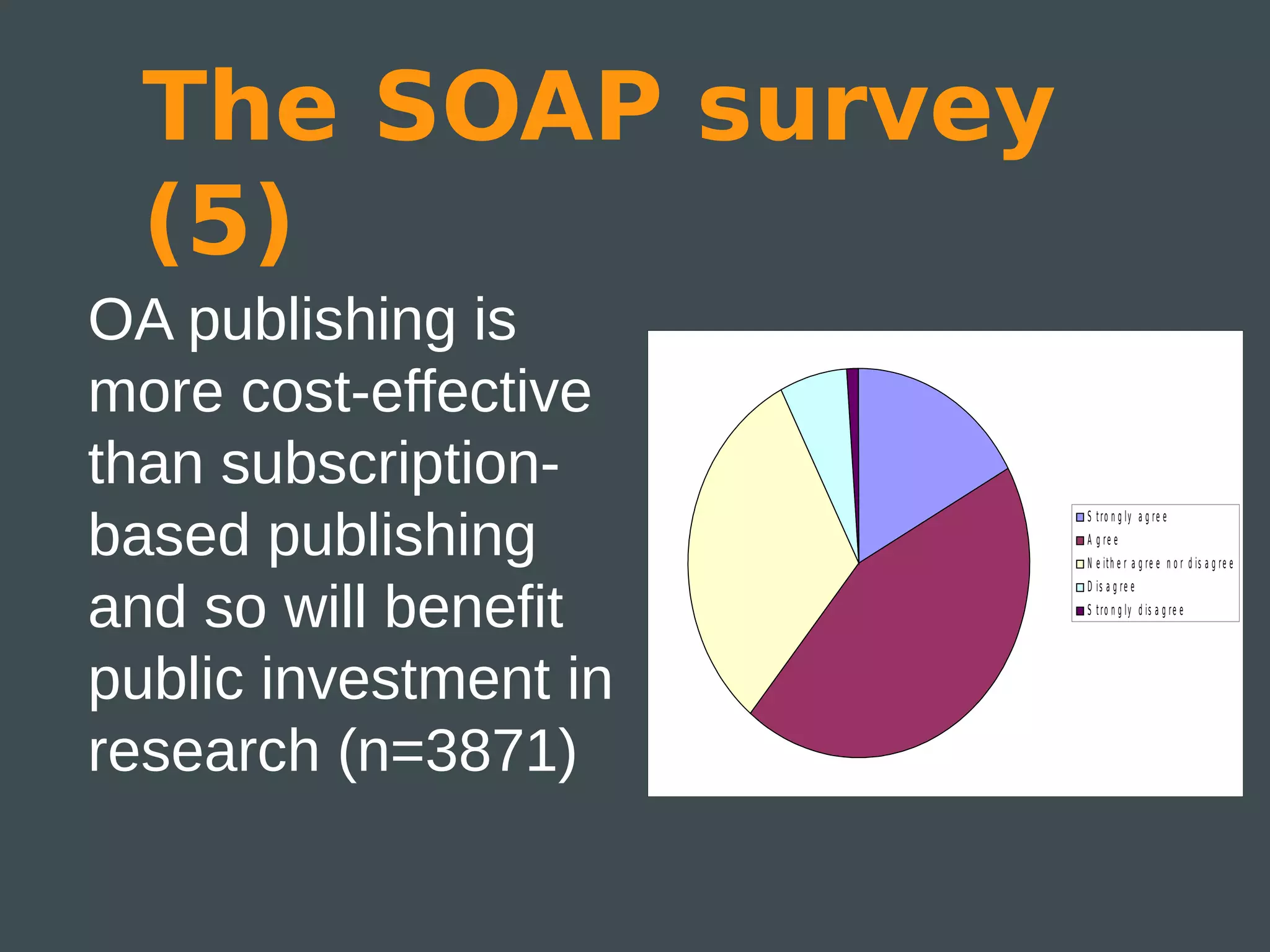
OA publishing is
more cost-effective
than subscription-
based publishing
                       S t r o n g ly a g r e e
                       A g re e
                       N e it h e r a g r e e n o r d is a g r e e


and so will benefit
                       D is a g r e e
                       S t r o n g ly d is a g r e e


public investment in
research (n=3871)
The SOAP survey
  (6)
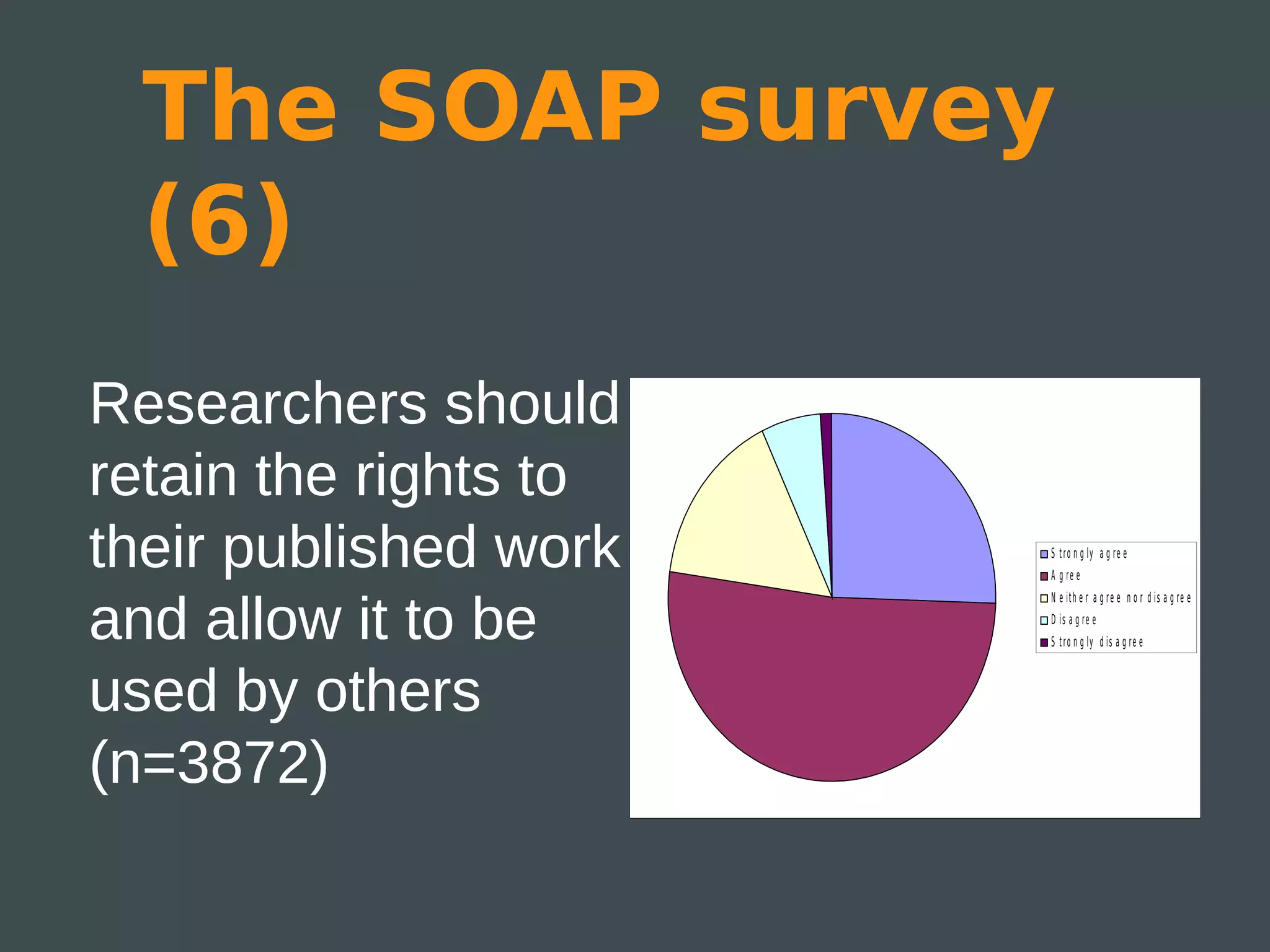
Researchers should
retain the rights to
their published work   S t ro n g ly a g re e
                       A g re e


and allow it to be
                       N e it h e r a g r e e n o r d is a g re e
                       D is a g re e
                       S t ro n g ly d is a g re e


used by others
(n=3872)
What researchers
  can do to promote
  OA?
Submit your research articles to OA journals, when
 there are appropriate OA journals in your field.
Deposit your postprints in an OA repository.
Deposit your data files in an OA repository along with
 the articles built on them.
When asked to referee a paper or serve on the
 editorial board for an OA journal, accept the
 invitation.
What researchers
  can do to promote
  OA? (2)
If you are an editor of a toll-access journal, then start a
  discussion about converting to OA.


Volunteer to serve on your university’s committee to
 evaluate faculty for promotion and tenure. Adjust the
 criteria to give faculty an incentive to provide OA to
 their peer-reviewed research articles, either through
 OAs journals or OA repositories.
What researchers
  can do to promote
  OA? (3)
Work with your professional societies to make sure they
 understand OA.
Write opinion pieces (articles, journal editorials, newspapers op-
 eds, letters to the editor, discussion forum postings) advancing
 the cause of OA.
Educate the next generation of scientists and scholars about OA.
(From What you can do to promote open access written by Peter
  Suber http://www.earlham.edu/~peters/fos/do.htm)
What research
 managers can do to
 promote OA?
Introduce OA polices.
Transform the TA journals into OA journals.
Set-up OA repositories.
Spread a word about OA.
What libraries can
 do to promote OA?
Set-up OA repositories.
Help researchers and students to self-archive.
Help to publish OA journals and create open
 educational resources.
Help in OA data curation and sharing.
Spread a word about OA.
Thank you! Questions?
iryna.kuchma@eifl.net


www.eifl.net

Open Access and the Evolving Scholarly Communication Environment

  • 1.
    Open Access andthe Evolving Scholarly Communication Environment Iryna Kuchma Open Access Programme manager OASCIR project final workshop, Faculty of Science, University of Khartoum, 17th of November 2011 www.eifl.net Attribution 3.0 Unported
  • 3.
    Removing barriers toknowledge sharing EIFL-OA: open access
  • 4.
    EIFL-OA achievements • 410+OA repositories & 2,600+ OA journals in EIFL partner countries • OA policies have been adopted by 24 institutions in the EIFL network • 65 awareness raising, advocacy and capacity building events and workshops in 2003-2011 in 33 countries with participants from over 50 countries
  • 5.
    Why OA? “Restrictive accesspolicies drastically reduces readership of electronic research journal articles. OA provides an environment within which literature and scholarly research articles are made freely accessible online without license restrictions and without charging users subscription or access fees…
  • 6.
    Why OA? (2) “OAis a vital means of dissemination of information which is crucial for national development and in achieving MDGs, given the crucial role that information plays in achieving social, economic, cultural and political development.” Professor Frank Youngman, DVC, University of Botswana
  • 7.
    Open access (OA) OAfor researchers: increased visibility, usage and impact for their work; OA for research institutions: publicises institutes’ research strengths, providing maximum return on investment; complete record of the research output in easily accessible form, new tools to manage institution's impact;
  • 8.
    OA (2) OA forpublishers: increased readership and citations, visibility and impact, the best possible dissemination service for research; OA for libraries: partnerships with scientists and research managers to set up OA repositories, to curate research data and to develop OA policies, with scholarly publishers they publish OA journals and books, and with educators – produce OERs.
  • 9.
    OA journals Use afunding model that does not charge readers or their institutions for access. Users can read, download, copy, distribute, print, search, or link to the full texts of the journal articles.
  • 10.
    OA journals inAfrica Over 420 OA journals from Egypt, South Africa, Nigeria, Tunisia, Kenya, Morocco, Ethiopia, Uganda, Tanzania, Libya, Ghana, Mauritius, Madagascar, Algeria, Senegal, Cote d'Ivoire, Sierra Leone and Sudan 58466 full text articles in African Journals OnLine
  • 17.
    OA repositories Contain researchoutputs Institutional or thematic Interoperable (OAI-PMH) Commons metadata protocol allows web applications (text and data mining)
  • 19.
    OA repositories Visibility, access,and preservation were the most important motivations cited by participating institutions to establish a repository. Other motivations included the need to evaluate researchers and departments, and as a response to requests from faculty. (A survey “Open Repository Development in Developing and Transition countries” conducted by EIFL and the University of Kansas Libraries)
  • 20.
    OA repositories (2) Publicizean institute’s research strengths, providing maximum return on research investment. Provide an administrative tool for institutions.
  • 21.
    OA repositories (3) Increaseimpact and usage of institute's research, providing new contacts and research partnerships for authors. Provide usage statistics showing global interest and value of institutional research.
  • 22.
    Open access repositories(4) FOSS to set up, free technical support. Low installation and maintenance costs, quick to set up and gain benefits. Institutions can mandate OA, speeding development.
  • 23.
    U of Kobjectives To provide modern educational and research environments that will enable students and researchers to face current challenges and to focus on knowledge as a principle driving force for development. To reach international levels in standards, contents and practices while maintaining local values and culture.
  • 24.
    U of Kobjectives (2) To keep up with the development and the new innovations that occur in the different fields of knowledge as well as to take the initiatives in innovation and creativity. To satisfy the increasing demand for excellence in higher education and to ensure the latest quality technology in all its outputs.
  • 25.
    U of Kobjectives (3) To promote libraries, laboratories and other teaching facilities to the latest technical standards and maintain their position as a place for interaction between the different components of the university. To employ information and communication technology to improve University performance with respect to education, research, capacity building, and skills polishing.
  • 26.
    OA advocacy EIFL providedfinancial support to five projects in Africa: national and institutional open access advocacy campaigns to reach out to research communities in Botswana, Ghana, Malawi, Sudan and Zimbabwe
  • 27.
    OA advocacy in Botswana Advocacyfor Open Access to Researchers/Deans/Graduate Students/Editors/Policy Makers/Educators/Library Professionals a project of Botswana Library Consortium and University of Botswana
  • 28.
    OA advocacy in Ghana OpenAccess Institutional Repositories Advocacy Campaign a project of the Consortium of Academic and Research Libraries in Ghana c/o Kwame Nkrumah University of Science and Technology, Kumasi, in partnership with Association of African Universities
  • 29.
    OA advocacy in Ghana(2) “Africa cannot attain sustainable development without access to knowledge and knowledge sharing,” stated professor Olugbemiro Jegede, Secretary General of the Association of African Universities at a recent workshop "Harnessing and Disseminating Research Information as a key to the Development of Knowledge-based Economies in Africa"
  • 30.
    OA advocacy in Malawi AwarenessCampaign for Kamuzu College of Nursing Library / University of Malawi Research Repository, a project of Kamuzu College of Nursing Library / University of Malawi in partnership with the National Commission for Science and Technology (NCST)
  • 31.
    OA advocacy in Sudan OpenAccess awareness-raising campaign among researchers at the Faculty of Science, University of Khartoum (UofK) implemented by the Faculty of Science, University of Khartoum Library with the partner: GrandIR, CB, travel support provided by Carlos III University Madrid
  • 32.
    OA advocacy in Zimbabwe Universityof Zimbabwe 2011 Open Access Advocacy Campaign implemented by The University of Zimbabwe library. Effective faculty based advocacy and trainings to research administrators. ETDs will be OA, a task force has been created to define processes & advance operational issues related to OA Policy.
  • 33.
    OA advocacy results Open accesspolicies (mandates) ensure that research funded by institutions is made freely available. Such policies have been adopted by Strathmore University in Kenya, Covenant University in Nigeria, University of Pretoria and University of Johannesburg in South Africa.
  • 35.
    UP Open Scholarship Programme 1. Theses and dissertations are available online and OA based on a policy of mandatory submission 2. Research and conference papers are available online and OA and researchers actively contribute based on a policy of mandatory submission 3. Researchers and students actively use OA material
  • 36.
    UP Open Scholarship Programme (2) 4. Researchers publish in available OA journals and the institution has policy and financial support in place for that 5. Researchers actively manage the copyright of their publications, inter alia with addenda to their contracts or using Creative Commons contracts, and the necessary policy exists 6. Publications from the institution's press/publishing house are available in OA based on policy
  • 37.
    UP Open Scholarship Programme (3) 7. The institution publishes its own online OA journals OR provides infrastructure and support for members of its community who are involved with society publishing 8. Dissemination forms part of its publication strategies.
  • 38.
    Open licenses International LivestockResearch Institute (ILRI) adopted a proposal for the institute to use an ‘open’ license for its published outputs. The aim is to encourage maximum uptake and re- use of ILRI’s research. Under this proposal, ILRI retains copyright over each output. It also explicitly encourages wide non-commercial re-use of each output, subject to full attribution of ILRI and the author(s), and use of an equally open license for any derivative output.
  • 39.
    Setting up shared repositories REPOSITÓRIO SABER: www.saber.ac.mz; 6 institutions: Centro de Formação Jurídica e Judiciária Instituto Superior de Ciências e Tecnologia de Moçambique Universidade Eduardo Mondlane Universidade Pedagógica Universidade Politécnica Universidade São Tomás de Moçambique
  • 40.
    Why OA? “Access torelevant and timely information is critical to support the University’s mission of teaching, learning, research and the managerial functions of the University. Access to information is also an essential condition for the economic and social development of the country. Open access will enhance access to local content and this goal can only be achieved through collaborative efforts.” Professor Kamau Ngamau, Dean Faculty of Agriculture, JKUAT
  • 41.
    Why OA? (2) “Oneof the key pillars of the University of Botswana new strategic plan “Strategy for excellence” is “Research Intensification”. OA will help the University of Botswana, Government, and research institutions to achieve this pillar by ensuring online accessibility to public funded research output that can be freely shared by everyone, enhance research quality, and improve visibility of the institution and the nation globally. ” Prof. Frank Youngman, DVC, University of Botswana
  • 42.
    Is OA onthe agenda at the AU? Is the issue of Open Access to information through libraries part of business for the African Union (AU) when it comes to assessing countries’ performance under the African Peer Review Mechanisms (APRM)? (Matseliso M. (Tseli) Moshoeshoe-Chadzingwa, National University of Lesotho, EIFL country coordinator in Lesotho and EIFL Advisory Board member)
  • 43.
    UNESCO-ASSAf-EIFL OA workshop Recommendations: Capacitybuilding: OA publishing and OA repositories, copyright management Advocacy campaigns for regulatory policy frameworks – Require open access to publicly funded research – explore possibilities of OA mandates
  • 44.
    CODIST II “OA technologiescould benefit Africa” (pre-event of the Second Session of the Committee on Development Information (CODIST II): the workshop “Promoting Innovation Development and Diffusion in Africa through OA Publishing”, in May 2011 at the Economic Commission for Africa (ECA). Delegates examined ways to improve knowledge sharing in Africa and to remove existing barriers.
  • 45.
    CODIST II (2) Participantsrecommended that Member States should adopt appropriate OA policies and that the ECA should take the leadership in these activities. “OA is a new way of publishing and of sharing information in the 21st century. Everyone has a role to play in knowledge development and content sharing and everyone can make an impact”, said Irene Onyancha, ECA’s Chief Librarian.
  • 47.
    The SOAP survey 11EIFL partner countries: Bulgaria, China, Egypt, Nigeria, Poland, Russia, Serbia, Slovenia, South Africa, Thailand and Ukraine About 86% of researchers are convinced that OA publishing is beneficial to their research field directly improving the way scientific community work and providing the benefits outside the scientific community – public good benefits.
  • 48.
    The SOAP survey (2) About63% of researchers published OA articles. Top five factors when making choices about publishing in a journal: prestige (prestige/perceived quality of the journal), journal impact factor, speed of publication of the journal, importance for career (importance of the journal for academic promotion, tenure or assessment), and relevance of the journal for the community.
  • 49.
    The SOAP survey (3) Publicly funded research should be made available to S tr o n g ly a g r e e A g re e be read and used N e ith e r a g r e e n o r d is a g r e e D is a g r e e S tr o n g ly d is a g r e e without access barriers (n=3875)
  • 50.
    The SOAP survey (4) OA articles are likely to be read and cited more often S t ro n g ly a g re e A g re e N e i t h e r a g r e e n o r d is a g r e e than those not OA D is a g re e S t r o n g l y d is a g r e e (n=3882)
  • 51.
    The SOAP survey (5) OA publishing is more cost-effective than subscription- based publishing S t r o n g ly a g r e e A g re e N e it h e r a g r e e n o r d is a g r e e and so will benefit D is a g r e e S t r o n g ly d is a g r e e public investment in research (n=3871)
  • 52.
    The SOAP survey (6) Researchers should retain the rights to their published work S t ro n g ly a g re e A g re e and allow it to be N e it h e r a g r e e n o r d is a g re e D is a g re e S t ro n g ly d is a g re e used by others (n=3872)
  • 53.
    What researchers can do to promote OA? Submit your research articles to OA journals, when there are appropriate OA journals in your field. Deposit your postprints in an OA repository. Deposit your data files in an OA repository along with the articles built on them. When asked to referee a paper or serve on the editorial board for an OA journal, accept the invitation.
  • 54.
    What researchers can do to promote OA? (2) If you are an editor of a toll-access journal, then start a discussion about converting to OA. Volunteer to serve on your university’s committee to evaluate faculty for promotion and tenure. Adjust the criteria to give faculty an incentive to provide OA to their peer-reviewed research articles, either through OAs journals or OA repositories.
  • 55.
    What researchers can do to promote OA? (3) Work with your professional societies to make sure they understand OA. Write opinion pieces (articles, journal editorials, newspapers op- eds, letters to the editor, discussion forum postings) advancing the cause of OA. Educate the next generation of scientists and scholars about OA. (From What you can do to promote open access written by Peter Suber http://www.earlham.edu/~peters/fos/do.htm)
  • 56.
    What research managerscan do to promote OA? Introduce OA polices. Transform the TA journals into OA journals. Set-up OA repositories. Spread a word about OA.
  • 57.
    What libraries can do to promote OA? Set-up OA repositories. Help researchers and students to self-archive. Help to publish OA journals and create open educational resources. Help in OA data curation and sharing. Spread a word about OA.
  • 58.