






Strategies for the future of public libraries
Nick Poole, Chief Executive, CILIP
CILIP Wales Conference 2016
Public libraries aren’t dying – they’re changing (again)
Times like these calls for solidarity and empathy – personally and professionally.
This downturn in the fortunes of public libraries is longer and deeper than
many of those that preceded it because it is the product of at least 3 waves of
change: technological change, social change and economic change.
This too shall pass...
“Approximate Statistical view of the Principal Public Libraries of Europe and the
United States of America” (Edwards,1849)
We’ve been here before (many times)...
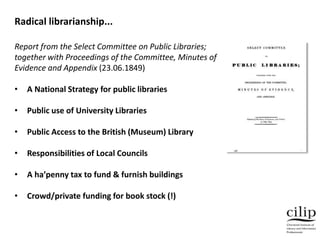
Report from the Select Committee on Public Libraries;
together with Proceedings of the Committee, Minutes of
Evidence and Appendix (23.06.1849)
• A National Strategy for public libraries
• Public use of University Libraries
• Public Access to the British (Museum) Library
• Responsibilities of Local Councils
• A ha’penny tax to fund & furnish buildings
• Crowd/private funding for book stock (!)
Radical librarianship...
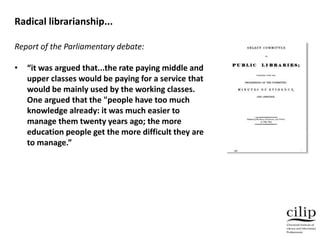
Report of the Parliamentary debate:
• “it was argued that...the rate paying middle and
upper classes would be paying for a service that
would be mainly used by the working classes.
One argued that the "people have too much
knowledge already: it was much easier to
manage them twenty years ago; the more
education people get the more difficult they are
to manage.”
Radical librarianship...
Royal Charter:
“To work for the benefit of the public to promote education and knowledge
through the establishment and development of libraries and information
services and to advance information science (being the science and practice of
the collection, collation, evaluation and organised dissemination of
information).”
• Unite all persons engaged or interested in information science
• Promote improvement of knowledge, skills, position and qualifications
• Promote study and research in librarianship and information science
• Promote adequate & appropriate provision of library services
• Scrutinise legislation affecting the provision of library and information services
CILIP’s role...
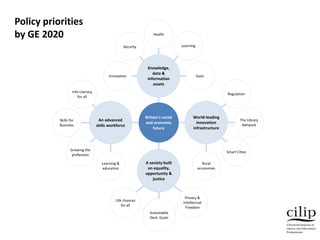
Policy priorities
by GE 2020
Britain’s social
and economic
future
Knowledge,
data &
information
assets
World-leading
innovation
infrastructure
An advanced
skills workforce
A society built
on equality,
opportunity &
justice
Health
Innovation
Security
Govt.
Learning
The Library
Network
Smart Cities
Rural
economies
Regulation
Learning &
education
Growing the
profession
Skills for
Business
Info Literacy
for all
Privacy &
Intellectual
Freedom
Sustainable
Devt. Goals
Life chances
for all
We want every single last member of society to have the opportunity to learn,
to read, to discover and to get on in life. We want them to live in an equal,
democratic and prosperous society.
A key way of achieving this is to secure a modern, sustainable, universal public
library service that meets the needs of local communities.
That includes literacy, opportunities for creativity, safe welcoming places,
learning, digital inclusion, business support or promoting health and
wellbeing, alongside a whole raft of other new & exotic functions...
What do we want?
Strategies for the future of public libraries..
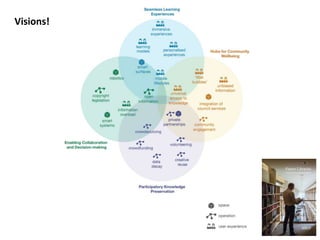
Visions!
The question is less strategic than tactical – it’s less about what
public libraries will look like in future and more about how we
organise ourselves to get there faster & stop losing services and
jobs in the process...
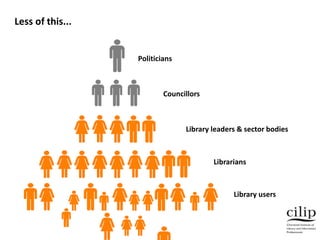
Less of this...
Librarians
Library users
Library leaders & sector bodies
Councillors
Politicians
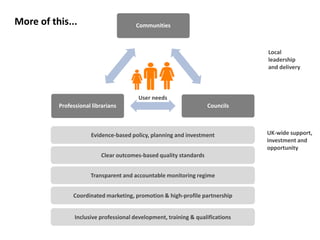
More of this... Communities
CouncilsProfessional librarians
User needs
Clear statutory duties (Local & National)Evidence-based policy, planning and investment
Clear statutory duties (Local & National)Clear outcomes-based quality standards
Transparent and accountable monitoring regime
Coordinated marketing, promotion & high-profile partnership
Inclusive professional development, training & qualifications
Local
leadership
and delivery
UK-wide support,
investment and
opportunity
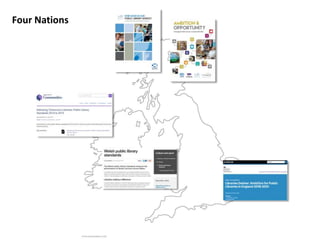
Four Nations
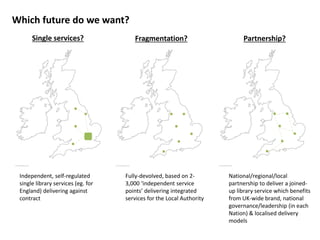
Which future do we want?
Single services? Fragmentation? Partnership?
Independent, self-regulated
single library services (eg. for
England) delivering against
contract
Fully-devolved, based on 2-
3,000 ‘independent service
points’ delivering integrated
services for the Local Authority
National/regional/local
partnership to deliver a joined-
up library service which benefits
from UK-wide brand, national
governance/leadership (in each
Nation) & localised delivery
models
Our tactics have to yield money, but whose money? Our strategy is extremely
confused:
• A redistribution or ring-fence of existing spend by Local Authorities?
• UK Government intervention in Local Authority spend?
• Relaxing of Austerity policy in relation to centrally-distributed funds?
• Release of additional ring-fenced money from the Exchequer?
• Distribution of Treasury money via project funders?
UK Government will not intervene in Local Authority expenditure in this
Parliament so our best tactics are to convince Councils to maintain
investment, encourage Government to increase the availability of project
funds & support the overall effort to ease austerity
Money
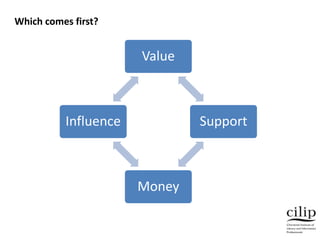
Which comes first?
Value
Support
Money
Influence
We’re underway already...
Governance & leadership
CILIP plays an active role on behalf of our profession in the Leadership for
Libraries Taskforce, even where this isn’t always easy.
There are no easy solutions, but there are some clear points to navigate by:
• We need professional librarians to deliver professional services
• We need to support and promote positive change
• We need to ensure that we retain the connection to professional ethics
• We need to be inclusive while promoting the value & status of professional librarians
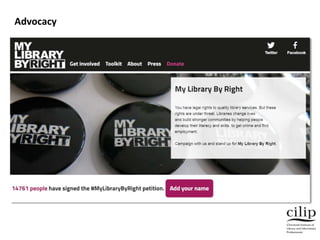
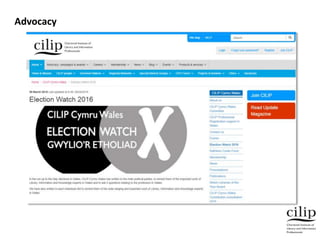
Advocacy
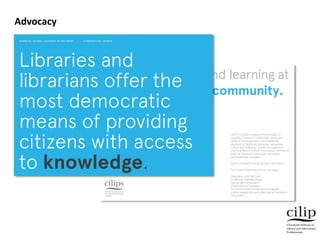
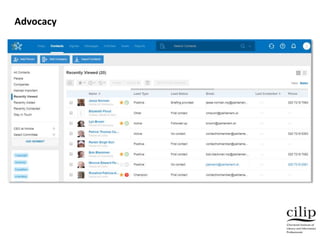
Advocacy
Advocacy
Advocacy
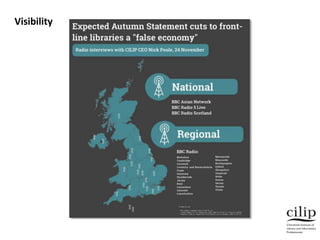
Visibility
Visibility
Visibility
Development
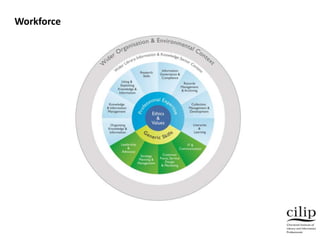
Workforce
We want to go further...
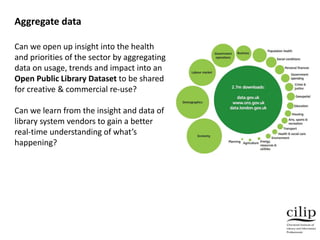
Can we open up insight into the health
and priorities of the sector by aggregating
data on usage, trends and impact into an
Open Public Library Dataset to be shared
for creative & commercial re-use?
Can we learn from the insight and data of
library system vendors to gain a better
real-time understanding of what’s
happening?
Aggregate data
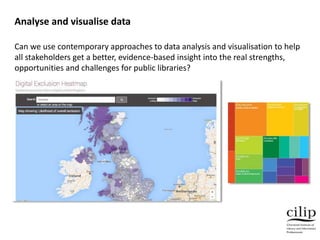
Can we use contemporary approaches to data analysis and visualisation to help
all stakeholders get a better, evidence-based insight into the real strengths,
opportunities and challenges for public libraries?
Analyse and visualise data
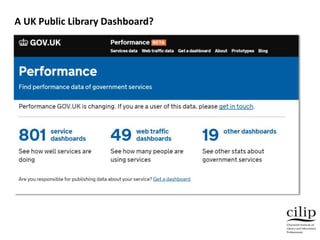
A UK Public Library Dashboard?
Partnerships that scale?
The process we’re going through is a process of change, not an existential
threat. There will always be public libraries, there will always be an audience
who need what public libraries uniquely deliver.
In Scotland, Wales & Northern Ireland, you’ve already made key decisions about
how you want to take control of that process of change. Hopefully in England,
this is what is happening through the ‘Ambition’. None of these futures are
certain, and we can have a positive impact on all of them.
This is not a decision about whether libraries are important, but of how they
will be funded, governed and developed in the future. We need to organise
ourselves tactically, effectively, positively and with unity of purpose to ensure
that those decisions are made by and with professional librarians.

A public library strategy for the future

  • 1.
    Strategies for thefuture of public libraries Nick Poole, Chief Executive, CILIP CILIP Wales Conference 2016
  • 2.
    Public libraries aren’tdying – they’re changing (again)
  • 3.
    Times like thesecalls for solidarity and empathy – personally and professionally. This downturn in the fortunes of public libraries is longer and deeper than many of those that preceded it because it is the product of at least 3 waves of change: technological change, social change and economic change. This too shall pass...
  • 4.
    “Approximate Statistical viewof the Principal Public Libraries of Europe and the United States of America” (Edwards,1849) We’ve been here before (many times)...
  • 5.
    Report from theSelect Committee on Public Libraries; together with Proceedings of the Committee, Minutes of Evidence and Appendix (23.06.1849) • A National Strategy for public libraries • Public use of University Libraries • Public Access to the British (Museum) Library • Responsibilities of Local Councils • A ha’penny tax to fund & furnish buildings • Crowd/private funding for book stock (!) Radical librarianship...
  • 6.
    Report of theParliamentary debate: • “it was argued that...the rate paying middle and upper classes would be paying for a service that would be mainly used by the working classes. One argued that the "people have too much knowledge already: it was much easier to manage them twenty years ago; the more education people get the more difficult they are to manage.” Radical librarianship...
  • 7.
    Royal Charter: “To workfor the benefit of the public to promote education and knowledge through the establishment and development of libraries and information services and to advance information science (being the science and practice of the collection, collation, evaluation and organised dissemination of information).” • Unite all persons engaged or interested in information science • Promote improvement of knowledge, skills, position and qualifications • Promote study and research in librarianship and information science • Promote adequate & appropriate provision of library services • Scrutinise legislation affecting the provision of library and information services CILIP’s role...
  • 8.
    Policy priorities by GE2020 Britain’s social and economic future Knowledge, data & information assets World-leading innovation infrastructure An advanced skills workforce A society built on equality, opportunity & justice Health Innovation Security Govt. Learning The Library Network Smart Cities Rural economies Regulation Learning & education Growing the profession Skills for Business Info Literacy for all Privacy & Intellectual Freedom Sustainable Devt. Goals Life chances for all
  • 9.
    We want everysingle last member of society to have the opportunity to learn, to read, to discover and to get on in life. We want them to live in an equal, democratic and prosperous society. A key way of achieving this is to secure a modern, sustainable, universal public library service that meets the needs of local communities. That includes literacy, opportunities for creativity, safe welcoming places, learning, digital inclusion, business support or promoting health and wellbeing, alongside a whole raft of other new & exotic functions... What do we want?
  • 10.
    Strategies for thefuture of public libraries..
  • 11.
  • 12.
    The question isless strategic than tactical – it’s less about what public libraries will look like in future and more about how we organise ourselves to get there faster & stop losing services and jobs in the process...
  • 13.
    Less of this... Librarians Libraryusers Library leaders & sector bodies Councillors Politicians
  • 14.
    More of this...Communities CouncilsProfessional librarians User needs Clear statutory duties (Local & National)Evidence-based policy, planning and investment Clear statutory duties (Local & National)Clear outcomes-based quality standards Transparent and accountable monitoring regime Coordinated marketing, promotion & high-profile partnership Inclusive professional development, training & qualifications Local leadership and delivery UK-wide support, investment and opportunity
  • 15.
  • 16.
    Which future dowe want? Single services? Fragmentation? Partnership? Independent, self-regulated single library services (eg. for England) delivering against contract Fully-devolved, based on 2- 3,000 ‘independent service points’ delivering integrated services for the Local Authority National/regional/local partnership to deliver a joined- up library service which benefits from UK-wide brand, national governance/leadership (in each Nation) & localised delivery models
  • 17.
    Our tactics haveto yield money, but whose money? Our strategy is extremely confused: • A redistribution or ring-fence of existing spend by Local Authorities? • UK Government intervention in Local Authority spend? • Relaxing of Austerity policy in relation to centrally-distributed funds? • Release of additional ring-fenced money from the Exchequer? • Distribution of Treasury money via project funders? UK Government will not intervene in Local Authority expenditure in this Parliament so our best tactics are to convince Councils to maintain investment, encourage Government to increase the availability of project funds & support the overall effort to ease austerity Money
  • 18.
  • 19.
  • 20.
    Governance & leadership CILIPplays an active role on behalf of our profession in the Leadership for Libraries Taskforce, even where this isn’t always easy. There are no easy solutions, but there are some clear points to navigate by: • We need professional librarians to deliver professional services • We need to support and promote positive change • We need to ensure that we retain the connection to professional ethics • We need to be inclusive while promoting the value & status of professional librarians
  • 21.
  • 22.
  • 23.
  • 24.
  • 25.
  • 26.
  • 27.
  • 28.
  • 29.
  • 30.
    We want togo further...
  • 31.
    Can we openup insight into the health and priorities of the sector by aggregating data on usage, trends and impact into an Open Public Library Dataset to be shared for creative & commercial re-use? Can we learn from the insight and data of library system vendors to gain a better real-time understanding of what’s happening? Aggregate data
  • 32.
    Can we usecontemporary approaches to data analysis and visualisation to help all stakeholders get a better, evidence-based insight into the real strengths, opportunities and challenges for public libraries? Analyse and visualise data
  • 33.
    A UK PublicLibrary Dashboard?
  • 34.
  • 35.
    The process we’regoing through is a process of change, not an existential threat. There will always be public libraries, there will always be an audience who need what public libraries uniquely deliver. In Scotland, Wales & Northern Ireland, you’ve already made key decisions about how you want to take control of that process of change. Hopefully in England, this is what is happening through the ‘Ambition’. None of these futures are certain, and we can have a positive impact on all of them. This is not a decision about whether libraries are important, but of how they will be funded, governed and developed in the future. We need to organise ourselves tactically, effectively, positively and with unity of purpose to ensure that those decisions are made by and with professional librarians.