Ethiopia: Open Data / Open
Science Agenda
Teklemichael Tefera
TeferaT@State.gov
Director, American Spaces
U.S. Embassy Ethiopia
Outline
 Understanding Open Science
 Benefits of Open Science
 Open Science Eco-system
 Open Science/Open Data Practices in
Ethiopia
 Open Access Publishing
 Initiatives and Achievements
 Different Players in Open Science
uptake
 Challenges
 Way Forward - Recommendations
2
What is Open Science?
 An effort to make the outputs of publicly
funded research more widely accessible in
digital format for the benefit of the scientific
community, the business sector and society
more generally (OECD 2015).
 Open Science refers to a scientific culture
that is characterized by its openness.
 The evolution of science towards a more
open and data-driven enterprise.
Open Science Environment
 Open Science depends on ICT based
scientific collaboration between
scientists and citizens
 Scientists share research results almost
immediately to a very wide audience
 It includes many stages of research
processes thus enabling re-usability of
scientific data
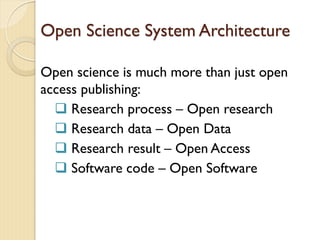
Open Science System Architecture
Open science is much more than just open
access publishing:
 Research process – Open research
 Research data – Open Data
 Research result – Open Access
 Software code – Open Software
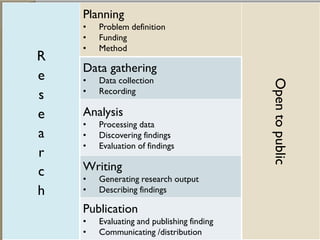
R
e
s
e
a
r
c
h
Planning
• Problem definition
• Funding
• Method
Opentopublic
Data gathering
• Data collection
• Recording
Analysis
• Processing data
• Discovering findings
• Evaluation of findings
Writing
• Generating research output
• Describing findings
Publication
• Evaluating and publishing finding
• Communicating /distribution
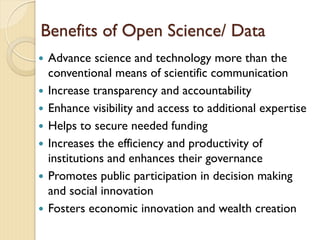
Benefits of Open Science/ Data
 Advance science and technology more than the
conventional means of scientific communication
 Increase transparency and accountability
 Enhance visibility and access to additional expertise
 Helps to secure needed funding
 Increases the efficiency and productivity of
institutions and enhances their governance
 Promotes public participation in decision making
and social innovation
 Fosters economic innovation and wealth creation
Open Science Practices in Ethiopia
 Open Access Publishing
 Open Research
 Open Data
 Open Software
Open Access Publishing -The Gold Route
 Publishing about 70 Scientific Journals
 Managed by scientific societies/
associations, not commercial publishers
 About 30 of them have given themselves up
to open access initiatives
 Quality is still an issue
 Publishing in an Int. high impact (open &
traditional) journal is a challenge by the
Ethiopian young scientists
9
Open Access Practices - the Green Route
 Institutional Repository Initiative at AAU
The DATAD project by the AAU, Accra
(2000/2001)
The launch of AAU-ETD project (2007)
 Forum for Social Studies (FSS) launched its
digital repository (2012)
 Universities (Jimma, St. Mary’s, Mekelle,
Haramaya, Gondar, Adama, etc.)
10
National Achievements
1. National Digital Repository Model
2. Collaborative Framework Agreement (MoU
signed by institutions)
3. Trained personnel (Technical & Advocacy)
4. Institutional Repositories at various level
5. National Harvester System
11
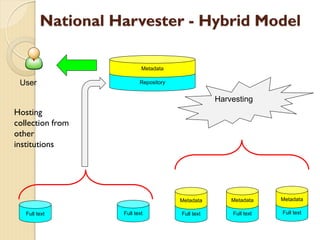
National Harvester - Hybrid Model
Repository
Metadata
Full text Full text
Metadata
Full text
Metadata
Full text
Metadata
Full text
Hosting
collection from
other
institutions
Harvesting
User
Open Science/ Data Uptake in Ethiopia
 Open research practice among Ethiopian
scientists is at infancy stage
 University of Cornell / ITOCA programme
in the field of agriculture
 Installation of TEEL database at about 30
academic and research institutions
 Capacity development training in the use
and management of research data (30*25)
 Medley as the research collaborative
platform
Open Science/ Data Uptake in Ethiopia
 Ministry of Information and Communication
Technology (MCIT), & Ministry of Health
(MoH) have already made their data open
through their portals
 An Indication that the GOE put the expansion of open data
as its first strategic priorities
 Discussions are happening on potential benefits
of open science for Ethiopia in terms of
innovation, knowledge transfer and raising the
profile of Ethiopian research across the world
 More later in Roberto Barbera’s talk on the Sci-
GaIA Open Science Platform
Actors in Open Science
 Researchers - motivation stems from the
values inherent in science (e.g. openness to
scrutiny, solving societal problems)
 Funding agencies - they adopted
mechanisms to promote open science by
including open or public access of funded
research outputs as a requirement
 Universities and research institutes -
play a role in training students and
researchers in repositories, data cleaning,
curation and management
Actors in Open Science
 Libraries & repositories - constitute the
physical infrastructure that allows scientists
to share, use and reuse the outcome of their
work
 Government ministries - have developed
strategies for open data, either as stand-alone
strategic efforts or as part of broader open
government agendas
Actors in Open Science
 Scientific journal publishers - offers a
broad range of open access publishing –
open in full or hybrid
 Businesses - constitute part of the demand
for open access and data that they use to
develop new technologies and products
 National Advocates and leader
 Infrastructure providers - EtherNet
Challenges to Open Science Practices
 Absence of policy framework needed to
encourage and govern Open Science practices
 Low level of awareness of open science and
its benefits among academic and research
communities
 Financial circumstances of the authors
themselves to practice elements of open
science
 Lack of incentives for publishing in open
access
18
Challenges to Open Science Practices
 Institutional legal mandate to coordinate
open science at national level
 Confusion with regards to ownership of
research datasets
 Inadequate infrastructure and skills to curate
and preserve research data
 High cost of Internet connectivity and low
bandwidth
Challenges to Open Science Practices
• Misconception about Open Access Journals
by leaders in the academia which often
resulted in denying academic promotions
• Lack of trust in digital services and cloud
technologies, or concerns about their
reliability, security and resilience
• Difficulty to integrate DR projects into
regular staff duty
20
What is Needed to Embrace Open
Science? - Way Forward
1. Nation-wide policy framework that
encourage Open Science - will not only help
to solicit content but also get away with many
bureaucratic hurdles
2. Creating awareness on the basics of open
science; benefits, principles of research ethics,
repeatability, and reliability
3. Devising reward mechanisms for planning
research using open methods and tools
4. Provision of platforms to managing research
data
What is Needed to Embrace Open
Science?:Way Forward
5. Involving the national infrastructure operators
such as the EtherNet will help to circumvent the
hosting and infrastructure issues
6. Sustainable advocacy work at various levels for
opening the whole research process, open access
publishing, and open data practices
7. Collaborating with national and international
partners helps to supplement financial and skill
requirements
22
What is Needed to Embrace Open
Science?:Way Forward
8. Standardized approach helps to ensure
interoperability between different data
repository and open access management
technologies
9. Institutional legal mandate at national level
would enable easier coordination and encourage
more faster collaboration
10. Developing a pool of funds for authors
practicing open access publishing is instrumental
to speed up communication of their research
results and advance science
23
Thank you!
Any Question?
24

Ethiopia: Open Data/Open Science Agenda/Teklemichael Tefera

  • 1.
    Ethiopia: Open Data/ Open Science Agenda Teklemichael Tefera TeferaT@State.gov Director, American Spaces U.S. Embassy Ethiopia
  • 2.
    Outline  Understanding OpenScience  Benefits of Open Science  Open Science Eco-system  Open Science/Open Data Practices in Ethiopia  Open Access Publishing  Initiatives and Achievements  Different Players in Open Science uptake  Challenges  Way Forward - Recommendations 2
  • 3.
    What is OpenScience?  An effort to make the outputs of publicly funded research more widely accessible in digital format for the benefit of the scientific community, the business sector and society more generally (OECD 2015).  Open Science refers to a scientific culture that is characterized by its openness.  The evolution of science towards a more open and data-driven enterprise.
  • 4.
    Open Science Environment Open Science depends on ICT based scientific collaboration between scientists and citizens  Scientists share research results almost immediately to a very wide audience  It includes many stages of research processes thus enabling re-usability of scientific data
  • 5.
    Open Science SystemArchitecture Open science is much more than just open access publishing:  Research process – Open research  Research data – Open Data  Research result – Open Access  Software code – Open Software
  • 6.
    R e s e a r c h Planning • Problem definition •Funding • Method Opentopublic Data gathering • Data collection • Recording Analysis • Processing data • Discovering findings • Evaluation of findings Writing • Generating research output • Describing findings Publication • Evaluating and publishing finding • Communicating /distribution
  • 7.
    Benefits of OpenScience/ Data  Advance science and technology more than the conventional means of scientific communication  Increase transparency and accountability  Enhance visibility and access to additional expertise  Helps to secure needed funding  Increases the efficiency and productivity of institutions and enhances their governance  Promotes public participation in decision making and social innovation  Fosters economic innovation and wealth creation
  • 8.
    Open Science Practicesin Ethiopia  Open Access Publishing  Open Research  Open Data  Open Software
  • 9.
    Open Access Publishing-The Gold Route  Publishing about 70 Scientific Journals  Managed by scientific societies/ associations, not commercial publishers  About 30 of them have given themselves up to open access initiatives  Quality is still an issue  Publishing in an Int. high impact (open & traditional) journal is a challenge by the Ethiopian young scientists 9
  • 10.
    Open Access Practices- the Green Route  Institutional Repository Initiative at AAU The DATAD project by the AAU, Accra (2000/2001) The launch of AAU-ETD project (2007)  Forum for Social Studies (FSS) launched its digital repository (2012)  Universities (Jimma, St. Mary’s, Mekelle, Haramaya, Gondar, Adama, etc.) 10
  • 11.
    National Achievements 1. NationalDigital Repository Model 2. Collaborative Framework Agreement (MoU signed by institutions) 3. Trained personnel (Technical & Advocacy) 4. Institutional Repositories at various level 5. National Harvester System 11
  • 12.
    National Harvester -Hybrid Model Repository Metadata Full text Full text Metadata Full text Metadata Full text Metadata Full text Hosting collection from other institutions Harvesting User
  • 13.
    Open Science/ DataUptake in Ethiopia  Open research practice among Ethiopian scientists is at infancy stage  University of Cornell / ITOCA programme in the field of agriculture  Installation of TEEL database at about 30 academic and research institutions  Capacity development training in the use and management of research data (30*25)  Medley as the research collaborative platform
  • 14.
    Open Science/ DataUptake in Ethiopia  Ministry of Information and Communication Technology (MCIT), & Ministry of Health (MoH) have already made their data open through their portals  An Indication that the GOE put the expansion of open data as its first strategic priorities  Discussions are happening on potential benefits of open science for Ethiopia in terms of innovation, knowledge transfer and raising the profile of Ethiopian research across the world  More later in Roberto Barbera’s talk on the Sci- GaIA Open Science Platform
  • 15.
    Actors in OpenScience  Researchers - motivation stems from the values inherent in science (e.g. openness to scrutiny, solving societal problems)  Funding agencies - they adopted mechanisms to promote open science by including open or public access of funded research outputs as a requirement  Universities and research institutes - play a role in training students and researchers in repositories, data cleaning, curation and management
  • 16.
    Actors in OpenScience  Libraries & repositories - constitute the physical infrastructure that allows scientists to share, use and reuse the outcome of their work  Government ministries - have developed strategies for open data, either as stand-alone strategic efforts or as part of broader open government agendas
  • 17.
    Actors in OpenScience  Scientific journal publishers - offers a broad range of open access publishing – open in full or hybrid  Businesses - constitute part of the demand for open access and data that they use to develop new technologies and products  National Advocates and leader  Infrastructure providers - EtherNet
  • 18.
    Challenges to OpenScience Practices  Absence of policy framework needed to encourage and govern Open Science practices  Low level of awareness of open science and its benefits among academic and research communities  Financial circumstances of the authors themselves to practice elements of open science  Lack of incentives for publishing in open access 18
  • 19.
    Challenges to OpenScience Practices  Institutional legal mandate to coordinate open science at national level  Confusion with regards to ownership of research datasets  Inadequate infrastructure and skills to curate and preserve research data  High cost of Internet connectivity and low bandwidth
  • 20.
    Challenges to OpenScience Practices • Misconception about Open Access Journals by leaders in the academia which often resulted in denying academic promotions • Lack of trust in digital services and cloud technologies, or concerns about their reliability, security and resilience • Difficulty to integrate DR projects into regular staff duty 20
  • 21.
    What is Neededto Embrace Open Science? - Way Forward 1. Nation-wide policy framework that encourage Open Science - will not only help to solicit content but also get away with many bureaucratic hurdles 2. Creating awareness on the basics of open science; benefits, principles of research ethics, repeatability, and reliability 3. Devising reward mechanisms for planning research using open methods and tools 4. Provision of platforms to managing research data
  • 22.
    What is Neededto Embrace Open Science?:Way Forward 5. Involving the national infrastructure operators such as the EtherNet will help to circumvent the hosting and infrastructure issues 6. Sustainable advocacy work at various levels for opening the whole research process, open access publishing, and open data practices 7. Collaborating with national and international partners helps to supplement financial and skill requirements 22
  • 23.
    What is Neededto Embrace Open Science?:Way Forward 8. Standardized approach helps to ensure interoperability between different data repository and open access management technologies 9. Institutional legal mandate at national level would enable easier coordination and encourage more faster collaboration 10. Developing a pool of funds for authors practicing open access publishing is instrumental to speed up communication of their research results and advance science 23
  • 24.