Opening Access to research : an African
                              perspective

                                                 Elsabé Olivier
Presented at the ICT in Higher Education Conference, 25 October,
                                                  Johannesburg
Contents

 Research in Africa
 Access to information
 Institutional repositories
 Open Access Journals
 Copyright issues
 International collaboration
Research in Africa


                     South Africa is responsible for
                     • 79% of the publications
                     • 0.55% of the world’s literature
                     • India produces 2.94% of the
                        world’s literature
                     Africa
                     • Is least able to pay for access
                        to information
                     • Will benefit greatly from Open
                        Access
Worldmap according to poverty


      http://www.worldmapper.org/display.php?selected=179
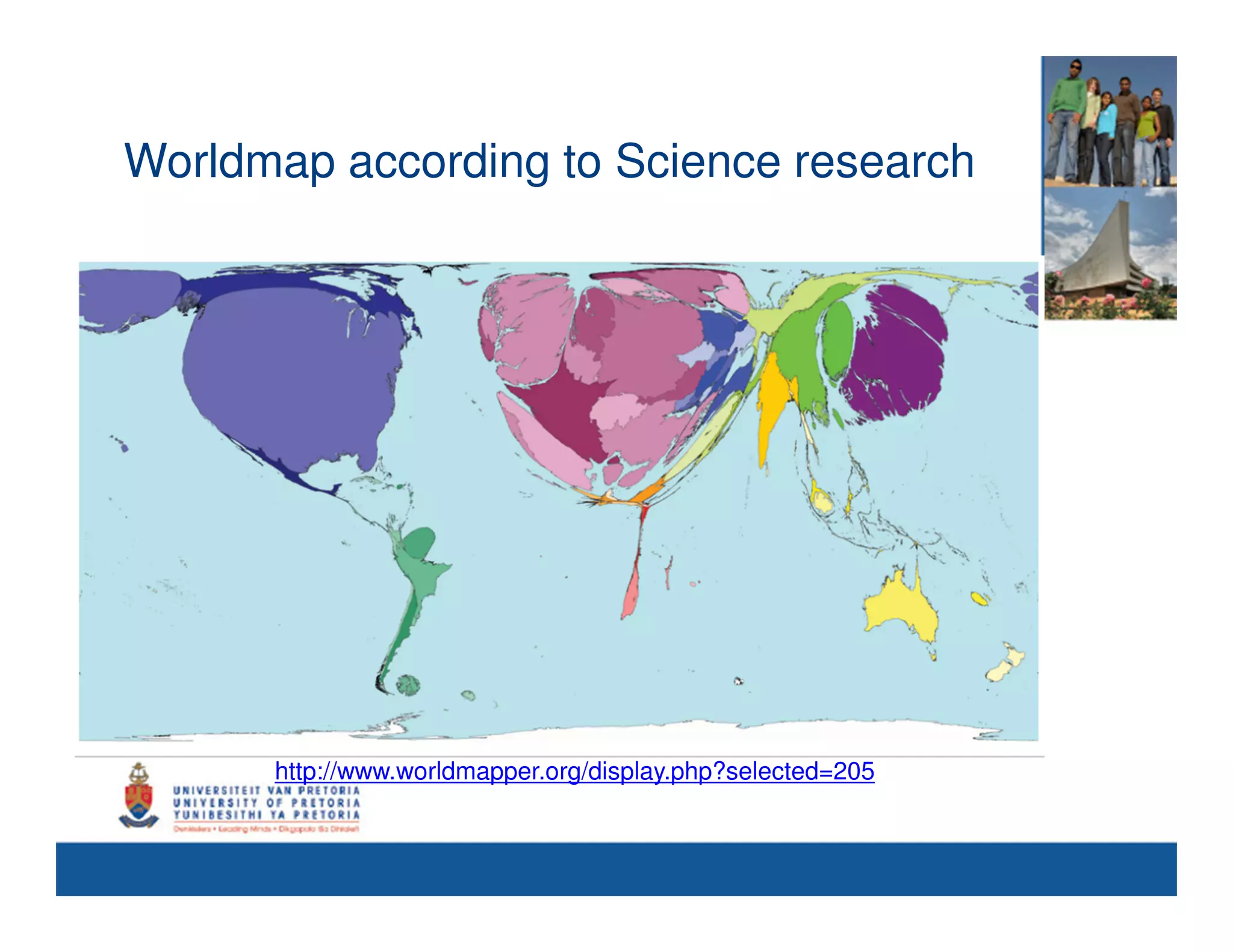
Worldmap according to Science research


      http://www.worldmapper.org/display.php?selected=205
Internet has changed our lives…

 Internet has brought about phenomenal changes
    Communication
    Management of tasks such as reservation of flights, movies,
    banking
    Information at your fingertips…or not?
Paying for online access…

             E35/R378/$49


                            E13/R149/$19- one day
The costs of the “Big deal”/online access

  Big Deal is an online aggregation of journals that
  publishers offer as a one-price, one size fits all
  package (Frazier 2001)
  Libraries gain electronic access from large publishers
  in the form of bundled journals & licenses
  Problem?
     Contract are inflexible and varies
     Libraries are struggling with price increases
     Libraries are paying different prices for same subscriptions
  Result : libraries are considering cancelling contracts
British research Libraries say No!


                                                                  22 July 2011:
                                                                  Unless Elsevier & Wiley
                                                                  agree to reductions,
                                                                  Research Libraries UK will
                                                                  not sign the Big Deal.

 http://chronicle.com/blogs/wiredcampus/british-research-libraries-say-no-to-big-deal-serials-packages/32371
The demise of the Big Deal


                                             Reasons:
                                             • Global financial crisis
                                             • Rise of the Open Access
                                               movement


           http://poynder.blogspot.com/2011/03/demise-of-big-deal.html
So, what is Open Access?

The opinion of an expert:
  Open-access (OA) literature is digital, online, free of charge,
  and free of most copyright and licensing restrictions. What
  makes it possible is the internet and the consent of the
  author or copyright-holder.
  It is compatible with peer-review
  Open Access literature is not free to produce and the
  business models for paying the bills depend on how OA is
  delivered
  Peter Suber http://www.earlham.edu/~peters/fos/brief.htm
What is the Open Access movement?

 The Open Access movement is
   A global movement in academia
   Dedicated to sharing information for the common good
   Of importance to researchers, academics, librarians, funding
   agencies, government officials, publishers
 Open Access can be achieved by:
   Open Access archives or repositories (green route)
   Open Access journals (gold route)
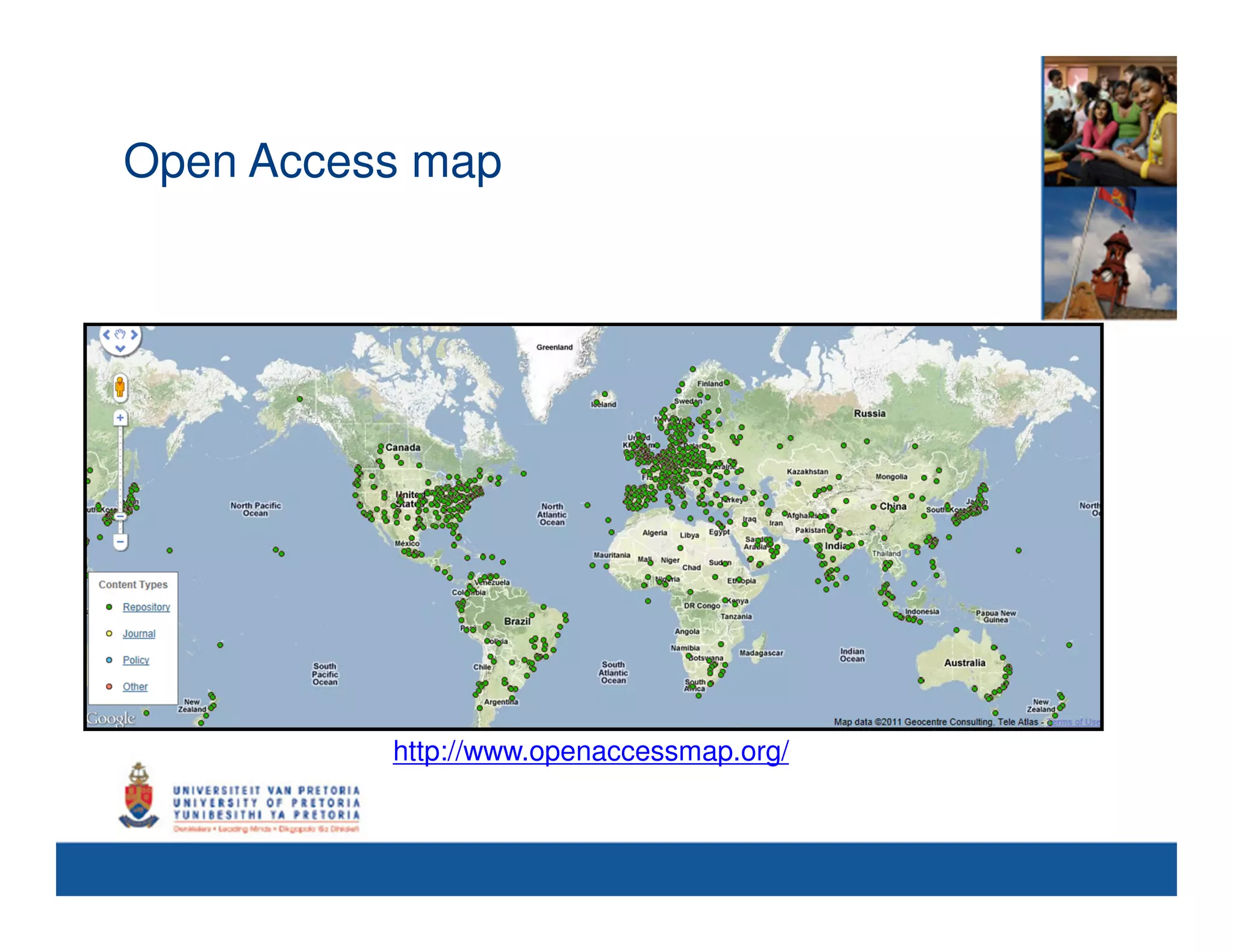
Open Access map


          http://www.openaccessmap.org/
Open Access archives/repositories (green
route)
 Archives/repositories
    Belong to an institution (universities, disciplines such as Physics,
    Economics
    Supplement publishing, it is not a substitution
    Do not perform peer review
    Internet users can easily find content, if repositories comply with
    the metadata harvesting protocol of the Open Archives Initiative
    Make scholarly content globally available
 A repository is a “critically important tool for managing a
 university’s image and impact on a global scale” (Alma
 Swan 2011)
Content of Open Access repositories

 Journal articles
    Preprints
    Postprints
    Final publisher’s version
 Scanned versions of formerly print only journals, such as
 HTS Teologiese Studies / Theological Studies
 Theses and dissertations
 Other material – grey material
 Datasets for the future
OpenDOAR : Directory of Open Access
Repositories

                               More than 2000
                               repositories, 50 in Africa,
                               24 in South Africa.


             http://opendoar.org/
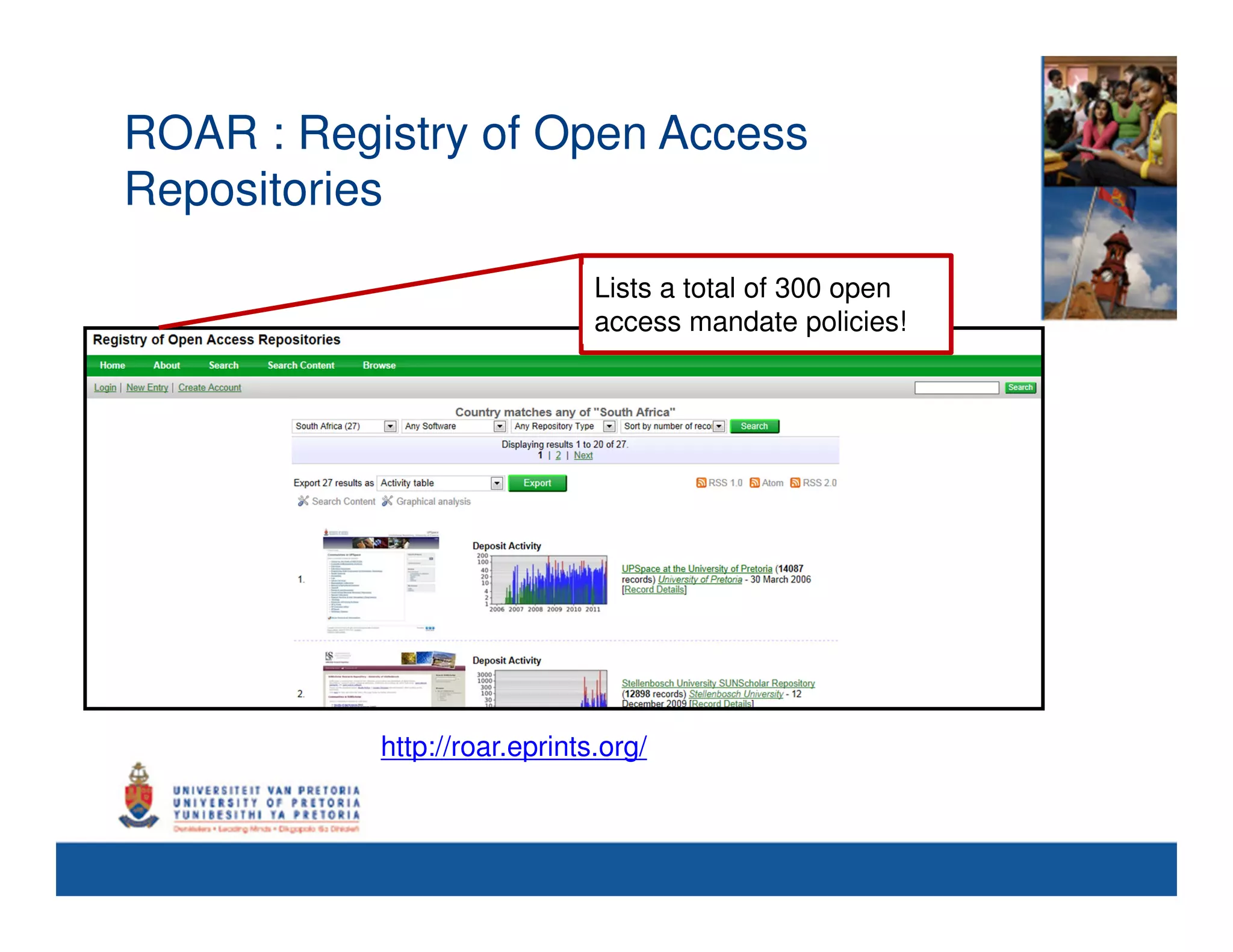
ROAR : Registry of Open Access
Repositories
                              Lists a total of 300 open
                              access mandate policies!


           http://roar.eprints.org/
University of Pretoria and Open Access

 University of Pretoria embraces Open Access
 movement
    it enhances the visibility and impact of an institution and its
    authors
    supports Open Access to research for all researchers
    worldwide
    takes responsibility for the dissemination of its research
    outputs
    realizes the value of archiving the staff and students’ research
    outputs in a repository thereby enabling global usage
Benefits of repositories

  Alma Swan (Swan 2011) identified the following
  benefits for institutions:
    It opens up the institution’s output for the whole world
    Maximizes the visibility and impact of these outputs
    Showcases the output to prospective staff, students,
    funders and other stakeholders
    Collects, curates and preserves the institution’s intellectual
    output
    Manages and measures research
UPSpace


                                    Collection of UP scholarly
                                    research articles – 6501
                                    items. Mandatory policy
                                    since 2009.


          http://repository.up.ac.za/
UPeTD


                                    Most used repository in
                                    Africa! Current total is
                                    6758 items.


        http://upetd.up.ac.za/UPeTD.htm
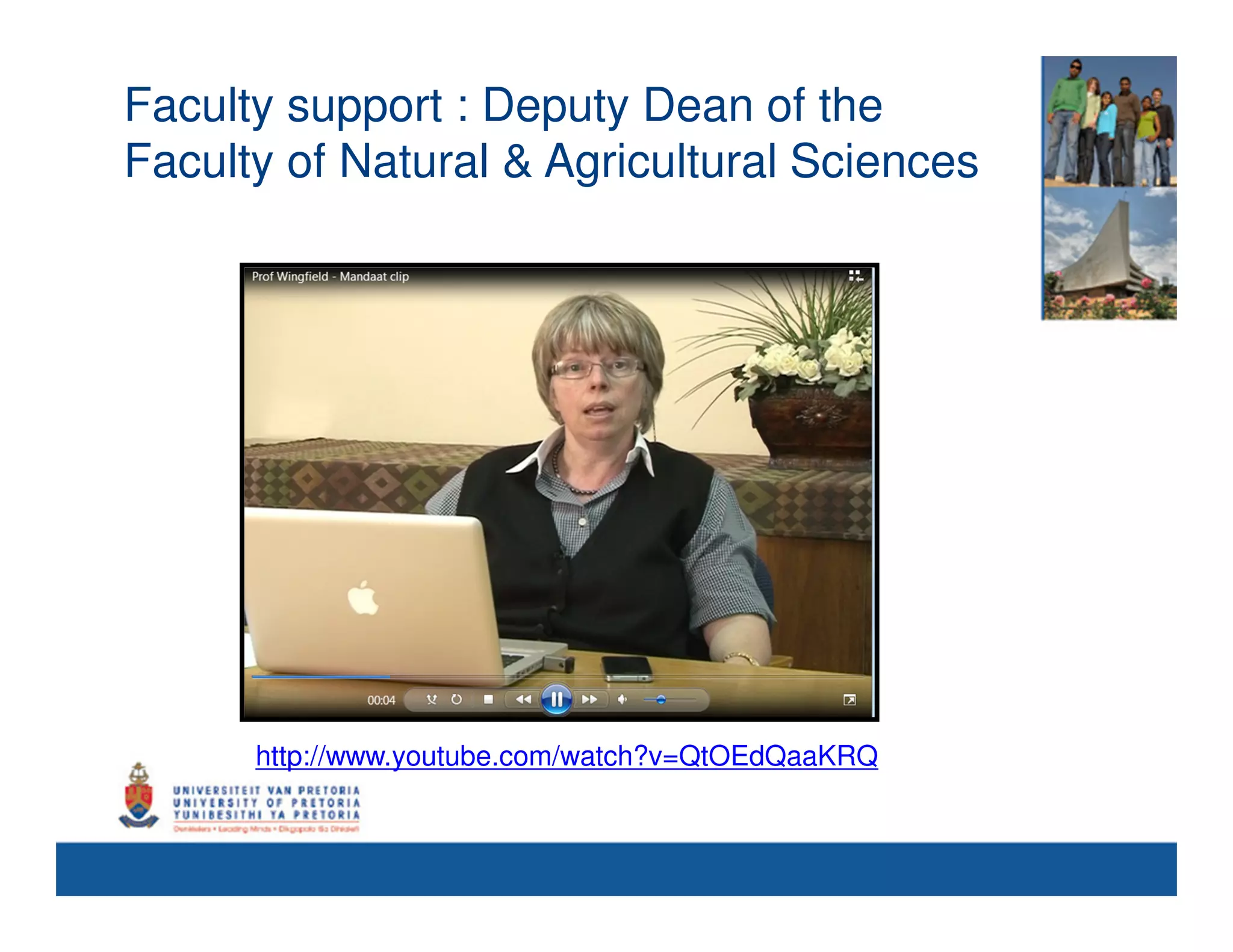
Faculty support : Deputy Dean of the
Faculty of Natural & Agricultural Sciences


      http://www.youtube.com/watch?v=QtOEdQaaKRQ
Open Access Journals (gold route)

 Research articles are peer reviewed and contents
 are made freely available
 Business model
    Some journals receive subsidy from hosting
    university/professional society
    Some require processing fees from authors
 Major Open Access publishers
    BioMed Central
    Hindawi
    AOSIS
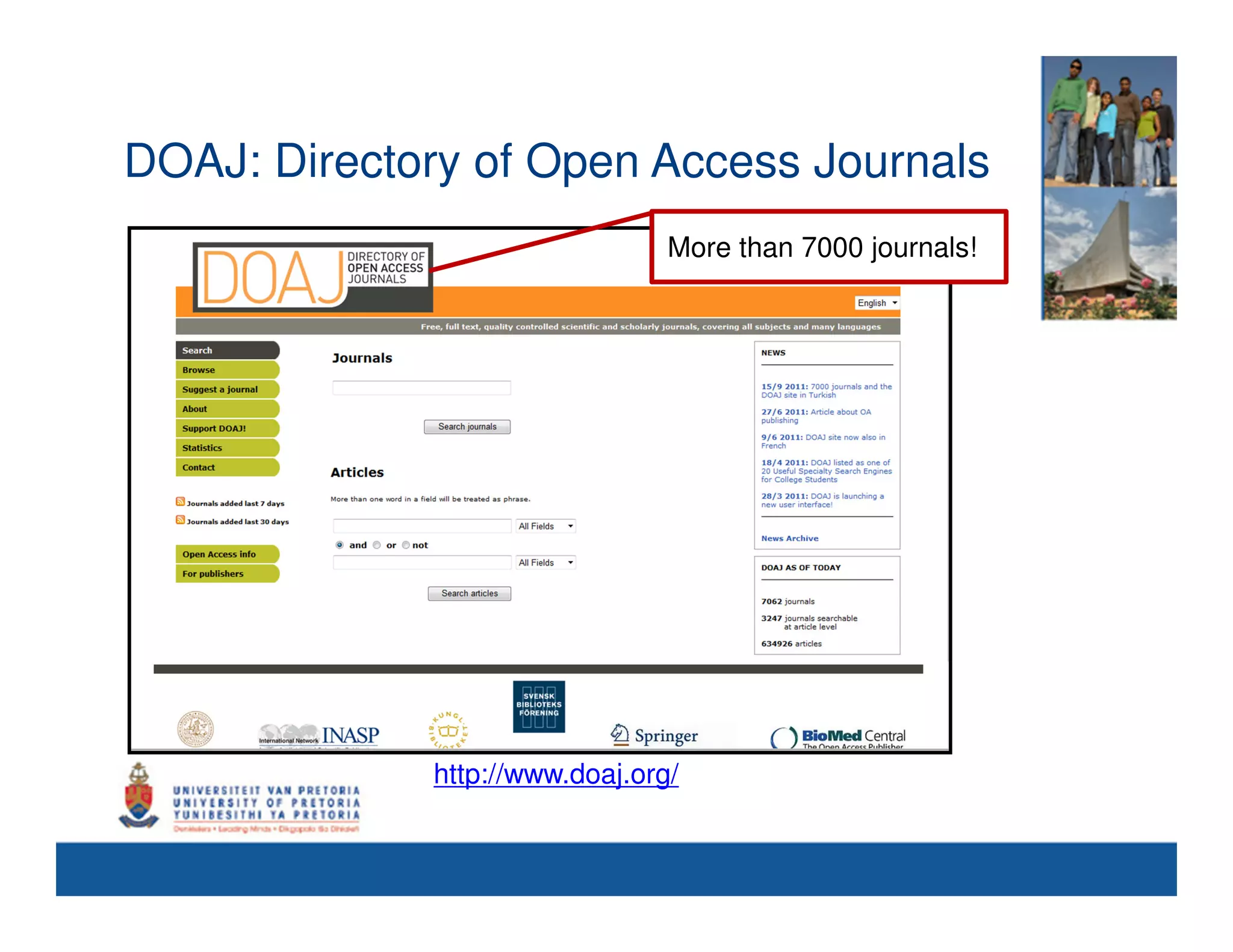
DOAJ: Directory of Open Access Journals
                                More than 7000 journals!


             http://www.doaj.org/
Accredited Open Access Journal list –
hosted by the University of Pretoria


             http://www.library.up.ac.za/aoajsa.htm
Copyright

 Open Access archives or repositories (green route)
    Traditionally authors sign Copyright Transfer Agreement
    Authors retain certain rights to re-use
    SHERPA/RoMEO website
    64% of 1022 publishers allow some form of self-archiving (36%) not
        8% allows archiving of the pre-print
        30% allows archiving of the post-print
        26% allows archiving of the pre-print and post-print

 Open Access journals (gold route)
    Creative Commons licenses
    Creator of the work is acknowledged
    Ensures re-use
SHERPA/RoMEO


                        Check your journal’s
                        archiving policy


         http://www.sherpa.ac.uk/romeo/
Creative commons license
What can universities & administrators do?

 Adopt an Open Access policy
    Open-Access repository
        Theses & dissertations
        Encourage researchers to self-archive their research articles
    Encourage researchers to maintain copyright or retain the right
    to self-archive
    Encourage the publication in Open Access journals
    Provide financial support for Open Access journal publication
    Journals hosted by your university should be made Open
    Access
    Conference proceedings of your university should be Open
    Access
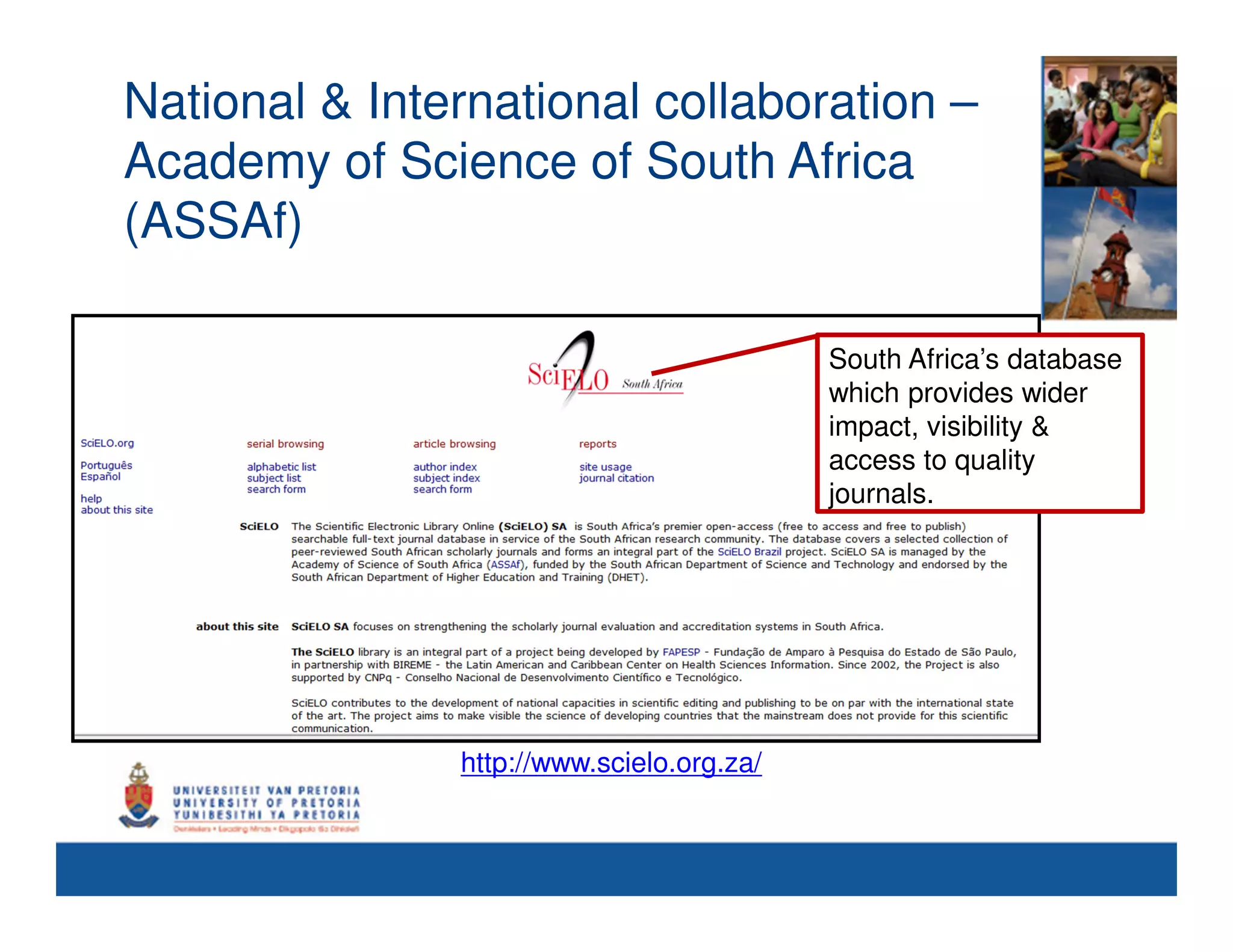
National & International collaboration –
Academy of Science of South Africa
(ASSAf)

                                           South Africa’s database
                                           which provides wider
                                           impact, visibility &
                                                       So
                                           access to quality
                                           journals.


               http://www.scielo.org.za/
National & International collaboration –
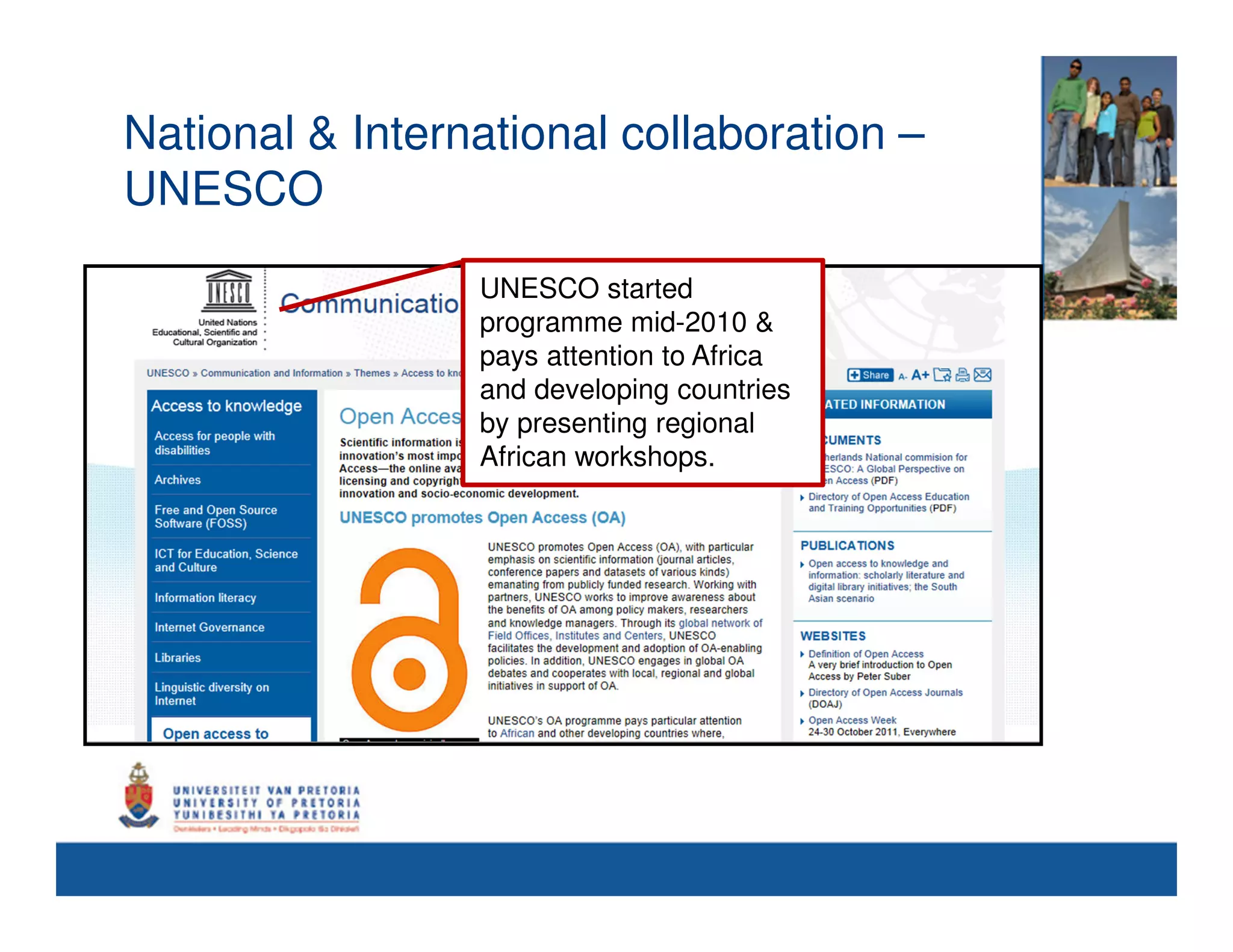
UNESCO
                 UNESCO started
                 programme mid-2010 &
                 pays attention to Africa
                             So
                 and developing countries
                 by presenting regional
                 African workshops.
National & International collaboration –
EIFL
                 EIFL is an international non-
                 profit organization enabling
                 access to knowledge in
                                So
                 developing countries by
                 awareness-raising events &
                 workshops.
African Journal Archive – retrospective OA
project of full-text to African journals


    http://www.sabinet.co.za/?page=african-journal-archive
Conclusion

 Readership of African research is reduced due to
 excessively expensive online subscriptions
 Open Access provides a solution to make research articles
 freely accessible online
 “OA is a vital means of dissemination of information which
 is crucial for national development and in achieving MDGs,
 given the crucial role that information plays in achieving
 social, economic, cultural and political development.”
 Professor Frank Youngman, DVC, University of Botswana
 BUT, we need the buy-in of everybody on the continent to
 change the face of African research
References

1.   Dlamini, H 2011 “UNESCO’s Open Access (OA) Strategy”
     http://www.slideshare.net/BioMedCentral/unescos-open-access-strategy
2.   Frazier, K 2001 “The librarians dilemma”, D-Lib Magazine, vol. 7, no. 3.
     http://www.dlib.org/dlib/march01/frazier/03frazier.html
3.   Open Access Movement, Wikipedia, http://en.wikipedia.org/wiki/Open_Access_movement
4.   Pool, R 2010 “Big-deal packages squeeze recession-hit libraries”, Research Information,
     June/July. http://www.researchinformation.info/features/feature.php?feature_id=269
5.   Pouris, A 2010 “'A scientometric assessment of the Southern Africa Development Community :
     science in the tip of Africa', Scientometrics, vol. 85, no 1, pp. 145-154.
     http://hdl.handle.net/2263/14657
6.   Poynder, R 2011 “The demise of the Big deal?”, Open and Shut?, March 14,
     http://poynder.blogspot.com/2011/03/demise-of-big-deal.html
7.   Swan, A. 2011. Business issues for institutional repositories: a briefing paper. OASIS, available
     at: http://www.openscholarship.org/upload/docs/application/pdf/2009-
     09/business_issues_for_irs.pdf
8.   What universities and administrators can do to promote Open Access,
     http://api.ning.com/files/eCaaveOCUKkaZKIserrmeINSAzUoFE9lJtNV*N5lD8lDVBTnIKVMzfXuB
     3gS7cm6SONOekb7otpJzULpOp0ZotSK-Il8bCIK/WhatUniversitiesandAdminCanDo.pdf
Thank you!
              Questions?

               Elsabé Olivier
     elsabe.olivier@up.ac.za


The presentation is licensed with Creative
Commons Attribution 3.0 License

Olivier opening(2011)

  • 1.
    Opening Access toresearch : an African perspective Elsabé Olivier Presented at the ICT in Higher Education Conference, 25 October, Johannesburg
  • 2.
    Contents Research inAfrica Access to information Institutional repositories Open Access Journals Copyright issues International collaboration
  • 3.
    Research in Africa South Africa is responsible for • 79% of the publications • 0.55% of the world’s literature • India produces 2.94% of the world’s literature Africa • Is least able to pay for access to information • Will benefit greatly from Open Access
  • 4.
    Worldmap according topoverty http://www.worldmapper.org/display.php?selected=179
  • 5.
    Worldmap according toScience research http://www.worldmapper.org/display.php?selected=205
  • 6.
    Internet has changedour lives… Internet has brought about phenomenal changes Communication Management of tasks such as reservation of flights, movies, banking Information at your fingertips…or not?
  • 7.
    Paying for onlineaccess… E35/R378/$49 E13/R149/$19- one day
  • 8.
    The costs ofthe “Big deal”/online access Big Deal is an online aggregation of journals that publishers offer as a one-price, one size fits all package (Frazier 2001) Libraries gain electronic access from large publishers in the form of bundled journals & licenses Problem? Contract are inflexible and varies Libraries are struggling with price increases Libraries are paying different prices for same subscriptions Result : libraries are considering cancelling contracts
  • 9.
    British research Librariessay No! 22 July 2011: Unless Elsevier & Wiley agree to reductions, Research Libraries UK will not sign the Big Deal. http://chronicle.com/blogs/wiredcampus/british-research-libraries-say-no-to-big-deal-serials-packages/32371
  • 10.
    The demise ofthe Big Deal Reasons: • Global financial crisis • Rise of the Open Access movement http://poynder.blogspot.com/2011/03/demise-of-big-deal.html
  • 11.
    So, what isOpen Access? The opinion of an expert: Open-access (OA) literature is digital, online, free of charge, and free of most copyright and licensing restrictions. What makes it possible is the internet and the consent of the author or copyright-holder. It is compatible with peer-review Open Access literature is not free to produce and the business models for paying the bills depend on how OA is delivered Peter Suber http://www.earlham.edu/~peters/fos/brief.htm
  • 12.
    What is theOpen Access movement? The Open Access movement is A global movement in academia Dedicated to sharing information for the common good Of importance to researchers, academics, librarians, funding agencies, government officials, publishers Open Access can be achieved by: Open Access archives or repositories (green route) Open Access journals (gold route)
  • 13.
    Open Access map http://www.openaccessmap.org/
  • 14.
    Open Access archives/repositories(green route) Archives/repositories Belong to an institution (universities, disciplines such as Physics, Economics Supplement publishing, it is not a substitution Do not perform peer review Internet users can easily find content, if repositories comply with the metadata harvesting protocol of the Open Archives Initiative Make scholarly content globally available A repository is a “critically important tool for managing a university’s image and impact on a global scale” (Alma Swan 2011)
  • 15.
    Content of OpenAccess repositories Journal articles Preprints Postprints Final publisher’s version Scanned versions of formerly print only journals, such as HTS Teologiese Studies / Theological Studies Theses and dissertations Other material – grey material Datasets for the future
  • 16.
    OpenDOAR : Directoryof Open Access Repositories More than 2000 repositories, 50 in Africa, 24 in South Africa. http://opendoar.org/
  • 17.
    ROAR : Registryof Open Access Repositories Lists a total of 300 open access mandate policies! http://roar.eprints.org/
  • 18.
    University of Pretoriaand Open Access University of Pretoria embraces Open Access movement it enhances the visibility and impact of an institution and its authors supports Open Access to research for all researchers worldwide takes responsibility for the dissemination of its research outputs realizes the value of archiving the staff and students’ research outputs in a repository thereby enabling global usage
  • 19.
    Benefits of repositories Alma Swan (Swan 2011) identified the following benefits for institutions: It opens up the institution’s output for the whole world Maximizes the visibility and impact of these outputs Showcases the output to prospective staff, students, funders and other stakeholders Collects, curates and preserves the institution’s intellectual output Manages and measures research
  • 20.
    UPSpace Collection of UP scholarly research articles – 6501 items. Mandatory policy since 2009. http://repository.up.ac.za/
  • 21.
    UPeTD Most used repository in Africa! Current total is 6758 items. http://upetd.up.ac.za/UPeTD.htm
  • 22.
    Faculty support :Deputy Dean of the Faculty of Natural & Agricultural Sciences http://www.youtube.com/watch?v=QtOEdQaaKRQ
  • 23.
    Open Access Journals(gold route) Research articles are peer reviewed and contents are made freely available Business model Some journals receive subsidy from hosting university/professional society Some require processing fees from authors Major Open Access publishers BioMed Central Hindawi AOSIS
  • 24.
    DOAJ: Directory ofOpen Access Journals More than 7000 journals! http://www.doaj.org/
  • 25.
    Accredited Open AccessJournal list – hosted by the University of Pretoria http://www.library.up.ac.za/aoajsa.htm
  • 26.
    Copyright Open Accessarchives or repositories (green route) Traditionally authors sign Copyright Transfer Agreement Authors retain certain rights to re-use SHERPA/RoMEO website 64% of 1022 publishers allow some form of self-archiving (36%) not 8% allows archiving of the pre-print 30% allows archiving of the post-print 26% allows archiving of the pre-print and post-print Open Access journals (gold route) Creative Commons licenses Creator of the work is acknowledged Ensures re-use
  • 27.
    SHERPA/RoMEO Check your journal’s archiving policy http://www.sherpa.ac.uk/romeo/
  • 28.
  • 29.
    What can universities& administrators do? Adopt an Open Access policy Open-Access repository Theses & dissertations Encourage researchers to self-archive their research articles Encourage researchers to maintain copyright or retain the right to self-archive Encourage the publication in Open Access journals Provide financial support for Open Access journal publication Journals hosted by your university should be made Open Access Conference proceedings of your university should be Open Access
  • 30.
    National & Internationalcollaboration – Academy of Science of South Africa (ASSAf) South Africa’s database which provides wider impact, visibility & So access to quality journals. http://www.scielo.org.za/
  • 31.
    National & Internationalcollaboration – UNESCO UNESCO started programme mid-2010 & pays attention to Africa So and developing countries by presenting regional African workshops.
  • 32.
    National & Internationalcollaboration – EIFL EIFL is an international non- profit organization enabling access to knowledge in So developing countries by awareness-raising events & workshops.
  • 33.
    African Journal Archive– retrospective OA project of full-text to African journals http://www.sabinet.co.za/?page=african-journal-archive
  • 34.
    Conclusion Readership ofAfrican research is reduced due to excessively expensive online subscriptions Open Access provides a solution to make research articles freely accessible online “OA is a vital means of dissemination of information which is crucial for national development and in achieving MDGs, given the crucial role that information plays in achieving social, economic, cultural and political development.” Professor Frank Youngman, DVC, University of Botswana BUT, we need the buy-in of everybody on the continent to change the face of African research
  • 35.
    References 1. Dlamini, H 2011 “UNESCO’s Open Access (OA) Strategy” http://www.slideshare.net/BioMedCentral/unescos-open-access-strategy 2. Frazier, K 2001 “The librarians dilemma”, D-Lib Magazine, vol. 7, no. 3. http://www.dlib.org/dlib/march01/frazier/03frazier.html 3. Open Access Movement, Wikipedia, http://en.wikipedia.org/wiki/Open_Access_movement 4. Pool, R 2010 “Big-deal packages squeeze recession-hit libraries”, Research Information, June/July. http://www.researchinformation.info/features/feature.php?feature_id=269 5. Pouris, A 2010 “'A scientometric assessment of the Southern Africa Development Community : science in the tip of Africa', Scientometrics, vol. 85, no 1, pp. 145-154. http://hdl.handle.net/2263/14657 6. Poynder, R 2011 “The demise of the Big deal?”, Open and Shut?, March 14, http://poynder.blogspot.com/2011/03/demise-of-big-deal.html 7. Swan, A. 2011. Business issues for institutional repositories: a briefing paper. OASIS, available at: http://www.openscholarship.org/upload/docs/application/pdf/2009- 09/business_issues_for_irs.pdf 8. What universities and administrators can do to promote Open Access, http://api.ning.com/files/eCaaveOCUKkaZKIserrmeINSAzUoFE9lJtNV*N5lD8lDVBTnIKVMzfXuB 3gS7cm6SONOekb7otpJzULpOp0ZotSK-Il8bCIK/WhatUniversitiesandAdminCanDo.pdf
  • 36.
    Thank you! Questions? Elsabé Olivier elsabe.olivier@up.ac.za The presentation is licensed with Creative Commons Attribution 3.0 License