Welcome To Kindergarten!
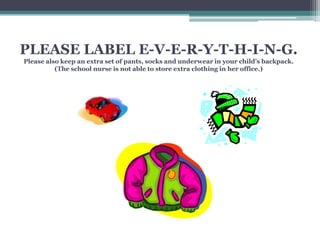
PLEASE LABEL E-V-E-R-Y-T-H-I-N-G.
Please also keep an extra set of pants, socks and underwear in your child’s backpack.
(The school nurse is not able to store extra clothing in her office.)
PLEASE SEND IN ONE, SMALL, HEALTHY SNACK AND ONE HEALTHY DRINK EACH
DAY. SOME STUDENTS ARE STILL CONFUSED ABOUT LUNCH VS SNACK.
PLEASE PROVIDE STRAWS, NAPKINS, AND UTENSILS, IF THEY ARE NEEDED.
PLEASE SEND SNACK ITEMS THAT ARE EASILY OPENED BY YOUR CHILD.
PUDDING CUPS, JUICE POUCHES AND SMALL FRUIT CUPS ARE ESPECIALLY
DIFFICULT FOR MOST YOUNG CHILDREN TO MANAGE, INDEPENDENTLY.
THE BOARD OF EDUCATION WELLNESS POLICY:
Healthful party menus and nonfood alternatives for celebrations will be encouraged.
Healthful snacks in appropriate portions will be encouraged. Students and staff will
be encouraged to wash their hands prior to mealtime.
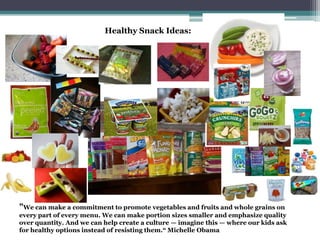
Healthy Snack Ideas:
"We can make a commitment to promote vegetables and fruits and whole grains on
every part of every menu. We can make portion sizes smaller and emphasize quality
over quantity. And we can help create a culture — imagine this — where our kids ask
for healthy options instead of resisting them.“ Michelle Obama
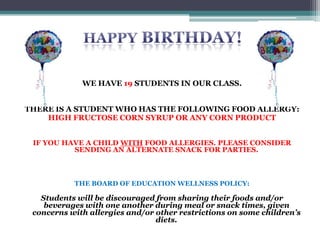
WE HAVE 17 STUDENTS IN OUR CLASS.
IF YOU HAVE A CHILD WITH FOOD ALLERGIES OR A SPECIAL
DIET, PLEASE CONSIDER SENDING AN ALTERNATE SNACK
JUST IN CASE THERE
THE BOARD OF EDUCATION WELLNESS POLICY:
Students will be discouraged from sharing their foods and/or
beverages with one another during meal or snack times,
given concerns with allergies and/or other restrictions on
some children's diets.
Non-Food Birthday Treat Ideas
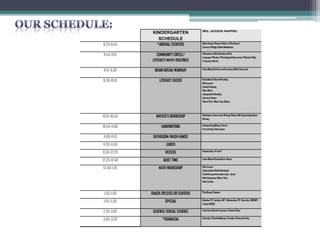
Arrival/IndependentReading
8:25-8:45
Announcements/MorningMeeting/MathRoutines
8:45-9:05
Reader’sWorkshop
9:05-10:35
PrepareForLunch
10:40-10:50
Lunch
10:55-11:25
Special
11:30-12:10
MathWorkshop
12:15-12:55
QuietTime/Snack
1:00-1:20
Yoga/MindfulnessAsNeeded
Writer’sWorkshop
1:20-1:50
Recess
2:00-2:25
Science/SocialStudies
2:30-3:00
CleanUp/Pack Up/Dismissal
3:00-3:20
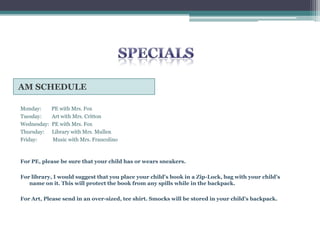
SCHEDULE
Monday: Art with Mr. Zilinski
Tuesday: PE with Mrs. Fox
Wednesday: PE with Mrs. Fox
Thursday: Music with Mrs. Francolino (Mr. Maki is Mrs. Francolino’s substitute.)
Friday: Library with Mrs. Addesso
For PE, please be sure that your child has or wears sneakers.
For library, I would suggest that you place your child’s book in a Zip-Lock, bag with your child’s
name on it. This will protect the book from any spills while in the backpack.
“

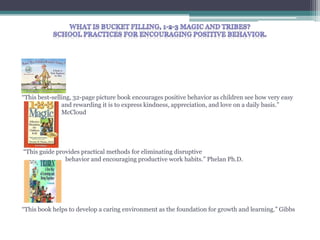
“This best-selling, 32-page picture book encourages positive behavior as children see how very easy
and rewarding it is to express kindness, appreciation, and love on a daily basis.”
McCloud
“This guide provides practical methods for eliminating disruptive
behavior and encouraging productive work habits.” Phelan Ph.D.
“This book helps to develop a caring environment as the foundation for growth and learning.” Gibbs
LINKS/FUN FRIDAY:
We have begun a program to support children as they learn about all of
the important, school behaviors, which will prepare them to be successful
and engaged learners.
All students begin the week with three links. Links are earned for
expected school behaviors. Links can also be lost. I am modeling and
shaping the expected behaviors, all of the time. At the end of the week,
children who have earned enough links will have the opportunity to have
Fun Friday and play a class game. If you have not earned enough links, you
will have extra time to practice academic skills. For students who have
earned a large amount of links, there is a drawing for a prize from the
prize box. Certificates are sent home with students who have earned a
large number of links, each week.
Please be cautious not to expect that your child will only earn links. It is
expected that mistakes will be made, as children are learning. Reminders
will be a part of this system, at the beginning of the year. This system
helps children begin to better monitor their own behavior. Some parents
use a similar system at home ;).
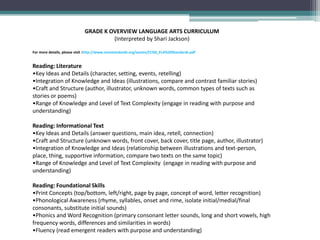
GRADE K OVERVIEW LANGUAGE ARTS CURRICULUM
(Interpreted by Shari Jackson)
For more details, please visit :http://www.corestandards.org/assets/CCSSI_ELA%20Standards.pdf
Reading: Literature
•Key Ideas and Details (character, setting, events, retelling)
•Integration of Knowledge and Ideas (illustrations, compare and contrast familiar stories)
•Craft and Structure (author, illustrator, unknown words, common types of texts such as
stories or poems)
•Range of Knowledge and Level of Text Complexity (engage in reading with purpose and
understanding)
Reading: Informational Text
•Key Ideas and Details (answer questions, main idea, retell, connection)
•Craft and Structure (unknown words, front cover, back cover, title page, author, illustrator)
•Integration of Knowledge and Ideas (relationship between illustrations and text-person,
place, thing, supportive information, compare two texts on the same topic)
•Range of Knowledge and Level of Text Complexity (engage in reading with purpose and
understanding)
Reading: Foundational Skills
•Print Concepts (top/bottom, left/right, page by page, concept of word, letter recognition)
•Phonological Awareness (rhyme, syllables, onset and rime, isolate initial/medial/final
consonants, substitute initial sounds)
•Phonics and Word Recognition (primary consonant letter sounds, long and short vowels, high
frequency words, differences and similarities in words)
•Fluency (read emergent readers with purpose and understanding)
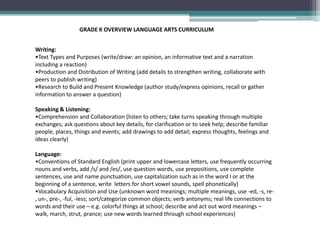
Writing:
•Text Types and Purposes (write/draw: an opinion, an informative text and a narration
including a reaction)
•Production and Distribution of Writing (add details to strengthen writing, collaborate with
peers to publish writing)
•Research to Build and Present Knowledge (author study/express opinions, recall or gather
information to answer a question)
Speaking & Listening:
•Comprehension and Collaboration (listen to others; take turns speaking through multiple
exchanges; ask questions about key details, for clarification or to seek help; describe familiar
people, places, things and events; add drawings to add detail; express thoughts, feelings and
ideas clearly)
Language:
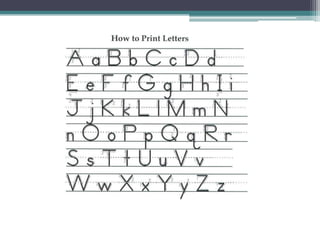
•Conventions of Standard English (print upper and lowercase letters, use frequently occurring
nouns and verbs, add /s/ and /es/, use question words, use prepositions, use complete
sentences, use and name punctuation, use capitalization such as in the word I or at the
beginning of a sentence, write letters for short vowel sounds, spell phonetically)
•Vocabulary Acquisition and Use (unknown word meanings; multiple meanings, use -ed, -s, re-
, un-, pre-, -ful, -less; sort/categorize common objects; verb antonyms; real life connections to
words and their use – e.g. colorful things at school; describe and act out word meanings –
walk, march, strut, prance; use new words learned through school experiences)
GRADE K OVERVIEW LANGUAGE ARTS CURRICULUM
Created by: Mrs. Colwell McKinney-TX
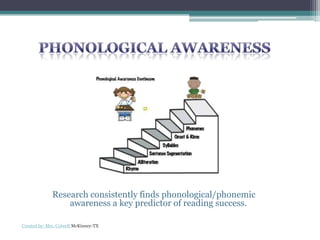
Research consistently finds phonological/phonemic
awareness a key predictor of reading success.
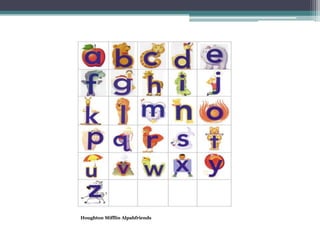
Fundations Key Words
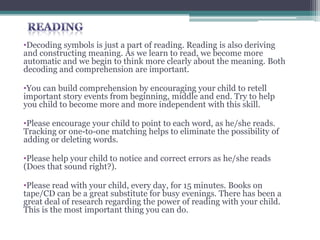
•Decoding symbols is just a part of reading. Reading is also
deriving and constructing meaning. As we learn to read, we
become more automatic and we begin to think more clearly about the
meaning. Both decoding and comprehension are important.
•You can build comprehension by encouraging your child to
retell important story events from beginning, middle and
end. Try to help you child to become more and more independent
with this skill.
•Please encourage your child to point to each word, as
he/she reads. Tracking or one-to-one matching helps to eliminate
the possibility of adding or deleting words.
•Please help your child to notice and correct errors as he/she
reads (Does that sound right?).
•Please read with your child, every day, for 15 minutes. Books
on tape/CD can be a great substitute for busy evenings. There has been
a great deal of research regarding the power of reading with your child.
This is the most important thing you can do.
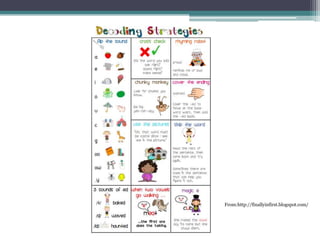
From:http://finallyinfirst.blogspot.com/
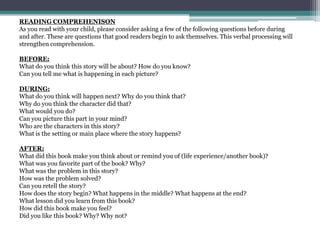
READING COMPREHENISON
As you read with your child, please consider asking a few of the following questions before during
and after. These are questions that good readers begin to ask themselves. This verbal processing will
strengthen comprehension.
BEFORE:
What do you think this story will be about? How do you know?
Can you tell me what is happening in each picture?
DURING:
What do you think will happen next? Why do you think that?
Why do you think the character did that?
What would you do?
Can you picture this part in your mind?
Who are the characters in this story?
What is the setting or main place where the story happens?
AFTER:
What did this book make you think about or remind you of (life experience/another book)?
What was you favorite part of the book? Why?
What was the problem in this story?
How was the problem solved?
Can you retell the story?
How does the story begin? What happens in the middle? What happens at the end?
What lesson did you learn from this book?
How did this book make you feel?
Did you like this book? Why? Why not?
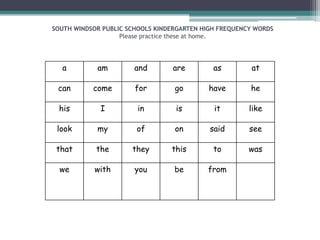
KINDERGARTEN HIGH FREQUENCY WORDS
Please practice these at home.
LIST 1 LIST 2 LIST 3 LIST 4 LIST 5 LIST 6
I the in of you if
like a was is it that
to with on what for he
can my by go are as
you little said him his be
we play she went they from
up our at not
some then have or
us but had
out your one
how words
their all
and were
there when
see do
her use
want an
out each
come which
them am
look
these
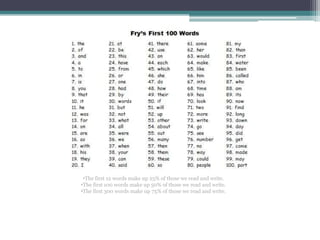
•The first 12 words make up 25% of those we read and write.
•The first 100 words make up 50% of those we read and write.
•The first 300 words make up 75% of those we read and write.
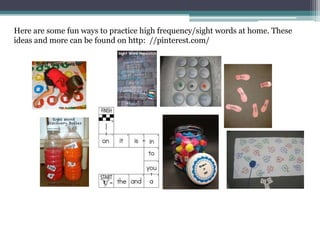
Here are some fun ways to practice high frequency/sight words at home. These
ideas and more can be found on http: //pinterest.com/
$20.00
My Online
Ordering CodeIs:
FZYFD
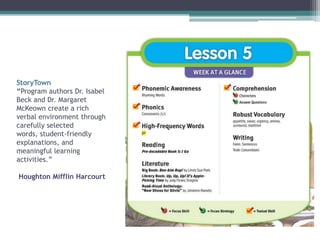
Wilson Fundations is a
phonological/phonemic awareness,
phonics, handwriting and spelling
program. Fundations lessons focus on
carefully sequenced skills that include print
knowledge, alphabet awareness,
phonological awareness, phonemic
awareness, decoding, vocabulary, fluency,
and spelling. Critical thinking, speaking
and listening skills are practiced.
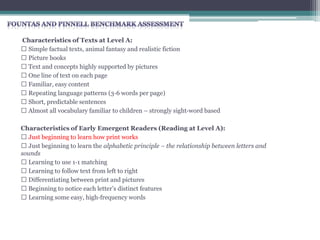
Characteristics of Texts at Level A:
Simple factual texts, animal fantasy and realistic fiction
Picture books
Text and concepts highly supported by pictures
One line of text on each page
Familiar, easy content
Repeating language patterns (3‐6 words per page)
Short, predictable sentences
Almost all vocabulary familiar to children – strongly sight‐word based
Characteristics of Early Emergent Readers (Reading at Level A):
Just beginning to learn how print works
Just beginning to learn the alphabetic principle – the relationship between letters and
sounds
Learning to use 1‐1 matching
Learning to follow text from left to right
Differentiating between print and pictures
Beginning to notice each letter’s distinct features
Learning some easy, high‐frequency words
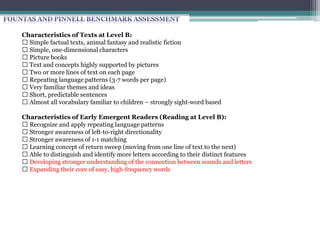
Characteristics of Texts at Level B:
Simple factual texts, animal fantasy and realistic fiction
Simple, one‐dimensional characters
Picture books
Text and concepts highly supported by pictures
Two or more lines of text on each page
Repeating language patterns (3‐7 words per page)
Very familiar themes and ideas
Short, predictable sentences
Almost all vocabulary familiar to children – strongly sight‐word based
Characteristics of Early Emergent Readers (Reading at Level B):
Recognize and apply repeating language patterns
Stronger awareness of left‐to‐right directionality
Stronger awareness of 1‐1 matching
Learning concept of return sweep (moving from one line of text to the next)
Able to distinguish and identify more letters according to their distinct features
Developing stronger understanding of the connection between sounds and letters
Expanding their core of easy, high‐frequency words
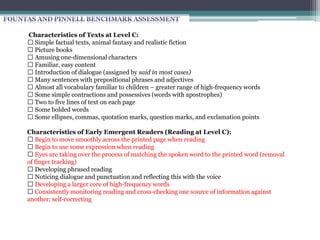
Characteristics of Texts at Level C:
Simple factual texts, animal fantasy and realistic fiction
Picture books
Amusing one‐dimensional characters
Familiar, easy content
Introduction of dialogue (assigned by said in most cases)
Many sentences with prepositional phrases and adjectives
Almost all vocabulary familiar to children – greater range of high‐frequency words
Some simple contractions and possessives (words with apostrophes)
Two to five lines of text on each page
Some bolded words
Some ellipses, commas, quotation marks, question marks, and exclamation points
Characteristics of Early Emergent Readers (Reading at Level C):
Begin to move smoothly across the printed page when reading
Begin to use some expression when reading
Eyes are taking over the process of matching the spoken word to the printed word (removal
of finger tracking)
Developing phrased reading
Noticing dialogue and punctuation and reflecting this with the voice
Developing a larger core of high‐frequency words
Consistently monitoring reading and cross‐checking one source of information against
another; self‐correcting
Characteristics of Texts at Level D:
Simple factual texts, animal fantasy and realistic fiction
Picture books
Amusing one‐dimensional characters
Familiar, easy content, themes, and ideas
Simple dialogue (some split dialogue)
Many sentences with prepositional phrases and adjectives
Some longer sentences (some with more than six words)
Some simple contractions and possessives (words with apostrophes)
Two to six lines of text on each page
Some sentences turn over to the next line
Some words with –s and –ing endings
Fewer repetitive language patterns
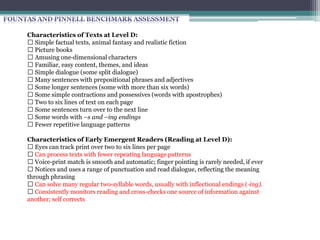
Characteristics of Early Emergent Readers (Reading at Level D):
Eyes can track print over two to six lines per page
Can process texts with fewer repeating language patterns
Voice‐print match is smooth and automatic; finger pointing is rarely needed, if ever
Notices and uses a range of punctuation and read dialogue, reflecting the meaning
through phrasing
Can solve many regular two‐syllable words, usually with inflectional endings (‐ing).
Consistently monitors reading and cross‐checks one source of information against
another; self corrects
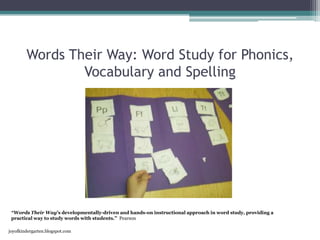
Words Their Way: Word Study for Phonics,
Vocabulary and Spelling
joyofkindergarten.blogspot.com
“Words Their Way’s developmentally-driven and hands-on instructional approach in word study, providing a
practical way to study words with students.” Pearson
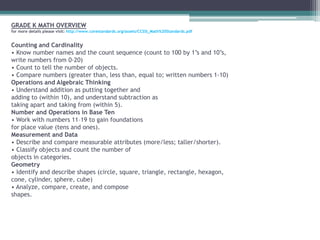
GRADE K MATH OVERVIEW
for more details please visit: http://www.corestandards.org/assets/CCSSI_Math%20Standards.pdf
Counting and Cardinality
• Know number names and the count sequence (count to 100 by 1’s and 10’s,
write numbers from 0-20)
• Count to tell the number of objects.
• Compare numbers (greater than, less than, equal to; written numbers 1-10)
Operations and Algebraic Thinking
• Understand addition as putting together and
adding to (within 10), and understand subtraction as
taking apart and taking from (within 5).
Number and Operations in Base Ten
• Work with numbers 11–19 to gain foundations
for place value (tens and ones).
Measurement and Data
• Describe and compare measurable attributes (more/less; taller/shorter).
• Classify objects and count the number of
objects in categories.
Geometry
• Identify and describe shapes (circle, square, triangle, rectangle, hexagon,
cone, cylinder, sphere, cube)
• Analyze, compare, create, and compose
shapes.
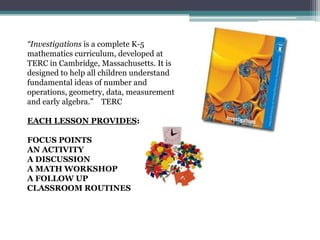
“Investigations is a complete K-5
mathematics curriculum, developed at
TERC in Cambridge, Massachusetts. It is
designed to help all children understand
fundamental ideas of number and
operations, geometry, data, measurement
and early algebra.” TERC
EACH LESSON PROVIDES:
FOCUS POINTS
AN ACTIVITY
A DISCUSSION
A MATH WORKSHOP
A FOLLOW UP
CLASSROOM ROUTINES
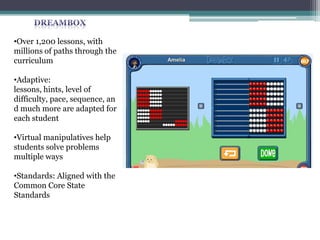
•Over 1,200 lessons, with
millions of paths through the
curriculum
•Adaptive: lessons, hints,
level of difficulty, pace,
sequence, and much more
are adapted for each student
•Virtual manipulatives help
students solve problems
multiple ways
•Standards: Aligned with the
Common Core State
Standards
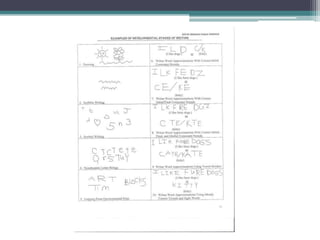
Text Types and Purposes:
CCSS.ELA-Literacy.W.K.3
Use a combination of drawing, dictating, and writing to narrate a single event or several loosely linked events, tell
about the events in the order in which they occurred, and provide a reaction to what happened.
CCSS.ELA-Literacy.W.K.2
Use a combination of drawing, dictating, and writing to compose informative/explanatory texts in which they
name what they are writing about and supply some information about the topic.
CCSS.ELA-Literacy.W.K.1
Use a combination of drawing, dictating, and writing to compose opinion pieces in which they tell a
reader the topic or the name of the book they are writing about and state an opinion or preference about the
topic or book (e.g., My favorite book is...).
Research to Build and Present Knowledge:
CCSS.ELA-Literacy.W.K.7
Participate in shared research and writing projects (e.g., explore a number of books by a
favorite author and express opinions about them).
CCSS.ELA-Literacy.W.K.8
With guidance and support from adults, recall information from experiences or gather information
from provided sources to answer a question.
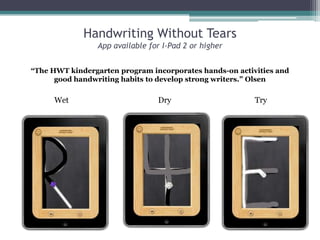
Handwriting Without Tears
App available for I-Pad 2 or higher
Wet Dry Try
“The HWT kindergarten program incorporates hands-on activities and
good handwriting habits to develop strong writers.” Olsen
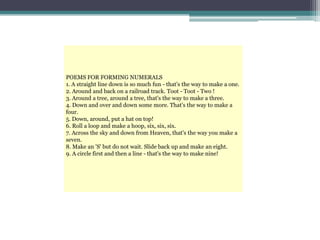
POEMS FOR FORMING NUMERALS
1. A straight line down is so much fun - that's the way to make a one.
2. Around and back on a railroad track. Toot - Toot - Two !
3. Around a tree, around a tree, that's the way to make a three.
4. Down and over and down some more. That's the way to make a
four.
5. Down, around, put a hat on top!
6. Roll a loop and make a hoop, six, six, six.
7. Across the sky and down from Heaven, that's the way you make a
seven.
8. Make an 'S' but do not wait. Slide back up and make an eight.
9. A circle first and then a line - that's the way to make nine!
Email:sjackson@swindsor.k12.ct.us
Phone: 860-648-5010 (EXT. 1955)
Website/Homework:
www.wappingkindergarten.weebly.com
Volunteers
Questions ???
Please collect materials.
Session Two Begins at 7:15. Thank you for coming!

Open House Wapping Elementary School

  • 1.
  • 2.
    PLEASE LABEL E-V-E-R-Y-T-H-I-N-G. Pleasealso keep an extra set of pants, socks and underwear in your child’s backpack. (The school nurse is not able to store extra clothing in her office.)
  • 3.
    PLEASE SEND INONE, SMALL, HEALTHY SNACK AND ONE HEALTHY DRINK EACH DAY. SOME STUDENTS ARE STILL CONFUSED ABOUT LUNCH VS SNACK. PLEASE PROVIDE STRAWS, NAPKINS, AND UTENSILS, IF THEY ARE NEEDED. PLEASE SEND SNACK ITEMS THAT ARE EASILY OPENED BY YOUR CHILD. PUDDING CUPS, JUICE POUCHES AND SMALL FRUIT CUPS ARE ESPECIALLY DIFFICULT FOR MOST YOUNG CHILDREN TO MANAGE, INDEPENDENTLY. THE BOARD OF EDUCATION WELLNESS POLICY: Healthful party menus and nonfood alternatives for celebrations will be encouraged. Healthful snacks in appropriate portions will be encouraged. Students and staff will be encouraged to wash their hands prior to mealtime.
  • 4.
    Healthy Snack Ideas: "Wecan make a commitment to promote vegetables and fruits and whole grains on every part of every menu. We can make portion sizes smaller and emphasize quality over quantity. And we can help create a culture — imagine this — where our kids ask for healthy options instead of resisting them.“ Michelle Obama
  • 5.
    WE HAVE 17STUDENTS IN OUR CLASS. IF YOU HAVE A CHILD WITH FOOD ALLERGIES OR A SPECIAL DIET, PLEASE CONSIDER SENDING AN ALTERNATE SNACK JUST IN CASE THERE THE BOARD OF EDUCATION WELLNESS POLICY: Students will be discouraged from sharing their foods and/or beverages with one another during meal or snack times, given concerns with allergies and/or other restrictions on some children's diets.
  • 6.
  • 7.
  • 8.
    SCHEDULE Monday: Art withMr. Zilinski Tuesday: PE with Mrs. Fox Wednesday: PE with Mrs. Fox Thursday: Music with Mrs. Francolino (Mr. Maki is Mrs. Francolino’s substitute.) Friday: Library with Mrs. Addesso For PE, please be sure that your child has or wears sneakers. For library, I would suggest that you place your child’s book in a Zip-Lock, bag with your child’s name on it. This will protect the book from any spills while in the backpack.
  • 9.
    “ “This best-selling, 32-pagepicture book encourages positive behavior as children see how very easy and rewarding it is to express kindness, appreciation, and love on a daily basis.” McCloud “This guide provides practical methods for eliminating disruptive behavior and encouraging productive work habits.” Phelan Ph.D. “This book helps to develop a caring environment as the foundation for growth and learning.” Gibbs
  • 10.
    LINKS/FUN FRIDAY: We havebegun a program to support children as they learn about all of the important, school behaviors, which will prepare them to be successful and engaged learners. All students begin the week with three links. Links are earned for expected school behaviors. Links can also be lost. I am modeling and shaping the expected behaviors, all of the time. At the end of the week, children who have earned enough links will have the opportunity to have Fun Friday and play a class game. If you have not earned enough links, you will have extra time to practice academic skills. For students who have earned a large amount of links, there is a drawing for a prize from the prize box. Certificates are sent home with students who have earned a large number of links, each week. Please be cautious not to expect that your child will only earn links. It is expected that mistakes will be made, as children are learning. Reminders will be a part of this system, at the beginning of the year. This system helps children begin to better monitor their own behavior. Some parents use a similar system at home ;).
  • 12.
    GRADE K OVERVIEWLANGUAGE ARTS CURRICULUM (Interpreted by Shari Jackson) For more details, please visit :http://www.corestandards.org/assets/CCSSI_ELA%20Standards.pdf Reading: Literature •Key Ideas and Details (character, setting, events, retelling) •Integration of Knowledge and Ideas (illustrations, compare and contrast familiar stories) •Craft and Structure (author, illustrator, unknown words, common types of texts such as stories or poems) •Range of Knowledge and Level of Text Complexity (engage in reading with purpose and understanding) Reading: Informational Text •Key Ideas and Details (answer questions, main idea, retell, connection) •Craft and Structure (unknown words, front cover, back cover, title page, author, illustrator) •Integration of Knowledge and Ideas (relationship between illustrations and text-person, place, thing, supportive information, compare two texts on the same topic) •Range of Knowledge and Level of Text Complexity (engage in reading with purpose and understanding) Reading: Foundational Skills •Print Concepts (top/bottom, left/right, page by page, concept of word, letter recognition) •Phonological Awareness (rhyme, syllables, onset and rime, isolate initial/medial/final consonants, substitute initial sounds) •Phonics and Word Recognition (primary consonant letter sounds, long and short vowels, high frequency words, differences and similarities in words) •Fluency (read emergent readers with purpose and understanding)
  • 13.
    Writing: •Text Types andPurposes (write/draw: an opinion, an informative text and a narration including a reaction) •Production and Distribution of Writing (add details to strengthen writing, collaborate with peers to publish writing) •Research to Build and Present Knowledge (author study/express opinions, recall or gather information to answer a question) Speaking & Listening: •Comprehension and Collaboration (listen to others; take turns speaking through multiple exchanges; ask questions about key details, for clarification or to seek help; describe familiar people, places, things and events; add drawings to add detail; express thoughts, feelings and ideas clearly) Language: •Conventions of Standard English (print upper and lowercase letters, use frequently occurring nouns and verbs, add /s/ and /es/, use question words, use prepositions, use complete sentences, use and name punctuation, use capitalization such as in the word I or at the beginning of a sentence, write letters for short vowel sounds, spell phonetically) •Vocabulary Acquisition and Use (unknown word meanings; multiple meanings, use -ed, -s, re- , un-, pre-, -ful, -less; sort/categorize common objects; verb antonyms; real life connections to words and their use – e.g. colorful things at school; describe and act out word meanings – walk, march, strut, prance; use new words learned through school experiences) GRADE K OVERVIEW LANGUAGE ARTS CURRICULUM
  • 14.
    Created by: Mrs.Colwell McKinney-TX Research consistently finds phonological/phonemic awareness a key predictor of reading success.
  • 15.
  • 16.
    •Decoding symbols isjust a part of reading. Reading is also deriving and constructing meaning. As we learn to read, we become more automatic and we begin to think more clearly about the meaning. Both decoding and comprehension are important. •You can build comprehension by encouraging your child to retell important story events from beginning, middle and end. Try to help you child to become more and more independent with this skill. •Please encourage your child to point to each word, as he/she reads. Tracking or one-to-one matching helps to eliminate the possibility of adding or deleting words. •Please help your child to notice and correct errors as he/she reads (Does that sound right?). •Please read with your child, every day, for 15 minutes. Books on tape/CD can be a great substitute for busy evenings. There has been a great deal of research regarding the power of reading with your child. This is the most important thing you can do.
  • 17.
  • 18.
    READING COMPREHENISON As youread with your child, please consider asking a few of the following questions before during and after. These are questions that good readers begin to ask themselves. This verbal processing will strengthen comprehension. BEFORE: What do you think this story will be about? How do you know? Can you tell me what is happening in each picture? DURING: What do you think will happen next? Why do you think that? Why do you think the character did that? What would you do? Can you picture this part in your mind? Who are the characters in this story? What is the setting or main place where the story happens? AFTER: What did this book make you think about or remind you of (life experience/another book)? What was you favorite part of the book? Why? What was the problem in this story? How was the problem solved? Can you retell the story? How does the story begin? What happens in the middle? What happens at the end? What lesson did you learn from this book? How did this book make you feel? Did you like this book? Why? Why not?
  • 19.
    KINDERGARTEN HIGH FREQUENCYWORDS Please practice these at home. LIST 1 LIST 2 LIST 3 LIST 4 LIST 5 LIST 6 I the in of you if like a was is it that to with on what for he can my by go are as you little said him his be we play she went they from up our at not some then have or us but had out your one how words their all and were there when see do her use want an out each come which them am look these
  • 20.
    •The first 12words make up 25% of those we read and write. •The first 100 words make up 50% of those we read and write. •The first 300 words make up 75% of those we read and write.
  • 21.
    Here are somefun ways to practice high frequency/sight words at home. These ideas and more can be found on http: //pinterest.com/
  • 22.
  • 23.
    Wilson Fundations isa phonological/phonemic awareness, phonics, handwriting and spelling program. Fundations lessons focus on carefully sequenced skills that include print knowledge, alphabet awareness, phonological awareness, phonemic awareness, decoding, vocabulary, fluency, and spelling. Critical thinking, speaking and listening skills are practiced.
  • 24.
    Characteristics of Textsat Level A: Simple factual texts, animal fantasy and realistic fiction Picture books Text and concepts highly supported by pictures One line of text on each page Familiar, easy content Repeating language patterns (3‐6 words per page) Short, predictable sentences Almost all vocabulary familiar to children – strongly sight‐word based Characteristics of Early Emergent Readers (Reading at Level A): Just beginning to learn how print works Just beginning to learn the alphabetic principle – the relationship between letters and sounds Learning to use 1‐1 matching Learning to follow text from left to right Differentiating between print and pictures Beginning to notice each letter’s distinct features Learning some easy, high‐frequency words
  • 25.
    Characteristics of Textsat Level B: Simple factual texts, animal fantasy and realistic fiction Simple, one‐dimensional characters Picture books Text and concepts highly supported by pictures Two or more lines of text on each page Repeating language patterns (3‐7 words per page) Very familiar themes and ideas Short, predictable sentences Almost all vocabulary familiar to children – strongly sight‐word based Characteristics of Early Emergent Readers (Reading at Level B): Recognize and apply repeating language patterns Stronger awareness of left‐to‐right directionality Stronger awareness of 1‐1 matching Learning concept of return sweep (moving from one line of text to the next) Able to distinguish and identify more letters according to their distinct features Developing stronger understanding of the connection between sounds and letters Expanding their core of easy, high‐frequency words
  • 26.
    Characteristics of Textsat Level C: Simple factual texts, animal fantasy and realistic fiction Picture books Amusing one‐dimensional characters Familiar, easy content Introduction of dialogue (assigned by said in most cases) Many sentences with prepositional phrases and adjectives Almost all vocabulary familiar to children – greater range of high‐frequency words Some simple contractions and possessives (words with apostrophes) Two to five lines of text on each page Some bolded words Some ellipses, commas, quotation marks, question marks, and exclamation points Characteristics of Early Emergent Readers (Reading at Level C): Begin to move smoothly across the printed page when reading Begin to use some expression when reading Eyes are taking over the process of matching the spoken word to the printed word (removal of finger tracking) Developing phrased reading Noticing dialogue and punctuation and reflecting this with the voice Developing a larger core of high‐frequency words Consistently monitoring reading and cross‐checking one source of information against another; self‐correcting
  • 27.
    Characteristics of Textsat Level D: Simple factual texts, animal fantasy and realistic fiction Picture books Amusing one‐dimensional characters Familiar, easy content, themes, and ideas Simple dialogue (some split dialogue) Many sentences with prepositional phrases and adjectives Some longer sentences (some with more than six words) Some simple contractions and possessives (words with apostrophes) Two to six lines of text on each page Some sentences turn over to the next line Some words with –s and –ing endings Fewer repetitive language patterns Characteristics of Early Emergent Readers (Reading at Level D): Eyes can track print over two to six lines per page Can process texts with fewer repeating language patterns Voice‐print match is smooth and automatic; finger pointing is rarely needed, if ever Notices and uses a range of punctuation and read dialogue, reflecting the meaning through phrasing Can solve many regular two‐syllable words, usually with inflectional endings (‐ing). Consistently monitors reading and cross‐checks one source of information against another; self corrects
  • 28.
    Words Their Way:Word Study for Phonics, Vocabulary and Spelling joyofkindergarten.blogspot.com “Words Their Way’s developmentally-driven and hands-on instructional approach in word study, providing a practical way to study words with students.” Pearson
  • 29.
    GRADE K MATHOVERVIEW for more details please visit: http://www.corestandards.org/assets/CCSSI_Math%20Standards.pdf Counting and Cardinality • Know number names and the count sequence (count to 100 by 1’s and 10’s, write numbers from 0-20) • Count to tell the number of objects. • Compare numbers (greater than, less than, equal to; written numbers 1-10) Operations and Algebraic Thinking • Understand addition as putting together and adding to (within 10), and understand subtraction as taking apart and taking from (within 5). Number and Operations in Base Ten • Work with numbers 11–19 to gain foundations for place value (tens and ones). Measurement and Data • Describe and compare measurable attributes (more/less; taller/shorter). • Classify objects and count the number of objects in categories. Geometry • Identify and describe shapes (circle, square, triangle, rectangle, hexagon, cone, cylinder, sphere, cube) • Analyze, compare, create, and compose shapes.
  • 30.
    “Investigations is acomplete K-5 mathematics curriculum, developed at TERC in Cambridge, Massachusetts. It is designed to help all children understand fundamental ideas of number and operations, geometry, data, measurement and early algebra.” TERC EACH LESSON PROVIDES: FOCUS POINTS AN ACTIVITY A DISCUSSION A MATH WORKSHOP A FOLLOW UP CLASSROOM ROUTINES
  • 31.
    •Over 1,200 lessons,with millions of paths through the curriculum •Adaptive: lessons, hints, level of difficulty, pace, sequence, and much more are adapted for each student •Virtual manipulatives help students solve problems multiple ways •Standards: Aligned with the Common Core State Standards
  • 33.
    Text Types andPurposes: CCSS.ELA-Literacy.W.K.3 Use a combination of drawing, dictating, and writing to narrate a single event or several loosely linked events, tell about the events in the order in which they occurred, and provide a reaction to what happened. CCSS.ELA-Literacy.W.K.2 Use a combination of drawing, dictating, and writing to compose informative/explanatory texts in which they name what they are writing about and supply some information about the topic. CCSS.ELA-Literacy.W.K.1 Use a combination of drawing, dictating, and writing to compose opinion pieces in which they tell a reader the topic or the name of the book they are writing about and state an opinion or preference about the topic or book (e.g., My favorite book is...). Research to Build and Present Knowledge: CCSS.ELA-Literacy.W.K.7 Participate in shared research and writing projects (e.g., explore a number of books by a favorite author and express opinions about them). CCSS.ELA-Literacy.W.K.8 With guidance and support from adults, recall information from experiences or gather information from provided sources to answer a question.
  • 34.
    Handwriting Without Tears Appavailable for I-Pad 2 or higher Wet Dry Try “The HWT kindergarten program incorporates hands-on activities and good handwriting habits to develop strong writers.” Olsen
  • 36.
    POEMS FOR FORMINGNUMERALS 1. A straight line down is so much fun - that's the way to make a one. 2. Around and back on a railroad track. Toot - Toot - Two ! 3. Around a tree, around a tree, that's the way to make a three. 4. Down and over and down some more. That's the way to make a four. 5. Down, around, put a hat on top! 6. Roll a loop and make a hoop, six, six, six. 7. Across the sky and down from Heaven, that's the way you make a seven. 8. Make an 'S' but do not wait. Slide back up and make an eight. 9. A circle first and then a line - that's the way to make nine!
  • 37.
    Email:sjackson@swindsor.k12.ct.us Phone: 860-648-5010 (EXT.1955) Website/Homework: www.wappingkindergarten.weebly.com Volunteers Questions ??? Please collect materials. Session Two Begins at 7:15. Thank you for coming!