SPLASH INTO PRE-K
BY Jacqueline I. de Terán
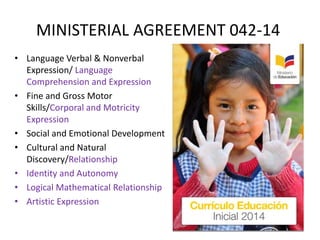
MINISTERIAL AGREEMENT 042-14
• Language Verbal & Nonverbal
Expression/ Language
Comprehension and Expression
• Fine and Gross Motor
Skills/Corporal and Motricity
Expression
• Social and Emotional Development
• Cultural and Natural
Discovery/Relationship
• Identity and Autonomy
• Logical Mathematical Relationship
• Artistic Expression
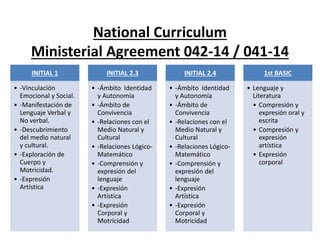
National Curriculum
Ministerial Agreement 042-14 / 041-14
INITIAL 1
• -Vinculación
Emocional y Social.
• -Manifestación de
Lenguaje Verbal y
No verbal.
• -Descubrimiento
del medio natural
y cultural.
• -Exploración de
Cuerpo y
Motricidad.
• -Expresión
Artística
INITIAL 2.3
• -Ámbito Identidad
y Autonomía
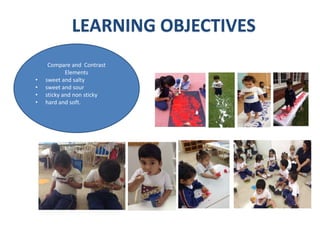
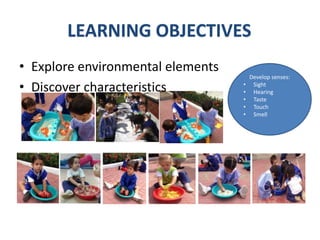
• -Ámbito de
Convivencia
• -Relaciones con el
Medio Natural y
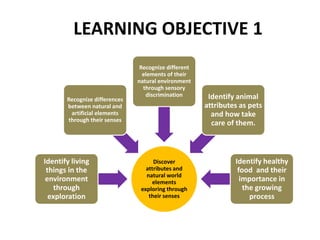
Cultural
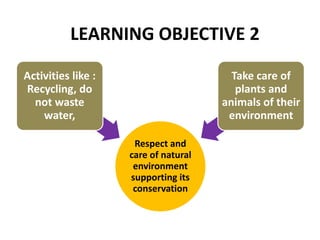
• -Relaciones Lógico-
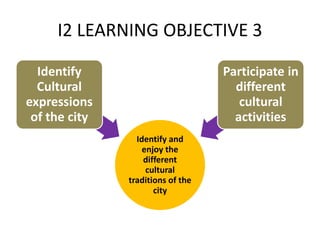
Matemático
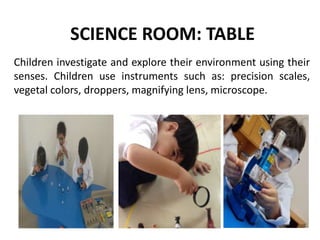
• -Comprensión y
expresión del
lenguaje
• -Expresión
Artística
• -Expresión
Corporal y
Motricidad
INITIAL 2.4
• -Ámbito Identidad
y Autonomía
• -Ámbito de
Convivencia
• -Relaciones con el
Medio Natural y
Cultural
• -Relaciones Lógico-
Matemático
• -Comprensión y
expresión del
lenguaje
• -Expresión
Artística
• -Expresión
Corporal y
Motricidad
1st BASIC
• Lenguaje y
Literatura
• Compresión y
expresión oral y
escrita
• Compresión y
expresión
artística
• Expresión
corporal
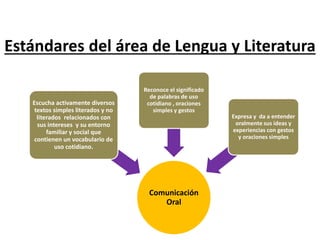
Estándares del área de Lengua y Literatura
Comunicación
Oral
Escucha activamente diversos
textos simples literados y no
literados relacionados con
sus intereses y su entorno
familiar y social que
contienen un vocabulario de
uso cotidiano.
Reconoce el significado
de palabras de uso
cotidiano , oraciones
simples y gestos
Expresa y da a entender
oralmente sus ideas y
experiencias con gestos
y oraciones simples
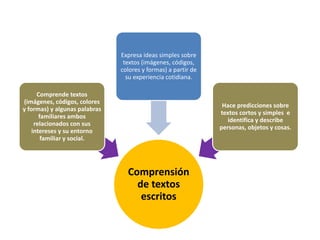
Comprensión
de textos
escritos
Comprende textos
(imágenes, códigos, colores
y formas) y algunas palabras
familiares ambos
relacionados con sus
intereses y su entorno
familiar y social.
Expresa ideas simples sobre
textos (imágenes, códigos,
colores y formas) a partir de
su experiencia cotidiana.
Hace predicciones sobre
textos cortos y simples e
identifica y describe
personas, objetos y cosas.
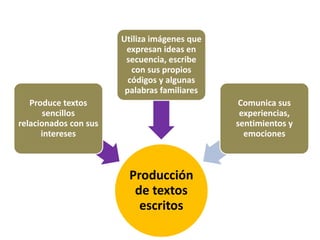
Producción
de textos
escritos
Produce textos
sencillos
relacionados con sus
intereses
Utiliza imágenes que
expresan ideas en
secuencia, escribe
con sus propios
códigos y algunas
palabras familiares
Comunica sus
experiencias,
sentimientos y
emociones
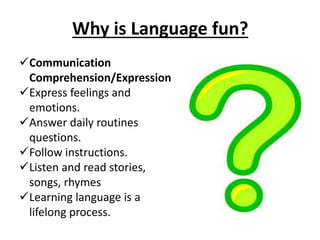
Why is Language fun?
Communication
Comprehension/Expression
Express feelings and
emotions.
Answer daily routines
questions.
Follow instructions.
Listen and read stories,
songs, rhymes
Learning language is a
lifelong process.
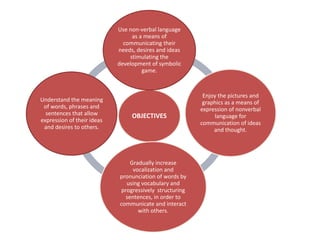
OBJECTIVES
Use non-verbal language
as a means of
communicating their
needs, desires and ideas
stimulating the
development of symbolic
game.
Enjoy the pictures and
graphics as a means of
expression of nonverbal
language for
communication of ideas
and thought.
Gradually increase
vocalization and
pronunciation of words by
using vocabulary and
progressively structuring
sentences, in order to
communicate and interact
with others.
Understand the meaning
of words, phrases and
sentences that allow
expression of their ideas
and desires to others.
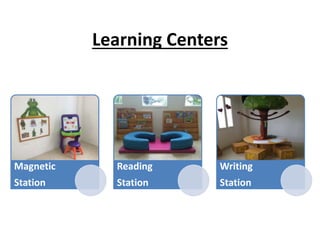
Learning Centers
Magnetic
Station
Reading
Station
Writing
Station
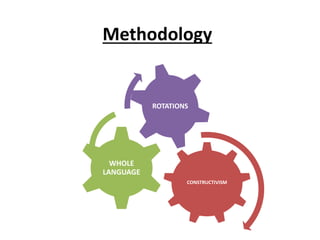
Methodology
CONSTRUCTIVISM
WHOLE
LANGUAGE
ROTATIONS
Programs
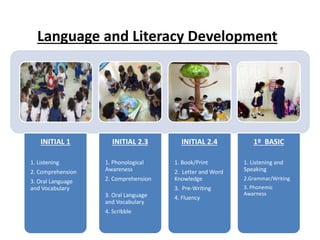
Language and Literacy Development
INITIAL 1
1. Listening
2. Comprehension
3. Oral Language
and Vocabulary
INITIAL 2.3
1. Phonological
Awareness
2. Comprehension
3. Oral Language
and Vocabulary
4. Scribble
INITIAL 2.4
1. Book/Print
2. Letter and Word
Knowledge
3. Pre-Writing
4. Fluency
1º BASIC
1. Listening and
Speaking
2.Grammar/Writing
3. Phonemic
Awarness
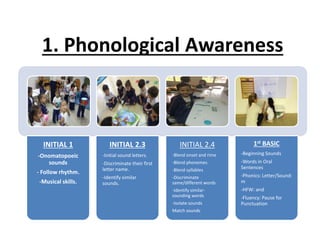
1. Phonological Awareness
INITIAL 1
-Onomatopoeic
sounds
- Follow rhythm.
-Musical skills.
INITIAL 2.3
-Initial sound letters.
-Discriminate their first
letter name.
-Identify similar
sounds.
INITIAL 2.4
-Blend onset and rime
-Blend phonemes
-Blend syllables
-Discriminate
same/different words
-Identify similar-
sounding words
-Isolate sounds
Match sounds
1st BASIC
-Beginning Sounds
-Words in Oral
Sentences
-Phonics: Letter/Sound:
m
-HFW: and
-Fluency: Pause for
Punctuation
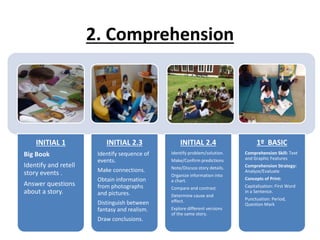
2. Comprehension
INITIAL 1
Big Book
Identify and retell
story events .
Answer questions
about a story.
INITIAL 2.3
Identify sequence of
events.
Make connections.
Obtain information
from photographs
and pictures.
Distinguish between
fantasy and realism.
Draw conclusions.
INITIAL 2.4
Identify problem/solution.
Make/Confirm predictions
Note/Discuss story details.
Organize information into
a chart.
Compare and contrast.
Determine cause and
effect.
Explore different versions
of the same story.
1º BASIC
Comprehension Skill: Text
and Graphic Features
Comprehension Strategy:
Analyze/Evaluate
Concepts of Print:
Capitalization: First Word
in a Sentence.
Punctuation: Period,
Question Mark
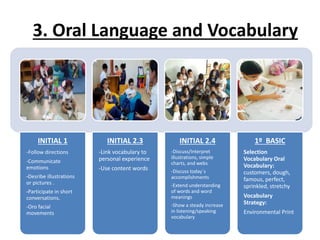
3. Oral Language and Vocabulary
INITIAL 1
-Follow directions
-Communicate
emotions
-Desribe illustrations
or pictures .
-Participate in short
conversations.
-Oro facial
movements
INITIAL 2.3
-Link vocabulary to
personal experience
-Use content words
INITIAL 2.4
-Discuss/Interpret
illustrations, simple
charts, and webs
-Discuss today´s
accomplishments
-Extend understanding
of words and word
meanings
-Show a steady increase
in listening/speaking
vocabulary
1º BASIC
Selection
Vocabulary Oral
Vocabulary:
customers, dough,
famous, perfect,
sprinkled, stretchy
Vocabulary
Strategy:
Environmental Print
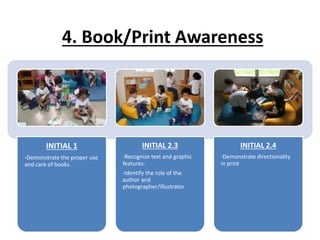
4. Book/Print Awareness
INITIAL 1
-Demonstrate the proper use
and care of books.
INITIAL 2.3
-Recognize text and graphic
features.
-Identify the role of the
author and
photographer/illustrator
INITIAL 2.4
-Demonstrate directionality
in print
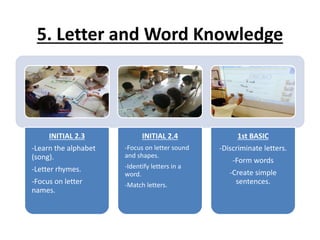
5. Letter and Word Knowledge
INITIAL 2.3
-Learn the alphabet
(song).
-Letter rhymes.
-Focus on letter
names.
INITIAL 2.4
-Focus on letter sound
and shapes.
-Identify letters in a
word.
-Match letters.
1st BASIC
-Discriminate letters.
-Form words
-Create simple
sentences.
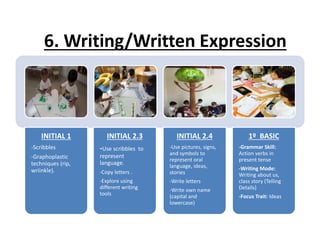
6. Writing/Written Expression
INITIAL 1
-Scribbles
-Graphoplastic
techniques (rip,
wriinkle).
INITIAL 2.3
-Use scribbles to
represent
language.
-Copy letters .
-Explore using
different writing
tools
INITIAL 2.4
-Use pictures, signs,
and symbols to
represent oral
language, ideas,
stories
-Write letters
-Write own name
(capital and
lowercase)
1º BASIC
-Grammar Skill:
Action verbs in
present tense
-Writing Mode:
Writing about us,
class story (Telling
Details)
-Focus Trait: Ideas
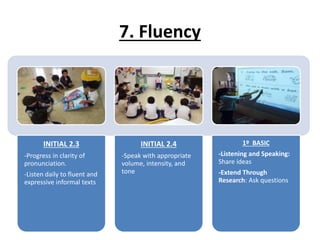
7. Fluency
INITIAL 2.3
-Progress in clarity of
pronunciation.
-Listen daily to fluent and
expressive informal texts
INITIAL 2.4
-Speak with appropriate
volume, intensity, and
tone
1º BASIC
-Listening and Speaking:
Share ideas
-Extend Through
Research: Ask questions
MATH
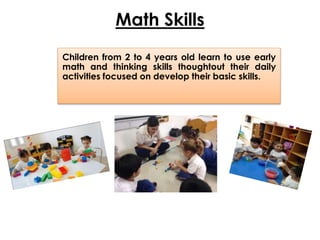
Math Skills
Children from 2 to 4 years old learn to use early
math and thinking skills thoughtout their daily
activities focused on develop their basic skills.
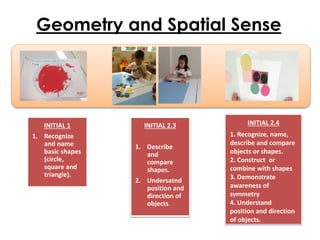
Geometry and Spatial Sense
INITIAL 1
1. Recognize
and name
basic shapes
(circle,
square and
triangle).
INITIAL 2.3
1. Describe
and
compare
shapes.
2. Undersatnd
position and
direction of
objects.
INITIAL 2.4
1. Recognize, name,
describe and compare
objects or shapes.
2. Construct or
combine with shapes
3. Demonstrate
awareness of
symmetry
4. Understand
position and direction
of objects.
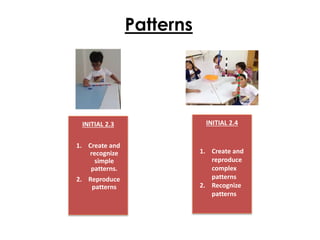
Patterns
INITIAL 2.3
1. Create and
recognize
simple
patterns.
2. Reproduce
patterns
INITIAL 2.4
1. Create and
reproduce
complex
patterns
2. Recognize
patterns
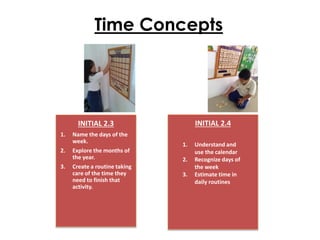
Time Concepts
INITIAL 2.3
1. Name the days of the
week.
2. Explore the months of
the year.
3. Create a routine taking
care of the time they
need to finish that
activity.
INITIAL 2.4
1. Understand and
use the calendar
2. Recognize days of
the week
3. Estimate time in
daily routines
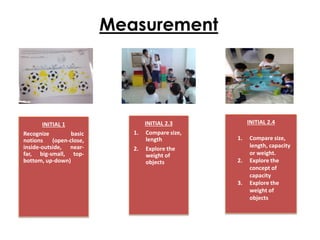
Measurement
INITIAL 1
Recognize basic
notions (open-close,
inside-outside, near-
far, big-small, top-
bottom, up-down)
INITIAL 2.3
1. Compare size,
length
2. Explore the
weight of
objects
INITIAL 2.4
1. Compare size,
length, capacity
or weight.
2. Explore the
concept of
capacity
3. Explore the
weight of
objects
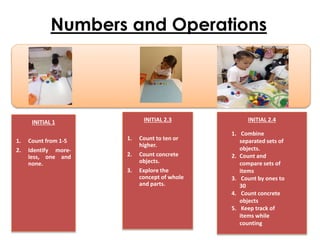
Numbers and Operations
INITIAL 1
1. Count from 1-5
2. Identify more-
less, one and
none.
INITIAL 2.3
1. Count to ten or
higher.
2. Count concrete
objects.
3. Explore the
concept of whole
and parts.
INITIAL 2.4
1. Combine
separated sets of
objects.
2. Count and
compare sets of
items
3. Count by ones to
30
4. Count concrete
objects
5. Keep track of
items while
counting
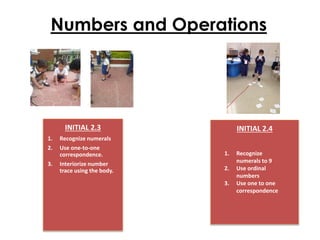
Numbers and Operations
INITIAL 2.3
1. Recognize numerals
2. Use one-to-one
correspondence.
3. Interiorize number
trace using the body.
INITIAL 2.4
1. Recognize
numerals to 9
2. Use ordinal
numbers
3. Use one to one
correspondence
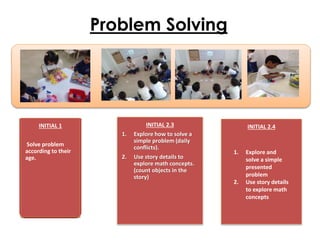
Problem Solving
INITIAL 1
Solve problem
according to their
age.
INITIAL 2.3
1. Explore how to solve a
simple problem (daily
conflicts).
2. Use story details to
explore math concepts.
(count objects in the
story)
INITIAL 2.4
1. Explore and
solve a simple
presented
problem
2. Use story details
to explore math
concepts
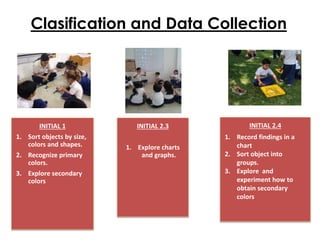
Clasification and Data Collection
INITIAL 1
1. Sort objects by size,
colors and shapes.
2. Recognize primary
colors.
3. Explore secondary
colors
INITIAL 2.3
1. Explore charts
and graphs.
INITIAL 2.4
1. Record findings in a
chart
2. Sort object into
groups.
3. Explore and
experiment how to
obtain secondary
colors
SCIENCE
NATURAL AND CULTURAL
ENVIRONMENT
• Explore and discover
elements and attributes
through investigation to
stimulate the childs
curiosity to increase
their respect for natural
and cultural
environment.
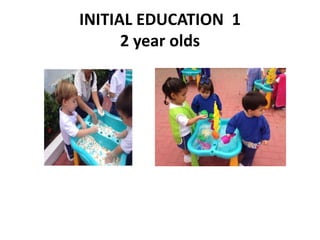
INITIAL EDUCATION 1
2 year olds
LEARNING OBJECTIVES
Compare and Contrast
Elements
• sweet and salty
• sweet and sour
• sticky and non sticky
• hard and soft.
Develop senses:
• Sight
• Hearing
• Taste
• Touch
• Smell
• Explore environmental elements
• Discover characteristics
LEARNING OBJECTIVES
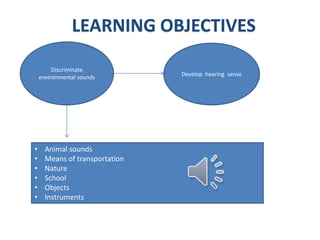
Discriminate
environmental sounds
Sounds:
• Animal sounds
• Means of transportation
• Nature
• School
• Objects
• Instruments
Develop hearing sense
LEARNING OBJECTIVES
INITIAL EDUCATION 2 ABCD
3-4 year olds
LEARNING OBJECTIVE 1
Discover
attributes and
natural world
elements
exploring through
their senses
Identify living
things in the
environment
through
exploration
Recognize differences
between natural and
artificial elements
through their senses
Recognize different
elements of their
natural environment
through sensory
discrimination Identify animal
attributes as pets
and how take
care of them.
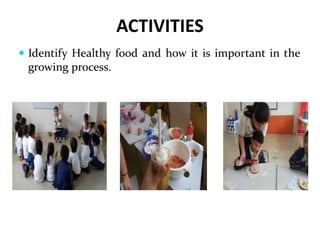
Identify healthy
food and their
importance in
the growing
process
LEARNING OBJECTIVE 2
Respect and
care of natural
environment
supporting its
conservation
Activities like :
Recycling, do
not waste
water,
Take care of
plants and
animals of their
environment
I2 LEARNING OBJECTIVE 3
Identify and
enjoy the
different
cultural
traditions of the
city
Identify
Cultural
expressions
of the city
Participate in
different
cultural
activities
SCIENCE ROOM: TABLE
Children investigate and explore their environment using their
senses. Children use instruments such as: precision scales,
vegetal colors, droppers, magnifying lens, microscope.
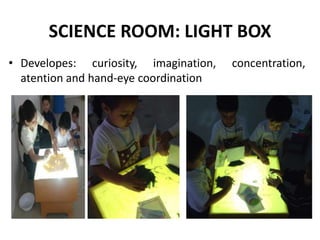
SCIENCE ROOM: LIGHT BOX
• Developes: curiosity, imagination, concentration,
atention and hand-eye coordination
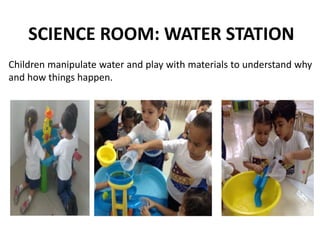
SCIENCE ROOM: WATER STATION
Children manipulate water and play with materials to understand why
and how things happen.
ACTIVITIES
INITIAL EDUCATION 2
4 year olds
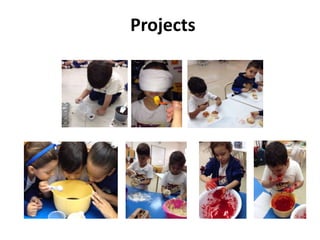
Projects
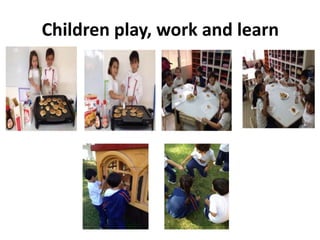
Children play, work and learn
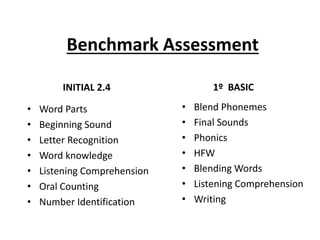
Benchmark Assessment
INITIAL 2.4
• Word Parts
• Beginning Sound
• Letter Recognition
• Word knowledge
• Listening Comprehension
• Oral Counting
• Number Identification
1º BASIC
• Blend Phonemes
• Final Sounds
• Phonics
• HFW
• Blending Words
• Listening Comprehension
• Writing
SPLASH INTO PREK 2015

SPLASH INTO PREK 2015

  • 1.
    SPLASH INTO PRE-K BYJacqueline I. de Terán
  • 3.
    MINISTERIAL AGREEMENT 042-14 •Language Verbal & Nonverbal Expression/ Language Comprehension and Expression • Fine and Gross Motor Skills/Corporal and Motricity Expression • Social and Emotional Development • Cultural and Natural Discovery/Relationship • Identity and Autonomy • Logical Mathematical Relationship • Artistic Expression
  • 4.
    National Curriculum Ministerial Agreement042-14 / 041-14 INITIAL 1 • -Vinculación Emocional y Social. • -Manifestación de Lenguaje Verbal y No verbal. • -Descubrimiento del medio natural y cultural. • -Exploración de Cuerpo y Motricidad. • -Expresión Artística INITIAL 2.3 • -Ámbito Identidad y Autonomía • -Ámbito de Convivencia • -Relaciones con el Medio Natural y Cultural • -Relaciones Lógico- Matemático • -Comprensión y expresión del lenguaje • -Expresión Artística • -Expresión Corporal y Motricidad INITIAL 2.4 • -Ámbito Identidad y Autonomía • -Ámbito de Convivencia • -Relaciones con el Medio Natural y Cultural • -Relaciones Lógico- Matemático • -Comprensión y expresión del lenguaje • -Expresión Artística • -Expresión Corporal y Motricidad 1st BASIC • Lenguaje y Literatura • Compresión y expresión oral y escrita • Compresión y expresión artística • Expresión corporal
  • 5.
    Estándares del áreade Lengua y Literatura Comunicación Oral Escucha activamente diversos textos simples literados y no literados relacionados con sus intereses y su entorno familiar y social que contienen un vocabulario de uso cotidiano. Reconoce el significado de palabras de uso cotidiano , oraciones simples y gestos Expresa y da a entender oralmente sus ideas y experiencias con gestos y oraciones simples
  • 6.
    Comprensión de textos escritos Comprende textos (imágenes,códigos, colores y formas) y algunas palabras familiares ambos relacionados con sus intereses y su entorno familiar y social. Expresa ideas simples sobre textos (imágenes, códigos, colores y formas) a partir de su experiencia cotidiana. Hace predicciones sobre textos cortos y simples e identifica y describe personas, objetos y cosas.
  • 7.
    Producción de textos escritos Produce textos sencillos relacionadoscon sus intereses Utiliza imágenes que expresan ideas en secuencia, escribe con sus propios códigos y algunas palabras familiares Comunica sus experiencias, sentimientos y emociones
  • 8.
    Why is Languagefun? Communication Comprehension/Expression Express feelings and emotions. Answer daily routines questions. Follow instructions. Listen and read stories, songs, rhymes Learning language is a lifelong process.
  • 9.
    OBJECTIVES Use non-verbal language asa means of communicating their needs, desires and ideas stimulating the development of symbolic game. Enjoy the pictures and graphics as a means of expression of nonverbal language for communication of ideas and thought. Gradually increase vocalization and pronunciation of words by using vocabulary and progressively structuring sentences, in order to communicate and interact with others. Understand the meaning of words, phrases and sentences that allow expression of their ideas and desires to others.
  • 10.
  • 11.
  • 12.
  • 13.
    Language and LiteracyDevelopment INITIAL 1 1. Listening 2. Comprehension 3. Oral Language and Vocabulary INITIAL 2.3 1. Phonological Awareness 2. Comprehension 3. Oral Language and Vocabulary 4. Scribble INITIAL 2.4 1. Book/Print 2. Letter and Word Knowledge 3. Pre-Writing 4. Fluency 1º BASIC 1. Listening and Speaking 2.Grammar/Writing 3. Phonemic Awarness
  • 14.
    1. Phonological Awareness INITIAL1 -Onomatopoeic sounds - Follow rhythm. -Musical skills. INITIAL 2.3 -Initial sound letters. -Discriminate their first letter name. -Identify similar sounds. INITIAL 2.4 -Blend onset and rime -Blend phonemes -Blend syllables -Discriminate same/different words -Identify similar- sounding words -Isolate sounds Match sounds 1st BASIC -Beginning Sounds -Words in Oral Sentences -Phonics: Letter/Sound: m -HFW: and -Fluency: Pause for Punctuation
  • 15.
    2. Comprehension INITIAL 1 BigBook Identify and retell story events . Answer questions about a story. INITIAL 2.3 Identify sequence of events. Make connections. Obtain information from photographs and pictures. Distinguish between fantasy and realism. Draw conclusions. INITIAL 2.4 Identify problem/solution. Make/Confirm predictions Note/Discuss story details. Organize information into a chart. Compare and contrast. Determine cause and effect. Explore different versions of the same story. 1º BASIC Comprehension Skill: Text and Graphic Features Comprehension Strategy: Analyze/Evaluate Concepts of Print: Capitalization: First Word in a Sentence. Punctuation: Period, Question Mark
  • 16.
    3. Oral Languageand Vocabulary INITIAL 1 -Follow directions -Communicate emotions -Desribe illustrations or pictures . -Participate in short conversations. -Oro facial movements INITIAL 2.3 -Link vocabulary to personal experience -Use content words INITIAL 2.4 -Discuss/Interpret illustrations, simple charts, and webs -Discuss today´s accomplishments -Extend understanding of words and word meanings -Show a steady increase in listening/speaking vocabulary 1º BASIC Selection Vocabulary Oral Vocabulary: customers, dough, famous, perfect, sprinkled, stretchy Vocabulary Strategy: Environmental Print
  • 17.
    4. Book/Print Awareness INITIAL1 -Demonstrate the proper use and care of books. INITIAL 2.3 -Recognize text and graphic features. -Identify the role of the author and photographer/illustrator INITIAL 2.4 -Demonstrate directionality in print
  • 18.
    5. Letter andWord Knowledge INITIAL 2.3 -Learn the alphabet (song). -Letter rhymes. -Focus on letter names. INITIAL 2.4 -Focus on letter sound and shapes. -Identify letters in a word. -Match letters. 1st BASIC -Discriminate letters. -Form words -Create simple sentences.
  • 19.
    6. Writing/Written Expression INITIAL1 -Scribbles -Graphoplastic techniques (rip, wriinkle). INITIAL 2.3 -Use scribbles to represent language. -Copy letters . -Explore using different writing tools INITIAL 2.4 -Use pictures, signs, and symbols to represent oral language, ideas, stories -Write letters -Write own name (capital and lowercase) 1º BASIC -Grammar Skill: Action verbs in present tense -Writing Mode: Writing about us, class story (Telling Details) -Focus Trait: Ideas
  • 20.
    7. Fluency INITIAL 2.3 -Progressin clarity of pronunciation. -Listen daily to fluent and expressive informal texts INITIAL 2.4 -Speak with appropriate volume, intensity, and tone 1º BASIC -Listening and Speaking: Share ideas -Extend Through Research: Ask questions
  • 21.
  • 22.
    Math Skills Children from2 to 4 years old learn to use early math and thinking skills thoughtout their daily activities focused on develop their basic skills.
  • 23.
    Geometry and SpatialSense INITIAL 1 1. Recognize and name basic shapes (circle, square and triangle). INITIAL 2.3 1. Describe and compare shapes. 2. Undersatnd position and direction of objects. INITIAL 2.4 1. Recognize, name, describe and compare objects or shapes. 2. Construct or combine with shapes 3. Demonstrate awareness of symmetry 4. Understand position and direction of objects.
  • 24.
    Patterns INITIAL 2.3 1. Createand recognize simple patterns. 2. Reproduce patterns INITIAL 2.4 1. Create and reproduce complex patterns 2. Recognize patterns
  • 25.
    Time Concepts INITIAL 2.3 1.Name the days of the week. 2. Explore the months of the year. 3. Create a routine taking care of the time they need to finish that activity. INITIAL 2.4 1. Understand and use the calendar 2. Recognize days of the week 3. Estimate time in daily routines
  • 26.
    Measurement INITIAL 1 Recognize basic notions(open-close, inside-outside, near- far, big-small, top- bottom, up-down) INITIAL 2.3 1. Compare size, length 2. Explore the weight of objects INITIAL 2.4 1. Compare size, length, capacity or weight. 2. Explore the concept of capacity 3. Explore the weight of objects
  • 27.
    Numbers and Operations INITIAL1 1. Count from 1-5 2. Identify more- less, one and none. INITIAL 2.3 1. Count to ten or higher. 2. Count concrete objects. 3. Explore the concept of whole and parts. INITIAL 2.4 1. Combine separated sets of objects. 2. Count and compare sets of items 3. Count by ones to 30 4. Count concrete objects 5. Keep track of items while counting
  • 28.
    Numbers and Operations INITIAL2.3 1. Recognize numerals 2. Use one-to-one correspondence. 3. Interiorize number trace using the body. INITIAL 2.4 1. Recognize numerals to 9 2. Use ordinal numbers 3. Use one to one correspondence
  • 29.
    Problem Solving INITIAL 1 Solveproblem according to their age. INITIAL 2.3 1. Explore how to solve a simple problem (daily conflicts). 2. Use story details to explore math concepts. (count objects in the story) INITIAL 2.4 1. Explore and solve a simple presented problem 2. Use story details to explore math concepts
  • 30.
    Clasification and DataCollection INITIAL 1 1. Sort objects by size, colors and shapes. 2. Recognize primary colors. 3. Explore secondary colors INITIAL 2.3 1. Explore charts and graphs. INITIAL 2.4 1. Record findings in a chart 2. Sort object into groups. 3. Explore and experiment how to obtain secondary colors
  • 31.
  • 32.
    NATURAL AND CULTURAL ENVIRONMENT •Explore and discover elements and attributes through investigation to stimulate the childs curiosity to increase their respect for natural and cultural environment.
  • 33.
  • 34.
    LEARNING OBJECTIVES Compare andContrast Elements • sweet and salty • sweet and sour • sticky and non sticky • hard and soft.
  • 35.
    Develop senses: • Sight •Hearing • Taste • Touch • Smell • Explore environmental elements • Discover characteristics LEARNING OBJECTIVES
  • 36.
    Discriminate environmental sounds Sounds: • Animalsounds • Means of transportation • Nature • School • Objects • Instruments Develop hearing sense LEARNING OBJECTIVES
  • 37.
    INITIAL EDUCATION 2ABCD 3-4 year olds
  • 38.
    LEARNING OBJECTIVE 1 Discover attributesand natural world elements exploring through their senses Identify living things in the environment through exploration Recognize differences between natural and artificial elements through their senses Recognize different elements of their natural environment through sensory discrimination Identify animal attributes as pets and how take care of them. Identify healthy food and their importance in the growing process
  • 39.
    LEARNING OBJECTIVE 2 Respectand care of natural environment supporting its conservation Activities like : Recycling, do not waste water, Take care of plants and animals of their environment
  • 40.
    I2 LEARNING OBJECTIVE3 Identify and enjoy the different cultural traditions of the city Identify Cultural expressions of the city Participate in different cultural activities
  • 41.
    SCIENCE ROOM: TABLE Childreninvestigate and explore their environment using their senses. Children use instruments such as: precision scales, vegetal colors, droppers, magnifying lens, microscope.
  • 42.
    SCIENCE ROOM: LIGHTBOX • Developes: curiosity, imagination, concentration, atention and hand-eye coordination
  • 43.
    SCIENCE ROOM: WATERSTATION Children manipulate water and play with materials to understand why and how things happen.
  • 44.
  • 45.
  • 46.
  • 47.
  • 48.
    Benchmark Assessment INITIAL 2.4 •Word Parts • Beginning Sound • Letter Recognition • Word knowledge • Listening Comprehension • Oral Counting • Number Identification 1º BASIC • Blend Phonemes • Final Sounds • Phonics • HFW • Blending Words • Listening Comprehension • Writing