


Welcome toKindergarten!
Welcome to Kindergarten!I will introduce you to kindergarten and to our classroom.If you have any questions during my presentation, please raise your hand and wait to be called on.
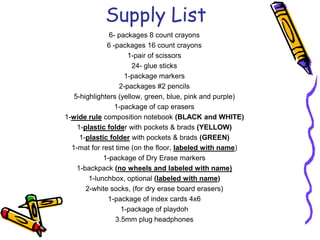
Supply List6- packages 8 count crayons6 -packages 16 count crayons1-pair of scissors24- glue sticks1-package markers2-packages #2 pencils5-highlighters (yellow, green, blue, pink and purple)1-package of cap erasers1-wide rule composition notebook (BLACK and WHITE)1-plastic folder with pockets & brads (YELLOW)1-plastic folder with pockets & brads (GREEN)1-mat for rest time (on the floor, labeled with name)1-package of Dry Erase markers1-backpack (no wheels and labeled with name)1-lunchbox, optional (labeled with name)2-white socks, (for dry erase board erasers)1-package of index cards 4x61-package of playdoh3.5mm plug headphonesLast Modified: Jun 05, 2009
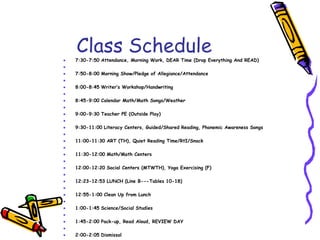
Class Schedule7:30-7:50 Attendance, Morning Work, DEAR Time (Drop Everything And READ) 7:50-8:00 Morning Show/Pledge of Allegiance/Attendance  8:00-8:45 Writer’s Workshop/Handwriting 8:45-9:00 Calendar Math/Math Songs/Weather 9:00-9:30 Teacher PE (Outside Play) 9:30-11:00 Literacy Centers, Guided/Shared Reading, Phonemic Awareness Songs 11:00-11:30 ART (TH), Quiet Reading Time/RtI/Snack 11:30-12:00 Math/Math Centers 12:00-12:20 Social Centers (MTWTH), Yoga Exercising (F)  12:23-12:53 LUNCH (Line B---Tables 10-18) 12:55-1:00 Clean Up from Lunch 1:00-1:45 Science/Social Studies 1:45-2:00 Pack-up, Read Aloud, REVIEW DAY 2:00-2:05 Dismissal 
All About MeMy name is Bethany "Beth" Salomon. This is my seventh year of teaching. I taught one year of 5th grade in New York, and have been teaching six years of kindergarten in Florida. I graduated college from Buffalo State College in Buffalo, New York with a Bachelor's and a Master's in Elementary Education and Reading. I enjoy cooking, reading, knitting and playing with my dogs Haylie and Lacey. I am excited to be your child's teacher this year, and I look forward to meeting you and your child!
Classroom RulesOur classroom rules are simple:*Listen and follow directions*Keep hands and feet to self*Be kind to others*Leave candy, toys and gum at home*Learn, learn, and learn!
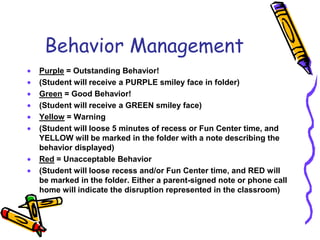
Behavior ManagementPurple = Outstanding Behavior!(Student will receive a PURPLE smiley face in folder)Green = Good Behavior!(Student will receive a GREEN smiley face)Yellow = Warning (Student will loose 5 minutes of recess or Fun Center time, and YELLOW will be marked in the folder with a note describing the behavior displayed)Red = Unacceptable Behavior(Student will loose recess and/or Fun Center time, and RED will be marked in the folder. Either a parent-signed note or phone call home will indicate the disruption represented in the classroom)
Behavior ManagementEach child has been given a folder that he/she is responsible for bringing to and from school each day.  Enclosed in this folder will be a monthly calendar. You will be able to see how your child behaved each day by the color I have indicated on the calendar. Please initial each day to see your child’s progress.Please be reminded that I do give warnings before I change the cards to give your child a chance to correct the behavior at hand. If for some reason the behavior is not corrected, after the warning, I will change your child’s card. At the end of the day, I will ask your child why they were on yellow or red, and I will write their explanation in their GREEN folder. At that time, I will discuss briefly with your child about the behavior they displayed, and I will help them come up with a positive solution for the next time.
ReadingDemonstrates Alphabet KnowledgeIdentifies letters by name (upper and lower case) in random order. Uses Reading Processes Effectively (Demonstrates Phonemic Awareness).Recognizes that words are made up of a series of sounds. Recognizes rhyming patterns and rhyming sounds. Matches words with the same beginning sound/ending sound. Identifies sounds heard at the beginning, middle, or end of a word. Blends individual sounds to form a word. Matches spoken sounds to letters in print. Makes meaningful predictions about text using word patterns, phonics, language patterns, and structures.
ReadingDemonstrates Concepts of PrintDemonstrates left to right page sequence Demonstrates awareness of text progression (left/right; top/bottom). Demonstrates return sweep. Demonstrates awareness that print, not pictures contains the message and that the message remains constant. Indicates cover, title, title page, front, and back of book. Indicates a letter, a word, a first letter, a last letter, an upper case letter, a lower case letter, and the space between words. Demonstrates an awareness of the function of periods, question marks, exclamation points, and quotation marks.
ReadingDemonstrates Effective Reading Behaviors"Reads along" when being read a familiar text.
Reads books from memory or with picture support daily.
Reads and listens to text for a variety of purposes (pleasure reading).
Self-selects materials for reading and listening.
Participates in discussions and activities related to text and across texts.
Asks and answers questions about material that has been read or heard.ReadingConstructs Meaning from a Variety of TextPredicts what a story is about using book title, illustrations, and other context clues. Predicts what might happen next in a story. Identifies beginning and ending of a story. Demonstrates awareness of story elements (setting, characters, problem, sequence of events, and resolution). Retells familiar stories and rhymes. Summarizes a story (tells what it is mostly about). Supports responses with information from the text. Recognizes  high frequency (sight words) words in context. Understands and follows simple directions during reading instruction.
WritingLearning to coordinate hand muscles with eye muscles.
Drawing  pictures to illustrate their stories.
Learning to write one's name correctly, using a capital letter for the first letter and lower case letters for the rest of the name , using sight words in sentences, writing a story with a beginning, middle and end and writing with detail.
Using phonetic “invented” spelling to formulate words.WritingFocuses on TopicStays focused on the topic when talking or writing.
Identifies and writes about a topic.Organizes IdeasDemonstrates ability to sequence events during shared writing experiences and/or within their own individualized writing pieces.Supports Topic With DetailsDemonstrates ability to identify ideas related to a topic during shared writing experiences and/or within their own individualized writing pieces.
Uses pictures to illustrate and support writing.
Uses linking or describing words within sentences to discuss ideas in detail.WritingUses Conventions (punctuation, capitalization, spelling, grammar).Recognizes that oral language can be written.
Writes from left to right and uses correct return sweep.
Recognizes and puts spaces between words.
Approximates words using more than one correct sound.
Writes  familiar words (sight words) correctly within sentences.
Reproduces print seen in the environment.Organizes to Communicate in WritingWrites a sentence using spelling approximations.

Kindergarten Curriculum Presentation 2009 2010

  • 1.
  • 2.
    Welcome to Kindergarten!Iwill introduce you to kindergarten and to our classroom.If you have any questions during my presentation, please raise your hand and wait to be called on.
  • 3.
    Supply List6- packages8 count crayons6 -packages 16 count crayons1-pair of scissors24- glue sticks1-package markers2-packages #2 pencils5-highlighters (yellow, green, blue, pink and purple)1-package of cap erasers1-wide rule composition notebook (BLACK and WHITE)1-plastic folder with pockets & brads (YELLOW)1-plastic folder with pockets & brads (GREEN)1-mat for rest time (on the floor, labeled with name)1-package of Dry Erase markers1-backpack (no wheels and labeled with name)1-lunchbox, optional (labeled with name)2-white socks, (for dry erase board erasers)1-package of index cards 4x61-package of playdoh3.5mm plug headphonesLast Modified: Jun 05, 2009
  • 4.
    Class Schedule7:30-7:50 Attendance,Morning Work, DEAR Time (Drop Everything And READ) 7:50-8:00 Morning Show/Pledge of Allegiance/Attendance  8:00-8:45 Writer’s Workshop/Handwriting 8:45-9:00 Calendar Math/Math Songs/Weather 9:00-9:30 Teacher PE (Outside Play) 9:30-11:00 Literacy Centers, Guided/Shared Reading, Phonemic Awareness Songs 11:00-11:30 ART (TH), Quiet Reading Time/RtI/Snack 11:30-12:00 Math/Math Centers 12:00-12:20 Social Centers (MTWTH), Yoga Exercising (F)  12:23-12:53 LUNCH (Line B---Tables 10-18) 12:55-1:00 Clean Up from Lunch 1:00-1:45 Science/Social Studies 1:45-2:00 Pack-up, Read Aloud, REVIEW DAY 2:00-2:05 Dismissal 
  • 5.
    All About MeMyname is Bethany "Beth" Salomon. This is my seventh year of teaching. I taught one year of 5th grade in New York, and have been teaching six years of kindergarten in Florida. I graduated college from Buffalo State College in Buffalo, New York with a Bachelor's and a Master's in Elementary Education and Reading. I enjoy cooking, reading, knitting and playing with my dogs Haylie and Lacey. I am excited to be your child's teacher this year, and I look forward to meeting you and your child!
  • 6.
    Classroom RulesOur classroomrules are simple:*Listen and follow directions*Keep hands and feet to self*Be kind to others*Leave candy, toys and gum at home*Learn, learn, and learn!
  • 7.
    Behavior ManagementPurple =Outstanding Behavior!(Student will receive a PURPLE smiley face in folder)Green = Good Behavior!(Student will receive a GREEN smiley face)Yellow = Warning (Student will loose 5 minutes of recess or Fun Center time, and YELLOW will be marked in the folder with a note describing the behavior displayed)Red = Unacceptable Behavior(Student will loose recess and/or Fun Center time, and RED will be marked in the folder. Either a parent-signed note or phone call home will indicate the disruption represented in the classroom)
  • 8.
    Behavior ManagementEach childhas been given a folder that he/she is responsible for bringing to and from school each day.  Enclosed in this folder will be a monthly calendar. You will be able to see how your child behaved each day by the color I have indicated on the calendar. Please initial each day to see your child’s progress.Please be reminded that I do give warnings before I change the cards to give your child a chance to correct the behavior at hand. If for some reason the behavior is not corrected, after the warning, I will change your child’s card. At the end of the day, I will ask your child why they were on yellow or red, and I will write their explanation in their GREEN folder. At that time, I will discuss briefly with your child about the behavior they displayed, and I will help them come up with a positive solution for the next time.
  • 9.
    ReadingDemonstrates Alphabet KnowledgeIdentifiesletters by name (upper and lower case) in random order. Uses Reading Processes Effectively (Demonstrates Phonemic Awareness).Recognizes that words are made up of a series of sounds. Recognizes rhyming patterns and rhyming sounds. Matches words with the same beginning sound/ending sound. Identifies sounds heard at the beginning, middle, or end of a word. Blends individual sounds to form a word. Matches spoken sounds to letters in print. Makes meaningful predictions about text using word patterns, phonics, language patterns, and structures.
  • 10.
    ReadingDemonstrates Concepts ofPrintDemonstrates left to right page sequence Demonstrates awareness of text progression (left/right; top/bottom). Demonstrates return sweep. Demonstrates awareness that print, not pictures contains the message and that the message remains constant. Indicates cover, title, title page, front, and back of book. Indicates a letter, a word, a first letter, a last letter, an upper case letter, a lower case letter, and the space between words. Demonstrates an awareness of the function of periods, question marks, exclamation points, and quotation marks.
  • 11.
    ReadingDemonstrates Effective ReadingBehaviors"Reads along" when being read a familiar text.
  • 12.
    Reads books frommemory or with picture support daily.
  • 13.
    Reads and listensto text for a variety of purposes (pleasure reading).
  • 14.
    Self-selects materials forreading and listening.
  • 15.
    Participates in discussionsand activities related to text and across texts.
  • 16.
    Asks and answersquestions about material that has been read or heard.ReadingConstructs Meaning from a Variety of TextPredicts what a story is about using book title, illustrations, and other context clues. Predicts what might happen next in a story. Identifies beginning and ending of a story. Demonstrates awareness of story elements (setting, characters, problem, sequence of events, and resolution). Retells familiar stories and rhymes. Summarizes a story (tells what it is mostly about). Supports responses with information from the text. Recognizes high frequency (sight words) words in context. Understands and follows simple directions during reading instruction.
  • 17.
    WritingLearning to coordinatehand muscles with eye muscles.
  • 18.
    Drawing picturesto illustrate their stories.
  • 19.
    Learning to writeone's name correctly, using a capital letter for the first letter and lower case letters for the rest of the name , using sight words in sentences, writing a story with a beginning, middle and end and writing with detail.
  • 20.
    Using phonetic “invented”spelling to formulate words.WritingFocuses on TopicStays focused on the topic when talking or writing.
  • 21.
    Identifies and writesabout a topic.Organizes IdeasDemonstrates ability to sequence events during shared writing experiences and/or within their own individualized writing pieces.Supports Topic With DetailsDemonstrates ability to identify ideas related to a topic during shared writing experiences and/or within their own individualized writing pieces.
  • 22.
    Uses pictures toillustrate and support writing.
  • 23.
    Uses linking ordescribing words within sentences to discuss ideas in detail.WritingUses Conventions (punctuation, capitalization, spelling, grammar).Recognizes that oral language can be written.
  • 24.
    Writes from leftto right and uses correct return sweep.
  • 25.
    Recognizes and putsspaces between words.
  • 26.
    Approximates words usingmore than one correct sound.
  • 27.
    Writes familiarwords (sight words) correctly within sentences.
  • 28.
    Reproduces print seenin the environment.Organizes to Communicate in WritingWrites a sentence using spelling approximations.