Communication
in ECCE
Rahul Gupta Bhaya
Consultant , Early Childhood Care n Education
Kolkata, India
Building Blocks of the Brain in Early
Childhood and how Communication
happens
Early Experience
Increase in Synaptic
Connections
Brain Architecture
Develops
Repeated Early
Experiences
Strengthens
Connection and
Pathways
Repetition of
communication in any mode
helps children to learn
best : Play, Story-telling,
activity based learning, any
type.
Neuron: The Building block of brain
What kinds of experiences foster brain
development & communication skill
Synaptic Density: Synapses are created with astonishing speed in the first three years of
life. For the rest of the first decade, children’s brains have twice as many synapses as
adults’ brains.
Drawings supplied by H.T. Chugani
Importance of communication in Early Childhood
… WHAT DOES RESEARCH SAY?
Facts on brain development
• 100 billion neurons (brain cells) are present at
birth.
• At birth the number of synapses (neural
connection is 2500 per neuron but increases to
15,000 by 2-3 years)
• During the first six years of life 90% of a
person’s brain is developed
• In the first few years of life, 700 new neural
connections are formed every second.
CECED, Ambedkar University Delhi
Communication in Different Modes
Interaction
STANDARDS INTERACTION
Adult-Child
Interaction
❖ Teacher greets every child on arrival & departure
❖ Children greet the teacher on arrival & departure
❖All children are treated equally with respect, affection and care
❖ Caregivers do not use physical punishment or verbal abuse to discipline
children
❖ Caregivers appreciate the cultural/ social and religious diversity of the
children and promote tolerance and unity
❖ Caregivers/teachers demonstrate sensitivity & awareness regarding needs
of children with special needs
❖ Children with special needs are encouraged and enabled to participate in
the learning environment
❖ Children approach the teachers/ caregivers freely at any time
❖ ECCE Teachers/Caregivers do not demonstrate any bias related to gender,
caste or class
❖ Caregivers encourage children to think, reason, question and experiment
during the day
❖ Meaningful interaction with their teachers during meal/snack time
Std-1: Interaction
STANDARDS INTERACTION
Child –Environmental/
Material Interaction
❖ Availability of varieties of equipment/ materials for indoor
learning/play activities
❖ Access and use of age appropriate learning materials and adapted
to children’s developmental needs.
❖ Opportunities provided for children to explore materials, use in
learning concepts, develop and practice skills.
❖ Opportunities given to play with things available in nature.
❖Locally made learning materials available and used by children.
❖ Children can access the play and learning material freely
Children take care of the material and put the material back at the
designated spot
Communication towards School
Readiness
(4 to 6 yrs)
Content of the Communication for School
Readiness
• Oral Language Development
• Reading Readiness
• Writing Readiness
• Math Readiness/Early numeracy
• Science Experiments
Language Matrix
Listening
(Process, Understand,
interpret and evaluate
spoken language in various
situation)
Speaking
(Engage in oral communication in a
variety of situations for a variety of
purposes and audiences)
Reading
(Process, interpret, evaluate written
language, symbols and text with
understanding)
Writing
(engage in written
communication in a
variety of forms for a
variety of purposes and
audiences)
Language
Oral Language Communication
• It is the foundation of
literacy development.
• Children say first word
between 12-18Months
age.
• Begin to use complex
sentence by the age 4-4
½ yrs.
Importance of Oral Language
Communication
• It involves speaking and listening
• Children who develop strong oral language skills during the
preschool years create an important foundation for their
later achievements in reading, especially reading
comprehension.
• Children who lag behind their peers in language
development are at high risk for later reading difficulties.
• Vocabulary knowledge is strongly related to reading
proficiency and overall academic success.
1.Vocabulary Enrichment
Processes:
• Thematic Open Conversation
• Chart based Open Conversation
• Guessing game
• Matching activity
• Naming
2.Rhymes
Processes:
• Rhymes telling and listening
• Vocabulary enrichment from rhymes
• Question answer session from rhymes
• Practice of rhyming words
3.Story
Processes:
• Vocabulary Enrichment from story
• Question answer session from story
• Drawing from story
• Role play from story
• Shared writing from story
Development from oracy to literacy
Emergent Literacy
• Child acquires (somewhat automatically) some language,
reading and writing skills before starting school when
adequate and appropriate exposure to language is provided.
• When these skills starts developing/ emerging in a child
she can be considered developmentally ready for formal
literacy instruction
• The process of language development culminating into
emergent literacy eventually builds a strong foundation for
future language development of the child.
Basic components of emergent Literacy:
• Motivation towards print material
• Vocabulary
• Print Awareness
• Narrative skills
• Letter Recognition
• Phonemic Awareness
Reading Readiness
• Developing reading skills at an
early age exposes children to
words, ideas and text before
entering school.
• Reading with young children is an
easy way to connect with them
and teach them invaluable words
and language skills.
• Preschool-age children learn
numbers and counting, shapes,
colors, animals and words that
vital to their early education.
Activities for reading readiness
• Sound consciousness
• Letter recognition
• Letter sound relationship
• Pretend reading
• Shared reading
Writing Readiness
• It is the fundamental skill
children need to develop
before they are able to
write
• It helps the child to
develop the ability to hold
and move a pencil
fluently and effectively
and produce legible
writing.
Activities for writing readiness
• Scribbling, drawing and writing from scribbling
• Pretend writing
• Shared writing
• Pattern making from dot joining
• Coloring
Math Readiness/Early Numeracy
Activities for early numeracy
• Counting
• Pattern making
• Concept of measurement
• Concept of whole and part
• Concept of simple addition and subtraction
• Graph
Science Experiments
Young children are naturally curious about the world
around them. Teaching science to preschoolers can enhance this
interest and help little ones to learn to explore their environment.
Hands-on science activities, experiments and projects allow the
preschooler to make discoveries about natural phenomena, the
outdoors and other scientific concepts. By engaging the young child
in science exploration activities the preschool teacher can help young
children to focus on the discovery process and possibly even decrease
unwanted behaviors. Simple activities and experiments that help the
children learn different properties of different objects can be done
with them. E.g. sinking and floating, classification of leaves, mixing
colours into water, heating metals and non-metals etc.
Key Aspects of the Teacher’s Role
Creating a Caring
Community of
Learners
Teaching to
Enhance
Development and
Learning
Planning
Curriculum to
Achieve Important
Goals
Assessing
Children’s
Development and
Learning
Establishing
Reciprocal
Relationships with
Families
Communication through outdoor play
• It provides a space for play, exploration and social
interactions.
• It is mandatory that all children have the opportunity to
engage in daily outdoor physical activity.
• A specific time must be set aside every day for break
time and for outdoor play/activities.
• This time can be effectively used for free choice of play
• It is important that the learning materials are modified
for children with special needs.
Classroom Management and
Use of Material
for better Communication
SETTING UP AN EARLY CHILDHOOD CLASSROOM
• The ECCE classroom arrangement must be flexible, which
can be adjusted to lesson plans and activities
• Large group activities include - singing, storytelling etc
• Smaller group activities include drawing, blocks etc.
• It should also have learning/activity ‘corners’ - creative
corner, book corner, game corner, drawing etc.
• It would facilitate play according to child’s interests
SMALL GROUP ACTIVITIES
LARGE GROUP ACTIVITIES
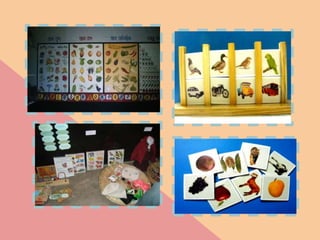
LEARNING/ACTIVITY CORNER
• A physical space is divided so that children can explore
things, experiment and pursue their own interests
• Learning corners are established places in the
classroom with resources that actively engage children
and AWW may change according to the theme/ topics
• Young children learn a great deal by interacting with
objects in their surroundings
• They are curious, love to explore and experiment with
objects and learn from such experiences.
ACTIVITY CORNERS
• Reading and Story Book Corner
• Dramatic Play corner
• Puzzles and Block Corner
• Creative Art Corner
• Writing Corner
• Science Corner
• Music Corner
DISPLAY
• It is essential to display children’s artwork on the wall.
• This helps children to remember activities in which they
participated and fosters their self-esteem
• They feel their work is valued.
• Parents feel proud of their children and take a more
active interest in their education when they see their
children’s work displayed in the centre.
• All displays should be at children’s eye level.
FURNITURES and MATS
• Furniture in the classroom must be child-sized
• Children feel comfortable sitting and working on them.
• It should have rounded edges and height should be of
child’s height so that they use their hands freely.
• Colourful mats can be used to mark the sitting area.
• Children must feel comfortable as they sit on the mat .
SHELVES
• Shelves should be low in height and hold
manipulative toys, puzzles and other learning
materials for children to explore.
• Children must have easy access to these resources.
• Storage shelves can be used to separate learning
corners to clearly mark boundaries.
LEARNING MATERIALS
• Developmentally appropriate play materials to foster all round development should be
available at the ECCE centre
• The materials should be safe, clean and in good conditions.
• Sufficient quantity should be available to work in small groups and it should be easily
accessible to the child.
• The materials should promote gross and fine motor development and help the child to
discover and explore, construct and social interaction along with creative expressions
through arts, painting, etc.
• The materials and teaching strategies should be differentiated on the basis of children’s
needs and context.
• Materials which can be adapted for meeting diverse abilities and multi-purpose usage should
be given preference.
• The materials should be differentiated on the basis of child use, teacher use and home use.
• AWW should be encouraged to develop learning materials using resources available. Parents,
local toy makers, craftsperson and other community members may be involved to create play
materials for children.
Item Name:
Lacing Aid
9/22/2020 42
Item Name: Tree &
Animal Jigsaw
Thank YouThank You

Communication in ecce

  • 1.
    Communication in ECCE Rahul GuptaBhaya Consultant , Early Childhood Care n Education Kolkata, India
  • 2.
    Building Blocks ofthe Brain in Early Childhood and how Communication happens
  • 3.
    Early Experience Increase inSynaptic Connections Brain Architecture Develops Repeated Early Experiences Strengthens Connection and Pathways Repetition of communication in any mode helps children to learn best : Play, Story-telling, activity based learning, any type.
  • 4.
    Neuron: The Buildingblock of brain
  • 5.
    What kinds ofexperiences foster brain development & communication skill Synaptic Density: Synapses are created with astonishing speed in the first three years of life. For the rest of the first decade, children’s brains have twice as many synapses as adults’ brains. Drawings supplied by H.T. Chugani
  • 6.
    Importance of communicationin Early Childhood … WHAT DOES RESEARCH SAY?
  • 7.
    Facts on braindevelopment • 100 billion neurons (brain cells) are present at birth. • At birth the number of synapses (neural connection is 2500 per neuron but increases to 15,000 by 2-3 years) • During the first six years of life 90% of a person’s brain is developed • In the first few years of life, 700 new neural connections are formed every second. CECED, Ambedkar University Delhi
  • 8.
  • 9.
    Interaction STANDARDS INTERACTION Adult-Child Interaction ❖ Teachergreets every child on arrival & departure ❖ Children greet the teacher on arrival & departure ❖All children are treated equally with respect, affection and care ❖ Caregivers do not use physical punishment or verbal abuse to discipline children ❖ Caregivers appreciate the cultural/ social and religious diversity of the children and promote tolerance and unity ❖ Caregivers/teachers demonstrate sensitivity & awareness regarding needs of children with special needs ❖ Children with special needs are encouraged and enabled to participate in the learning environment ❖ Children approach the teachers/ caregivers freely at any time ❖ ECCE Teachers/Caregivers do not demonstrate any bias related to gender, caste or class ❖ Caregivers encourage children to think, reason, question and experiment during the day ❖ Meaningful interaction with their teachers during meal/snack time
  • 10.
    Std-1: Interaction STANDARDS INTERACTION Child–Environmental/ Material Interaction ❖ Availability of varieties of equipment/ materials for indoor learning/play activities ❖ Access and use of age appropriate learning materials and adapted to children’s developmental needs. ❖ Opportunities provided for children to explore materials, use in learning concepts, develop and practice skills. ❖ Opportunities given to play with things available in nature. ❖Locally made learning materials available and used by children. ❖ Children can access the play and learning material freely Children take care of the material and put the material back at the designated spot
  • 11.
  • 12.
    Content of theCommunication for School Readiness • Oral Language Development • Reading Readiness • Writing Readiness • Math Readiness/Early numeracy • Science Experiments
  • 13.
    Language Matrix Listening (Process, Understand, interpretand evaluate spoken language in various situation) Speaking (Engage in oral communication in a variety of situations for a variety of purposes and audiences) Reading (Process, interpret, evaluate written language, symbols and text with understanding) Writing (engage in written communication in a variety of forms for a variety of purposes and audiences) Language
  • 14.
    Oral Language Communication •It is the foundation of literacy development. • Children say first word between 12-18Months age. • Begin to use complex sentence by the age 4-4 ½ yrs.
  • 15.
    Importance of OralLanguage Communication • It involves speaking and listening • Children who develop strong oral language skills during the preschool years create an important foundation for their later achievements in reading, especially reading comprehension. • Children who lag behind their peers in language development are at high risk for later reading difficulties. • Vocabulary knowledge is strongly related to reading proficiency and overall academic success.
  • 16.
    1.Vocabulary Enrichment Processes: • ThematicOpen Conversation • Chart based Open Conversation • Guessing game • Matching activity • Naming
  • 17.
    2.Rhymes Processes: • Rhymes tellingand listening • Vocabulary enrichment from rhymes • Question answer session from rhymes • Practice of rhyming words
  • 18.
    3.Story Processes: • Vocabulary Enrichmentfrom story • Question answer session from story • Drawing from story • Role play from story • Shared writing from story
  • 19.
  • 20.
    Emergent Literacy • Childacquires (somewhat automatically) some language, reading and writing skills before starting school when adequate and appropriate exposure to language is provided. • When these skills starts developing/ emerging in a child she can be considered developmentally ready for formal literacy instruction • The process of language development culminating into emergent literacy eventually builds a strong foundation for future language development of the child.
  • 21.
    Basic components ofemergent Literacy: • Motivation towards print material • Vocabulary • Print Awareness • Narrative skills • Letter Recognition • Phonemic Awareness
  • 22.
    Reading Readiness • Developingreading skills at an early age exposes children to words, ideas and text before entering school. • Reading with young children is an easy way to connect with them and teach them invaluable words and language skills. • Preschool-age children learn numbers and counting, shapes, colors, animals and words that vital to their early education.
  • 23.
    Activities for readingreadiness • Sound consciousness • Letter recognition • Letter sound relationship • Pretend reading • Shared reading
  • 24.
    Writing Readiness • Itis the fundamental skill children need to develop before they are able to write • It helps the child to develop the ability to hold and move a pencil fluently and effectively and produce legible writing.
  • 25.
    Activities for writingreadiness • Scribbling, drawing and writing from scribbling • Pretend writing • Shared writing • Pattern making from dot joining • Coloring
  • 26.
  • 27.
    Activities for earlynumeracy • Counting • Pattern making • Concept of measurement • Concept of whole and part • Concept of simple addition and subtraction • Graph
  • 28.
  • 29.
    Young children arenaturally curious about the world around them. Teaching science to preschoolers can enhance this interest and help little ones to learn to explore their environment. Hands-on science activities, experiments and projects allow the preschooler to make discoveries about natural phenomena, the outdoors and other scientific concepts. By engaging the young child in science exploration activities the preschool teacher can help young children to focus on the discovery process and possibly even decrease unwanted behaviors. Simple activities and experiments that help the children learn different properties of different objects can be done with them. E.g. sinking and floating, classification of leaves, mixing colours into water, heating metals and non-metals etc.
  • 30.
    Key Aspects ofthe Teacher’s Role Creating a Caring Community of Learners Teaching to Enhance Development and Learning Planning Curriculum to Achieve Important Goals Assessing Children’s Development and Learning Establishing Reciprocal Relationships with Families
  • 31.
    Communication through outdoorplay • It provides a space for play, exploration and social interactions. • It is mandatory that all children have the opportunity to engage in daily outdoor physical activity. • A specific time must be set aside every day for break time and for outdoor play/activities. • This time can be effectively used for free choice of play • It is important that the learning materials are modified for children with special needs.
  • 32.
    Classroom Management and Useof Material for better Communication
  • 33.
    SETTING UP ANEARLY CHILDHOOD CLASSROOM • The ECCE classroom arrangement must be flexible, which can be adjusted to lesson plans and activities • Large group activities include - singing, storytelling etc • Smaller group activities include drawing, blocks etc. • It should also have learning/activity ‘corners’ - creative corner, book corner, game corner, drawing etc. • It would facilitate play according to child’s interests
  • 34.
  • 35.
  • 36.
    LEARNING/ACTIVITY CORNER • Aphysical space is divided so that children can explore things, experiment and pursue their own interests • Learning corners are established places in the classroom with resources that actively engage children and AWW may change according to the theme/ topics • Young children learn a great deal by interacting with objects in their surroundings • They are curious, love to explore and experiment with objects and learn from such experiences.
  • 37.
    ACTIVITY CORNERS • Readingand Story Book Corner • Dramatic Play corner • Puzzles and Block Corner • Creative Art Corner • Writing Corner • Science Corner • Music Corner
  • 38.
    DISPLAY • It isessential to display children’s artwork on the wall. • This helps children to remember activities in which they participated and fosters their self-esteem • They feel their work is valued. • Parents feel proud of their children and take a more active interest in their education when they see their children’s work displayed in the centre. • All displays should be at children’s eye level.
  • 39.
    FURNITURES and MATS •Furniture in the classroom must be child-sized • Children feel comfortable sitting and working on them. • It should have rounded edges and height should be of child’s height so that they use their hands freely. • Colourful mats can be used to mark the sitting area. • Children must feel comfortable as they sit on the mat .
  • 40.
    SHELVES • Shelves shouldbe low in height and hold manipulative toys, puzzles and other learning materials for children to explore. • Children must have easy access to these resources. • Storage shelves can be used to separate learning corners to clearly mark boundaries.
  • 41.
    LEARNING MATERIALS • Developmentallyappropriate play materials to foster all round development should be available at the ECCE centre • The materials should be safe, clean and in good conditions. • Sufficient quantity should be available to work in small groups and it should be easily accessible to the child. • The materials should promote gross and fine motor development and help the child to discover and explore, construct and social interaction along with creative expressions through arts, painting, etc. • The materials and teaching strategies should be differentiated on the basis of children’s needs and context. • Materials which can be adapted for meeting diverse abilities and multi-purpose usage should be given preference. • The materials should be differentiated on the basis of child use, teacher use and home use. • AWW should be encouraged to develop learning materials using resources available. Parents, local toy makers, craftsperson and other community members may be involved to create play materials for children.
  • 42.
    Item Name: Lacing Aid 9/22/202042 Item Name: Tree & Animal Jigsaw
  • 48.