Literate about Literacy
Literacy Week 2017
Monique Jackson Reynolds (M.Ed.)
Technology Integration Literacy
Specialist
All you nee to know about what your children
need to know:
• What is Literacy?
• Being functionally literate
• Literacy Development at School
• In class
• Language Arts: The 4 Domains of Literacy
• Word Recognition (Phonics Skills) and Fluency
• Grammar and Conventions (Expanded Vocabulary)
• Comprehension (Understanding)
• Listening, Speaking and Writing
• Literacy development at Home
WHAT IS LITERACY?
Literacy in relation to language
development is the ability to read
(with understanding), speak
clearly and write with relevance in
accordance with the structure of
the language.
Being Functionally Literate
• A functionally literate person is one who can
engage in all the activities in which literacy is
required for effective functioning of his/her to
continue to use reading, writing and calculation
for his/her own and the community's
development. Being functionally literate differs
from one particular community to another.
What are some essential activitis in life we need to be literate to accomplish?
In Class
•Students are explicitly taught the skills to
recognize words, read fluently at their levels,
comprehend what they read, apply vocabulary
skills to use grammar well in writing and
speaking. They are modeled to, given guided
practise, shared practise and independent
practise.
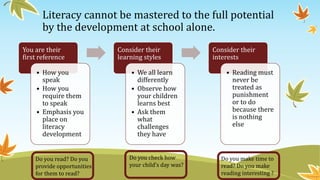
Literacy cannot be mastered to the full potential
by the development at school alone.
You are their
first reference
• How you
speak
• How you
require them
to speak
• Emphasis you
place on
literacy
development
Consider their
learning styles
• We all learn
differently
• Observe how
your children
learns best
• Ask them
what
challenges
they have
Consider their
interests
• Reading must
never be
treated as
punishment
or to do
because there
is nothing
else
Do you make time to
read? Do you make
reading interesting ?
Do you check how
your child’s day was?
Do you read? Do you
provide opportunities
for them to read?
Partner with your child’s teacher and act on
recommendations:
- Reading Assessments
- Psychological Educational Assessments
- Small group tutoring
- Individual Tutoring
- Books and special resources
• Fill Skills gaps (could be from absence, sickness, auditory, visual
impairment, inattentiveness, behaviour issues, cognitive
development (learns in a rare manner)
• Find out- check up, ask questions, search for solutions
Don’t wait until it is test time 
Don’t curse out the child if you know you have not done your best too.
But what else can
I do?
Family Literacy Tips: From A to Z
Encourage literacy in your home and community.
Here are some great tips to start everyone on the road to reading well.
Ask your child questions about the story you're reading to ensure comprehension.
Book family time to read with your children every day or even once per week.
Create a special reading place in your home, with your child's favorite books within reach.
Donate funds to a literacy cause.
Encourage children to read words on TV, street signs, mugs and T-shirts.
Find new stories to read with your children every week. Vary their length and subject matter.
Give your time to read aloud to a child.
Have a child read a book to you.
International Literacy Day is held on September 8 every year. Celebrate the day by picking up a book and reading to a child.
January 27 is Family Literacy Day in Canada and November 1 in the United States. Find out how to create an event in your corner of the world.
Keep teens reading. Give them books, newspaper articles and magazines about things that interest them – music, movies, TV and computers.
Let children count out the change when making a purchase. Reinforce the importance of math in everyday life!
Make every day a learning day. Ask your children to make a shopping list, read recipes together or help them make a calendar for the week.
Newborns benefit from reading too!
Organize a children's book club with friends in your neighborhood.
Pick one night a week to make a regular visit to the library.
Quiet, cozy reading spaces are good places for your child to read independently.
Remember that children learn by example – if you recognize the importance of reading, your children will too!
Start early! It's never too early to read to your children.
Treat a child to a story a day.
Use reading time to create a special bond with a child.
Volunteer your time. Family literacy groups in your community could use your help with tutoring adults and reading to children.
Write a letter.
X-ercise your mind! Reading ability is like a muscle, if you don't exercise it often, you will not maintain the same level of reading ability.
You are the key to improving a child's reading ability by placing a high priority on reading in your home.
Zap off the TV/tablet - pick up a book instead!
From ReadnigRockets.com

Literate about literacy

  • 1.
    Literate about Literacy LiteracyWeek 2017 Monique Jackson Reynolds (M.Ed.) Technology Integration Literacy Specialist
  • 2.
    All you neeto know about what your children need to know: • What is Literacy? • Being functionally literate • Literacy Development at School • In class • Language Arts: The 4 Domains of Literacy • Word Recognition (Phonics Skills) and Fluency • Grammar and Conventions (Expanded Vocabulary) • Comprehension (Understanding) • Listening, Speaking and Writing • Literacy development at Home
  • 3.
    WHAT IS LITERACY? Literacyin relation to language development is the ability to read (with understanding), speak clearly and write with relevance in accordance with the structure of the language.
  • 4.
    Being Functionally Literate •A functionally literate person is one who can engage in all the activities in which literacy is required for effective functioning of his/her to continue to use reading, writing and calculation for his/her own and the community's development. Being functionally literate differs from one particular community to another. What are some essential activitis in life we need to be literate to accomplish?
  • 5.
    In Class •Students areexplicitly taught the skills to recognize words, read fluently at their levels, comprehend what they read, apply vocabulary skills to use grammar well in writing and speaking. They are modeled to, given guided practise, shared practise and independent practise.
  • 6.
    Literacy cannot bemastered to the full potential by the development at school alone. You are their first reference • How you speak • How you require them to speak • Emphasis you place on literacy development Consider their learning styles • We all learn differently • Observe how your children learns best • Ask them what challenges they have Consider their interests • Reading must never be treated as punishment or to do because there is nothing else Do you make time to read? Do you make reading interesting ? Do you check how your child’s day was? Do you read? Do you provide opportunities for them to read?
  • 7.
    Partner with yourchild’s teacher and act on recommendations: - Reading Assessments - Psychological Educational Assessments - Small group tutoring - Individual Tutoring - Books and special resources • Fill Skills gaps (could be from absence, sickness, auditory, visual impairment, inattentiveness, behaviour issues, cognitive development (learns in a rare manner) • Find out- check up, ask questions, search for solutions Don’t wait until it is test time  Don’t curse out the child if you know you have not done your best too.
  • 8.
    But what elsecan I do?
  • 9.
    Family Literacy Tips:From A to Z Encourage literacy in your home and community. Here are some great tips to start everyone on the road to reading well. Ask your child questions about the story you're reading to ensure comprehension. Book family time to read with your children every day or even once per week. Create a special reading place in your home, with your child's favorite books within reach. Donate funds to a literacy cause. Encourage children to read words on TV, street signs, mugs and T-shirts. Find new stories to read with your children every week. Vary their length and subject matter. Give your time to read aloud to a child. Have a child read a book to you. International Literacy Day is held on September 8 every year. Celebrate the day by picking up a book and reading to a child. January 27 is Family Literacy Day in Canada and November 1 in the United States. Find out how to create an event in your corner of the world. Keep teens reading. Give them books, newspaper articles and magazines about things that interest them – music, movies, TV and computers. Let children count out the change when making a purchase. Reinforce the importance of math in everyday life! Make every day a learning day. Ask your children to make a shopping list, read recipes together or help them make a calendar for the week. Newborns benefit from reading too! Organize a children's book club with friends in your neighborhood. Pick one night a week to make a regular visit to the library. Quiet, cozy reading spaces are good places for your child to read independently. Remember that children learn by example – if you recognize the importance of reading, your children will too! Start early! It's never too early to read to your children. Treat a child to a story a day. Use reading time to create a special bond with a child. Volunteer your time. Family literacy groups in your community could use your help with tutoring adults and reading to children. Write a letter. X-ercise your mind! Reading ability is like a muscle, if you don't exercise it often, you will not maintain the same level of reading ability. You are the key to improving a child's reading ability by placing a high priority on reading in your home. Zap off the TV/tablet - pick up a book instead! From ReadnigRockets.com