Turning ADHD into
“Awesome Dynamic Highly
Dependable”
Kellyn Gorman
Director of Data and AI
Silk
Who am I?
Kellyn Gorman
• Director of Data and AI at Silk, Consultant at Redgate Software and
Core Contributor at DZone
• Lives in Portland, OR on the Columbia River in a floating home
• 30 Yrs in Tech, DBA- MSSQL, Oracle, MySQL, DB2, PostgreSQL, Sybase
• Techie, author, contributor, mentor and sponsor.
https:dbakevlar.com
@DBAkevlar
https://linkedIn/in/kellyngorman
Attention Deficit Hyperactive Dynamic
“Strange Brilliant Child”
Obliviously brilliant
Daydreamer
Ability to recite stories from memory
When put on the spot, became anxious and suffered “brain shut-down”
Never sat still, always climbing
Lack of impulse control- took apart electronics, always touching everything, speaking up when asked to be silent
On the spectrum- difficulty interacting with peers
Considerable anxiety- happiest alone
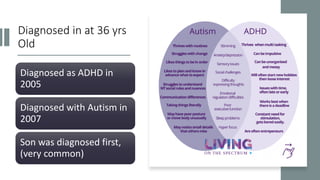
Diagnosed in at 36 yrs
Old
Diagnosed as ADHD in
2005
Diagnosed with Autism in
2007
Son was diagnosed first,
(very common)
Growing Up
with ADHD
• Not living up to your potential
• Stop being lazy
• Pay attention/Pull it together!
• Please sit still/stop climbing/stop running/dancing
around/stop touching everything!
• Why must you talk so much? Ask so many questions?
• Widespread misinformation about drugs used in the
treatment of ADHD
• Although recent breakthroughs in public stigma around
ADHD and Autism have been made, still a lot of
misinformation.
My ADHD Brain as an Adult
What is ADHD?
• Attention Deficit [Hyperactivity] Disorder
• Most common neurodevelopmental
conditions in human beings.
• Often diagnosed in childhood
• Although 3-7 types identified,
common issues are:
• Inattentiveness
• Lack of self-control,
(impulsiveness)
• Hyperactivity
• Hyper-focus, (for some)
• Lack of detail
• Anxiety
• Emotional
• Difficult to diagnose and no one set of
tests exist.
• Significant stigma around ADHD
What is Going
on When you
Have ADHD?
• Impacted areas of the brain with low levels of activity when
tedious or stressful situations occur.
• Scenarios that are interactive, interesting or exciting create
normal neuro-transmitter activity.
• Can be very demoralizing throughout the entire lifetime of
the individual.
• Impacts to education, relationships, career and overall
quality of life.
• Male brains are impacted differently than female brains
both due to how we are raised and chemical differences.
Less Known
Symptoms
• Obsessive itching, tics, picking or scratching at self.
• Hyper-sensitivity to clothing seams, tags or even
colors.
• Hoarding/sloppy/messy
• Addictive behavior: food, shopping, drugs, sex, etc.
• Working memory deficit- A small detail will be
forgotten or a word you just discussed can’t be
recalled.
• Combination with other neurodivergent issues is
common.
• Hyperactivity can be demonstrated more than in
physical activity- finger tapping, leg shaking,
talking fast, eye movement, aggression, emotional
or physical outbursts, etc.
Three Primary
Types of ADHD
Inattentive Presentation
• Executive dysfunction
• Inattentive to detail
• Difficulty with paying attention
• Unable to follow instructions or remember conversations.
Hyperactive-Impulsive Presentation
• Very talkative and may speak very fast. Tendency to interrupt.
• Unable to sit still
• Fidgets
• Restless
• Poor sleep patterns
• Impulsive/lack of control
• Accident prone
Combined Presentation
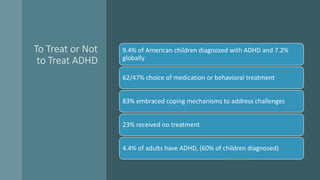
To Treat or Not
to Treat ADHD
9.4% of American children diagnosed with ADHD and 7.2%
globally
62/47% choice of medication or behavioral treatment
83% embraced coping mechanisms to address challenges
23% received no treatment
4.4% of adults have ADHD, (60% of children diagnosed)
• Data and Statistics About ADHD | CDC
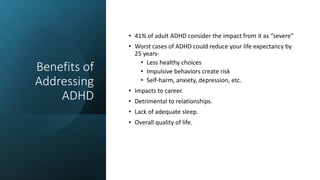
Benefits of
Addressing
ADHD
• 41% of adult ADHD consider the impact from it as “severe”
• Worst cases of ADHD could reduce your life expectancy by
25 years-
• Less healthy choices
• Impulsive behaviors create risk
• Self-harm, anxiety, depression, etc.
• Impacts to career.
• Detrimental to relationships.
• Lack of adequate sleep.
• Overall quality of life.
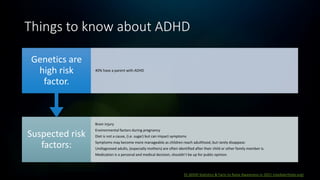
Things to know about ADHD
31 ADHD Statistics & Facts to Raise Awareness in 2021 (medalerthelp.org)
Suspected risk
factors:
Brain injury
Environmental factors during pregnancy
Diet is not a cause, (i.e. sugar) but can impact symptoms
Symptoms may become more manageable as children reach adulthood, but rarely disappear.
Undiagnosed adults, (especially mothers) are often identified after their child or other family member is.
Medication is a personal and medical decision, shouldn’t be up for public opinion.
Genetics are
high risk
factor.
40% have a parent with ADHD
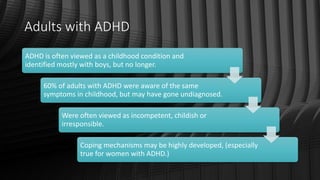
Adults with ADHD
ADHD is often viewed as a childhood condition and
identified mostly with boys, but no longer.
60% of adults with ADHD were aware of the same
symptoms in childhood, but may have gone undiagnosed.
Were often viewed as incompetent, childish or
irresponsible.
Coping mechanisms may be highly developed, (especially
true for women with ADHD.)
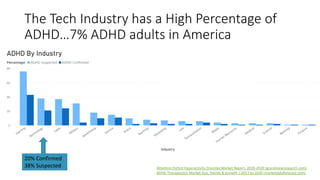
The Tech Industry has a High Percentage of
ADHD…7% ADHD adults in America
Attention Deficit Hyperactivity Disorder Market Report, 2018-2020 (grandviewresearch.com)
ADHD Therapeutics Market Size, Trends & Growth | 2017 to 2020 (marketdataforecast.com)
20% Confirmed
38% Suspected
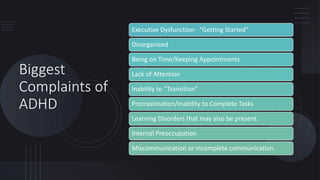
Biggest
Complaints of
ADHD
Executive Dysfunction- “Getting Started”
Disorganized
Being on Time/Keeping Appointments
Lack of Attention
Inability to “Transition”
Procrastination/Inability to Complete Tasks
Learning Disorders that may also be present.
Internal Preoccupation
Miscommunication or incomplete communication.
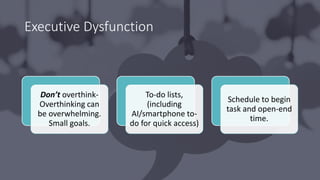
Executive Dysfunction
Don’t overthink-
Overthinking can
be overwhelming.
Small goals.
To-do lists,
(including
AI/smartphone to-
do for quick access)
Schedule to begin
task and open-end
time.
Disorganization
• Remove clutter- If you don’t need it, then get rid of it.
• Schedule time for designated tasks- email, daily, quick cleanup, etc. to keep from becoming
overwhelming.
• Consider, (if available) to outsource weak points, such as housecleaning, weekly shopping
• Simplify clothing choices.
• Keep copies of important items with you, (medication, paperwork.) If you take medication, have
some with you if you forget to take it.
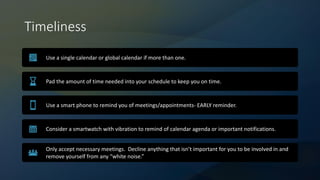
Timeliness
Use a single calendar or global calendar if more than one.
Pad the amount of time needed into your schedule to keep you on time.
Use a smart phone to remind you of meetings/appointments- EARLY reminder.
Consider a smartwatch with vibration to remind of calendar agenda or important notifications.
Only accept necessary meetings. Decline anything that isn’t important for you to be involved in and
remove yourself from any “white noise.”
Distracted
“That snail is too loud….”
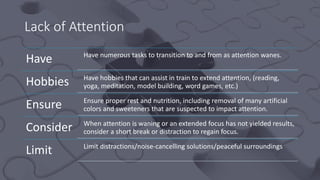
Lack of Attention
Have Have numerous tasks to transition to and from as attention wanes.
Hobbies Have hobbies that can assist in train to extend attention, (reading,
yoga, meditation, model building, word games, etc.)
Ensure Ensure proper rest and nutrition, including removal of many artificial
colors and sweeteners that are suspected to impact attention.
Consider When attention is waning or an extended focus has not yielded results,
consider a short break or distraction to regain focus.
Limit Limit distractions/noise-cancelling solutions/peaceful surroundings
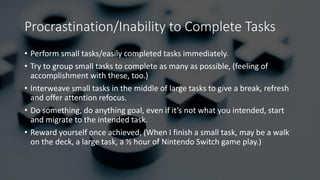
Procrastination/Inability to Complete Tasks
• Perform small tasks/easily completed tasks immediately.
• Try to group small tasks to complete as many as possible, (feeling of
accomplishment with these, too.)
• Interweave small tasks in the middle of large tasks to give a break, refresh
and offer attention refocus.
• Do something, do anything goal, even if it’s not what you intended, start
and migrate to the intended task.
• Reward yourself once achieved, (When I finish a small task, may be a walk
on the deck, a large task, a ½ hour of Nintendo Switch game play.)
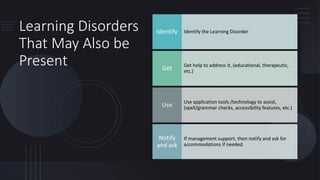
Learning Disorders
That May Also be
Present
Identify the Learning Disorder
Identify
Get help to address it, (educational, therapeutic,
etc.)
Get
Use application tools /technology to assist,
(spell/grammar checks, accessibility features, etc.)
Use
If management support, then notify and ask for
accommodations if needed.
Notify
and ask
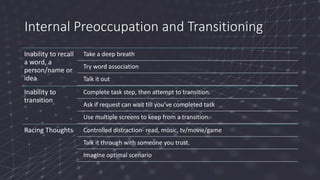
Internal Preoccupation and Transitioning
Inability to recall
a word, a
person/name or
idea
Take a deep breath
Try word association
Talk it out
Inability to
transition
Complete task step, then attempt to transition.
Ask if request can wait till you’ve completed task
Use multiple screens to keep from a transition.
Racing Thoughts Controlled distraction- read, music, tv/movie/game
Talk it through with someone you trust.
Imagine optimal scenario
Communication
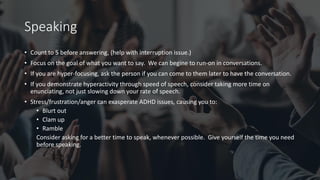
Speaking
• Count to 5 before answering, (help with interruption issue.)
• Focus on the goal of what you want to say. We can begine to run-on in conversations.
• If you are hyper-focusing, ask the person if you can come to them later to have the conversation.
• If you demonstrate hyperactivity through speed of speech, consider taking more time on
enunciating, not just slowing down your rate of speech.
• Stress/frustration/anger can exasperate ADHD issues, causing you to:
• Blurt out
• Clam up
• Ramble
Consider asking for a better time to speak, whenever possible. Give yourself the time you need
before speaking.
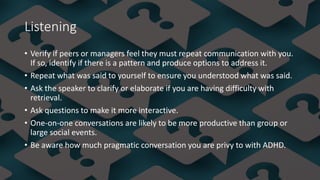
Listening
• Verify if peers or managers feel they must repeat communication with you.
If so, identify if there is a pattern and produce options to address it.
• Repeat what was said to yourself to ensure you understood what was said.
• Ask the speaker to clarify or elaborate if you are having difficulty with
retrieval.
• Ask questions to make it more interactive.
• One-on-one conversations are likely to be more productive than group or
large social events.
• Be aware how much pragmatic conversation you are privy to with ADHD.
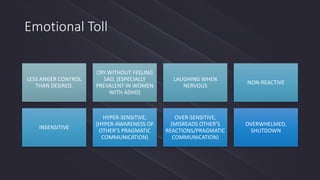
Emotional Toll
LESS ANGER CONTROL
THAN DESIRED.
CRY WITHOUT FEELING
SAD, (ESPECIALLY
PREVALENT IN WOMEN
WITH ADHD)
LAUGHING WHEN
NERVOUS
NON-REACTIVE
INSENSITIVE
HYPER-SENSITIVE,
(HYPER-AWARENESS OF
OTHER’S PRAGMATIC
COMMUNICATION)
OVER-SENSITIVE,
(MISREADS OTHER’S
REACTIONS/PRAGMATIC
COMMUNICATION)
OVERWHELMED,
SHUTDOWN
Office Space/Open Space
• Open Space Offices are Everywhere…
• Re-arrange so desk faces a wall.
• Purchase noise-cancelling headphones.
• Locate quiet location for focus time.
• Arrange monitors to build barrier from distractions.
• Incorporate breaks throughout the day.
• Consider a “Do Not Disturb” sign for focus times.
Ask for an opportunity to move to quieter location if there is an issue.
Work Environment
• Need Structure? Build out with scheduling, web meetings and timers.
• At home distractions
• Home Office
• Try observed, controlled outing, (coffee house)
Work From Home
• Ask for scheduled times for work vs. collaboration.
• Set aside scheduled time for emails.
• Schedule focus time into calendar free of meetings and interruptions
Collaboration Group/
Make a list of what works for you and what doesn’t when it comes to work!
Work With, Not Against ADHD
Load up your plate with
more tasks than you think
you can accomplish, allows
for easier transition and
ability to keep busy.
Multi-task when able.
Keeps notes/data in a single
locations vs. multiple and
accessible from all devices.
Use your impulsiveness to
take risks that might end up
opportunities lost.
Persistence- The difference
between failure and success
is often trying one more
time.
Let your manager know
how he can make you
successful, (Train your
manager)
Find other neurodiverse
individuals who may be
able to help you find
opportunities for success.
Team up with individual
that is meticulous, detail
oriented and balances out
your ADHD mindset.
Tools
• Organizers
• Smart Phones, (along with smart watches- discuss benefits)
• Timers
• Routines
• Smart Home Devices
• Bill Pay/Auto Pay
• Online Automation
• Applications/Services
• Meal/Grocery Delivery
• Simplify EVERYTHING.
I Still Face Challenges…
• Topics which I don’t find interesting or part of my area of focus.
• Mundane employment training or certification tests can take me an extensive amount of time.
• The last 5% of many tasks can go undone if waiting on someone else.
• Tasks that are low-priority and/or don’t have a deadline or clear directions.
• A task or initiative that I don’t believe in or goes against my knowledge on the topic.
• Busy, noisy or distracting work environments.
• Office setups that aren’t constructive to my ADHD.
These scenarios can set me up for failure and at my age, I simply don’t have the patience for it
anymore.
Be Kind To Yourself
Don’t expect
perfection, expect
small successes.
Give yourself a
break, (i.e. take
breaks and show
yourself kindness.)
Get plenty of rest
and eat healthy.
Make yourself
comfortable.
Remove or mask
distractions.
You feel things for
a reason- find out
the why, address
the why.
My Own Tips To Success
Identify and OWN your ADHD. Find your superpower!
Find what you’re passionate about and build it into your job and hobbies.
Your job is only as good as your boss.
Train your boss to be good at managing YOU.
Set yourself up for success.
Rid yourself or silence the “negative noise”- people, places and things.
Automate or “Auto-pilot” everything and anything to free up focus resources.
Essential notifications from smartphone to Apple watch keeps me dependable and on-time.
Small tasks I do immediately, and “pepper” transitioned between larger tasks when focus wanes.
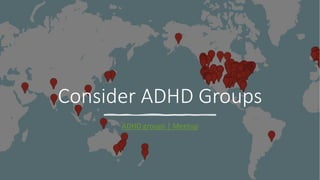
Consider ADHD Groups
ADHD groups | Meetup
ADHD
Awareness
Month
is October!
Kellyn Gorman
Kellyn.Gorman@silk.us
@DBAKevlar
https://dbakevlar.com
Data Platform Neurodiversity Data – Oct. 3rd Full Day of
Virtual Sessions!
Neurodiversity Day 2024, Thu, Oct 3, 2024, 8:00 AM |
Meetup
References
• Learn the 8 Superpowers of Highly Successful ADHD Leaders | Inc.com
• CHADD - Improving the lives of people affected by ADHD
• ADHD Support for Parents of ADD, ADHD Children | HealthyPlace
• Learn the 8 Superpowers of Highly Successful ADHD Leaders | Inc.com
• Difference Between ADHD and Executive Function Disorder
• 12 Things to do for Coping with Attention Deficit Hyperactivity Disorder
• Home | ADDA - Attention Deficit Disorder Associationer (ADHD or ADD) Successfully
• The Queen of Distraction: How Women with ADHD Can Conquer Chaos, Find Focus, and Get More Done: Terry Matlen, Sari Solden: 9781626250895:
Amazon.com: Books
• Fast Minds: How to Thrive If You Have ADHD (Or Think You Might): Surman, Craig, Bilkey, Tim, Weintraub, Karen: 9780425274064: Amazon.com: Books
• Driven to Distraction (Revised): Recognizing and Coping with Attention Deficit Disorder: Hallowell M.D., Edward M., Ratey M.D., John J.: 2015307743152:
Amazon.com: Books
• CliftonStrengths Online Talent Assessment | EN - Gallup
Thank you!
Kellyn Gorman
Director of Data and AI, Silk
Dbakevlar@gmail.com
@Dbakevlar