International Journal of Electrical and Computer Engineering (IJECE)
Vol. 14, No. 2, April 2024, pp. 1572~1582
ISSN: 2088-8708, DOI: 10.11591/ijece.v14i2.pp1572-1582  1572
Journal homepage: http://ijece.iaescore.com
Effective driver distraction warning system incorporating fast
image recognition methods
Van Binh Nguyen1
, Phu Duy Trinh2
1
School of Electrical Engineering, International University, Vietnam National University, Ho Chi Minh City, Vietnam
2
FPT Telecom, FPT Group, Ho Chi Minh City, Vietnam
Article Info ABSTRACT
Article history:
Received Jan 21, 2023
Revised Nov 4, 2023
Accepted Dec 18, 2023
Modern cars are equipped with advanced automatic technology featuring
various safety measures for car occupants. However, the growing density of
vehicles, especially in areas where infrastructure development lags, poses
potential dangers, particularly accidents caused by driver subjectivity. These
incidents may occur due to driver distraction or the presence of high-risk
obstacles on the road. This article presents a comprehensive solution to assist
drivers in mitigating these risks. Firstly, the study introduces a novel method
to enhance the recognition of a driver's facial features by analyzing
benchmarks and the whites of the eyes to assess the distraction level.
Secondly, a domain division method is proposed to identify obstacles and
lanes in front of the vehicle, enabling the assessment of the danger level.
This information is promptly relayed to the driver and relevant individuals,
such as the driver's manager or supervisor. An experimental device has also
been developed to evaluate the effectiveness of the algorithms, solutions,
and processing capabilities of the system.
Keywords:
Distraction warning system
Eye recognition
Lane recognition
Object identification
Driver assistance system
This is an open access article under the CC BY-SA license.
Corresponding Author:
Van Binh Nguyen
School of Electrical Engineering, International University, Vietnam National University
Linh Trung Ward, Thu Duc City, Ho Chi Minh City, 700000, Vietnam
Email: nvbinh@hcmiu.edu.vn
1. INTRODUCTION
It can be noted that modern car technology has significantly enhanced safety measures, contributing
to the reduction of losses resulting from accidents. However, in many accident cases, the root cause does not
stem from the vehicle itself but rather from the subjectivity of the driver. Incidents often occur due to driver
distraction, fatigue, or drowsiness. During such instances, drivers experience reduced alertness and
responsiveness to external factors that may pose danger. This phenomenon is referred to as "Micro Sleep,"
defined as a brief and involuntary period of sleep that can occur at any time due to fatigue or prolonged sleep
deprivation. Micro-sleep episodes typically last for a few seconds and can pose a severe risk, especially for
individuals operating a vehicle.
Several signs indicate that individuals are not fully awake while driving, such as frequent yawning,
continuous and slow eye blinking, a bowed or tilted head, and drifting from the lane. Previous studies have
explored various methods to assess distraction and assist drivers based on facial variables. Two primary
approaches to evaluating fatigue or sleepiness include physiological-based techniques and behavioral-based
techniques. Physiological techniques involve the use of electrodes to measure indicators on the body.
However, this method can be inconvenient for the driver. On the other hand, the behavioral-based approach
assesses eye, face, and head movements, as well as yawning behavior, to detect sleepiness. Most studies
suggest that, to ensure comfort and avoid impacting driving, assessing driver behavior through camera image
processing is a viable option.
Int J Elec & Comp Eng ISSN: 2088-8708 
Effective driver distraction warning system incorporating fast image … (Van Binh Nguyen)
1573
Several works utilize eye images to assess the driver's fatigue state. For example, Horng et al. [1]
proposed a vision-based real-time driver fatigue detection system that locates the driver's face using skin
color characteristics, employs an edge detection method to identify eye regions, and uses the obtained eye
images for sleepiness detection, generating warning alarms for the driver. However, this system must run on
a personal computer and faces challenges in rapid application within a car. Another non-intrusive prototype
computer vision system monitors a driver's vigilance in real-time, based on a hardware system for acquiring
driver images. It uses an active infrared (IR) illuminator to monitor eyelid movements and facial pose,
characterizing the driver's level of vigilance [2]. Nevertheless, this system is tailored to a specific individual
rather than being applicable to a broader range of drivers. Rahman et al. [3] proposed an eye blink
monitoring algorithm that uses eye feature points to determine the state of the eye and activates an alarm.
However, this article does not account for specific blinking patterns and facial expressions. Another
embedded monitoring system was introduced to detect symptoms of driver drowsiness by exploiting the
bright pupils' phenomenon. The algorithm detects and tracks the driver's eyes, but encounters issues with
light poles being misclassified as eyes due to their shape and size [4]. Flores et al. [5] presented a system
designed to track and analyze the face to determine a drowsiness index. It operates under different light
conditions. However, the system still exhibits a high percentage of error and false alarms, indicating a need
for improvement. Similar directions of research can be found in other publications [6]–[8].
Other works combine eye images with additional facial features to assess sleepiness status.
Kumar et al. [9] presented an analysis of a fusion method for eye blinking and yawning detection based on
changes in mouth features. The algorithm employs OpenCV with the Haar cascade function for detecting
facial features and the active contour method for lip activity. However, this research does not consider head
movement to enhance the proposed method's accuracy. Teyeb et al. [10] developed a drowsy detection
system using image processing to analyze eye blinking status for measuring eye closure period and head
posture determination. However, the method for determining the angle of head inclination is not optimal,
particularly in cases of the head tilted forward. Khunpisuth et al. [11] addressed driver drowsiness by
creating an experiment to evaluate the level of sleepiness. Using the Haar cascade classifier, the frequency of
head tilting and eye blinking was used to warn driver drowsy status. However, various light conditions might
impact the accuracy of the proposed method. Similar combinations were explored in another study [12].
Several contributions to fatigue detection involve the incorporation of various facial factors.
Saradadevi and Bajaj presented driver fatigue determination based on monitoring the mouth [13]. The
method locates and tracks the driver's mouth using a cascade of classifiers for faces. Support vector machines
are used to train face images. It is evident that combining more eye elements and head movement is
necessary for better results. Another work proposed an efficient system for evaluating fatigue using face and
yawning extraction based on support vector machines and circular Hough transform for mouth detection [14].
The system does not require any training data and could work with a low-cost webcam under various lighting
conditions. Tawari et al. [15] presented a system which tracks facial features and analyzes their geometric
configuration to estimate the head pose using a 3D model. Liu et al. [16] presented a space-time restrained
AdaBoost method to increase the detection rates. In this work, a space-time restriction strategy is designed to
restrain the detection window and scale of the AdaBoost method to reduce false-detection cases. Recently,
another drowsiness detection system by analyzing the driver's face with a standard camera was proposed
[17]. In this case, a set of facial landmark locations are detected by a fuzzy inference system (FIS). This is a
relatively accurate proposal but still not complete for practical application. Akrout and Mahdi [18] proposed
work to recognize driver behavior by determining the characteristics of the face. This is a fusion system
based on the detection of yawn, somnolence, and 3D head pose estimation. However, the results of the study
are still influenced by lighting conditions.
In cases where the driver has specific factors, such as wearing glasses or staying in low-light
conditions, different approaches are also suggested. Assari and Rahmati [19] proposed and implemented a
infrared light based hardware system. They follow face detection steps, with facial components considered
the most important and effective for drowsiness detection. Ahmad and Borole [20] implemented a system
using the object identifier within the MATLAB vision toolbox, which detects face, mouth, nose, eyes. In this
system, yawning is determined and considered based on the mouth opening portion. The algorithms are
formulated under various categories, such as a normal driver, a driver with glasses under different light
situations. Li and Zhou [21] presented a wearable eye tracker that detects both the 2D position and diameter
of a pupil based on its light absorption feature. This research uses infrared lights to illuminate the eye from
different directions, while photodiodes sense the reflected light, which are used to infer the pupil information.
The system can exploit characteristics of various eye movement stages and can be applied for drowsiness
detection.
Several recent studies have adopted a neural network approach to detect short periods of sleepiness.
Doppala et al. [22] proposed a drowsiness identification system by capturing image frames of the driver's
face from the video stream. In this study, a deep convolutional neural network (D-CNN) model is suggested
 ISSN: 2088-8708
Int J Elec & Comp Eng, Vol. 14, No. 2, April 2024: 1572-1582
1574
to detect drowsiness under various circumstances, such as drivers with and without glasses. In another
system, the driver is alerted when they are drowsy using convolutional neural networks (CNN) [23].
In addition to detecting the state of a drowsy face, determining the direction of the vehicle's
movement on the road and detecting obstacles also helps warn of unexpected incidents. Nugraha et al. [24]
used the you only look once network (YOLO) as the object detector and polynomial regression as the road
guidance. Kemsaram et al. [25] presented a neural network to detect lane markings, objects, using a
monocular. Another work presented a lane detection algorithm based on the combined CNN with the random
sample consensus (RANSAC) approach [26]. It can be seen that the works mentioned are partially or
incompletely resolved for drowsiness detection and driver warning systems.
In order to improve the accuracy and speed of facial information processing, as well as the detection
of objects on the road, this study introduces new approaches. Two cameras are used to directly observe the
driver's face and objects on the road, employing rapid image processing methods to recognize and assess the
driver's drowsy situation. This image processing method utilizes a novel approach to determine benchmark
points and characteristic white areas on the face and in the eyes. Additionally, lanes, obstacles, and traffic
signs are identified to assess the level of danger to vehicles and drivers. In the event of distraction, an on-
board warning system will trigger a signal to alert the driver. Simultaneously, the driver's information will be
transmitted to the monitoring system or the vehicle management department.
The article comprises three main parts. Section 2 introduces a method to identify distractions based
on benchmarks and white areas of the face. The image separation method, applying the fast image
recognition algorithm, is proposed in section 3. Section 4 provides a description of the complete monitoring
system, outlining the practical application of the results. Finally, Section 5 contains conclusions.
2. FACE IMAGE RECOGNITION ALGORITHM
The observations and studies clearly indicate that the most prominent signs of driver distraction are
the tilt of the head and eye gestures. In such cases, the eyes tend to remain closed for a longer duration than
during regular blinking, and the head is typically bent or slightly tilted for an extended period. The position
of the head may suggest that the driver is either distracted due to drowsiness or focused on objects not on the
road ahead. The algorithm for determining the head tilt and eye-closed state is illustrated in Figure 1. The
process involves analyzing the original camera image to ascertain the position of the driver's head.
Subsequently, the degree of head tilt and eye closure is transmitted to the evaluation and analysis block. In
situations of potential danger, both the on-board warning system and the remote management alert are
activated.
Figure 1. Distracted state identification process
2.1. Determine head tilt angle
To assess facial features, it is essential to determine the position of the head in the image. Digital
camera images undergo preprocessing steps, including conversion to grayscale and filtering image noise. The
resulting image is then input into the initial face recognition model. Face recognition can be achieved through
various methods, such as the AdaBoost classification algorithm using Haar-like features, which is available
in the OpenCV library. Additionally, methods like histogram of oriented gradients and linear support vector
machine, pre-trained for face detection, can be applied. Deep learning algorithms are also employed for
locating face coordinates in images.
Int J Elec & Comp Eng ISSN: 2088-8708 
Effective driver distraction warning system incorporating fast image … (Van Binh Nguyen)
1575
Due to its effectiveness, this study utilizes the Haar-like feature-based AdaBoost detection method.
The Haar-like feature employs a simple but efficient transformation, calculating its characteristic as the
difference between the sum of geometric domains. Through this method, the coordinate frame for the face
boundary is determined for further inclusion in subsequent algorithms.
To identify changing facial features, this study employs a novel approach by utilizing the improved
facial Landmark model. The method applied to this model is capable of detecting crucial facial features,
including mouth, eyes, eyebrows, nose, and facial corners such as the corners of the eyes and eyelids. Most
landmark detection methods are applied based on a regression problem where the detector redefines the
mapping from an image to landmark locations. The technique employs the Softmax regression method,
utilizing neural networks to learn facial properties, and end-to-end regression with tiered architecture to
update face landmark estimates. This technique still harnesses the inherent advantages of the CNN network.
Existing detectors are trained from sets of available databases with images of different lighting conditions,
various facial expressions, and diverse face rotations. Therefore, the algorithm typically achieves a high
accuracy, usually exceeding 94%.
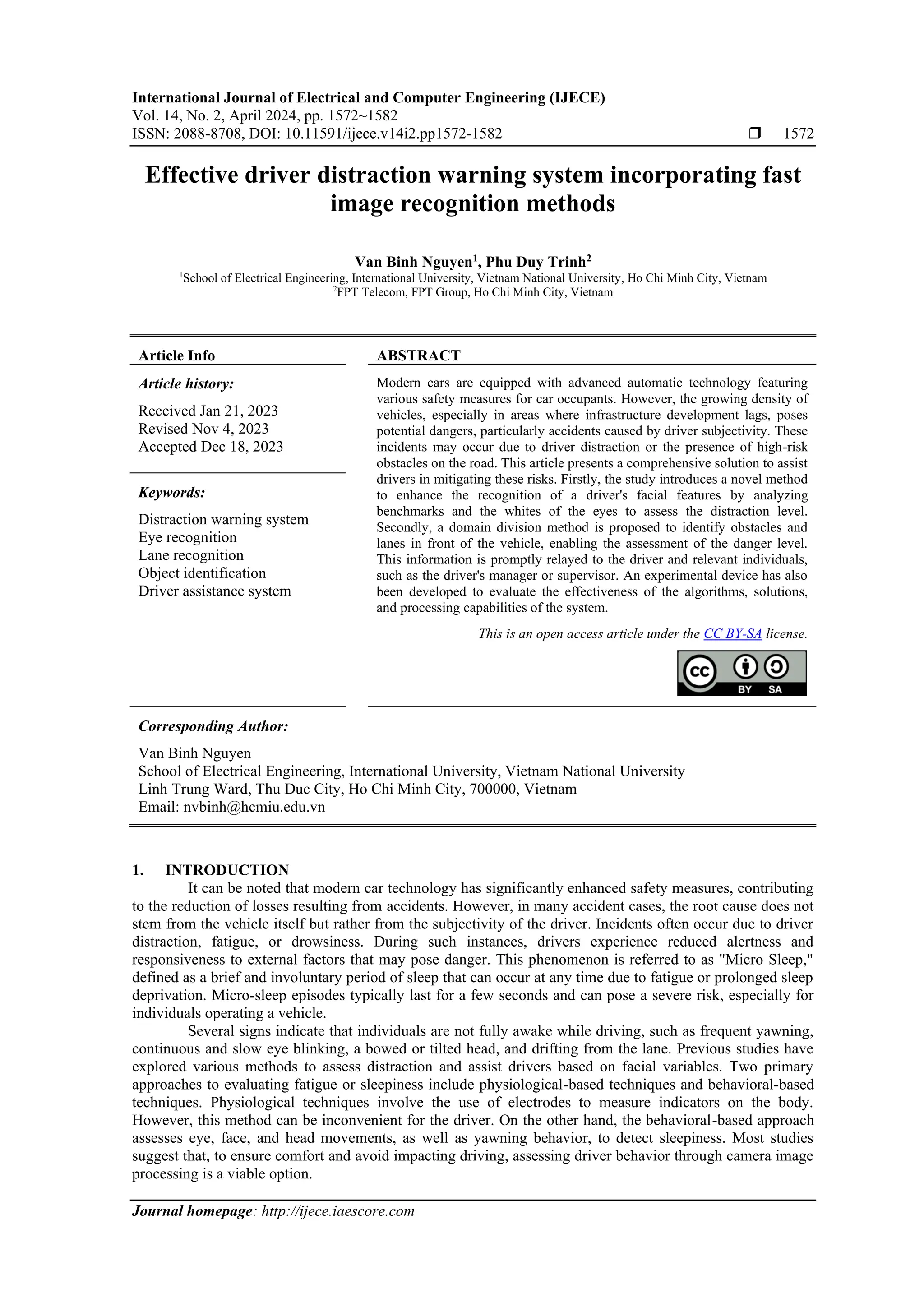
To clearly assess the facial features, this study separates the important points from p1 to p15. The
locations of these points are shown in Figure 2. These points have features that are easy to identify by
algorithms using face benchmark model. To assess eye status, six points around the border of each eye
should be identified and two points on either side of the mouth image are determined to assess head status.
Figure 2. Characteristic defining points for face states
To determine head tilt, this study proposes to use four points of the eyes and mouth. These points
are p1, p8, p14 and p15. These points are characterized by their large bends, so they are easy to identify by
Facial Benchmark model with high accuracy. The location of these points and the changes of the points when
the face moves are shown in Figure 3. The center point of the face p18 is defined as the midpoint of the line
segment connecting the midpoints of the lines p1p8 and p14p15 in Figure 3(a).
Normally, when the driver looks ahead, the y-axis position on the image coordinates of point p18 has
a small value. When bowing forward in Figure 3(b), this coordinate increases, corresponding to the point p18
being lowers in the frame. In the case of the head tilted as shown in Figures 3(c) and 3(d), the coordinates of
point p18 also drop dramatically in the frame. The coordinates of point p18 are determined as (1).
𝑦18 =
|𝑦1+𝑦8+𝑦14+𝑦15|
4
(1)
When the driver is sitting upright, the head tends to tilt to one side rather than forward. The
inclination of the head is determined by the deflection angle of the line passing through the point p18 and the
inclination of the line segment p1p8. By determining the position of the p18 point and the tilt of the head, it is
possible to assess the state of distraction. If the driver tilts his head for long enough, distraction begins to
appear.
 ISSN: 2088-8708
Int J Elec & Comp Eng, Vol. 14, No. 2, April 2024: 1572-1582
1576
(a) (b)
(c) (d)
Figure 3. Results of identifying facial points with different tilt states of the head, including (a) normal head
state, (b) forward head tilt state, (c) slight head tilt to the left, and (d) strong head tilt to the left
2.2. Eye state recognition
In most cases, a medium-quality camera can be used to receive images of the eye for recognition
algorithms. In case of necessity, different types of cameras can be used to improve the results of eye status
assessment such as infrared cameras [17], or glasses with specialized cameras [21]. The work in this paper
implements an algorithm for analyzing eye states using a standard camera in normal lighting conditions.
Many methods have been presented to automatically detect blinks in a sequence of images in a
video. Nevertheless, a major drawback of previous approaches is their dependency on various factors when
setting up the recognition model. These approaches are influenced by factors such as camera angle, image
resolution, light source hitting the eye, or movements of the driver being detected. To address this problem,
this study continues to use the points identified, as shown in Figure 2. From the position coordinates of the
recognized eye landmarks, determining the state of sleepiness is possible by relying on the longer duration of
the blinking state. Each person has a different blink pattern in terms of how fast they open and close their
eyes, how wide the eyes are when opened and closed, and the blink cycle or average time between blinks.
Normally, a blink lasts about 100 to 400 ms. In this study, blinks lasting more than 1,200 ms are considered
distracting.
The proposed method in this study leverages the performance of the facial Landmark detector to
recognize the position of the eye and the contour of the eye on the image frame. It identifies the bright sclera
area of the eye, as the sclera region has the advantage of having the highest brightness on the face, making it
more easily detected, especially in low-light conditions. From landmark points, the algorithm calculates the
eye aspect ratio (EAR) to estimate the eye's open state. The EAR ratio based on eye height and width is
calculated using (2). The positions of the points to determine this ratio are shown in Figure 4. For different
eye states, the benchmark points will shift accordingly. The denominator part of the formula is multiplied by
the factor k. This is a factor that depends on eye shape. If the eye opening is small, the k-factor is usually set
to less than 1. This is to improve the sensitivity of the eye state assessment.
𝐸𝐴𝑅1 =
|𝑦4−𝑦3|+|𝑦6−𝑦5|
𝑘|𝑥2−𝑥1|
(2)
𝐸𝐴𝑅2 =
|𝑦10−𝑦9|+|𝑦12−𝑦11|
𝑘|𝑥8−𝑥7|
(3)
𝐸𝐴𝑅 =
𝐸𝐴𝑅1+𝐸𝐴𝑅2
2
(4)
With the calculation of the eye-opening characteristic by EAR, the calculated value is less affected
by the position and relative tilt of the head. Different individuals will have different EAR rates. To increase
Int J Elec & Comp Eng ISSN: 2088-8708 
Effective driver distraction warning system incorporating fast image … (Van Binh Nguyen)
1577
the accuracy of the eye closure detection algorithm, the EAR ratio is calculated for both eyes, and the results
are averaged as shown in (4). If the closed-eye state (corresponding to a very small EAR ratio) lasts longer
than the standard blink state (1,200 ms), the eyes will be detected as closed. This situation is considered a
case of drowsiness, distraction, and potentially dangerous situations.
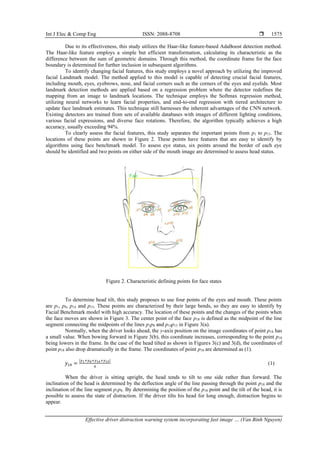
In the case of low light, this study proposes to use the white area of the eye (sclera area) to assess
eye condition. This area is clearly the brightest in the face and is more easily recognized by the grayscale
conversion algorithm with a defined threshold level. Figure 4 describes the results of identifying benchmarks
around the eyes and the white areas of the eyes in different states. In Figure 4(a), the eyes are normally open,
and the benchmarks around the eyes are far apart and the white area is easily identified by its maximum
horizontal and vertical length. In Figures 4(b) to 4(d), the eyes gradually close, and the distances of the
surrounding points become smaller and the white area is therefore also smaller. The white area in the
processing method is simply determined by calculating the length of the white area in the x and y axes.
Obviously, the larger this length multiplication is, the greater the degree of eye opening. This value is used in
conjunction with the EAR ratio to increase the accuracy of the algorithm in different lighting conditions.
The process of recognizing the eye state has achieved good results. Blinks are checked with head
states to give accurate alerts. The processing method ensures the determination of eye opening in a short time
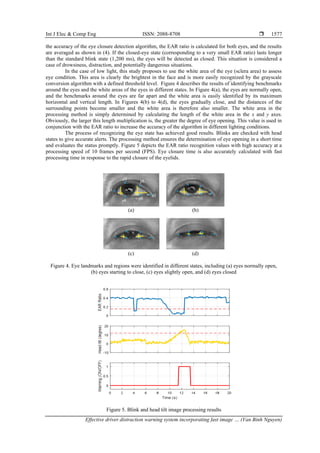
and evaluates the status promptly. Figure 5 depicts the EAR ratio recognition values with high accuracy at a
processing speed of 10 frames per second (FPS). Eye closure time is also accurately calculated with fast
processing time in response to the rapid closure of the eyelids.
(a) (b)
(c) (d)
Figure 4. Eye landmarks and regions were identified in different states, including (a) eyes normally open,
(b) eyes starting to close, (c) eyes slightly open, and (d) eyes closed
Figure 5. Blink and head tilt image processing results
 ISSN: 2088-8708
Int J Elec & Comp Eng, Vol. 14, No. 2, April 2024: 1572-1582
1578
According to the actual running results in the EAR ratio chart, at the 4th
second, the eyes blink for a
short time. By the 8th
second, the eyes have a slow closing phenomenon. Nearing the 10th second, the EAR
rate crossed the 0.15 threshold. From the head tilt chart, as can be seen, from the 9th second, the head begins
to tilt gradually. When the tilt exceeds the normal threshold, 12 degrees, the eyes are still closed. Near the
12th
second, the time to close the eyes has exceeded the period of 1,200 ms, along with the head tilt has
exceeded the threshold, the alarm system activates (as shown in the last chart). After the warning signal,
about 0.5 seconds, the driver started to wake up, his eyes opened quickly. Then the head starts to straighten
again. The local siren warning process lasts for about 2 seconds. When the eye and head condition return to
normal, the alarm system turns off automatically.
3. ALGORITHMS TO RECOGNIZE OBJECTS
3.1. Algorithm to recognize lanes
To observe obstacles on the road as well as the position of the vehicle on the road, a second camera
is placed forward to capture the image in front of the vehicle. This camera takes on the task of recognizing
lanes, traffic signs, as well as dangerous objects appearing. This risk assessment from the camera image is
done using both conventional image processing methods and machine learning approaches. Algorithm
flowcharts of the two image processing directions are shown in Figure 6.
Figure 6. Flow chart for processing image and warning
Int J Elec & Comp Eng ISSN: 2088-8708 
Effective driver distraction warning system incorporating fast image … (Van Binh Nguyen)
1579
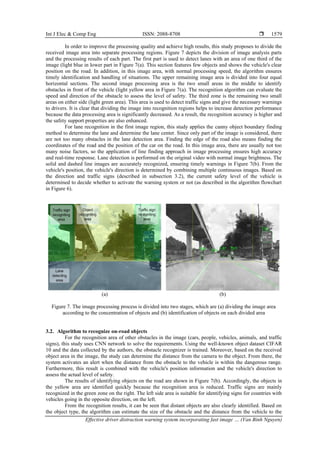
In order to improve the processing quality and achieve high results, this study proposes to divide the
received image area into separate processing regions. Figure 7 depicts the division of image analysis parts
and the processing results of each part. The first part is used to detect lanes with an area of one third of the
image (light blue in lower part in Figure 7(a). This section features few objects and shows the vehicle's clear
position on the road. In addition, in this image area, with normal processing speed, the algorithm ensures
timely identification and handling of situations. The upper remaining image area is divided into four equal
horizontal sections. The second image processing area is the two small areas in the middle to identify
obstacles in front of the vehicle (light yellow area in Figure 7(a). The recognition algorithm can evaluate the
speed and direction of the obstacle to assess the level of safety. The third zone is the remaining two small
areas on either side (light green area). This area is used to detect traffic signs and give the necessary warnings
to drivers. It is clear that dividing the image into recognition regions helps to increase detection performance
because the data processing area is significantly decreased. As a result, the recognition accuracy is higher and
the safety support properties are also enhanced.
For lane recognition in the first image region, this study applies the canny object boundary finding
method to determine the lane and determine the lane center. Since only part of the image is considered, there
are not too many obstacles in the lane detection area. Finding the edge of the road also means finding the
coordinates of the road and the position of the car on the road. In this image area, there are usually not too
many noise factors, so the application of line finding approach in image processing ensures high accuracy
and real-time response. Lane detection is performed on the original video with normal image brightness. The
solid and dashed line images are accurately recognized, ensuring timely warnings in Figure 7(b). From the
vehicle's position, the vehicle's direction is determined by combining multiple continuous images. Based on
the direction and traffic signs (described in subsection 3.2), the current safety level of the vehicle is
determined to decide whether to activate the warning system or not (as described in the algorithm flowchart
in Figure 6).
(a) (b)
Figure 7. The image processing process is divided into two stages, which are (a) dividing the image area
according to the concentration of objects and (b) identification of objects on each divided area
3.2. Algorithm to recognize on-road objects
For the recognition area of other obstacles in the image (cars, people, vehicles, animals, and traffic
signs), this study uses CNN network to solve the requirements. Using the well-known object dataset CIFAR
10 and the data collected by the authors, the obstacle recognizer is trained. Moreover, based on the received
object area in the image, the study can determine the distance from the camera to the object. From there, the
system activates an alert when the distance from the obstacle to the vehicle is within the dangerous range.
Furthermore, this result is combined with the vehicle's position information and the vehicle's direction to
assess the actual level of safety.
The results of identifying objects on the road are shown in Figure 7(b). Accordingly, the objects in
the yellow area are identified quickly because the recognition area is reduced. Traffic signs are mainly
recognized in the green zone on the right. The left side area is suitable for identifying signs for countries with
vehicles going in the opposite direction, on the left.
From the recognition results, it can be seen that distant objects are also clearly identified. Based on
the object type, the algorithm can estimate the size of the obstacle and the distance from the vehicle to the
 ISSN: 2088-8708
Int J Elec & Comp Eng, Vol. 14, No. 2, April 2024: 1572-1582
1580
obstacle with relative accuracy. This information is processed at a distance, when the object is in the danger
range corresponding to the current vehicle speed, the warning signal will be activated directly on the vehicle
and transmitted to the management department.
4. BUILDING COMPLETE SYSTEM
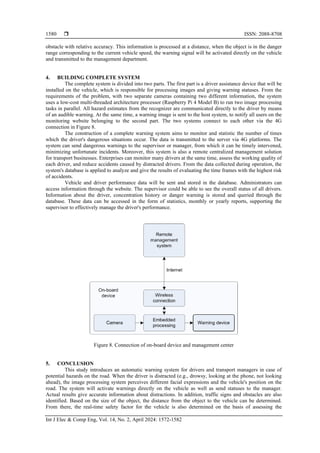
The complete system is divided into two parts. The first part is a driver assistance device that will be
installed on the vehicle, which is responsible for processing images and giving warning statuses. From the
requirements of the problem, with two separate cameras containing two different information, the system
uses a low-cost multi-threaded architecture processor (Raspberry Pi 4 Model B) to run two image processing
tasks in parallel. All hazard estimates from the recognizer are communicated directly to the driver by means
of an audible warning. At the same time, a warning image is sent to the host system, to notify all users on the
monitoring website belonging to the second part. The two systems connect to each other via the 4G
connection in Figure 8.
The construction of a complete warning system aims to monitor and statistic the number of times
which the driver's dangerous situations occur. The data is transmitted to the server via 4G platforms. The
system can send dangerous warnings to the supervisor or manager, from which it can be timely intervened,
minimizing unfortunate incidents. Moreover, this system is also a remote centralized management solution
for transport businesses. Enterprises can monitor many drivers at the same time, assess the working quality of
each driver, and reduce accidents caused by distracted drivers. From the data collected during operation, the
system's database is applied to analyze and give the results of evaluating the time frames with the highest risk
of accidents.
Vehicle and driver performance data will be sent and stored in the database. Administrators can
access information through the website. The supervisor could be able to see the overall status of all drivers.
Information about the driver, concentration history or danger warning is stored and queried through the
database. These data can be accessed in the form of statistics, monthly or yearly reports, supporting the
supervisor to effectively manage the driver's performance.
Figure 8. Connection of on-board device and management center
5. CONCLUSION
This study introduces an automatic warning system for drivers and transport managers in case of
potential hazards on the road. When the driver is distracted (e.g., drowsy, looking at the phone, not looking
ahead), the image processing system perceives different facial expressions and the vehicle's position on the
road. The system will activate warnings directly on the vehicle as well as send statuses to the manager.
Actual results give accurate information about distractions. In addition, traffic signs and obstacles are also
identified. Based on the size of the object, the distance from the object to the vehicle can be determined.
From there, the real-time safety factor for the vehicle is also determined on the basis of assessing the
Int J Elec & Comp Eng ISSN: 2088-8708 
Effective driver distraction warning system incorporating fast image … (Van Binh Nguyen)
1581
direction of the vehicle's movement. Research results show that the system adapts well in normal conditions
with medium light with fast response speed. In low-light conditions, the application of white area recognition
gives positive results, improving the system's reliability. The widespread application of this system greatly
reduces the risks from the driver's subjectivity, as well as from unusual factors on the road.
REFERENCES
[1] W.-B. Horng, C.-Y. Chen, Y. Chang, and C.-H. Fan, “Driver fatigue detection based on eye tracking and dynamic template
matching,” in IEEE International Conference on Networking, Sensing and Control, 2004, 2004, pp. 7–12, doi:
10.1109/ICNSC.2004.1297400.
[2] L. M. Bergasa, J. Nuevo, M. A. Sotelo, and M. Vazquez, “Real-time system for monitoring driver vigilance,” in IEEE Intelligent
Vehicles Symposium, 2004, pp. 78–83, doi: 10.1109/IVS.2004.1336359.
[3] A. Rahman, M. Sirshar, and A. Khan, “Real time drowsiness detection using eye blink monitoring,” in 2015 National Software
Engineering Conference (NSEC), Dec. 2015, pp. 1–7, doi: 10.1109/NSEC.2015.7396336.
[4] S. Vitabile, A. De Paola, and F. Sorbello, “A real-time non-intrusive FPGA-based drowsiness detection system,” Journal of
Ambient Intelligence and Humanized Computing, vol. 2, no. 4, pp. 251–262, Dec. 2011, doi: 10.1007/s12652-011-0049-z.
[5] M. J. Flores, J. M. Armingol, and A. de la Escalera, “Real-time warning system for driver drowsiness detection using visual
information,” Journal of Intelligent & Robotic Systems, vol. 59, no. 2, pp. 103–125, Aug. 2010, doi: 10.1007/s10846-009-9391-1.
[6] J. Xu, J. Min, and J. Hu, “Real‐time eye tracking for the assessment of driver fatigue,” Healthcare Technology Letters, vol. 5,
no. 2, pp. 54–58, Apr. 2018, doi: 10.1049/htl.2017.0020.
[7] M. W. Johns, A. Tucker, R. Chapman, K. Crowley, and N. Michael, “Monitoring eye and eyelid movements by infrared
reflectance oculography to measure drowsiness in drivers,” Somnologie - Schlafforschung und Schlafmedizin, vol. 11, no. 4,
pp. 234–242, Dec. 2007, doi: 10.1007/s11818-007-0311-y.
[8] L. Lin et al., “Driver fatigue detection based on eye state,” Technology and Health Care, vol. 23, no. s2, pp. S453–S463, Jun.
2015, doi: 10.3233/THC-150982.
[9] N. Kumar, N. C. Barwar, and N. Kuamr, “Analysis of real time driver fatigue detection based on eye and yawning,” International
Journal of Computer Science and Information Technologies, vol. 5, no. 6, pp. 7821–7826, 2014.
[10] I. Teyeb, O. Jemai, M. Zaied, and C. Ben Amar, “A novel approach for drowsy driver detection using head posture estimation and
eyes recognition system based on wavelet network,” in IISA 2014, The 5th International Conference on Information, Intelligence,
Systems and Applications, Jul. 2014, pp. 379–384, doi: 10.1109/IISA.2014.6878809.
[11] O. Khunpisuth, T. Chotchinasri, V. Koschakosai, and N. Hnoohom, “Driver drowsiness detection using eye-closeness detection,”
in 2016 12th International Conference on Signal-Image Technology & Internet-Based Systems (SITIS), 2016, pp. 661–668, doi:
10.1109/SITIS.2016.110.
[12] Q. Ji and X. Yang, “Real-time eye, gaze, and face pose tracking for monitoring driver vigilance,” Real-Time Imaging, vol. 8,
no. 5, pp. 357–377, Oct. 2002, doi: 10.1006/rtim.2002.0279.
[13] M. Saradadevi and P. Bajaj, “Driver fatigue detection using mouth and yawning analysis,” International journal of Computer
science and network security, vol. 8, no. 6, pp. 183–188, 2008.
[14] N. Alioua, A. Amine, and M. Rziza, “Driver’s fatigue detection based on yawning extraction,” International Journal of Vehicular
Technology, vol. 2014, pp. 1–7, Aug. 2014, doi: 10.1155/2014/678786.
[15] A. Tawari, S. Martin, and M. M. Trivedi, “Continuous head movement estimator for driver assistance: Issues, algorithms, and on-
road evaluations,” IEEE Transactions on Intelligent Transportation Systems, vol. 15, no. 2, pp. 818–830, Apr. 2014, doi:
10.1109/TITS.2014.2300870.
[16] T. Liu, “Driver’s face detection using space-time restrained Adaboost method,” KSII Transactions on Internet and Information
Systems, 2012, doi: 10.3837/tiis.2012.09.021.
[17] G. Salzillo, C. Natale, G. B. Fioccola, and E. Landolfi, “Evaluation of driver drowsiness based on real-time face analysis,” in
2020 IEEE International Conference on Systems, Man, and Cybernetics (SMC), Oct. 2020, pp. 328–335, doi:
10.1109/SMC42975.2020.9283133.
[18] B. Akrout and W. Mahdi, “A novel approach for driver fatigue detection based on visual characteristics analysis,” Journal of
Ambient Intelligence and Humanized Computing, vol. 14, no. 1, pp. 527–552, Jan. 2023, doi: 10.1007/s12652-021-03311-9.
[19] M. A. Assari and M. Rahmati, “Driver drowsiness detection using face expression recognition,” in 2011 IEEE International
Conference on Signal and Image Processing Applications (ICSIPA), Nov. 2011, pp. 337–341, doi:
10.1109/ICSIPA.2011.6144162.
[20] R. Ahmad and J. N. Borole, “Drowsy driver identification using eye blink detection,” IJISET-International Journal of Computer
Science and Information Technologies, vol. 6, no. 1, pp. 270–274, 2015.
[21] T. Li and X. Zhou, “Battery-free eye tracker on glasses,” in Proceedings of the 24th Annual International Conference on Mobile
Computing and Networking, Oct. 2018, pp. 67–82, doi: 10.1145/3241539.3241578.
[22] B. P. Doppala, B. Vamsi, D. Bhattacharyya, and J. N. Rao, “A machine intelligence model to detect drowsiness for preventing
road accidents,” in 2022 International Conference on Applied Artificial Intelligence and Computing (ICAAIC), May 2022,
pp. 406–411, doi: 10.1109/ICAAIC53929.2022.9793256.
[23] A. V. Sant, A. S. Naik, A. Sarkar, and V. Dixit, “Driver drowsiness detection and alert system: a solution for ride-hailing and
logistics companies,” in 2021 IEEE Pune Section International Conference (PuneCon), Dec. 2021, pp. 1–5, doi:
10.1109/PuneCon52575.2021.9686546.
[24] B. T. Nugraha, S.-F. Su, and Fahmizal, “Towards self-driving car using convolutional neural network and road lane detector,” in
2017 2nd International Conference on Automation, Cognitive Science, Optics, Micro Electro--Mechanical System, and
Information Technology (ICACOMIT), Oct. 2017, pp. 65–69, doi: 10.1109/ICACOMIT.2017.8253388.
[25] N. Kemsaram, A. Das, and G. Dubbelman, “An integrated framework for autonomous driving: object detection, lane detection,
and free space detection,” in 2019 Third World Conference on Smart Trends in Systems Security and Sustainablity (WorldS4), Jul.
2019, pp. 260–265, doi: 10.1109/WorldS4.2019.8904020.
[26] J. Kim and M. Lee, “Robust lane detection based on convolutional neural network and random sample consensus,” in Neural
Information Processing: 21st International Conference, ICONIP 2014, Kuching, Malaysia, November 3-6, 2014. Proceedings,
Part I 21, 2014, pp. 454–461.
 ISSN: 2088-8708
Int J Elec & Comp Eng, Vol. 14, No. 2, April 2024: 1572-1582
1582
BIOGRAPHIES OF AUTHORS
Van Binh Nguyen received his B.Sc. (2001) degree from the University of
Communication and Transportation (UTC - Vietnam) in automatic control. In 2007 he had his
Master of Philosophy (MPhil) from the University of Sheffield (United Kingdom) in automatic
control and systems. He received the Dr.-Ing degree in electrical machines and drives from
TU-Dresden, Germany in 2015. Currently, he is a lecturer at School of Electrical Engineering,
International University, Vietnam National University, Ho Chi Minh City. His fields of interest
include image processing technology, intelligent transportation systems, soft computing
techniques, energy conversion, robotic manipulation control. He can be contacted at email:
nvbinh@hcmiu.edu.vn.
Phu Duy Trinh received his B.Sc. (2017) degree from the University of
Communication and Transportation (UTC - Vietnam) in automatic control. In 2022 he had his
Master of Science from UTC - Vietnam in automatic control and systems. His fields of interest
include image processing technology and intelligent transportation system. He can be
contacted at email: trinhphuduy1002@gmail.com.

Effective driver distraction warning system incorporating fast image recognition methods

  • 1.
    International Journal ofElectrical and Computer Engineering (IJECE) Vol. 14, No. 2, April 2024, pp. 1572~1582 ISSN: 2088-8708, DOI: 10.11591/ijece.v14i2.pp1572-1582  1572 Journal homepage: http://ijece.iaescore.com Effective driver distraction warning system incorporating fast image recognition methods Van Binh Nguyen1 , Phu Duy Trinh2 1 School of Electrical Engineering, International University, Vietnam National University, Ho Chi Minh City, Vietnam 2 FPT Telecom, FPT Group, Ho Chi Minh City, Vietnam Article Info ABSTRACT Article history: Received Jan 21, 2023 Revised Nov 4, 2023 Accepted Dec 18, 2023 Modern cars are equipped with advanced automatic technology featuring various safety measures for car occupants. However, the growing density of vehicles, especially in areas where infrastructure development lags, poses potential dangers, particularly accidents caused by driver subjectivity. These incidents may occur due to driver distraction or the presence of high-risk obstacles on the road. This article presents a comprehensive solution to assist drivers in mitigating these risks. Firstly, the study introduces a novel method to enhance the recognition of a driver's facial features by analyzing benchmarks and the whites of the eyes to assess the distraction level. Secondly, a domain division method is proposed to identify obstacles and lanes in front of the vehicle, enabling the assessment of the danger level. This information is promptly relayed to the driver and relevant individuals, such as the driver's manager or supervisor. An experimental device has also been developed to evaluate the effectiveness of the algorithms, solutions, and processing capabilities of the system. Keywords: Distraction warning system Eye recognition Lane recognition Object identification Driver assistance system This is an open access article under the CC BY-SA license. Corresponding Author: Van Binh Nguyen School of Electrical Engineering, International University, Vietnam National University Linh Trung Ward, Thu Duc City, Ho Chi Minh City, 700000, Vietnam Email: nvbinh@hcmiu.edu.vn 1. INTRODUCTION It can be noted that modern car technology has significantly enhanced safety measures, contributing to the reduction of losses resulting from accidents. However, in many accident cases, the root cause does not stem from the vehicle itself but rather from the subjectivity of the driver. Incidents often occur due to driver distraction, fatigue, or drowsiness. During such instances, drivers experience reduced alertness and responsiveness to external factors that may pose danger. This phenomenon is referred to as "Micro Sleep," defined as a brief and involuntary period of sleep that can occur at any time due to fatigue or prolonged sleep deprivation. Micro-sleep episodes typically last for a few seconds and can pose a severe risk, especially for individuals operating a vehicle. Several signs indicate that individuals are not fully awake while driving, such as frequent yawning, continuous and slow eye blinking, a bowed or tilted head, and drifting from the lane. Previous studies have explored various methods to assess distraction and assist drivers based on facial variables. Two primary approaches to evaluating fatigue or sleepiness include physiological-based techniques and behavioral-based techniques. Physiological techniques involve the use of electrodes to measure indicators on the body. However, this method can be inconvenient for the driver. On the other hand, the behavioral-based approach assesses eye, face, and head movements, as well as yawning behavior, to detect sleepiness. Most studies suggest that, to ensure comfort and avoid impacting driving, assessing driver behavior through camera image processing is a viable option.
  • 2.
    Int J Elec& Comp Eng ISSN: 2088-8708  Effective driver distraction warning system incorporating fast image … (Van Binh Nguyen) 1573 Several works utilize eye images to assess the driver's fatigue state. For example, Horng et al. [1] proposed a vision-based real-time driver fatigue detection system that locates the driver's face using skin color characteristics, employs an edge detection method to identify eye regions, and uses the obtained eye images for sleepiness detection, generating warning alarms for the driver. However, this system must run on a personal computer and faces challenges in rapid application within a car. Another non-intrusive prototype computer vision system monitors a driver's vigilance in real-time, based on a hardware system for acquiring driver images. It uses an active infrared (IR) illuminator to monitor eyelid movements and facial pose, characterizing the driver's level of vigilance [2]. Nevertheless, this system is tailored to a specific individual rather than being applicable to a broader range of drivers. Rahman et al. [3] proposed an eye blink monitoring algorithm that uses eye feature points to determine the state of the eye and activates an alarm. However, this article does not account for specific blinking patterns and facial expressions. Another embedded monitoring system was introduced to detect symptoms of driver drowsiness by exploiting the bright pupils' phenomenon. The algorithm detects and tracks the driver's eyes, but encounters issues with light poles being misclassified as eyes due to their shape and size [4]. Flores et al. [5] presented a system designed to track and analyze the face to determine a drowsiness index. It operates under different light conditions. However, the system still exhibits a high percentage of error and false alarms, indicating a need for improvement. Similar directions of research can be found in other publications [6]–[8]. Other works combine eye images with additional facial features to assess sleepiness status. Kumar et al. [9] presented an analysis of a fusion method for eye blinking and yawning detection based on changes in mouth features. The algorithm employs OpenCV with the Haar cascade function for detecting facial features and the active contour method for lip activity. However, this research does not consider head movement to enhance the proposed method's accuracy. Teyeb et al. [10] developed a drowsy detection system using image processing to analyze eye blinking status for measuring eye closure period and head posture determination. However, the method for determining the angle of head inclination is not optimal, particularly in cases of the head tilted forward. Khunpisuth et al. [11] addressed driver drowsiness by creating an experiment to evaluate the level of sleepiness. Using the Haar cascade classifier, the frequency of head tilting and eye blinking was used to warn driver drowsy status. However, various light conditions might impact the accuracy of the proposed method. Similar combinations were explored in another study [12]. Several contributions to fatigue detection involve the incorporation of various facial factors. Saradadevi and Bajaj presented driver fatigue determination based on monitoring the mouth [13]. The method locates and tracks the driver's mouth using a cascade of classifiers for faces. Support vector machines are used to train face images. It is evident that combining more eye elements and head movement is necessary for better results. Another work proposed an efficient system for evaluating fatigue using face and yawning extraction based on support vector machines and circular Hough transform for mouth detection [14]. The system does not require any training data and could work with a low-cost webcam under various lighting conditions. Tawari et al. [15] presented a system which tracks facial features and analyzes their geometric configuration to estimate the head pose using a 3D model. Liu et al. [16] presented a space-time restrained AdaBoost method to increase the detection rates. In this work, a space-time restriction strategy is designed to restrain the detection window and scale of the AdaBoost method to reduce false-detection cases. Recently, another drowsiness detection system by analyzing the driver's face with a standard camera was proposed [17]. In this case, a set of facial landmark locations are detected by a fuzzy inference system (FIS). This is a relatively accurate proposal but still not complete for practical application. Akrout and Mahdi [18] proposed work to recognize driver behavior by determining the characteristics of the face. This is a fusion system based on the detection of yawn, somnolence, and 3D head pose estimation. However, the results of the study are still influenced by lighting conditions. In cases where the driver has specific factors, such as wearing glasses or staying in low-light conditions, different approaches are also suggested. Assari and Rahmati [19] proposed and implemented a infrared light based hardware system. They follow face detection steps, with facial components considered the most important and effective for drowsiness detection. Ahmad and Borole [20] implemented a system using the object identifier within the MATLAB vision toolbox, which detects face, mouth, nose, eyes. In this system, yawning is determined and considered based on the mouth opening portion. The algorithms are formulated under various categories, such as a normal driver, a driver with glasses under different light situations. Li and Zhou [21] presented a wearable eye tracker that detects both the 2D position and diameter of a pupil based on its light absorption feature. This research uses infrared lights to illuminate the eye from different directions, while photodiodes sense the reflected light, which are used to infer the pupil information. The system can exploit characteristics of various eye movement stages and can be applied for drowsiness detection. Several recent studies have adopted a neural network approach to detect short periods of sleepiness. Doppala et al. [22] proposed a drowsiness identification system by capturing image frames of the driver's face from the video stream. In this study, a deep convolutional neural network (D-CNN) model is suggested
  • 3.
     ISSN: 2088-8708 IntJ Elec & Comp Eng, Vol. 14, No. 2, April 2024: 1572-1582 1574 to detect drowsiness under various circumstances, such as drivers with and without glasses. In another system, the driver is alerted when they are drowsy using convolutional neural networks (CNN) [23]. In addition to detecting the state of a drowsy face, determining the direction of the vehicle's movement on the road and detecting obstacles also helps warn of unexpected incidents. Nugraha et al. [24] used the you only look once network (YOLO) as the object detector and polynomial regression as the road guidance. Kemsaram et al. [25] presented a neural network to detect lane markings, objects, using a monocular. Another work presented a lane detection algorithm based on the combined CNN with the random sample consensus (RANSAC) approach [26]. It can be seen that the works mentioned are partially or incompletely resolved for drowsiness detection and driver warning systems. In order to improve the accuracy and speed of facial information processing, as well as the detection of objects on the road, this study introduces new approaches. Two cameras are used to directly observe the driver's face and objects on the road, employing rapid image processing methods to recognize and assess the driver's drowsy situation. This image processing method utilizes a novel approach to determine benchmark points and characteristic white areas on the face and in the eyes. Additionally, lanes, obstacles, and traffic signs are identified to assess the level of danger to vehicles and drivers. In the event of distraction, an on- board warning system will trigger a signal to alert the driver. Simultaneously, the driver's information will be transmitted to the monitoring system or the vehicle management department. The article comprises three main parts. Section 2 introduces a method to identify distractions based on benchmarks and white areas of the face. The image separation method, applying the fast image recognition algorithm, is proposed in section 3. Section 4 provides a description of the complete monitoring system, outlining the practical application of the results. Finally, Section 5 contains conclusions. 2. FACE IMAGE RECOGNITION ALGORITHM The observations and studies clearly indicate that the most prominent signs of driver distraction are the tilt of the head and eye gestures. In such cases, the eyes tend to remain closed for a longer duration than during regular blinking, and the head is typically bent or slightly tilted for an extended period. The position of the head may suggest that the driver is either distracted due to drowsiness or focused on objects not on the road ahead. The algorithm for determining the head tilt and eye-closed state is illustrated in Figure 1. The process involves analyzing the original camera image to ascertain the position of the driver's head. Subsequently, the degree of head tilt and eye closure is transmitted to the evaluation and analysis block. In situations of potential danger, both the on-board warning system and the remote management alert are activated. Figure 1. Distracted state identification process 2.1. Determine head tilt angle To assess facial features, it is essential to determine the position of the head in the image. Digital camera images undergo preprocessing steps, including conversion to grayscale and filtering image noise. The resulting image is then input into the initial face recognition model. Face recognition can be achieved through various methods, such as the AdaBoost classification algorithm using Haar-like features, which is available in the OpenCV library. Additionally, methods like histogram of oriented gradients and linear support vector machine, pre-trained for face detection, can be applied. Deep learning algorithms are also employed for locating face coordinates in images.
  • 4.
    Int J Elec& Comp Eng ISSN: 2088-8708  Effective driver distraction warning system incorporating fast image … (Van Binh Nguyen) 1575 Due to its effectiveness, this study utilizes the Haar-like feature-based AdaBoost detection method. The Haar-like feature employs a simple but efficient transformation, calculating its characteristic as the difference between the sum of geometric domains. Through this method, the coordinate frame for the face boundary is determined for further inclusion in subsequent algorithms. To identify changing facial features, this study employs a novel approach by utilizing the improved facial Landmark model. The method applied to this model is capable of detecting crucial facial features, including mouth, eyes, eyebrows, nose, and facial corners such as the corners of the eyes and eyelids. Most landmark detection methods are applied based on a regression problem where the detector redefines the mapping from an image to landmark locations. The technique employs the Softmax regression method, utilizing neural networks to learn facial properties, and end-to-end regression with tiered architecture to update face landmark estimates. This technique still harnesses the inherent advantages of the CNN network. Existing detectors are trained from sets of available databases with images of different lighting conditions, various facial expressions, and diverse face rotations. Therefore, the algorithm typically achieves a high accuracy, usually exceeding 94%. To clearly assess the facial features, this study separates the important points from p1 to p15. The locations of these points are shown in Figure 2. These points have features that are easy to identify by algorithms using face benchmark model. To assess eye status, six points around the border of each eye should be identified and two points on either side of the mouth image are determined to assess head status. Figure 2. Characteristic defining points for face states To determine head tilt, this study proposes to use four points of the eyes and mouth. These points are p1, p8, p14 and p15. These points are characterized by their large bends, so they are easy to identify by Facial Benchmark model with high accuracy. The location of these points and the changes of the points when the face moves are shown in Figure 3. The center point of the face p18 is defined as the midpoint of the line segment connecting the midpoints of the lines p1p8 and p14p15 in Figure 3(a). Normally, when the driver looks ahead, the y-axis position on the image coordinates of point p18 has a small value. When bowing forward in Figure 3(b), this coordinate increases, corresponding to the point p18 being lowers in the frame. In the case of the head tilted as shown in Figures 3(c) and 3(d), the coordinates of point p18 also drop dramatically in the frame. The coordinates of point p18 are determined as (1). 𝑦18 = |𝑦1+𝑦8+𝑦14+𝑦15| 4 (1) When the driver is sitting upright, the head tends to tilt to one side rather than forward. The inclination of the head is determined by the deflection angle of the line passing through the point p18 and the inclination of the line segment p1p8. By determining the position of the p18 point and the tilt of the head, it is possible to assess the state of distraction. If the driver tilts his head for long enough, distraction begins to appear.
  • 5.
     ISSN: 2088-8708 IntJ Elec & Comp Eng, Vol. 14, No. 2, April 2024: 1572-1582 1576 (a) (b) (c) (d) Figure 3. Results of identifying facial points with different tilt states of the head, including (a) normal head state, (b) forward head tilt state, (c) slight head tilt to the left, and (d) strong head tilt to the left 2.2. Eye state recognition In most cases, a medium-quality camera can be used to receive images of the eye for recognition algorithms. In case of necessity, different types of cameras can be used to improve the results of eye status assessment such as infrared cameras [17], or glasses with specialized cameras [21]. The work in this paper implements an algorithm for analyzing eye states using a standard camera in normal lighting conditions. Many methods have been presented to automatically detect blinks in a sequence of images in a video. Nevertheless, a major drawback of previous approaches is their dependency on various factors when setting up the recognition model. These approaches are influenced by factors such as camera angle, image resolution, light source hitting the eye, or movements of the driver being detected. To address this problem, this study continues to use the points identified, as shown in Figure 2. From the position coordinates of the recognized eye landmarks, determining the state of sleepiness is possible by relying on the longer duration of the blinking state. Each person has a different blink pattern in terms of how fast they open and close their eyes, how wide the eyes are when opened and closed, and the blink cycle or average time between blinks. Normally, a blink lasts about 100 to 400 ms. In this study, blinks lasting more than 1,200 ms are considered distracting. The proposed method in this study leverages the performance of the facial Landmark detector to recognize the position of the eye and the contour of the eye on the image frame. It identifies the bright sclera area of the eye, as the sclera region has the advantage of having the highest brightness on the face, making it more easily detected, especially in low-light conditions. From landmark points, the algorithm calculates the eye aspect ratio (EAR) to estimate the eye's open state. The EAR ratio based on eye height and width is calculated using (2). The positions of the points to determine this ratio are shown in Figure 4. For different eye states, the benchmark points will shift accordingly. The denominator part of the formula is multiplied by the factor k. This is a factor that depends on eye shape. If the eye opening is small, the k-factor is usually set to less than 1. This is to improve the sensitivity of the eye state assessment. 𝐸𝐴𝑅1 = |𝑦4−𝑦3|+|𝑦6−𝑦5| 𝑘|𝑥2−𝑥1| (2) 𝐸𝐴𝑅2 = |𝑦10−𝑦9|+|𝑦12−𝑦11| 𝑘|𝑥8−𝑥7| (3) 𝐸𝐴𝑅 = 𝐸𝐴𝑅1+𝐸𝐴𝑅2 2 (4) With the calculation of the eye-opening characteristic by EAR, the calculated value is less affected by the position and relative tilt of the head. Different individuals will have different EAR rates. To increase
  • 6.
    Int J Elec& Comp Eng ISSN: 2088-8708  Effective driver distraction warning system incorporating fast image … (Van Binh Nguyen) 1577 the accuracy of the eye closure detection algorithm, the EAR ratio is calculated for both eyes, and the results are averaged as shown in (4). If the closed-eye state (corresponding to a very small EAR ratio) lasts longer than the standard blink state (1,200 ms), the eyes will be detected as closed. This situation is considered a case of drowsiness, distraction, and potentially dangerous situations. In the case of low light, this study proposes to use the white area of the eye (sclera area) to assess eye condition. This area is clearly the brightest in the face and is more easily recognized by the grayscale conversion algorithm with a defined threshold level. Figure 4 describes the results of identifying benchmarks around the eyes and the white areas of the eyes in different states. In Figure 4(a), the eyes are normally open, and the benchmarks around the eyes are far apart and the white area is easily identified by its maximum horizontal and vertical length. In Figures 4(b) to 4(d), the eyes gradually close, and the distances of the surrounding points become smaller and the white area is therefore also smaller. The white area in the processing method is simply determined by calculating the length of the white area in the x and y axes. Obviously, the larger this length multiplication is, the greater the degree of eye opening. This value is used in conjunction with the EAR ratio to increase the accuracy of the algorithm in different lighting conditions. The process of recognizing the eye state has achieved good results. Blinks are checked with head states to give accurate alerts. The processing method ensures the determination of eye opening in a short time and evaluates the status promptly. Figure 5 depicts the EAR ratio recognition values with high accuracy at a processing speed of 10 frames per second (FPS). Eye closure time is also accurately calculated with fast processing time in response to the rapid closure of the eyelids. (a) (b) (c) (d) Figure 4. Eye landmarks and regions were identified in different states, including (a) eyes normally open, (b) eyes starting to close, (c) eyes slightly open, and (d) eyes closed Figure 5. Blink and head tilt image processing results
  • 7.
     ISSN: 2088-8708 IntJ Elec & Comp Eng, Vol. 14, No. 2, April 2024: 1572-1582 1578 According to the actual running results in the EAR ratio chart, at the 4th second, the eyes blink for a short time. By the 8th second, the eyes have a slow closing phenomenon. Nearing the 10th second, the EAR rate crossed the 0.15 threshold. From the head tilt chart, as can be seen, from the 9th second, the head begins to tilt gradually. When the tilt exceeds the normal threshold, 12 degrees, the eyes are still closed. Near the 12th second, the time to close the eyes has exceeded the period of 1,200 ms, along with the head tilt has exceeded the threshold, the alarm system activates (as shown in the last chart). After the warning signal, about 0.5 seconds, the driver started to wake up, his eyes opened quickly. Then the head starts to straighten again. The local siren warning process lasts for about 2 seconds. When the eye and head condition return to normal, the alarm system turns off automatically. 3. ALGORITHMS TO RECOGNIZE OBJECTS 3.1. Algorithm to recognize lanes To observe obstacles on the road as well as the position of the vehicle on the road, a second camera is placed forward to capture the image in front of the vehicle. This camera takes on the task of recognizing lanes, traffic signs, as well as dangerous objects appearing. This risk assessment from the camera image is done using both conventional image processing methods and machine learning approaches. Algorithm flowcharts of the two image processing directions are shown in Figure 6. Figure 6. Flow chart for processing image and warning
  • 8.
    Int J Elec& Comp Eng ISSN: 2088-8708  Effective driver distraction warning system incorporating fast image … (Van Binh Nguyen) 1579 In order to improve the processing quality and achieve high results, this study proposes to divide the received image area into separate processing regions. Figure 7 depicts the division of image analysis parts and the processing results of each part. The first part is used to detect lanes with an area of one third of the image (light blue in lower part in Figure 7(a). This section features few objects and shows the vehicle's clear position on the road. In addition, in this image area, with normal processing speed, the algorithm ensures timely identification and handling of situations. The upper remaining image area is divided into four equal horizontal sections. The second image processing area is the two small areas in the middle to identify obstacles in front of the vehicle (light yellow area in Figure 7(a). The recognition algorithm can evaluate the speed and direction of the obstacle to assess the level of safety. The third zone is the remaining two small areas on either side (light green area). This area is used to detect traffic signs and give the necessary warnings to drivers. It is clear that dividing the image into recognition regions helps to increase detection performance because the data processing area is significantly decreased. As a result, the recognition accuracy is higher and the safety support properties are also enhanced. For lane recognition in the first image region, this study applies the canny object boundary finding method to determine the lane and determine the lane center. Since only part of the image is considered, there are not too many obstacles in the lane detection area. Finding the edge of the road also means finding the coordinates of the road and the position of the car on the road. In this image area, there are usually not too many noise factors, so the application of line finding approach in image processing ensures high accuracy and real-time response. Lane detection is performed on the original video with normal image brightness. The solid and dashed line images are accurately recognized, ensuring timely warnings in Figure 7(b). From the vehicle's position, the vehicle's direction is determined by combining multiple continuous images. Based on the direction and traffic signs (described in subsection 3.2), the current safety level of the vehicle is determined to decide whether to activate the warning system or not (as described in the algorithm flowchart in Figure 6). (a) (b) Figure 7. The image processing process is divided into two stages, which are (a) dividing the image area according to the concentration of objects and (b) identification of objects on each divided area 3.2. Algorithm to recognize on-road objects For the recognition area of other obstacles in the image (cars, people, vehicles, animals, and traffic signs), this study uses CNN network to solve the requirements. Using the well-known object dataset CIFAR 10 and the data collected by the authors, the obstacle recognizer is trained. Moreover, based on the received object area in the image, the study can determine the distance from the camera to the object. From there, the system activates an alert when the distance from the obstacle to the vehicle is within the dangerous range. Furthermore, this result is combined with the vehicle's position information and the vehicle's direction to assess the actual level of safety. The results of identifying objects on the road are shown in Figure 7(b). Accordingly, the objects in the yellow area are identified quickly because the recognition area is reduced. Traffic signs are mainly recognized in the green zone on the right. The left side area is suitable for identifying signs for countries with vehicles going in the opposite direction, on the left. From the recognition results, it can be seen that distant objects are also clearly identified. Based on the object type, the algorithm can estimate the size of the obstacle and the distance from the vehicle to the
  • 9.
     ISSN: 2088-8708 IntJ Elec & Comp Eng, Vol. 14, No. 2, April 2024: 1572-1582 1580 obstacle with relative accuracy. This information is processed at a distance, when the object is in the danger range corresponding to the current vehicle speed, the warning signal will be activated directly on the vehicle and transmitted to the management department. 4. BUILDING COMPLETE SYSTEM The complete system is divided into two parts. The first part is a driver assistance device that will be installed on the vehicle, which is responsible for processing images and giving warning statuses. From the requirements of the problem, with two separate cameras containing two different information, the system uses a low-cost multi-threaded architecture processor (Raspberry Pi 4 Model B) to run two image processing tasks in parallel. All hazard estimates from the recognizer are communicated directly to the driver by means of an audible warning. At the same time, a warning image is sent to the host system, to notify all users on the monitoring website belonging to the second part. The two systems connect to each other via the 4G connection in Figure 8. The construction of a complete warning system aims to monitor and statistic the number of times which the driver's dangerous situations occur. The data is transmitted to the server via 4G platforms. The system can send dangerous warnings to the supervisor or manager, from which it can be timely intervened, minimizing unfortunate incidents. Moreover, this system is also a remote centralized management solution for transport businesses. Enterprises can monitor many drivers at the same time, assess the working quality of each driver, and reduce accidents caused by distracted drivers. From the data collected during operation, the system's database is applied to analyze and give the results of evaluating the time frames with the highest risk of accidents. Vehicle and driver performance data will be sent and stored in the database. Administrators can access information through the website. The supervisor could be able to see the overall status of all drivers. Information about the driver, concentration history or danger warning is stored and queried through the database. These data can be accessed in the form of statistics, monthly or yearly reports, supporting the supervisor to effectively manage the driver's performance. Figure 8. Connection of on-board device and management center 5. CONCLUSION This study introduces an automatic warning system for drivers and transport managers in case of potential hazards on the road. When the driver is distracted (e.g., drowsy, looking at the phone, not looking ahead), the image processing system perceives different facial expressions and the vehicle's position on the road. The system will activate warnings directly on the vehicle as well as send statuses to the manager. Actual results give accurate information about distractions. In addition, traffic signs and obstacles are also identified. Based on the size of the object, the distance from the object to the vehicle can be determined. From there, the real-time safety factor for the vehicle is also determined on the basis of assessing the
  • 10.
    Int J Elec& Comp Eng ISSN: 2088-8708  Effective driver distraction warning system incorporating fast image … (Van Binh Nguyen) 1581 direction of the vehicle's movement. Research results show that the system adapts well in normal conditions with medium light with fast response speed. In low-light conditions, the application of white area recognition gives positive results, improving the system's reliability. The widespread application of this system greatly reduces the risks from the driver's subjectivity, as well as from unusual factors on the road. REFERENCES [1] W.-B. Horng, C.-Y. Chen, Y. Chang, and C.-H. Fan, “Driver fatigue detection based on eye tracking and dynamic template matching,” in IEEE International Conference on Networking, Sensing and Control, 2004, 2004, pp. 7–12, doi: 10.1109/ICNSC.2004.1297400. [2] L. M. Bergasa, J. Nuevo, M. A. Sotelo, and M. Vazquez, “Real-time system for monitoring driver vigilance,” in IEEE Intelligent Vehicles Symposium, 2004, pp. 78–83, doi: 10.1109/IVS.2004.1336359. [3] A. Rahman, M. Sirshar, and A. Khan, “Real time drowsiness detection using eye blink monitoring,” in 2015 National Software Engineering Conference (NSEC), Dec. 2015, pp. 1–7, doi: 10.1109/NSEC.2015.7396336. [4] S. Vitabile, A. De Paola, and F. Sorbello, “A real-time non-intrusive FPGA-based drowsiness detection system,” Journal of Ambient Intelligence and Humanized Computing, vol. 2, no. 4, pp. 251–262, Dec. 2011, doi: 10.1007/s12652-011-0049-z. [5] M. J. Flores, J. M. Armingol, and A. de la Escalera, “Real-time warning system for driver drowsiness detection using visual information,” Journal of Intelligent & Robotic Systems, vol. 59, no. 2, pp. 103–125, Aug. 2010, doi: 10.1007/s10846-009-9391-1. [6] J. Xu, J. Min, and J. Hu, “Real‐time eye tracking for the assessment of driver fatigue,” Healthcare Technology Letters, vol. 5, no. 2, pp. 54–58, Apr. 2018, doi: 10.1049/htl.2017.0020. [7] M. W. Johns, A. Tucker, R. Chapman, K. Crowley, and N. Michael, “Monitoring eye and eyelid movements by infrared reflectance oculography to measure drowsiness in drivers,” Somnologie - Schlafforschung und Schlafmedizin, vol. 11, no. 4, pp. 234–242, Dec. 2007, doi: 10.1007/s11818-007-0311-y. [8] L. Lin et al., “Driver fatigue detection based on eye state,” Technology and Health Care, vol. 23, no. s2, pp. S453–S463, Jun. 2015, doi: 10.3233/THC-150982. [9] N. Kumar, N. C. Barwar, and N. Kuamr, “Analysis of real time driver fatigue detection based on eye and yawning,” International Journal of Computer Science and Information Technologies, vol. 5, no. 6, pp. 7821–7826, 2014. [10] I. Teyeb, O. Jemai, M. Zaied, and C. Ben Amar, “A novel approach for drowsy driver detection using head posture estimation and eyes recognition system based on wavelet network,” in IISA 2014, The 5th International Conference on Information, Intelligence, Systems and Applications, Jul. 2014, pp. 379–384, doi: 10.1109/IISA.2014.6878809. [11] O. Khunpisuth, T. Chotchinasri, V. Koschakosai, and N. Hnoohom, “Driver drowsiness detection using eye-closeness detection,” in 2016 12th International Conference on Signal-Image Technology & Internet-Based Systems (SITIS), 2016, pp. 661–668, doi: 10.1109/SITIS.2016.110. [12] Q. Ji and X. Yang, “Real-time eye, gaze, and face pose tracking for monitoring driver vigilance,” Real-Time Imaging, vol. 8, no. 5, pp. 357–377, Oct. 2002, doi: 10.1006/rtim.2002.0279. [13] M. Saradadevi and P. Bajaj, “Driver fatigue detection using mouth and yawning analysis,” International journal of Computer science and network security, vol. 8, no. 6, pp. 183–188, 2008. [14] N. Alioua, A. Amine, and M. Rziza, “Driver’s fatigue detection based on yawning extraction,” International Journal of Vehicular Technology, vol. 2014, pp. 1–7, Aug. 2014, doi: 10.1155/2014/678786. [15] A. Tawari, S. Martin, and M. M. Trivedi, “Continuous head movement estimator for driver assistance: Issues, algorithms, and on- road evaluations,” IEEE Transactions on Intelligent Transportation Systems, vol. 15, no. 2, pp. 818–830, Apr. 2014, doi: 10.1109/TITS.2014.2300870. [16] T. Liu, “Driver’s face detection using space-time restrained Adaboost method,” KSII Transactions on Internet and Information Systems, 2012, doi: 10.3837/tiis.2012.09.021. [17] G. Salzillo, C. Natale, G. B. Fioccola, and E. Landolfi, “Evaluation of driver drowsiness based on real-time face analysis,” in 2020 IEEE International Conference on Systems, Man, and Cybernetics (SMC), Oct. 2020, pp. 328–335, doi: 10.1109/SMC42975.2020.9283133. [18] B. Akrout and W. Mahdi, “A novel approach for driver fatigue detection based on visual characteristics analysis,” Journal of Ambient Intelligence and Humanized Computing, vol. 14, no. 1, pp. 527–552, Jan. 2023, doi: 10.1007/s12652-021-03311-9. [19] M. A. Assari and M. Rahmati, “Driver drowsiness detection using face expression recognition,” in 2011 IEEE International Conference on Signal and Image Processing Applications (ICSIPA), Nov. 2011, pp. 337–341, doi: 10.1109/ICSIPA.2011.6144162. [20] R. Ahmad and J. N. Borole, “Drowsy driver identification using eye blink detection,” IJISET-International Journal of Computer Science and Information Technologies, vol. 6, no. 1, pp. 270–274, 2015. [21] T. Li and X. Zhou, “Battery-free eye tracker on glasses,” in Proceedings of the 24th Annual International Conference on Mobile Computing and Networking, Oct. 2018, pp. 67–82, doi: 10.1145/3241539.3241578. [22] B. P. Doppala, B. Vamsi, D. Bhattacharyya, and J. N. Rao, “A machine intelligence model to detect drowsiness for preventing road accidents,” in 2022 International Conference on Applied Artificial Intelligence and Computing (ICAAIC), May 2022, pp. 406–411, doi: 10.1109/ICAAIC53929.2022.9793256. [23] A. V. Sant, A. S. Naik, A. Sarkar, and V. Dixit, “Driver drowsiness detection and alert system: a solution for ride-hailing and logistics companies,” in 2021 IEEE Pune Section International Conference (PuneCon), Dec. 2021, pp. 1–5, doi: 10.1109/PuneCon52575.2021.9686546. [24] B. T. Nugraha, S.-F. Su, and Fahmizal, “Towards self-driving car using convolutional neural network and road lane detector,” in 2017 2nd International Conference on Automation, Cognitive Science, Optics, Micro Electro--Mechanical System, and Information Technology (ICACOMIT), Oct. 2017, pp. 65–69, doi: 10.1109/ICACOMIT.2017.8253388. [25] N. Kemsaram, A. Das, and G. Dubbelman, “An integrated framework for autonomous driving: object detection, lane detection, and free space detection,” in 2019 Third World Conference on Smart Trends in Systems Security and Sustainablity (WorldS4), Jul. 2019, pp. 260–265, doi: 10.1109/WorldS4.2019.8904020. [26] J. Kim and M. Lee, “Robust lane detection based on convolutional neural network and random sample consensus,” in Neural Information Processing: 21st International Conference, ICONIP 2014, Kuching, Malaysia, November 3-6, 2014. Proceedings, Part I 21, 2014, pp. 454–461.
  • 11.
     ISSN: 2088-8708 IntJ Elec & Comp Eng, Vol. 14, No. 2, April 2024: 1572-1582 1582 BIOGRAPHIES OF AUTHORS Van Binh Nguyen received his B.Sc. (2001) degree from the University of Communication and Transportation (UTC - Vietnam) in automatic control. In 2007 he had his Master of Philosophy (MPhil) from the University of Sheffield (United Kingdom) in automatic control and systems. He received the Dr.-Ing degree in electrical machines and drives from TU-Dresden, Germany in 2015. Currently, he is a lecturer at School of Electrical Engineering, International University, Vietnam National University, Ho Chi Minh City. His fields of interest include image processing technology, intelligent transportation systems, soft computing techniques, energy conversion, robotic manipulation control. He can be contacted at email: nvbinh@hcmiu.edu.vn. Phu Duy Trinh received his B.Sc. (2017) degree from the University of Communication and Transportation (UTC - Vietnam) in automatic control. In 2022 he had his Master of Science from UTC - Vietnam in automatic control and systems. His fields of interest include image processing technology and intelligent transportation system. He can be contacted at email: trinhphuduy1002@gmail.com.