By,
Faisal Ahmed Khan
1HK14MBA05
ONLINE CONSUMER DECISION MAKING
PROCESS
Online shopping behavior (also called online
buying behavior and Internet shopping/buying
behavior) refers to the process of purchasing
products or services via the Internet.
Online shopping became popular in the mid-1990s
with the popularization of the World Wide
Web(WWW).
WHAT CONSUMERS WANT FROM ONLINE
STORES?
• Service:
• want timely, human feedback
• Simplicity:
• want simple, easy to use site technology
• Convergence:
• want sites that feel like offline stores
GROWTH OF ONLINE SHOPPING:
4
A recent survey states that nearly 70% of consumers have purchased at least one
defined category via internet.
Online-Shopping Usage Statistics:
5
ONLINE SHOPPING:
ADVANTAGES: DISADVANTAGES:
6
Convenience Fraud and Low Security
Information and Lack of full cost
reviews disclosure
Price selection No Hands-on inspection
INDIAN PERSPECTIVE OF ONLINE SHOPPING:
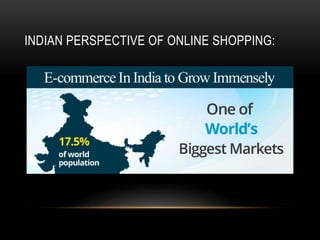
At about 150 million Internet users, India now has the third largest
Internet population in the world, after China (at 575M) and the US (at
275M).
1 . According to the Internet and Mobile Association of India (IAMAI),
the number of Social Media users in Urban India reached 66 Million by
June 2013 and by the end of 2014, is expected to cross 80 million
users.
2 . This clearly demonstrates that India is growing fast and people are
becoming habitual of using the Internet as the evolution of human
society, the improvement in Communication processes and Digital
Convergence open up innovative opportunities and challenges for
Marketing. Subsequently, the Internet has moved ahead to play a
significant role in the Consumer Decision Making Process.
Online Consumer Behavior: The Internet has become an important
channel for companies to provide product information and offer direct
sales to their customers. Firms of all sizes and from all industries have
invested in Internet applications and try to establish a net presence.
People increasingly use the Internet to check out company or product
information. A consumer’s intention to purchase specific products may
vary greatly and hence predicting general intentions to adopt the
Internet for purchasing, may be of limited use if the customer’s motives
to purchase specific products are likely to differ. At other times,
consumers click because they believe the link will bring them closer to
what they seek. The Online Consumer may also have different social
and work environment than the Offline Consumer. The Online Consumer
is generally more powerful, demanding and utilitarian in his/her
shopping expeditions.
Online decision making process

Online decision making process

  • 1.
    By, Faisal Ahmed Khan 1HK14MBA05 ONLINECONSUMER DECISION MAKING PROCESS
  • 2.
    Online shopping behavior(also called online buying behavior and Internet shopping/buying behavior) refers to the process of purchasing products or services via the Internet. Online shopping became popular in the mid-1990s with the popularization of the World Wide Web(WWW).
  • 3.
    WHAT CONSUMERS WANTFROM ONLINE STORES? • Service: • want timely, human feedback • Simplicity: • want simple, easy to use site technology • Convergence: • want sites that feel like offline stores
  • 4.
    GROWTH OF ONLINESHOPPING: 4 A recent survey states that nearly 70% of consumers have purchased at least one defined category via internet.
  • 5.
  • 6.
    ONLINE SHOPPING: ADVANTAGES: DISADVANTAGES: 6 ConvenienceFraud and Low Security Information and Lack of full cost reviews disclosure Price selection No Hands-on inspection
  • 8.
    INDIAN PERSPECTIVE OFONLINE SHOPPING:
  • 9.
    At about 150million Internet users, India now has the third largest Internet population in the world, after China (at 575M) and the US (at 275M). 1 . According to the Internet and Mobile Association of India (IAMAI), the number of Social Media users in Urban India reached 66 Million by June 2013 and by the end of 2014, is expected to cross 80 million users. 2 . This clearly demonstrates that India is growing fast and people are becoming habitual of using the Internet as the evolution of human society, the improvement in Communication processes and Digital Convergence open up innovative opportunities and challenges for Marketing. Subsequently, the Internet has moved ahead to play a significant role in the Consumer Decision Making Process.
  • 14.
    Online Consumer Behavior:The Internet has become an important channel for companies to provide product information and offer direct sales to their customers. Firms of all sizes and from all industries have invested in Internet applications and try to establish a net presence. People increasingly use the Internet to check out company or product information. A consumer’s intention to purchase specific products may vary greatly and hence predicting general intentions to adopt the Internet for purchasing, may be of limited use if the customer’s motives to purchase specific products are likely to differ. At other times, consumers click because they believe the link will bring them closer to what they seek. The Online Consumer may also have different social and work environment than the Offline Consumer. The Online Consumer is generally more powerful, demanding and utilitarian in his/her shopping expeditions.