By,
Faisal Ahmed Khan
MBA- 2nd Sem
HKBK-CE
 The law of sale of goods was contained in chapter VII of the
Indian contract Act. 1872
 Contracts for the sale of goods are subject to the general
legal principles applicable to all contracts, such as offer and
its acceptance or other essential elements of a contract.
 A contract of sale of goods is a contract whereby the seller
transfers or agrees to transfer the property in goods to buyer
for a price.
 The term “ contract of sale” is a generic term and includes
both a sale and an agreement to sell.
 A “buyer" means a person who buys or agrees to buy goods.
 A "delivery" means voluntary transfer of possession from one
person to another.
 A “sale” means an act of transferring goods from the seller to
the buyer, where the seller receives monetary benefit.
1. Two parties: there must be two distinct parties i.e a buyer
and the seller, to effect a contract of sale and they must be
competent to enter into a contract.
2. Goods: there must be some goods the property in which is
or is to be transferred from the seller to the buyer. The
goods which form the subject matter of the contract of sale
must be movable.
3. Price: the consideration for the contract of sale, called price,
must be money. When goods are exchanged for goods, if is
not a sale but a barter. Partly in money and kind is a
contract of sale.
4. All the essential elements of a valid contract.
Where under a contract of sale, the property in the goods is
transferred from the seller to the buyer, the contract is called
a “sale” but where the transfer of the property in the goods is
to take place at a future time or subject to some conditions
thereafter to be fulfilled. The contract is called “agreement to
sell “.
An agreement to sell becomes a sale when the time elapses
or the conditions, subject to which the property in the goods
is to be transferred are fulfilled.
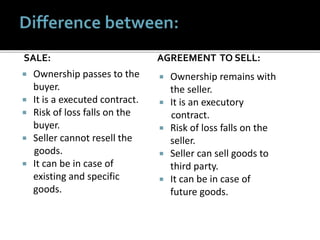
 Ownership passes to the
buyer.
 It is a executed contract.
 Risk of loss falls on the
buyer.
 Seller cannot resell the
goods.
 It can be in case of
existing and specific
goods.
 Ownership remains with
the seller.
 It is an executory
contract.
 Risk of loss falls on the
seller.
 Seller can sell goods to
third party.
 It can be in case of
future goods.
SALE: AGREEMENT TO SELL:
 In case of breach of a
contract, seller can sue for
the price of the goods .
 The seller is only entitled to
the ratable dividend of the
price due if the buyer
becomes insolvent.
 The buyer is entitled to
recover the specific
property from the assignee
if the seller becomes
insolvent.
 In case of breach of a
contract, seller can sue only
for damages not for the
price.
 The seller may refuse to sell
the goods to the buyer w/o
payments if the buyer
becomes insolvent.
 Buyer can claim only ratable
dividend for the money
paid.
SALE AGREEMENTTO SELL
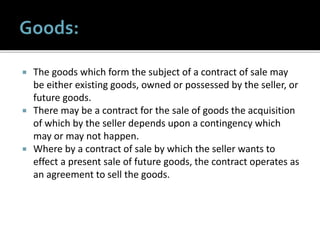
 The goods which form the subject of a contract of sale may
be either existing goods, owned or possessed by the seller, or
future goods.
 There may be a contract for the sale of goods the acquisition
of which by the seller depends upon a contingency which
may or may not happen.
 Where by a contract of sale by which the seller wants to
effect a present sale of future goods, the contract operates as
an agreement to sell the goods.
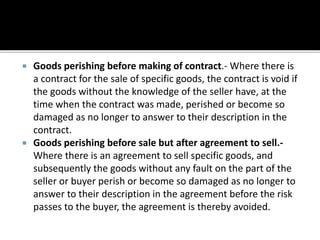
 Goods perishing before making of contract.- Where there is
a contract for the sale of specific goods, the contract is void if
the goods without the knowledge of the seller have, at the
time when the contract was made, perished or become so
damaged as no longer to answer to their description in the
contract.
 Goods perishing before sale but after agreement to sell.-
Where there is an agreement to sell specific goods, and
subsequently the goods without any fault on the part of the
seller or buyer perish or become so damaged as no longer to
answer to their description in the agreement before the risk
passes to the buyer, the agreement is thereby avoided.
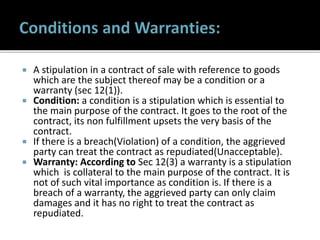
 A stipulation in a contract of sale with reference to goods
which are the subject thereof may be a condition or a
warranty (sec 12(1)).
 Condition: a condition is a stipulation which is essential to
the main purpose of the contract. It goes to the root of the
contract, its non fulfillment upsets the very basis of the
contract.
 If there is a breach(Violation) of a condition, the aggrieved
party can treat the contract as repudiated(Unacceptable).
 Warranty: According to Sec 12(3) a warranty is a stipulation
which is collateral to the main purpose of the contract. It is
not of such vital importance as condition is. If there is a
breach of a warranty, the aggrieved party can only claim
damages and it has no right to treat the contract as
repudiated.
 A stipulation in a contract of sale with reference to goods
which are the subject thereof may be a condition or a
warranty.
 A condition is a stipulation essential to the main purpose of
the contract, the breach of which gives rise to right to treat
the contract as repudiated.
 A warranty is a stipulation collateral to the main purpose of
the contract, the breach of which gives rise to a claim for
damages but not to a right to reject the goods and treat the
contract as repudiated.
 Whether a stipulation in a contract of sale is condition or a
warranty depends in each case on the construction of the
contract.
 Example :- [Behn v. Burness,1863]
By charter party( a contract by which a ship is hired for the
carriage of goods), it was agreed that ship m of 420 tons
“now in port of Amsterdam” should proceed direct to new
port to load a cargo. In fact at the time of the contract the
ship was not in the port of Amsterdam and when the ship
reached Newport, the charterer refused to load. Held, the
words “now in the port of Amsterdam” amounted to a
condition, the breach of which entitled the charterer to
repudiate the contract.
 Where a contract of sale is subject to any condition to the
fulfilled by the seller, the buyer may waive the condition or
elect to treat the breach of the condition as a breach of
warranty and not as a ground for relating the contract as
repudiated.
 Where a contract of sale is not severe and the buyer has
accepted the goods or part thereof, the breach of any
condition to be fulfilled by the seller can only be treated as a
breach of warranty and not as a ground for rejecting the
goods and treating the contract as repudiated, unless there is
a term of the contract, express or implied, to that effect.
 Nothing in this section shall affect the case of any condition
or warranty fulfillment of which is excused by law by reason
of impossibility of otherwise.
14
Thank you 

Sales and Goods Act-1930

  • 1.
  • 2.
     The lawof sale of goods was contained in chapter VII of the Indian contract Act. 1872  Contracts for the sale of goods are subject to the general legal principles applicable to all contracts, such as offer and its acceptance or other essential elements of a contract.  A contract of sale of goods is a contract whereby the seller transfers or agrees to transfer the property in goods to buyer for a price.  The term “ contract of sale” is a generic term and includes both a sale and an agreement to sell.
  • 3.
     A “buyer"means a person who buys or agrees to buy goods.  A "delivery" means voluntary transfer of possession from one person to another.  A “sale” means an act of transferring goods from the seller to the buyer, where the seller receives monetary benefit.
  • 4.
    1. Two parties:there must be two distinct parties i.e a buyer and the seller, to effect a contract of sale and they must be competent to enter into a contract. 2. Goods: there must be some goods the property in which is or is to be transferred from the seller to the buyer. The goods which form the subject matter of the contract of sale must be movable. 3. Price: the consideration for the contract of sale, called price, must be money. When goods are exchanged for goods, if is not a sale but a barter. Partly in money and kind is a contract of sale. 4. All the essential elements of a valid contract.
  • 5.
    Where under acontract of sale, the property in the goods is transferred from the seller to the buyer, the contract is called a “sale” but where the transfer of the property in the goods is to take place at a future time or subject to some conditions thereafter to be fulfilled. The contract is called “agreement to sell “. An agreement to sell becomes a sale when the time elapses or the conditions, subject to which the property in the goods is to be transferred are fulfilled.
  • 6.
     Ownership passesto the buyer.  It is a executed contract.  Risk of loss falls on the buyer.  Seller cannot resell the goods.  It can be in case of existing and specific goods.  Ownership remains with the seller.  It is an executory contract.  Risk of loss falls on the seller.  Seller can sell goods to third party.  It can be in case of future goods. SALE: AGREEMENT TO SELL:
  • 7.
     In caseof breach of a contract, seller can sue for the price of the goods .  The seller is only entitled to the ratable dividend of the price due if the buyer becomes insolvent.  The buyer is entitled to recover the specific property from the assignee if the seller becomes insolvent.  In case of breach of a contract, seller can sue only for damages not for the price.  The seller may refuse to sell the goods to the buyer w/o payments if the buyer becomes insolvent.  Buyer can claim only ratable dividend for the money paid. SALE AGREEMENTTO SELL
  • 8.
     The goodswhich form the subject of a contract of sale may be either existing goods, owned or possessed by the seller, or future goods.  There may be a contract for the sale of goods the acquisition of which by the seller depends upon a contingency which may or may not happen.  Where by a contract of sale by which the seller wants to effect a present sale of future goods, the contract operates as an agreement to sell the goods.
  • 9.
     Goods perishingbefore making of contract.- Where there is a contract for the sale of specific goods, the contract is void if the goods without the knowledge of the seller have, at the time when the contract was made, perished or become so damaged as no longer to answer to their description in the contract.  Goods perishing before sale but after agreement to sell.- Where there is an agreement to sell specific goods, and subsequently the goods without any fault on the part of the seller or buyer perish or become so damaged as no longer to answer to their description in the agreement before the risk passes to the buyer, the agreement is thereby avoided.
  • 10.
     A stipulationin a contract of sale with reference to goods which are the subject thereof may be a condition or a warranty (sec 12(1)).  Condition: a condition is a stipulation which is essential to the main purpose of the contract. It goes to the root of the contract, its non fulfillment upsets the very basis of the contract.  If there is a breach(Violation) of a condition, the aggrieved party can treat the contract as repudiated(Unacceptable).  Warranty: According to Sec 12(3) a warranty is a stipulation which is collateral to the main purpose of the contract. It is not of such vital importance as condition is. If there is a breach of a warranty, the aggrieved party can only claim damages and it has no right to treat the contract as repudiated.
  • 11.
     A stipulationin a contract of sale with reference to goods which are the subject thereof may be a condition or a warranty.  A condition is a stipulation essential to the main purpose of the contract, the breach of which gives rise to right to treat the contract as repudiated.  A warranty is a stipulation collateral to the main purpose of the contract, the breach of which gives rise to a claim for damages but not to a right to reject the goods and treat the contract as repudiated.  Whether a stipulation in a contract of sale is condition or a warranty depends in each case on the construction of the contract.
  • 12.
     Example :-[Behn v. Burness,1863] By charter party( a contract by which a ship is hired for the carriage of goods), it was agreed that ship m of 420 tons “now in port of Amsterdam” should proceed direct to new port to load a cargo. In fact at the time of the contract the ship was not in the port of Amsterdam and when the ship reached Newport, the charterer refused to load. Held, the words “now in the port of Amsterdam” amounted to a condition, the breach of which entitled the charterer to repudiate the contract.
  • 13.
     Where acontract of sale is subject to any condition to the fulfilled by the seller, the buyer may waive the condition or elect to treat the breach of the condition as a breach of warranty and not as a ground for relating the contract as repudiated.  Where a contract of sale is not severe and the buyer has accepted the goods or part thereof, the breach of any condition to be fulfilled by the seller can only be treated as a breach of warranty and not as a ground for rejecting the goods and treating the contract as repudiated, unless there is a term of the contract, express or implied, to that effect.  Nothing in this section shall affect the case of any condition or warranty fulfillment of which is excused by law by reason of impossibility of otherwise.
  • 14.