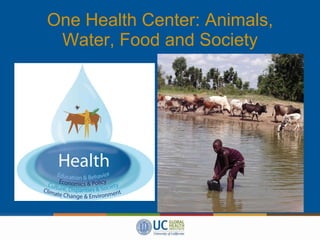
One Health Center: Animals, Water, Food and Society
Why is One Health important? Millions of people worldwide die or suffer from diseases that are not attributable to a single cause but instead are the result of a confluence of factors related to water, animals, and plants that work concurrently and synergistically to adversely affect human health. Given this synergy, integrated, holistic interventions will have larger impact and be more cost-effective than individual, isolated interventions in each area.
Mission Statement The mission of the One Health Center (OHC) is to assess and respond to global health problems arising from the human-water-animal-food interface, and to design, implement, and evaluate practical, cost-effective, and sustainable solutions that focus on the foundations of health in collaboration with local partners.
Operationalizing the mission The mission will be realized by: integrating expertise  drawn from a variety of disciplines, including medicine, public health, veterinary medicine, social sciences, engineering, and agricultural and environmental sciences engaging collaboratively  with partners in California and around the world in action-based research aimed at improving and promoting health using the One Health approach training  a cadre of global leaders, health workers, scientists, and engineers in the One Health approach
Some examples of OHC research/intervention areas Improved water management in underserved areas of the world to conserve water, increase its quantity and quality, and utilize it more effectively to specifically improve health outcomes Poultry immunization to improve animal health, reduce the risk of zoonotic diseases, and improve access to eggs and poultry meat for children Enhanced vector-control and disease-surveillance strategies Improved food safety through water and ecosystem management Promotion of low-cost and sustainable approaches to combat malnutrition, especially among children Use of agricultural biotechnology for improved nutrition and food security Implementation of better household practices to prevent the spread of water-related diseases
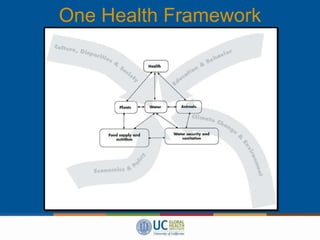
One Health Framework
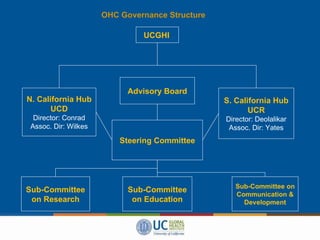
UCGHI Advisory Board N. California Hub UCD Director: Conrad Assoc. Dir: Wilkes S. California Hub UCR Director: Deolalikar Assoc. Dir: Yates Steering Committee Sub-Committee on Research Sub-Committee on Education Sub-Committee on Communication & Development OHC Governance Structure
OHC Signature Research Project Impact and Cost-Effectiveness of the One Health Approach on Child Health and Nutritional Status in Uganda Proposal highly ranked by the National Institutes of Health. Pilot a randomized control trial in rural Soroti district of Uganda that will involve the following staged interventions: hand-washing-with-soap stations and educational campaigns poultry immunization to improve animal health and increase access to eggs and poultry meat for young children treatment for intestinal parasites among children lipid-based nutrient supplements for home fortification of complementary foods for children under two  Conduct rigorous impact evaluation of the different interventions to determine the added benefits of the One Health approach.
Partners for Signature Project Department of Medicine, Makerere University, Kampala The Malaria Consortium Ministry of Health, Government of Uganda Program in International and Community Nutrition, UC Davis Center for Disease Vector Research, UC Riverside
Educational Program New 2 unit graduate course on One Health was offered in April 2010. The course consisted of eight 2 hour sessions during the month. Video-conferencing brought students and faculty together at three sites: UC Davis, UC Davis Medical Center, and UC Riverside. Enrollment limited to 25 graduate students from the three sites. UCD students were drawn from International and Community Nutrition; International Agricultural Development; Center for Health & Environment; Medical residents; and School of Veterinary Medicine.  UCR graduate students came from the Departments of Cell, Molecular and Developmental Biology; Entomology; Environmental Sciences; and Sociology.
OHC Contribution to  UCSF Master’s Program Foundations of Global Health Includes 4 lectures by OHC faculty, including: Overview presentation on the concept and importance of One Health Three presentations on the socioeconomic determinants of zoonotic diseases; relationship between malnutrition, agriculture and animal health; and waterborne disease and watershed management. Possible field placements   for Master’s students in action-based research projects in water management, nutrition, animal health, and vector disease control.
Other OHC Training Activities Co-sponsored international workshop, UCR:    “Facing the Challenges of Vector-Borne  Diseases in the 21st Century,” March 2010 OHC-UCR has applied for an NSF IGERT (Integrative Graduate Education and Research Traineeship) grant on “Water SENSE: Social, Engineering and Natural Sciences Engagement.” Symposium on  One Health  for students and faculty from all UC campuses, February 2011.
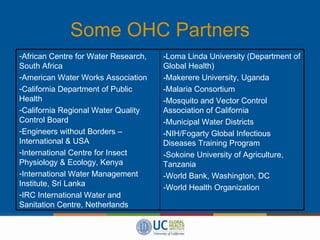
Some OHC Partners African Centre for Water Research, South Africa American Water Works Association California Department of Public Health California Regional Water Quality Control Board Engineers without Borders – International & USA International Centre for Insect Physiology & Ecology, Kenya International Water Management Institute, Sri Lanka  IRC International Water and Sanitation Centre, Netherlands -Loma Linda University (Department of Global Health) -Makerere University, Uganda -Malaria Consortium -Mosquito and Vector Control Association of California -Municipal Water Districts -NIH/Fogarty Global Infectious Diseases Training Program  -Sokoine University of Agriculture, Tanzania -World Bank, Washington, DC -World Health Organization

One Health Overview

  • 1.
    One Health Center:Animals, Water, Food and Society
  • 2.
    Why is OneHealth important? Millions of people worldwide die or suffer from diseases that are not attributable to a single cause but instead are the result of a confluence of factors related to water, animals, and plants that work concurrently and synergistically to adversely affect human health. Given this synergy, integrated, holistic interventions will have larger impact and be more cost-effective than individual, isolated interventions in each area.
  • 3.
    Mission Statement Themission of the One Health Center (OHC) is to assess and respond to global health problems arising from the human-water-animal-food interface, and to design, implement, and evaluate practical, cost-effective, and sustainable solutions that focus on the foundations of health in collaboration with local partners.
  • 4.
    Operationalizing the missionThe mission will be realized by: integrating expertise drawn from a variety of disciplines, including medicine, public health, veterinary medicine, social sciences, engineering, and agricultural and environmental sciences engaging collaboratively with partners in California and around the world in action-based research aimed at improving and promoting health using the One Health approach training a cadre of global leaders, health workers, scientists, and engineers in the One Health approach
  • 5.
    Some examples ofOHC research/intervention areas Improved water management in underserved areas of the world to conserve water, increase its quantity and quality, and utilize it more effectively to specifically improve health outcomes Poultry immunization to improve animal health, reduce the risk of zoonotic diseases, and improve access to eggs and poultry meat for children Enhanced vector-control and disease-surveillance strategies Improved food safety through water and ecosystem management Promotion of low-cost and sustainable approaches to combat malnutrition, especially among children Use of agricultural biotechnology for improved nutrition and food security Implementation of better household practices to prevent the spread of water-related diseases
  • 6.
  • 7.
    UCGHI Advisory BoardN. California Hub UCD Director: Conrad Assoc. Dir: Wilkes S. California Hub UCR Director: Deolalikar Assoc. Dir: Yates Steering Committee Sub-Committee on Research Sub-Committee on Education Sub-Committee on Communication & Development OHC Governance Structure
  • 8.
    OHC Signature ResearchProject Impact and Cost-Effectiveness of the One Health Approach on Child Health and Nutritional Status in Uganda Proposal highly ranked by the National Institutes of Health. Pilot a randomized control trial in rural Soroti district of Uganda that will involve the following staged interventions: hand-washing-with-soap stations and educational campaigns poultry immunization to improve animal health and increase access to eggs and poultry meat for young children treatment for intestinal parasites among children lipid-based nutrient supplements for home fortification of complementary foods for children under two Conduct rigorous impact evaluation of the different interventions to determine the added benefits of the One Health approach.
  • 9.
    Partners for SignatureProject Department of Medicine, Makerere University, Kampala The Malaria Consortium Ministry of Health, Government of Uganda Program in International and Community Nutrition, UC Davis Center for Disease Vector Research, UC Riverside
  • 10.
    Educational Program New2 unit graduate course on One Health was offered in April 2010. The course consisted of eight 2 hour sessions during the month. Video-conferencing brought students and faculty together at three sites: UC Davis, UC Davis Medical Center, and UC Riverside. Enrollment limited to 25 graduate students from the three sites. UCD students were drawn from International and Community Nutrition; International Agricultural Development; Center for Health & Environment; Medical residents; and School of Veterinary Medicine. UCR graduate students came from the Departments of Cell, Molecular and Developmental Biology; Entomology; Environmental Sciences; and Sociology.
  • 11.
    OHC Contribution to UCSF Master’s Program Foundations of Global Health Includes 4 lectures by OHC faculty, including: Overview presentation on the concept and importance of One Health Three presentations on the socioeconomic determinants of zoonotic diseases; relationship between malnutrition, agriculture and animal health; and waterborne disease and watershed management. Possible field placements for Master’s students in action-based research projects in water management, nutrition, animal health, and vector disease control.
  • 12.
    Other OHC TrainingActivities Co-sponsored international workshop, UCR: “Facing the Challenges of Vector-Borne Diseases in the 21st Century,” March 2010 OHC-UCR has applied for an NSF IGERT (Integrative Graduate Education and Research Traineeship) grant on “Water SENSE: Social, Engineering and Natural Sciences Engagement.” Symposium on One Health for students and faculty from all UC campuses, February 2011.
  • 13.
    Some OHC PartnersAfrican Centre for Water Research, South Africa American Water Works Association California Department of Public Health California Regional Water Quality Control Board Engineers without Borders – International & USA International Centre for Insect Physiology & Ecology, Kenya International Water Management Institute, Sri Lanka IRC International Water and Sanitation Centre, Netherlands -Loma Linda University (Department of Global Health) -Makerere University, Uganda -Malaria Consortium -Mosquito and Vector Control Association of California -Municipal Water Districts -NIH/Fogarty Global Infectious Diseases Training Program -Sokoine University of Agriculture, Tanzania -World Bank, Washington, DC -World Health Organization

Editor's Notes

  • #3 One Health is an emerging area of professional practice arising from the recognition of the growing interconnections and influence –economic, cultural and physical- between humans, animals, and their environment. It describes the collaboration of these various scientific disciplines in the pursuit of better health for all. One Health understands that humans do not exist in isolation, but are part of the larger, total living ecosystem, and that the activities and conditions of each member affect the others
  • #8 MARC PRESENTS
  • #9 International partners came together: