One Health
One Health is an integrated, unifying approach that aims to
sustainably balance and optimize the health of people, animals,
and ecosystems. It recognizes the health of humans, domestic
and wild animals, plants, and the wider environment (including
ecosystems) are closely linked and interdependent (2021)
Key underlying principles including
• Equity between sectors and disciplines;
• sociopolitical and multicultural Parity (the doctrine that all people are equal
and deserve equal rights and opportunities) and inclusion and engagement
of communities and marginalized voices;
• socioecological Equilibrium that seeks a harmonious balance between
human–animal–environment interaction and acknowledging the importance
of biodiversity, access to sufficient natural space and resources, and the
intrinsic value of all living things within the ecosystem;
• Stewardship and the responsibility of humans to change behavior and adopt
sustainable solutions that recognize the importance of animal welfare and
the integrity of the whole ecosystem, thus securing the well-being of current
and future generations; and
• Transdisciplinarity and multisectoral collaboration, which includes all
relevant disciplines, both modern and traditional forms of knowledge and a
broad representative array of perspectives.
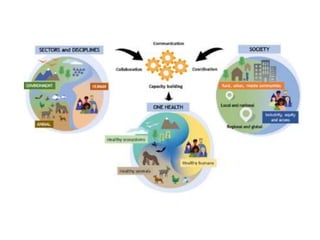
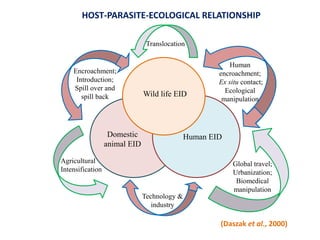
Wild life EID
Domestic
animal EID
Human EID
Translocation
Agricultural
Intensification
Global travel;
Urbanization;
Biomedical
manipulation
Technology &
industry
Encroachment;
Introduction;
Spill over and
spill back
Human
encroachment;
Ex situ contact;
Ecological
manipulation
(Daszak et al., 2000)
HOST-PARASITE-ECOLOGICAL RELATIONSHIP
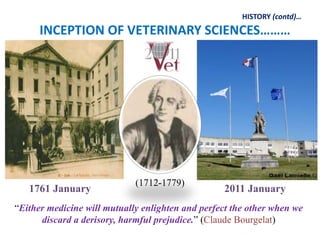
1761 January 2011 January
INCEPTION OF VETERINARY SCIENCES………
HISTORY (contd)…
“Either medicine will mutually enlighten and perfect the other when we
discard a derisory, harmful prejudice.” (Claude Bourgelat)
(1712-1779)
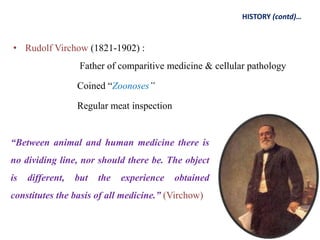
• Rudolf Virchow (1821-1902) :
Father of comparitive medicine & cellular pathology
Coined “Zoonoses”
Regular meat inspection
HISTORY (contd)…
“Between animal and human medicine there is
no dividing line, nor should there be. The object
is different, but the experience obtained
constitutes the basis of all medicine.” (Virchow)
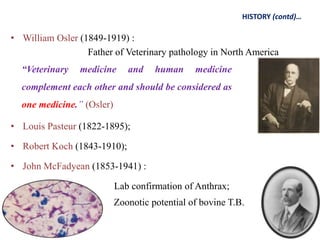
• William Osler (1849-1919) :
Father of Veterinary pathology in North America
• Louis Pasteur (1822-1895);
• Robert Koch (1843-1910);
• John McFadyean (1853-1941) :
Lab confirmation of Anthrax;
Zoonotic potential of bovine T.B.
HISTORY (contd)…
“Veterinary medicine and human medicine
complement each other and should be considered as
one medicine.” (Osler)
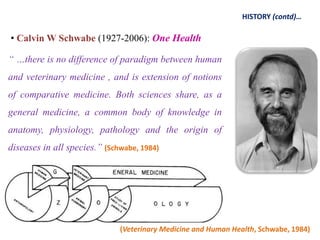
• Calvin W Schwabe (1927-2006): One Health
HISTORY (contd)…
“ …there is no difference of paradigm between human
and veterinary medicine , and is extension of notions
of comparative medicine. Both sciences share, as a
general medicine, a common body of knowledge in
anatomy, physiology, pathology and the origin of
diseases in all species.” (Schwabe, 1984)
(Veterinary Medicine and Human Health, Schwabe, 1984)
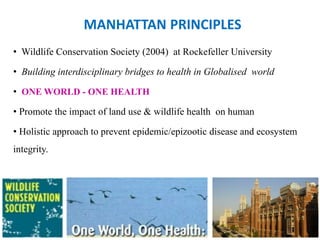
• Wildlife Conservation Society (2004) at Rockefeller University
• Building interdisciplinary bridges to health in Globalised world
• ONE WORLD - ONE HEALTH
• Promote the impact of land use & wildlife health on human
• Holistic approach to prevent epidemic/epizootic disease and ecosystem
integrity.
MANHATTAN PRINCIPLES
• AMA (June 25, 2007) House of Delegates approved resolution
• AVMA (July, 2007) implemented One Health Concept
• To revive integration of human, animal or environmental health
(Klement et al., 2009)
• Inter-professional collaboration (Hristovski et al., 2010)
• To extend research on EIDs; surveillance (Atlas et al., 2010)
• Improve scientific knowledge & clinical care
ONE HEALTH INITIATIVE
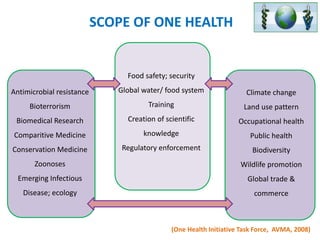
SCOPE OF ONE HEALTH
Antimicrobial resistance
Bioterrorism
Biomedical Research
Comparitive Medicine
Conservation Medicine
Zoonoses
Emerging Infectious
Disease; ecology
Food safety; security
Global water/ food system
Training
Creation of scientific
knowledge
Regulatory enforcement
Climate change
Land use pattern
Occupational health
Public health
Biodiversity
Wildlife promotion
Global trade &
commerce
(One Health Initiative Task Force, AVMA, 2008)
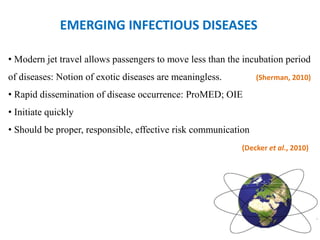
EMERGING INFECTIOUS DISEASES
• Modern jet travel allows passengers to move less than the incubation period
of diseases: Notion of exotic diseases are meaningless. (Sherman, 2010)
• Rapid dissemination of disease occurrence: ProMED; OIE
• Initiate quickly
• Should be proper, responsible, effective risk communication
(Decker et al., 2010)
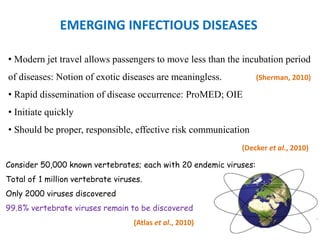
EMERGING INFECTIOUS DISEASES
• Modern jet travel allows passengers to move less than the incubation period
of diseases: Notion of exotic diseases are meaningless. (Sherman, 2010)
• Rapid dissemination of disease occurrence: ProMED; OIE
• Initiate quickly
• Should be proper, responsible, effective risk communication
(Decker et al., 2010)
Consider 50,000 known vertebrates; each with 20 endemic viruses:
Total of 1 million vertebrate viruses.
Only 2000 viruses discovered
99.8% vertebrate viruses remain to be discovered
(Atlas et al., 2010)
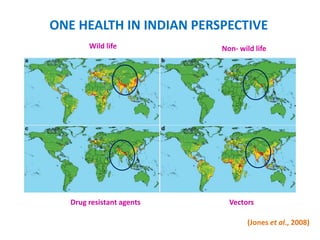
ONE HEALTH IN INDIAN PERSPECTIVE
Wild life Non- wild life
Vectors
Drug resistant agents
(Jones et al., 2008)
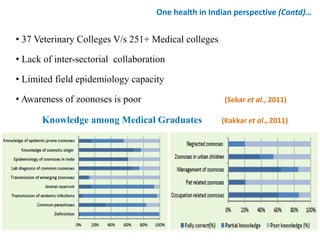
• 37 Veterinary Colleges V/s 251+ Medical colleges
• Lack of inter-sectorial collaboration
• Limited field epidemiology capacity
• Awareness of zoonoses is poor (Sekar et al., 2011)
One health in Indian perspective (Contd)…
Knowledge among Medical Graduates (Kakkar et al., 2011)
• Lack of national programme on Zoonoses managed by Dept of Animal
Husbandry, Ministry of Agriculture except for Rabies in few states
• Lack of authentic data on occurrence of the diseases
• No Public Health implementing agency (Asokan et al., 2011)
One health in Indian perspective (Contd)…
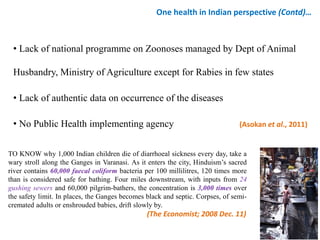
TO KNOW why 1,000 Indian children die of diarrhoeal sickness every day, take a
wary stroll along the Ganges in Varanasi. As it enters the city, Hinduism’s sacred
river contains 60,000 faecal coliform bacteria per 100 millilitres, 120 times more
than is considered safe for bathing. Four miles downstream, with inputs from 24
gushing sewers and 60,000 pilgrim-bathers, the concentration is 3,000 times over
the safety limit. In places, the Ganges becomes black and septic. Corpses, of semi-
cremated adults or enshrouded babies, drift slowly by.
(The Economist; 2008 Dec. 11)
• Consensus among stakeholders
• Collaboration among professionals,
• Cooperation among interdisciplinary groups,
• Coordination among partner agencies and
• Commitment (Political and financial) by donors, partners, regional
organizations and national governments
How to reach One Health??..
For low/ middle income nations : US$ 1.3 billion spend for
One Health per year till 2020
(Contributing to One World, One Health: A Strategic Framework for Reducing
Risks of Infectious Diseases at the Animal-Human-Ecosystem Interface, 2008)
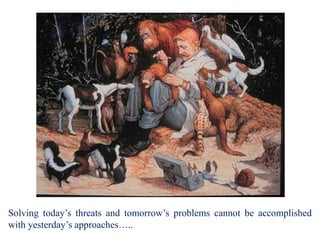
Solving today’s threats and tomorrow’s problems cannot be accomplished
with yesterday’s approaches…..

One Health.ppt

  • 1.
  • 2.
    One Health isan integrated, unifying approach that aims to sustainably balance and optimize the health of people, animals, and ecosystems. It recognizes the health of humans, domestic and wild animals, plants, and the wider environment (including ecosystems) are closely linked and interdependent (2021)
  • 3.
    Key underlying principlesincluding • Equity between sectors and disciplines; • sociopolitical and multicultural Parity (the doctrine that all people are equal and deserve equal rights and opportunities) and inclusion and engagement of communities and marginalized voices; • socioecological Equilibrium that seeks a harmonious balance between human–animal–environment interaction and acknowledging the importance of biodiversity, access to sufficient natural space and resources, and the intrinsic value of all living things within the ecosystem; • Stewardship and the responsibility of humans to change behavior and adopt sustainable solutions that recognize the importance of animal welfare and the integrity of the whole ecosystem, thus securing the well-being of current and future generations; and • Transdisciplinarity and multisectoral collaboration, which includes all relevant disciplines, both modern and traditional forms of knowledge and a broad representative array of perspectives.
  • 5.
    Wild life EID Domestic animalEID Human EID Translocation Agricultural Intensification Global travel; Urbanization; Biomedical manipulation Technology & industry Encroachment; Introduction; Spill over and spill back Human encroachment; Ex situ contact; Ecological manipulation (Daszak et al., 2000) HOST-PARASITE-ECOLOGICAL RELATIONSHIP
  • 6.
    1761 January 2011January INCEPTION OF VETERINARY SCIENCES……… HISTORY (contd)… “Either medicine will mutually enlighten and perfect the other when we discard a derisory, harmful prejudice.” (Claude Bourgelat) (1712-1779)
  • 7.
    • Rudolf Virchow(1821-1902) : Father of comparitive medicine & cellular pathology Coined “Zoonoses” Regular meat inspection HISTORY (contd)… “Between animal and human medicine there is no dividing line, nor should there be. The object is different, but the experience obtained constitutes the basis of all medicine.” (Virchow)
  • 8.
    • William Osler(1849-1919) : Father of Veterinary pathology in North America • Louis Pasteur (1822-1895); • Robert Koch (1843-1910); • John McFadyean (1853-1941) : Lab confirmation of Anthrax; Zoonotic potential of bovine T.B. HISTORY (contd)… “Veterinary medicine and human medicine complement each other and should be considered as one medicine.” (Osler)
  • 9.
    • Calvin WSchwabe (1927-2006): One Health HISTORY (contd)… “ …there is no difference of paradigm between human and veterinary medicine , and is extension of notions of comparative medicine. Both sciences share, as a general medicine, a common body of knowledge in anatomy, physiology, pathology and the origin of diseases in all species.” (Schwabe, 1984) (Veterinary Medicine and Human Health, Schwabe, 1984)
  • 10.
    • Wildlife ConservationSociety (2004) at Rockefeller University • Building interdisciplinary bridges to health in Globalised world • ONE WORLD - ONE HEALTH • Promote the impact of land use & wildlife health on human • Holistic approach to prevent epidemic/epizootic disease and ecosystem integrity. MANHATTAN PRINCIPLES
  • 11.
    • AMA (June25, 2007) House of Delegates approved resolution • AVMA (July, 2007) implemented One Health Concept • To revive integration of human, animal or environmental health (Klement et al., 2009) • Inter-professional collaboration (Hristovski et al., 2010) • To extend research on EIDs; surveillance (Atlas et al., 2010) • Improve scientific knowledge & clinical care ONE HEALTH INITIATIVE
  • 12.
    SCOPE OF ONEHEALTH Antimicrobial resistance Bioterrorism Biomedical Research Comparitive Medicine Conservation Medicine Zoonoses Emerging Infectious Disease; ecology Food safety; security Global water/ food system Training Creation of scientific knowledge Regulatory enforcement Climate change Land use pattern Occupational health Public health Biodiversity Wildlife promotion Global trade & commerce (One Health Initiative Task Force, AVMA, 2008)
  • 13.
    EMERGING INFECTIOUS DISEASES •Modern jet travel allows passengers to move less than the incubation period of diseases: Notion of exotic diseases are meaningless. (Sherman, 2010) • Rapid dissemination of disease occurrence: ProMED; OIE • Initiate quickly • Should be proper, responsible, effective risk communication (Decker et al., 2010)
  • 14.
    EMERGING INFECTIOUS DISEASES •Modern jet travel allows passengers to move less than the incubation period of diseases: Notion of exotic diseases are meaningless. (Sherman, 2010) • Rapid dissemination of disease occurrence: ProMED; OIE • Initiate quickly • Should be proper, responsible, effective risk communication (Decker et al., 2010) Consider 50,000 known vertebrates; each with 20 endemic viruses: Total of 1 million vertebrate viruses. Only 2000 viruses discovered 99.8% vertebrate viruses remain to be discovered (Atlas et al., 2010)
  • 15.
    ONE HEALTH ININDIAN PERSPECTIVE Wild life Non- wild life Vectors Drug resistant agents (Jones et al., 2008)
  • 16.
    • 37 VeterinaryColleges V/s 251+ Medical colleges • Lack of inter-sectorial collaboration • Limited field epidemiology capacity • Awareness of zoonoses is poor (Sekar et al., 2011) One health in Indian perspective (Contd)… Knowledge among Medical Graduates (Kakkar et al., 2011)
  • 17.
    • Lack ofnational programme on Zoonoses managed by Dept of Animal Husbandry, Ministry of Agriculture except for Rabies in few states • Lack of authentic data on occurrence of the diseases • No Public Health implementing agency (Asokan et al., 2011) One health in Indian perspective (Contd)… TO KNOW why 1,000 Indian children die of diarrhoeal sickness every day, take a wary stroll along the Ganges in Varanasi. As it enters the city, Hinduism’s sacred river contains 60,000 faecal coliform bacteria per 100 millilitres, 120 times more than is considered safe for bathing. Four miles downstream, with inputs from 24 gushing sewers and 60,000 pilgrim-bathers, the concentration is 3,000 times over the safety limit. In places, the Ganges becomes black and septic. Corpses, of semi- cremated adults or enshrouded babies, drift slowly by. (The Economist; 2008 Dec. 11)
  • 18.
    • Consensus amongstakeholders • Collaboration among professionals, • Cooperation among interdisciplinary groups, • Coordination among partner agencies and • Commitment (Political and financial) by donors, partners, regional organizations and national governments How to reach One Health??.. For low/ middle income nations : US$ 1.3 billion spend for One Health per year till 2020 (Contributing to One World, One Health: A Strategic Framework for Reducing Risks of Infectious Diseases at the Animal-Human-Ecosystem Interface, 2008)
  • 19.
    Solving today’s threatsand tomorrow’s problems cannot be accomplished with yesterday’s approaches…..