ANUPAM SAHA
SUNIRMAL BHATTACHARJEE
Email ID - sunirmal.pharma@gmail.com
PHARMACOKINETIC- ONE
COMPARTMENT MODELING
INTRODUCTION:
• Pharmacokinetics
• Clinical pharmacokinetics
• Compartments
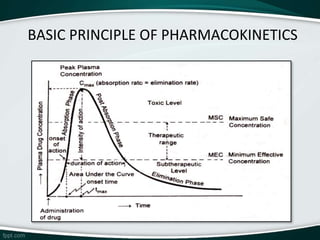
BASIC PRINCIPLE OF PHARMACOKINETICS
One Compartment Open Model
• Physiologically based pharmacokinetic (PBPK)modeling is a
mathematical modeling technique for predicting the absorption,
distribution, metabolism and excretion (ADME) of synthetic or natural
chemical substances in humans and other animal species. This is
called pharmacokinetic model.
• Pharmacokinetic models are developed based on certain
assumptions. It should be remembered that application of mathematic
to physiological events means to correlate mathematics with
physiological events , so assumption made should be realistic and
practical.
The following assumptions
are : -
– The process of drug absorption from the absorption site may be
explained by the first order kinetics.
– Once a drug enters the systemic circulation, it rapidly distributes to other
body fluids and tissue , and a dynamic equilibrium is achieved
instantaneously between the drug in the blood and the drug in other
tissues.
– Any changes that occur in the plasma levels of a drug reflects
proportional changes in the tissue drug level.
– Elimination in the drug from body follows an apparent first order rate
constant.
• ZERO ORDER KINETICS
Zero order Half- Life
t1/2 = C0 /2K0
• FIRST- ORDER KINETICS
First-Order Half-Life
• Mixed-Order Kinetics
t1/2 = o.693/K
dC/dt = K0C0 =-K0
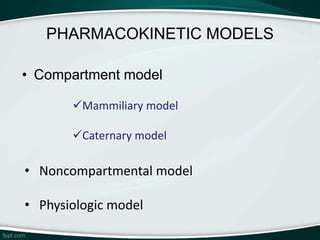
PHARMACOKINETIC MODELS
• Compartment model
Mammiliary model
Caternary model
• Noncompartmental model
• Physiologic model
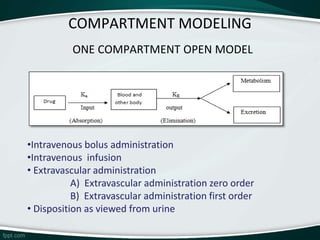
COMPARTMENT MODELING
ONE COMPARTMENT OPEN MODEL
•Intravenous bolus administration
•Intravenous infusion
• Extravascular administration
A) Extravascular administration zero order
B) Extravascular administration first order
• Disposition as viewed from urine
INTRAVENOUS BOLUS ADMINISTRATION
dX/dt = Rate in (availability) – Rate out (elimination)
dX/dt = - KE X
• Elimination Rate Constant
KE= Km + Ke
Pharmacokinetic parameters
dX/dt = - KE X
Integration
lnX = lnX0 – KE t
X = X0 e-Ket
logX = logX0 – KEt / 2.303 logC = logC0 – KEt / 2.303
• Elimination Half-Life
• Apparent Volume of Distribution
• AUC Estimation
X0 = Ke Vd AUC
• Clearance
• Total Body Clearance
ClT = ClR + ClNR
𝑉𝑑 =
𝑋0
𝐾𝑒 (𝐴𝑈𝐶)
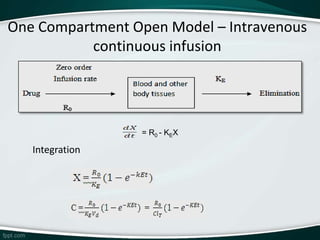
One Compartment Open Model – Intravenous
continuous infusion
= R0 - KEX
Integration
Loading Dose Plus IV Infusion
XO,L = CSSVd
XO,L =
Extravascular Administration
>
=
<
Urinary Excretion Data
• Useful when there is a lack of sensitive analytical
technique
• It is more convenient
• Less sensitive analytical method required
• Direct measurement of bioavailability
• CLR =
References
• Ali j.et al (2004) “Biopharmaceutics and Pharmacokinetics” 2nd ed. Birla Publications Pvt. Ltd.
Delhi, 64-115
• Analysis of blood & urine data, Compartment models, kinetics of one & two compartment
models [Online] Available at <http://pharmaquest. weebly.com /uploads/9/9/4 /2/994
2916/blood_urine_data.pdf> [Accessed 15-8-2012]
• Brahmankar D.M., Jaiswal S.B. (2009) “Biopharmaceutics and Pharmacokinetics A Treatise”
2nd ed. Vallabh Prakashan, Delhi p.p. 235-298
• Cheng HY, Jusko WJ (1998) Mean residence time concepts for pharmacokinetic systems
with nonlinear drug elimination described by the Michaelis-Menten equation [Online]
Available at <http://www.ncbi.nlm.nih.gov/pubmed/3244627> [Accessed 05-8-2012]
• Compartmental Analysis [Online] available at <http://www.uq.edu.au/ pharmacy/sduf
full/Comp _ analysis.pdf> [Accessed 1-8-2012]
• Dhillon S. and Gill K. Basic pharmacokinetics [Online] Available at <http:// www.
pharmpress.com/files/docs/clinical_pharmacokinetics_samplechapter.pdf>[Accessed 12-8 –
2012]
• Introduction to Pharmacokinetics and Pharmacodynamics [Online] Available at <http://w
ww.ashp.org/DocLibrary/Bookstore/P2418-Chapter1.aspx> [Accessed 12-8-2012]
• Mathematics in Pharmacokinetics What and Why (A second attempt to make it clearer)
[Online] Available at<http://www.cop.ufl.edu/wp-content/uploads/2010/10/PKMATH
stark.pdf> [Accessed 24-8-2012]
• Mathematics in Pharmacokinetics What and Why (A second attempt to make it
clearer) [Online] Available at<http://www.cop.ufl.edu/wp-content/uploads/ 2010
/10/PKMATHstark.pdf> [Accessed 24-8-2012]
• Multi-compartment model [Online] Available at <http://en.wikipedia.org/wiki/Multi-com
partment_model> [Accessed 29-8-2012]
• Pharmacokinetic Modeling [Online] Available at <http://www.nap.e du/openboo
k.php? record_ I d=11707&page=29> [Accessed 15-7-2012]
• Pharmacokinetics and Biopharmaceutics (46:138) Lecture tutorial [Online] Available
at <http://www.uiowa.edu/~c046138/tut-noncomp.htm> [Accessed 17-7-2012]
• Shargel L. et al (2004) “Applied Biopharmaceutics and Pharmacokinetics” 5th ed. Mc
• Graw Hill’s, North Carolina
• Tipnis H.P. Nagarsenker M.S. (2003) “Introduction to Biopharmaceutics and
Pharmacokinetics” 2nd ed. 2003 Nirali Prakashan India 61-92
• Venkateswarlu V. (2004) “Biopharmaceutics and Pharmacokinetics” Pharma Book
Syndicate, Hyderabad 170
• What are compartmental models? [Online] Available at<http://blog.learnpkpd. com/
2011/01/05/what-are-compartmental-models/> [Accessed 29-8-2012]
• Available <http://www.sciencedirect.com/science/article/pii/S 0304401705002591&d
o cid=v8E_yvAgSz46FM&imgurl=http://ars.els-cdn.com/content/image/>[Accessed
9-8-2012]

One compartment modelling

  • 1.
    ANUPAM SAHA SUNIRMAL BHATTACHARJEE EmailID - sunirmal.pharma@gmail.com PHARMACOKINETIC- ONE COMPARTMENT MODELING
  • 2.
    INTRODUCTION: • Pharmacokinetics • Clinicalpharmacokinetics • Compartments
  • 3.
    BASIC PRINCIPLE OFPHARMACOKINETICS
  • 4.
    One Compartment OpenModel • Physiologically based pharmacokinetic (PBPK)modeling is a mathematical modeling technique for predicting the absorption, distribution, metabolism and excretion (ADME) of synthetic or natural chemical substances in humans and other animal species. This is called pharmacokinetic model. • Pharmacokinetic models are developed based on certain assumptions. It should be remembered that application of mathematic to physiological events means to correlate mathematics with physiological events , so assumption made should be realistic and practical.
  • 5.
    The following assumptions are: - – The process of drug absorption from the absorption site may be explained by the first order kinetics. – Once a drug enters the systemic circulation, it rapidly distributes to other body fluids and tissue , and a dynamic equilibrium is achieved instantaneously between the drug in the blood and the drug in other tissues. – Any changes that occur in the plasma levels of a drug reflects proportional changes in the tissue drug level. – Elimination in the drug from body follows an apparent first order rate constant.
  • 6.
    • ZERO ORDERKINETICS Zero order Half- Life t1/2 = C0 /2K0 • FIRST- ORDER KINETICS First-Order Half-Life • Mixed-Order Kinetics t1/2 = o.693/K dC/dt = K0C0 =-K0
  • 7.
    PHARMACOKINETIC MODELS • Compartmentmodel Mammiliary model Caternary model • Noncompartmental model • Physiologic model
  • 8.
    COMPARTMENT MODELING ONE COMPARTMENTOPEN MODEL •Intravenous bolus administration •Intravenous infusion • Extravascular administration A) Extravascular administration zero order B) Extravascular administration first order • Disposition as viewed from urine
  • 9.
    INTRAVENOUS BOLUS ADMINISTRATION dX/dt= Rate in (availability) – Rate out (elimination) dX/dt = - KE X
  • 10.
    • Elimination RateConstant KE= Km + Ke Pharmacokinetic parameters dX/dt = - KE X Integration lnX = lnX0 – KE t X = X0 e-Ket logX = logX0 – KEt / 2.303 logC = logC0 – KEt / 2.303
  • 11.
    • Elimination Half-Life •Apparent Volume of Distribution
  • 12.
    • AUC Estimation X0= Ke Vd AUC • Clearance • Total Body Clearance ClT = ClR + ClNR 𝑉𝑑 = 𝑋0 𝐾𝑒 (𝐴𝑈𝐶)
  • 13.
    One Compartment OpenModel – Intravenous continuous infusion = R0 - KEX Integration
  • 14.
    Loading Dose PlusIV Infusion XO,L = CSSVd XO,L =
  • 15.
  • 16.
    Urinary Excretion Data •Useful when there is a lack of sensitive analytical technique • It is more convenient • Less sensitive analytical method required • Direct measurement of bioavailability • CLR =
  • 17.
    References • Ali j.etal (2004) “Biopharmaceutics and Pharmacokinetics” 2nd ed. Birla Publications Pvt. Ltd. Delhi, 64-115 • Analysis of blood & urine data, Compartment models, kinetics of one & two compartment models [Online] Available at <http://pharmaquest. weebly.com /uploads/9/9/4 /2/994 2916/blood_urine_data.pdf> [Accessed 15-8-2012] • Brahmankar D.M., Jaiswal S.B. (2009) “Biopharmaceutics and Pharmacokinetics A Treatise” 2nd ed. Vallabh Prakashan, Delhi p.p. 235-298 • Cheng HY, Jusko WJ (1998) Mean residence time concepts for pharmacokinetic systems with nonlinear drug elimination described by the Michaelis-Menten equation [Online] Available at <http://www.ncbi.nlm.nih.gov/pubmed/3244627> [Accessed 05-8-2012] • Compartmental Analysis [Online] available at <http://www.uq.edu.au/ pharmacy/sduf full/Comp _ analysis.pdf> [Accessed 1-8-2012] • Dhillon S. and Gill K. Basic pharmacokinetics [Online] Available at <http:// www. pharmpress.com/files/docs/clinical_pharmacokinetics_samplechapter.pdf>[Accessed 12-8 – 2012] • Introduction to Pharmacokinetics and Pharmacodynamics [Online] Available at <http://w ww.ashp.org/DocLibrary/Bookstore/P2418-Chapter1.aspx> [Accessed 12-8-2012] • Mathematics in Pharmacokinetics What and Why (A second attempt to make it clearer) [Online] Available at<http://www.cop.ufl.edu/wp-content/uploads/2010/10/PKMATH stark.pdf> [Accessed 24-8-2012]
  • 18.
    • Mathematics inPharmacokinetics What and Why (A second attempt to make it clearer) [Online] Available at<http://www.cop.ufl.edu/wp-content/uploads/ 2010 /10/PKMATHstark.pdf> [Accessed 24-8-2012] • Multi-compartment model [Online] Available at <http://en.wikipedia.org/wiki/Multi-com partment_model> [Accessed 29-8-2012] • Pharmacokinetic Modeling [Online] Available at <http://www.nap.e du/openboo k.php? record_ I d=11707&page=29> [Accessed 15-7-2012] • Pharmacokinetics and Biopharmaceutics (46:138) Lecture tutorial [Online] Available at <http://www.uiowa.edu/~c046138/tut-noncomp.htm> [Accessed 17-7-2012] • Shargel L. et al (2004) “Applied Biopharmaceutics and Pharmacokinetics” 5th ed. Mc • Graw Hill’s, North Carolina • Tipnis H.P. Nagarsenker M.S. (2003) “Introduction to Biopharmaceutics and Pharmacokinetics” 2nd ed. 2003 Nirali Prakashan India 61-92 • Venkateswarlu V. (2004) “Biopharmaceutics and Pharmacokinetics” Pharma Book Syndicate, Hyderabad 170 • What are compartmental models? [Online] Available at<http://blog.learnpkpd. com/ 2011/01/05/what-are-compartmental-models/> [Accessed 29-8-2012] • Available <http://www.sciencedirect.com/science/article/pii/S 0304401705002591&d o cid=v8E_yvAgSz46FM&imgurl=http://ars.els-cdn.com/content/image/>[Accessed 9-8-2012]