Presented Presented By:
Roll Rooma Khalid
M.phil Pharmaceutics
(2014-2016)
ISLAMIA UNIVERSITY BAHAWALPUR
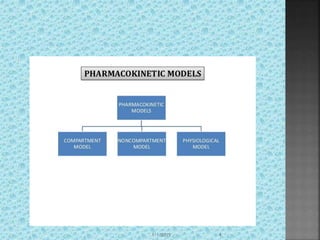
 INTRODUCTION
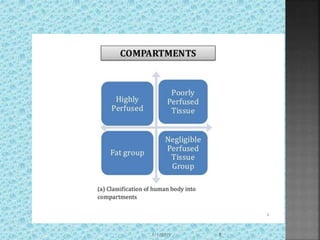
 COMPARTMENT MODELS
 TWO COMPARTMENT MODEL(I.V BOLUS)
 METHOD OF RESIDUAL
 PARAMETERS OF TWO COMPARTMENT
 INTRAVENOUS INFUSION
 CLINICAL APPLICATIONS
1/1/2015 2
PHARMACOKINETICS:
 pharmacon:drug
 kinesis-motion/change of rate
pharmacokinetics is the study of kinetics
of absorption,distribution,metabolism and
excretion(ADME) of drugs and their
corresponding pharmacologic,therapeutic
or toxic responses in man and animals.
1/1/2015 3
1/1/2015 4
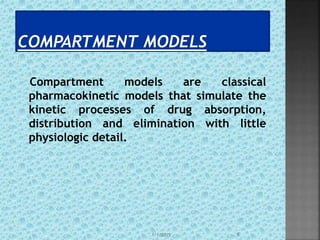
Compartment models are classical
pharmacokinetic models that simulate the
kinetic processes of drug absorption,
distribution and elimination with little
physiologic detail.
1/1/2015 5
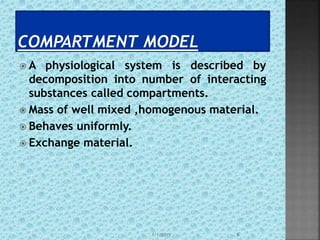
 A physiological system is described by
decomposition into number of interacting
substances called compartments.
 Mass of well mixed ,homogenous material.
 Behaves uniformly.
 Exchange material.
1/1/2015 6
 OPEN MODEL:
Administered drug dose is
eliminated from the body by an excretory
mechanism.
 CLOSED MODEL:
The drug dose is not eliminated
from the body.
1/1/2015 7
1/1/2015 8
 Many drugs given in single IV bolus dose
demonstrate a plasma level time curve that
does not decline as single exponential
process
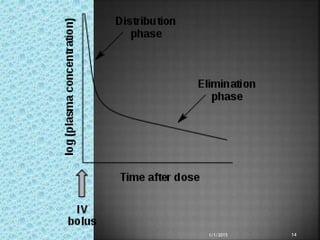
 In two compartment model drugs the
plasma drug conc. Declines biexponentially
as the sum of two first order process, i.e
distribution and elimination
 Does not equilibrate throughout the body
1/1/2015 9
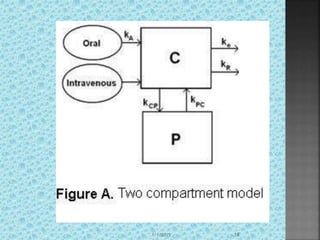
 Drug distributes in 2 compartments
i.e central compartment &
tissue/peripheral compartment.
1/1/2015 10
 Represents the blood ,extracellular fluid
and highly perfused tissues
 Drug distributes rapidly and uniformly
1/1/2015 11
 Contains tissues in which drug equilibrates more
slowly
 Drug transfer b/w the two compartments is
assumed to be take place by first order processes
1/1/2015 12
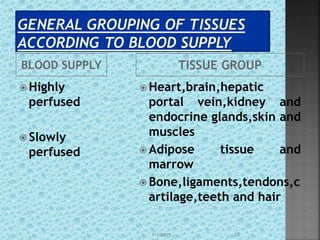
BLOOD SUPPLY TISSUE GROUP
 Highly
perfused
 Slowly
perfused
 Heart,brain,hepatic
portal vein,kidney and
endocrine glands,skin and
muscles
 Adipose tissue and
marrow
 Bone,ligaments,tendons,c
artilage,teeth and hair
1/1/2015 13
1/1/2015 14
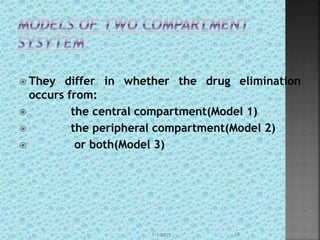
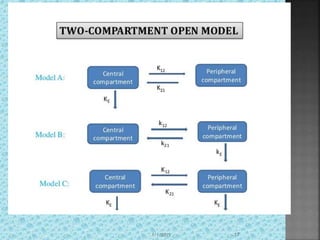
 They differ in whether the drug elimination
occurs from:
 the central compartment(Model 1)
 the peripheral compartment(Model 2)
 or both(Model 3)
1/1/2015 15
 MODEL 1:
Major sites of drug elimination occurs in
organs such as kidney and liver(highly
perfused with blood).
 MODEL 2:
Drug is assumed to follow the first order
kinetics
1/1/2015 16
1/1/2015 17
1/1/2015 18
 Rate constants k12 and k21 represents the
first order rate transfer constants for the
movement of drug from compartment 1 to
compartment 2 i.e k12
 And from compartment 2 to 1 i.e k21
1/1/2015 19
 Blood sampling
 Analyzed for drug content
 Distributive phase: drug is diffused into
peripheral compartment till equillibrium is
attained
 Elimination phase
1/1/2015 20
1/1/2015 21
 t=0
 After an I.V dose drug levels will first
increase,reach maximum and then decline
 tmax
 Distribution equilibrium
1/1/2015 22
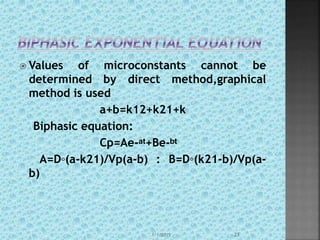
 Values of microconstants cannot be
determined by direct method,graphical
method is used
a+b=k12+k21+k
Biphasic equation:
Cp=Ae-ᵃᵗ+Be-ᵇᵗ
A=D◦(a-k21)/Vp(a-b) : B=D◦(k21-b)/Vp(a-
b)
1/1/2015 23
 Useful procedure for fitting a curve to the
experimental data of a drug when drug
does not clearly follow one compartment
model
 I.V administration of drug
 Blood sampling
 Assay
 Data is obtained and plotted on semilog
graph paper,curve line is obtained
1/1/2015 24
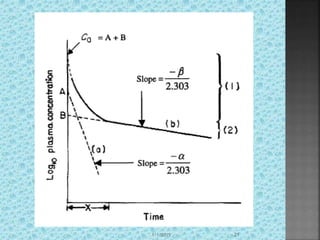
 Curve line realationship b/w the log of the
plasma conc.and the time indicates that
the drug is distributed in more than one
compartments
 So from data biexponential equation is
derived:
Cp=Ae-ᵃᵗ+Be-ᵇᵗ
1/1/2015 25
1/1/2015 26
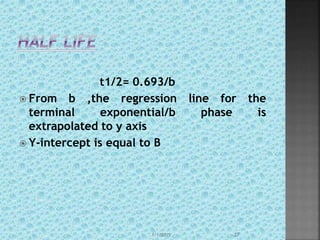
t1/2= 0.693/b
 From b ,the regression line for the
terminal exponential/b phase is
extrapolated to y axis
 Y-intercept is equal to B
1/1/2015 27
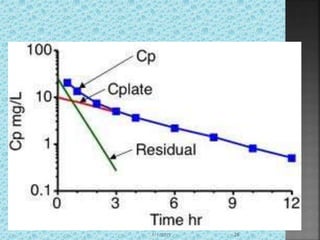
 Values from the extrapolated line are then
subtracted from the original experimenatl
values
 Residual plasma conc. Is obtained
 Straight line is obtained
 Residual plasma conc.
1/1/2015 28
 Apparent volume of distribution
 Drug clearance
 Biological half life
 Elimination rate constant
 AUC
1/1/2015 29
 Relates plasma conc. to the amount of
drug in the body
 Drugs with large extravascular
distribution,apparent Vd is generally large
 Drugs with high peripheral tissue binding
also have large apparent Vd
 For polar drugs,apparent Vd is small
 Reflects the extent of drug distribution
1/1/2015 30
Several Vd are calculated as:
 Volume of central compartment
 Apparent Vd at the steady state
 Extrapolated volume of distribution
 volume of distribution by area
1/1/2015 31
 Useful for determining drug conc.directly
after an IV injection into the body
 Also called initial volume of distribution
 Generally smaller than the terminal Vd
 Vp as mass balance factor
 By plasma conc. and from AUC
1/1/2015 32
D◦=VpCp
Vp=D◦/A+B
Vp=D◦/k[AUC]
1/1/2015 33
 The rate of drug entry into the tissue
compartment from central compartment is
equal to the rate of drug exit from tissue
compartment into the central compartment
Dtk21=Dpk12
Dt=k12Dp/k21 [Dp=CpVp]
Dt=k12.CpVp/k21
1/1/2015 34
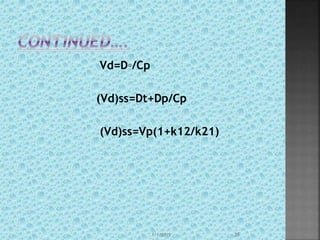
Vd=D◦/Cp
(Vd)ss=Dt+Dp/Cp
(Vd)ss=Vp(1+k12/k21)
1/1/2015 35
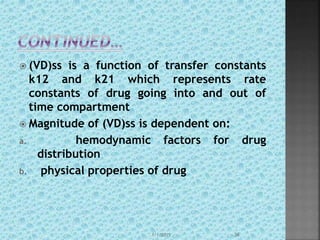
 (VD)ss is a function of transfer constants
k12 and k21 which represents rate
constants of drug going into and out of
time compartment
 Magnitude of (VD)ss is dependent on:
a. hemodynamic factors for drug
distribution
b. physical properties of drug
1/1/2015 36
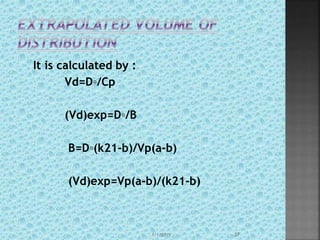
It is calculated by :
Vd=D◦/Cp
(Vd)exp=D◦/B
B=D◦(k21-b)/Vp(a-b)
(Vd)exp=Vp(a-b)/(k21-b)
1/1/2015 37
 This equation shows that a change in the
distribution of drug which is observed by
change in the value for vp,will be reflected
in change in (Vd)exp
1/1/2015 38
 reduced drug clearance from the body
may increase AUC such that (Vp)ᵦ is either
reduced or unchanged depending on the
value of b.
(Vp)ᵦ=(Vd)area=Do/b[AUC]͚͚◦
Cl=Do/[AUC]͚◦
(Vd)ᵦ=Cl/b
(Vd)ᵦ=k.Vd/b
1/1/2015 39
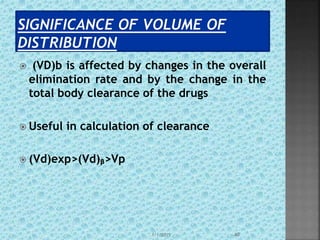
 (VD)b is affected by changes in the overall
elimination rate and by the change in the
total body clearance of the drugs
 Useful in calculation of clearance
 (Vd)exp>(Vd)ᵦ>Vp
1/1/2015 40
 Changes in disease state may not result in
different pharmacokinetic parameters.
 Changes in pk parameters should not lead
to the physiologic changes.
1/1/2015 41
 Apparent Vt is conceptual volume only and
does not represent the true anatomic
volume
Vt=Vpk12/k21
Dt=[k12Dp◦](e-ᵇᵗ_e-ᵃᵗ)/a-b
1/1/2015 42
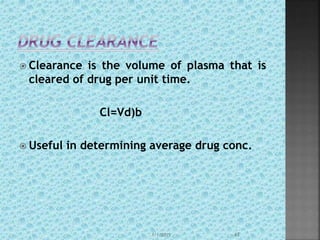
 Clearance is the volume of plasma that is
cleared of drug per unit time.
Cl=Vd)b
 Useful in determining average drug conc.
1/1/2015 43
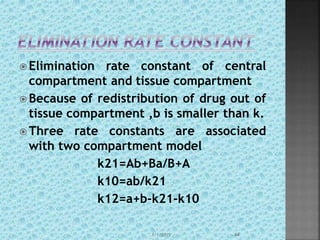
 Elimination rate constant of central
compartment and tissue compartment
 Because of redistribution of drug out of
tissue compartment ,b is smaller than k.
 Three rate constants are associated
with two compartment model
k21=Ab+Ba/B+A
k10=ab/k21
k12=a+b-k21-k10
1/1/2015 44
 Biological half life can be determined from
the rate constant.
t1/2=0.693/b
1/1/2015 45
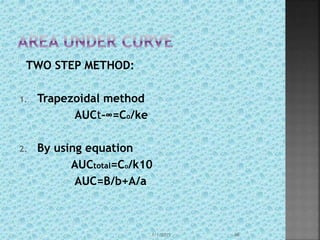
TWO STEP METHOD:
1. Trapezoidal method
AUCt-∞=Co/ke
2. By using equation
AUCtotal=Co/k10
AUC=B/b+A/a
1/1/2015 46
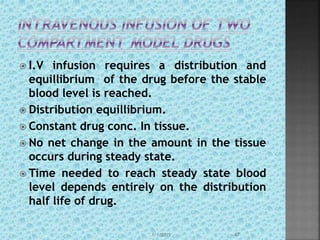
 I.V infusion requires a distribution and
equillibrium of the drug before the stable
blood level is reached.
 Distribution equillibrium.
 Constant drug conc. In tissue.
 No net change in the amount in the tissue
occurs during steady state.
 Time needed to reach steady state blood
level depends entirely on the distribution
half life of drug.
1/1/2015 47
 Equation describing plasma drug
concentration:
Cp=R/Vpk[1-(k-b/a-b)e-ᵅᵗ_(a-k/a-b)e-
ᵇᵗ]
 At steady state:
Css=R/Vpk
 Infusion rate:
R=CssVpk
1/1/2015 48
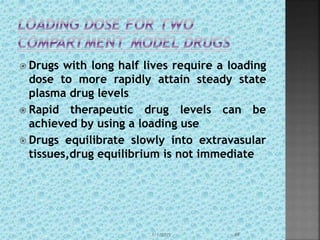
 Drugs with long half lives require a loading
dose to more rapidly attain steady state
plasma drug levels
 Rapid therapeutic drug levels can be
achieved by using a loading use
 Drugs equilibrate slowly into extravasular
tissues,drug equilibrium is not immediate
1/1/2015 49
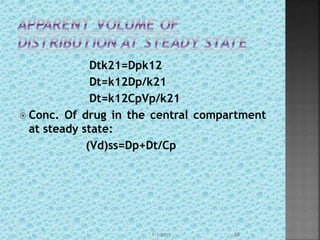
Dtk21=Dpk12
Dt=k12Dp/k21
Dt=k12CpVp/k21
 Conc. Of drug in the central compartment
at steady state:
(Vd)ss=Dp+Dt/Cp
1/1/2015 50
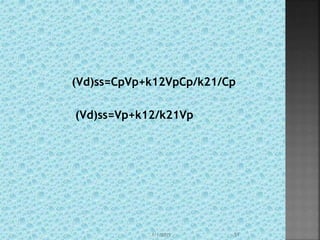
(Vd)ss=CpVp+k12VpCp/k21/Cp
(Vd)ss=Vp+k12/k21Vp
1/1/2015 51
 Hydromorphone studies
 Drug distribution of Loperamide
1/1/2015 52
 Pharmacokinetic models predict drug
disposition after drug administration.
 Statistical methods are used for the
estimation and data interpretation of
pharmacokinetic parameters.
 Useful in drug formulation and treatment
regimen.
1/1/2015 53
 The drug behaviour within the body
might be able to fit different
compartmental models depending upon
the route of drug administration.
1/1/2015 54
55
1/1/2015 56

Two compartment model

  • 1.
    Presented Presented By: RollRooma Khalid M.phil Pharmaceutics (2014-2016) ISLAMIA UNIVERSITY BAHAWALPUR
  • 2.
     INTRODUCTION  COMPARTMENTMODELS  TWO COMPARTMENT MODEL(I.V BOLUS)  METHOD OF RESIDUAL  PARAMETERS OF TWO COMPARTMENT  INTRAVENOUS INFUSION  CLINICAL APPLICATIONS 1/1/2015 2
  • 3.
    PHARMACOKINETICS:  pharmacon:drug  kinesis-motion/changeof rate pharmacokinetics is the study of kinetics of absorption,distribution,metabolism and excretion(ADME) of drugs and their corresponding pharmacologic,therapeutic or toxic responses in man and animals. 1/1/2015 3
  • 4.
  • 5.
    Compartment models areclassical pharmacokinetic models that simulate the kinetic processes of drug absorption, distribution and elimination with little physiologic detail. 1/1/2015 5
  • 6.
     A physiologicalsystem is described by decomposition into number of interacting substances called compartments.  Mass of well mixed ,homogenous material.  Behaves uniformly.  Exchange material. 1/1/2015 6
  • 7.
     OPEN MODEL: Administereddrug dose is eliminated from the body by an excretory mechanism.  CLOSED MODEL: The drug dose is not eliminated from the body. 1/1/2015 7
  • 8.
  • 9.
     Many drugsgiven in single IV bolus dose demonstrate a plasma level time curve that does not decline as single exponential process  In two compartment model drugs the plasma drug conc. Declines biexponentially as the sum of two first order process, i.e distribution and elimination  Does not equilibrate throughout the body 1/1/2015 9
  • 10.
     Drug distributesin 2 compartments i.e central compartment & tissue/peripheral compartment. 1/1/2015 10
  • 11.
     Represents theblood ,extracellular fluid and highly perfused tissues  Drug distributes rapidly and uniformly 1/1/2015 11
  • 12.
     Contains tissuesin which drug equilibrates more slowly  Drug transfer b/w the two compartments is assumed to be take place by first order processes 1/1/2015 12
  • 13.
    BLOOD SUPPLY TISSUEGROUP  Highly perfused  Slowly perfused  Heart,brain,hepatic portal vein,kidney and endocrine glands,skin and muscles  Adipose tissue and marrow  Bone,ligaments,tendons,c artilage,teeth and hair 1/1/2015 13
  • 14.
  • 15.
     They differin whether the drug elimination occurs from:  the central compartment(Model 1)  the peripheral compartment(Model 2)  or both(Model 3) 1/1/2015 15
  • 16.
     MODEL 1: Majorsites of drug elimination occurs in organs such as kidney and liver(highly perfused with blood).  MODEL 2: Drug is assumed to follow the first order kinetics 1/1/2015 16
  • 17.
  • 18.
  • 19.
     Rate constantsk12 and k21 represents the first order rate transfer constants for the movement of drug from compartment 1 to compartment 2 i.e k12  And from compartment 2 to 1 i.e k21 1/1/2015 19
  • 20.
     Blood sampling Analyzed for drug content  Distributive phase: drug is diffused into peripheral compartment till equillibrium is attained  Elimination phase 1/1/2015 20
  • 21.
  • 22.
     t=0  Afteran I.V dose drug levels will first increase,reach maximum and then decline  tmax  Distribution equilibrium 1/1/2015 22
  • 23.
     Values ofmicroconstants cannot be determined by direct method,graphical method is used a+b=k12+k21+k Biphasic equation: Cp=Ae-ᵃᵗ+Be-ᵇᵗ A=D◦(a-k21)/Vp(a-b) : B=D◦(k21-b)/Vp(a- b) 1/1/2015 23
  • 24.
     Useful procedurefor fitting a curve to the experimental data of a drug when drug does not clearly follow one compartment model  I.V administration of drug  Blood sampling  Assay  Data is obtained and plotted on semilog graph paper,curve line is obtained 1/1/2015 24
  • 25.
     Curve linerealationship b/w the log of the plasma conc.and the time indicates that the drug is distributed in more than one compartments  So from data biexponential equation is derived: Cp=Ae-ᵃᵗ+Be-ᵇᵗ 1/1/2015 25
  • 26.
  • 27.
    t1/2= 0.693/b  Fromb ,the regression line for the terminal exponential/b phase is extrapolated to y axis  Y-intercept is equal to B 1/1/2015 27
  • 28.
     Values fromthe extrapolated line are then subtracted from the original experimenatl values  Residual plasma conc. Is obtained  Straight line is obtained  Residual plasma conc. 1/1/2015 28
  • 29.
     Apparent volumeof distribution  Drug clearance  Biological half life  Elimination rate constant  AUC 1/1/2015 29
  • 30.
     Relates plasmaconc. to the amount of drug in the body  Drugs with large extravascular distribution,apparent Vd is generally large  Drugs with high peripheral tissue binding also have large apparent Vd  For polar drugs,apparent Vd is small  Reflects the extent of drug distribution 1/1/2015 30
  • 31.
    Several Vd arecalculated as:  Volume of central compartment  Apparent Vd at the steady state  Extrapolated volume of distribution  volume of distribution by area 1/1/2015 31
  • 32.
     Useful fordetermining drug conc.directly after an IV injection into the body  Also called initial volume of distribution  Generally smaller than the terminal Vd  Vp as mass balance factor  By plasma conc. and from AUC 1/1/2015 32
  • 33.
  • 34.
     The rateof drug entry into the tissue compartment from central compartment is equal to the rate of drug exit from tissue compartment into the central compartment Dtk21=Dpk12 Dt=k12Dp/k21 [Dp=CpVp] Dt=k12.CpVp/k21 1/1/2015 34
  • 35.
  • 36.
     (VD)ss isa function of transfer constants k12 and k21 which represents rate constants of drug going into and out of time compartment  Magnitude of (VD)ss is dependent on: a. hemodynamic factors for drug distribution b. physical properties of drug 1/1/2015 36
  • 37.
    It is calculatedby : Vd=D◦/Cp (Vd)exp=D◦/B B=D◦(k21-b)/Vp(a-b) (Vd)exp=Vp(a-b)/(k21-b) 1/1/2015 37
  • 38.
     This equationshows that a change in the distribution of drug which is observed by change in the value for vp,will be reflected in change in (Vd)exp 1/1/2015 38
  • 39.
     reduced drugclearance from the body may increase AUC such that (Vp)ᵦ is either reduced or unchanged depending on the value of b. (Vp)ᵦ=(Vd)area=Do/b[AUC]͚͚◦ Cl=Do/[AUC]͚◦ (Vd)ᵦ=Cl/b (Vd)ᵦ=k.Vd/b 1/1/2015 39
  • 40.
     (VD)b isaffected by changes in the overall elimination rate and by the change in the total body clearance of the drugs  Useful in calculation of clearance  (Vd)exp>(Vd)ᵦ>Vp 1/1/2015 40
  • 41.
     Changes indisease state may not result in different pharmacokinetic parameters.  Changes in pk parameters should not lead to the physiologic changes. 1/1/2015 41
  • 42.
     Apparent Vtis conceptual volume only and does not represent the true anatomic volume Vt=Vpk12/k21 Dt=[k12Dp◦](e-ᵇᵗ_e-ᵃᵗ)/a-b 1/1/2015 42
  • 43.
     Clearance isthe volume of plasma that is cleared of drug per unit time. Cl=Vd)b  Useful in determining average drug conc. 1/1/2015 43
  • 44.
     Elimination rateconstant of central compartment and tissue compartment  Because of redistribution of drug out of tissue compartment ,b is smaller than k.  Three rate constants are associated with two compartment model k21=Ab+Ba/B+A k10=ab/k21 k12=a+b-k21-k10 1/1/2015 44
  • 45.
     Biological halflife can be determined from the rate constant. t1/2=0.693/b 1/1/2015 45
  • 46.
    TWO STEP METHOD: 1.Trapezoidal method AUCt-∞=Co/ke 2. By using equation AUCtotal=Co/k10 AUC=B/b+A/a 1/1/2015 46
  • 47.
     I.V infusionrequires a distribution and equillibrium of the drug before the stable blood level is reached.  Distribution equillibrium.  Constant drug conc. In tissue.  No net change in the amount in the tissue occurs during steady state.  Time needed to reach steady state blood level depends entirely on the distribution half life of drug. 1/1/2015 47
  • 48.
     Equation describingplasma drug concentration: Cp=R/Vpk[1-(k-b/a-b)e-ᵅᵗ_(a-k/a-b)e- ᵇᵗ]  At steady state: Css=R/Vpk  Infusion rate: R=CssVpk 1/1/2015 48
  • 49.
     Drugs withlong half lives require a loading dose to more rapidly attain steady state plasma drug levels  Rapid therapeutic drug levels can be achieved by using a loading use  Drugs equilibrate slowly into extravasular tissues,drug equilibrium is not immediate 1/1/2015 49
  • 50.
    Dtk21=Dpk12 Dt=k12Dp/k21 Dt=k12CpVp/k21  Conc. Ofdrug in the central compartment at steady state: (Vd)ss=Dp+Dt/Cp 1/1/2015 50
  • 51.
  • 52.
     Hydromorphone studies Drug distribution of Loperamide 1/1/2015 52
  • 53.
     Pharmacokinetic modelspredict drug disposition after drug administration.  Statistical methods are used for the estimation and data interpretation of pharmacokinetic parameters.  Useful in drug formulation and treatment regimen. 1/1/2015 53
  • 54.
     The drugbehaviour within the body might be able to fit different compartmental models depending upon the route of drug administration. 1/1/2015 54
  • 55.
  • 56.