Prepared by :
Rawand Sirwan Izzaddin
Master Candidate in Pharmaceutics
PHARMACOKINETIC
MODELS
Content
• Basic considerations in pharmacokinetics
• Compartment models
• One compartment model
• Assumptions
• Intravenous bolus administration
• Intravenous infusion
• Extravascular administration (zero order and first order absorption
model)
BASIC CONSIDERATIONS IN
PHARMACOKINETICS
• Pharmacokinetic parameters
• Pharmacodynamic parameters
• Zero, first order & mixed order kinetic
• Rates and orders of kinetics
• Plasma drug conc. Time profiles
• Compartmental models – physiological model
• Applications of pharmacokinetics
• Non compartment model
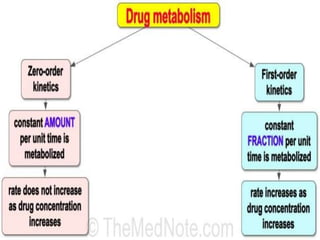
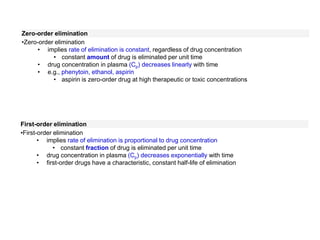
Zero-order elimination
•Zero-order elimination
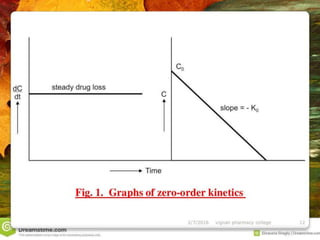
• implies rate of elimination is constant, regardless of drug concentration
• constant amount of drug is eliminated per unit time
• drug concentration in plasma (Cp) decreases linearly with time
• e.g., phenytoin, ethanol, aspirin
• aspirin is zero-order drug at high therapeutic or toxic concentrations
First-order elimination
•First-order elimination
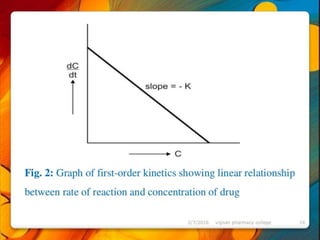
• implies rate of elimination is proportional to drug concentration
• constant fraction of drug is eliminated per unit time
• drug concentration in plasma (Cp) decreases exponentially with time
• first-order drugs have a characteristic, constant half-life of elimination
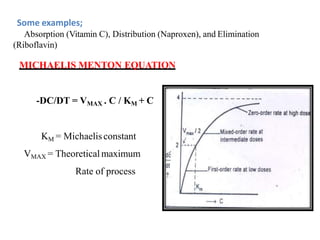
Some examples;
Absorption (Vitamin C), Distribution (Naproxen), and Elimination
(Riboflavin)
MICHAELIS MENTON EQUATION
-DC/DT = VMAX . C / KM + C
KM = Michaelisconstant
VMAX = Theoreticalmaximum
Rate of process
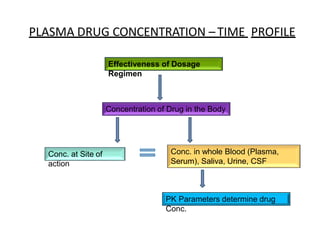
PLASMA DRUG CONCENTRATION –TIME PROFILE
Effectiveness of Dosage
Regimen
Concentration of Drug in the Body
Conc. at Site of
action
Conc. in whole Blood (Plasma,
Serum), Saliva, Urine, CSF
PK Parameters determine drug
Conc.
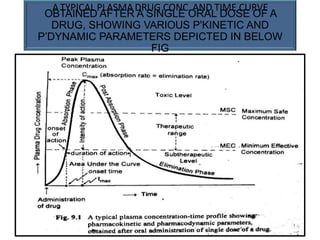
ATYPICAL PLASMA DRUG CONC. AND TIME CURVE
OBTAINED AFTER A SINGLE ORAL DOSE OF A
DRUG, SHOWING VARIOUS P'KINETIC AND
P’DYNAMIC PARAMETERS DEPICTED IN BELOW
FIG
8
PHARMACOKINETIC
PARAMETERS
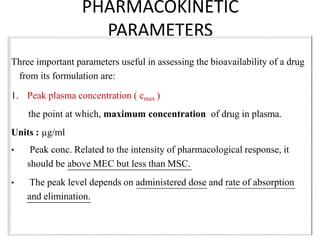
Three important parameters useful in assessing the bioavailability of a drug
from its formulation are:
1. Peak plasma concentration ( cmax )
the point at which, maximum concentration of drug in plasma.
Units : µg/ml
• Peak conc. Related to the intensity of pharmacological response, it
should be above MEC but less than MSC.
• The peak level depends on administered dose and rate of absorption
and elimination.
2. Time of peak concentration (tmax )
the time for the drug to reach peak concentration in plasma
(after extra vascular administration).
Units : hrs
• Useful in estimating onset of action and rate of absorption.
• Important in assessing the efficacy of single dose drugs used to treatacute
conditions (pain, insomnia ).
3. Area under curve (AUC)
It represents the total integrated area under the plasma level-time profile and
expresses the total amount of the drug that comes into systemic circulationafter
its administration.
Units : µg/ml x hrs
• Represents extent of absorption – evaluating the bioavailability of drug fromits
dosage form.
• Important for drugs administered repetitively for treatment of chronicconditions
(asthma or epilepsy).
PHARMACODYNAMIC
PARAMETERS
1. Minimum effective concentration (MEC)
Minimum concentration of drug in plasma/receptor site required to produce
therapeutic effect.
•
•
Concentration below MEC – sub therapeutic level
Antibiotics - MEC
2. Maximum safe concentration (MSC)
Concentration in plasma above which adverse or unwanted effects are
precipitated.
• Concentration above MSC – toxic level
3. Onset time
Time required to start producing pharmacological response.
Time for plasma concentration to reach mec after administrating drug
4. Onset of action
The beginning of pharmacologic response.
It occurs when plasma drug concentration just exceeds the requiredmec.
5. Duration of action
The time period for which the plasma concentration of drug remains above MEC
level.
6. Intensity of action
It is the minimum pharmacologic response produced by the peak plasma conc. Of
drug.
7. Therapeutic range the drug conc. Between MEC and MSC
CONCEPT OF “HALF
LIFE”
 ½ Life = how much time it takes for blood levels of drug to decrease to half
of what it was at equilibrium
 There are really two kinds of ½ life…
“Distribution” ½ life = when plasma levels fall to half what they were
at equilibrium due to distribution to/storage in body’s tissuereservoirs.
“Elimination” ½ life = when plasma levels fall to half what they were
at equilibrium due to drug being metabolized and eliminated.
 It is usually the elimination ½ life that is used to determinedosing
schedules, to decide when it is safe to put patients on a newdrug.
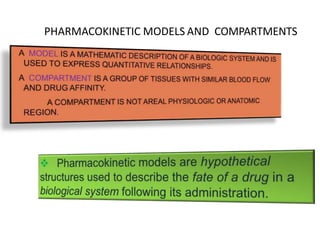
PHARMACOKINETIC MODELS AND COMPARTMENTS
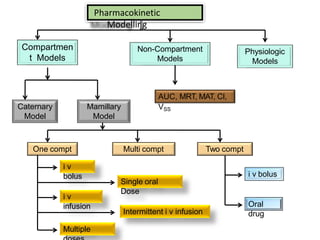
Pharmacokinetic
Modelling
Compartmen
t Models
Non-Compartment
Models
Physiologic
Models
Caternary
Model
One compt
Mamillary
Model
Multi compt Two compt
i v
bolus
Single oral
Dose
i v
infusion
Intermittent i v infusion
Multiple
i v bolus
Oral
drug
AUC, MRT, MAT, Cl,
VSS
PHARMACOKINETIC MODELS
 Means of expressing mathematically or quantitatively, time course of drug
through out the body and compute meaningful pharmacokinetic parameters.
Useful in :
• Characterize the behavior of drug in patient.
• Predicting conc. Of drug in various body fluids with dosage regimen.
• Calculating optimum dosage regimen for individual patient.
• Evaluating bioequivalence between different formulation.
• Explaining drug interaction.
Pharmacokinetic models are hypothetical structures that are used to describe the
fate of a drug in a biological system following its administration.
Model
• Mathematical representation of the data.
• It is just hypothetical
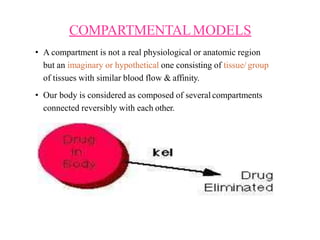
COMPARTMENTALMODELS
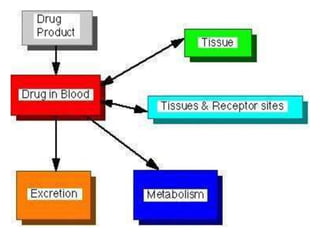
• A compartment is not a real physiological or anatomic region
but an imaginary or hypothetical one consisting of tissue/ group
of tissues with similar blood flow & affinity.
• Our body is considered as composed of several compartments
connected reversibly with each other.
ADVANT
AGES
• Gives visual representation of various rate processes involved in drug
disposition.
• Possible to derive equations describing drug concentration changes ineach
compartment.
• One can estimate the amount of drug in any compartment of the system after
drug is introduced into a given compartment.
DISADVANTAGES
• Drug given by IV route may behave according to single compartmentmodel
but the same drug given by oral route may show 2 compartment behaviour.
• The type of compartment behaviour i.E. Type of compartment model may
change with the route of administration.
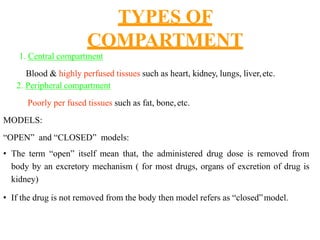
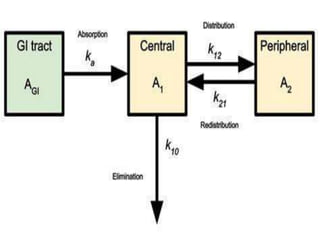
1. Central compartment
Blood & highly perfused tissues such as heart, kidney, lungs, liver,etc.
2. Peripheral compartment
Poorly per fused tissues such as fat, bone,etc.
MODELS:
“OPEN” and “CLOSED” models:
• The term “open” itself mean that, the administered drug dose is removed from
body by an excretory mechanism ( for most drugs, organs of excretion of drug is
kidney)
• If the drug is not removed from the body then model refers as “closed”model.
TYPES OF
COMPARTMENT
Pharmacokinetics refers to the rate and extent of
distribution of a drug to different tissues, and the rate
of elimination of the drug.
Compartmental & Non-Compartmental model :-
• Compartmental are
1. One-Compartment model
2. Two-Compartment model
• Non-Compartmental model
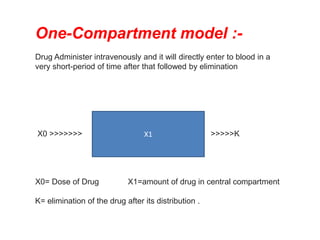
One-Compartment model :-
Drug Administer intravenously and it will directly enter to blood in a
very short-period of time after that followed by elimination
X0 >>>>>>> >>>>>K
X0= Dose of Drug X1=amount of drug in central compartment
K= elimination of the drug after its distribution .
X1
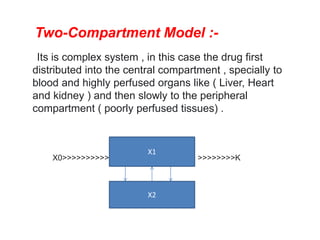
Two-Compartment Model :-
Its is complex system , in this case the drug first
distributed into the central compartment , specially to
blood and highly perfused organs like ( Liver, Heart
and kidney ) and then slowly to the peripheral
compartment ( poorly perfused tissues) .
X0>>>>>>>>>> >>>>>>>>K
X1
X2
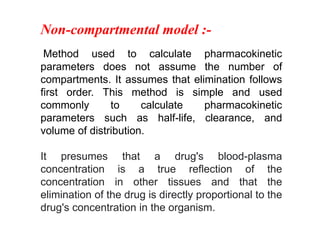
Non-compartmental model :-
Method used to calculate pharmacokinetic
parameters does not assume the number of
compartments. It assumes that elimination follows
first order. This method is simple and used
commonly to calculate pharmacokinetic
parameters such as half-life, clearance, and
volume of distribution.
It presumes that a drug's blood-plasma
concentration is a true reflection of the
concentration in other tissues and that the
elimination of the drug is directly proportional to the
drug's concentration in the organism.
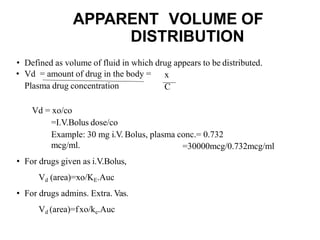
APPARENT VOLUME OF
DISTRIBUTION
• Defined as volume of fluid in which drug appears to be distributed.
• Vd = amount of drug in the body =
Plasma drug concentration
x
C
Vd = xo/co
=I.V.Bolus dose/co
Example: 30 mg i.V. Bolus, plasma conc.= 0.732
mcg/ml. =30000mcg/0.732mcg/ml
• For drugs given as i.V.Bolus,
Vd (area)=xo/KE.Auc
• For drugs admins. Extra. Vas.
Vd (area)=fxo/ke.Auc
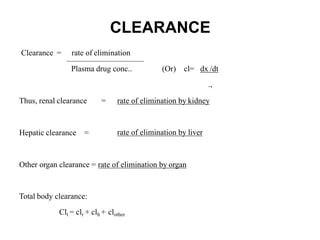
CLEARANCE
Clearance = rate of elimination
Plasma drug conc.. (Or) cl= dx /dt
.,
Thus, renal clearance
Hepatic clearance =
= rate of elimination by kidney
rate of elimination by liver
Other organ clearance = rate of elimination by organ
Total body clearance:
Clt = clr + clh + clother
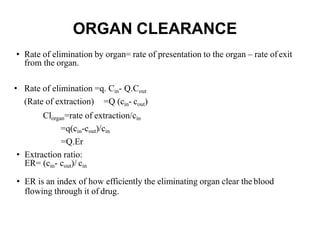
ORGAN CLEARANCE
• Rate of elimination by organ= rate of presentation to the organ – rate ofexit
from the organ.
• Rate of elimination =q. Cin- Q.Cout
(Rate of extraction) =Q (cin- cout)
Clorgan=rate of extraction/cin
=q(cin-cout)/cin
=Q.Er
• Extraction ratio:
ER= (cin- cout)/ cin
• ER is an index of how efficiently the eliminating organ clear the blood
flowing through it of drug.
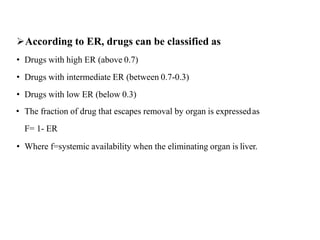
According to ER, drugs can be classified as
• Drugs with high ER (above 0.7)
• Drugs with intermediate ER (between 0.7-0.3)
• Drugs with low ER (below 0.3)
• The fraction of drug that escapes removal by organ is expressedas
F= 1- ER
• Where f=systemic availability when the eliminating organ is liver.
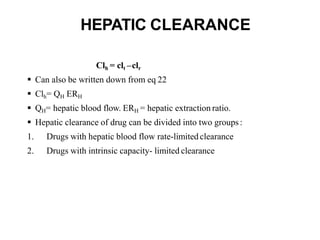
HEPATIC CLEARANCE
Clh = clt –clr
 Can also be written down from eq 22
 Clh= QH ERH
 QH= hepatic blood flow. ERH = hepatic extraction ratio.
 Hepatic clearance of drug can be divided into two groups:
1. Drugs with hepatic blood flow rate-limited clearance
2. Drugs with intrinsic capacity- limited clearance

1612188029641020.pptx

  • 1.
    Prepared by : RawandSirwan Izzaddin Master Candidate in Pharmaceutics PHARMACOKINETIC MODELS
  • 2.
    Content • Basic considerationsin pharmacokinetics • Compartment models • One compartment model • Assumptions • Intravenous bolus administration • Intravenous infusion • Extravascular administration (zero order and first order absorption model)
  • 3.
    BASIC CONSIDERATIONS IN PHARMACOKINETICS •Pharmacokinetic parameters • Pharmacodynamic parameters • Zero, first order & mixed order kinetic • Rates and orders of kinetics • Plasma drug conc. Time profiles • Compartmental models – physiological model • Applications of pharmacokinetics • Non compartment model
  • 5.
    Zero-order elimination •Zero-order elimination •implies rate of elimination is constant, regardless of drug concentration • constant amount of drug is eliminated per unit time • drug concentration in plasma (Cp) decreases linearly with time • e.g., phenytoin, ethanol, aspirin • aspirin is zero-order drug at high therapeutic or toxic concentrations First-order elimination •First-order elimination • implies rate of elimination is proportional to drug concentration • constant fraction of drug is eliminated per unit time • drug concentration in plasma (Cp) decreases exponentially with time • first-order drugs have a characteristic, constant half-life of elimination
  • 9.
    Some examples; Absorption (VitaminC), Distribution (Naproxen), and Elimination (Riboflavin) MICHAELIS MENTON EQUATION -DC/DT = VMAX . C / KM + C KM = Michaelisconstant VMAX = Theoreticalmaximum Rate of process
  • 10.
    PLASMA DRUG CONCENTRATION–TIME PROFILE Effectiveness of Dosage Regimen Concentration of Drug in the Body Conc. at Site of action Conc. in whole Blood (Plasma, Serum), Saliva, Urine, CSF PK Parameters determine drug Conc.
  • 11.
    ATYPICAL PLASMA DRUGCONC. AND TIME CURVE OBTAINED AFTER A SINGLE ORAL DOSE OF A DRUG, SHOWING VARIOUS P'KINETIC AND P’DYNAMIC PARAMETERS DEPICTED IN BELOW FIG 8
  • 12.
    PHARMACOKINETIC PARAMETERS Three important parametersuseful in assessing the bioavailability of a drug from its formulation are: 1. Peak plasma concentration ( cmax ) the point at which, maximum concentration of drug in plasma. Units : µg/ml • Peak conc. Related to the intensity of pharmacological response, it should be above MEC but less than MSC. • The peak level depends on administered dose and rate of absorption and elimination.
  • 13.
    2. Time ofpeak concentration (tmax ) the time for the drug to reach peak concentration in plasma (after extra vascular administration). Units : hrs • Useful in estimating onset of action and rate of absorption. • Important in assessing the efficacy of single dose drugs used to treatacute conditions (pain, insomnia ).
  • 14.
    3. Area undercurve (AUC) It represents the total integrated area under the plasma level-time profile and expresses the total amount of the drug that comes into systemic circulationafter its administration. Units : µg/ml x hrs • Represents extent of absorption – evaluating the bioavailability of drug fromits dosage form. • Important for drugs administered repetitively for treatment of chronicconditions (asthma or epilepsy).
  • 15.
    PHARMACODYNAMIC PARAMETERS 1. Minimum effectiveconcentration (MEC) Minimum concentration of drug in plasma/receptor site required to produce therapeutic effect. • • Concentration below MEC – sub therapeutic level Antibiotics - MEC 2. Maximum safe concentration (MSC) Concentration in plasma above which adverse or unwanted effects are precipitated. • Concentration above MSC – toxic level
  • 16.
    3. Onset time Timerequired to start producing pharmacological response. Time for plasma concentration to reach mec after administrating drug 4. Onset of action The beginning of pharmacologic response. It occurs when plasma drug concentration just exceeds the requiredmec. 5. Duration of action The time period for which the plasma concentration of drug remains above MEC level. 6. Intensity of action It is the minimum pharmacologic response produced by the peak plasma conc. Of drug. 7. Therapeutic range the drug conc. Between MEC and MSC
  • 17.
    CONCEPT OF “HALF LIFE” ½ Life = how much time it takes for blood levels of drug to decrease to half of what it was at equilibrium  There are really two kinds of ½ life… “Distribution” ½ life = when plasma levels fall to half what they were at equilibrium due to distribution to/storage in body’s tissuereservoirs. “Elimination” ½ life = when plasma levels fall to half what they were at equilibrium due to drug being metabolized and eliminated.  It is usually the elimination ½ life that is used to determinedosing schedules, to decide when it is safe to put patients on a newdrug.
  • 18.
  • 19.
    Pharmacokinetic Modelling Compartmen t Models Non-Compartment Models Physiologic Models Caternary Model One compt Mamillary Model Multicompt Two compt i v bolus Single oral Dose i v infusion Intermittent i v infusion Multiple i v bolus Oral drug AUC, MRT, MAT, Cl, VSS
  • 20.
    PHARMACOKINETIC MODELS  Meansof expressing mathematically or quantitatively, time course of drug through out the body and compute meaningful pharmacokinetic parameters. Useful in : • Characterize the behavior of drug in patient. • Predicting conc. Of drug in various body fluids with dosage regimen. • Calculating optimum dosage regimen for individual patient. • Evaluating bioequivalence between different formulation. • Explaining drug interaction. Pharmacokinetic models are hypothetical structures that are used to describe the fate of a drug in a biological system following its administration. Model • Mathematical representation of the data. • It is just hypothetical
  • 21.
    COMPARTMENTALMODELS • A compartmentis not a real physiological or anatomic region but an imaginary or hypothetical one consisting of tissue/ group of tissues with similar blood flow & affinity. • Our body is considered as composed of several compartments connected reversibly with each other.
  • 22.
    ADVANT AGES • Gives visualrepresentation of various rate processes involved in drug disposition. • Possible to derive equations describing drug concentration changes ineach compartment. • One can estimate the amount of drug in any compartment of the system after drug is introduced into a given compartment. DISADVANTAGES • Drug given by IV route may behave according to single compartmentmodel but the same drug given by oral route may show 2 compartment behaviour. • The type of compartment behaviour i.E. Type of compartment model may change with the route of administration.
  • 23.
    1. Central compartment Blood& highly perfused tissues such as heart, kidney, lungs, liver,etc. 2. Peripheral compartment Poorly per fused tissues such as fat, bone,etc. MODELS: “OPEN” and “CLOSED” models: • The term “open” itself mean that, the administered drug dose is removed from body by an excretory mechanism ( for most drugs, organs of excretion of drug is kidney) • If the drug is not removed from the body then model refers as “closed”model. TYPES OF COMPARTMENT
  • 25.
    Pharmacokinetics refers tothe rate and extent of distribution of a drug to different tissues, and the rate of elimination of the drug. Compartmental & Non-Compartmental model :- • Compartmental are 1. One-Compartment model 2. Two-Compartment model • Non-Compartmental model
  • 26.
    One-Compartment model :- DrugAdminister intravenously and it will directly enter to blood in a very short-period of time after that followed by elimination X0 >>>>>>> >>>>>K X0= Dose of Drug X1=amount of drug in central compartment K= elimination of the drug after its distribution . X1
  • 27.
    Two-Compartment Model :- Itsis complex system , in this case the drug first distributed into the central compartment , specially to blood and highly perfused organs like ( Liver, Heart and kidney ) and then slowly to the peripheral compartment ( poorly perfused tissues) . X0>>>>>>>>>> >>>>>>>>K X1 X2
  • 29.
    Non-compartmental model :- Methodused to calculate pharmacokinetic parameters does not assume the number of compartments. It assumes that elimination follows first order. This method is simple and used commonly to calculate pharmacokinetic parameters such as half-life, clearance, and volume of distribution. It presumes that a drug's blood-plasma concentration is a true reflection of the concentration in other tissues and that the elimination of the drug is directly proportional to the drug's concentration in the organism.
  • 30.
    APPARENT VOLUME OF DISTRIBUTION •Defined as volume of fluid in which drug appears to be distributed. • Vd = amount of drug in the body = Plasma drug concentration x C Vd = xo/co =I.V.Bolus dose/co Example: 30 mg i.V. Bolus, plasma conc.= 0.732 mcg/ml. =30000mcg/0.732mcg/ml • For drugs given as i.V.Bolus, Vd (area)=xo/KE.Auc • For drugs admins. Extra. Vas. Vd (area)=fxo/ke.Auc
  • 31.
    CLEARANCE Clearance = rateof elimination Plasma drug conc.. (Or) cl= dx /dt ., Thus, renal clearance Hepatic clearance = = rate of elimination by kidney rate of elimination by liver Other organ clearance = rate of elimination by organ Total body clearance: Clt = clr + clh + clother
  • 32.
    ORGAN CLEARANCE • Rateof elimination by organ= rate of presentation to the organ – rate ofexit from the organ. • Rate of elimination =q. Cin- Q.Cout (Rate of extraction) =Q (cin- cout) Clorgan=rate of extraction/cin =q(cin-cout)/cin =Q.Er • Extraction ratio: ER= (cin- cout)/ cin • ER is an index of how efficiently the eliminating organ clear the blood flowing through it of drug.
  • 33.
    According to ER,drugs can be classified as • Drugs with high ER (above 0.7) • Drugs with intermediate ER (between 0.7-0.3) • Drugs with low ER (below 0.3) • The fraction of drug that escapes removal by organ is expressedas F= 1- ER • Where f=systemic availability when the eliminating organ is liver.
  • 34.
    HEPATIC CLEARANCE Clh =clt –clr  Can also be written down from eq 22  Clh= QH ERH  QH= hepatic blood flow. ERH = hepatic extraction ratio.  Hepatic clearance of drug can be divided into two groups: 1. Drugs with hepatic blood flow rate-limited clearance 2. Drugs with intrinsic capacity- limited clearance