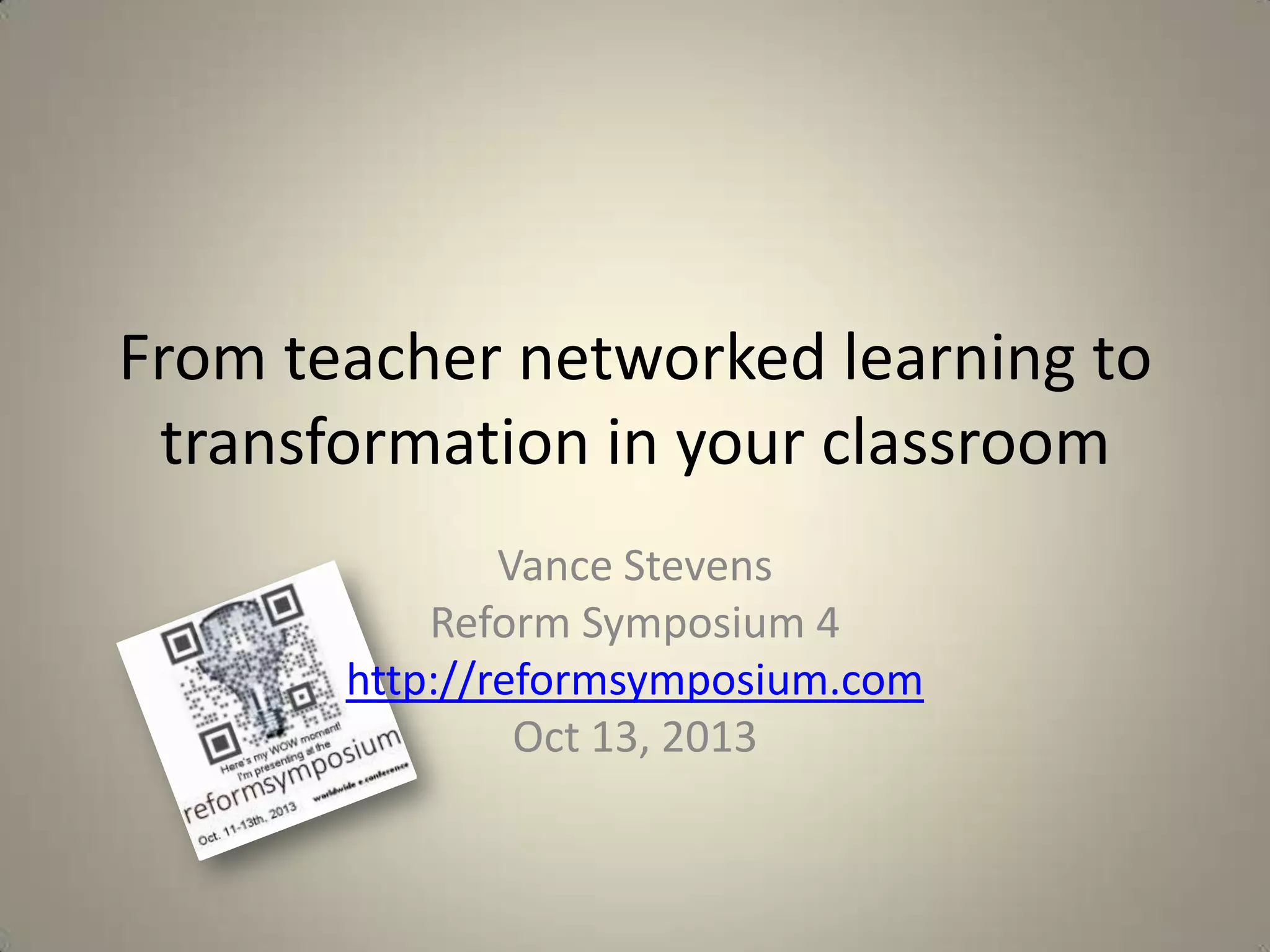
From teacher networked learning to
transformation in your classroom
Vance Stevens
Reform Symposium 4
http://reformsymposium.com
Oct 13, 2013
If you follow this presentation at
http://slideshare.net/vances
All the hyperlinks will work
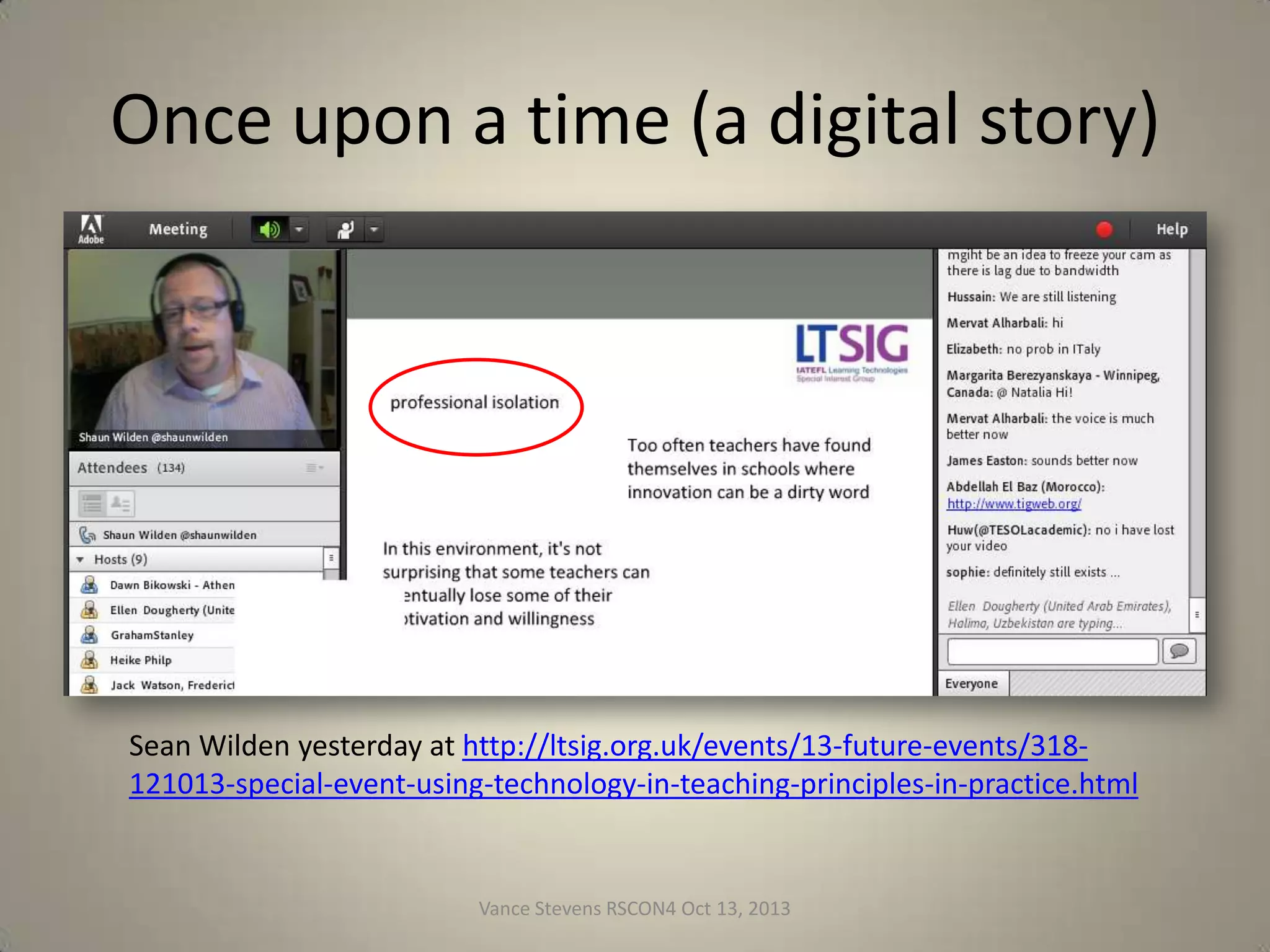
Once upon a time (a digital story)

Sean Wilden yesterday at http://ltsig.org.uk/events/13-future-events/318121013-special-event-using-technology-in-teaching-principles-in-practice.html

Vance Stevens RSCON4 Oct 13, 2013

3
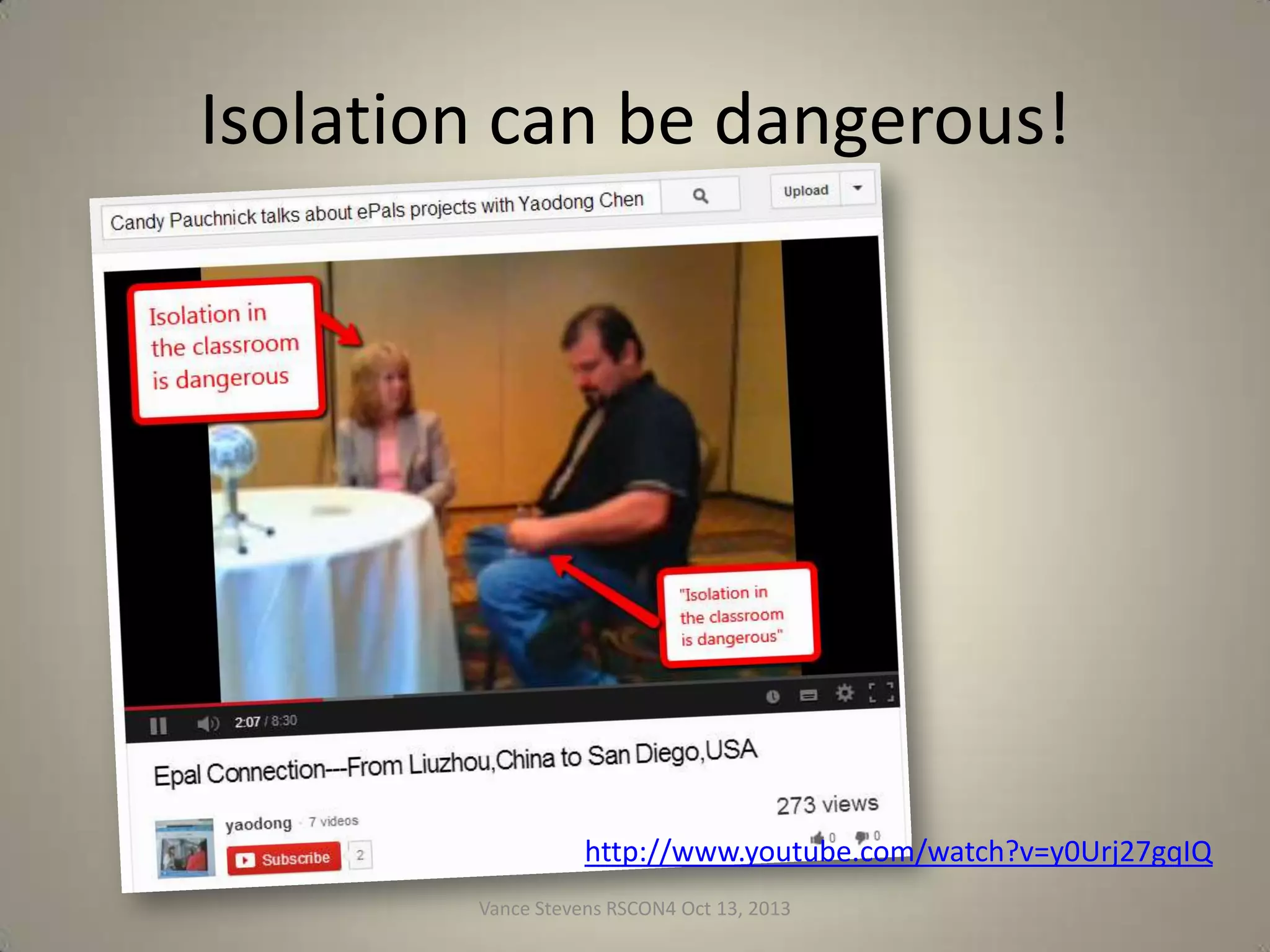
Isolation can be dangerous!

http://www.youtube.com/watch?v=y0Urj27gqIQ
Vance Stevens RSCON4 Oct 13, 2013

4
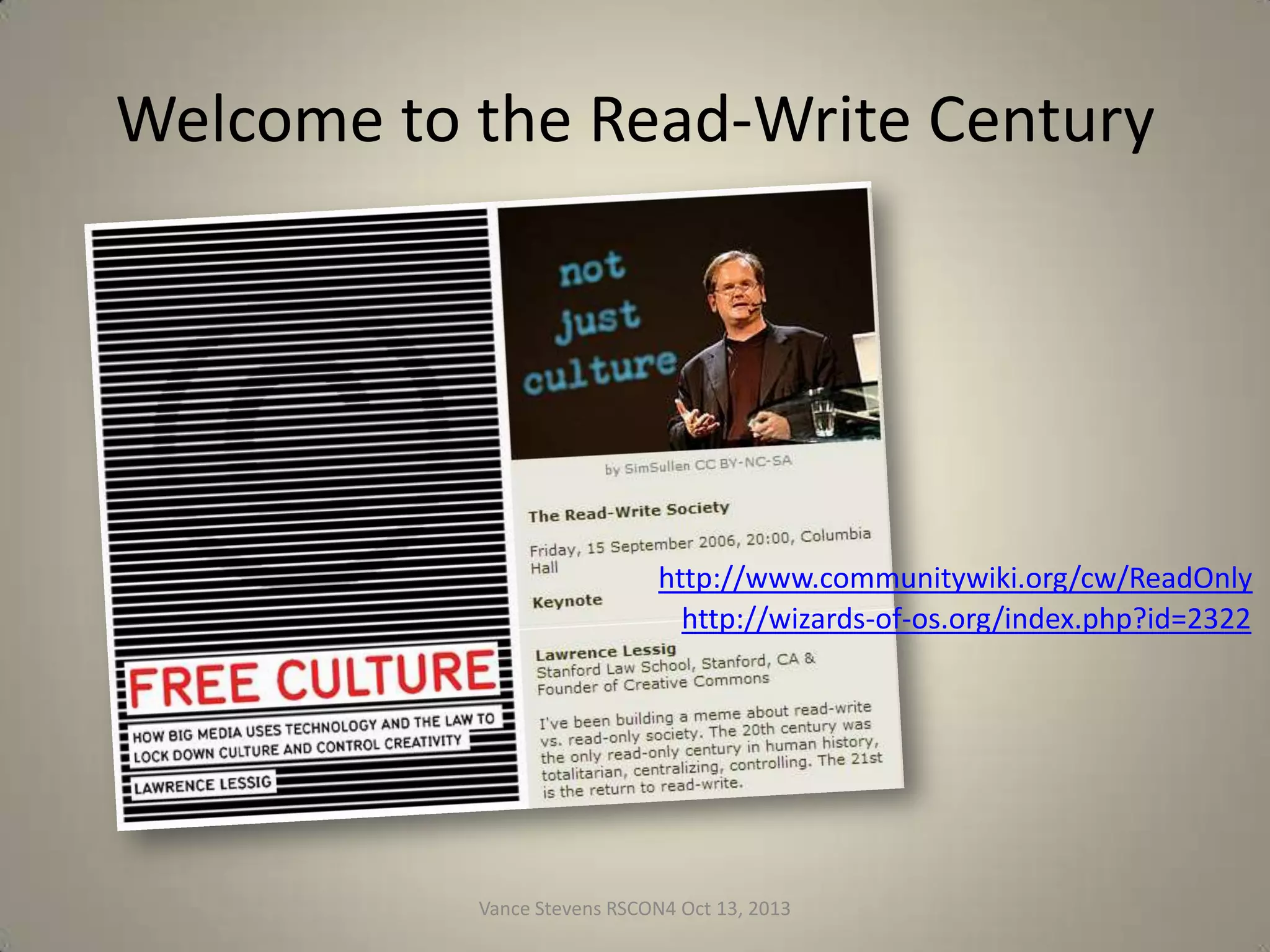
Welcome to the Read-Write Century

http://www.communitywiki.org/cw/ReadOnly
http://wizards-of-os.org/index.php?id=2322

Vance Stevens RSCON4 Oct 13, 2013

5
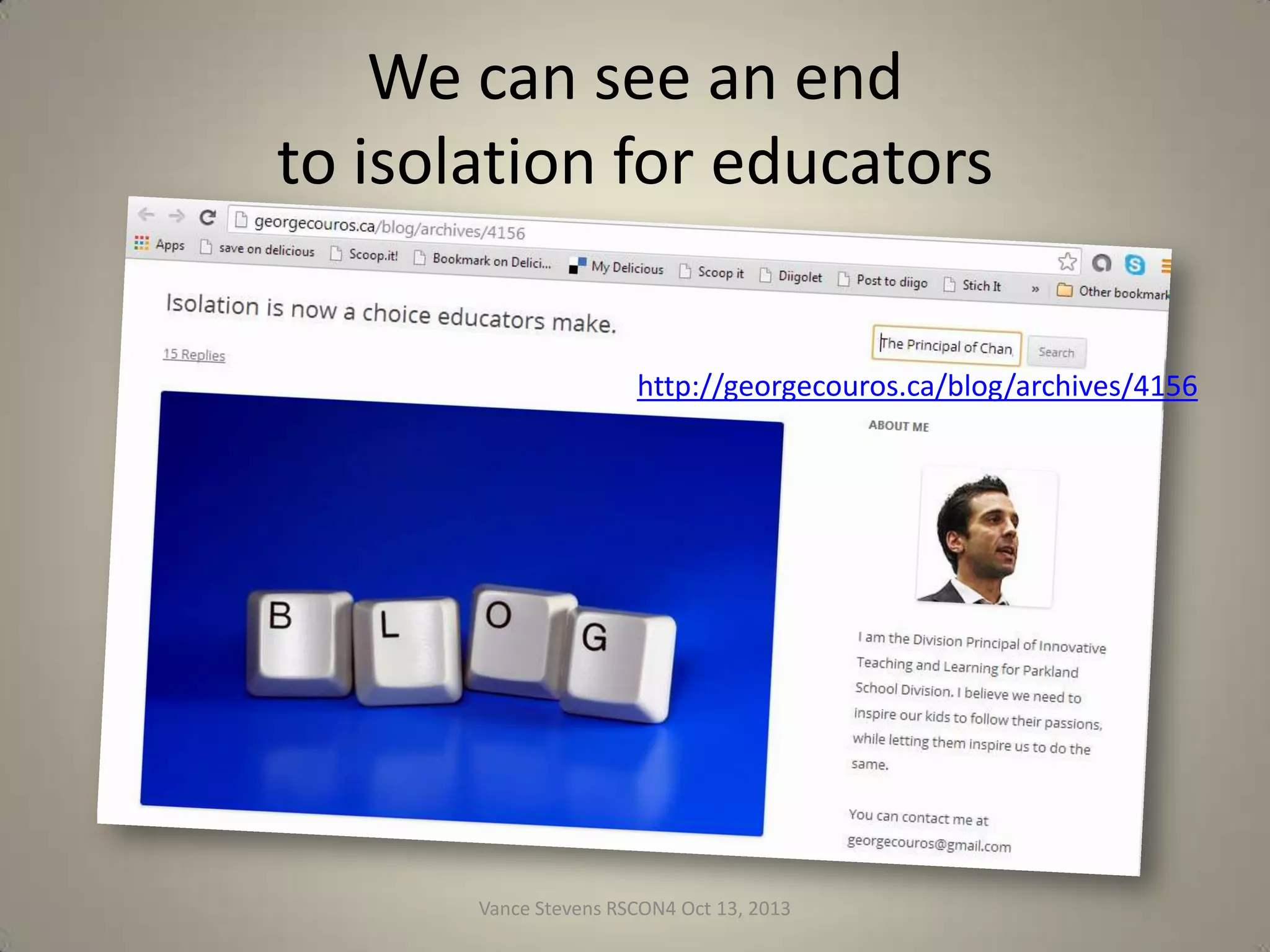
We can see an end
to isolation for educators
http://georgecouros.ca/blog/archives/4156

Vance Stevens RSCON4 Oct 13, 2013

6
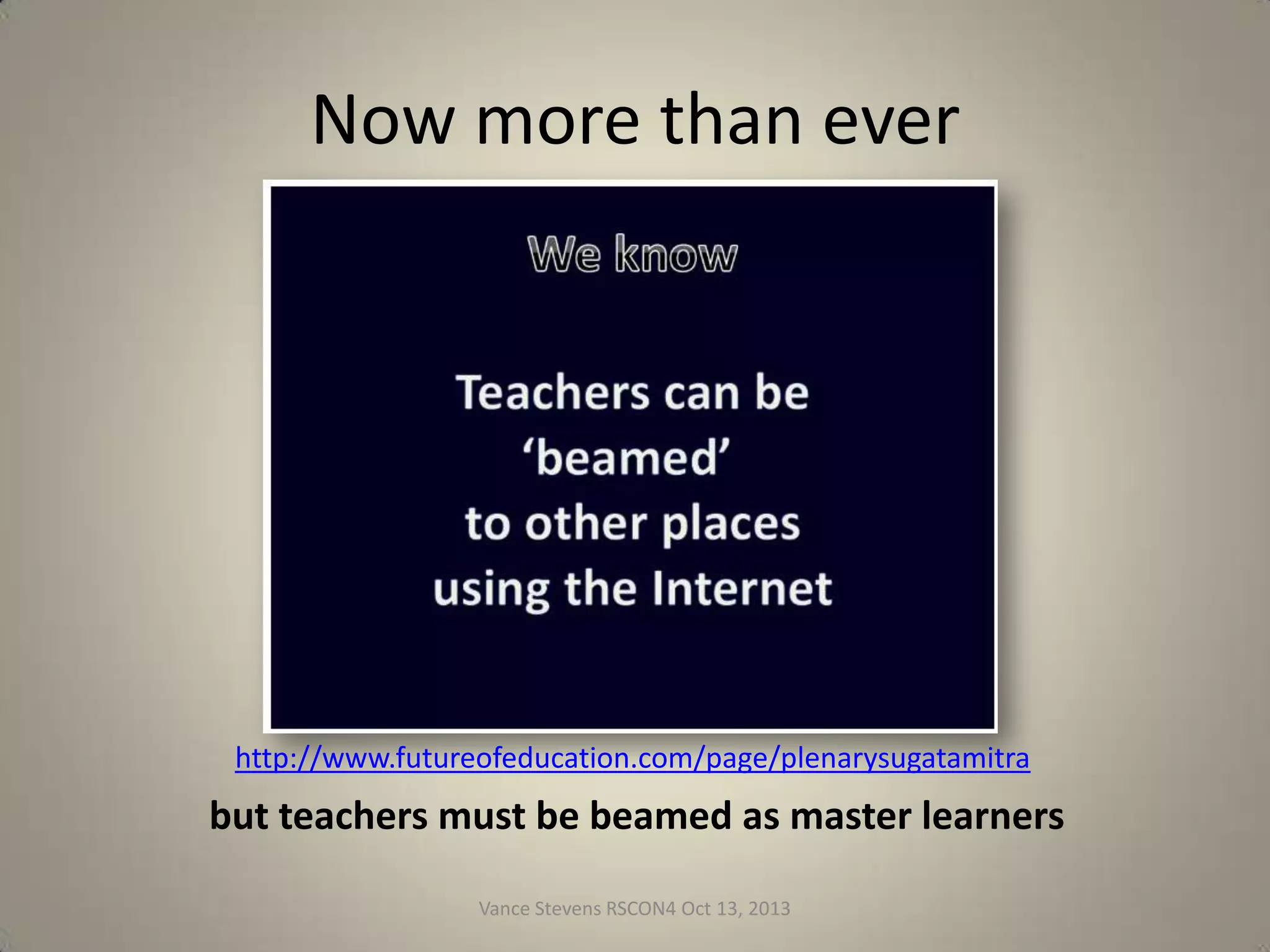
Now more than ever

http://www.futureofeducation.com/page/plenarysugatamitra

but teachers must be beamed as master learners
Vance Stevens RSCON4 Oct 13, 2013

7
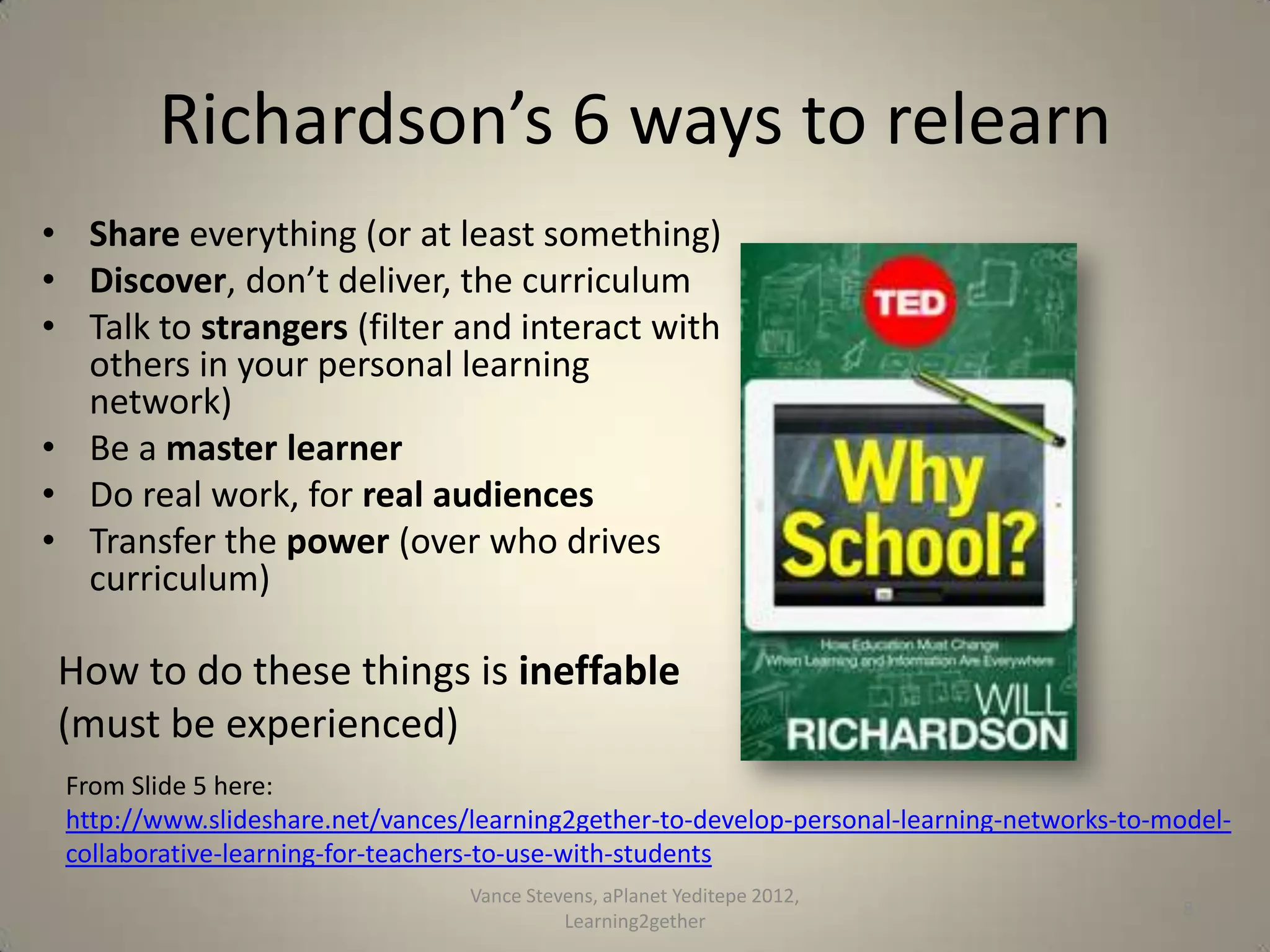
Richardson’s 6 ways to relearn
• Share everything (or at least something)
• Discover, don’t deliver, the curriculum
• Talk to strangers (filter and interact with
others in your personal learning
network)
• Be a master learner
• Do real work, for real audiences
• Transfer the power (over who drives
curriculum)

How to do these things is ineffable
(must be experienced)
From Slide 5 here:
http://www.slideshare.net/vances/learning2gether-to-develop-personal-learning-networks-to-modelcollaborative-learning-for-teachers-to-use-with-students
Vance Stevens RSCON4 Oct 13, 2013

8
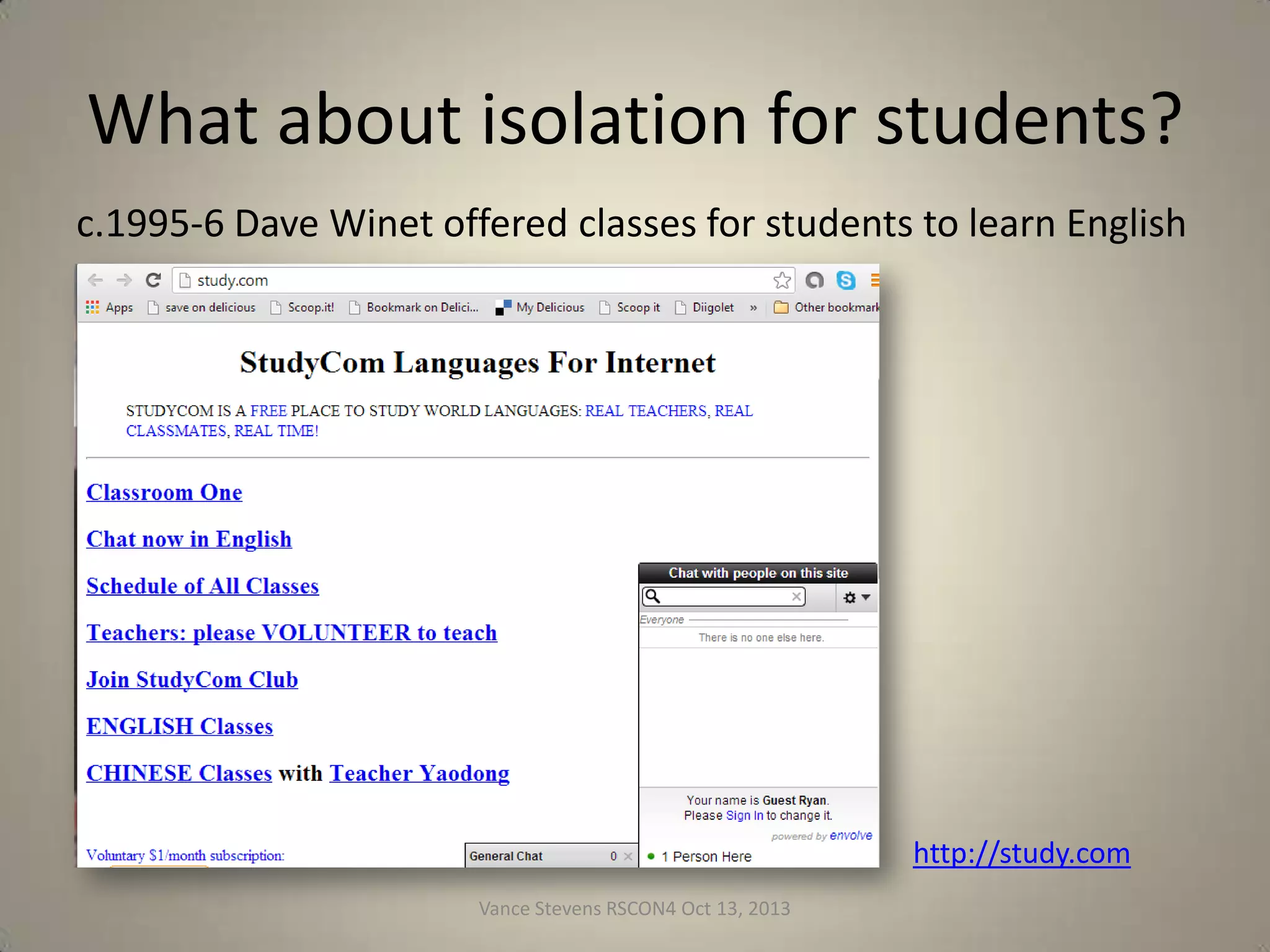
What about isolation for students?
c.1995-6 Dave Winet offered classes for students to learn English

http://study.com
Vance Stevens RSCON4 Oct 13, 2013

9
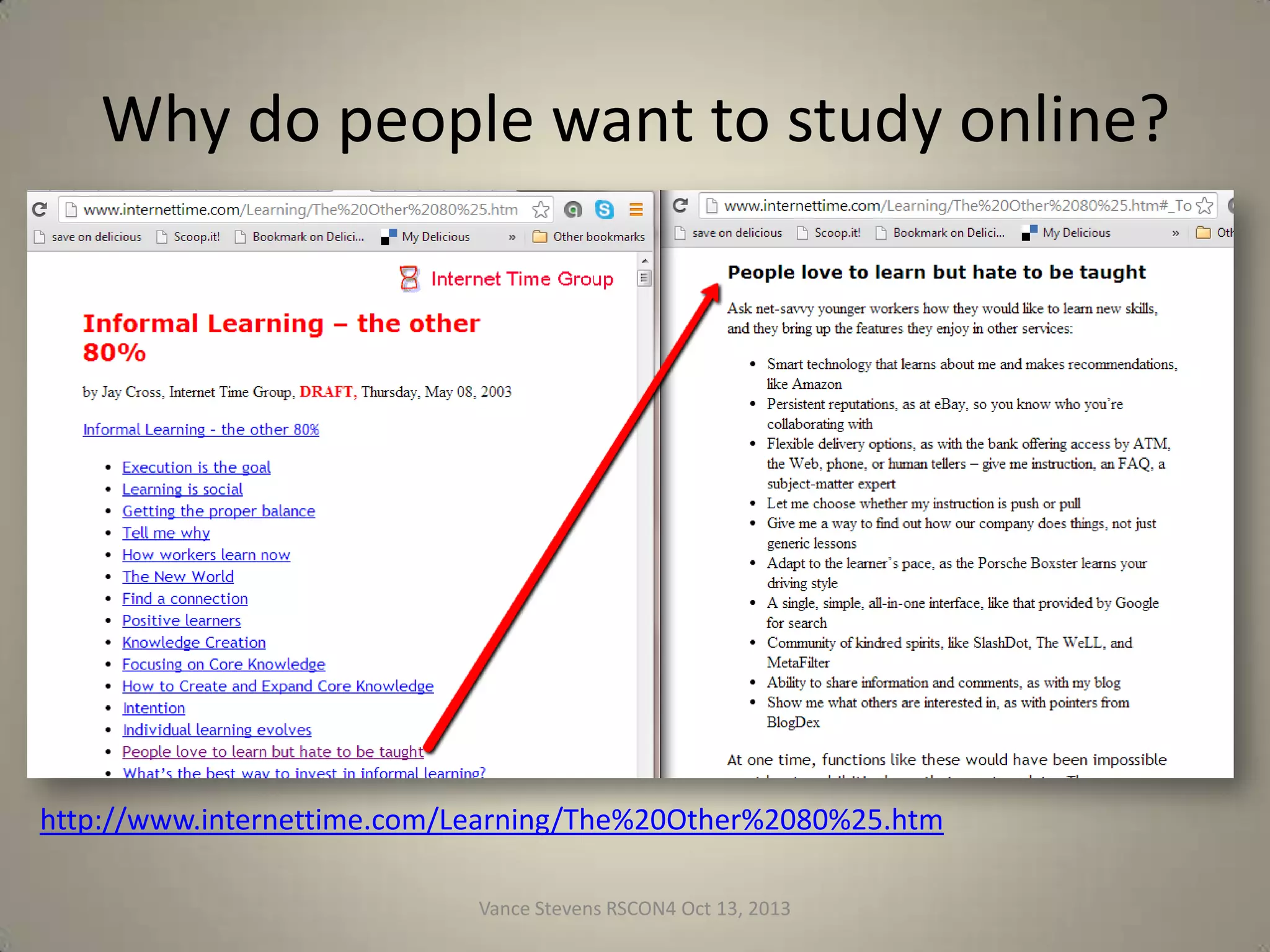
Why do people want to study online?
• Teachers instinctively prepared syllabuses

http://www.internettime.com/Learning/The%20Other%2080%25.htm
Vance Stevens RSCON4 Oct 13, 2013

10
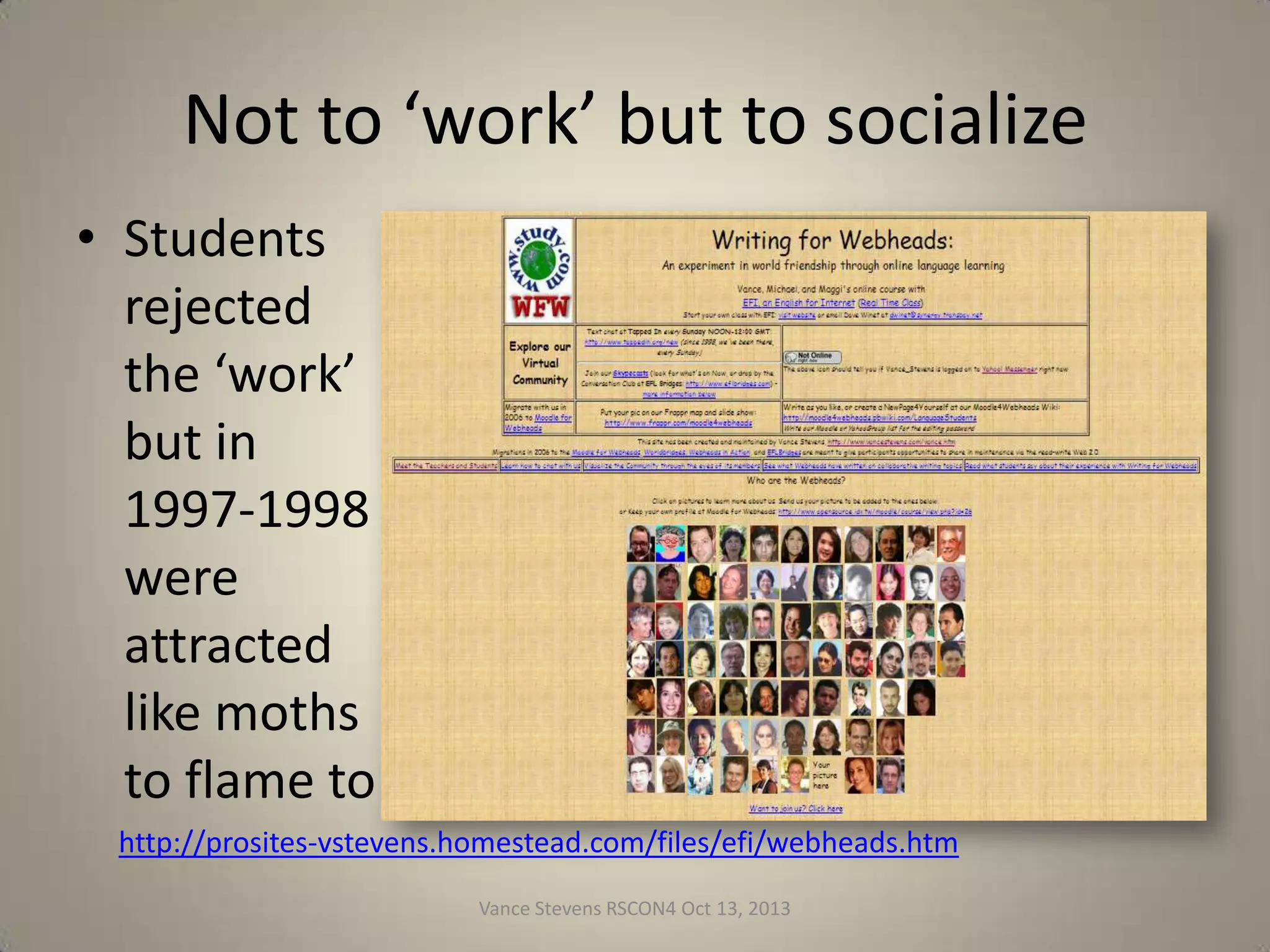
Not to ‘work’ but to socialize
• Students
rejected
the ‘work’
but in
1997-1998
were
attracted
like moths
to flame to
http://prosites-vstevens.homestead.com/files/efi/webheads.htm
Vance Stevens RSCON4 Oct 13, 2013

11
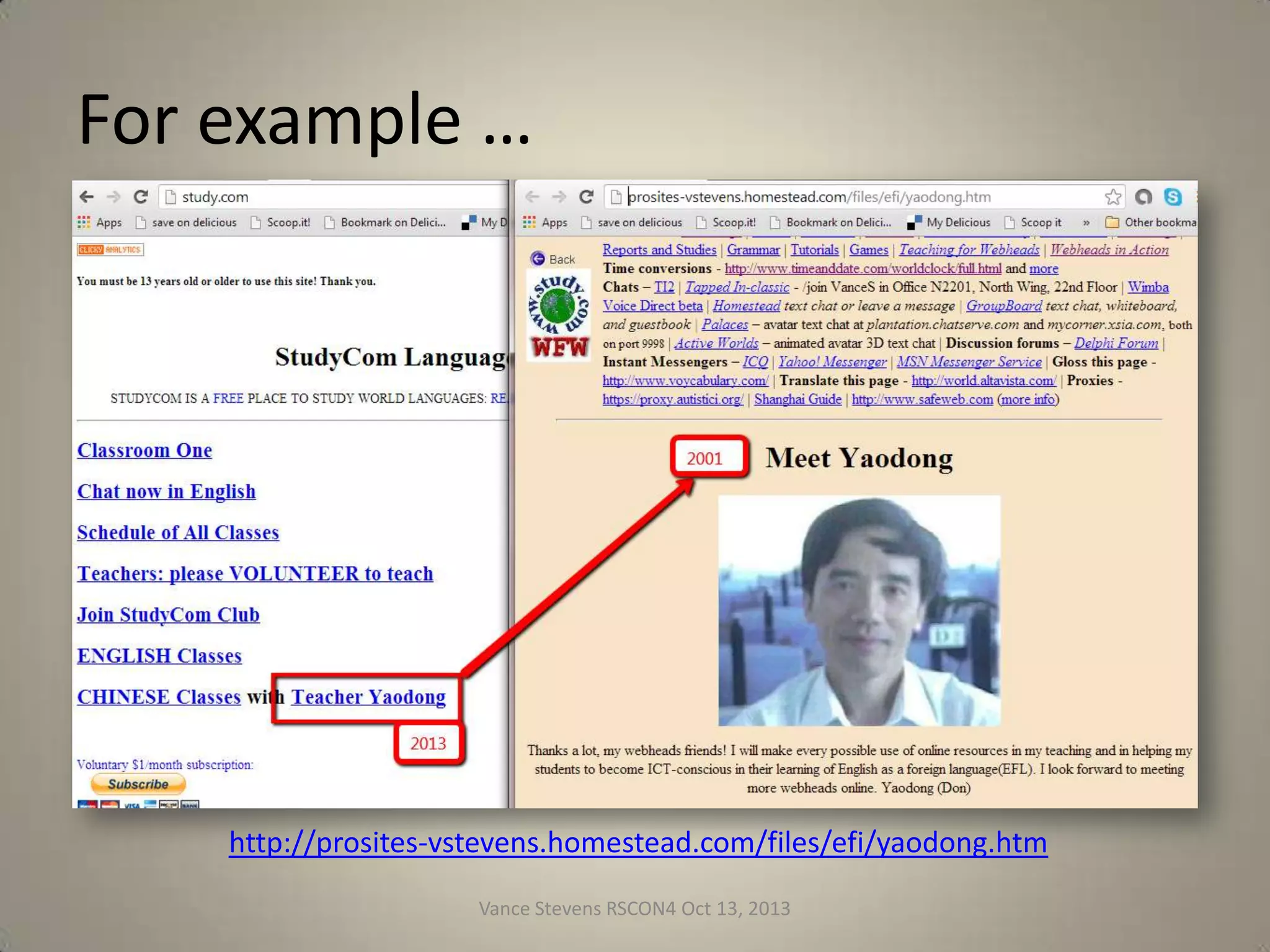
For example …

http://prosites-vstevens.homestead.com/files/efi/yaodong.htm
Vance Stevens RSCON4 Oct 13, 2013

12
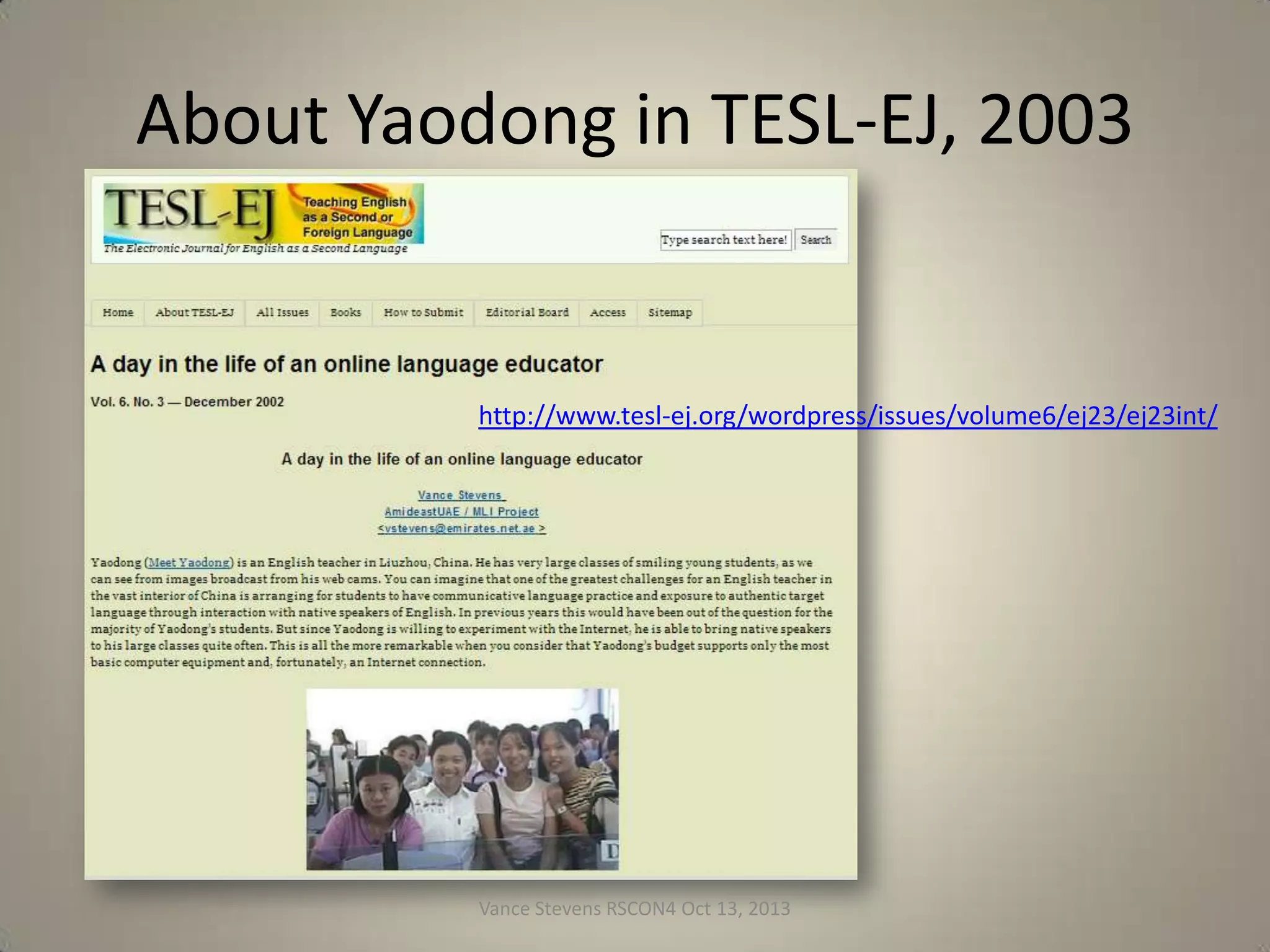
About Yaodong in TESL-EJ, 2003

http://www.tesl-ej.org/wordpress/issues/volume6/ej23/ej23int/

Vance Stevens RSCON4 Oct 13, 2013

13
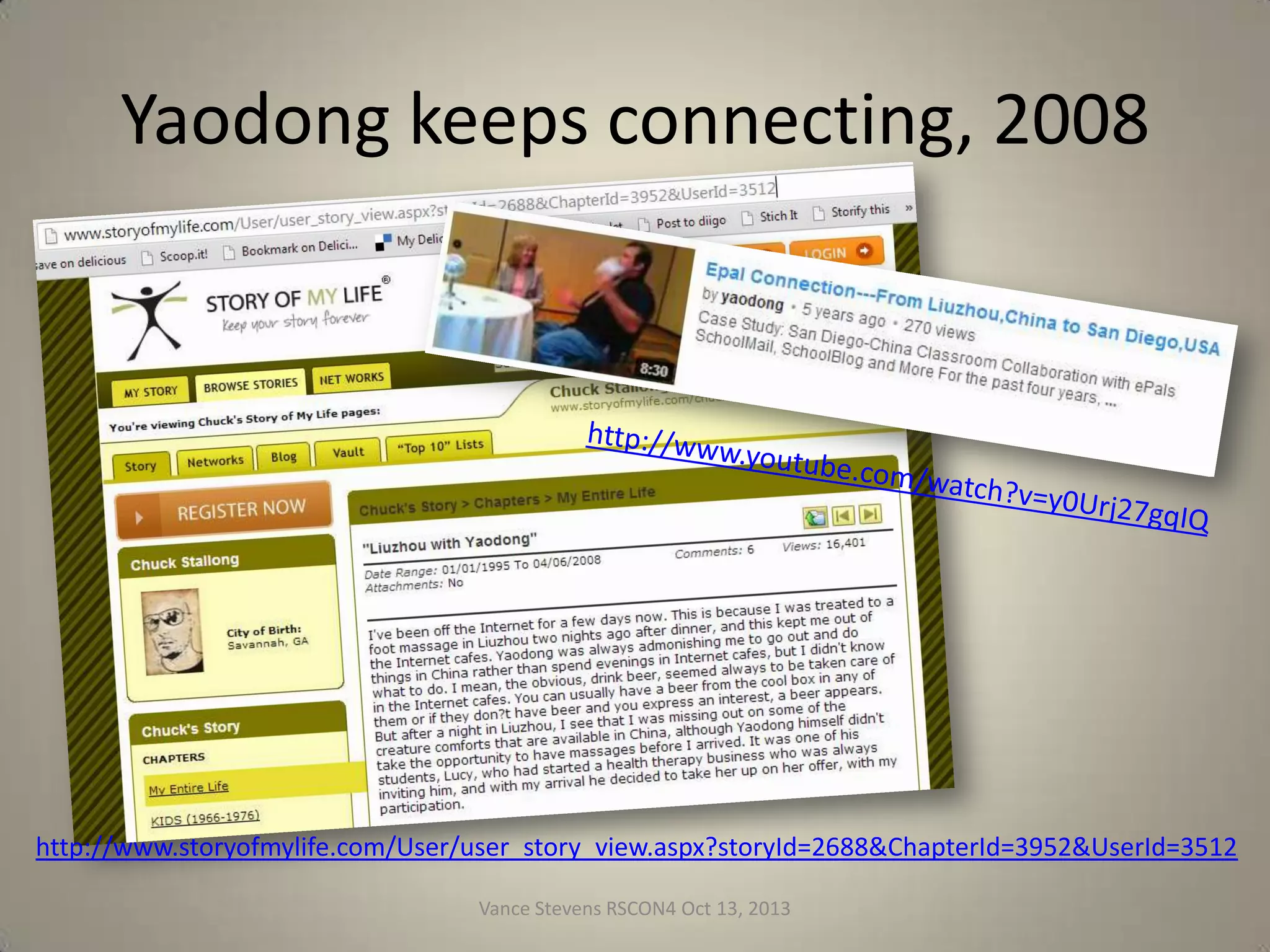
Yaodong keeps connecting, 2008

http://www.storyofmylife.com/User/user_story_view.aspx?storyId=2688&ChapterId=3952&UserId=3512
Vance Stevens RSCON4 Oct 13, 2013

14
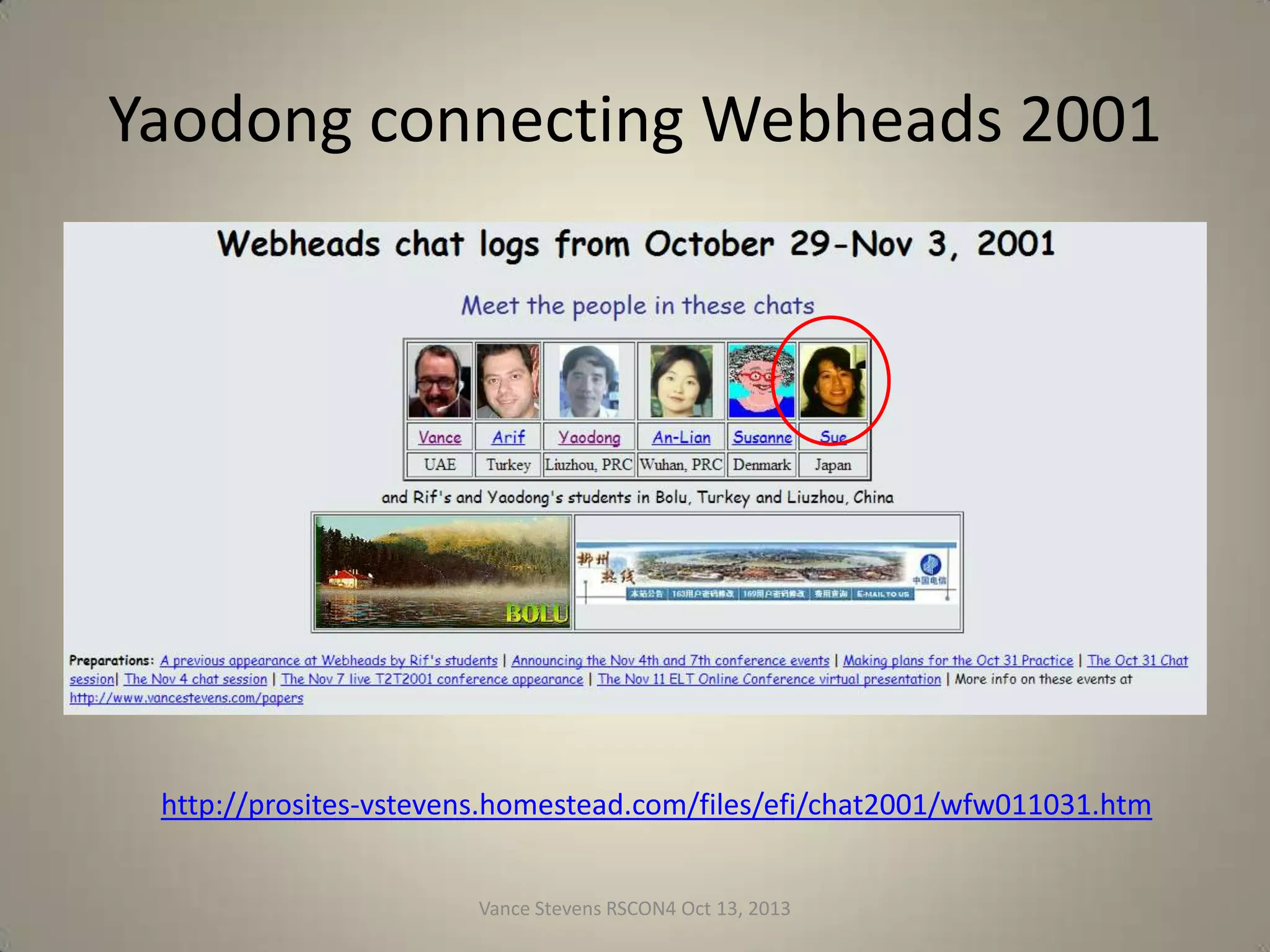
Yaodong connecting Webheads 2001

http://prosites-vstevens.homestead.com/files/efi/chat2001/wfw011031.htm
Vance Stevens RSCON4 Oct 13, 2013

15
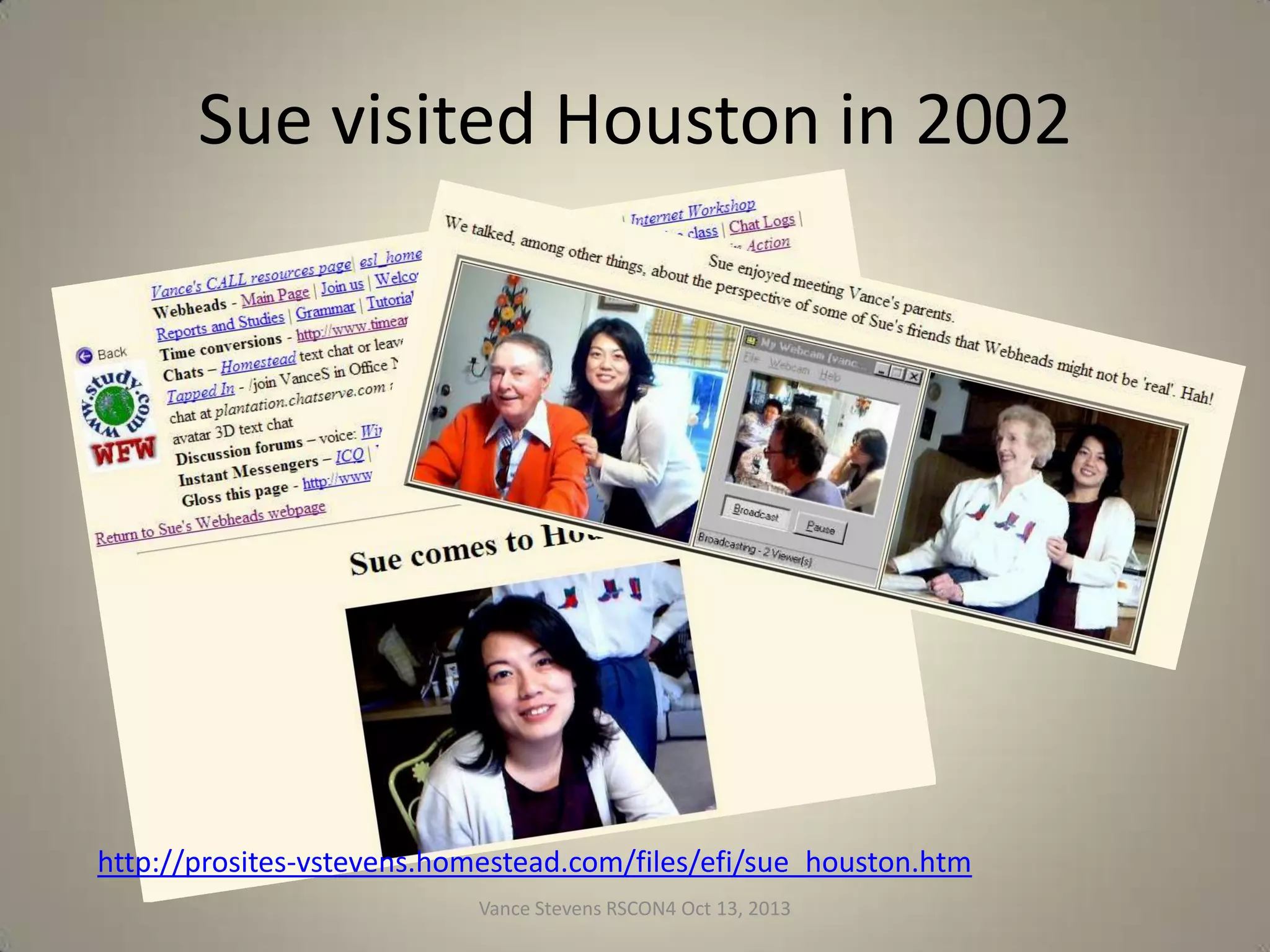
Sue visited Houston in 2002

http://prosites-vstevens.homestead.com/files/efi/sue_houston.htm
Vance Stevens RSCON4 Oct 13, 2013

16
How do we figure out how to structure
learning to meet social expectations?
• In Writing for Webheads
we learned from the students who interacted with us
– how to construct communities that would promote language
learning
– through greater opportunities to socialize in spaces where the
target language was used throughout

• In Webheads in Action
we teach one another experientially, so that we
– learn by trying out online community building techniques
– in spaces where technology is being used online to promote
greater awareness of how it might facilitate language learning

Vance Stevens RSCON4 Oct 13, 2013

17
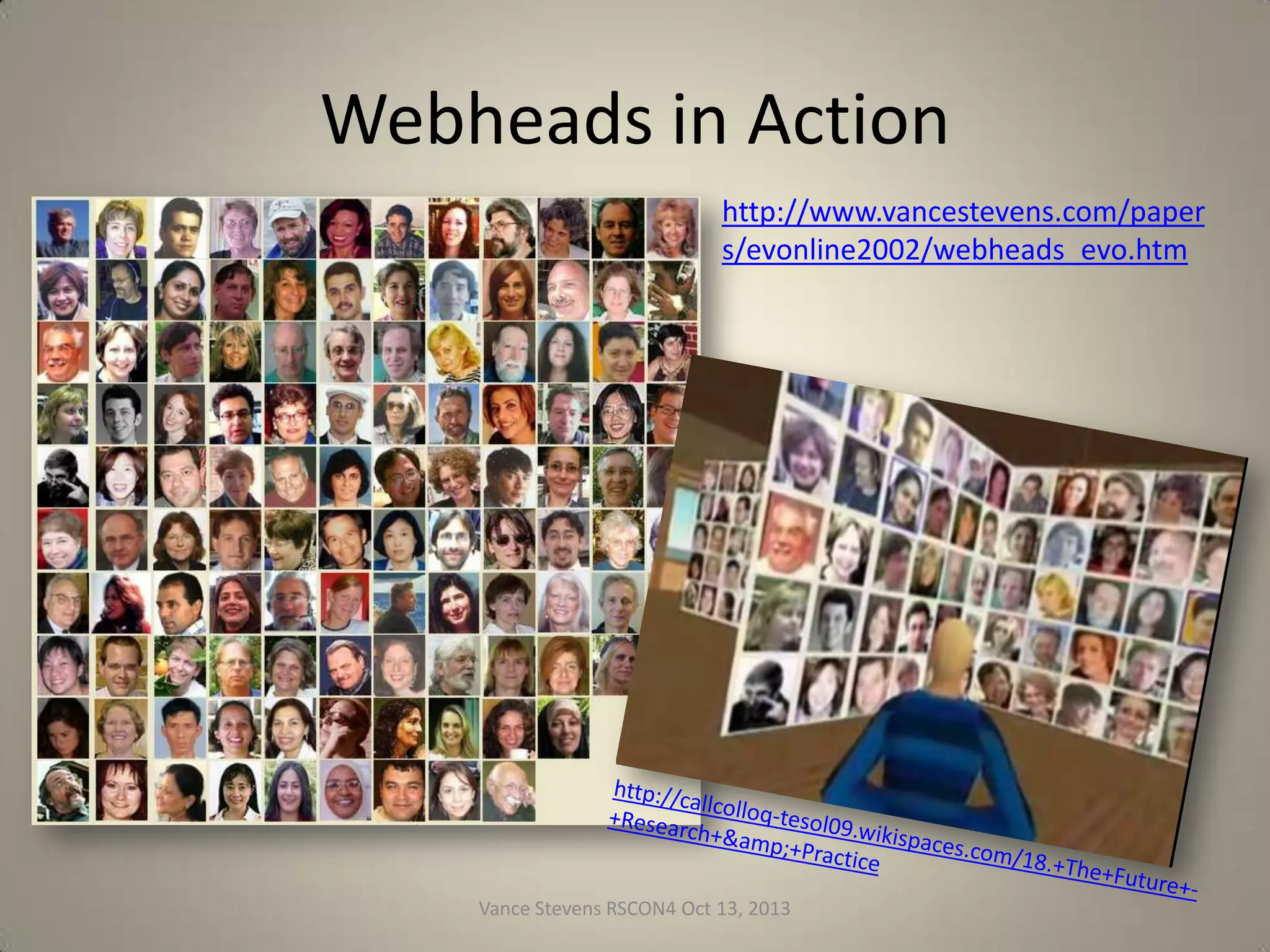
Webheads in Action
http://www.vancestevens.com/paper
s/evonline2002/webheads_evo.htm

Vance Stevens RSCON4 Oct 13, 2013

18
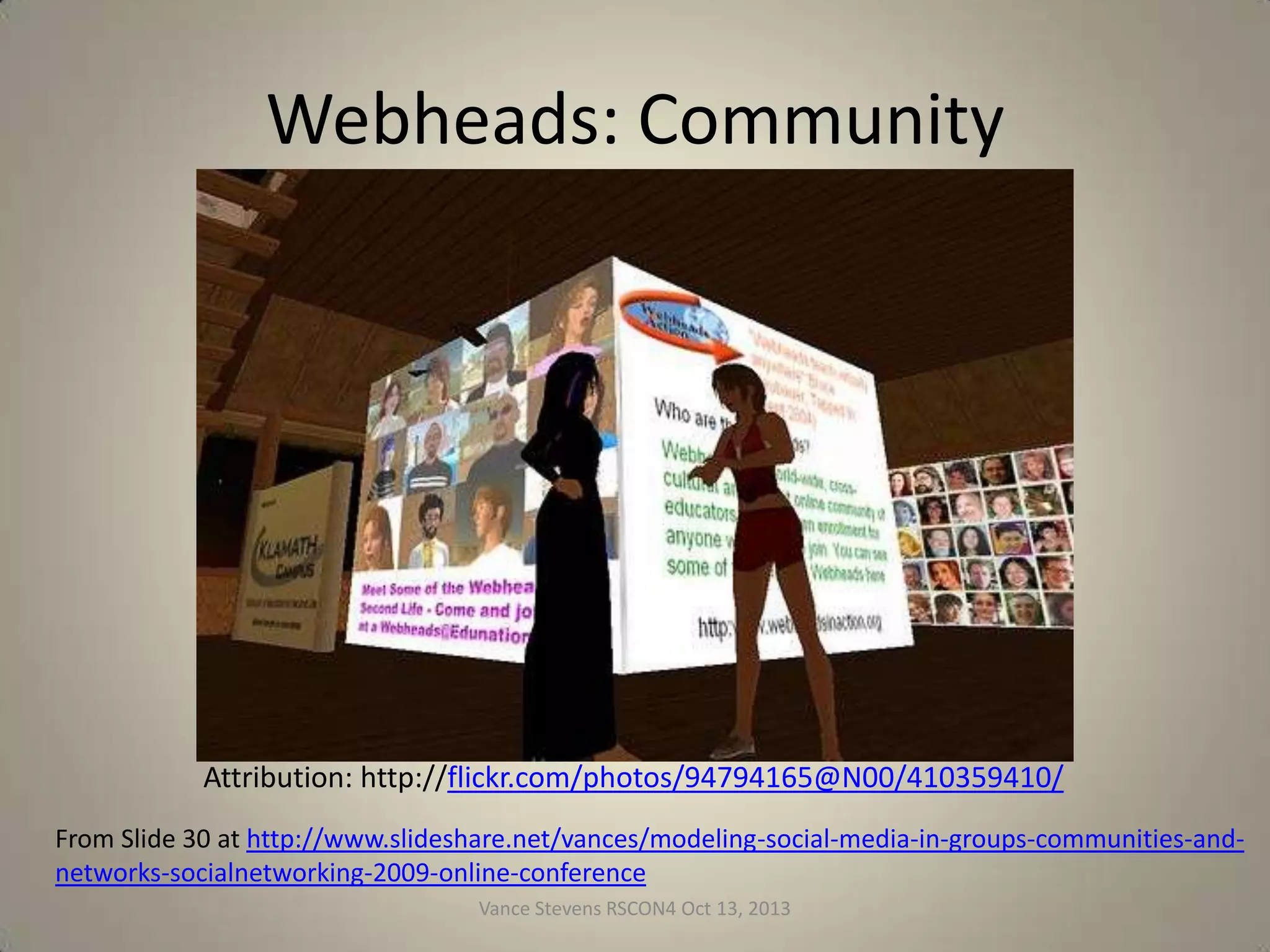
Webheads: Community

Attribution: http://flickr.com/photos/94794165@N00/410359410/
From Slide 30 at http://www.slideshare.net/vances/modeling-social-media-in-groups-communities-andnetworks-socialnetworking-2009-online-conference
Vance Stevens RSCON4 Oct 13, 2013

19
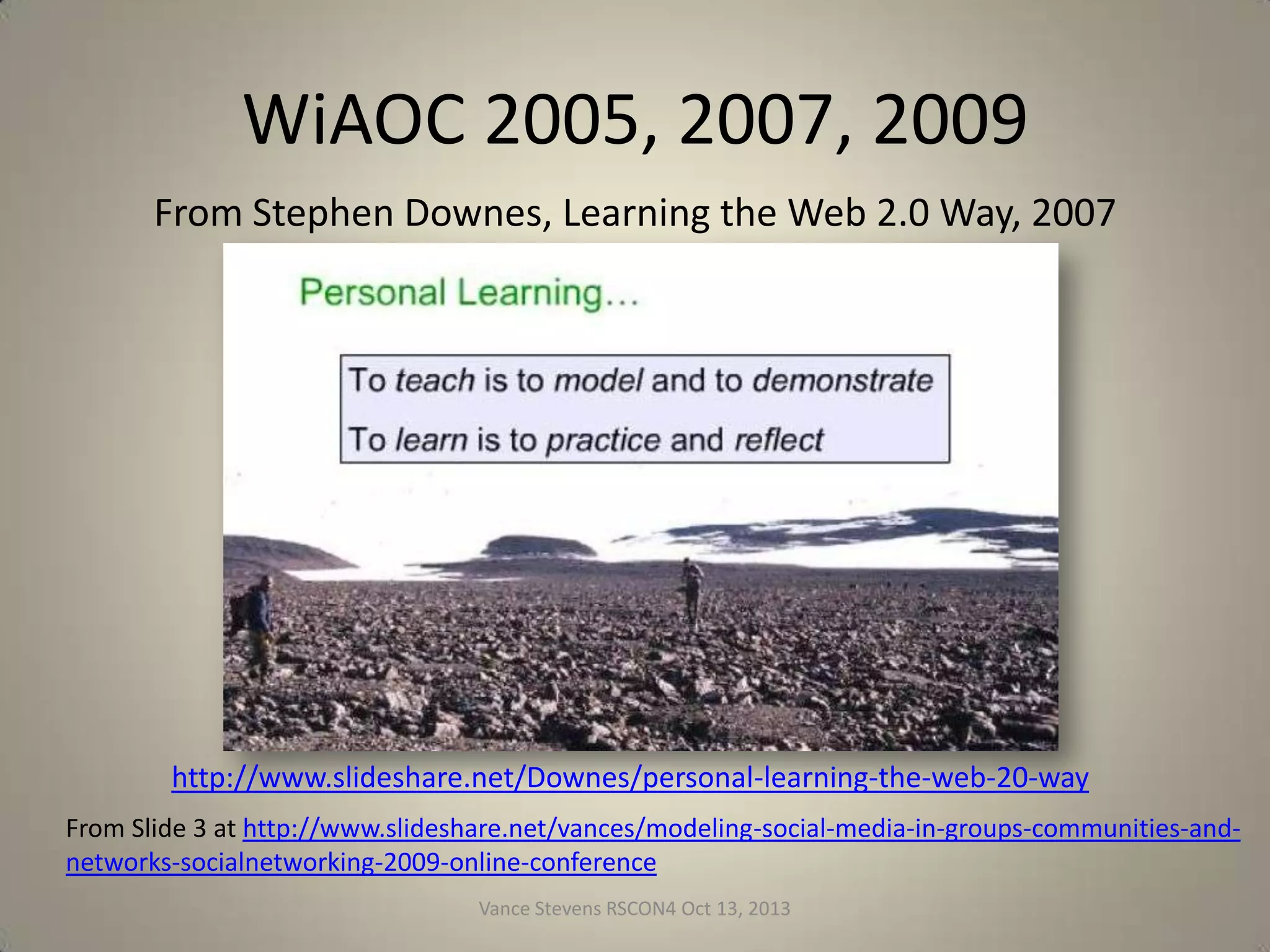
WiAOC 2005, 2007, 2009
From Stephen Downes, Learning the Web 2.0 Way, 2007

http://www.slideshare.net/Downes/personal-learning-the-web-20-way
From Slide 3 at http://www.slideshare.net/vances/modeling-social-media-in-groups-communities-andnetworks-socialnetworking-2009-online-conference
Vance Stevens RSCON4 Oct 13, 2013

20
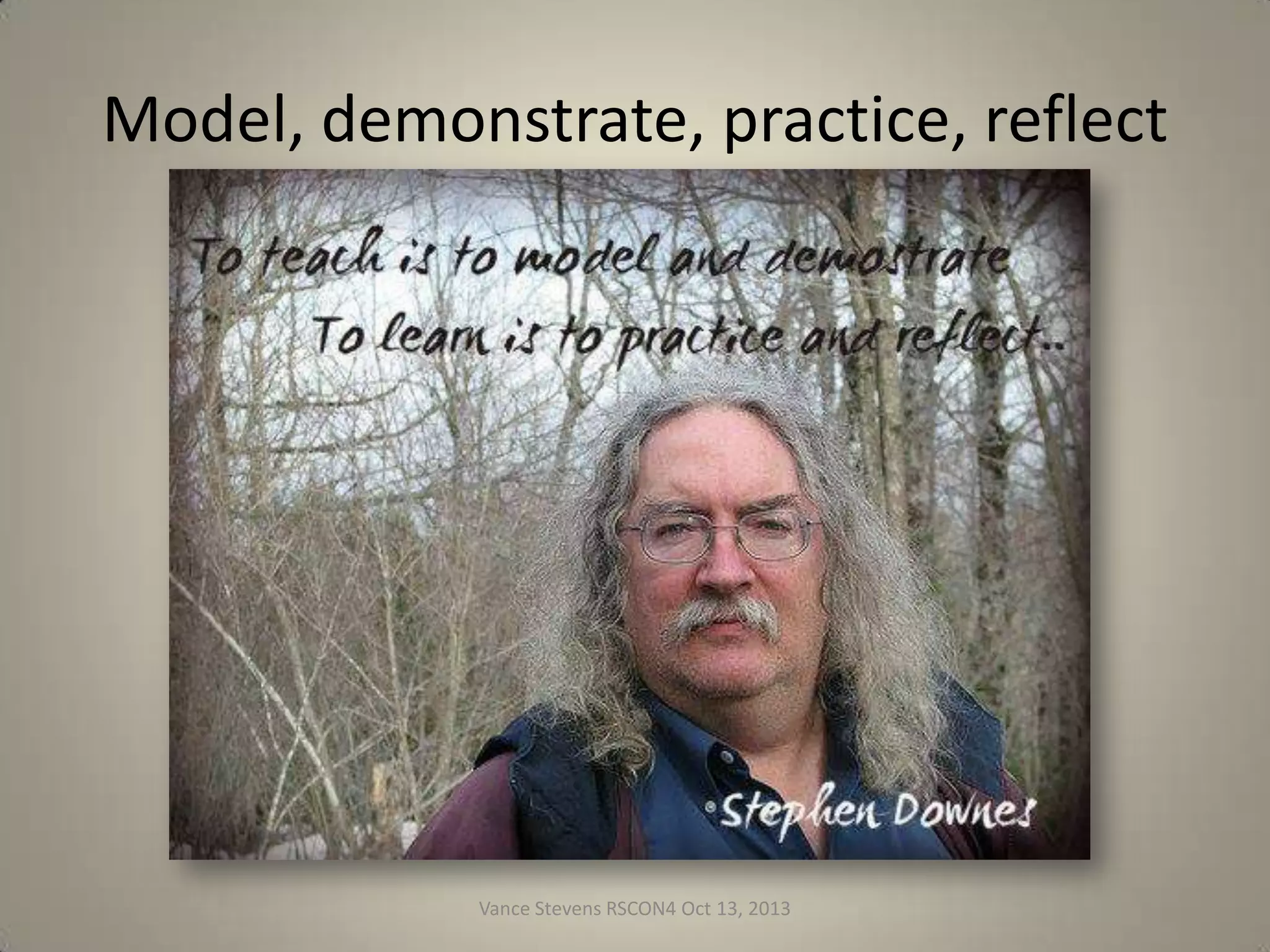
Model, demonstrate, practice, reflect

Vance Stevens RSCON4 Oct 13, 2013

21
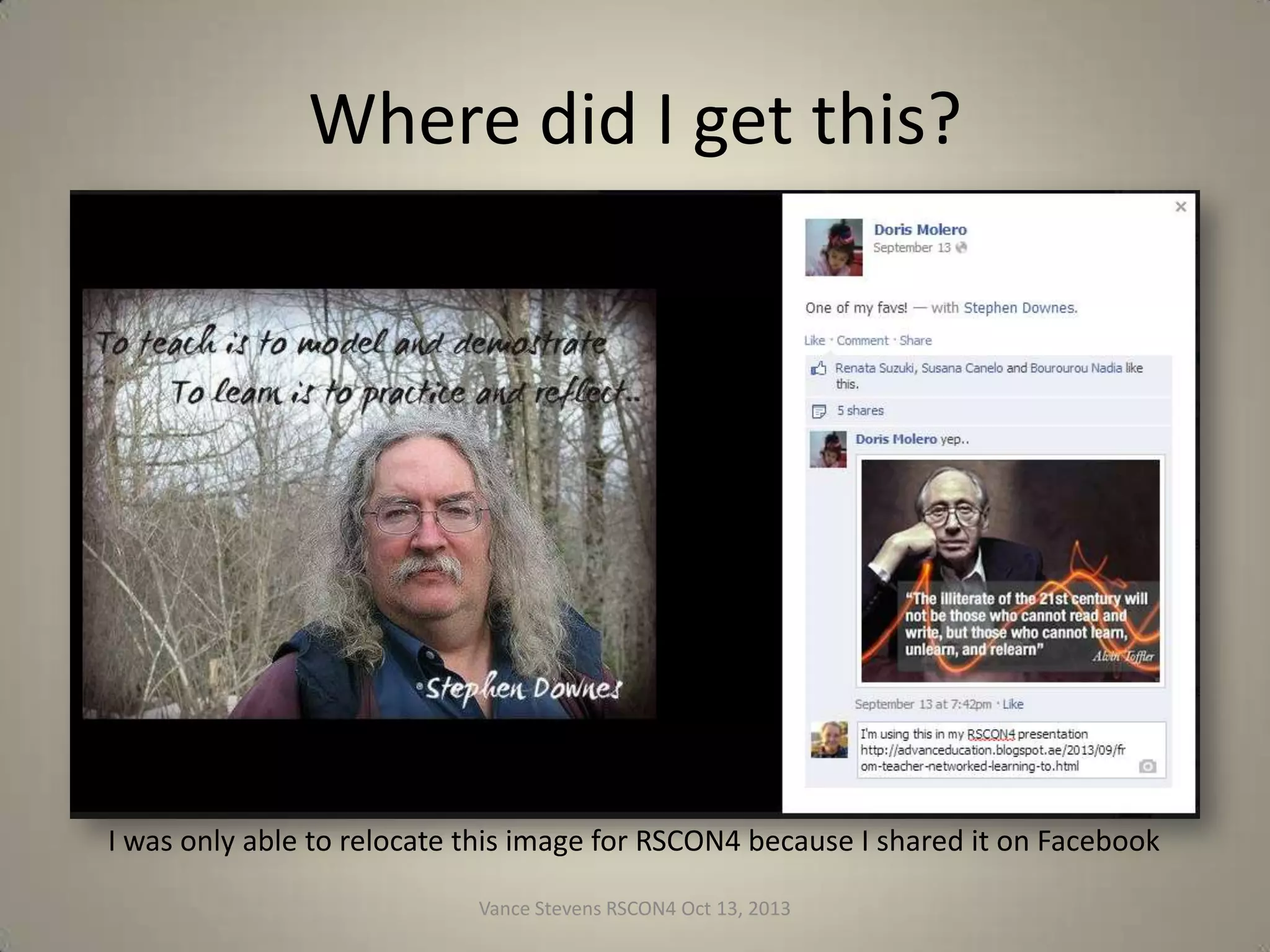
Where did I get this?

I was only able to relocate this image for RSCON4 because I shared it on Facebook
Vance Stevens RSCON4 Oct 13, 2013

22
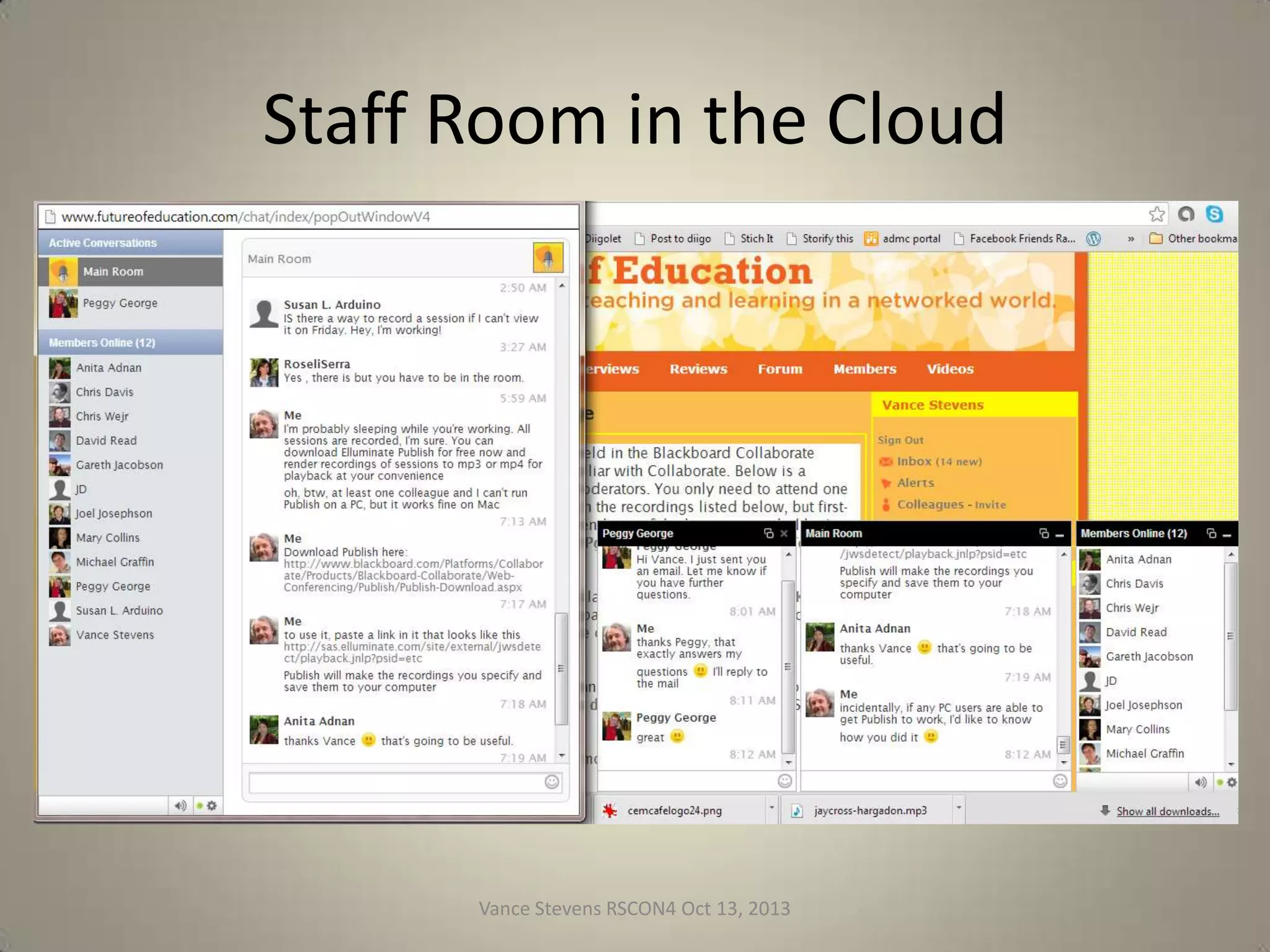
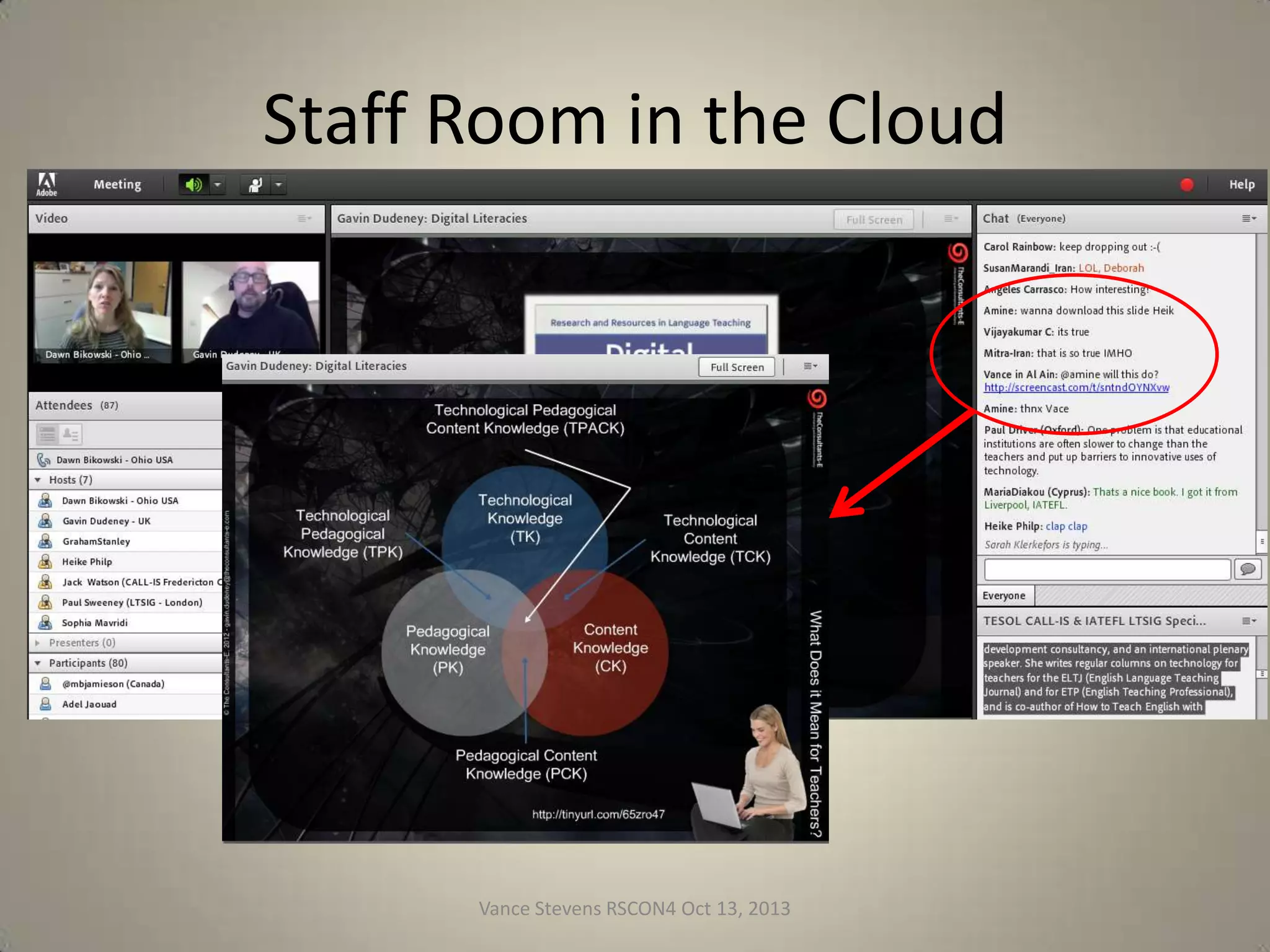
What would it look like?
If you wanted to model effective connected learning to
socially-oriented peers online? Maybe like this?

Vance Stevens RSCON4 Oct 13, 2013

23
Staff Room in the Cloud

Vance Stevens RSCON4 Oct 13, 2013

24
Staff Room in the Cloud

Vance Stevens RSCON4 Oct 13, 2013

25
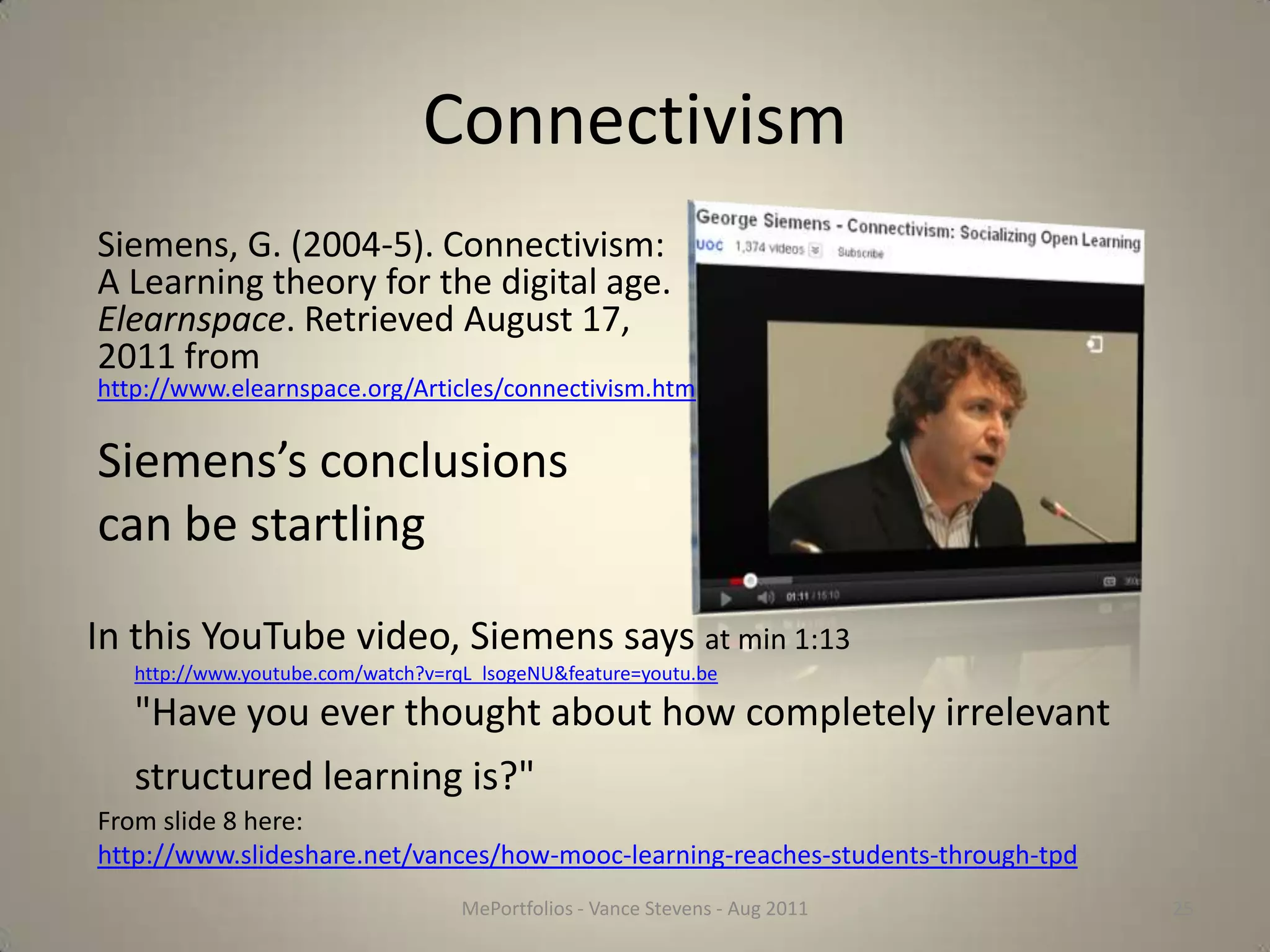
Connectivism
Siemens, G. (2004-5). Connectivism:
A Learning theory for the digital age.
Elearnspace. Retrieved August 17,
2011 from

http://www.elearnspace.org/Articles/connectivism.htm

Siemens’s conclusions
can be startling
In this YouTube video, Siemens says at min 1:13
http://www.youtube.com/watch?v=rqL_lsogeNU&feature=youtu.be

"Have you ever thought about how completely irrelevant

structured learning is?"
From slide 8 here:
http://www.slideshare.net/vances/how-mooc-learning-reaches-students-through-tpd
Vance Stevens RSCON4 Oct 13, 2013

26
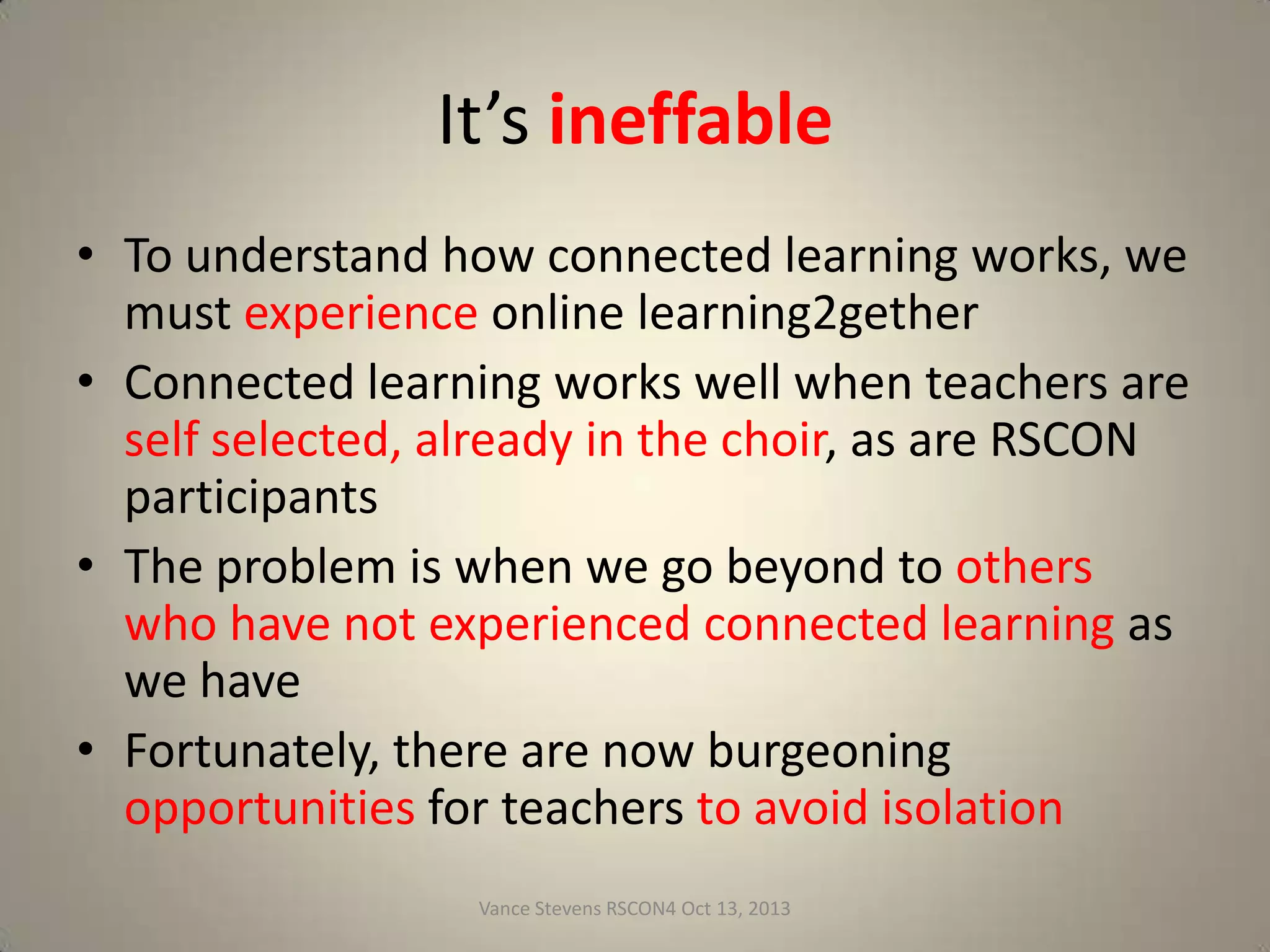
It’s ineffable
• To understand how connected learning works, we
must experience online learning2gether
• Connected learning works well when teachers are
self selected, already in the choir, as are RSCON
participants
• The problem is when we go beyond to others
who have not experienced connected learning as
we have
• Fortunately, there are now burgeoning
opportunities for teachers to avoid isolation
Vance Stevens RSCON4 Oct 13, 2013

27
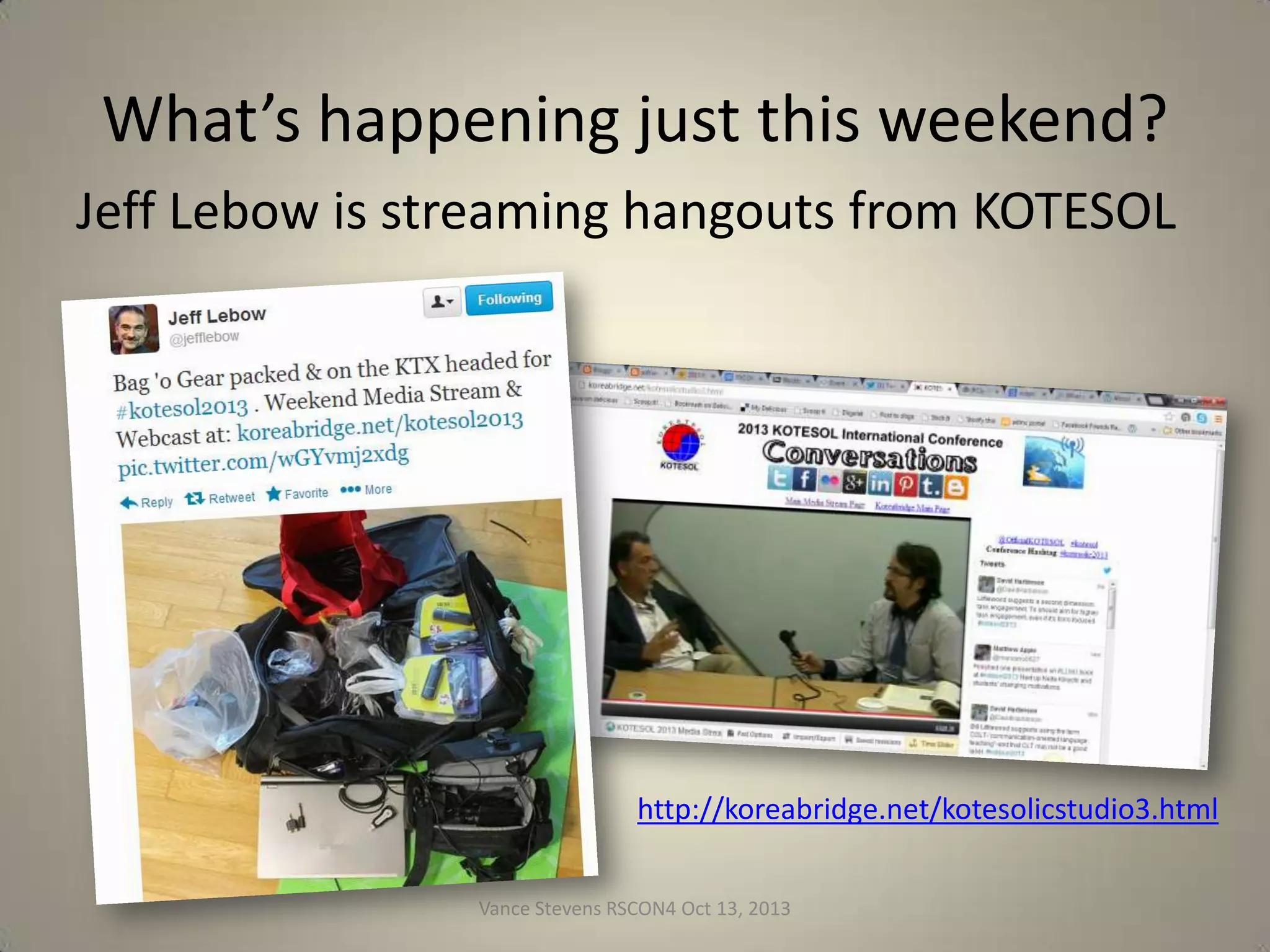
What’s happening just this weekend?
Jeff Lebow is streaming hangouts from KOTESOL

http://koreabridge.net/kotesolicstudio3.html
Vance Stevens RSCON4 Oct 13, 2013

28
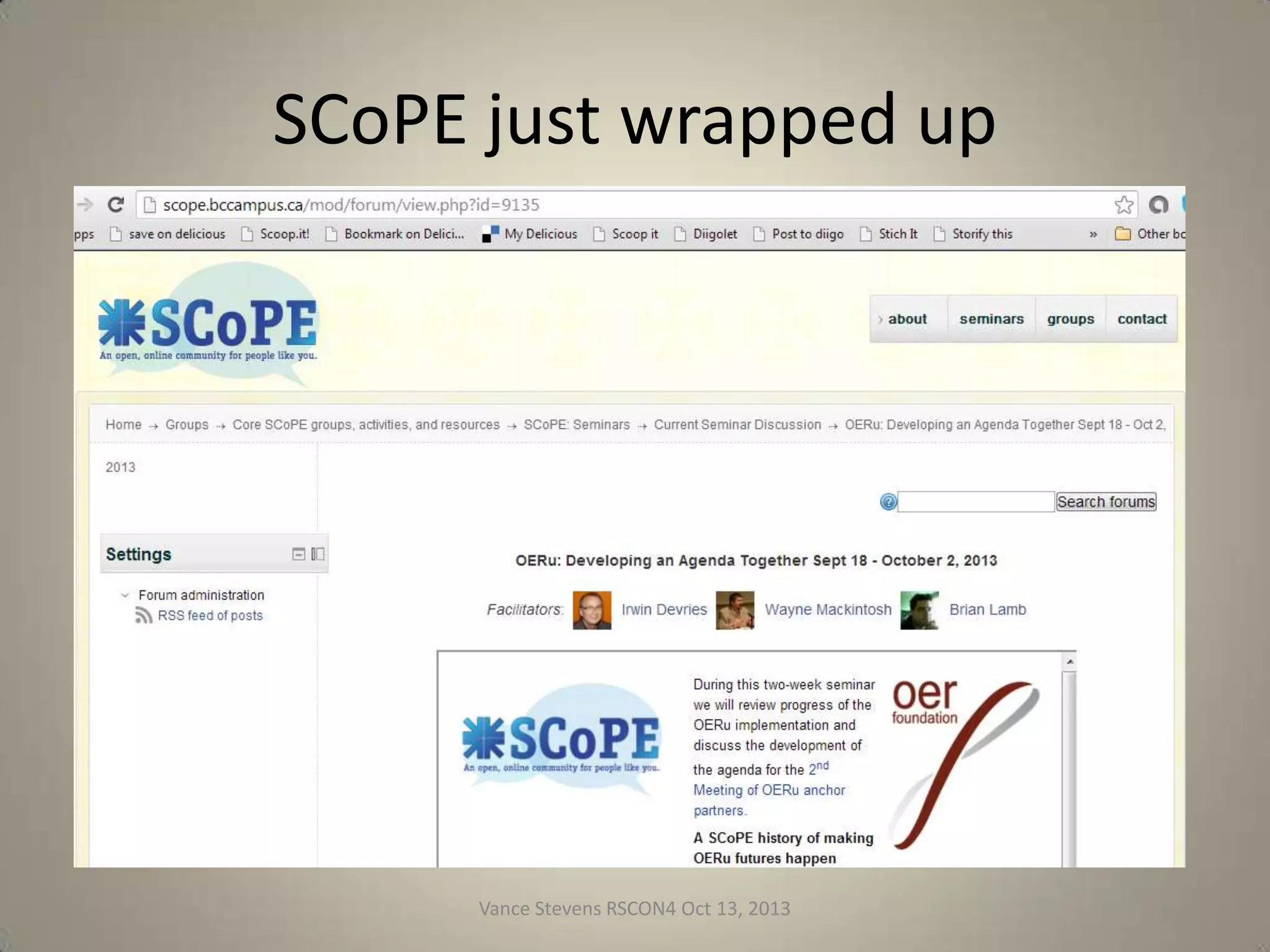
SCoPE just wrapped up

Vance Stevens RSCON4 Oct 13, 2013

29
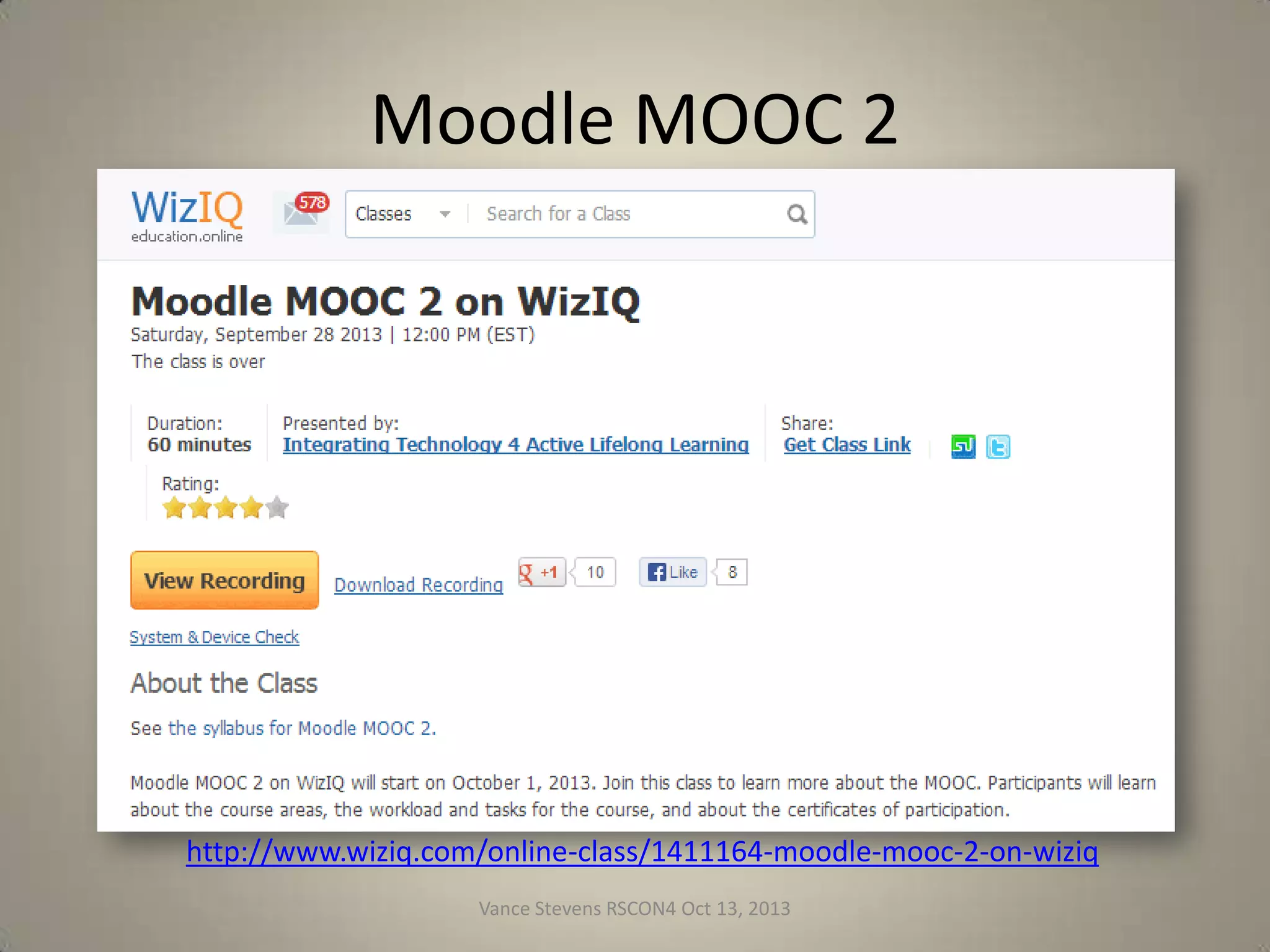
Moodle MOOC 2

http://www.wiziq.com/online-class/1411164-moodle-mooc-2-on-wiziq
Vance Stevens RSCON4 Oct 13, 2013

30
#eltchat

https://sas.elluminate.com/drtbl?sid=2008350&suid=D.AC3D28B09030E834760F4D57961C11
Vance Stevens RSCON4 Oct 13, 2013

31
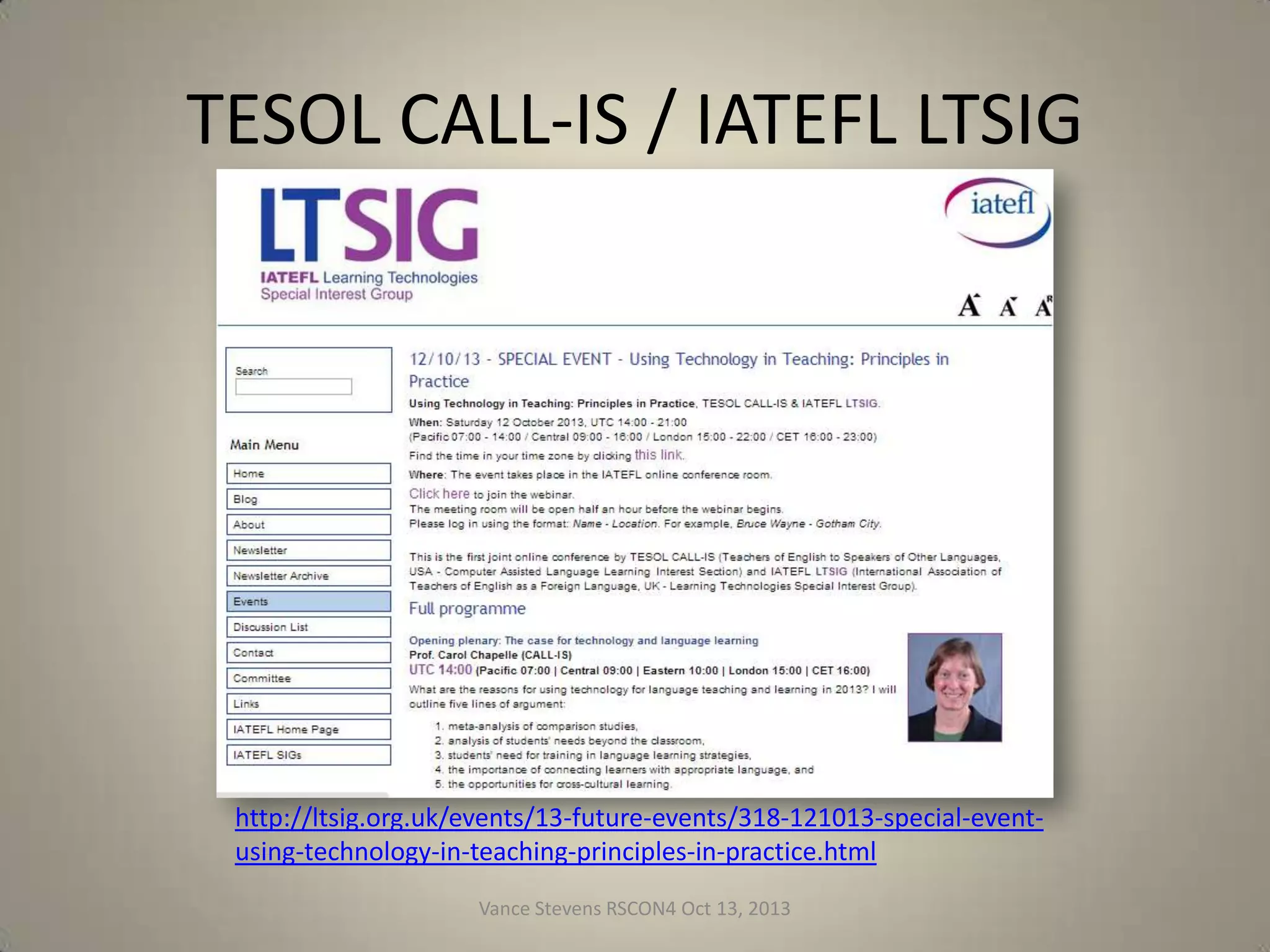
TESOL CALL-IS / IATEFL LTSIG

http://ltsig.org.uk/events/13-future-events/318-121013-special-eventusing-technology-in-teaching-principles-in-practice.html
Vance Stevens RSCON4 Oct 13, 2013

32
EVO Electronic Village Online

January and February each year
http://evosessions.pbworks.com/

Vance Stevens RSCON4 Oct 13, 2013

33
Connected Educator Month

http://connectededucators.org/

Vance Stevens RSCON4 Oct 13, 2013

34
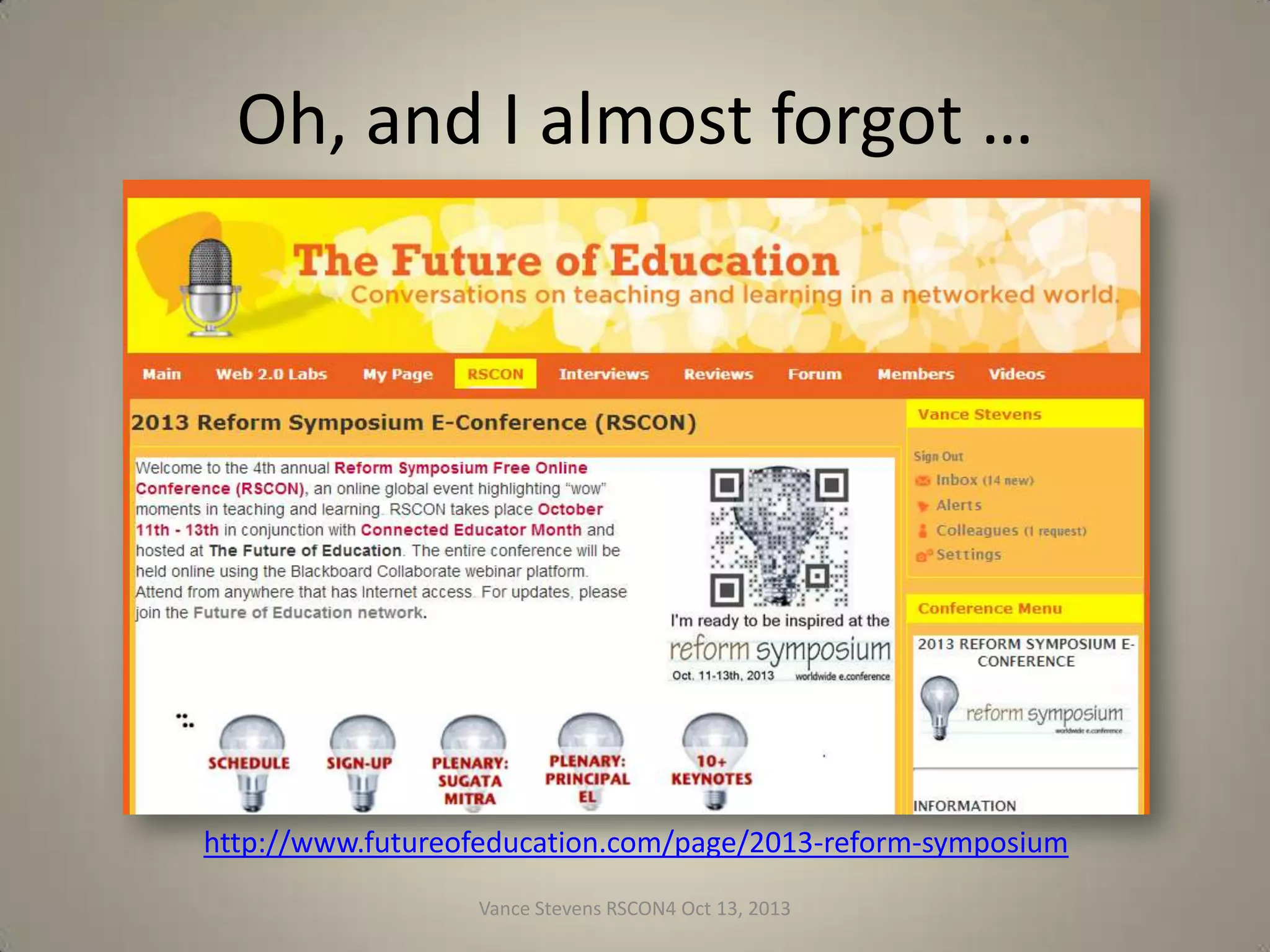
Oh, and I almost forgot …

http://www.futureofeducation.com/page/2013-reform-symposium
Vance Stevens RSCON4 Oct 13, 2013

35
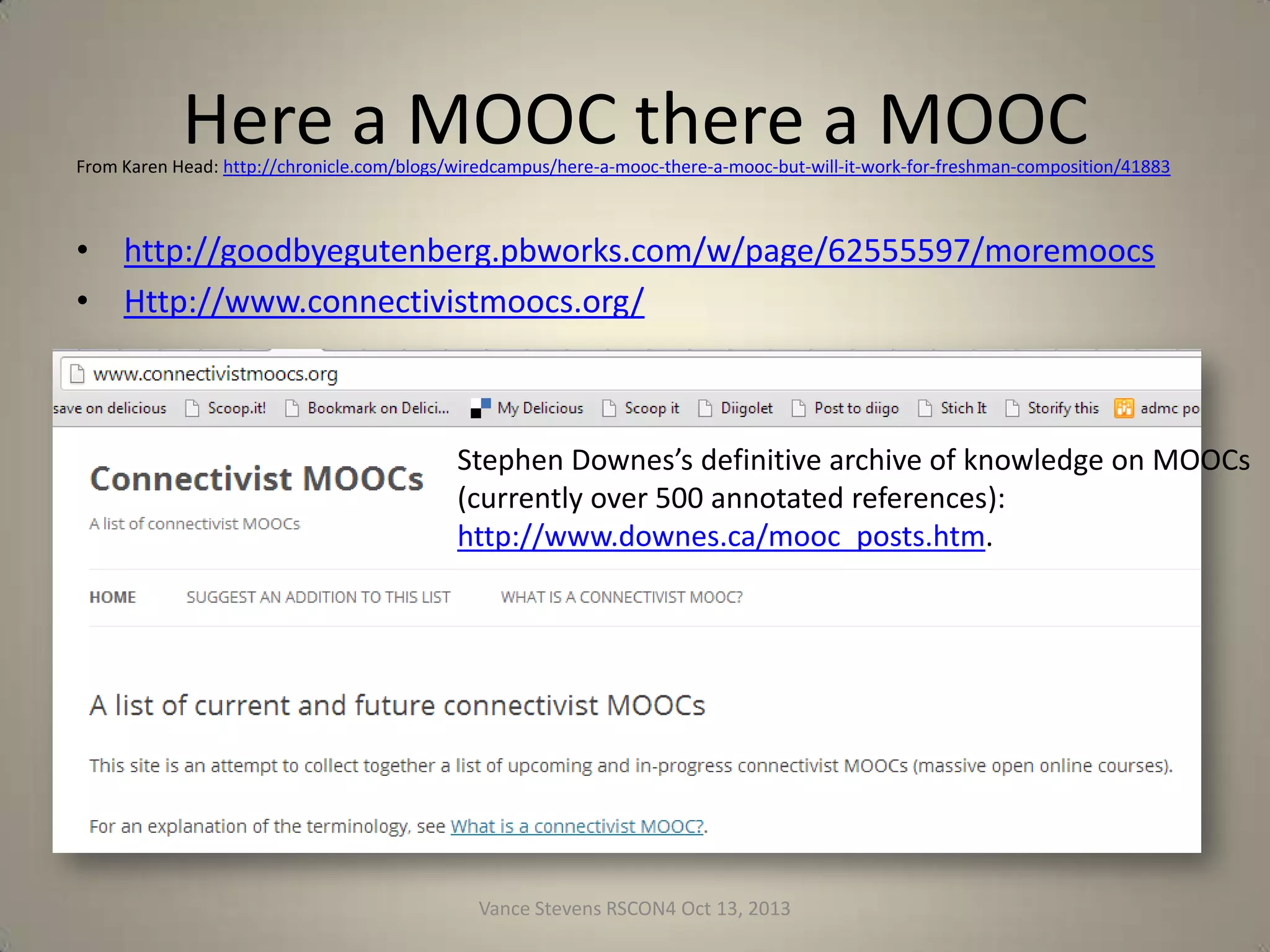
Here a MOOC there a MOOC

From Karen Head: http://chronicle.com/blogs/wiredcampus/here-a-mooc-there-a-mooc-but-will-it-work-for-freshman-composition/41883

• http://goodbyegutenberg.pbworks.com/w/page/62555597/moremoocs
• Http://www.connectivistmoocs.org/

Stephen Downes’s definitive archive of knowledge on MOOCs
(currently over 500 annotated references):
http://www.downes.ca/mooc_posts.htm.

Vance Stevens RSCON4 Oct 13, 2013

36
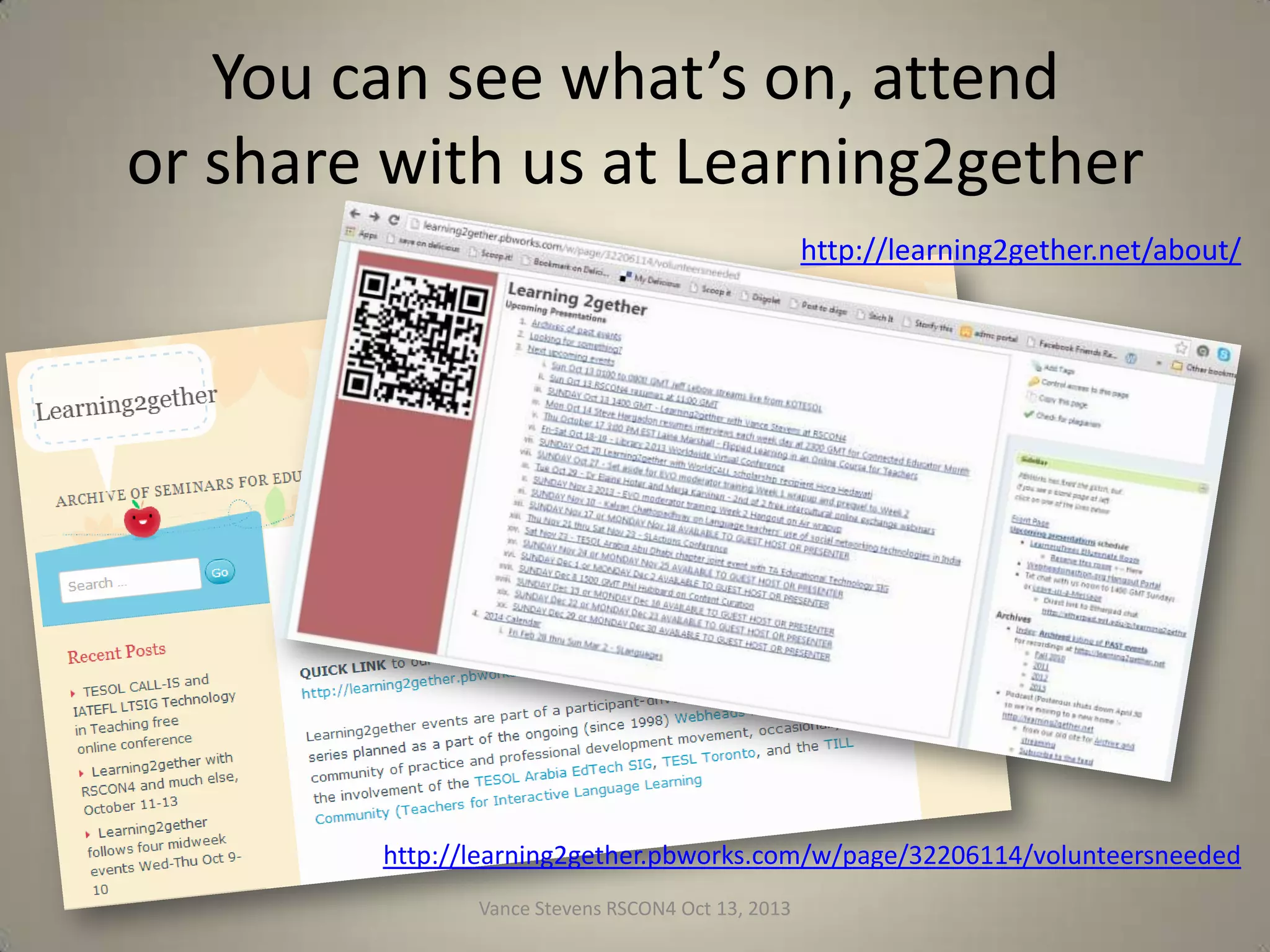
You can see what’s on, attend
or share with us at Learning2gether
http://learning2gether.net/about/

http://learning2gether.pbworks.com/w/page/32206114/volunteersneeded
Vance Stevens RSCON4 Oct 13, 2013

37
Saving the most important to the end
The Students!
• Our mindsets must change so that students
can be inculcated in the same way we are
learning to learn
• Students are already learning to connect (in
their way!) e.g.
– LA unified school district problem
– Tom Woods in Australia

Vance Stevens RSCON4 Oct 13, 2013

38
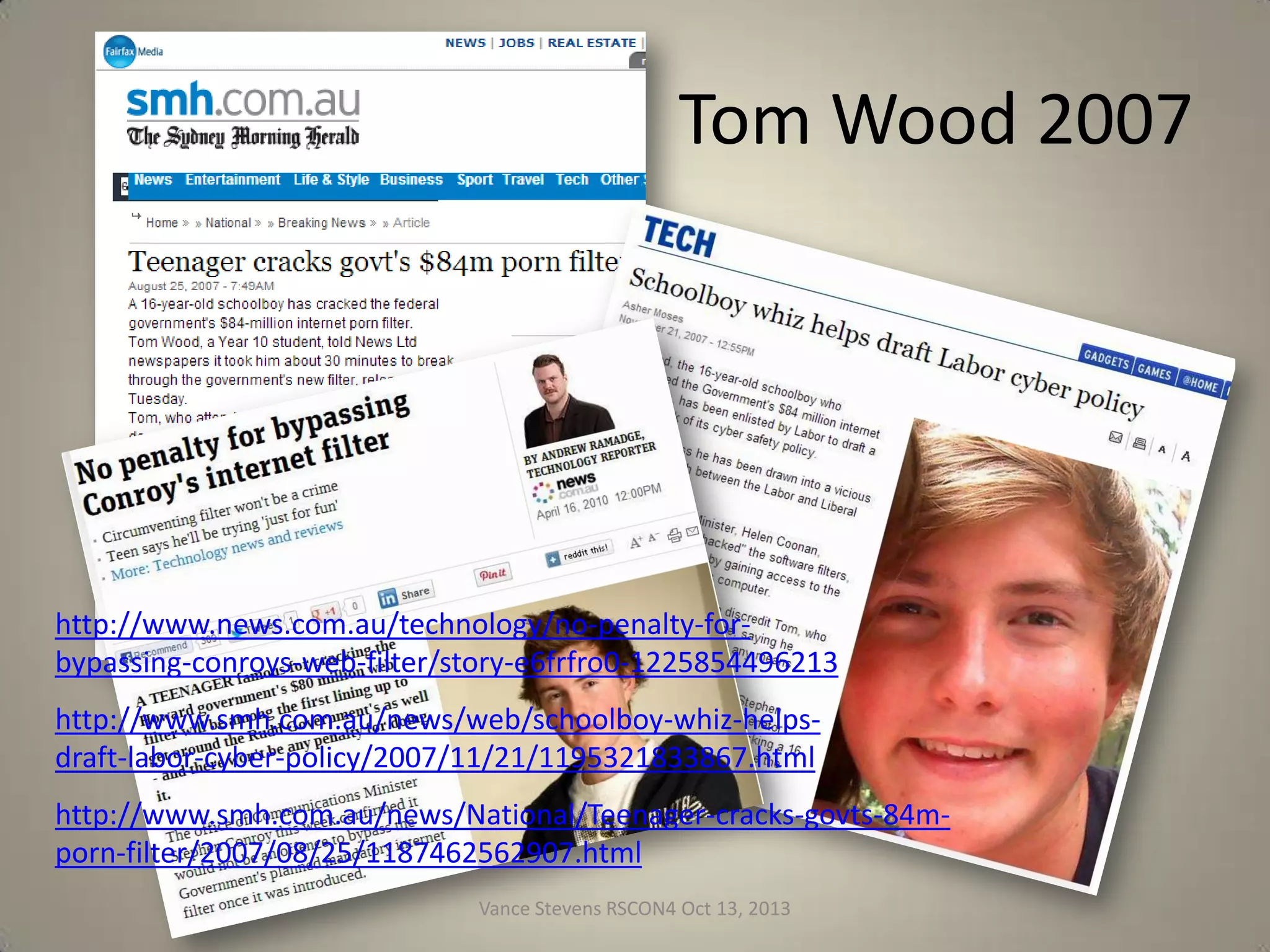
Tom Wood 2007

http://www.news.com.au/technology/no-penalty-forbypassing-conroys-web-filter/story-e6frfro0-1225854496213
http://www.smh.com.au/news/web/schoolboy-whiz-helpsdraft-labor-cyber-policy/2007/11/21/1195321833867.html
http://www.smh.com.au/news/National/Teenager-cracks-govts-84mporn-filter/2007/08/25/1187462562907.html
Vance Stevens RSCON4 Oct 13, 2013

39
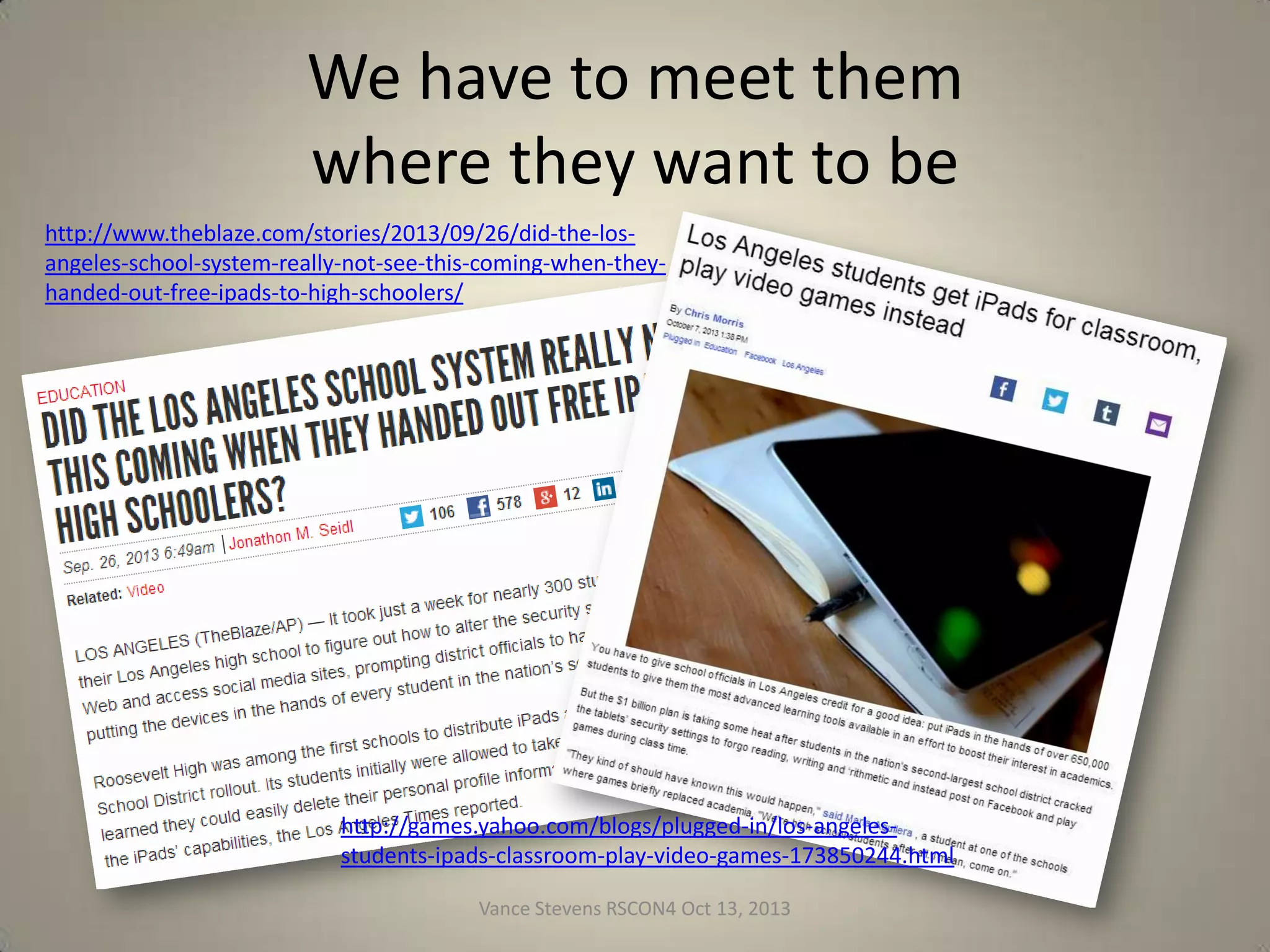
We have to meet them
where they want to be
http://www.theblaze.com/stories/2013/09/26/did-the-losangeles-school-system-really-not-see-this-coming-when-theyhanded-out-free-ipads-to-high-schoolers/

http://games.yahoo.com/blogs/plugged-in/los-angelesstudents-ipads-classroom-play-video-games-173850244.html
Vance Stevens RSCON4 Oct 13, 2013

40
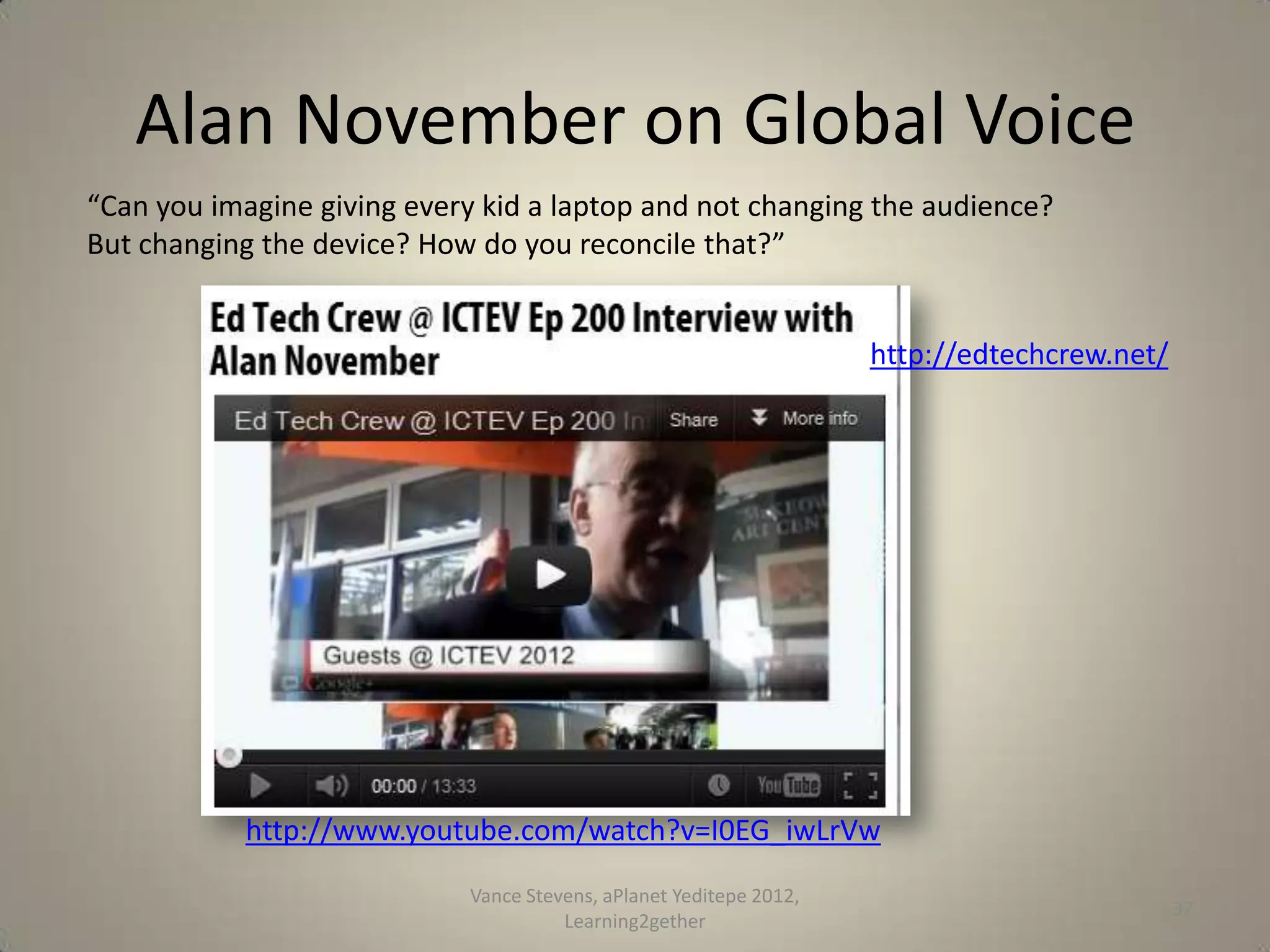
Alan November on Global Voice
“Can you imagine giving every kid a laptop and not changing the audience?
But changing the device? How do you reconcile that?”
http://edtechcrew.net/

http://www.youtube.com/watch?v=I0EG_iwLrVw
Vance Stevens RSCON4 Oct 13, 2013

41
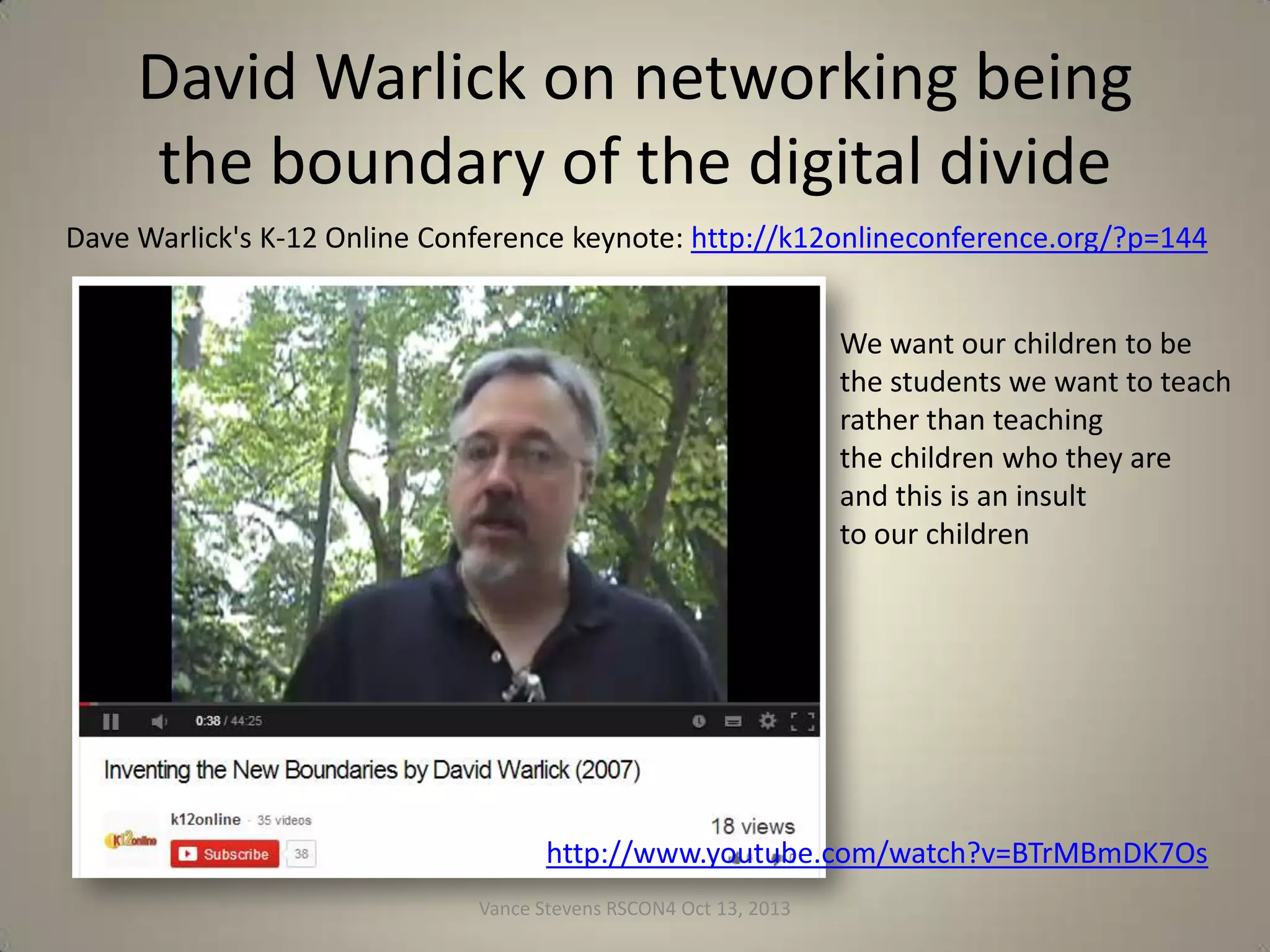
David Warlick on networking being
the boundary of the digital divide
Dave Warlick's K-12 Online Conference keynote: http://k12onlineconference.org/?p=144
We want our children to be
the students we want to teach
rather than teaching
the children who they are
and this is an insult
to our children

http://www.youtube.com/watch?v=BTrMBmDK7Os
Vance Stevens RSCON4 Oct 13, 2013

42
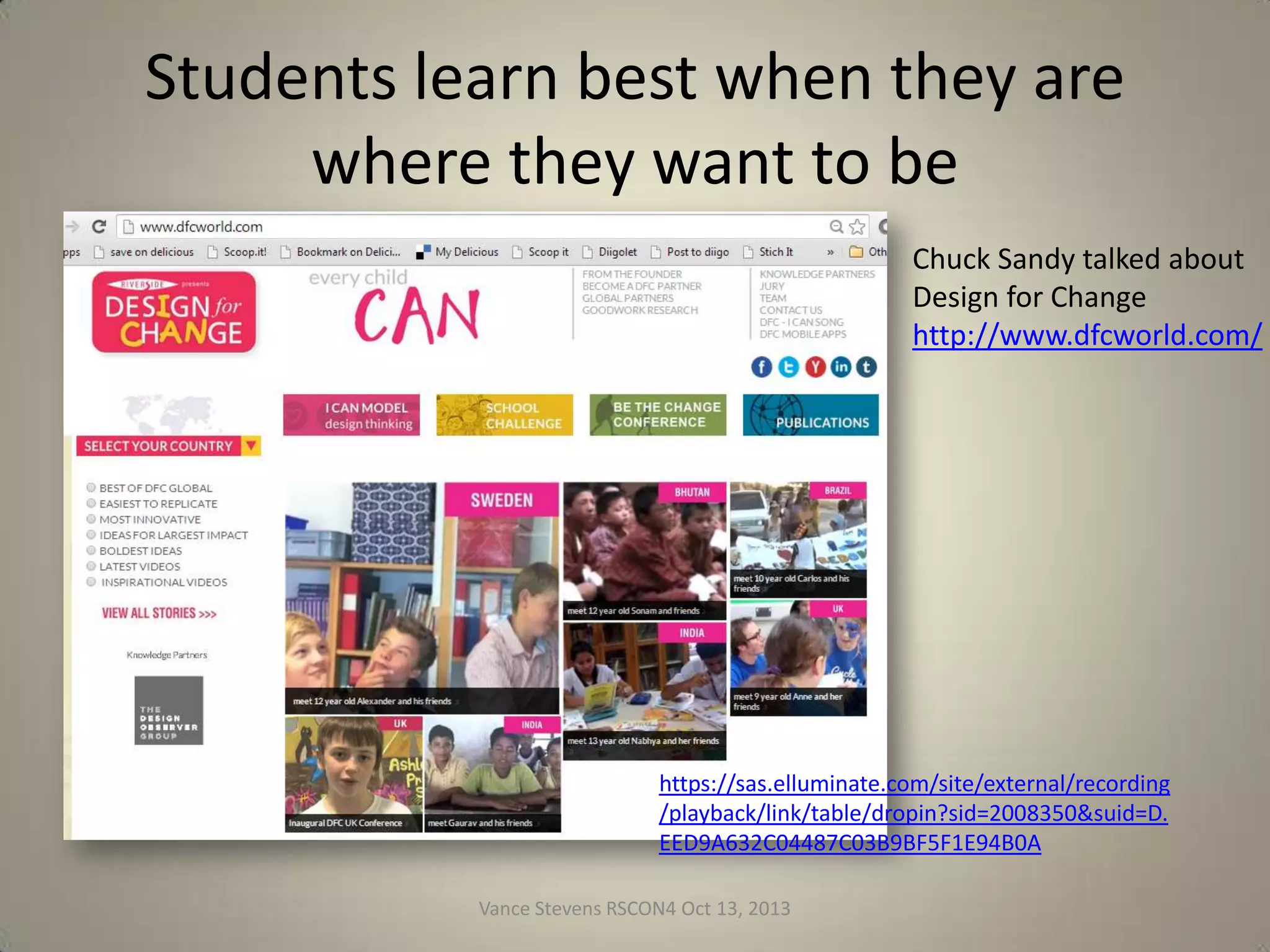
Students learn best when they are
where they want to be
Chuck Sandy talked about
Design for Change
http://www.dfcworld.com/

https://sas.elluminate.com/site/external/recording
/playback/link/table/dropin?sid=2008350&suid=D.
EED9A632C04487C03B9BF5F1E94B0A
Vance Stevens RSCON4 Oct 13, 2013

43
What’s with the MOOCs?
How MOOC Learning Reaches
Students through TPD
Vance Stevens
Higher Colleges of Technology, UAE
AAMC / PACE / KBZAC
Title slide from: http://www.slideshare.net/vances/how-mooc-learning-reaches-students-through-tpd
Stevens, V. (2013). What's with the MOOCs? TESL-EJ, Volume 16, Number 4, pp. 1-14: http://tesl-ej.org/pdf/ej64/int.pdf
Also available at: http://www.tesl-ej.org/wordpress/issues/volume16/ej64/ej64int/
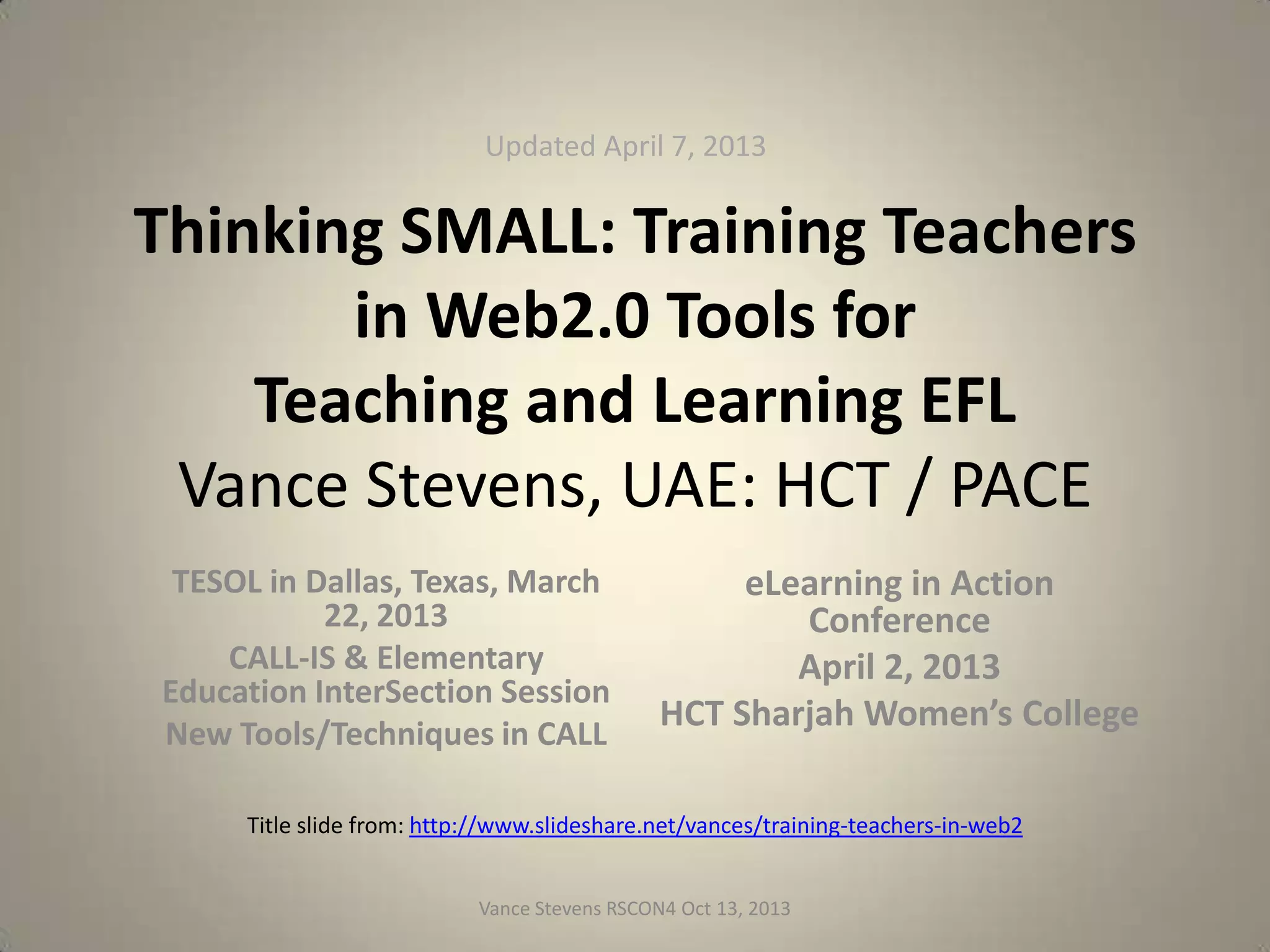
Updated April 7, 2013

Thinking SMALL: Training Teachers
in Web2.0 Tools for
Teaching and Learning EFL
Vance Stevens, UAE: HCT / PACE
TESOL in Dallas, Texas, March
22, 2013
CALL-IS & Elementary
Education InterSection Session
New Tools/Techniques in CALL

eLearning in Action
Conference
April 2, 2013
HCT Sharjah Women’s College

Title slide from: http://www.slideshare.net/vances/training-teachers-in-web2
RSCON4
Vance Stevens
http://advanceducation.blogspot.com
All materials presented here available at the blog URL above
and at
http://slideshare.net/vances
http://www.futureofeducation.com/forum/topics/fromteacher-networked-learning-to-transformation-in-your
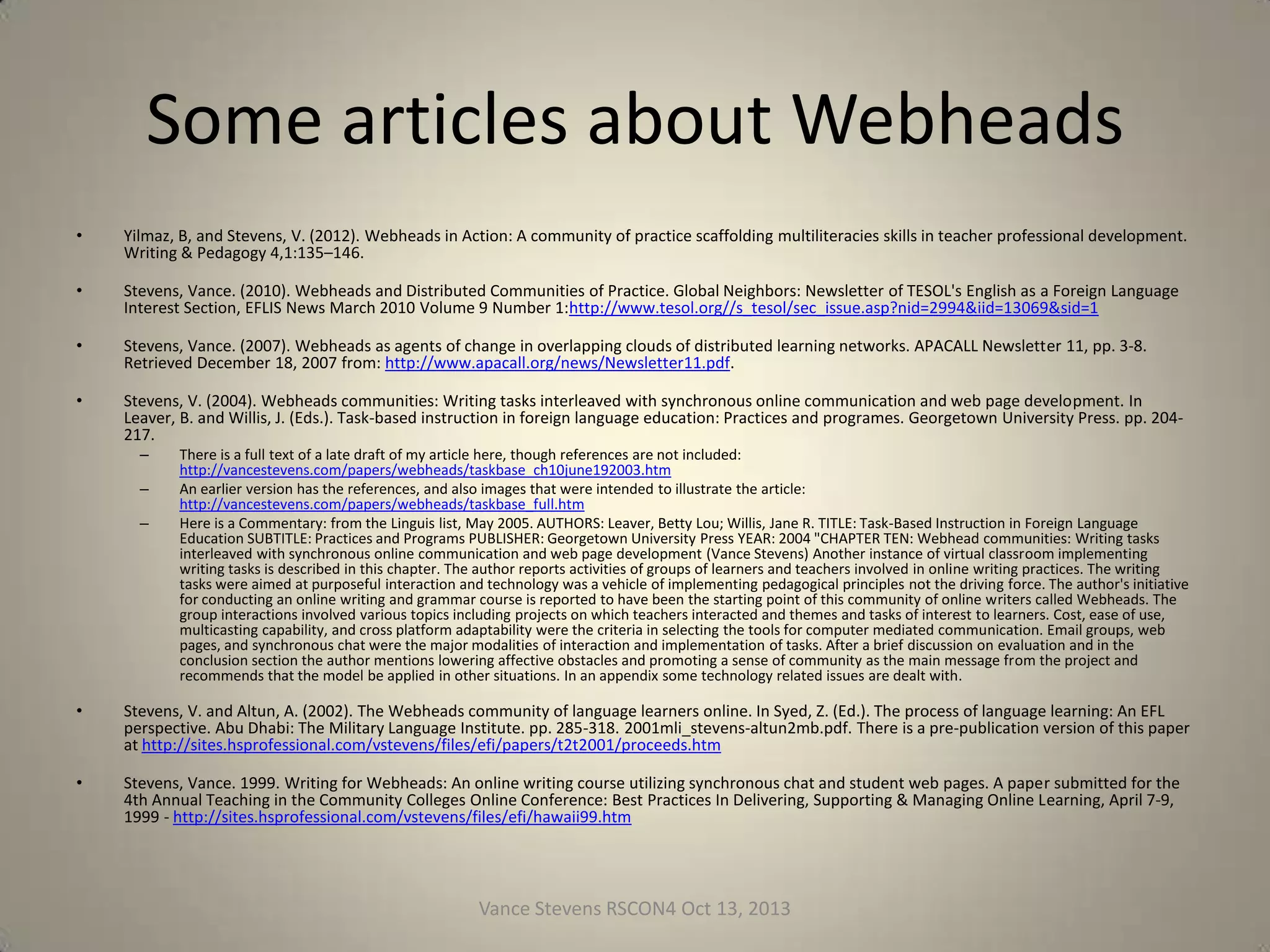
Some articles about Webheads
•

Yilmaz, B, and Stevens, V. (2012). Webheads in Action: A community of practice scaffolding multiliteracies skills in teacher professional development.
Writing & Pedagogy 4,1:135–146.

•

Stevens, Vance. (2010). Webheads and Distributed Communities of Practice. Global Neighbors: Newsletter of TESOL's English as a Foreign Language
Interest Section, EFLIS News March 2010 Volume 9 Number 1:http://www.tesol.org//s_tesol/sec_issue.asp?nid=2994&iid=13069&sid=1

•

Stevens, Vance. (2007). Webheads as agents of change in overlapping clouds of distributed learning networks. APACALL Newsletter 11, pp. 3-8.
Retrieved December 18, 2007 from: http://www.apacall.org/news/Newsletter11.pdf.

•

Stevens, V. (2004). Webheads communities: Writing tasks interleaved with synchronous online communication and web page development. In
Leaver, B. and Willis, J. (Eds.). Task-based instruction in foreign language education: Practices and programes. Georgetown University Press. pp. 204217.
–
–
–

There is a full text of a late draft of my article here, though references are not included:
http://vancestevens.com/papers/webheads/taskbase_ch10june192003.htm
An earlier version has the references, and also images that were intended to illustrate the article:
http://vancestevens.com/papers/webheads/taskbase_full.htm
Here is a Commentary: from the Linguis list, May 2005. AUTHORS: Leaver, Betty Lou; Willis, Jane R. TITLE: Task-Based Instruction in Foreign Language
Education SUBTITLE: Practices and Programs PUBLISHER: Georgetown University Press YEAR: 2004 "CHAPTER TEN: Webhead communities: Writing tasks
interleaved with synchronous online communication and web page development (Vance Stevens) Another instance of virtual classroom implementing
writing tasks is described in this chapter. The author reports activities of groups of learners and teachers involved in online writing practices. The writing
tasks were aimed at purposeful interaction and technology was a vehicle of implementing pedagogical principles not the driving force. The author's initiative
for conducting an online writing and grammar course is reported to have been the starting point of this community of online writers called Webheads. The
group interactions involved various topics including projects on which teachers interacted and themes and tasks of interest to learners. Cost, ease of use,
multicasting capability, and cross platform adaptability were the criteria in selecting the tools for computer mediated communication. Email groups, web
pages, and synchronous chat were the major modalities of interaction and implementation of tasks. After a brief discussion on evaluation and in the
conclusion section the author mentions lowering affective obstacles and promoting a sense of community as the main message from the project and
recommends that the model be applied in other situations. In an appendix some technology related issues are dealt with.

•

Stevens, V. and Altun, A. (2002). The Webheads community of language learners online. In Syed, Z. (Ed.). The process of language learning: An EFL
perspective. Abu Dhabi: The Military Language Institute. pp. 285-318. 2001mli_stevens-altun2mb.pdf. There is a pre-publication version of this paper
at http://sites.hsprofessional.com/vstevens/files/efi/papers/t2t2001/proceeds.htm

•

Stevens, Vance. 1999. Writing for Webheads: An online writing course utilizing synchronous chat and student web pages. A paper submitted for the
4th Annual Teaching in the Community Colleges Online Conference: Best Practices In Delivering, Supporting & Managing Online Learning, April 7-9,
1999 - http://sites.hsprofessional.com/vstevens/files/efi/hawaii99.htm

Vance Stevens RSCON4 Oct 13, 2013

47

From teacher networked learning to transformation in your classroom

  • 1.
    From teacher networkedlearning to transformation in your classroom Vance Stevens Reform Symposium 4 http://reformsymposium.com Oct 13, 2013
  • 2.
    If you followthis presentation at http://slideshare.net/vances All the hyperlinks will work
  • 3.
    Once upon atime (a digital story) Sean Wilden yesterday at http://ltsig.org.uk/events/13-future-events/318121013-special-event-using-technology-in-teaching-principles-in-practice.html Vance Stevens RSCON4 Oct 13, 2013 3
  • 4.
    Isolation can bedangerous! http://www.youtube.com/watch?v=y0Urj27gqIQ Vance Stevens RSCON4 Oct 13, 2013 4
  • 5.
    Welcome to theRead-Write Century http://www.communitywiki.org/cw/ReadOnly http://wizards-of-os.org/index.php?id=2322 Vance Stevens RSCON4 Oct 13, 2013 5
  • 6.
    We can seean end to isolation for educators http://georgecouros.ca/blog/archives/4156 Vance Stevens RSCON4 Oct 13, 2013 6
  • 7.
    Now more thanever http://www.futureofeducation.com/page/plenarysugatamitra but teachers must be beamed as master learners Vance Stevens RSCON4 Oct 13, 2013 7
  • 8.
    Richardson’s 6 waysto relearn • Share everything (or at least something) • Discover, don’t deliver, the curriculum • Talk to strangers (filter and interact with others in your personal learning network) • Be a master learner • Do real work, for real audiences • Transfer the power (over who drives curriculum) How to do these things is ineffable (must be experienced) From Slide 5 here: http://www.slideshare.net/vances/learning2gether-to-develop-personal-learning-networks-to-modelcollaborative-learning-for-teachers-to-use-with-students Vance Stevens RSCON4 Oct 13, 2013 8
  • 9.
    What about isolationfor students? c.1995-6 Dave Winet offered classes for students to learn English http://study.com Vance Stevens RSCON4 Oct 13, 2013 9
  • 10.
    Why do peoplewant to study online? • Teachers instinctively prepared syllabuses http://www.internettime.com/Learning/The%20Other%2080%25.htm Vance Stevens RSCON4 Oct 13, 2013 10
  • 11.
    Not to ‘work’but to socialize • Students rejected the ‘work’ but in 1997-1998 were attracted like moths to flame to http://prosites-vstevens.homestead.com/files/efi/webheads.htm Vance Stevens RSCON4 Oct 13, 2013 11
  • 12.
  • 13.
    About Yaodong inTESL-EJ, 2003 http://www.tesl-ej.org/wordpress/issues/volume6/ej23/ej23int/ Vance Stevens RSCON4 Oct 13, 2013 13
  • 14.
    Yaodong keeps connecting,2008 http://www.storyofmylife.com/User/user_story_view.aspx?storyId=2688&ChapterId=3952&UserId=3512 Vance Stevens RSCON4 Oct 13, 2013 14
  • 15.
    Yaodong connecting Webheads2001 http://prosites-vstevens.homestead.com/files/efi/chat2001/wfw011031.htm Vance Stevens RSCON4 Oct 13, 2013 15
  • 16.
    Sue visited Houstonin 2002 http://prosites-vstevens.homestead.com/files/efi/sue_houston.htm Vance Stevens RSCON4 Oct 13, 2013 16
  • 17.
    How do wefigure out how to structure learning to meet social expectations? • In Writing for Webheads we learned from the students who interacted with us – how to construct communities that would promote language learning – through greater opportunities to socialize in spaces where the target language was used throughout • In Webheads in Action we teach one another experientially, so that we – learn by trying out online community building techniques – in spaces where technology is being used online to promote greater awareness of how it might facilitate language learning Vance Stevens RSCON4 Oct 13, 2013 17
  • 18.
  • 19.
    Webheads: Community Attribution: http://flickr.com/photos/94794165@N00/410359410/ FromSlide 30 at http://www.slideshare.net/vances/modeling-social-media-in-groups-communities-andnetworks-socialnetworking-2009-online-conference Vance Stevens RSCON4 Oct 13, 2013 19
  • 20.
    WiAOC 2005, 2007,2009 From Stephen Downes, Learning the Web 2.0 Way, 2007 http://www.slideshare.net/Downes/personal-learning-the-web-20-way From Slide 3 at http://www.slideshare.net/vances/modeling-social-media-in-groups-communities-andnetworks-socialnetworking-2009-online-conference Vance Stevens RSCON4 Oct 13, 2013 20
  • 21.
    Model, demonstrate, practice,reflect Vance Stevens RSCON4 Oct 13, 2013 21
  • 22.
    Where did Iget this? I was only able to relocate this image for RSCON4 because I shared it on Facebook Vance Stevens RSCON4 Oct 13, 2013 22
  • 23.
    What would itlook like? If you wanted to model effective connected learning to socially-oriented peers online? Maybe like this? Vance Stevens RSCON4 Oct 13, 2013 23
  • 24.
    Staff Room inthe Cloud Vance Stevens RSCON4 Oct 13, 2013 24
  • 25.
    Staff Room inthe Cloud Vance Stevens RSCON4 Oct 13, 2013 25
  • 26.
    Connectivism Siemens, G. (2004-5).Connectivism: A Learning theory for the digital age. Elearnspace. Retrieved August 17, 2011 from http://www.elearnspace.org/Articles/connectivism.htm Siemens’s conclusions can be startling In this YouTube video, Siemens says at min 1:13 http://www.youtube.com/watch?v=rqL_lsogeNU&feature=youtu.be "Have you ever thought about how completely irrelevant structured learning is?" From slide 8 here: http://www.slideshare.net/vances/how-mooc-learning-reaches-students-through-tpd Vance Stevens RSCON4 Oct 13, 2013 26
  • 27.
    It’s ineffable • Tounderstand how connected learning works, we must experience online learning2gether • Connected learning works well when teachers are self selected, already in the choir, as are RSCON participants • The problem is when we go beyond to others who have not experienced connected learning as we have • Fortunately, there are now burgeoning opportunities for teachers to avoid isolation Vance Stevens RSCON4 Oct 13, 2013 27
  • 28.
    What’s happening justthis weekend? Jeff Lebow is streaming hangouts from KOTESOL http://koreabridge.net/kotesolicstudio3.html Vance Stevens RSCON4 Oct 13, 2013 28
  • 29.
    SCoPE just wrappedup Vance Stevens RSCON4 Oct 13, 2013 29
  • 30.
  • 31.
  • 32.
    TESOL CALL-IS /IATEFL LTSIG http://ltsig.org.uk/events/13-future-events/318-121013-special-eventusing-technology-in-teaching-principles-in-practice.html Vance Stevens RSCON4 Oct 13, 2013 32
  • 33.
    EVO Electronic VillageOnline January and February each year http://evosessions.pbworks.com/ Vance Stevens RSCON4 Oct 13, 2013 33
  • 34.
  • 35.
    Oh, and Ialmost forgot … http://www.futureofeducation.com/page/2013-reform-symposium Vance Stevens RSCON4 Oct 13, 2013 35
  • 36.
    Here a MOOCthere a MOOC From Karen Head: http://chronicle.com/blogs/wiredcampus/here-a-mooc-there-a-mooc-but-will-it-work-for-freshman-composition/41883 • http://goodbyegutenberg.pbworks.com/w/page/62555597/moremoocs • Http://www.connectivistmoocs.org/ Stephen Downes’s definitive archive of knowledge on MOOCs (currently over 500 annotated references): http://www.downes.ca/mooc_posts.htm. Vance Stevens RSCON4 Oct 13, 2013 36
  • 37.
    You can seewhat’s on, attend or share with us at Learning2gether http://learning2gether.net/about/ http://learning2gether.pbworks.com/w/page/32206114/volunteersneeded Vance Stevens RSCON4 Oct 13, 2013 37
  • 38.
    Saving the mostimportant to the end The Students! • Our mindsets must change so that students can be inculcated in the same way we are learning to learn • Students are already learning to connect (in their way!) e.g. – LA unified school district problem – Tom Woods in Australia Vance Stevens RSCON4 Oct 13, 2013 38
  • 39.
  • 40.
    We have tomeet them where they want to be http://www.theblaze.com/stories/2013/09/26/did-the-losangeles-school-system-really-not-see-this-coming-when-theyhanded-out-free-ipads-to-high-schoolers/ http://games.yahoo.com/blogs/plugged-in/los-angelesstudents-ipads-classroom-play-video-games-173850244.html Vance Stevens RSCON4 Oct 13, 2013 40
  • 41.
    Alan November onGlobal Voice “Can you imagine giving every kid a laptop and not changing the audience? But changing the device? How do you reconcile that?” http://edtechcrew.net/ http://www.youtube.com/watch?v=I0EG_iwLrVw Vance Stevens RSCON4 Oct 13, 2013 41
  • 42.
    David Warlick onnetworking being the boundary of the digital divide Dave Warlick's K-12 Online Conference keynote: http://k12onlineconference.org/?p=144 We want our children to be the students we want to teach rather than teaching the children who they are and this is an insult to our children http://www.youtube.com/watch?v=BTrMBmDK7Os Vance Stevens RSCON4 Oct 13, 2013 42
  • 43.
    Students learn bestwhen they are where they want to be Chuck Sandy talked about Design for Change http://www.dfcworld.com/ https://sas.elluminate.com/site/external/recording /playback/link/table/dropin?sid=2008350&suid=D. EED9A632C04487C03B9BF5F1E94B0A Vance Stevens RSCON4 Oct 13, 2013 43
  • 44.
    What’s with theMOOCs? How MOOC Learning Reaches Students through TPD Vance Stevens Higher Colleges of Technology, UAE AAMC / PACE / KBZAC Title slide from: http://www.slideshare.net/vances/how-mooc-learning-reaches-students-through-tpd Stevens, V. (2013). What's with the MOOCs? TESL-EJ, Volume 16, Number 4, pp. 1-14: http://tesl-ej.org/pdf/ej64/int.pdf Also available at: http://www.tesl-ej.org/wordpress/issues/volume16/ej64/ej64int/
  • 45.
    Updated April 7,2013 Thinking SMALL: Training Teachers in Web2.0 Tools for Teaching and Learning EFL Vance Stevens, UAE: HCT / PACE TESOL in Dallas, Texas, March 22, 2013 CALL-IS & Elementary Education InterSection Session New Tools/Techniques in CALL eLearning in Action Conference April 2, 2013 HCT Sharjah Women’s College Title slide from: http://www.slideshare.net/vances/training-teachers-in-web2
  • 46.
    RSCON4 Vance Stevens http://advanceducation.blogspot.com All materialspresented here available at the blog URL above and at http://slideshare.net/vances http://www.futureofeducation.com/forum/topics/fromteacher-networked-learning-to-transformation-in-your
  • 47.
    Some articles aboutWebheads • Yilmaz, B, and Stevens, V. (2012). Webheads in Action: A community of practice scaffolding multiliteracies skills in teacher professional development. Writing & Pedagogy 4,1:135–146. • Stevens, Vance. (2010). Webheads and Distributed Communities of Practice. Global Neighbors: Newsletter of TESOL's English as a Foreign Language Interest Section, EFLIS News March 2010 Volume 9 Number 1:http://www.tesol.org//s_tesol/sec_issue.asp?nid=2994&iid=13069&sid=1 • Stevens, Vance. (2007). Webheads as agents of change in overlapping clouds of distributed learning networks. APACALL Newsletter 11, pp. 3-8. Retrieved December 18, 2007 from: http://www.apacall.org/news/Newsletter11.pdf. • Stevens, V. (2004). Webheads communities: Writing tasks interleaved with synchronous online communication and web page development. In Leaver, B. and Willis, J. (Eds.). Task-based instruction in foreign language education: Practices and programes. Georgetown University Press. pp. 204217. – – – There is a full text of a late draft of my article here, though references are not included: http://vancestevens.com/papers/webheads/taskbase_ch10june192003.htm An earlier version has the references, and also images that were intended to illustrate the article: http://vancestevens.com/papers/webheads/taskbase_full.htm Here is a Commentary: from the Linguis list, May 2005. AUTHORS: Leaver, Betty Lou; Willis, Jane R. TITLE: Task-Based Instruction in Foreign Language Education SUBTITLE: Practices and Programs PUBLISHER: Georgetown University Press YEAR: 2004 "CHAPTER TEN: Webhead communities: Writing tasks interleaved with synchronous online communication and web page development (Vance Stevens) Another instance of virtual classroom implementing writing tasks is described in this chapter. The author reports activities of groups of learners and teachers involved in online writing practices. The writing tasks were aimed at purposeful interaction and technology was a vehicle of implementing pedagogical principles not the driving force. The author's initiative for conducting an online writing and grammar course is reported to have been the starting point of this community of online writers called Webheads. The group interactions involved various topics including projects on which teachers interacted and themes and tasks of interest to learners. Cost, ease of use, multicasting capability, and cross platform adaptability were the criteria in selecting the tools for computer mediated communication. Email groups, web pages, and synchronous chat were the major modalities of interaction and implementation of tasks. After a brief discussion on evaluation and in the conclusion section the author mentions lowering affective obstacles and promoting a sense of community as the main message from the project and recommends that the model be applied in other situations. In an appendix some technology related issues are dealt with. • Stevens, V. and Altun, A. (2002). The Webheads community of language learners online. In Syed, Z. (Ed.). The process of language learning: An EFL perspective. Abu Dhabi: The Military Language Institute. pp. 285-318. 2001mli_stevens-altun2mb.pdf. There is a pre-publication version of this paper at http://sites.hsprofessional.com/vstevens/files/efi/papers/t2t2001/proceeds.htm • Stevens, Vance. 1999. Writing for Webheads: An online writing course utilizing synchronous chat and student web pages. A paper submitted for the 4th Annual Teaching in the Community Colleges Online Conference: Best Practices In Delivering, Supporting & Managing Online Learning, April 7-9, 1999 - http://sites.hsprofessional.com/vstevens/files/efi/hawaii99.htm Vance Stevens RSCON4 Oct 13, 2013 47