STRENGTHEN SALES PLANNING & COMMERCIAL
              STRATEGIES.

       A MANAGEMENT FRAMEWORK.
   LATAM SALES & DISTRIBUTION CHAIN.
    (For Medical & Healthcare Industries)


                    Osvaldo Quiroz Leyton
                    Ingeniero Comercial. Lic.Cs.Economicas
                    Master of Business Administration
                  email: oqleyton7@msn.com // oqleyton@vtr.net
TOPICS:


First section.
1. Highlighting Business Management.

Second section.
2. Putting Business Management in Action
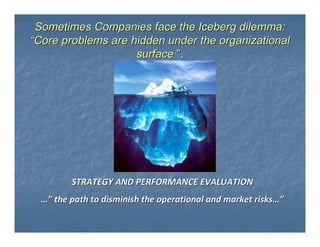
Sometimes Companies face the Iceberg dilemma:
“Core problems are hidden under the organizational
                    surface ”.


         STRATEGY AND PERFORMANCE EVALUATION
  …” the path to disminish the operational and market risks…”
1)   First section.
     Highlighting Business Management
Key Drivers Developing Strategy:

1. Corporate Human Resources.
2. Leadership, Innovation and Management
   Capabilities.
3. Management System, and efficient use of
   Technology.
4. Financial Planning and Corporate
   Performance Evaluation
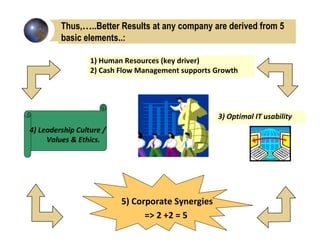
Thus,…..Better Results at any company are derived from 5
         basic elements..:

                  1) Human Resources (key driver)
                  2) Cash Flow Management supports Growth


                                                   3) Optimal IT usability
4) Leadership Culture /
     Values & Ethics.


                          5) Corporate Synergies
                                => 2 +2 = 5
“..Barriers that limit the firm success..”


1. Emptiness or lack of corporate Strategy Mindset.
2. Poor, lack of useful communication among the corporate
   teams, executives of the company.
3. Activities are not being evaluated, lack of systematic
   tracking.
Why is it important to do Strategy (II)

1. Addressing the sense of Direction.Strategy (I)
 Why is it important to do
     Planning secure coordinated efforts.
     Sharing the vision. Staff knows where the company goes,
     settle commitment and value the incentives to
     accomplish goals.

2.   Strategy diminish the uncertainty.
        …so, corporate teams take into account unexpected
        changes, weigh up impacts and develop coordinate
        answers..
Why is it important to do Strategy (II)

3.   Minimize losses and avoid double work.
        We deploy management skills to detect failures on-time
4.   Setting dashboards, indicators for Management
     Performance purpose.
        Without planning, control management is not affordable.
        Evaluating management performance let us foresee
        issues, and take corrective actions.
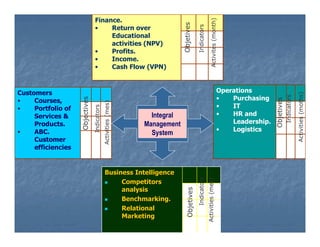
INTEGRATIVE MANAGEMENT.

 A basic framework to balance
 Management Functions in the
            Company
Finance.


                                                                                                                 Activites (month)
                                                                              Objetives

                                                                                             Indicators
                                 •    Return over
                                      Educational
                                      activities (NPV)
                                 •    Profits.
                                 •    Income.
                                 •    Cash Flow (VPN)


Customers                                                                                                                       Operations


                                                                                                                                                                           Activities (moths)
                                                                                                                                                              Indicators
                                                                                                                                •   Purchasing
                    Objectives


                                                                                                                                                  Objetives
•    Courses,
                                              Activities (mes)                                                                  •   IT
                                 Indicators

•    Portfolio of
     Services &                                                    Integral                                                     •   HR and
     Products.                                                   Management                                                         Leadership.
•    ABC.                                                                                                                       •   Logistics
                                                                   System
     Customer
     efficiencies


                                              Business Intelligence


                                                                                             Indicators
                                                                                                          Activities (mes)
                                                   Competitors
                                                   analysis                      Objetives
                                                   Benchmarking.
                                                   Relational
                                                   Marketing
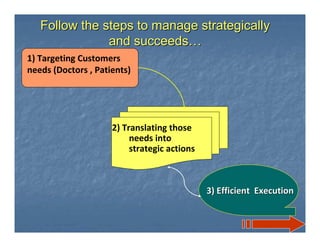
Follow the steps to manage strategically
               and succeeds…
1) Targeting Customers
needs (Doctors , Patients)


                     2) Translating those
                          needs into
                          strategic actions


                                              3) Efficient Execution
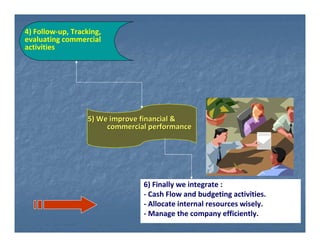
4) Follow-up, Tracking,
evaluating commercial
activities


                   5) We improve financial &
                        commercial performance


                                 6) Finally we integrate :
                                 - Cash Flow and budgeting activities.
                                 - Allocate internal resources wisely.
                                 - Manage the company efficiently.
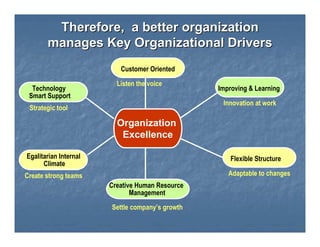
Therefore, a better organization
       manages Key Organizational Drivers
                          Customer Oriented

                         Listen the voice
  Technology                                     Improving & Learning
 Smart Support
                                                  Innovation at work
 Strategic tool

                         Organization
                          Excellence

Egalitarian Internal                                 Flexible Structure
      Climate
Create strong teams                                 Adaptable to changes
                       Creative Human Resource
                              Management
                       Settle company’s growth
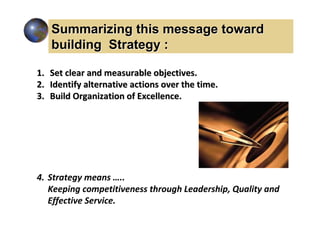
Summarizing this message toward
   building Strategy :

1. Set clear and measurable objectives.
2. Identify alternative actions over the time.
3. Build Organization of Excellence.


4. Strategy means …..
   Keeping competitiveness through Leadership, Quality and
   Effective Service.
2th section.
Putting Business Management in
            Action.

1.   The Salesman Mindset
2.   Product Portfolio Management
3.   Customer Focus
4.   Pricing
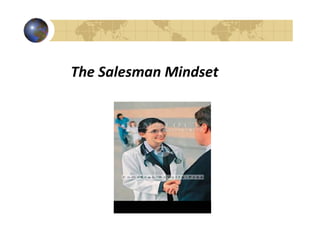
The Salesman Mindset
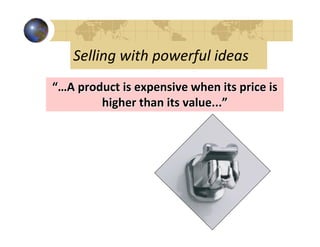
Selling with powerful ideas
“…A product is expensive when its price is
        higher than its value...”
“… Attitudes to construct the path for
          selling effectively ..”
Be PROACTIVE:
   Goes one step ahead the customer, deploy helpful
   initiative.
Be OPTIMIST:
   Always believes can do better this or the next visit.
Be SELF-CONFIDENT:
   Strongly beliefs, he/she provides the best products.
Increase KNOWLEDGE:
    Knows the products and its competitors.
Be POSITIVE:
   Shows assertiveness, never losing attitudes.
Pitfalls to avoid in the selling activity:
     • Selling without first training on “the System/Solutions”.
     • Assuming client understands the philosophy and its
       benefits.

Therefore:

1.   Clients must be taken through the entire “adoption process of the
     System”.
2.   Clients have to be driven in educational programs, courses and
     workshops to let us evaluate further improvements (Post -Selling).
3.   We take into account commercial risks, because, a Client who buys
     products without enough education, could misuse the system, this could
     be a risky investment.
4.   Exercise Permanent Customer retention.
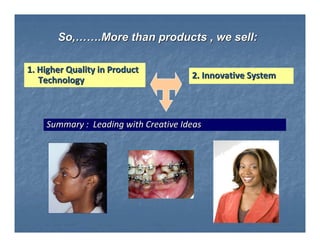
So,…….More than products , we sell:

1. Higher Quality in Product
   Technology                         2. Innovative System


    Summary : Leading with Creative Ideas
Product Portfolio Management


VectorTAS-Intelligent Design
VectorTAS-Intelligent
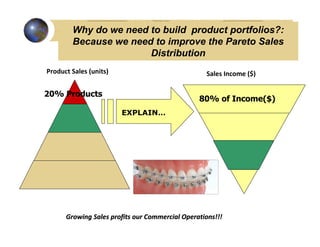
Why do we need to build product portfolios?:
        Because we need to improve the Pareto Sales
                       Distribution
Product Sales (units)                             Sales Income ($)

20% Products
                                                80% of Income($)
                        EXPLAIN…


      Growing Sales profits our Commercial Operations!!!
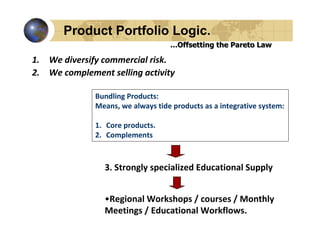
Product Portfolio Logic.
                                   …Offsetting the Pareto Law

1. We diversify commercial risk.
2. We complement selling activity

              Bundling Products:
              Means, we always tide products as a integrative system:

              1. Core products.
              2. Complements


                3. Strongly specialized Educational Supply


                •Regional Workshops / courses / Monthly
                Meetings / Educational Workflows.
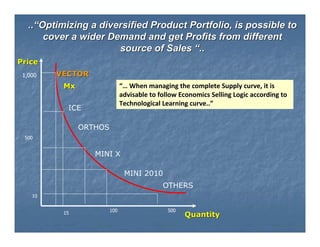
..“Optimizing a diversified Product Portfolio, is possible to
       cover a wider Demand and get Profits from different
                       source of Sales “..
Price
 1,000   VECTOR
           Mx                  “… When managing the complete Supply curve, it is
                               advisable to follow Economics Selling Logic according to
                               Technological Learning curve..”
            ICE

                ORTHOS
 500


                   MINI X

                                MINI 2010
                                             OTHERS
    10


                         100                   500
           15                                        Quantity
So, What do we sell? :
1.   Products & Systems as a highly technology development.

2.   Cost-Effective, Efficient & High Quality solutions.

3.   Integral packages of Product and Services: The product & System
     and Systematic Educational activities for Customers

4.   Long-Term profitable solutions.

5.   Regarding the global economic environment, wider competitive
     labor market, we provide solutions that increase the labor
     productivity (TIME IS MONEY).
CUSTOMER FOCUS.

  Appraisal methods to evaluate
Commercial Events and Educational
            Activities
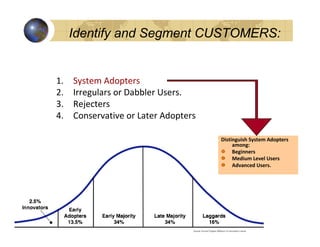
Identify and Segment CUSTOMERS:


1.   System Adopters
2.   Irregulars or Dabbler Users.
3.   Rejecters
4.   Conservative or Later Adopters

                                      Distinguish System Adopters
                                           among:
                                           Beginners
                                           Medium Level Users
                                           Advanced Users.
Measure the Market and Demand.


       Measure and Segment the
               Market


Quantity of                   Quantity of
 Dealers                        Clients


                Sales Forecast

 Income = f [ Doc demand (Customer (demand) ]
                 This is a Derived Demand. Sales depends of the
                 customer located at the end of distribution channel.
Customer segment.
Placing marketing ideas.
       MACRO VARIABLES                TARGETING LIFE CYCLE
         Dr. Gjerset says. "As teeth and jaws come into alignment, self-
         esteem increases too. Patients can look forward to a lifetime of
         improved dental health."


         “Today more adults are having orthodontic treatment because of
         greater awareness of the health benefits of a proper bite and the
         increased self-esteem that comes with an attractive smile. Given
         today's technological advances and the affordability of
         treatment, patients of all ages are improving their smiles.“


         ..While orthodontic treatment can be successful at almost any
         age, early detection of orthodontic problems may prevent
         complications in the long run. Early guidance of jaw growth, in
         some cases, may decrease a patient's need for more involved
         procedures later on. ..
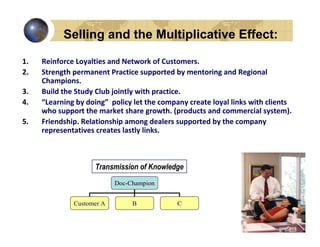
Selling and the Multiplicative Effect:

1.   Reinforce Loyalties and Network of Customers.
2.   Strength permanent Practice supported by mentoring and Regional
     Champions.
3.   Build the Study Club jointly with practice.
4.   “Learning by doing” policy let the company create loyal links with clients
     who support the market share growth. (products and commercial system).
5.   Friendship. Relationship among dealers supported by the company
     representatives creates lastly links.


                    Transmission of Knowledge
                           Doc-Champion


              Customer A        B            C
Selling and the Multiplicative Effect:

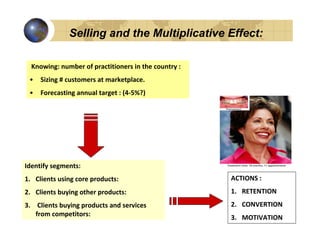
  Knowing: number of practitioners in the country :
 •   Sizing # customers at marketplace.
 •   Forecasting annual target : (4-5%?)


Identify segments:
1. Clients using core products:                       ACTIONS :
2. Clients buying other products:                     1. RETENTION
3. Clients buying products and services               2. CONVERTION
   from competitors:                                  3. MOTIVATION
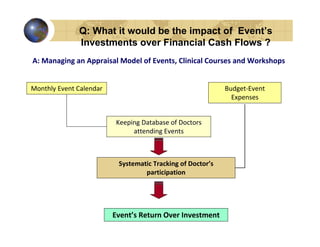
Q: What it would be the impact of Event’s
              Investments over Financial Cash Flows ?
A: Managing an Appraisal Model of Events, Clinical Courses and Workshops


Monthly Event Calendar                                      Budget-Event
                                                              Expenses


                          Keeping Database of Doctors
                               attending Events


                          Systematic Tracking of Doctor’s
                                  participation


                         Event’s Return Over Investment
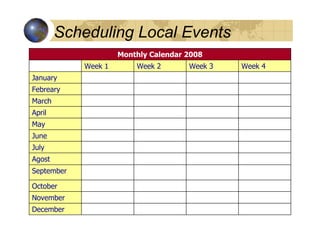
Scheduling Local Events
                     Monthly Calendar 2008
            Week 1       Week 2       Week 3   Week 4
January
Febreary
March
April
May
June
July
Agost
September

October
November
December
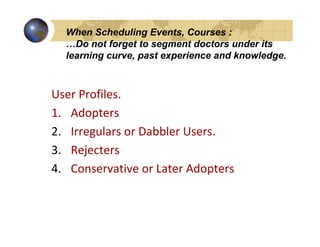
When Scheduling Events, Courses :
  …Do not forget to segment doctors under its
  learning curve, past experience and knowledge.


User Profiles.
1. Adopters
2. Irregulars or Dabbler Users.
3. Rejecters
4. Conservative or Later Adopters
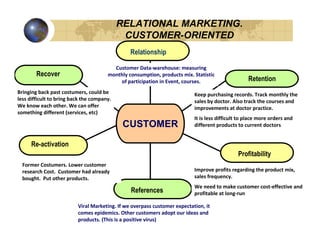
RELATIONAL MARKETING.
                                             CUSTOMER-ORIENTED
                                                Relationship

                                         Customer Data-warehouse: measuring
        Recover                        monthly consumption, products mix. Statistic
                                           of participation in Event, courses.                     Retention
Bringing back past costumers, could be                                     Keep purchasing records. Track monthly the
less difficult to bring back the company.                                  sales by doctor. Also track the courses and
We know each other. We can offer                                           improvements at doctor practice.
something different (services, etc)
                                                                           It is less difficult to place more orders and
                                             CUSTOMER                      different products to current doctors


      Re-activation
                                                                                               Profitability
  Former Costumers. Lower customer
  research Cost. Customer had already                                      Improve profits regarding the product mix,
  bought. Put other products.                                              sales frequency.
                                                                           We need to make customer cost-effective and
                                                References                 profitable at long-run

                          Viral Marketing. If we overpass customer expectation, it
                          comes epidemics. Other customers adopt our ideas and
                          products. (This is a positive virus)
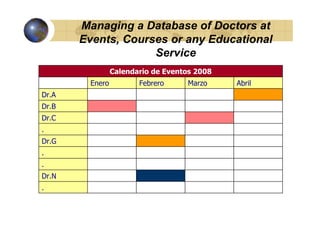
Managing a Database of Doctors at
       Events, Courses or any Educational
                    Service
                 Calendario de Eventos 2008
         Enero          Febrero     Marzo     Abril
Dr.A
Dr.B
Dr.C
.
Dr.G
.
.
Dr.N
.
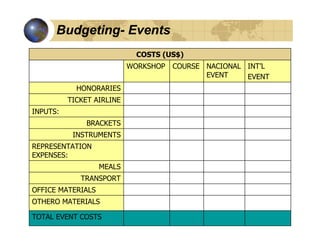
Budgeting- Events
                             COSTS (US$)
                           WORKSHOP   COURSE NACIONAL INT’L
                                             EVENT    EVENT
            HONORARIES
          TICKET AIRLINE
INPUTS:
              BRACKETS
           INSTRUMENTS
REPRESENTATION
EXPENSES:
                   MEALS
             TRANSPORT
OFFICE MATERIALS
OTHERO MATERIALS

TOTAL EVENT COSTS
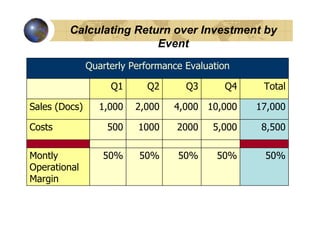
Calculating Return over Investment by
                         Event
               Quarterly Performance Evaluation

                    Q1      Q2       Q3      Q4     Total

Sales (Docs)     1,000    2,000   4,000 10,000     17,000

Costs              500    1000     2000    5,000    8,500

Montly            50%     50%      50%      50%     50%
Operational
Margin
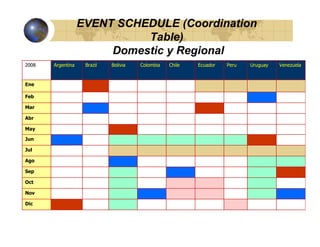
EVENT SCHEDULE (Coordination
                             Table)
                        Domestic y Regional
2008   Argentina    Brazil   Bolivia   Colombia   Chile   Ecuador   Peru   Uruguay   Venezuela


Ene

Feb

Mar

Abr

May

Jun

Jul

Ago

Sep

Oct

Nov

Dic
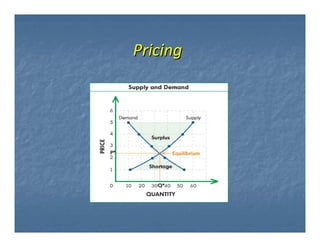
Pricing
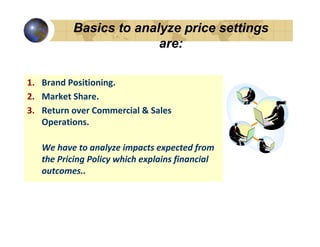
Basics to analyze price settings
                        are:

1. Brand Positioning.
2. Market Share.
3. Return over Commercial & Sales
   Operations.

   We have to analyze impacts expected from
   the Pricing Policy which explains financial
   outcomes..
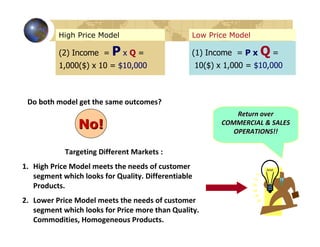
High Price Model                       Low Price Model

          (2) Income =    PxQ=                   (1) Income = P x     Q=
          1,000($) x 10 = $10,000                    10($) x 1,000 = $10,000


 Do both model get the same outcomes?
                                                                Return over
                No!                                         COMMERCIAL & SALES
                                                               OPERATIONS!!

            Targeting Different Markets :
1. High Price Model meets the needs of customer
   segment which looks for Quality. Differentiable
   Products.
2. Lower Price Model meets the needs of customer
   segment which looks for Price more than Quality.
   Commodities, Homogeneous Products.
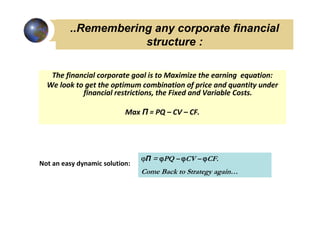
..Remembering any corporate financial
                     structure :

   The financial corporate goal is to Maximize the earning equation:
  We look to get the optimum combination of price and quantity under
            financial restrictions, the Fixed and Variable Costs.

                           Max Π = PQ – CV – CF.


                                ϕΠ = ϕPQ – ϕCV – ϕCF.
Not an easy dynamic solution:
                                Come Back to Strategy again…
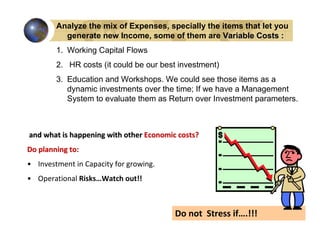
Analyze the mix of Expenses, specially the items that let you
          generate new Income, some of them are Variable Costs :
        1. Working Capital Flows
        2. HR costs (it could be our best investment)
        3. Education and Workshops. We could see those items as a
           dynamic investments over the time; If we have a Management
           System to evaluate them as Return over Investment parameters.


and what is happening with other Economic costs?
Do planning to:
• Investment in Capacity for growing.
• Operational Risks…Watch out!!


                                         Do not Stress if….!!!
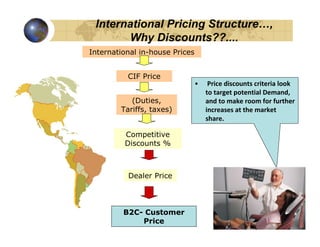
International Pricing Structure…,
       Why Discounts??....
International in-house Prices


          CIF Price
                                •    Price discounts criteria look
                                    to target potential Demand,
           (Duties,                 and to make room for further
        Tariffs, taxes)             increases at the market
                                    share.

         Competitive
         Discounts %


          Dealer Price


         B2C- Customer
             Price
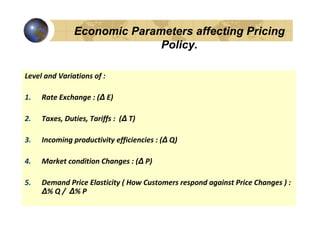
Economic Parameters affecting Pricing
                             Policy.

Level and Variations of :

1.   Rate Exchange : (∆ E)

2.   Taxes, Duties, Tariffs : (∆ T)

3.   Incoming productivity efficiencies : (∆ Q)

4.   Market condition Changes : (∆ P)

5.   Demand Price Elasticity ( How Customers respond against Price Changes ) :
     ∆% Q / ∆% P
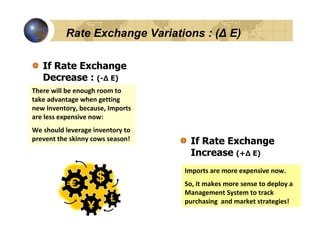
Rate Exchange Variations : (∆ E)

   If Rate Exchange
   Decrease : (-∆ E)
There will be enough room to
take advantage when getting
new Inventory, because, Imports
are less expensive now:
We should leverage inventory to
prevent the skinny cows season!    If Rate Exchange
                                   Increase (+∆ E)
                                  Imports are more expensive now.
                                  So, it makes more sense to deploy a
                                  Management System to track
                                  purchasing and market strategies!
Taxes, Duties, Tariffs : (∆ T)

Well, you and every importer face Taxes as
Inevitable Costs!.
So, Tracking internal Demand, Programming
Purchase let us work for gaining more inventory
efficiencies.
Incoming productivity efficiencies : (∆ Q)


Company.                      Distributors.
  Productive improvements       Improvements supported by
  transmitted to Customers.     the Management System
  High Quality Manufactured     Dealers Strategic-Oriented
  Products.
                                Dealers Customer-focused
  Highly Management support
Market condition Changes : (∆ P)

If we compete by Price, add more services.
Advisable to keep a diversified offer;
Wider spectrum in product portfolio which mix
different quality products and prices.


                          In we compete by Differentiated Products,
                          strengthen branding efforts.
                          Keep the message to customers, we hold the
                          best quality. “cheap is expensive”.
                          Focus the sales effort in Relational Marketing.
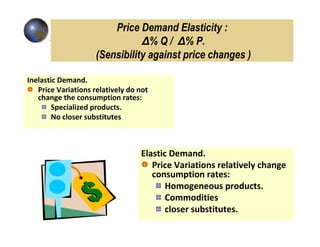
Price Demand Elasticity :
                                ∆% Q / ∆% P.
                     (Sensibility against price changes )

Inelastic Demand.
   Price Variations relatively do not
   change the consumption rates:
        Specialized products.
        No closer substitutes


                                  Elastic Demand.
                                     Price Variations relatively change
                                     consumption rates:
                                         Homogeneous products.
                                         Commodities
                                         closer substitutes.
Concluding……
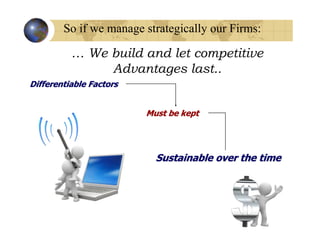
So if we manage strategically our Firms:

          … We build and let competitive
               Advantages last..
Differentiable Factors


                         Must be kept


                           Sustainable over the time
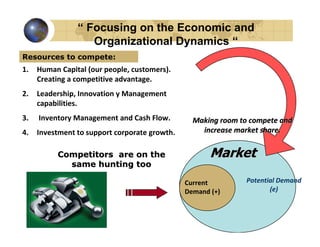
“ Focusing on the Economic and
                   Organizational Dynamics “
Resources to compete:
1.   Human Capital (our people, customers).
     Creating a competitive advantage.
2.   Leadership, Innovation y Management
     capabilities.
3.   Inventory Management and Cash Flow.         Making room to compete and
4.   Investment to support corporate growth.       increase market share.


          Competitors are on the                      Market
            same hunting too

                                               Current         Potential Demand
                                               Demand (+)             (e)
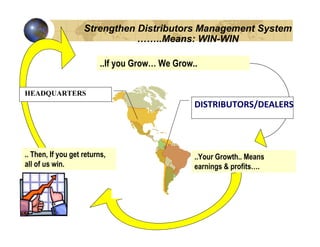
Strengthen Distributors Management System
                               ……..Means: WIN-WIN

                          ..If you Grow… We Grow..

HEADQUARTERS
                                                 DISTRIBUTORS/DEALERS


.. Then, If you get returns,                     ..Your Growth.. Means
all of us win.                                   earnings & profits….
Actions to improve Management
System:


   1. Education
   2. Commercial
      Strategy
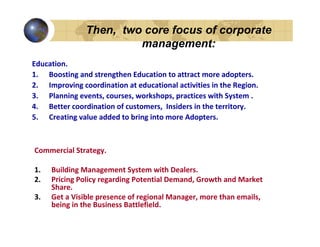
Then, two core focus of corporate
                        management:
Education.
1. Boosting and strengthen Education to attract more adopters.
2. Improving coordination at educational activities in the Region.
3. Planning events, courses, workshops, practices with System .
4. Better coordination of customers, Insiders in the territory.
5. Creating value added to bring into more Adopters.


Commercial Strategy.

1.   Building Management System with Dealers.
2.   Pricing Policy regarding Potential Demand, Growth and Market
     Share.
3.   Get a Visible presence of regional Manager, more than emails,
     being in the Business Battlefield.
Reinforcing Ideas:
a)   Protect our current accomplishments, but do not forget there are
     more doctors in the marketplace.
        • Increasing physical and valuable sales.
        • Strengthen sales regarding current Doctors as customers, so ,
            expand quantity of products in the same customer.
        • Add more Damon Adopters.

b)   Monitor if current customers are improving their practice.
       • More patients means better practice, reputation, return over
           investment, more sales. (cause-effects)

c)   Strengthen Distributor Management Capabilities
        • Building-up the competitive Advantage.
        • We need to think strategically; Improve management and
            produce effective coordination.
Finally:…
   1.   We Set procedures and formalizations to follow-up Commercial
        Performance in the Region. The What’s, How’s and When’s.

   2.   We manage business under a formal Regional Management
        Network.

   3.   We Gain “coordination” regarding the Regional events.

   4.   Strengthen clinical courses, training, participation of more
        doctors at every regional event

   5.   The Pricing Policy (Discounts) follows Growth, Market Share
        criteria.


PLANNING / ORGANIZATIONAL OBJECTIVES/ ALSO FINANCIAL GOALS
THANK YOU!


 Osvaldo Quiroz Leyton.
                Leyton
 MBA. Eng. Business & Economics.
Email: oqleyton7@msn.com// oqleyton@vtr.net

Improving corporate management performance english version__osvaldo

  • 1.
    STRENGTHEN SALES PLANNING& COMMERCIAL STRATEGIES. A MANAGEMENT FRAMEWORK. LATAM SALES & DISTRIBUTION CHAIN. (For Medical & Healthcare Industries) Osvaldo Quiroz Leyton Ingeniero Comercial. Lic.Cs.Economicas Master of Business Administration email: oqleyton7@msn.com // oqleyton@vtr.net
  • 2.
    TOPICS: First section. 1. HighlightingBusiness Management. Second section. 2. Putting Business Management in Action
  • 3.
    Sometimes Companies facethe Iceberg dilemma: “Core problems are hidden under the organizational surface ”. STRATEGY AND PERFORMANCE EVALUATION …” the path to disminish the operational and market risks…”
  • 4.
    1) First section. Highlighting Business Management
  • 5.
    Key Drivers DevelopingStrategy: 1. Corporate Human Resources. 2. Leadership, Innovation and Management Capabilities. 3. Management System, and efficient use of Technology. 4. Financial Planning and Corporate Performance Evaluation
  • 6.
    Thus,…..Better Results atany company are derived from 5 basic elements..: 1) Human Resources (key driver) 2) Cash Flow Management supports Growth 3) Optimal IT usability 4) Leadership Culture / Values & Ethics. 5) Corporate Synergies => 2 +2 = 5
  • 7.
    “..Barriers that limitthe firm success..” 1. Emptiness or lack of corporate Strategy Mindset. 2. Poor, lack of useful communication among the corporate teams, executives of the company. 3. Activities are not being evaluated, lack of systematic tracking.
  • 8.
    Why is itimportant to do Strategy (II) 1. Addressing the sense of Direction.Strategy (I) Why is it important to do Planning secure coordinated efforts. Sharing the vision. Staff knows where the company goes, settle commitment and value the incentives to accomplish goals. 2. Strategy diminish the uncertainty. …so, corporate teams take into account unexpected changes, weigh up impacts and develop coordinate answers..
  • 9.
    Why is itimportant to do Strategy (II) 3. Minimize losses and avoid double work. We deploy management skills to detect failures on-time 4. Setting dashboards, indicators for Management Performance purpose. Without planning, control management is not affordable. Evaluating management performance let us foresee issues, and take corrective actions.
  • 10.
    INTEGRATIVE MANAGEMENT. Abasic framework to balance Management Functions in the Company
  • 11.
    Finance. Activites (month) Objetives Indicators • Return over Educational activities (NPV) • Profits. • Income. • Cash Flow (VPN) Customers Operations Activities (moths) Indicators • Purchasing Objectives Objetives • Courses, Activities (mes) • IT Indicators • Portfolio of Services & Integral • HR and Products. Management Leadership. • ABC. • Logistics System Customer efficiencies Business Intelligence Indicators Activities (mes) Competitors analysis Objetives Benchmarking. Relational Marketing
  • 12.
    Follow the stepsto manage strategically and succeeds… 1) Targeting Customers needs (Doctors , Patients) 2) Translating those needs into strategic actions 3) Efficient Execution
  • 13.
    4) Follow-up, Tracking, evaluatingcommercial activities 5) We improve financial & commercial performance 6) Finally we integrate : - Cash Flow and budgeting activities. - Allocate internal resources wisely. - Manage the company efficiently.
  • 14.
    Therefore, a betterorganization manages Key Organizational Drivers Customer Oriented Listen the voice Technology Improving & Learning Smart Support Innovation at work Strategic tool Organization Excellence Egalitarian Internal Flexible Structure Climate Create strong teams Adaptable to changes Creative Human Resource Management Settle company’s growth
  • 15.
    Summarizing this messagetoward building Strategy : 1. Set clear and measurable objectives. 2. Identify alternative actions over the time. 3. Build Organization of Excellence. 4. Strategy means ….. Keeping competitiveness through Leadership, Quality and Effective Service.
  • 16.
    2th section. Putting BusinessManagement in Action. 1. The Salesman Mindset 2. Product Portfolio Management 3. Customer Focus 4. Pricing
  • 17.
  • 18.
    Selling with powerfulideas “…A product is expensive when its price is higher than its value...”
  • 19.
    “… Attitudes toconstruct the path for selling effectively ..” Be PROACTIVE: Goes one step ahead the customer, deploy helpful initiative. Be OPTIMIST: Always believes can do better this or the next visit. Be SELF-CONFIDENT: Strongly beliefs, he/she provides the best products. Increase KNOWLEDGE: Knows the products and its competitors. Be POSITIVE: Shows assertiveness, never losing attitudes.
  • 20.
    Pitfalls to avoidin the selling activity: • Selling without first training on “the System/Solutions”. • Assuming client understands the philosophy and its benefits. Therefore: 1. Clients must be taken through the entire “adoption process of the System”. 2. Clients have to be driven in educational programs, courses and workshops to let us evaluate further improvements (Post -Selling). 3. We take into account commercial risks, because, a Client who buys products without enough education, could misuse the system, this could be a risky investment. 4. Exercise Permanent Customer retention.
  • 21.
    So,…….More than products, we sell: 1. Higher Quality in Product Technology 2. Innovative System Summary : Leading with Creative Ideas
  • 22.
  • 23.
    Why do weneed to build product portfolios?: Because we need to improve the Pareto Sales Distribution Product Sales (units) Sales Income ($) 20% Products 80% of Income($) EXPLAIN… Growing Sales profits our Commercial Operations!!!
  • 24.
    Product Portfolio Logic. …Offsetting the Pareto Law 1. We diversify commercial risk. 2. We complement selling activity Bundling Products: Means, we always tide products as a integrative system: 1. Core products. 2. Complements 3. Strongly specialized Educational Supply •Regional Workshops / courses / Monthly Meetings / Educational Workflows.
  • 25.
    ..“Optimizing a diversifiedProduct Portfolio, is possible to cover a wider Demand and get Profits from different source of Sales “.. Price 1,000 VECTOR Mx “… When managing the complete Supply curve, it is advisable to follow Economics Selling Logic according to Technological Learning curve..” ICE ORTHOS 500 MINI X MINI 2010 OTHERS 10 100 500 15 Quantity
  • 26.
    So, What dowe sell? : 1. Products & Systems as a highly technology development. 2. Cost-Effective, Efficient & High Quality solutions. 3. Integral packages of Product and Services: The product & System and Systematic Educational activities for Customers 4. Long-Term profitable solutions. 5. Regarding the global economic environment, wider competitive labor market, we provide solutions that increase the labor productivity (TIME IS MONEY).
  • 27.
    CUSTOMER FOCUS. Appraisal methods to evaluate Commercial Events and Educational Activities
  • 28.
    Identify and SegmentCUSTOMERS: 1. System Adopters 2. Irregulars or Dabbler Users. 3. Rejecters 4. Conservative or Later Adopters Distinguish System Adopters among: Beginners Medium Level Users Advanced Users.
  • 29.
    Measure the Marketand Demand. Measure and Segment the Market Quantity of Quantity of Dealers Clients Sales Forecast Income = f [ Doc demand (Customer (demand) ] This is a Derived Demand. Sales depends of the customer located at the end of distribution channel.
  • 30.
    Customer segment. Placing marketingideas. MACRO VARIABLES TARGETING LIFE CYCLE Dr. Gjerset says. "As teeth and jaws come into alignment, self- esteem increases too. Patients can look forward to a lifetime of improved dental health." “Today more adults are having orthodontic treatment because of greater awareness of the health benefits of a proper bite and the increased self-esteem that comes with an attractive smile. Given today's technological advances and the affordability of treatment, patients of all ages are improving their smiles.“ ..While orthodontic treatment can be successful at almost any age, early detection of orthodontic problems may prevent complications in the long run. Early guidance of jaw growth, in some cases, may decrease a patient's need for more involved procedures later on. ..
  • 31.
    Selling and theMultiplicative Effect: 1. Reinforce Loyalties and Network of Customers. 2. Strength permanent Practice supported by mentoring and Regional Champions. 3. Build the Study Club jointly with practice. 4. “Learning by doing” policy let the company create loyal links with clients who support the market share growth. (products and commercial system). 5. Friendship. Relationship among dealers supported by the company representatives creates lastly links. Transmission of Knowledge Doc-Champion Customer A B C
  • 32.
    Selling and theMultiplicative Effect: Knowing: number of practitioners in the country : • Sizing # customers at marketplace. • Forecasting annual target : (4-5%?) Identify segments: 1. Clients using core products: ACTIONS : 2. Clients buying other products: 1. RETENTION 3. Clients buying products and services 2. CONVERTION from competitors: 3. MOTIVATION
  • 33.
    Q: What itwould be the impact of Event’s Investments over Financial Cash Flows ? A: Managing an Appraisal Model of Events, Clinical Courses and Workshops Monthly Event Calendar Budget-Event Expenses Keeping Database of Doctors attending Events Systematic Tracking of Doctor’s participation Event’s Return Over Investment
  • 34.
    Scheduling Local Events Monthly Calendar 2008 Week 1 Week 2 Week 3 Week 4 January Febreary March April May June July Agost September October November December
  • 35.
    When Scheduling Events,Courses : …Do not forget to segment doctors under its learning curve, past experience and knowledge. User Profiles. 1. Adopters 2. Irregulars or Dabbler Users. 3. Rejecters 4. Conservative or Later Adopters
  • 36.
    RELATIONAL MARKETING. CUSTOMER-ORIENTED Relationship Customer Data-warehouse: measuring Recover monthly consumption, products mix. Statistic of participation in Event, courses. Retention Bringing back past costumers, could be Keep purchasing records. Track monthly the less difficult to bring back the company. sales by doctor. Also track the courses and We know each other. We can offer improvements at doctor practice. something different (services, etc) It is less difficult to place more orders and CUSTOMER different products to current doctors Re-activation Profitability Former Costumers. Lower customer research Cost. Customer had already Improve profits regarding the product mix, bought. Put other products. sales frequency. We need to make customer cost-effective and References profitable at long-run Viral Marketing. If we overpass customer expectation, it comes epidemics. Other customers adopt our ideas and products. (This is a positive virus)
  • 37.
    Managing a Databaseof Doctors at Events, Courses or any Educational Service Calendario de Eventos 2008 Enero Febrero Marzo Abril Dr.A Dr.B Dr.C . Dr.G . . Dr.N .
  • 38.
    Budgeting- Events COSTS (US$) WORKSHOP COURSE NACIONAL INT’L EVENT EVENT HONORARIES TICKET AIRLINE INPUTS: BRACKETS INSTRUMENTS REPRESENTATION EXPENSES: MEALS TRANSPORT OFFICE MATERIALS OTHERO MATERIALS TOTAL EVENT COSTS
  • 39.
    Calculating Return overInvestment by Event Quarterly Performance Evaluation Q1 Q2 Q3 Q4 Total Sales (Docs) 1,000 2,000 4,000 10,000 17,000 Costs 500 1000 2000 5,000 8,500 Montly 50% 50% 50% 50% 50% Operational Margin
  • 40.
    EVENT SCHEDULE (Coordination Table) Domestic y Regional 2008 Argentina Brazil Bolivia Colombia Chile Ecuador Peru Uruguay Venezuela Ene Feb Mar Abr May Jun Jul Ago Sep Oct Nov Dic
  • 41.
  • 42.
    Basics to analyzeprice settings are: 1. Brand Positioning. 2. Market Share. 3. Return over Commercial & Sales Operations. We have to analyze impacts expected from the Pricing Policy which explains financial outcomes..
  • 43.
    High Price Model Low Price Model (2) Income = PxQ= (1) Income = P x Q= 1,000($) x 10 = $10,000 10($) x 1,000 = $10,000 Do both model get the same outcomes? Return over No! COMMERCIAL & SALES OPERATIONS!! Targeting Different Markets : 1. High Price Model meets the needs of customer segment which looks for Quality. Differentiable Products. 2. Lower Price Model meets the needs of customer segment which looks for Price more than Quality. Commodities, Homogeneous Products.
  • 44.
    ..Remembering any corporatefinancial structure : The financial corporate goal is to Maximize the earning equation: We look to get the optimum combination of price and quantity under financial restrictions, the Fixed and Variable Costs. Max Π = PQ – CV – CF. ϕΠ = ϕPQ – ϕCV – ϕCF. Not an easy dynamic solution: Come Back to Strategy again…
  • 45.
    Analyze the mixof Expenses, specially the items that let you generate new Income, some of them are Variable Costs : 1. Working Capital Flows 2. HR costs (it could be our best investment) 3. Education and Workshops. We could see those items as a dynamic investments over the time; If we have a Management System to evaluate them as Return over Investment parameters. and what is happening with other Economic costs? Do planning to: • Investment in Capacity for growing. • Operational Risks…Watch out!! Do not Stress if….!!!
  • 46.
    International Pricing Structure…, Why Discounts??.... International in-house Prices CIF Price • Price discounts criteria look to target potential Demand, (Duties, and to make room for further Tariffs, taxes) increases at the market share. Competitive Discounts % Dealer Price B2C- Customer Price
  • 47.
    Economic Parameters affectingPricing Policy. Level and Variations of : 1. Rate Exchange : (∆ E) 2. Taxes, Duties, Tariffs : (∆ T) 3. Incoming productivity efficiencies : (∆ Q) 4. Market condition Changes : (∆ P) 5. Demand Price Elasticity ( How Customers respond against Price Changes ) : ∆% Q / ∆% P
  • 48.
    Rate Exchange Variations: (∆ E) If Rate Exchange Decrease : (-∆ E) There will be enough room to take advantage when getting new Inventory, because, Imports are less expensive now: We should leverage inventory to prevent the skinny cows season! If Rate Exchange Increase (+∆ E) Imports are more expensive now. So, it makes more sense to deploy a Management System to track purchasing and market strategies!
  • 49.
    Taxes, Duties, Tariffs: (∆ T) Well, you and every importer face Taxes as Inevitable Costs!. So, Tracking internal Demand, Programming Purchase let us work for gaining more inventory efficiencies.
  • 50.
    Incoming productivity efficiencies: (∆ Q) Company. Distributors. Productive improvements Improvements supported by transmitted to Customers. the Management System High Quality Manufactured Dealers Strategic-Oriented Products. Dealers Customer-focused Highly Management support
  • 51.
    Market condition Changes: (∆ P) If we compete by Price, add more services. Advisable to keep a diversified offer; Wider spectrum in product portfolio which mix different quality products and prices. In we compete by Differentiated Products, strengthen branding efforts. Keep the message to customers, we hold the best quality. “cheap is expensive”. Focus the sales effort in Relational Marketing.
  • 52.
    Price Demand Elasticity: ∆% Q / ∆% P. (Sensibility against price changes ) Inelastic Demand. Price Variations relatively do not change the consumption rates: Specialized products. No closer substitutes Elastic Demand. Price Variations relatively change consumption rates: Homogeneous products. Commodities closer substitutes.
  • 53.
  • 54.
    So if wemanage strategically our Firms: … We build and let competitive Advantages last.. Differentiable Factors Must be kept Sustainable over the time
  • 55.
    “ Focusing onthe Economic and Organizational Dynamics “ Resources to compete: 1. Human Capital (our people, customers). Creating a competitive advantage. 2. Leadership, Innovation y Management capabilities. 3. Inventory Management and Cash Flow. Making room to compete and 4. Investment to support corporate growth. increase market share. Competitors are on the Market same hunting too Current Potential Demand Demand (+) (e)
  • 56.
    Strengthen Distributors ManagementSystem ……..Means: WIN-WIN ..If you Grow… We Grow.. HEADQUARTERS DISTRIBUTORS/DEALERS .. Then, If you get returns, ..Your Growth.. Means all of us win. earnings & profits….
  • 57.
    Actions to improveManagement System: 1. Education 2. Commercial Strategy
  • 58.
    Then, two corefocus of corporate management: Education. 1. Boosting and strengthen Education to attract more adopters. 2. Improving coordination at educational activities in the Region. 3. Planning events, courses, workshops, practices with System . 4. Better coordination of customers, Insiders in the territory. 5. Creating value added to bring into more Adopters. Commercial Strategy. 1. Building Management System with Dealers. 2. Pricing Policy regarding Potential Demand, Growth and Market Share. 3. Get a Visible presence of regional Manager, more than emails, being in the Business Battlefield.
  • 59.
    Reinforcing Ideas: a) Protect our current accomplishments, but do not forget there are more doctors in the marketplace. • Increasing physical and valuable sales. • Strengthen sales regarding current Doctors as customers, so , expand quantity of products in the same customer. • Add more Damon Adopters. b) Monitor if current customers are improving their practice. • More patients means better practice, reputation, return over investment, more sales. (cause-effects) c) Strengthen Distributor Management Capabilities • Building-up the competitive Advantage. • We need to think strategically; Improve management and produce effective coordination.
  • 60.
    Finally:… 1. We Set procedures and formalizations to follow-up Commercial Performance in the Region. The What’s, How’s and When’s. 2. We manage business under a formal Regional Management Network. 3. We Gain “coordination” regarding the Regional events. 4. Strengthen clinical courses, training, participation of more doctors at every regional event 5. The Pricing Policy (Discounts) follows Growth, Market Share criteria. PLANNING / ORGANIZATIONAL OBJECTIVES/ ALSO FINANCIAL GOALS
  • 61.
    THANK YOU! OsvaldoQuiroz Leyton. Leyton MBA. Eng. Business & Economics. Email: oqleyton7@msn.com// oqleyton@vtr.net