Reverse osmosis
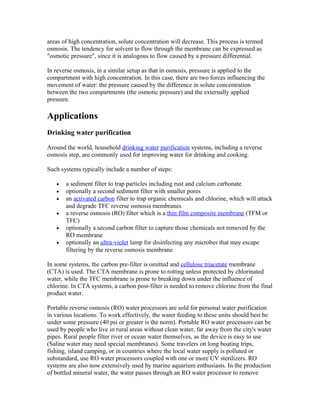
Schematics of a reverse osmosis system (desalination) using a pressure exchanger. 1:Sea
water inflow, 2: Fresh water flow (40%), 3:Concentrate Flow (60%), 4:Sea water flow
(60%), 5: Concentrate (drain), A: High pressure pump flow (40%), B: Circulation pump,
C:Osmosis unit with membrane, D: Pressure exchanger
Reverse osmosis is similar to the membrane filtration treatment process. However there
are key differences between reverse osmosis and filtration. The predominant removal
mechanism in membrane filtration is straining, or size exclusion, so the process can
theoretically achieve perfect exclusion of particles regardless of operational parameters
such as influent pressure and concentration. RO (Reverse Osmosis), however involves a
diffusive mechanism so that separation efficiency is dependent on influent solute
concentration, pressure and water flux rate [1]
. It works by using pressure to force a
solution through a membrane, retaining the solute on one side and allowing the pure
solvent to pass to the other side. This is the reverse of the normal osmosis process, which
is the natural movement of solvent from an area of low solute concentration, through a
membrane, to an area of high solute concentration when no external pressure is applied.
History
The process of osmosis through semipermeable membranes was first observed in 1748 by
Jean Antoine Nollet. For the following 200 years, osmosis was only a phenomenon
observed in the laboratory. In 1949 the University of California at Los Angeles (UCLA)
first investigated desalination of seawater using semipermeable membranes. Researches
from both UCLA and the University of Florida successfully produced freshwater from
seawater in the mid-1950s, but the flux was too low to be commercially viable. The
future of RO is promising. By the end of 2001, about 15,200 desalination plants were in
operation or in the planning stages worldwide. [1]
Process
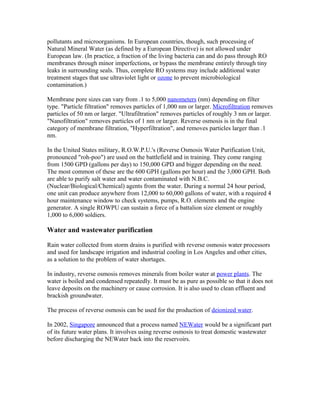
A semipermeable membrane coil used in desalinization.
Formally, reverse osmosis is the process of forcing a solvent from a region of high solute
concentration through a semipermeable membrane to a region of low solute concentration
by applying a pressure in excess of the osmotic pressure.
The membranes used for reverse osmosis have a dense barrier layer in the polymer matrix
where most separation occurs. In most cases the membrane is designed to allow only
water to pass through this dense layer while preventing the passage of solutes (such as
salt ions). This process requires that a high pressure be exerted on the high concentration
side of the membrane, usually 2–17 bar (30–250 psi) for fresh and brackish water, and
40–70 bar (600–1000 psi) for seawater, which has around 24 bar (350 psi) natural
osmotic pressure that must be overcome.
This process is best known for its use in desalination (removing the salt from sea water to
get fresh water), but since the early 1970s it has also been used to purify fresh water for
medical, industrial, and domestic applications.
Osmosis describes how solvent moves between two solutions separated by a
semipermeable membrane to reduce concentration differences between the solutions.
When two solutions with different concentrations of a solute are mixed, the total amount
of solutes in the two solutions will be equally distributed in the total amount of solvent
from the two solutions. Instead of mixing the two solutions together, they can be put in
two compartments where they are separated from each other by a semipermeable
membrane. The semipermeable membrane does not allow the solutes to move from one
compartment to the other, but allows the solvent to move. Since equilibrium cannot be
achieved by the movement of solutes from the compartment with high solute
concentration to the one with low solute concentration, it is instead achieved by the
movement of the solvent from areas of low solute concentration to areas of high solute
concentration. When the solvent moves away from low concentration areas, it causes
these areas to become more concentrated. On the other side, when the solvent moves into
areas of high concentration, solute concentration will decrease. This process is termed
osmosis. The tendency for solvent to flow through the membrane can be expressed as
"osmotic pressure", since it is analogous to flow caused by a pressure differential.
In reverse osmosis, in a similar setup as that in osmosis, pressure is applied to the
compartment with high concentration. In this case, there are two forces influencing the
movement of water: the pressure caused by the difference in solute concentration
between the two compartments (the osmotic pressure) and the externally applied
pressure.
Applications
Drinking water purification
Around the world, household drinking water purification systems, including a reverse
osmosis step, are commonly used for improving water for drinking and cooking.
Such systems typically include a number of steps:
• a sediment filter to trap particles including rust and calcium carbonate
• optionally a second sediment filter with smaller pores
• an activated carbon filter to trap organic chemicals and chlorine, which will attack
and degrade TFC reverse osmosis membranes
• a reverse osmosis (RO) filter which is a thin film composite membrane (TFM or
TFC)
• optionally a second carbon filter to capture those chemicals not removed by the
RO membrane
• optionally an ultra-violet lamp for disinfecting any microbes that may escape
filtering by the reverse osmosis membrane
In some systems, the carbon pre-filter is omitted and cellulose triacetate membrane
(CTA) is used. The CTA membrane is prone to rotting unless protected by chlorinated
water, while the TFC membrane is prone to breaking down under the influence of
chlorine. In CTA systems, a carbon post-filter is needed to remove chlorine from the final
product water.
Portable reverse osmosis (RO) water processors are sold for personal water purification
in various locations. To work effectively, the water feeding to these units should best be
under some pressure (40 psi or greater is the norm). Portable RO water processors can be
used by people who live in rural areas without clean water, far away from the city's water
pipes. Rural people filter river or ocean water themselves, as the device is easy to use
(Saline water may need special membranes). Some travelers on long boating trips,
fishing, island camping, or in countries where the local water supply is polluted or
substandard, use RO water processors coupled with one or more UV sterilizers. RO
systems are also now extensively used by marine aquarium enthusiasts. In the production
of bottled mineral water, the water passes through an RO water processor to remove
pollutants and microorganisms. In European countries, though, such processing of
Natural Mineral Water (as defined by a European Directive) is not allowed under
European law. (In practice, a fraction of the living bacteria can and do pass through RO
membranes through minor imperfections, or bypass the membrane entirely through tiny
leaks in surrounding seals. Thus, complete RO systems may include additional water
treatment stages that use ultraviolet light or ozone to prevent microbiological
contamination.)
Membrane pore sizes can vary from .1 to 5,000 nanometers (nm) depending on filter
type. "Particle filtration" removes particles of 1,000 nm or larger. Microfiltration removes
particles of 50 nm or larger. "Ultrafiltration" removes particles of roughly 3 nm or larger.
"Nanofiltration" removes particles of 1 nm or larger. Reverse osmosis is in the final
category of membrane filtration, "Hyperfiltration", and removes particles larger than .1
nm.
In the United States military, R.O.W.P.U.'s (Reverse Osmosis Water Purification Unit,
pronounced "roh-poo") are used on the battlefield and in training. They come ranging
from 1500 GPD (gallons per day) to 150,000 GPD and bigger depending on the need.
The most common of these are the 600 GPH (gallons per hour) and the 3,000 GPH. Both
are able to purify salt water and water contaminated with N.B.C.
(Nuclear/Biological/Chemical) agents from the water. During a normal 24 hour period,
one unit can produce anywhere from 12,000 to 60,000 gallons of water, with a required 4
hour maintenance window to check systems, pumps, R.O. elements and the engine
generator. A single ROWPU can sustain a force of a battalion size element or roughly
1,000 to 6,000 soldiers.
Water and wastewater purification
Rain water collected from storm drains is purified with reverse osmosis water processors
and used for landscape irrigation and industrial cooling in Los Angeles and other cities,
as a solution to the problem of water shortages.
In industry, reverse osmosis removes minerals from boiler water at power plants. The
water is boiled and condensed repeatedly. It must be as pure as possible so that it does not
leave deposits on the machinery or cause corrosion. It is also used to clean effluent and
brackish groundwater.
The process of reverse osmosis can be used for the production of deionized water.
In 2002, Singapore announced that a process named NEWater would be a significant part
of its future water plans. It involves using reverse osmosis to treat domestic wastewater
before discharging the NEWater back into the reservoirs.
Food Industry
In addition to desalination, reverse osmosis is a more economical operation for
concentrating food liquids (such as fruit juices) than conventional heat-treatment
processes. Research has been done on concentration of orange juice and tomato juice. Its
advantages include a low operating cost and the ability to avoid heat treatment processes,
which makes it suitable for heat-sensitive substances like the protein and enzymes found
in most food products.
Reverse osmosis is extensively used in the dairy industry for the production of whey
protein powders and for the concentration of milk to reduce shipping costs. In whey
applications, the whey (liquid remaining after cheese manufacture) is pre-concentrated
with RO from 6% total solids to 10-20% total solids before UF (ultrafiltration)
processing. The UF retentate can then be used to make various whey powders including
WPI (whey protein isolate) used in bodybuilding formulations. Additionally, the UF
permeate, which contains lactose, is concentrated by RO from 5% total solids to 18–22%
total solids to reduce crystallization and drying costs of the lactose powder.
Although use of the process was once frowned upon in the wine industry, it is now
widely understood and used. An estimated 60 reverse osmosis machines were in use in
Bordeaux, France in 2002. Known users include many of the elite classed growths
(Kramer) such as Château Léoville-Las Cases in Bordeaux.
Desalination
Areas that have no or limited surface water or groundwater may choose to desalinate
seawater or brackish water to obtain drinking water. Reverse osmosis is the most
common method of desalination, although 85 percent of desalinated water is produced in
multistage flash plants.[2]
Large reverse osmosis and multistage flash desalination plants
are used in the Middle East, especially Saudi Arabia. The energy requirements of the
plants are large, but electricity can be produced relatively cheaply with the abundant oil
reserves in the region. The desalination plants are often located adjacent to the power
plants, which reduces energy losses in transmission and allows waste heat to be used in
the desalination process of multistage flash plants, reducing the amount of energy needed
to desalinate the water and providing cooling for the power plant.
Sea Water Reverse Osmosis (SWRO) is a reverse osmosis desalination membrane
process that has been commercially used since the early 1970s. Its first practical
demonstration was done by Sidney Loeb and Srinivasa Sourirajan from UCLA in
Coalinga, California. Because no heating or phase changes are needed, energy
requirements are low in comparison to other processes of desalination, though still much
higher than other forms of water supply (including reverse osmosis treatment of
wastewater).[citation needed]
The typical single pass SWRO system consists of the following components:
• Intake
• Pre-treatment
• High-pressure pump
• Membrane assembly
• Remineralization and pH adjustment
• Disinfection
Pre-treatment
Pre-treatment is important when working with RO and nanofiltration (NF) membranes
due to the nature of their spiral wound design. The material is engineered in such a
fashion to allow only one way flow through the system. As such the spiral wound design
doesn't allow for backpulsing with water or air agitation to scour its surface and remove
solids. Since accumulated material cannot be removed from the membrane surface
systems they are highly susceptible to fouling (loss of production capacity). Therefore,
pretreatment is a necessity for any RO or NF system. Pretreatment in SWRO system has
four major components:
• Screening of solids: Solids within the water must be removed and the water
treated to prevent fouling of the membranes by fine particle or biological growth,
and reduce the risk of damage to high-pressure pump components.
• Cartridge filtration - Generally string-wound polypropylene filters that remove
between 1 - 5 micrometre sized particles.
• Dosing of oxidizing biocides such as chlorine to kill bacteria followed by bisulfite
dosing to deactivate the chlorine which can destroy a thin-film composite
membrane. There are also biofouling inhibitors which do not kill bacteria but
simply prevent them from growing slime on the membrane surface.
• Prefiltration pH adjustment: If the pH, hardness and the alkalinity in the feedwater
result in a scaling tendency when they are concentrated in the reject stream, acid
is dosed to maintain carbonates in their soluble carbonic acid form.
CO3
-2
+ H3O+
= HCO3
-
+ H2O
HCO3
-
+ H3O+
= H2CO3 + H2O
• Carbonic acid cannot combine with calcium to form calcium carbonate scale.
Calcium Carbonate Scaling tendency is estimated using the Langelier Saturation
Index. Adding too much sulfuric acid to control carbonate scales may result in
calcium sulfate, barium sulfate or strontium sulfate scale formation on the RO
membrane.
• Prefiltration Antiscalants: Scale inhibitors (also known as antiscalants) prevent
formation of all scales compared to acid which can only prevent formation of
calcium carbonate and calcium phosphate scales. In addition to inhibiting
carbonate and phosphate scales, antiscalants inhibit sulfate and fluoride scales,
disperse colloids and metal oxides and specialty products exist to inhibit silica
formation.
High pressure pump
The pump supplies the pressure needed to push water through the membrane, even as the
membrane rejects the passage of salt through it. Typical pressures for brackish water
range from 225 to 375 psi (15.5 to 26 bar, or 1.6 to 2.6 MPa). In the case of seawater,
they range from 800 to 1,180 psi (55 to 81.5 bar or 6 to 8 MPa).
Membrane assembly
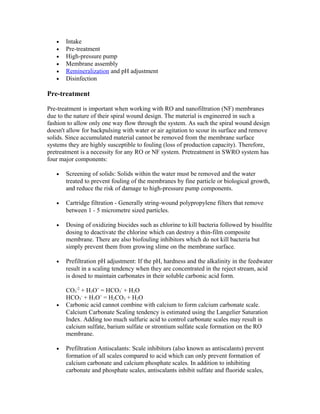
The layers of a membrane.
The membrane assembly consists of a pressure vessel with a membrane that allows
feedwater to be pressed against it. The membrane must be strong enough to withstand
whatever pressure is applied against it. RO membranes are made in a variety of
configurations, with the two most common configurations being spiral-wound and a
hollow-fiber.
Disadvantages
Household reverse osmosis units use a lot of water because they have low back pressure.
As a result, they recover only 5 to 15 percent of the water entering the system. The
remainder is discharged as waste water. Because waste water carries with it the rejected
contaminants, methods to recover this water are not practical for household systems.
Waste water is typically connected to the house drains and will add to the load on the
household septic system. An RO unit delivering 5 gallons of treated water per day may
discharge 40 to 90 gallons of waste water per day to the septic system. [3]
Large scale industrial/municipal systems have a production efficiency of closer to 48%
because they can generate the high pressure needed for RO filtration.
New developments
Prefiltration of high fouling waters with another, larger-pore membrane with less
hydraulic energy requirement, has been evaluated and sometimes used since the 1970s.
However, this means the water passes through two membranes and is often repressurized,
requiring more energy input in the system, increasing the cost.
Other recent development work has focused on integrating RO with electrodialysis in
order to improve recovery of valuable deionized products or minimize concentrate
volume requiring discharge or disposal.

RO

  • 1.
    Reverse osmosis Schematics ofa reverse osmosis system (desalination) using a pressure exchanger. 1:Sea water inflow, 2: Fresh water flow (40%), 3:Concentrate Flow (60%), 4:Sea water flow (60%), 5: Concentrate (drain), A: High pressure pump flow (40%), B: Circulation pump, C:Osmosis unit with membrane, D: Pressure exchanger Reverse osmosis is similar to the membrane filtration treatment process. However there are key differences between reverse osmosis and filtration. The predominant removal mechanism in membrane filtration is straining, or size exclusion, so the process can theoretically achieve perfect exclusion of particles regardless of operational parameters such as influent pressure and concentration. RO (Reverse Osmosis), however involves a diffusive mechanism so that separation efficiency is dependent on influent solute concentration, pressure and water flux rate [1] . It works by using pressure to force a solution through a membrane, retaining the solute on one side and allowing the pure solvent to pass to the other side. This is the reverse of the normal osmosis process, which is the natural movement of solvent from an area of low solute concentration, through a membrane, to an area of high solute concentration when no external pressure is applied. History The process of osmosis through semipermeable membranes was first observed in 1748 by Jean Antoine Nollet. For the following 200 years, osmosis was only a phenomenon observed in the laboratory. In 1949 the University of California at Los Angeles (UCLA) first investigated desalination of seawater using semipermeable membranes. Researches from both UCLA and the University of Florida successfully produced freshwater from seawater in the mid-1950s, but the flux was too low to be commercially viable. The future of RO is promising. By the end of 2001, about 15,200 desalination plants were in operation or in the planning stages worldwide. [1]
  • 2.
    Process A semipermeable membranecoil used in desalinization. Formally, reverse osmosis is the process of forcing a solvent from a region of high solute concentration through a semipermeable membrane to a region of low solute concentration by applying a pressure in excess of the osmotic pressure. The membranes used for reverse osmosis have a dense barrier layer in the polymer matrix where most separation occurs. In most cases the membrane is designed to allow only water to pass through this dense layer while preventing the passage of solutes (such as salt ions). This process requires that a high pressure be exerted on the high concentration side of the membrane, usually 2–17 bar (30–250 psi) for fresh and brackish water, and 40–70 bar (600–1000 psi) for seawater, which has around 24 bar (350 psi) natural osmotic pressure that must be overcome. This process is best known for its use in desalination (removing the salt from sea water to get fresh water), but since the early 1970s it has also been used to purify fresh water for medical, industrial, and domestic applications. Osmosis describes how solvent moves between two solutions separated by a semipermeable membrane to reduce concentration differences between the solutions. When two solutions with different concentrations of a solute are mixed, the total amount of solutes in the two solutions will be equally distributed in the total amount of solvent from the two solutions. Instead of mixing the two solutions together, they can be put in two compartments where they are separated from each other by a semipermeable membrane. The semipermeable membrane does not allow the solutes to move from one compartment to the other, but allows the solvent to move. Since equilibrium cannot be achieved by the movement of solutes from the compartment with high solute concentration to the one with low solute concentration, it is instead achieved by the movement of the solvent from areas of low solute concentration to areas of high solute concentration. When the solvent moves away from low concentration areas, it causes these areas to become more concentrated. On the other side, when the solvent moves into
  • 3.
    areas of highconcentration, solute concentration will decrease. This process is termed osmosis. The tendency for solvent to flow through the membrane can be expressed as "osmotic pressure", since it is analogous to flow caused by a pressure differential. In reverse osmosis, in a similar setup as that in osmosis, pressure is applied to the compartment with high concentration. In this case, there are two forces influencing the movement of water: the pressure caused by the difference in solute concentration between the two compartments (the osmotic pressure) and the externally applied pressure. Applications Drinking water purification Around the world, household drinking water purification systems, including a reverse osmosis step, are commonly used for improving water for drinking and cooking. Such systems typically include a number of steps: • a sediment filter to trap particles including rust and calcium carbonate • optionally a second sediment filter with smaller pores • an activated carbon filter to trap organic chemicals and chlorine, which will attack and degrade TFC reverse osmosis membranes • a reverse osmosis (RO) filter which is a thin film composite membrane (TFM or TFC) • optionally a second carbon filter to capture those chemicals not removed by the RO membrane • optionally an ultra-violet lamp for disinfecting any microbes that may escape filtering by the reverse osmosis membrane In some systems, the carbon pre-filter is omitted and cellulose triacetate membrane (CTA) is used. The CTA membrane is prone to rotting unless protected by chlorinated water, while the TFC membrane is prone to breaking down under the influence of chlorine. In CTA systems, a carbon post-filter is needed to remove chlorine from the final product water. Portable reverse osmosis (RO) water processors are sold for personal water purification in various locations. To work effectively, the water feeding to these units should best be under some pressure (40 psi or greater is the norm). Portable RO water processors can be used by people who live in rural areas without clean water, far away from the city's water pipes. Rural people filter river or ocean water themselves, as the device is easy to use (Saline water may need special membranes). Some travelers on long boating trips, fishing, island camping, or in countries where the local water supply is polluted or substandard, use RO water processors coupled with one or more UV sterilizers. RO systems are also now extensively used by marine aquarium enthusiasts. In the production of bottled mineral water, the water passes through an RO water processor to remove
  • 4.
    pollutants and microorganisms.In European countries, though, such processing of Natural Mineral Water (as defined by a European Directive) is not allowed under European law. (In practice, a fraction of the living bacteria can and do pass through RO membranes through minor imperfections, or bypass the membrane entirely through tiny leaks in surrounding seals. Thus, complete RO systems may include additional water treatment stages that use ultraviolet light or ozone to prevent microbiological contamination.) Membrane pore sizes can vary from .1 to 5,000 nanometers (nm) depending on filter type. "Particle filtration" removes particles of 1,000 nm or larger. Microfiltration removes particles of 50 nm or larger. "Ultrafiltration" removes particles of roughly 3 nm or larger. "Nanofiltration" removes particles of 1 nm or larger. Reverse osmosis is in the final category of membrane filtration, "Hyperfiltration", and removes particles larger than .1 nm. In the United States military, R.O.W.P.U.'s (Reverse Osmosis Water Purification Unit, pronounced "roh-poo") are used on the battlefield and in training. They come ranging from 1500 GPD (gallons per day) to 150,000 GPD and bigger depending on the need. The most common of these are the 600 GPH (gallons per hour) and the 3,000 GPH. Both are able to purify salt water and water contaminated with N.B.C. (Nuclear/Biological/Chemical) agents from the water. During a normal 24 hour period, one unit can produce anywhere from 12,000 to 60,000 gallons of water, with a required 4 hour maintenance window to check systems, pumps, R.O. elements and the engine generator. A single ROWPU can sustain a force of a battalion size element or roughly 1,000 to 6,000 soldiers. Water and wastewater purification Rain water collected from storm drains is purified with reverse osmosis water processors and used for landscape irrigation and industrial cooling in Los Angeles and other cities, as a solution to the problem of water shortages. In industry, reverse osmosis removes minerals from boiler water at power plants. The water is boiled and condensed repeatedly. It must be as pure as possible so that it does not leave deposits on the machinery or cause corrosion. It is also used to clean effluent and brackish groundwater. The process of reverse osmosis can be used for the production of deionized water. In 2002, Singapore announced that a process named NEWater would be a significant part of its future water plans. It involves using reverse osmosis to treat domestic wastewater before discharging the NEWater back into the reservoirs.
  • 5.
    Food Industry In additionto desalination, reverse osmosis is a more economical operation for concentrating food liquids (such as fruit juices) than conventional heat-treatment processes. Research has been done on concentration of orange juice and tomato juice. Its advantages include a low operating cost and the ability to avoid heat treatment processes, which makes it suitable for heat-sensitive substances like the protein and enzymes found in most food products. Reverse osmosis is extensively used in the dairy industry for the production of whey protein powders and for the concentration of milk to reduce shipping costs. In whey applications, the whey (liquid remaining after cheese manufacture) is pre-concentrated with RO from 6% total solids to 10-20% total solids before UF (ultrafiltration) processing. The UF retentate can then be used to make various whey powders including WPI (whey protein isolate) used in bodybuilding formulations. Additionally, the UF permeate, which contains lactose, is concentrated by RO from 5% total solids to 18–22% total solids to reduce crystallization and drying costs of the lactose powder. Although use of the process was once frowned upon in the wine industry, it is now widely understood and used. An estimated 60 reverse osmosis machines were in use in Bordeaux, France in 2002. Known users include many of the elite classed growths (Kramer) such as Château Léoville-Las Cases in Bordeaux. Desalination Areas that have no or limited surface water or groundwater may choose to desalinate seawater or brackish water to obtain drinking water. Reverse osmosis is the most common method of desalination, although 85 percent of desalinated water is produced in multistage flash plants.[2] Large reverse osmosis and multistage flash desalination plants are used in the Middle East, especially Saudi Arabia. The energy requirements of the plants are large, but electricity can be produced relatively cheaply with the abundant oil reserves in the region. The desalination plants are often located adjacent to the power plants, which reduces energy losses in transmission and allows waste heat to be used in the desalination process of multistage flash plants, reducing the amount of energy needed to desalinate the water and providing cooling for the power plant. Sea Water Reverse Osmosis (SWRO) is a reverse osmosis desalination membrane process that has been commercially used since the early 1970s. Its first practical demonstration was done by Sidney Loeb and Srinivasa Sourirajan from UCLA in Coalinga, California. Because no heating or phase changes are needed, energy requirements are low in comparison to other processes of desalination, though still much higher than other forms of water supply (including reverse osmosis treatment of wastewater).[citation needed] The typical single pass SWRO system consists of the following components:
  • 6.
    • Intake • Pre-treatment •High-pressure pump • Membrane assembly • Remineralization and pH adjustment • Disinfection Pre-treatment Pre-treatment is important when working with RO and nanofiltration (NF) membranes due to the nature of their spiral wound design. The material is engineered in such a fashion to allow only one way flow through the system. As such the spiral wound design doesn't allow for backpulsing with water or air agitation to scour its surface and remove solids. Since accumulated material cannot be removed from the membrane surface systems they are highly susceptible to fouling (loss of production capacity). Therefore, pretreatment is a necessity for any RO or NF system. Pretreatment in SWRO system has four major components: • Screening of solids: Solids within the water must be removed and the water treated to prevent fouling of the membranes by fine particle or biological growth, and reduce the risk of damage to high-pressure pump components. • Cartridge filtration - Generally string-wound polypropylene filters that remove between 1 - 5 micrometre sized particles. • Dosing of oxidizing biocides such as chlorine to kill bacteria followed by bisulfite dosing to deactivate the chlorine which can destroy a thin-film composite membrane. There are also biofouling inhibitors which do not kill bacteria but simply prevent them from growing slime on the membrane surface. • Prefiltration pH adjustment: If the pH, hardness and the alkalinity in the feedwater result in a scaling tendency when they are concentrated in the reject stream, acid is dosed to maintain carbonates in their soluble carbonic acid form. CO3 -2 + H3O+ = HCO3 - + H2O HCO3 - + H3O+ = H2CO3 + H2O • Carbonic acid cannot combine with calcium to form calcium carbonate scale. Calcium Carbonate Scaling tendency is estimated using the Langelier Saturation Index. Adding too much sulfuric acid to control carbonate scales may result in calcium sulfate, barium sulfate or strontium sulfate scale formation on the RO membrane. • Prefiltration Antiscalants: Scale inhibitors (also known as antiscalants) prevent formation of all scales compared to acid which can only prevent formation of calcium carbonate and calcium phosphate scales. In addition to inhibiting carbonate and phosphate scales, antiscalants inhibit sulfate and fluoride scales,
  • 7.
    disperse colloids andmetal oxides and specialty products exist to inhibit silica formation. High pressure pump The pump supplies the pressure needed to push water through the membrane, even as the membrane rejects the passage of salt through it. Typical pressures for brackish water range from 225 to 375 psi (15.5 to 26 bar, or 1.6 to 2.6 MPa). In the case of seawater, they range from 800 to 1,180 psi (55 to 81.5 bar or 6 to 8 MPa). Membrane assembly The layers of a membrane. The membrane assembly consists of a pressure vessel with a membrane that allows feedwater to be pressed against it. The membrane must be strong enough to withstand whatever pressure is applied against it. RO membranes are made in a variety of configurations, with the two most common configurations being spiral-wound and a hollow-fiber. Disadvantages Household reverse osmosis units use a lot of water because they have low back pressure. As a result, they recover only 5 to 15 percent of the water entering the system. The remainder is discharged as waste water. Because waste water carries with it the rejected contaminants, methods to recover this water are not practical for household systems. Waste water is typically connected to the house drains and will add to the load on the household septic system. An RO unit delivering 5 gallons of treated water per day may discharge 40 to 90 gallons of waste water per day to the septic system. [3] Large scale industrial/municipal systems have a production efficiency of closer to 48% because they can generate the high pressure needed for RO filtration. New developments
  • 8.
    Prefiltration of highfouling waters with another, larger-pore membrane with less hydraulic energy requirement, has been evaluated and sometimes used since the 1970s. However, this means the water passes through two membranes and is often repressurized, requiring more energy input in the system, increasing the cost. Other recent development work has focused on integrating RO with electrodialysis in order to improve recovery of valuable deionized products or minimize concentrate volume requiring discharge or disposal.