Reverse Osmosis (RO) Basics
Presented by Nitin Chauhan of Culligan
(Hall’s Water Group)
For ASPE Cleveland Chapter
October 2012
Outline of Topics
I. RO
– Fundamentals of RO
– RO Selection and Design Criteria
– How to size a RO
II. Benefits of Using RO
– Energy Savings
• Research from DOE (Dept of Energy)
– Other Benefits
– RO for BFW
• Water Savings
• Chemical Savings
• RO Brine Reclaim
Outline of Topics Cont’d
III. Culligan Background
– Culligan International
– Hall’s Water Group
– Culligan of Greater Cleveland
Fundamentals of RO
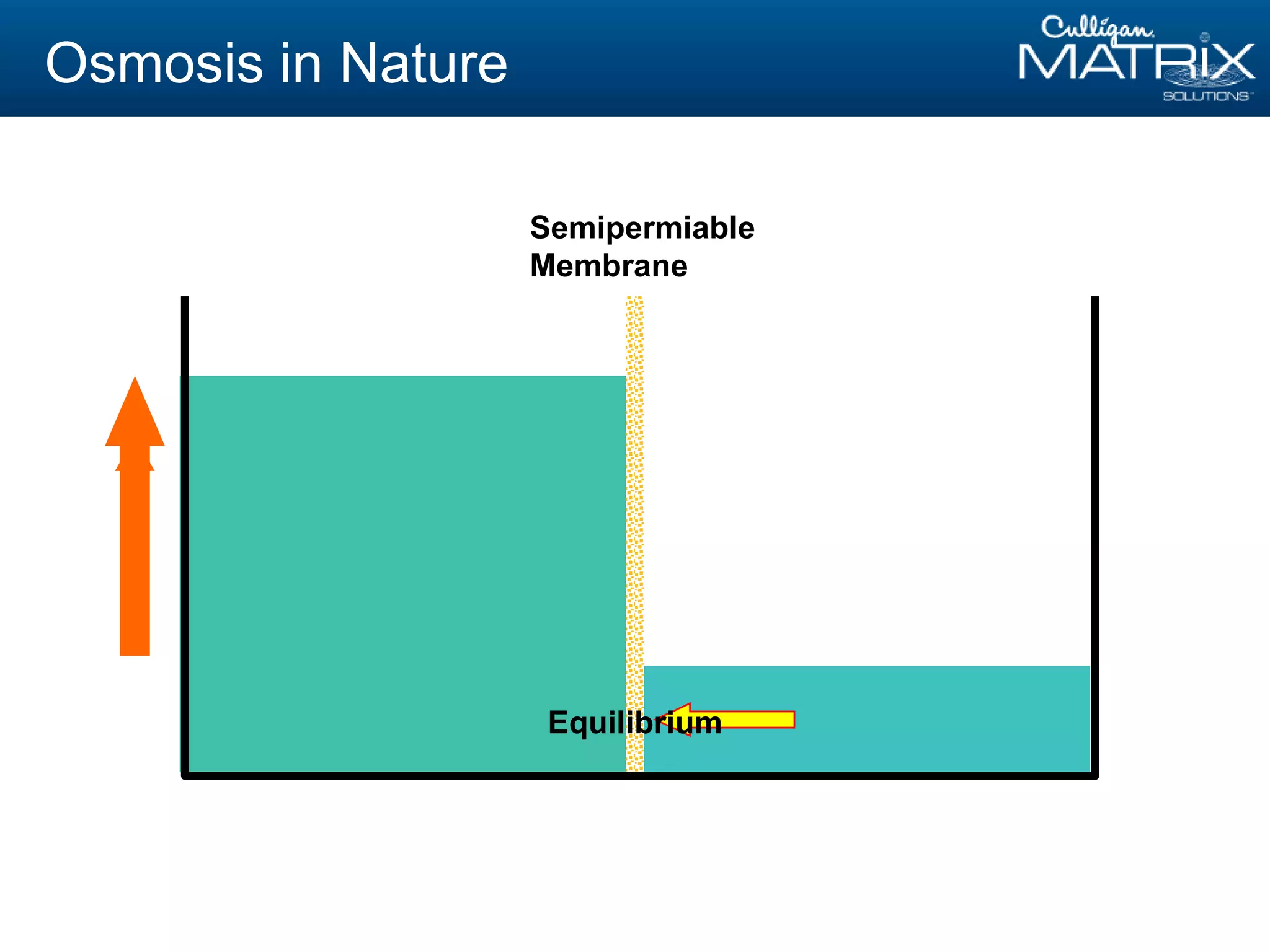
The movement of a solvent (water in our
case) across a semi-permeable membrane
from a solution of lower concentration to a
solution of higher concentration that tends to
equalize the concentrations of solute on the
both sides of the membrane.
What is Osmosis?
Osmosis
Time
Less
Concentrated
More
Concentrated
Equilibrium
Brackish Water Fresh Water
Semipermiable
Membrane
Osmosis in Nature
Osmotic
Pressure
Semipermiable
Membrane
PressureGradientOsmosis in Nature
Semipermiable
Membrane
Equilibrium
Osmosis in Nature
Semipermiable
Membrane
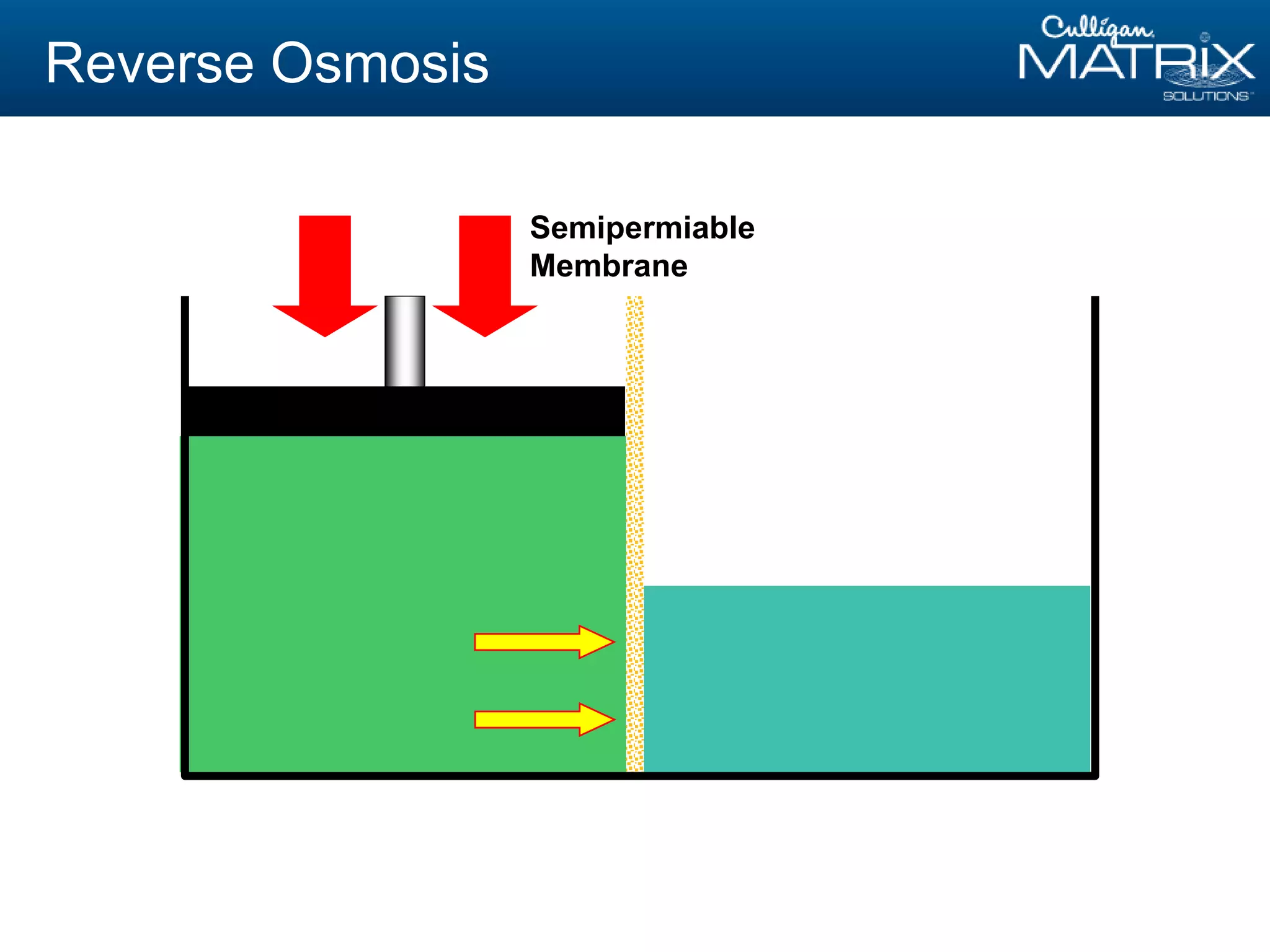
Reverse Osmosis
Semipermiable
Membrane
Reverse Osmosis
Semipermiable
Membrane
Reverse Osmosis
Waste Water Product Water
Semipermiable
Membrane
Reverse Osmosis
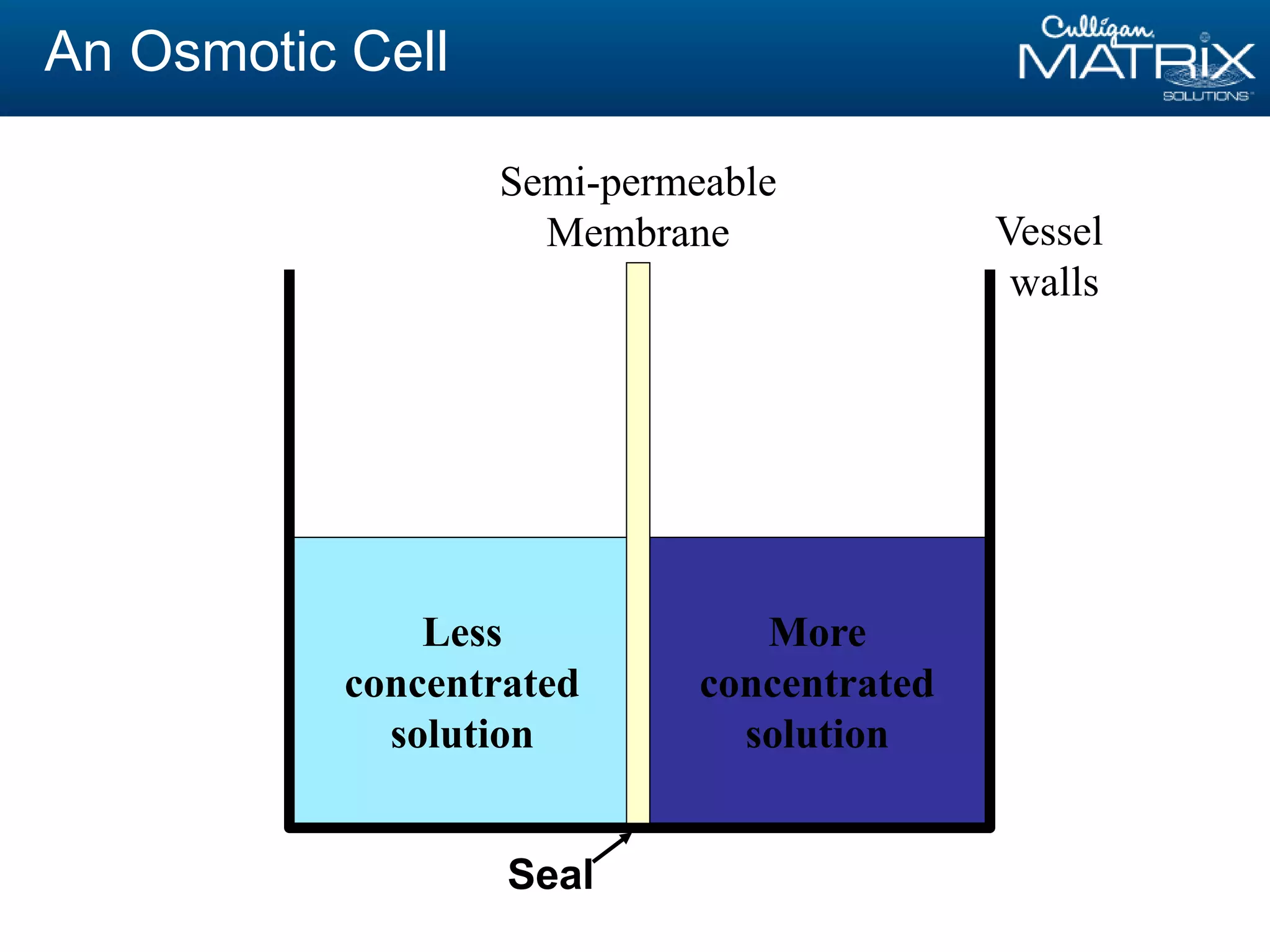
An Osmotic Cell
More
concentrated
solution
Less
concentrated
solution
Semi-permeable
Membrane Vessel
walls
Seal
Reverse Osmosis
Driving
Pressure
Osmotic
Pressure
Applied
Pressure
General RO System Design
FOR EXAMPLE, A SINGLE 4” MEMBRANE SYSTEM
FEED
PERMEATE
CONCENTRATE
1 GPM
4 GPM
5 GPM
RAW FEED
3 GPM
RECYCLE
2 GPM
2 GPM
20%PERM FLOW
FEED FLOW
RECOVERY =
x 100 = 98%
10 PPM
667 PPM
500 PPM
500 PPM
667 PPM
PERM TDS
FEED TDS
REJECTION =
x 100 =
1 -( )
BY ADDING RECYCLE, THE RECOVERY WILL INCREASE BUT PRODUCT TDS WILL ALSO GO UP
12 PPM
566 PPM
33%
General RO System Design
ADDING MORE MEMBRANES IN SERIES WILL ALSO INCREASE RECOVERY
FEED
PERMEATE
CONC
PERM FLOW
FEED FLOW
RECOVERY =
x 100 =
1 GPM
20 %33 %43 %
1 GPM
2 GPM
1 GPM
3 GPM
5 GPM 4 GPM6 GPM 5 GPM 4 GPM
7 GPM 6 GPM 5 GPM 4 GPM
RO Selection and System Design
Brackish Water 4” Elements 8” Elements
Average
Permeate Flow
1 GPM 5 GPM
Maximum Feed
Flow
16 GPM 64 GPM
Minimum
Concentrate
Flow
4 GPM 20 GPM
Pretreatment
Water Problems Feed Water
Requirements
Media Treatment Chemical
Treatment
Suspend Solids
(TSS)
NTU < 1 or
SDI < 3 (5 max)
Depth Filter Inject Coagulants/
Flocculants
Chlorine
(Oxidizers)
0 ppm Carbon Filter Sodium Meta
Bisulfite (SBS)
(inject 2 x Cl conc.)
Hardness Softened Water Softener Antiscalant
(~ 5 ppm)
Bacteria 0 counts Ultra Violet Light
or Ozone
Chlorine
Pretreatment
Water Problems Feed Water
Requirements
Media Treatment Chemical
Treatment
Iron, Hydrogen
Sulfide
Fe (2+), 4 ppm
Fe (3+), 0.1 ppm
Manganese Green
Sand
1) Chlorinate
2) Filter
3) Dechlorinate
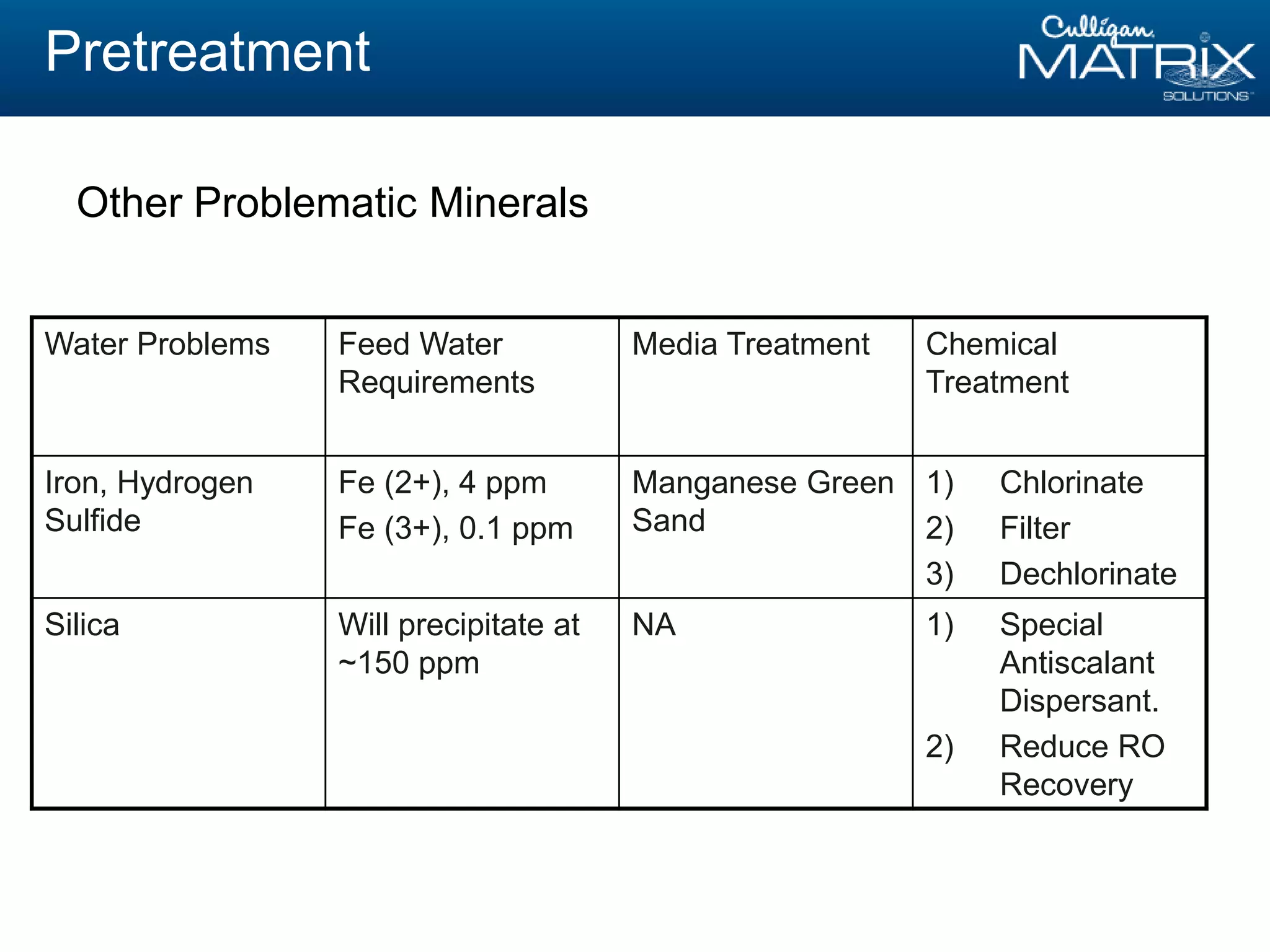
Silica Will precipitate at
~150 ppm
NA 1) Special
Antiscalant
Dispersant.
2) Reduce RO
Recovery
Other Problematic Minerals
Factors to Consider When Sizing RO
 Temperature
 Pressure
 Total Dissolved Solids (TDS)
R.O. Performance Factors
At lower temperatures,
the water is denser,
requiring more
pressure to ‘push’ it
through the membrane
Rejection
Output
Temperature
R.O. Performance Factors
Higher pressure
increases the quality
and quantity of
product water Output
RejectionPressure
R.O. Performance Factors
TDS
Higher TDS (total
dissolved solids)
raises the natural
‘osmotic’ pressure,
which increases the
water’s tendency to
reverse it’s flow
across the membrane
Output
Rejection
 Energy Savings-Reference DOE
Report
 Water Savings via increased Boiler
cycles of concentration COC (typically
increase from 10 to 50 COC.
 Chemical Savings in the 25 to 50%
range.
 Water reclamation via RO for reject
water.
Benefits of Using RO
26
Case Study By Department of Energy
RO Boiler Savings
Typical Boiler PFD
Q
Sodium Zeolite
Softeners
Plant Boiler(s)
DA Vent
Plant Load
Deareator
Make Up
Condensate
Steam
Loss
Steam Rate
Blowdown
Feedwater
2 cycles of
concentration
100 TDS200 TDS
Cycles of Concentration - COC
Calculating % Blowdown
FW Cycles = Neutralized Boiler Conductivity
__________________________
Feedwater Conductivity
Dearator/ Feedwater mmhos = 100
ppm
Neutralized Boiler mmhos = 3000
ppm
= 3.33 % Blowdown
% Blowdown = 1 X100
______________
Feedwater Cycles
Effects of Concentration on Chemical Feed Rate
Feed rate at 10% blowdown or 10 FW cycle =
Feedwater
Plant Boiler(s)
Deareator
Blowdown
Require a
50ppm of
residual in
the boiler
Feed rate at 2% blowdown or 50 FW cycles =
?
Make Up
Boiler Residual / FW Cycles = Feed Rate
5 ppm
1 ppm
Boiler ASME Limits
TDS max
(ppm) 700-3500 600-3000 500-2500 200-1000
ALK. max
(ppm)
350 300 250 200
TSS Max
(ppm)
15 10 8 3
Conductivity
(µmho/cm)
1100-5400 900-4600 800-3800 300-1500
Silica max
(ppm SiO2)
150 90 40 30
0-300 301-450 451-600 601 -750Boiler PSIG
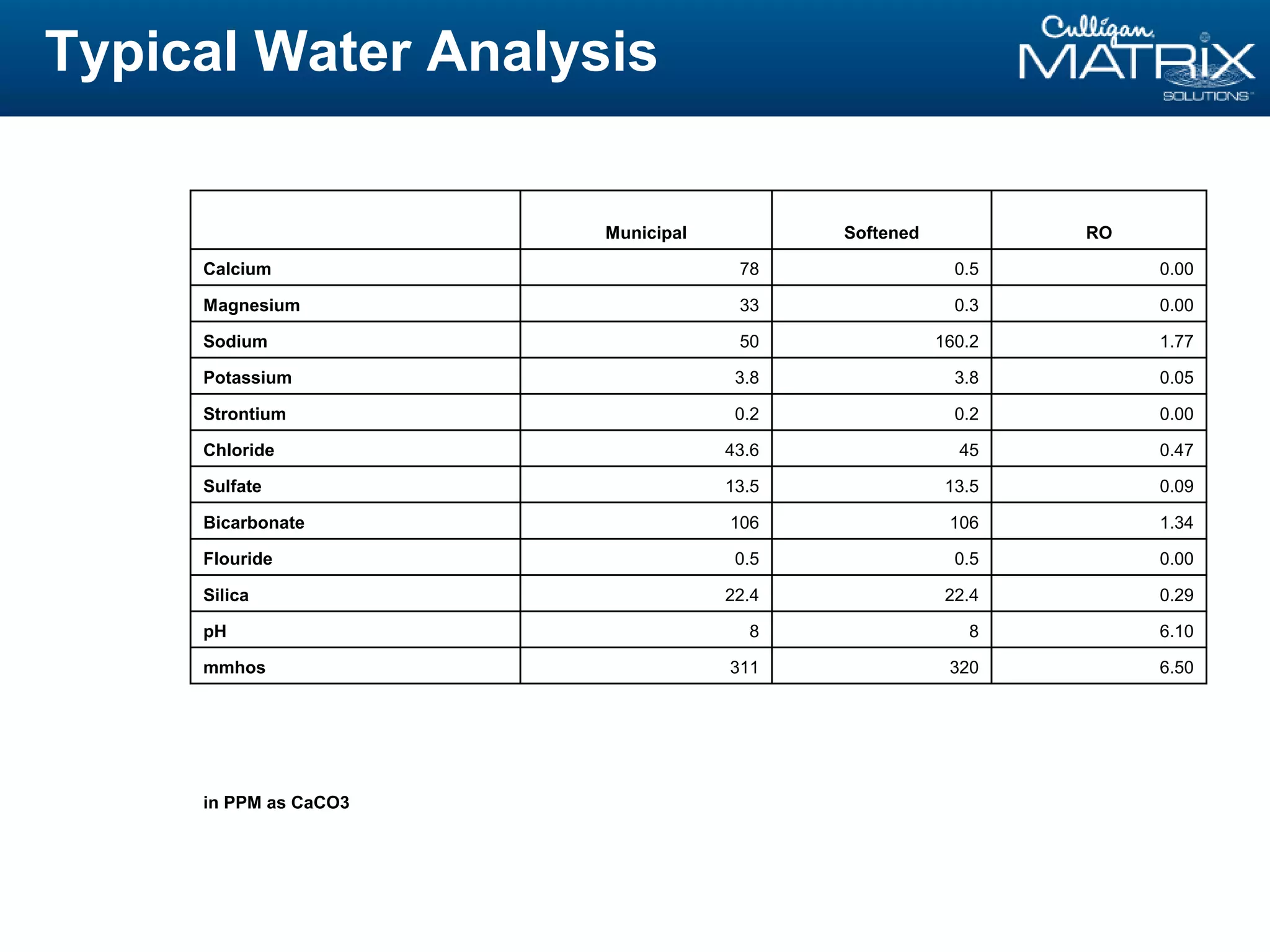
Typical Water Analysis
Municipal Softened RO
Calcium 78 0.5 0.00
Magnesium 33 0.3 0.00
Sodium 50 160.2 1.77
Potassium 3.8 3.8 0.05
Strontium 0.2 0.2 0.00
Chloride 43.6 45 0.47
Sulfate 13.5 13.5 0.09
Bicarbonate 106 106 1.34
Flouride 0.5 0.5 0.00
Silica 22.4 22.4 0.29
pH 8 8 6.10
mmhos 311 320 6.50
in PPM as CaCO3
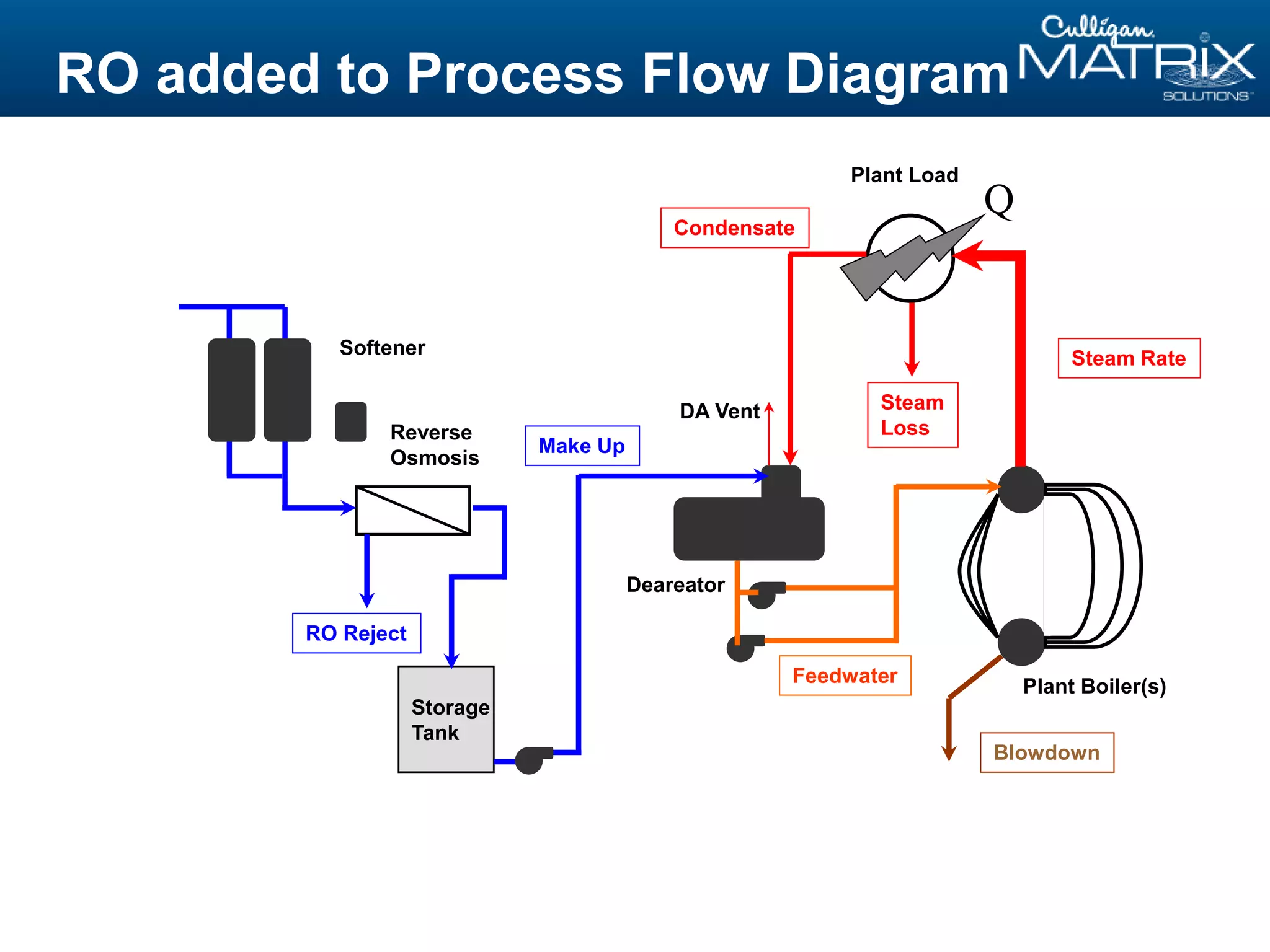
Feedwater
Plant Boiler(s)
DA Vent
Plant Load
Deareator
Make Up
Condensate
Steam
Loss
Steam Rate
Reverse
Osmosis
Softener
RO Reject
Q
Blowdown
Storage
Tank
RO added to Process Flow Diagram
Other Benefits
 Possible improved steam quality
– Lower operating boiler alkalinity
– Lower operating boiler TDS
 Reduction in Neutralizing Amine feed rate
– Easier Compliance with FDA steam requirements
– Better Condensate corrosion protection
 Softened RO reject water could be put to use.
– Once thru cooling
– Wash down water, truck rinsing
– Possible CIP rinses
– Other non critical apps.
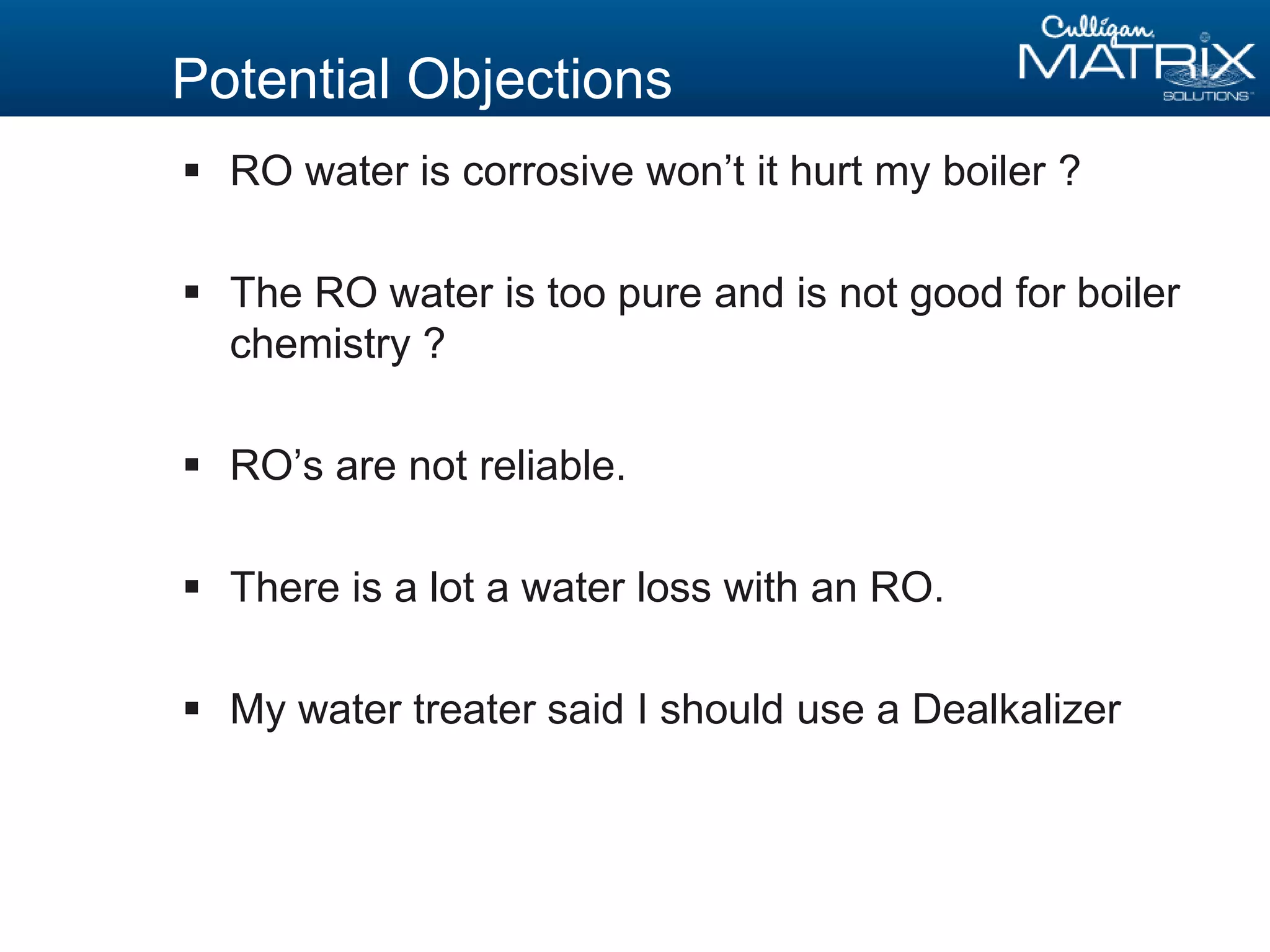
Potential Objections
 RO water is corrosive won’t it hurt my boiler ?
 The RO water is too pure and is not good for boiler
chemistry ?
 RO’s are not reliable.
 There is a lot a water loss with an RO.
 My water treater said I should use a Dealkalizer
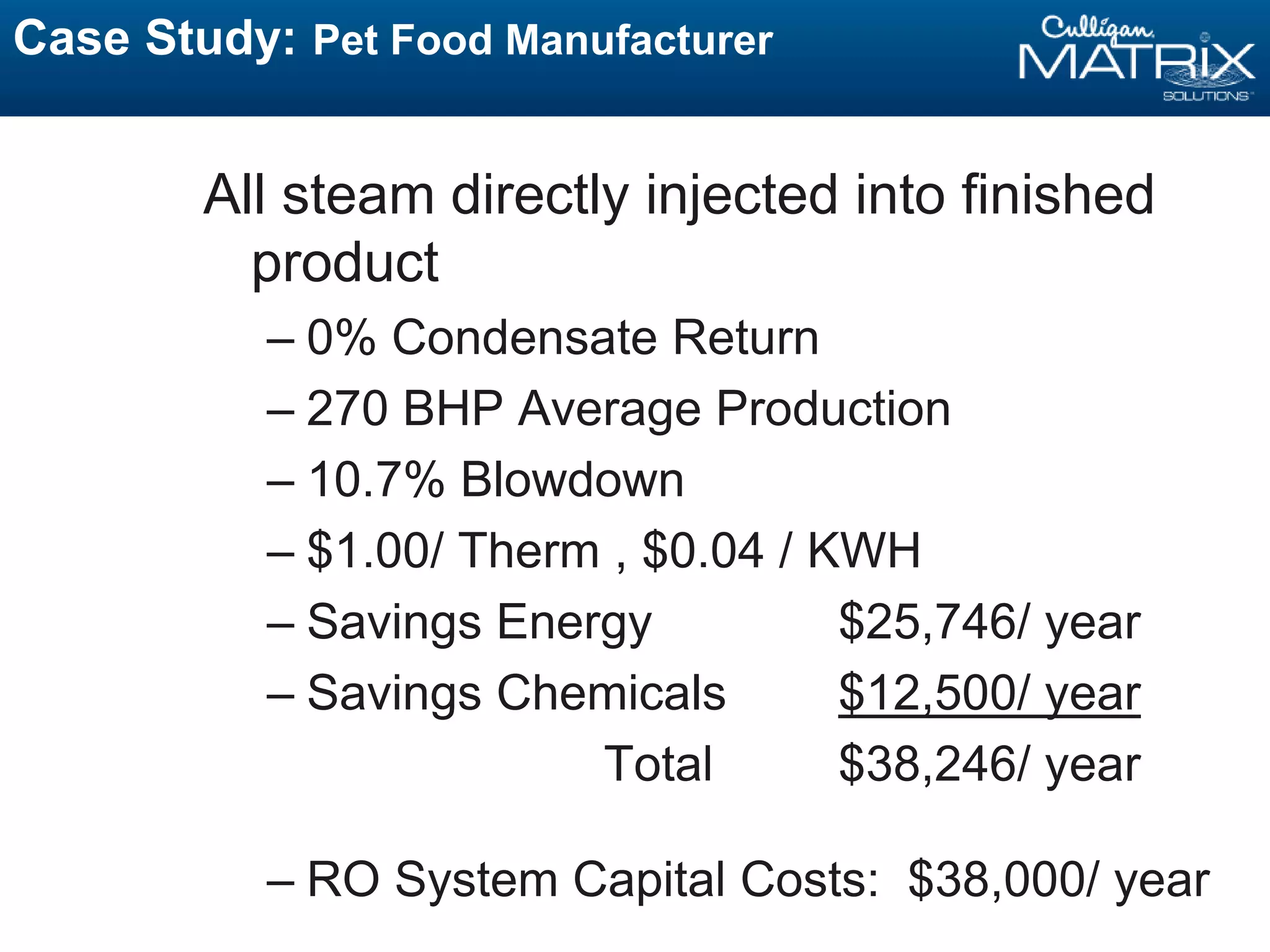
All steam directly injected into finished
product
– 0% Condensate Return
– 270 BHP Average Production
– 10.7% Blowdown
– $1.00/ Therm , $0.04 / KWH
– Savings Energy $25,746/ year
– Savings Chemicals $12,500/ year
Total $38,246/ year
– RO System Capital Costs: $38,000/ year
Case Study: Pet Food Manufacturer
Minimum Conditions for Justifications
 350 BHP or 12,000 lbs/hr
 50% Condensate Return or Less
 Gas Prices $1.00 per Therm
 Feed water TDS 350
 % Blowdown >7.5% or 13 Feed water Cycles
Energy Saving Calculator Boiler Energy Savings.xls
39
Georgia Pacific Case Study
RO Brine Reclaim
RO Brine Reclaim
41
PFD Brine Reclaim Example
22 GPM Reject to
Drain
RO
Product
Storage
Reject
Storage
Boiler
Make Up
Storage
44 GPM of Reject Water
Existing RO Units
Product
132 GPM
176
GPM
New Brine Reclaim Unit
Product
22 GPM
Inlet
Supply
Tank
Chemical
Feed
Saved 11,500,000 gallons /yr of city water
Boiler Blowdown reduced from 25% to 2%
Netting: $61,000 per year in energy savings
50% Boiler Chemical savings
Culligan Background
 Culligan International
 Hall’s Water Group
 Culligan of Greater Cleveland
43
 Over 1400 dealerships around the
world - local service and support
 Largest Pure Water play company
 Over 600 North American locations
 Service companies like Coca-cola,
Toyota, John Deere, IBM and
others
 200 U.S. patents
Culligan International Overview
US and Worldwide Support and Expertise
44
Picture this from the 167th floor of
the Burge Dubai…….where Culligan works..
Shangri
La Hotel
Dusit – Hotel
Index - Service
Emirates
Towers -
Etisalet - RO
Monarch –
Food service
45
Culligan Matrix Solutions is based on building blocks
– Large array of applications covered with just a few components
– Simple, check the box system design concept
– Each piece pre-engineered to work interchangeably
– Pick the appropriate size, and all the pieces easily interconnect
– Great platform to implement our technology & third party’s
– Maximizes potential to capture spend
Modular Advanced Water Treatment Systems
Pre-Treatment Membrane
Technology
Polish Storage Distribution
Control, Instrumentation, Pre-Packaging and Skid Mounting
Culligan’s Matrix Solutions Concept
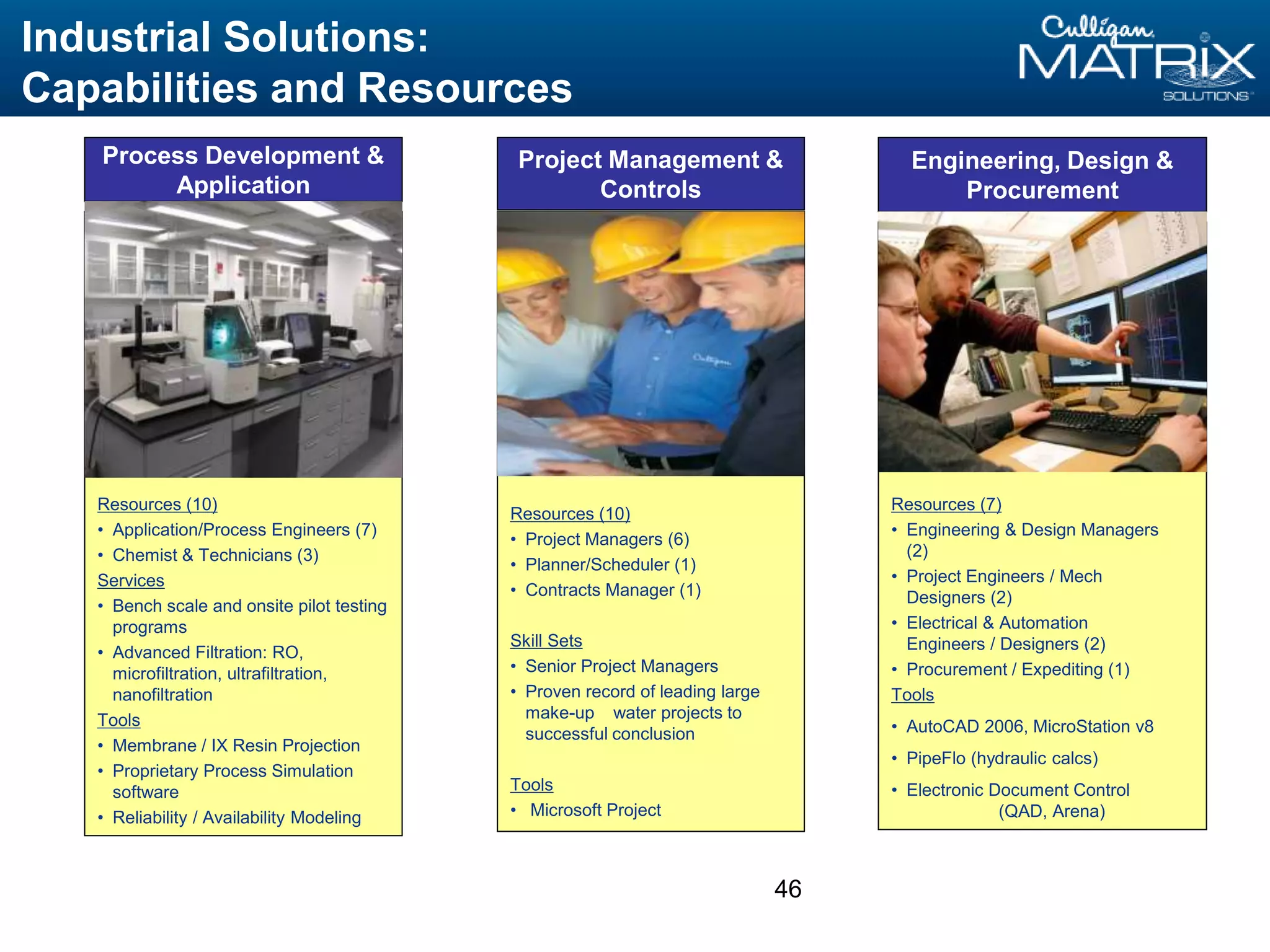
46
Project Management &
Controls
Engineering, Design &
Procurement
Industrial Solutions:
Capabilities and Resources
Resources (10)
• Project Managers (6)
• Planner/Scheduler (1)
• Contracts Manager (1)
Skill Sets
• Senior Project Managers
• Proven record of leading large
make-up water projects to
successful conclusion
Tools
• Microsoft Project
Resources (7)
• Engineering & Design Managers
(2)
• Project Engineers / Mech
Designers (2)
• Electrical & Automation
Engineers / Designers (2)
• Procurement / Expediting (1)
Tools
• AutoCAD 2006, MicroStation v8
• PipeFlo (hydraulic calcs)
• Electronic Document Control
(QAD, Arena)
Resources (10)
• Application/Process Engineers (7)
• Chemist & Technicians (3)
Services
• Bench scale and onsite pilot testing
programs
• Advanced Filtration: RO,
microfiltration, ultrafiltration,
nanofiltration
Tools
• Membrane / IX Resin Projection
• Proprietary Process Simulation
software
• Reliability / Availability Modeling
Process Development &
Application
Hall’s Water Group Overview
 One of the Largest Culligan Dealers in the
Franchise Network
 29 locations from Coast-to-Coast
 Over 700 employees
 6 locations in Ohio
Q & A
? ? ?

Noh reverse osmosis

  • 1.
    Reverse Osmosis (RO)Basics Presented by Nitin Chauhan of Culligan (Hall’s Water Group) For ASPE Cleveland Chapter October 2012
  • 2.
    Outline of Topics I.RO – Fundamentals of RO – RO Selection and Design Criteria – How to size a RO II. Benefits of Using RO – Energy Savings • Research from DOE (Dept of Energy) – Other Benefits – RO for BFW • Water Savings • Chemical Savings • RO Brine Reclaim
  • 3.
    Outline of TopicsCont’d III. Culligan Background – Culligan International – Hall’s Water Group – Culligan of Greater Cleveland
  • 4.
    Fundamentals of RO Themovement of a solvent (water in our case) across a semi-permeable membrane from a solution of lower concentration to a solution of higher concentration that tends to equalize the concentrations of solute on the both sides of the membrane. What is Osmosis?
  • 5.
  • 6.
    Brackish Water FreshWater Semipermiable Membrane Osmosis in Nature Osmotic Pressure
  • 7.
  • 8.
  • 9.
  • 10.
  • 11.
  • 12.
    Waste Water ProductWater Semipermiable Membrane Reverse Osmosis
  • 13.
  • 14.
  • 16.
    General RO SystemDesign FOR EXAMPLE, A SINGLE 4” MEMBRANE SYSTEM FEED PERMEATE CONCENTRATE 1 GPM 4 GPM 5 GPM RAW FEED 3 GPM RECYCLE 2 GPM 2 GPM 20%PERM FLOW FEED FLOW RECOVERY = x 100 = 98% 10 PPM 667 PPM 500 PPM 500 PPM 667 PPM PERM TDS FEED TDS REJECTION = x 100 = 1 -( ) BY ADDING RECYCLE, THE RECOVERY WILL INCREASE BUT PRODUCT TDS WILL ALSO GO UP 12 PPM 566 PPM 33%
  • 17.
    General RO SystemDesign ADDING MORE MEMBRANES IN SERIES WILL ALSO INCREASE RECOVERY FEED PERMEATE CONC PERM FLOW FEED FLOW RECOVERY = x 100 = 1 GPM 20 %33 %43 % 1 GPM 2 GPM 1 GPM 3 GPM 5 GPM 4 GPM6 GPM 5 GPM 4 GPM 7 GPM 6 GPM 5 GPM 4 GPM
  • 18.
    RO Selection andSystem Design Brackish Water 4” Elements 8” Elements Average Permeate Flow 1 GPM 5 GPM Maximum Feed Flow 16 GPM 64 GPM Minimum Concentrate Flow 4 GPM 20 GPM
  • 19.
    Pretreatment Water Problems FeedWater Requirements Media Treatment Chemical Treatment Suspend Solids (TSS) NTU < 1 or SDI < 3 (5 max) Depth Filter Inject Coagulants/ Flocculants Chlorine (Oxidizers) 0 ppm Carbon Filter Sodium Meta Bisulfite (SBS) (inject 2 x Cl conc.) Hardness Softened Water Softener Antiscalant (~ 5 ppm) Bacteria 0 counts Ultra Violet Light or Ozone Chlorine
  • 20.
    Pretreatment Water Problems FeedWater Requirements Media Treatment Chemical Treatment Iron, Hydrogen Sulfide Fe (2+), 4 ppm Fe (3+), 0.1 ppm Manganese Green Sand 1) Chlorinate 2) Filter 3) Dechlorinate Silica Will precipitate at ~150 ppm NA 1) Special Antiscalant Dispersant. 2) Reduce RO Recovery Other Problematic Minerals
  • 21.
    Factors to ConsiderWhen Sizing RO  Temperature  Pressure  Total Dissolved Solids (TDS)
  • 22.
    R.O. Performance Factors Atlower temperatures, the water is denser, requiring more pressure to ‘push’ it through the membrane Rejection Output Temperature
  • 23.
    R.O. Performance Factors Higherpressure increases the quality and quantity of product water Output RejectionPressure
  • 24.
    R.O. Performance Factors TDS HigherTDS (total dissolved solids) raises the natural ‘osmotic’ pressure, which increases the water’s tendency to reverse it’s flow across the membrane Output Rejection
  • 25.
     Energy Savings-ReferenceDOE Report  Water Savings via increased Boiler cycles of concentration COC (typically increase from 10 to 50 COC.  Chemical Savings in the 25 to 50% range.  Water reclamation via RO for reject water. Benefits of Using RO
  • 26.
    26 Case Study ByDepartment of Energy
  • 27.
  • 28.
    Typical Boiler PFD Q SodiumZeolite Softeners Plant Boiler(s) DA Vent Plant Load Deareator Make Up Condensate Steam Loss Steam Rate Blowdown Feedwater
  • 29.
    2 cycles of concentration 100TDS200 TDS Cycles of Concentration - COC
  • 30.
    Calculating % Blowdown FWCycles = Neutralized Boiler Conductivity __________________________ Feedwater Conductivity Dearator/ Feedwater mmhos = 100 ppm Neutralized Boiler mmhos = 3000 ppm = 3.33 % Blowdown % Blowdown = 1 X100 ______________ Feedwater Cycles
  • 31.
    Effects of Concentrationon Chemical Feed Rate Feed rate at 10% blowdown or 10 FW cycle = Feedwater Plant Boiler(s) Deareator Blowdown Require a 50ppm of residual in the boiler Feed rate at 2% blowdown or 50 FW cycles = ? Make Up Boiler Residual / FW Cycles = Feed Rate 5 ppm 1 ppm
  • 32.
    Boiler ASME Limits TDSmax (ppm) 700-3500 600-3000 500-2500 200-1000 ALK. max (ppm) 350 300 250 200 TSS Max (ppm) 15 10 8 3 Conductivity (µmho/cm) 1100-5400 900-4600 800-3800 300-1500 Silica max (ppm SiO2) 150 90 40 30 0-300 301-450 451-600 601 -750Boiler PSIG
  • 33.
    Typical Water Analysis MunicipalSoftened RO Calcium 78 0.5 0.00 Magnesium 33 0.3 0.00 Sodium 50 160.2 1.77 Potassium 3.8 3.8 0.05 Strontium 0.2 0.2 0.00 Chloride 43.6 45 0.47 Sulfate 13.5 13.5 0.09 Bicarbonate 106 106 1.34 Flouride 0.5 0.5 0.00 Silica 22.4 22.4 0.29 pH 8 8 6.10 mmhos 311 320 6.50 in PPM as CaCO3
  • 34.
    Feedwater Plant Boiler(s) DA Vent PlantLoad Deareator Make Up Condensate Steam Loss Steam Rate Reverse Osmosis Softener RO Reject Q Blowdown Storage Tank RO added to Process Flow Diagram
  • 35.
    Other Benefits  Possibleimproved steam quality – Lower operating boiler alkalinity – Lower operating boiler TDS  Reduction in Neutralizing Amine feed rate – Easier Compliance with FDA steam requirements – Better Condensate corrosion protection  Softened RO reject water could be put to use. – Once thru cooling – Wash down water, truck rinsing – Possible CIP rinses – Other non critical apps.
  • 36.
    Potential Objections  ROwater is corrosive won’t it hurt my boiler ?  The RO water is too pure and is not good for boiler chemistry ?  RO’s are not reliable.  There is a lot a water loss with an RO.  My water treater said I should use a Dealkalizer
  • 37.
    All steam directlyinjected into finished product – 0% Condensate Return – 270 BHP Average Production – 10.7% Blowdown – $1.00/ Therm , $0.04 / KWH – Savings Energy $25,746/ year – Savings Chemicals $12,500/ year Total $38,246/ year – RO System Capital Costs: $38,000/ year Case Study: Pet Food Manufacturer
  • 38.
    Minimum Conditions forJustifications  350 BHP or 12,000 lbs/hr  50% Condensate Return or Less  Gas Prices $1.00 per Therm  Feed water TDS 350  % Blowdown >7.5% or 13 Feed water Cycles Energy Saving Calculator Boiler Energy Savings.xls
  • 39.
  • 40.
    RO Brine Reclaim ROBrine Reclaim
  • 41.
    41 PFD Brine ReclaimExample 22 GPM Reject to Drain RO Product Storage Reject Storage Boiler Make Up Storage 44 GPM of Reject Water Existing RO Units Product 132 GPM 176 GPM New Brine Reclaim Unit Product 22 GPM Inlet Supply Tank Chemical Feed Saved 11,500,000 gallons /yr of city water Boiler Blowdown reduced from 25% to 2% Netting: $61,000 per year in energy savings 50% Boiler Chemical savings
  • 42.
    Culligan Background  CulliganInternational  Hall’s Water Group  Culligan of Greater Cleveland
  • 43.
    43  Over 1400dealerships around the world - local service and support  Largest Pure Water play company  Over 600 North American locations  Service companies like Coca-cola, Toyota, John Deere, IBM and others  200 U.S. patents Culligan International Overview US and Worldwide Support and Expertise
  • 44.
    44 Picture this fromthe 167th floor of the Burge Dubai…….where Culligan works.. Shangri La Hotel Dusit – Hotel Index - Service Emirates Towers - Etisalet - RO Monarch – Food service
  • 45.
    45 Culligan Matrix Solutionsis based on building blocks – Large array of applications covered with just a few components – Simple, check the box system design concept – Each piece pre-engineered to work interchangeably – Pick the appropriate size, and all the pieces easily interconnect – Great platform to implement our technology & third party’s – Maximizes potential to capture spend Modular Advanced Water Treatment Systems Pre-Treatment Membrane Technology Polish Storage Distribution Control, Instrumentation, Pre-Packaging and Skid Mounting Culligan’s Matrix Solutions Concept
  • 46.
    46 Project Management & Controls Engineering,Design & Procurement Industrial Solutions: Capabilities and Resources Resources (10) • Project Managers (6) • Planner/Scheduler (1) • Contracts Manager (1) Skill Sets • Senior Project Managers • Proven record of leading large make-up water projects to successful conclusion Tools • Microsoft Project Resources (7) • Engineering & Design Managers (2) • Project Engineers / Mech Designers (2) • Electrical & Automation Engineers / Designers (2) • Procurement / Expediting (1) Tools • AutoCAD 2006, MicroStation v8 • PipeFlo (hydraulic calcs) • Electronic Document Control (QAD, Arena) Resources (10) • Application/Process Engineers (7) • Chemist & Technicians (3) Services • Bench scale and onsite pilot testing programs • Advanced Filtration: RO, microfiltration, ultrafiltration, nanofiltration Tools • Membrane / IX Resin Projection • Proprietary Process Simulation software • Reliability / Availability Modeling Process Development & Application
  • 47.
    Hall’s Water GroupOverview  One of the Largest Culligan Dealers in the Franchise Network  29 locations from Coast-to-Coast  Over 700 employees  6 locations in Ohio
  • 48.