The Fedora Project
The Fedora Project Fedora Digital Object Repository System Extensible digital object model Repository System exposed via Web service APIs Scalable, persistent storage for content and metadata Local and remote content Associate services with objects Content versioning Fedora Use cases Content Management (CMS) Digital Library architecture Digital Asset Management Institutional Repository Scholarly publishing Preservation Open source software
Priorities for digital libraries Managing digital resources as if they are all the same Delivering digital resources as if they are all unique and free to participate in any number of contexts Supporting digital scholarship wherever it may lead
Shortcomings of commercial digital library products Narrow focus on specific media formats (e.g. image databases, document management) Fail to effectively address interrelationships among digital entities Fail to address interoperability Fail to provide facilities for managing programs and tools that deliver digital content. Not extensible; do not enable easy integration of new tools and services
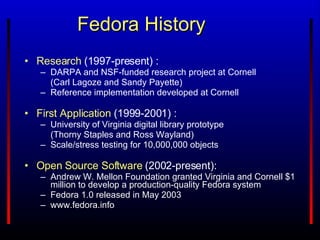
Fedora History Research  (1997-present) :  DARPA and NSF-funded research project at Cornell (Carl Lagoze and Sandy Payette) Reference implementation developed at Cornell  First Application  (1999-2001) :   University of Virginia digital library prototype (Thorny Staples and Ross Wayland) Scale/stress testing for 10,000,000 objects Open Source Software   (2002-present):   Andrew W. Mellon Foundation granted Virginia and Cornell $1 million to develop a production-quality Fedora system Fedora 1.0 released in May 2003 www.fedora.info
Fedora 1.x Architecture Software  Release 1.2 Features Demo Use Cases
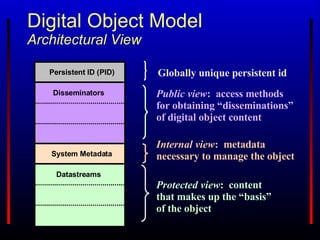
Persistent ID ( PID ) Disseminators System Metadata Datastreams Globally unique persistent id Public view :  access methods for obtaining “disseminations” of digital object content   Internal view :  metadata necessary to manage the object Protected view :  content that makes up the “basis” of the object Digital Object Model  Architectural View
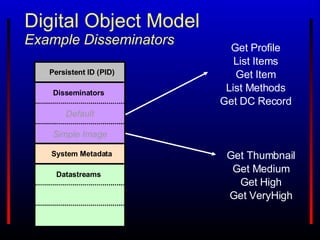
Persistent ID ( PID ) Default Disseminators Simple Image System Metadata Datastreams Digital Object Model  Example Disseminators Get Profile List Items Get Item List Methods Get DC Record Get Thumbnail Get Medium Get High Get VeryHigh
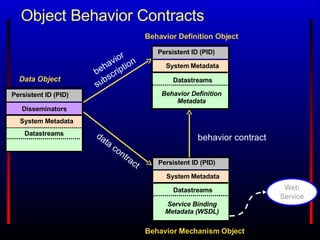
Data Object Web Service Object Behavior Contracts   behavior contract behavior subscription data contract Behavior Mechanism Object Behavior Definition Object Persistent ID (PID) Behavior Definition Metadata System Metadata Datastreams Persistent ID (PID) Service Binding Metadata (WSDL) System Metadata Datastreams Persistent ID (PID) Disseminators Datastreams System Metadata
DEMO:  Basic Use Cases Image (multiple datastreams) Image (Mr. SID) EAD (Rita Mae Brown papers) Text conversion (TEI to PDF) Basic Search
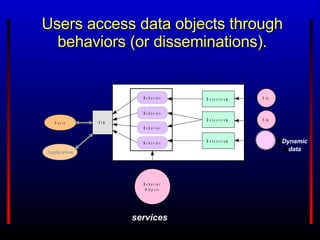
Users access data objects through behaviors (or disseminations). Application Dynamic data services
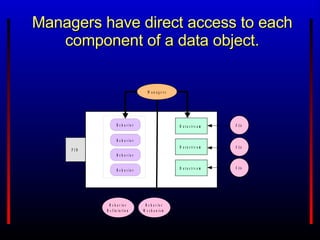
Managers have direct access to each component of a data object.
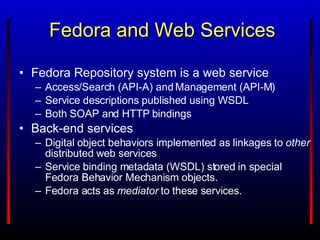
Fedora and Web Services Fedora Repository system is a web service Access/Search (API-A) and Management (API-M) Service descriptions published using WSDL Both SOAP and HTTP bindings Back-end services Digital object behaviors implemented as linkages to  other  distributed web services Service binding metadata (WSDL) stored in special Fedora Behavior Mechanism objects. Fedora acts as  mediator  to these services.
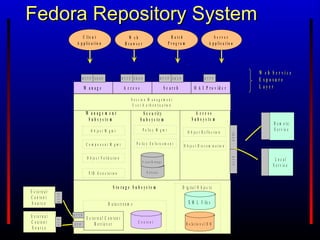
Fedora Repository System Client and Web Service Interactions Fedora Repository System Content Transform Service Content Transform Service user Web Service Dispatch Web Service Service Service Backend Frontend client application client application web browser user
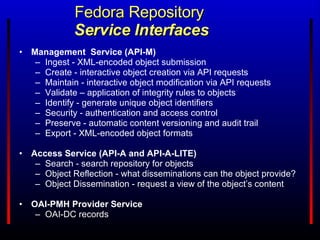
Fedora Repository  Service Interfaces Management  Service (API-M) Ingest - XML-encoded object submission Create - interactive object creation via API requests Maintain - interactive object modification via API requests Validate – application of integrity rules to objects Identify - generate unique object identifiers Security - authentication and access control Preserve - automatic content versioning and audit trail Export - XML-encoded object formats Access Service (API-A and API-A-LITE) Search - search repository for objects Object Reflection - what disseminations can the object provide? Object Dissemination - request a view of the object’s content OAI-PMH Provider Service OAI-DC records
Fedora Repository System
Fedora 1.2  Software Feature Set Open Fedora APIs  Repository as web services (REST and SOAP bindings); WSDL interface defs Flexible Digital Object Model Content View: objects as bundle of items (content and metadata) Service View: objects as a set of service methods (“behaviors”) Extensible functionality by associating services with objects Repository System Core Services: Management, Access/Search, OAI-PMH Storage:  XML object store; relational db object cache; relational db object registry Mediation -  auto-dispatching to distributed web services for content transformation Auto-Indexing – system metadata and DC record of each object HTTP Basic Authentication and Access Control Built-in disseminator services: XSLT x-form, image manipulation, xml-to-PDF Content Versioning Automatic version control (saves version of content/metadata when modified) Enables  date-time stamped   API requests  (see object as it looked at a point in time) Clients Fedora Administrator: GUI client to create/maintain objects Default Web browser interface: search; access objects via default disseminator Command line utilities (batch load, ingest, purge, others) Migration Utility – mass export/ingest
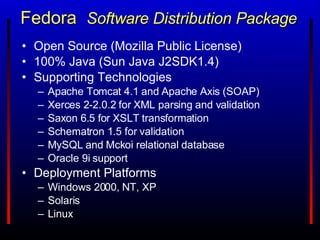
Fedora  Software Distribution Package Open Source (Mozilla Public License) 100% Java (Sun Java J2SDK1.4) Supporting Technologies Apache Tomcat 4.1 and Apache Axis (SOAP) Xerces 2-2.0.2 for XML parsing and validation Saxon 6.5 for XSLT transformation Schematron 1.5 for validation MySQL and Mckoi relational database Oracle 9i support Deployment Platforms Windows 2000, NT, XP Solaris Linux
DEMO:  Basic Use Cases Image (multiple datastreams) Image (Mr. SID) EAD (Rita Mae Brown papers) Text conversion (TEI to PDF) Basic Search
Projects using Fedora University of Virginia:   digital library (images,  EAD , e-texts) Tufts University:   educational (VUE/ concept maps); digital library VTLS:   basis for new commercial product (library system) Indiana University:   EVIA Digital Archive  (video) Northwestern:   academic technologies ( images ,  art , video, e-texts) Rutgers University:   digital library (e-journals, numeric data) Yale University:   Electronic Records Archive New York University:   Humanities Computing Group
Fedora Downloads since May 2003 Total downloads:  >1500 Average downloads per day: 9 # Countries: 32 Types of orgs: Universities: libraries, IT, departments Software and technology companies Defense/military Banks National libraries and archives Publishers Research labs Library automation vendors Scholarly societies
Future Software Releases Fedora Object XML (FOXML) Internal storage format; direct expression of Fedora object model Better support for relationships (“kinship” metadata) Better support for audit trail (event history) Format identifiers for dynamic service binding Shibboleth authentication Policy Enforcement XACML expression language Fedora policy enforcement module Web interface for easy content submission Batch object modification utility Administrative Reporting Object Event History (ABC/RDF disseminations) Better support for “collections” New ingest and export formats (METS1.3, DIDL) December 2003 – December 2004
Future Development Proposals Digital Library in a Box Full-featured DL application with “Fedora inside” Optimized for common set of content types Fedora Power Server Integrity Management Tools Service and link liveness checker Fault Tolerance Mirroring and Replication Peer-to-peer interoperability features Repository clustering Load balancing Object Creation Tools Workflow applications based on content models Web interface for document/content submission
End

Fedora

  • 1.
  • 2.
    The Fedora ProjectFedora Digital Object Repository System Extensible digital object model Repository System exposed via Web service APIs Scalable, persistent storage for content and metadata Local and remote content Associate services with objects Content versioning Fedora Use cases Content Management (CMS) Digital Library architecture Digital Asset Management Institutional Repository Scholarly publishing Preservation Open source software
  • 3.
    Priorities for digitallibraries Managing digital resources as if they are all the same Delivering digital resources as if they are all unique and free to participate in any number of contexts Supporting digital scholarship wherever it may lead
  • 4.
    Shortcomings of commercialdigital library products Narrow focus on specific media formats (e.g. image databases, document management) Fail to effectively address interrelationships among digital entities Fail to address interoperability Fail to provide facilities for managing programs and tools that deliver digital content. Not extensible; do not enable easy integration of new tools and services
  • 5.
    Fedora History Research (1997-present) : DARPA and NSF-funded research project at Cornell (Carl Lagoze and Sandy Payette) Reference implementation developed at Cornell First Application (1999-2001) : University of Virginia digital library prototype (Thorny Staples and Ross Wayland) Scale/stress testing for 10,000,000 objects Open Source Software (2002-present): Andrew W. Mellon Foundation granted Virginia and Cornell $1 million to develop a production-quality Fedora system Fedora 1.0 released in May 2003 www.fedora.info
  • 6.
    Fedora 1.x ArchitectureSoftware Release 1.2 Features Demo Use Cases
  • 7.
    Persistent ID (PID ) Disseminators System Metadata Datastreams Globally unique persistent id Public view : access methods for obtaining “disseminations” of digital object content Internal view : metadata necessary to manage the object Protected view : content that makes up the “basis” of the object Digital Object Model Architectural View
  • 8.
    Persistent ID (PID ) Default Disseminators Simple Image System Metadata Datastreams Digital Object Model Example Disseminators Get Profile List Items Get Item List Methods Get DC Record Get Thumbnail Get Medium Get High Get VeryHigh
  • 9.
    Data Object WebService Object Behavior Contracts behavior contract behavior subscription data contract Behavior Mechanism Object Behavior Definition Object Persistent ID (PID) Behavior Definition Metadata System Metadata Datastreams Persistent ID (PID) Service Binding Metadata (WSDL) System Metadata Datastreams Persistent ID (PID) Disseminators Datastreams System Metadata
  • 10.
    DEMO: BasicUse Cases Image (multiple datastreams) Image (Mr. SID) EAD (Rita Mae Brown papers) Text conversion (TEI to PDF) Basic Search
  • 11.
    Users access dataobjects through behaviors (or disseminations). Application Dynamic data services
  • 12.
    Managers have directaccess to each component of a data object.
  • 13.
    Fedora and WebServices Fedora Repository system is a web service Access/Search (API-A) and Management (API-M) Service descriptions published using WSDL Both SOAP and HTTP bindings Back-end services Digital object behaviors implemented as linkages to other distributed web services Service binding metadata (WSDL) stored in special Fedora Behavior Mechanism objects. Fedora acts as mediator to these services.
  • 14.
    Fedora Repository SystemClient and Web Service Interactions Fedora Repository System Content Transform Service Content Transform Service user Web Service Dispatch Web Service Service Service Backend Frontend client application client application web browser user
  • 15.
    Fedora Repository Service Interfaces Management Service (API-M) Ingest - XML-encoded object submission Create - interactive object creation via API requests Maintain - interactive object modification via API requests Validate – application of integrity rules to objects Identify - generate unique object identifiers Security - authentication and access control Preserve - automatic content versioning and audit trail Export - XML-encoded object formats Access Service (API-A and API-A-LITE) Search - search repository for objects Object Reflection - what disseminations can the object provide? Object Dissemination - request a view of the object’s content OAI-PMH Provider Service OAI-DC records
  • 16.
  • 17.
    Fedora 1.2 Software Feature Set Open Fedora APIs Repository as web services (REST and SOAP bindings); WSDL interface defs Flexible Digital Object Model Content View: objects as bundle of items (content and metadata) Service View: objects as a set of service methods (“behaviors”) Extensible functionality by associating services with objects Repository System Core Services: Management, Access/Search, OAI-PMH Storage: XML object store; relational db object cache; relational db object registry Mediation - auto-dispatching to distributed web services for content transformation Auto-Indexing – system metadata and DC record of each object HTTP Basic Authentication and Access Control Built-in disseminator services: XSLT x-form, image manipulation, xml-to-PDF Content Versioning Automatic version control (saves version of content/metadata when modified) Enables date-time stamped API requests (see object as it looked at a point in time) Clients Fedora Administrator: GUI client to create/maintain objects Default Web browser interface: search; access objects via default disseminator Command line utilities (batch load, ingest, purge, others) Migration Utility – mass export/ingest
  • 18.
    Fedora SoftwareDistribution Package Open Source (Mozilla Public License) 100% Java (Sun Java J2SDK1.4) Supporting Technologies Apache Tomcat 4.1 and Apache Axis (SOAP) Xerces 2-2.0.2 for XML parsing and validation Saxon 6.5 for XSLT transformation Schematron 1.5 for validation MySQL and Mckoi relational database Oracle 9i support Deployment Platforms Windows 2000, NT, XP Solaris Linux
  • 19.
    DEMO: BasicUse Cases Image (multiple datastreams) Image (Mr. SID) EAD (Rita Mae Brown papers) Text conversion (TEI to PDF) Basic Search
  • 20.
    Projects using FedoraUniversity of Virginia: digital library (images, EAD , e-texts) Tufts University: educational (VUE/ concept maps); digital library VTLS: basis for new commercial product (library system) Indiana University: EVIA Digital Archive (video) Northwestern: academic technologies ( images , art , video, e-texts) Rutgers University: digital library (e-journals, numeric data) Yale University: Electronic Records Archive New York University: Humanities Computing Group
  • 21.
    Fedora Downloads sinceMay 2003 Total downloads: >1500 Average downloads per day: 9 # Countries: 32 Types of orgs: Universities: libraries, IT, departments Software and technology companies Defense/military Banks National libraries and archives Publishers Research labs Library automation vendors Scholarly societies
  • 22.
    Future Software ReleasesFedora Object XML (FOXML) Internal storage format; direct expression of Fedora object model Better support for relationships (“kinship” metadata) Better support for audit trail (event history) Format identifiers for dynamic service binding Shibboleth authentication Policy Enforcement XACML expression language Fedora policy enforcement module Web interface for easy content submission Batch object modification utility Administrative Reporting Object Event History (ABC/RDF disseminations) Better support for “collections” New ingest and export formats (METS1.3, DIDL) December 2003 – December 2004
  • 23.
    Future Development ProposalsDigital Library in a Box Full-featured DL application with “Fedora inside” Optimized for common set of content types Fedora Power Server Integrity Management Tools Service and link liveness checker Fault Tolerance Mirroring and Replication Peer-to-peer interoperability features Repository clustering Load balancing Object Creation Tools Workflow applications based on content models Web interface for document/content submission
  • 24.