1
suppositoriessuppositories
By
ARUNKUMAR B. WALIKAR
M.PHARM
DEPARTMENT OF PHARMACEUTICS
B.L.D.E.A’s
S S M COLLEGE OF PHARMACY, VIJAYPUR
contentscontents
Introduction
Classification of suppositories
Advantages & disadvantages
Ideal properties of suppositories
Formulation of suppositories
Preparation of suppositories
Evaluation & packing of suppositories
2
IntroductionIntroduction
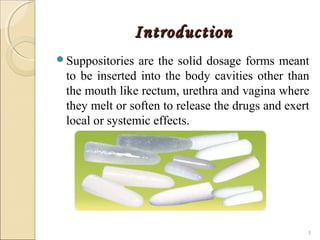
Suppositories are the solid dosage forms meant
to be inserted into the body cavities other than
the mouth like rectum, urethra and vagina where
they melt or soften to release the drugs and exert
local or systemic effects.
3
Classification Of SuppositoriesClassification Of Suppositories
Rectal suppositories
Vaginal suppositories ( PESSARIES )
Urethral suppositories ( BOUGIES )
Nasal suppositories
Ear suppositories or ear cones(Aurinaries)
4
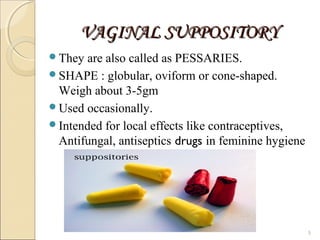
VAGINAL SUPPOSITORYVAGINAL SUPPOSITORY
They are also called as PESSARIES.
SHAPE : globular, oviform or cone-shaped.
Weigh about 3-5gm
Used occasionally.
Intended for local effects like contraceptives,
Antifungal, antiseptics drugs in feminine hygiene
5
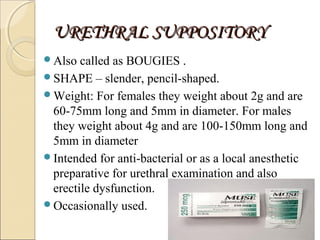
URETHRAL SUPPOSITORYURETHRAL SUPPOSITORY
Also called as BOUGIES .
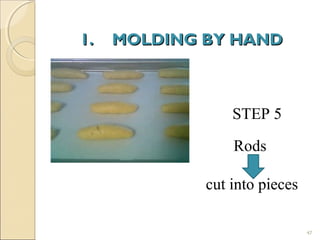
SHAPE – slender, pencil-shaped.
Weight: For females they weight about 2g and are
60-75mm long and 5mm in diameter. For males
they weight about 4g and are 100-150mm long and
5mm in diameter
Intended for anti-bacterial or as a local anesthetic
preparative for urethral examination and also
erectile dysfunction.
Occasionally used.
6
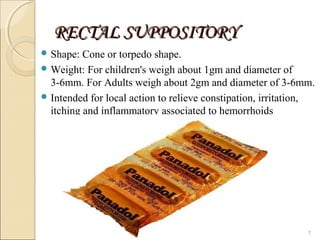
RECTAL SUPPOSITORYRECTAL SUPPOSITORY
 Shape: Cone or torpedo shape.
 Weight: For children's weigh about 1gm and diameter of
3-6mm. For Adults weigh about 2gm and diameter of 3-6mm.
 Intended for local action to relieve constipation, irritation,
itching and inflammatory associated to hemorrhoids
7
NASAL SUPPOSITORYNASAL SUPPOSITORY
Shape: They are thin cylindrical in shape
Weigh: Around 1gm
Base used: Glycero-gelatin base
Used occasionally.
Intended for Anti-inflammatory and anti-allergic
drugs
8
EAR CONE (Aurinaries)EAR CONE (Aurinaries)
Shape: They are long cylindrical in shape
Weigh: Around 1gm
Base used: Glycero-gelatin base
Used occasionally.
Eg: Waxylone
9
Classification Of Suppositories ViaClassification Of Suppositories Via
Position Of ActionPosition Of Action
LOCAL EFFECT :
In case of pain, itching and hemorrhoid.
Locally active drugs include astringents,
antiseptics, local anesthetics,
vasoconstrictors, anti-inflammatory,
soothing and protective agents and some
laxatives.
SYSTEMIC EFFECT :
Anti-asthmatics, anti rheumatics, anti-pyretic
and analgesics
10
ADVANTAGESADVANTAGES
EASILY ADMINSTERED to children, old
persons, to unconscious or sometimes to
mentally unstable persons who cannot
swallow the drug.
Convenient mode of administration for drugs
which irritate the GIT, causing vomiting and
destroyed in acidic pH of stomach and
enzymes of GIT.
FASTER ONSET OF ACTION as
compared to oral administration because
absorption of drug through rectal mucosa
directly reaches blood
11
DISADVANTAGESDISADVANTAGES
They are not acceptable by the patients.
The manufacturing process is difficult.
The drugs which cause irritation to the
mucous membrane cannot be administered
as suppositories.
Most of the suppositories should be stored
at low temperature10-20°c in a
refrigerator , other wise the base gets
liquified.
Leakage of the suppositories occurs upon
insertion into the body cavity at elevated
temperature.
12
IDEAL PROPERTIES OFIDEAL PROPERTIES OF
SUPPOSITORY BASESSUPPOSITORY BASES
It should melt at body temperature or
dissolve or disperse in body fluids.
It should release any medicament easily.
It should keep its shape when being
handled.
It should be non-toxic and non-irritant to
the mucous membrane.
It should be stable on storage and also
stable if heated above its M.P.
13
IDEAL PROPERTIESIDEAL PROPERTIES
OF SUPPOSITORYOF SUPPOSITORY
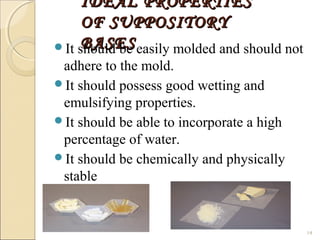
BASESBASESIt should be easily molded and should not
adhere to the mold.
It should possess good wetting and
emulsifying properties.
It should be able to incorporate a high
percentage of water.
It should be chemically and physically
stable
14
Formulation of suppositoriesFormulation of suppositories
1. Bases
2. Anti- oxidants
3. Emulsifying agents
4. Hardening agents
5. Preservatives
6. Thickening agents
7. Plasticizers
15
1. Hydrophilic bases: these are the one which have the ability to
absorb additional water in the preparation.
They are of two types
i. water-dispersible bases:
 properties: These are mixtures of non-ionic surfactants which
are chemically related to polyethylene glycols.
 These are used alone or in combination with other types of
bases
 Cellulose derivatives like methylcellulose sodium carboxy
methylcellulose also come under this class.
Eg; polyoxyethylene sorbitan fatty acid (tween) 16
SUPPOSITORY BASESSUPPOSITORY BASES
ii)Water soluble bases:ii)Water soluble bases:
A. Glycerinated gelatin or Glycero-gelatin:
 This occurs as a gel .It is a mixture of gelatin,
glycerol and water.
 According to B.P the composition of the base
is gelatin-14%w/w ,glycerol-70%w/w
 To get a stiff mass, the quantity of gelatin
should be increased to32%w/w and that of
glycerol reduced to 40%w/w.
17
A. Glycerinated gelatin
B. Polyethylene glycol (PEG) polymers.
18
A- Glycerinated GelatinA- Glycerinated Gelatin
 Glycerinated Gelatin is a useful suppository
base, particularly for vaginal suppositories,
where the prolonged localized action is usually
desired.
 Glycerinated gelatin suppositories are
translucent, resilient, gelatinous solids that tend
to dissolve or disperse slowly in mucous
secretions to provide prolonged release of active
ingredients.
 It is suitable for use with a wide range of
medicaments including alkaloids, boric acid, and
zinc oxide.
19
Suppositories made with glycerinated gelatin must
be kept in well-closed containers in a cool place
since they will absorb and dissolve in atmospheric
moisture.
Suppositories may have a dehydrating effect and
be irritating to the tissues upon insertion. The
water present in the formula of suppositories
minimizes this action and the suppositories may
be moistened with water prior to insertion to
reduce the tendency of the base to draw water
from mucous.
20
In addition, those suppositories intended for
extended shelf-life should have a
preservative added, such as methylparaben
or propylparaben, or a suitable combination
of the two.
To facilitate administration, glycerinated
gelatin suppositories should be dipped in
water just before use.
21
Preparation of glycerinated gelatin rectalPreparation of glycerinated gelatin rectal
suppositoriessuppositories
Mix or dissolve the medicaments in water to make
a total of 10 g.
Add 70 g of glycerin and mix.
Add 20 g of granular gelatin, mix carefully to
avoid incorporation of air.
Heat on a steam bath until the gelatin is dissolved.
Pour the melted mixture into molds and allow to
congeal.
22
Preparation of glycerinated gelatinPreparation of glycerinated gelatin
urethral suppositoriesurethral suppositories
The gelatin constitutes about 60% of the
weight of the formula, the glycerin about
20%, and the medicated aqueous portion
about 20%.
23
B-B- Polyethylene Glycol PolymersPolyethylene Glycol Polymers
 Polyethylene Glycol Polymers have received
much attention as suppository bases in recent
years because they possess many desirable
properties.
 They are chemically stable, nonirritating,
miscible with water and mucous secretions, and
can be formulated, either by molding or
compression, in a wide range of hardness and
melting point.
24
Like glycerinated gelatin, they do not melt at
body temperature, but dissolve to provide a more
prolonged release than theobroma oil.
Certain polyethylene glycol polymers may be
used singly as suppository bases but, more
commonly, formulas call for compounds of two or
more molecular weights mixed in various
proportions as needed to yield a finished product
of satisfactory hardness and dissolution time.
25
PEGs having average molecular weights of 200,
400 and 600 are clear, colorless liquids.
Those having molecular weights of greater than
1000 are wax-like, white solids with hardness
increasing with an increase in the molecular
weight.
 Since the water miscible suppositories dissolve
in body fluids and need not be formulated to melt
at body temperature, they can be formulated with
much higher melting points.
26
This property permits a slower release of
medicaments from the base, safe storage at room
temperature without need for refrigeration, and
ease and slow insertion.
To prevent irritation of the mucous membranes
after insertion of PEGs suppositories, they should
contain at least 20% of water or dipped in water
just prior to use.
27
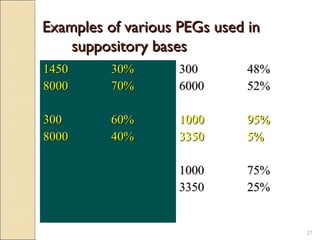
Examples of various PEGs used inExamples of various PEGs used in
suppository basessuppository bases
14501450
80008000
300300
80008000
30%30%
70%70%
60%60%
40%40%
300300
60006000
10001000
33503350
10001000
33503350
48%48%
52%52%
95%95%
5%5%
75%75%
25%25%
2.2. Oleaginous Bases (Fatty) 0rOleaginous Bases (Fatty) 0r Lipophilic BasesLipophilic Bases
1. Coca butter:
 Properties: It is a natural triglyceride
 It can exist in more than one crystalline
form i.e., it exhibits polymorphism
 It consists of mixture of oleic acid ,
palmitic acid , stearic acid .
28
29
If the base is fatty, it has the followingIf the base is fatty, it has the following
additional requirements:additional requirements:
Acid value is below 0.2.
Saponification value ranges from 200 to
245.
Iodine value is less than 7.
The interval between melting point and
solidification point is small.
30
A- Theobroma OilA- Theobroma Oil oror cocoa buttercocoa butter
 Theobroma Oil or cocoa butter is used as a
suppository base because, in large measure, it fulfills
the requirements of an ideal base.
 Cocoa butter is primarily a tri-glyceride, it is
yellowish- white, solid, brittle fat, which smells and
tastes like chocolate.
 At ordinary room temperatures of 15° to 25°C it is a
hard, amorphous solid, but at 30° to 35°C i.e., at
body temperature, it melts to a bland, nonirritating
oil.
31
 Thus in warm climates, theobroma oil
suppositories should be refrigerated.
 Cocoa butter has iodine value between 34 and
38.
 Its acid value not higher than 4.
32
Disadvantages of theobroma oilDisadvantages of theobroma oil
 Shrinks only slightly on solidification; a mould
lubricant is therefore required.
 Exists in four polymorphic forms with different
melting points (18.9, 23.0, 28.0, and 34.5ºC).
Theobroma should only be heated for a short time
and at temperatures below 36 ºC in order to
minimize the formation of the unstable low melting
point forms.
33
The change (reduction) in melting point caused by
addition of certain drugs such as volatile oils, phenol
or chloral hydrate to cocoa butter suppositories. The
solution is to raise the melting point back to the
desired range by addition of 3% to 5% of beeswax or
spermaceti.
Theobroma oil has a low absorptive capacity for
water, but this can be increased by adding surfactants
such as cholesterol 2%, emulsifying wax up to 10%,
polysorbates 5 to 10%, or wool fat 5 to 10%.
However, the addition of surfactants may lead to a
drug- base interaction or affect the release of drug
from suppository.
34
Theobroma oil is prone to oxidation (due to
high iodine value); this can be partly
overcome by storage in a cool, dark place.
Theobroma oil may vary in consistency, odor,
and color depending on its source like other
natural products.
The low melting point of theobroma oil may
pose storage problems in hot climates.
35
3. Miscellaneous Bases3. Miscellaneous Bases
Chemical or physical Mixtures of oleaginous and
water soluble or water miscible materials.
Emulsions, generally of w/o type (i.e. mixing of
cocoa butter with emulsifying agents).
Polyoxyl 40 stearate is a mixture of the mono-
stearate and di-stearate esters of mixed poly-
oxyethylene diols and the free glycols.
Soap may be used as a base (i.e. Glycerin
suppositories, USP, with soap as the base).
2.Anti-oxidants2.Anti-oxidants
They protect the drug and the base from
getting degraded due to oxidation.
Examples :
i. Ethyl or propyl gallate
ii. Ascorbic acid and its esters
iii.Hydroquinone
iv.Tocopherols
36
3.Emulsifying agents:3.Emulsifying agents:
 They increase the water-absorbing capacity
of fatty bases. This makes it possible to
include aqueous solutions in the formulation.
 Examples : polysorbates (tween 60)
 Wool alcohol ,wool fat
4. Hardening agents:
 These are included in those formulations
where the melting point of the base is
decreased by the drug.
37
38
These agents bring the melting point to normal.
Examples : macrogols with high molecular
weight.
5.Preservatives : They should be included in
suppositories which contain water soluble bases
to prevent microbial growth.
Examples :methyl paraben , propyl paraben
6.Thickening Agents: They increase the
viscosity of molten base and prevent
sedimentation of suspended insoluble solids.
Examples: Aluminium monostearate ,collodial
silica ,magnesium stearate.
7.Plasticizers :7.Plasticizers :
They impart plasticity to the fatty base
and makes it less brittle.
Examples :
i. Castor oil
ii.Glycerine or propylene glycol
iii.Glycol
iv.Tween 80
v.Tween 85
39
METHODS OF PREPARATIONMETHODS OF PREPARATION
Four methods
Suppositories can be extemporaneously
prepared by one of four methods.
1. Molding by hand or Hand Rolling
2. Compression
3. Fusion Molding or Pour molding
4. Compression in a tabletting machine
40
41
It is the oldest and simplest method of suppository
preparation and may be used when only a few
suppositories are to be prepared in a cocoa butter
base.
It has the advantage of avoiding the necessity of
heating the cocoa butter.
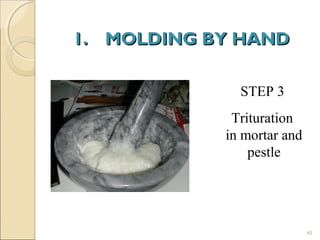
A plastic-like mass is prepared by triturating
grated cocoa butter and active ingredients in a
mortar.
1. Hand Rolling or MOLDING BY HANDor MOLDING BY HAND
42
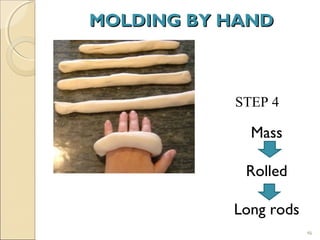
The mass is formed into a ball in the palm of the
hands, then rolled into a uniform cylinder with a
large spatula or small flat board on a pill tile.
The cylinder is then cut into the appropriate
number of pieces which are rolled on one end to
produce a conical shape.
Effective hand rolling requires considerable
practice and skill. The suppository "pipe" or
cylinder tends to crack or hollow in the center,
especially when the mass is insufficiently kneaded
and softened.
MOLDING BY HANDMOLDING BY HAND
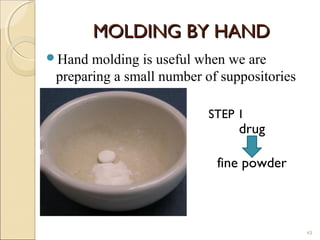
Hand molding is useful when we are
preparing a small number of suppositories
43
STEP 1
drug
fine powder
MOLDING BY HANDMOLDING BY HAND
44
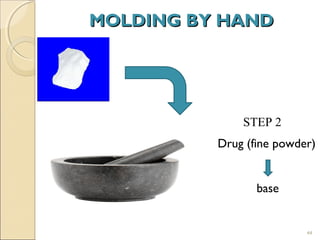
STEP 2
Drug (fine powder)
base
45
1.1. MOLDING BY HANDMOLDING BY HAND
STEP 3
Trituration
in mortar and
pestle
MOLDING BY HANDMOLDING BY HAND
46
STEP 4
Mass
Rolled
Long rods
47
1.1. MOLDING BY HANDMOLDING BY HAND
STEP 5
Rods
cut into pieces
48
2. Compression Molding2. Compression Molding
Compression molding is a method of preparing
suppositories from a mixed mass of grated
suppository base and medicaments which is forced
into a special compression mold using suppository
making machines.
The suppository base and the other ingredients are
combined by thorough mixing.
The friction of the process causing the base to
soften into a past-like consistency.
49
On a small scale, a mortar and pestle may be used
(preheated mortar facilitate softening of the base).
On large scale, mechanically operated kneading
mixers and a warmed mixing vessel may be
applied.
In the compression machine, the suppository mass
is placed into a cylinder which is then closed.
Pressure is applied from one end to release the
mass from the other end into the suppository mold
or die.
Compression Molding…..Compression Molding…..
50
When the die is filled with the mass, a
movable end plate at the back of the die is
removed and when additional pressure is
applied to the mass in the cylinder, the
formed suppositories are ejected.
The end plate is returned, and the process is
repeated until all of the suppository mass
has been used.
Compression Molding…..Compression Molding…..
51
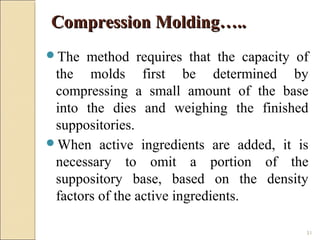
The method requires that the capacity of
the molds first be determined by
compressing a small amount of the base
into the dies and weighing the finished
suppositories.
When active ingredients are added, it is
necessary to omit a portion of the
suppository base, based on the density
factors of the active ingredients.
Compression Molding…..Compression Molding…..
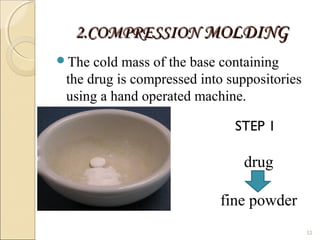
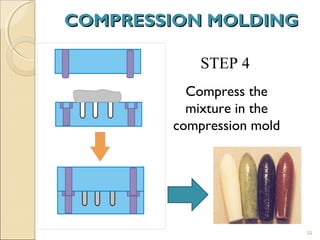
2.COMPRESSION2.COMPRESSION MOLDINGMOLDING
The cold mass of the base containing
the drug is compressed into suppositories
using a hand operated machine.
52
STEP 1
drug
fine powder
COMPRESSION MOLDINGCOMPRESSION MOLDING
53
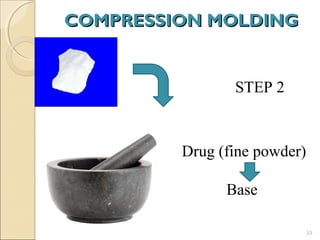
STEP 2
Drug (fine powder)
Base
COMPRESSION MOLDINGCOMPRESSION MOLDING
54
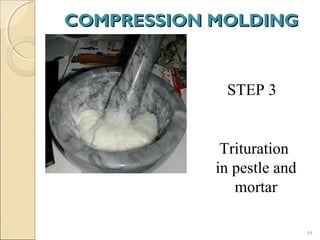
STEP 3
Trituration
in pestle and
mortar
COMPRESSION MOLDINGCOMPRESSION MOLDING
55
STEP 4
Compress the
mixture in the
compression mold
56
3. Fusion Molding3. Fusion Molding
Fusion Molding involves:
1- Melting the suppository base
2- Dispersing or dissolving the drug in the melted
base.
3- The mixture is removed from the heat and
poured into a suppository mold.
4- Allowing the melt to congeal
5- Removing the formed suppositories from the
mold.
The fusion method can be used with all types of
suppositories and must be used with most of them.
57
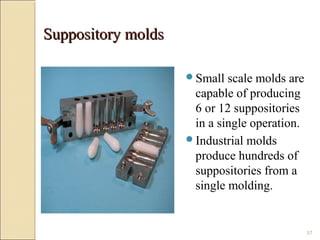
Suppository moldsSuppository molds
Small scale molds are
capable of producing
6 or 12 suppositories
in a single operation.
Industrial molds
produce hundreds of
suppositories from a
single molding.
58
Lubrication of the moldLubrication of the mold
Depending on the formulation, suppository molds
may require lubrication before the melt is poured
to facilitate the clean and easy removal of the
molded suppository.
Lubrication is seldom necessary when the
suppository base is contracting sufficiently on
cooling.
Lubrication is usually necessary when
glycerinated gelatin suppositories are prepared.

suppostories by A B Walikar

  • 1.
    1 suppositoriessuppositories By ARUNKUMAR B. WALIKAR M.PHARM DEPARTMENTOF PHARMACEUTICS B.L.D.E.A’s S S M COLLEGE OF PHARMACY, VIJAYPUR
  • 2.
    contentscontents Introduction Classification of suppositories Advantages& disadvantages Ideal properties of suppositories Formulation of suppositories Preparation of suppositories Evaluation & packing of suppositories 2
  • 3.
    IntroductionIntroduction Suppositories are thesolid dosage forms meant to be inserted into the body cavities other than the mouth like rectum, urethra and vagina where they melt or soften to release the drugs and exert local or systemic effects. 3
  • 4.
    Classification Of SuppositoriesClassificationOf Suppositories Rectal suppositories Vaginal suppositories ( PESSARIES ) Urethral suppositories ( BOUGIES ) Nasal suppositories Ear suppositories or ear cones(Aurinaries) 4
  • 5.
    VAGINAL SUPPOSITORYVAGINAL SUPPOSITORY Theyare also called as PESSARIES. SHAPE : globular, oviform or cone-shaped. Weigh about 3-5gm Used occasionally. Intended for local effects like contraceptives, Antifungal, antiseptics drugs in feminine hygiene 5
  • 6.
    URETHRAL SUPPOSITORYURETHRAL SUPPOSITORY Alsocalled as BOUGIES . SHAPE – slender, pencil-shaped. Weight: For females they weight about 2g and are 60-75mm long and 5mm in diameter. For males they weight about 4g and are 100-150mm long and 5mm in diameter Intended for anti-bacterial or as a local anesthetic preparative for urethral examination and also erectile dysfunction. Occasionally used. 6
  • 7.
    RECTAL SUPPOSITORYRECTAL SUPPOSITORY Shape: Cone or torpedo shape.  Weight: For children's weigh about 1gm and diameter of 3-6mm. For Adults weigh about 2gm and diameter of 3-6mm.  Intended for local action to relieve constipation, irritation, itching and inflammatory associated to hemorrhoids 7
  • 8.
    NASAL SUPPOSITORYNASAL SUPPOSITORY Shape:They are thin cylindrical in shape Weigh: Around 1gm Base used: Glycero-gelatin base Used occasionally. Intended for Anti-inflammatory and anti-allergic drugs 8
  • 9.
    EAR CONE (Aurinaries)EARCONE (Aurinaries) Shape: They are long cylindrical in shape Weigh: Around 1gm Base used: Glycero-gelatin base Used occasionally. Eg: Waxylone 9
  • 10.
    Classification Of SuppositoriesViaClassification Of Suppositories Via Position Of ActionPosition Of Action LOCAL EFFECT : In case of pain, itching and hemorrhoid. Locally active drugs include astringents, antiseptics, local anesthetics, vasoconstrictors, anti-inflammatory, soothing and protective agents and some laxatives. SYSTEMIC EFFECT : Anti-asthmatics, anti rheumatics, anti-pyretic and analgesics 10
  • 11.
    ADVANTAGESADVANTAGES EASILY ADMINSTERED tochildren, old persons, to unconscious or sometimes to mentally unstable persons who cannot swallow the drug. Convenient mode of administration for drugs which irritate the GIT, causing vomiting and destroyed in acidic pH of stomach and enzymes of GIT. FASTER ONSET OF ACTION as compared to oral administration because absorption of drug through rectal mucosa directly reaches blood 11
  • 12.
    DISADVANTAGESDISADVANTAGES They are notacceptable by the patients. The manufacturing process is difficult. The drugs which cause irritation to the mucous membrane cannot be administered as suppositories. Most of the suppositories should be stored at low temperature10-20°c in a refrigerator , other wise the base gets liquified. Leakage of the suppositories occurs upon insertion into the body cavity at elevated temperature. 12
  • 13.
    IDEAL PROPERTIES OFIDEALPROPERTIES OF SUPPOSITORY BASESSUPPOSITORY BASES It should melt at body temperature or dissolve or disperse in body fluids. It should release any medicament easily. It should keep its shape when being handled. It should be non-toxic and non-irritant to the mucous membrane. It should be stable on storage and also stable if heated above its M.P. 13
  • 14.
    IDEAL PROPERTIESIDEAL PROPERTIES OFSUPPOSITORYOF SUPPOSITORY BASESBASESIt should be easily molded and should not adhere to the mold. It should possess good wetting and emulsifying properties. It should be able to incorporate a high percentage of water. It should be chemically and physically stable 14
  • 15.
    Formulation of suppositoriesFormulationof suppositories 1. Bases 2. Anti- oxidants 3. Emulsifying agents 4. Hardening agents 5. Preservatives 6. Thickening agents 7. Plasticizers 15
  • 16.
    1. Hydrophilic bases:these are the one which have the ability to absorb additional water in the preparation. They are of two types i. water-dispersible bases:  properties: These are mixtures of non-ionic surfactants which are chemically related to polyethylene glycols.  These are used alone or in combination with other types of bases  Cellulose derivatives like methylcellulose sodium carboxy methylcellulose also come under this class. Eg; polyoxyethylene sorbitan fatty acid (tween) 16 SUPPOSITORY BASESSUPPOSITORY BASES
  • 17.
    ii)Water soluble bases:ii)Watersoluble bases: A. Glycerinated gelatin or Glycero-gelatin:  This occurs as a gel .It is a mixture of gelatin, glycerol and water.  According to B.P the composition of the base is gelatin-14%w/w ,glycerol-70%w/w  To get a stiff mass, the quantity of gelatin should be increased to32%w/w and that of glycerol reduced to 40%w/w. 17 A. Glycerinated gelatin B. Polyethylene glycol (PEG) polymers.
  • 18.
    18 A- Glycerinated GelatinA-Glycerinated Gelatin  Glycerinated Gelatin is a useful suppository base, particularly for vaginal suppositories, where the prolonged localized action is usually desired.  Glycerinated gelatin suppositories are translucent, resilient, gelatinous solids that tend to dissolve or disperse slowly in mucous secretions to provide prolonged release of active ingredients.  It is suitable for use with a wide range of medicaments including alkaloids, boric acid, and zinc oxide.
  • 19.
    19 Suppositories made withglycerinated gelatin must be kept in well-closed containers in a cool place since they will absorb and dissolve in atmospheric moisture. Suppositories may have a dehydrating effect and be irritating to the tissues upon insertion. The water present in the formula of suppositories minimizes this action and the suppositories may be moistened with water prior to insertion to reduce the tendency of the base to draw water from mucous.
  • 20.
    20 In addition, thosesuppositories intended for extended shelf-life should have a preservative added, such as methylparaben or propylparaben, or a suitable combination of the two. To facilitate administration, glycerinated gelatin suppositories should be dipped in water just before use.
  • 21.
    21 Preparation of glycerinatedgelatin rectalPreparation of glycerinated gelatin rectal suppositoriessuppositories Mix or dissolve the medicaments in water to make a total of 10 g. Add 70 g of glycerin and mix. Add 20 g of granular gelatin, mix carefully to avoid incorporation of air. Heat on a steam bath until the gelatin is dissolved. Pour the melted mixture into molds and allow to congeal.
  • 22.
    22 Preparation of glycerinatedgelatinPreparation of glycerinated gelatin urethral suppositoriesurethral suppositories The gelatin constitutes about 60% of the weight of the formula, the glycerin about 20%, and the medicated aqueous portion about 20%.
  • 23.
    23 B-B- Polyethylene GlycolPolymersPolyethylene Glycol Polymers  Polyethylene Glycol Polymers have received much attention as suppository bases in recent years because they possess many desirable properties.  They are chemically stable, nonirritating, miscible with water and mucous secretions, and can be formulated, either by molding or compression, in a wide range of hardness and melting point.
  • 24.
    24 Like glycerinated gelatin,they do not melt at body temperature, but dissolve to provide a more prolonged release than theobroma oil. Certain polyethylene glycol polymers may be used singly as suppository bases but, more commonly, formulas call for compounds of two or more molecular weights mixed in various proportions as needed to yield a finished product of satisfactory hardness and dissolution time.
  • 25.
    25 PEGs having averagemolecular weights of 200, 400 and 600 are clear, colorless liquids. Those having molecular weights of greater than 1000 are wax-like, white solids with hardness increasing with an increase in the molecular weight.  Since the water miscible suppositories dissolve in body fluids and need not be formulated to melt at body temperature, they can be formulated with much higher melting points.
  • 26.
    26 This property permitsa slower release of medicaments from the base, safe storage at room temperature without need for refrigeration, and ease and slow insertion. To prevent irritation of the mucous membranes after insertion of PEGs suppositories, they should contain at least 20% of water or dipped in water just prior to use.
  • 27.
    27 Examples of variousPEGs used inExamples of various PEGs used in suppository basessuppository bases 14501450 80008000 300300 80008000 30%30% 70%70% 60%60% 40%40% 300300 60006000 10001000 33503350 10001000 33503350 48%48% 52%52% 95%95% 5%5% 75%75% 25%25%
  • 28.
    2.2. Oleaginous Bases(Fatty) 0rOleaginous Bases (Fatty) 0r Lipophilic BasesLipophilic Bases 1. Coca butter:  Properties: It is a natural triglyceride  It can exist in more than one crystalline form i.e., it exhibits polymorphism  It consists of mixture of oleic acid , palmitic acid , stearic acid . 28
  • 29.
    29 If the baseis fatty, it has the followingIf the base is fatty, it has the following additional requirements:additional requirements: Acid value is below 0.2. Saponification value ranges from 200 to 245. Iodine value is less than 7. The interval between melting point and solidification point is small.
  • 30.
    30 A- Theobroma OilA-Theobroma Oil oror cocoa buttercocoa butter  Theobroma Oil or cocoa butter is used as a suppository base because, in large measure, it fulfills the requirements of an ideal base.  Cocoa butter is primarily a tri-glyceride, it is yellowish- white, solid, brittle fat, which smells and tastes like chocolate.  At ordinary room temperatures of 15° to 25°C it is a hard, amorphous solid, but at 30° to 35°C i.e., at body temperature, it melts to a bland, nonirritating oil.
  • 31.
    31  Thus inwarm climates, theobroma oil suppositories should be refrigerated.  Cocoa butter has iodine value between 34 and 38.  Its acid value not higher than 4.
  • 32.
    32 Disadvantages of theobromaoilDisadvantages of theobroma oil  Shrinks only slightly on solidification; a mould lubricant is therefore required.  Exists in four polymorphic forms with different melting points (18.9, 23.0, 28.0, and 34.5ºC). Theobroma should only be heated for a short time and at temperatures below 36 ºC in order to minimize the formation of the unstable low melting point forms.
  • 33.
    33 The change (reduction)in melting point caused by addition of certain drugs such as volatile oils, phenol or chloral hydrate to cocoa butter suppositories. The solution is to raise the melting point back to the desired range by addition of 3% to 5% of beeswax or spermaceti. Theobroma oil has a low absorptive capacity for water, but this can be increased by adding surfactants such as cholesterol 2%, emulsifying wax up to 10%, polysorbates 5 to 10%, or wool fat 5 to 10%. However, the addition of surfactants may lead to a drug- base interaction or affect the release of drug from suppository.
  • 34.
    34 Theobroma oil isprone to oxidation (due to high iodine value); this can be partly overcome by storage in a cool, dark place. Theobroma oil may vary in consistency, odor, and color depending on its source like other natural products. The low melting point of theobroma oil may pose storage problems in hot climates.
  • 35.
    35 3. Miscellaneous Bases3.Miscellaneous Bases Chemical or physical Mixtures of oleaginous and water soluble or water miscible materials. Emulsions, generally of w/o type (i.e. mixing of cocoa butter with emulsifying agents). Polyoxyl 40 stearate is a mixture of the mono- stearate and di-stearate esters of mixed poly- oxyethylene diols and the free glycols. Soap may be used as a base (i.e. Glycerin suppositories, USP, with soap as the base).
  • 36.
    2.Anti-oxidants2.Anti-oxidants They protect thedrug and the base from getting degraded due to oxidation. Examples : i. Ethyl or propyl gallate ii. Ascorbic acid and its esters iii.Hydroquinone iv.Tocopherols 36
  • 37.
    3.Emulsifying agents:3.Emulsifying agents: They increase the water-absorbing capacity of fatty bases. This makes it possible to include aqueous solutions in the formulation.  Examples : polysorbates (tween 60)  Wool alcohol ,wool fat 4. Hardening agents:  These are included in those formulations where the melting point of the base is decreased by the drug. 37
  • 38.
    38 These agents bringthe melting point to normal. Examples : macrogols with high molecular weight. 5.Preservatives : They should be included in suppositories which contain water soluble bases to prevent microbial growth. Examples :methyl paraben , propyl paraben 6.Thickening Agents: They increase the viscosity of molten base and prevent sedimentation of suspended insoluble solids. Examples: Aluminium monostearate ,collodial silica ,magnesium stearate.
  • 39.
    7.Plasticizers :7.Plasticizers : Theyimpart plasticity to the fatty base and makes it less brittle. Examples : i. Castor oil ii.Glycerine or propylene glycol iii.Glycol iv.Tween 80 v.Tween 85 39
  • 40.
    METHODS OF PREPARATIONMETHODSOF PREPARATION Four methods Suppositories can be extemporaneously prepared by one of four methods. 1. Molding by hand or Hand Rolling 2. Compression 3. Fusion Molding or Pour molding 4. Compression in a tabletting machine 40
  • 41.
    41 It is theoldest and simplest method of suppository preparation and may be used when only a few suppositories are to be prepared in a cocoa butter base. It has the advantage of avoiding the necessity of heating the cocoa butter. A plastic-like mass is prepared by triturating grated cocoa butter and active ingredients in a mortar. 1. Hand Rolling or MOLDING BY HANDor MOLDING BY HAND
  • 42.
    42 The mass isformed into a ball in the palm of the hands, then rolled into a uniform cylinder with a large spatula or small flat board on a pill tile. The cylinder is then cut into the appropriate number of pieces which are rolled on one end to produce a conical shape. Effective hand rolling requires considerable practice and skill. The suppository "pipe" or cylinder tends to crack or hollow in the center, especially when the mass is insufficiently kneaded and softened. MOLDING BY HANDMOLDING BY HAND
  • 43.
    MOLDING BY HANDMOLDINGBY HAND Hand molding is useful when we are preparing a small number of suppositories 43 STEP 1 drug fine powder
  • 44.
    MOLDING BY HANDMOLDINGBY HAND 44 STEP 2 Drug (fine powder) base
  • 45.
    45 1.1. MOLDING BYHANDMOLDING BY HAND STEP 3 Trituration in mortar and pestle
  • 46.
    MOLDING BY HANDMOLDINGBY HAND 46 STEP 4 Mass Rolled Long rods
  • 47.
    47 1.1. MOLDING BYHANDMOLDING BY HAND STEP 5 Rods cut into pieces
  • 48.
    48 2. Compression Molding2.Compression Molding Compression molding is a method of preparing suppositories from a mixed mass of grated suppository base and medicaments which is forced into a special compression mold using suppository making machines. The suppository base and the other ingredients are combined by thorough mixing. The friction of the process causing the base to soften into a past-like consistency.
  • 49.
    49 On a smallscale, a mortar and pestle may be used (preheated mortar facilitate softening of the base). On large scale, mechanically operated kneading mixers and a warmed mixing vessel may be applied. In the compression machine, the suppository mass is placed into a cylinder which is then closed. Pressure is applied from one end to release the mass from the other end into the suppository mold or die. Compression Molding…..Compression Molding…..
  • 50.
    50 When the dieis filled with the mass, a movable end plate at the back of the die is removed and when additional pressure is applied to the mass in the cylinder, the formed suppositories are ejected. The end plate is returned, and the process is repeated until all of the suppository mass has been used. Compression Molding…..Compression Molding…..
  • 51.
    51 The method requiresthat the capacity of the molds first be determined by compressing a small amount of the base into the dies and weighing the finished suppositories. When active ingredients are added, it is necessary to omit a portion of the suppository base, based on the density factors of the active ingredients. Compression Molding…..Compression Molding…..
  • 52.
    2.COMPRESSION2.COMPRESSION MOLDINGMOLDING The coldmass of the base containing the drug is compressed into suppositories using a hand operated machine. 52 STEP 1 drug fine powder
  • 53.
  • 54.
    COMPRESSION MOLDINGCOMPRESSION MOLDING 54 STEP3 Trituration in pestle and mortar
  • 55.
    COMPRESSION MOLDINGCOMPRESSION MOLDING 55 STEP4 Compress the mixture in the compression mold
  • 56.
    56 3. Fusion Molding3.Fusion Molding Fusion Molding involves: 1- Melting the suppository base 2- Dispersing or dissolving the drug in the melted base. 3- The mixture is removed from the heat and poured into a suppository mold. 4- Allowing the melt to congeal 5- Removing the formed suppositories from the mold. The fusion method can be used with all types of suppositories and must be used with most of them.
  • 57.
    57 Suppository moldsSuppository molds Smallscale molds are capable of producing 6 or 12 suppositories in a single operation. Industrial molds produce hundreds of suppositories from a single molding.
  • 58.
    58 Lubrication of themoldLubrication of the mold Depending on the formulation, suppository molds may require lubrication before the melt is poured to facilitate the clean and easy removal of the molded suppository. Lubrication is seldom necessary when the suppository base is contracting sufficiently on cooling. Lubrication is usually necessary when glycerinated gelatin suppositories are prepared.