Australian International School,
HCMC
Group 4 Internal Assessment Marking Form
Candidate’s Name (Family Name, Given Name)
Tam Hieu Nguyen
IB Candidate Number:
200892275
Instructors Name: Mr.Armstrong Subject and Level:
Physics
Date Performed
Research Question: Q = mc∆T
Q=heat energy
M=mass
C=specific heat
∆T=change in temperature
LEVELS AWARDED
Personal Engagement
/2
Explor
ation
/6
Analy
sis
/6
Evaluati
on
/6
Communicat
ion
/4
TOTAL
/22
NOTE:A score of ZERO (0) in any category indicates that that category of thereport does not reach the minimal level as
described in the category
PERSONAL ENGAGEMENT
LIMITED (1) SIGNIFICANT (2) Mark
The evidence of personal engagement with the
exploration is limitedwith little independent
thinking, initiative orcreativity.
The evidence of personal engagement with the
exploration is clearwith significant
independent thinking, initiative orcreativity.
The justification given for choosing the research
question and/or the topicunder investigation does
not demonstrate personal significance, interest or
curiosity.
The justification given for choosing the research
question and/or the topicunder investigation
demonstrates personal significance, interest or
curiosity.
There is little evidence of personalinput and
initiative in the designing, implementation or
presentation of theinvestigation.
There is evidence of personalinput and initiative
in the designing, implementation or presentation
of the investigation.
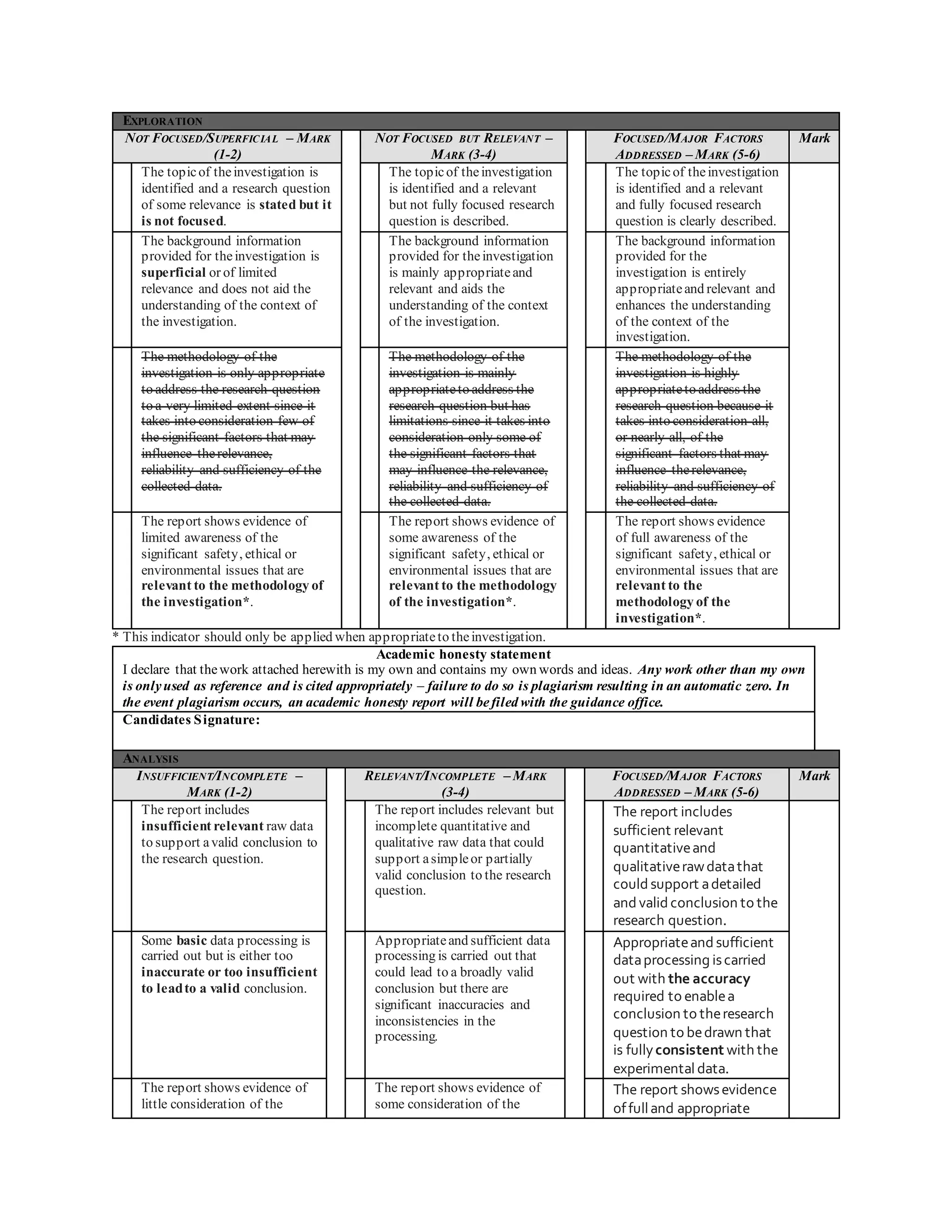
EXPLORATION
NOT FOCUSED/SUPERFICIAL – MARK
(1-2)
NOT FOCUSED BUT RELEVANT –
MARK (3-4)
FOCUSED/MAJOR FACTORS
ADDRESSED – MARK (5-6)
Mark
The topicof theinvestigation is
identified and a research question
of some relevance is stated but it
is not focused.
The topicof theinvestigation
is identified and a relevant
but not fully focused research
question is described.
The topicof theinvestigation
is identified and a relevant
and fully focused research
question is clearly described.
The background information
provided for theinvestigation is
superficial or of limited
relevance and does not aid the
understanding of the context of
the investigation.
The background information
provided for theinvestigation
is mainly appropriateand
relevant and aids the
understanding of the context
of the investigation.
The background information
provided for the
investigation is entirely
appropriateand relevant and
enhances the understanding
of the context of the
investigation.
The methodology of the
investigation is only appropriate
to address the research question
to a very limited extent since it
takes into consideration few of
the significant factors that may
influence therelevance,
reliability and sufficiency of the
collected data.
The methodology of the
investigation is mainly
appropriateto address the
research question but has
limitations since it takes into
consideration only some of
the significant factors that
may influence the relevance,
reliability and sufficiency of
the collected data.
The methodology of the
investigation is highly
appropriateto address the
research question because it
takes into consideration all,
or nearly all, of the
significant factors that may
influence therelevance,
reliability and sufficiency of
the collected data.
The report shows evidence of
limited awareness of the
significant safety, ethical or
environmental issues that are
relevant to the methodology of
the investigation*.
The report shows evidence of
some awareness of the
significant safety, ethical or
environmental issues that are
relevant to the methodology
of the investigation*.
The report shows evidence
of full awareness of the
significant safety, ethical or
environmental issues that are
relevant to the
methodology of the
investigation*.
* This indicator should only be applied when appropriateto theinvestigation.
Academic honesty statement
I declare that thework attached herewith is my own and contains my own words and ideas. Any work other than my own
is onlyused as reference and is cited appropriately – failure to do so is plagiarism resulting in an automatic zero. In
the event plagiarism occurs, an academic honesty report will befiled with the guidance office.
Candidates Signature:
ANALYSIS
INSUFFICIENT/INCOMPLETE –
MARK (1-2)
RELEVANT/INCOMPLETE – MARK
(3-4)
FOCUSED/MAJOR FACTORS
ADDRESSED – MARK (5-6)
Mark
The report includes
insufficient relevant raw data
to support avalid conclusion to
the research question.
The report includes relevant but
incomplete quantitative and
qualitative raw data that could
support asimpleor partially
valid conclusion to the research
question.
The report includes
sufficient relevant
quantitativeand
qualitativerawdatathat
could support adetailed
and valid conclusion to the
research question.
Some basic data processing is
carried out but is either too
inaccurate or too insufficient
to leadto a valid conclusion.
Appropriateand sufficient data
processing is carried out that
could lead to a broadly valid
conclusion but there are
significant inaccuracies and
inconsistencies in the
processing.
Appropriateand sufficient
dataprocessing iscarried
out with the accuracy
required to enablea
conclusion to theresearch
question to bedrawn that
is fullyconsistent with the
experimental data.
The report shows evidence of
little consideration of the
The report shows evidence of
some consideration of the
The report showsevidence
offull and appropriate
impact of measurement
uncertainty on the analysis.
impact of measurement
uncertainty on the analysis.
consideration ofthe
impact ofmeasurement
uncertaintyon the
analysis.
The processed data is
incorrectly or insufficiently
interpreted so that the
conclusion is invalid or very
incomplete.
The processed data is
interpreted so that a broadly
valid but incomplete or limited
conclusion to the research
question can be deduced.
The processed datais
correctlyinterpreted so
that acompletelyvalid and
detailed conclusion to the
research question can be
deduced.
EVALUATION
NOT RELEVANT/SUPERFICIAL –
MARK (1-2)
SOME RELEVANCE/DESCRIPTIONS –
MARK (3-4)
FULLY JUSTIFIED/
DESCRIBED/RELEVANT– MARK (5-
6)
Mark
A conclusion is outlined
which is not relevant to the
research question or is not
supported by thedata
presented.
A conclusion isdescribed
which isrelevant to the
research question and
supported bythedata
presented.
A detailed conclusion is
describedandjustified
which isentirely relevant to
theresearch question and
fullysupported bythedata
presented.
The conclusion makes
superficial comparison to
the accepted scientific
context.
A conclusion isdescribed
which makessome relevant
comparison to theaccepted
scientific context.
A conclusion iscorrectly
describedandjustified
through relevant
comparison to theaccepted
scientific context.
Strengths and weaknesses of
the investigation, such as
limitations of the data and
sources of error, are
outlinedbut are restricted
to an account of the
practical or procedural
issues faced.
Strengthsand weaknesses of
theinvestigation,such as
limitationsofthedataand
sourcesof error, are described
and provideevidence ofsome
awareness ofthe
methodologicalissues
involved in establishing the
conclusion.
Strengthsand weaknesses
oftheinvestigation,such as
limitationsofthedataand
sourcesof error, are
discussedand provide
evidenceof aclear
understanding ofthe
methodologicalissues
involved in establishing the
conclusion.
The student has outlined
very few realistic and
relevant suggestions for the
improvement and extension
of the investigation.
The student hasdescribed
somerealistic and relevant
suggestionsforthe
improvement and extension of
theinvestigation.
The student hasdiscussed
realistic and relevant
suggestionsforthe
improvement and extension
oftheinvestigation.
COMMUNICATION
UNCLEAR WITH ERRORS – MARK (1-2) CLEAR AND ERRORS DO NOT HAMPER
UNDERSTANDING – MARK (3-4)
Mark
The presentation of the investigation is unclear,
making it difficult to understandthe focus, process
and outcomes.
The presentation of the investigation is clear.
Any errors do not hamper understanding of
the focus, process and outcomes.
The report is not well structured and is unclear: the
necessary information on focus, process and outcomes
is missing or is presented in an incoherent or
disorganized way.
The report is well structured and clear: the
necessary information on focus, process and
outcomes is present and presented in a coherent
way.
The understanding of thefocus, process and outcomes
of the investigation is obscured by the presence of
inappropriateor irrelevant information.
The report is relevant and concise thereby
facilitating a ready understanding of the focus,
process and outcomes of the investigation.
There are many errors in theuse of subject specific
terminology and conventions*.
The use of subject-specific terminology and
conventions is appropriateand correct. Any
errors do not hamper understanding.
Parents Signature:
I have viewed my son/daughters
work . Date:
.
SPECIFIC HEAT CAPACITY OF COOKING OIL
1. Research Question
How to measure the specific heat capacity of cooking oil?
2. Theory/Background
specific heat capacity is the quantity of heat requiredtoraise the temperature
of a unit of mass of a substance by a unit change in temperature.
C=Q/m∆T (heat capacity=heat energy divide by mass multiply withthe change
of temperature)
where ∆Q is the change in heat content inJoules, m is the mass in kg, c is the
specific heat capacity inJ/kg0c and ∆T is the change in temperature in0C or K.
In order to make object’s temperature increase thenthe internal energy must
also increase.
Internal energy: Internal energy is definedas the energy associatedwiththe
random, disorderedmotionof molecules. (http://hyperphysics.phy-
astr.gsu.edu/hbase/thermo/inteng.html)
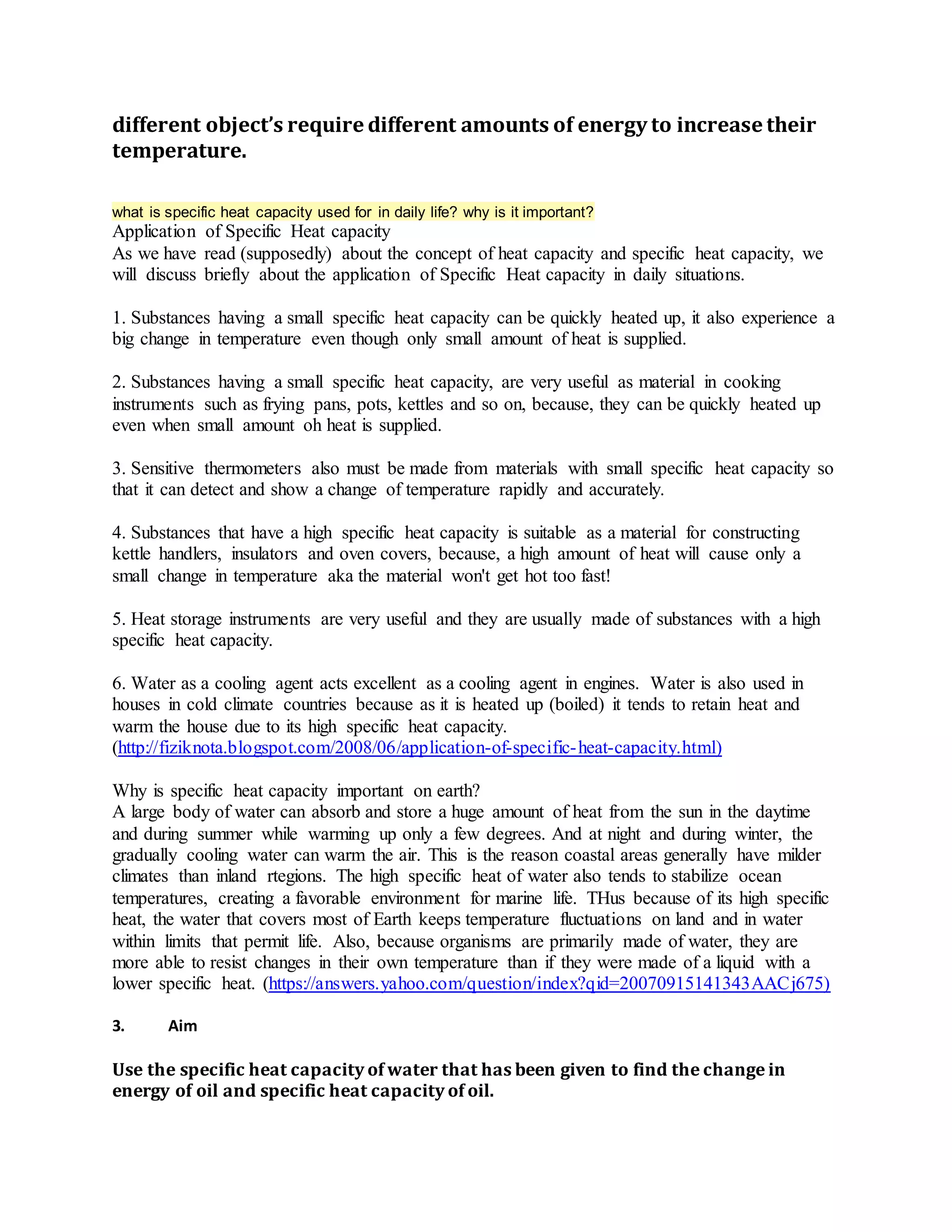
different object’s require different amounts of energy to increase their
temperature.
what is specific heat capacity used for in daily life? why is it important?
Application of Specific Heat capacity
As we have read (supposedly) about the concept of heat capacity and specific heat capacity, we
will discuss briefly about the application of Specific Heat capacity in daily situations.
1. Substances having a small specific heat capacity can be quickly heated up, it also experience a
big change in temperature even though only small amount of heat is supplied.
2. Substances having a small specific heat capacity, are very useful as material in cooking
instruments such as frying pans, pots, kettles and so on, because, they can be quickly heated up
even when small amount oh heat is supplied.
3. Sensitive thermometers also must be made from materials with small specific heat capacity so
that it can detect and show a change of temperature rapidly and accurately.
4. Substances that have a high specific heat capacity is suitable as a material for constructing
kettle handlers, insulators and oven covers, because, a high amount of heat will cause only a
small change in temperature aka the material won't get hot too fast!
5. Heat storage instruments are very useful and they are usually made of substances with a high
specific heat capacity.
6. Water as a cooling agent acts excellent as a cooling agent in engines. Water is also used in
houses in cold climate countries because as it is heated up (boiled) it tends to retain heat and
warm the house due to its high specific heat capacity.
(http://fiziknota.blogspot.com/2008/06/application-of-specific-heat-capacity.html)
Why is specific heat capacity important on earth?
A large body of water can absorb and store a huge amount of heat from the sun in the daytime
and during summer while warming up only a few degrees. And at night and during winter, the
gradually cooling water can warm the air. This is the reason coastal areas generally have milder
climates than inland rtegions. The high specific heat of water also tends to stabilize ocean
temperatures, creating a favorable environment for marine life. THus because of its high specific
heat, the water that covers most of Earth keeps temperature fluctuations on land and in water
within limits that permit life. Also, because organisms are primarily made of water, they are
more able to resist changes in their own temperature than if they were made of a liquid with a
lower specific heat. (https://answers.yahoo.com/question/index?qid=20070915141343AACj675)
3. Aim
Use the specific heat capacity of water that has been given to find the change in
energy of oil and specific heat capacity of oil.
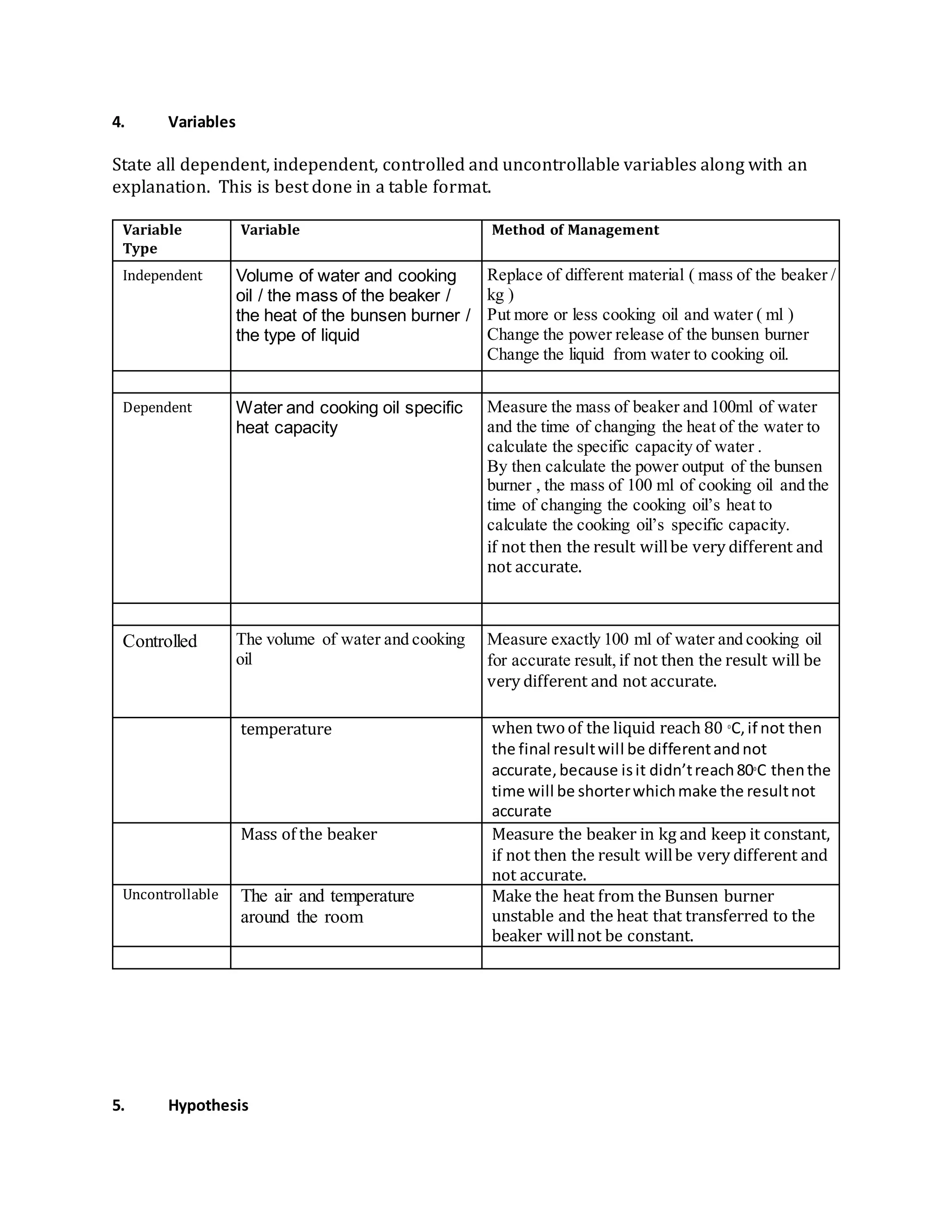
4. Variables
State all dependent, independent, controlled and uncontrollable variables along with an
explanation. This is best done in a table format.
Variable
Type
Variable Method of Management
Independent Volume of water and cooking
oil / the mass of the beaker /
the heat of the bunsen burner /
the type of liquid
Replace of different material ( mass of the beaker /
kg )
Put more or less cooking oil and water ( ml )
Change the power release of the bunsen burner
Change the liquid from water to cooking oil.
Dependent Water and cooking oil specific
heat capacity
Measure the mass of beaker and 100ml of water
and the time of changing the heat of the water to
calculate the specific capacity of water .
By then calculate the power output of the bunsen
burner , the mass of 100 ml of cooking oil and the
time of changing the cooking oil’s heat to
calculate the cooking oil’s specific capacity.
if not then the result willbe very different and
not accurate.
Controlled The volume of water and cooking
oil
Measure exactly 100 ml of water and cooking oil
for accurate result, if not then the result will be
very different and not accurate.
temperature when twoof the liquid reach 80 0
C,if not then
the final resultwill be differentandnot
accurate,because isit didn’treach800
C thenthe
time will be shorterwhichmake the resultnot
accurate
Mass of the beaker Measure the beaker in kg and keep it constant,
if not then the result willbe very different and
not accurate.
Uncontrollable The air and temperature
around the room
Make the heat from the Bunsen burner
unstable and the heat that transferred to the
beaker willnot be constant.
5. Hypothesis
From my knowledge,I know that oil islighterthan water because it always flow whenwe mixedthem
together.Moreover,the specificheatcapacity that the worksheetgivenme is4200 J/kg0
C,I predicted
that the specificheat capacity of oil will decrease approximatelyto 3000 or 2500 J/kg0
C. In additional,
the mass of oil is lighterthan water and this isdirect proportional withthe specificheat capacity, heat
energyand the time it needsto reach 800
C. Last but not least,in my theoriesand background part I
said that everysubstance will require differentamountof energyto increase the temperature and I
foundthat specificheat capacity for oil is2000J/kg0
C. As a conclusion,everynumberthat we calculate
for oil will be smallercompared to the number that we have for water.
6. Apparatus
1. Bunsen burner: (http://media-
2.web.britannica.com/eb-media/73/63573-004-
7CF1F150.jpg)
2. 250ml Beaker:
(http://exchangedownloads.smarttech.com/public/content/
0c/0c590c87-d1d2-41f8-b463-
9e78bb3bef2a/previews/medium/0001.png)
3. Thermometer:
(https://www.google.com/search?q=thermometer&es_sm=
91&source=lnms&tbm=isch&sa=X&ved=0CAcQ_AUoAWo
VChMIpLTEkvyOyQIVwTemCh0OEgQ8&biw=1440&bih=7
12#imgrc=n2cX4PGXLXtVaM%3A)
4. Tripod(not for camera :))) ) :
(http://www.proprofs.com/flashcards/upload/a4632045.jpg)
5. Gauze:
(http://kalyx.com/images/full/images_SP/SP_15101.jpg)
6. Electronic scale:
(http://i00.i.aliimg.com/wsphoto/v0/568101714/Precision-
Electronic-Scale-Hot-font-b-Sale-b-font-Digital-Balance-font-b-
Weight-b-font.jpg)
7. 100ml of water:
(http://genblock.com/wp-content/uploads/2015/08/water-
hd-desktop-wallpapers-for-widescreen-abstract-picture-
water-wallpaper.jpg)
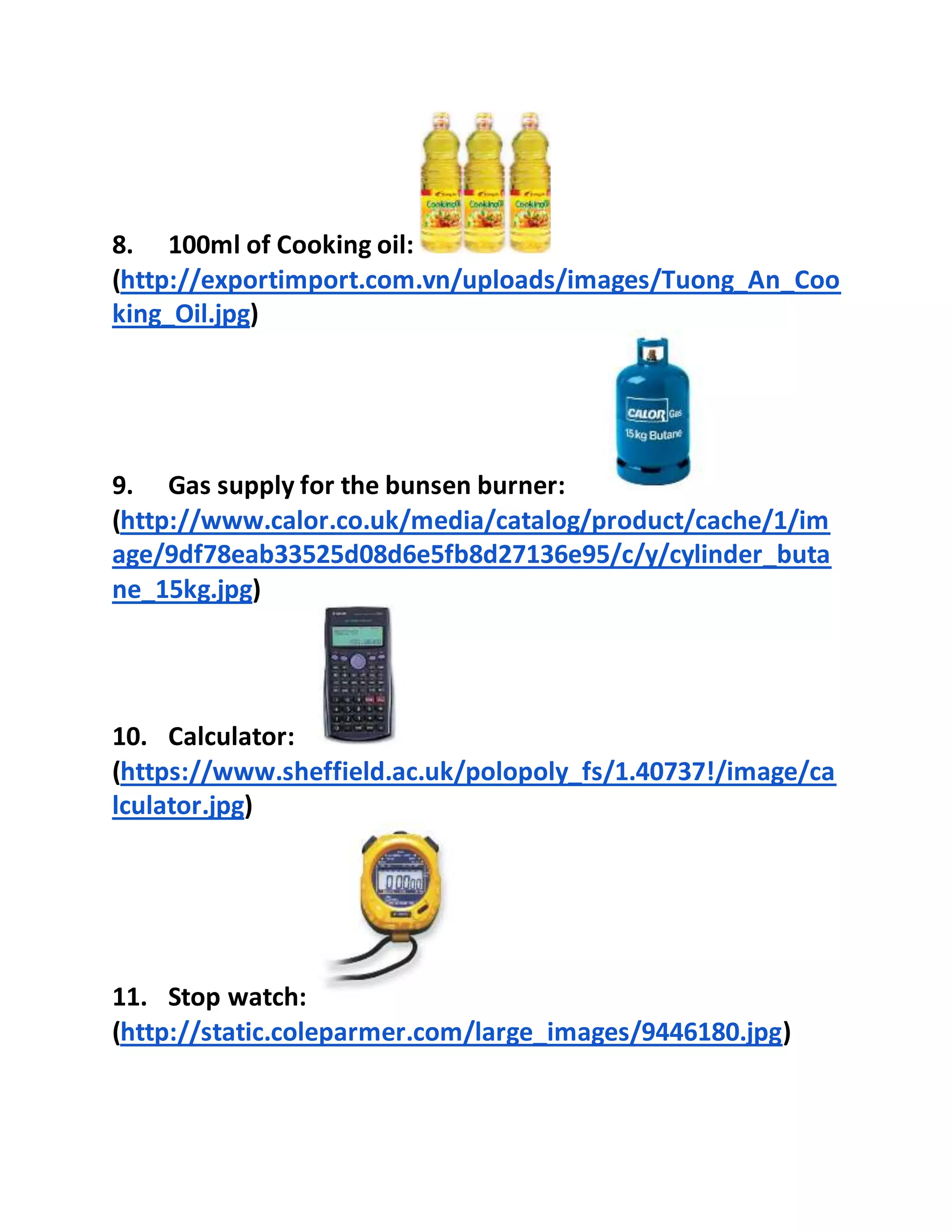
8. 100ml of Cooking oil:
(http://exportimport.com.vn/uploads/images/Tuong_An_Coo
king_Oil.jpg)
9. Gas supply for the bunsen burner:
(http://www.calor.co.uk/media/catalog/product/cache/1/im
age/9df78eab33525d08d6e5fb8d27136e95/c/y/cylinder_buta
ne_15kg.jpg)
10. Calculator:
(https://www.sheffield.ac.uk/polopoly_fs/1.40737!/image/ca
lculator.jpg)
11. Stop watch:
(http://static.coleparmer.com/large_images/9446180.jpg)
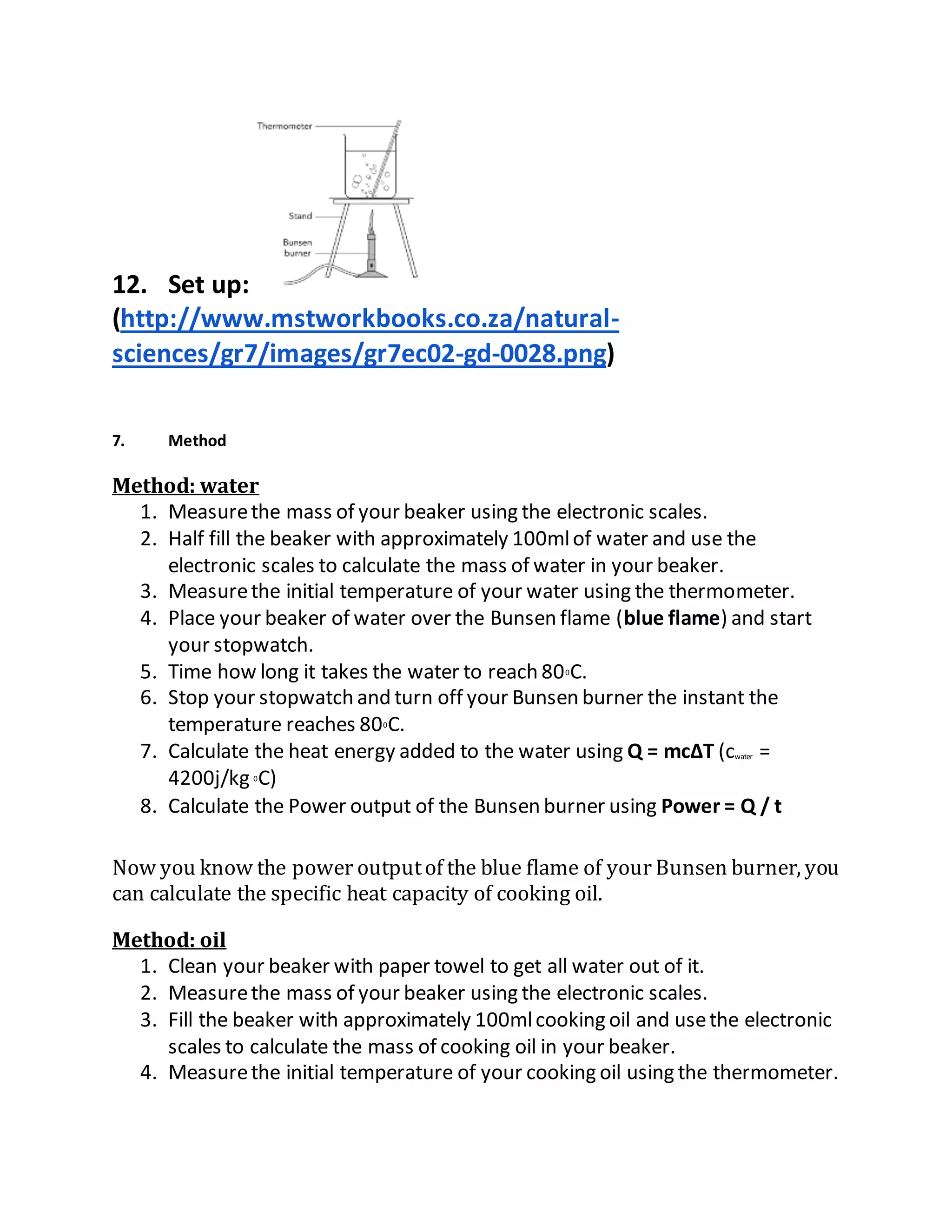
12. Set up:
(http://www.mstworkbooks.co.za/natural-
sciences/gr7/images/gr7ec02-gd-0028.png)
7. Method
Method: water
1. Measurethe mass of your beaker using the electronic scales.
2. Half fill the beaker with approximately 100mlof water and use the
electronic scales to calculate the mass of water in your beaker.
3. Measurethe initial temperature of your water using the thermometer.
4. Place your beaker of water over the Bunsen flame (blue flame) and start
your stopwatch.
5. Time how long it takes the water to reach 800C.
6. Stop your stopwatch and turn off your Bunsen burner the instant the
temperature reaches 800C.
7. Calculate the heat energy added to the water using Q = mc∆T (cwater =
4200j/kg 0C)
8. Calculate the Power output of the Bunsen burner using Power = Q / t
Now you know the power outputof the blue flame of your Bunsen burner, you
can calculate the specific heat capacity of cooking oil.
Method: oil
1. Clean your beaker with paper towel to get all water out of it.
2. Measurethe mass of your beaker using the electronic scales.
3. Fill the beaker with approximately 100mlcooking oil and usethe electronic
scales to calculate the mass of cooking oil in your beaker.
4. Measurethe initial temperature of your cooking oil using the thermometer.
5. Place your beaker of oil over the Bunsen flame (blue flame) and startyour
stopwatch.
6. Time how long it takes the oil to reach 800C.
7. Stop your stopwatch and turn off your Bunsen burner the instant the
temperature reaches 800C.
8. Calculate the specific heat capacity of the cooking oil.
Be carefulbecause it will be very hot and dangerous.
8. Results/Data Collection
water recordeddata SI unit
Mass of the beaker 116.5 g 0.1165 kg
mass of the beakerwith 100ml of water 208.3 g 0.2083kg
initial temperature of water 250C 250C
Final temperature of water 800C 800C
Time it took for the water to reach 800C 5 minutesand 7seconds 307s
the mass of the liquidwithout the mass of the beaker: 0.1165-0.2083= 0.0918
The change intemperature:800C- 250C= 550C
Oil Recordeddata SI unit
Mass of beaker 116.5 g 0.1165kg
Mass of beakerwith100ml of oil 200g 0.2kg
initial temperature of oil 260C 260C
final temperature of oil 800C 800C
time ittook to reach 800C 3 minutesand44 second 224 seconds
The mass of the oil withoutthe massof the beaker:0.2-0.1165= 0.0835 kg
the change in temperature: 800C-260C= 54 0C
9. Analysis/Data Processingand Presentation
formula for heat energy=mc∆T
Q = mc∆T
Q=heat energy (calories)
M=mass(kilogram)
C=specific heat (j/kg 0C)
∆T=change in temperature (Seconds)
Formulafor Power= Heat energy dividedby time
Power=Q/T
Q= heat energy (calories)
T= Time (seconds)
Water:
calculate the heat energy addedto the water:0.0918 X 4200 X (80-25) =21206 J
Calculate the power output of the Bunsen burner:21206/307=69.07W
Oil:
Calculate the heat energy addedto the oil: 69.07 X224=15471.68 J
Calculate specific heat capacity of cooking oil:15471.68÷(0.0835 X (80-26)) =
3431.3 (J/kg0C)
10. Evaluation
Our experimentwasconducted successfullyhoweverwe didnot get the exact resultdue to some
errors of the measurementandsurrounding factors. The researchedvalue for specificheat capacity of
oil is 2005 howeverwe got 3431.3 J/kg0
C. Some errors and improvementare in the box below.
Weakness/Limitation Impact on Results Improvement
Only do it once Not accurate result Do it at leasts 3 times
Decimal places and significant figure Not accurate result take all number
using digital thermometer for better
measurement
less accurate result Use digital thermometer
Eyes perspective toward the measure
of 100ml of water and oil. In additional
the eyes perspective for the
thermometer
Less accurate result change the eyes perspective.
Significant heat loss due to the
surrounding or room temperature
Less accurate,
because the time
will take longer to
reach 80 degrees
20 degrees to 25 is good enough,
we should do more than 3 times
and every times and each times
with different room temperature.
11. Conclusion
My hypothesiswas wrong about the specificheat capacity of oil.Furthermore,my resultwas very
differentfromthe researchresult,which is 3431.3 compare to 2005 J/kg0C. If I have a chance, I’ll do
the experimentagainand the resultwill be more accurate when I fixmy wrong in the evaluationpart.
Beside thisexperiment,Iwould love to do more experimentaboutheat capacity, for instance: gold,
copper,milk, oxygenand solidthat meltwhich is molten.
12. Reference List
Include in the text and picture.

Oil and water specific heat capacity

  • 1.
    Australian International School, HCMC Group4 Internal Assessment Marking Form Candidate’s Name (Family Name, Given Name) Tam Hieu Nguyen IB Candidate Number: 200892275 Instructors Name: Mr.Armstrong Subject and Level: Physics Date Performed Research Question: Q = mc∆T Q=heat energy M=mass C=specific heat ∆T=change in temperature LEVELS AWARDED Personal Engagement /2 Explor ation /6 Analy sis /6 Evaluati on /6 Communicat ion /4 TOTAL /22 NOTE:A score of ZERO (0) in any category indicates that that category of thereport does not reach the minimal level as described in the category PERSONAL ENGAGEMENT LIMITED (1) SIGNIFICANT (2) Mark The evidence of personal engagement with the exploration is limitedwith little independent thinking, initiative orcreativity. The evidence of personal engagement with the exploration is clearwith significant independent thinking, initiative orcreativity. The justification given for choosing the research question and/or the topicunder investigation does not demonstrate personal significance, interest or curiosity. The justification given for choosing the research question and/or the topicunder investigation demonstrates personal significance, interest or curiosity. There is little evidence of personalinput and initiative in the designing, implementation or presentation of theinvestigation. There is evidence of personalinput and initiative in the designing, implementation or presentation of the investigation.
  • 2.
    EXPLORATION NOT FOCUSED/SUPERFICIAL –MARK (1-2) NOT FOCUSED BUT RELEVANT – MARK (3-4) FOCUSED/MAJOR FACTORS ADDRESSED – MARK (5-6) Mark The topicof theinvestigation is identified and a research question of some relevance is stated but it is not focused. The topicof theinvestigation is identified and a relevant but not fully focused research question is described. The topicof theinvestigation is identified and a relevant and fully focused research question is clearly described. The background information provided for theinvestigation is superficial or of limited relevance and does not aid the understanding of the context of the investigation. The background information provided for theinvestigation is mainly appropriateand relevant and aids the understanding of the context of the investigation. The background information provided for the investigation is entirely appropriateand relevant and enhances the understanding of the context of the investigation. The methodology of the investigation is only appropriate to address the research question to a very limited extent since it takes into consideration few of the significant factors that may influence therelevance, reliability and sufficiency of the collected data. The methodology of the investigation is mainly appropriateto address the research question but has limitations since it takes into consideration only some of the significant factors that may influence the relevance, reliability and sufficiency of the collected data. The methodology of the investigation is highly appropriateto address the research question because it takes into consideration all, or nearly all, of the significant factors that may influence therelevance, reliability and sufficiency of the collected data. The report shows evidence of limited awareness of the significant safety, ethical or environmental issues that are relevant to the methodology of the investigation*. The report shows evidence of some awareness of the significant safety, ethical or environmental issues that are relevant to the methodology of the investigation*. The report shows evidence of full awareness of the significant safety, ethical or environmental issues that are relevant to the methodology of the investigation*. * This indicator should only be applied when appropriateto theinvestigation. Academic honesty statement I declare that thework attached herewith is my own and contains my own words and ideas. Any work other than my own is onlyused as reference and is cited appropriately – failure to do so is plagiarism resulting in an automatic zero. In the event plagiarism occurs, an academic honesty report will befiled with the guidance office. Candidates Signature: ANALYSIS INSUFFICIENT/INCOMPLETE – MARK (1-2) RELEVANT/INCOMPLETE – MARK (3-4) FOCUSED/MAJOR FACTORS ADDRESSED – MARK (5-6) Mark The report includes insufficient relevant raw data to support avalid conclusion to the research question. The report includes relevant but incomplete quantitative and qualitative raw data that could support asimpleor partially valid conclusion to the research question. The report includes sufficient relevant quantitativeand qualitativerawdatathat could support adetailed and valid conclusion to the research question. Some basic data processing is carried out but is either too inaccurate or too insufficient to leadto a valid conclusion. Appropriateand sufficient data processing is carried out that could lead to a broadly valid conclusion but there are significant inaccuracies and inconsistencies in the processing. Appropriateand sufficient dataprocessing iscarried out with the accuracy required to enablea conclusion to theresearch question to bedrawn that is fullyconsistent with the experimental data. The report shows evidence of little consideration of the The report shows evidence of some consideration of the The report showsevidence offull and appropriate
  • 3.
    impact of measurement uncertaintyon the analysis. impact of measurement uncertainty on the analysis. consideration ofthe impact ofmeasurement uncertaintyon the analysis. The processed data is incorrectly or insufficiently interpreted so that the conclusion is invalid or very incomplete. The processed data is interpreted so that a broadly valid but incomplete or limited conclusion to the research question can be deduced. The processed datais correctlyinterpreted so that acompletelyvalid and detailed conclusion to the research question can be deduced. EVALUATION NOT RELEVANT/SUPERFICIAL – MARK (1-2) SOME RELEVANCE/DESCRIPTIONS – MARK (3-4) FULLY JUSTIFIED/ DESCRIBED/RELEVANT– MARK (5- 6) Mark A conclusion is outlined which is not relevant to the research question or is not supported by thedata presented. A conclusion isdescribed which isrelevant to the research question and supported bythedata presented. A detailed conclusion is describedandjustified which isentirely relevant to theresearch question and fullysupported bythedata presented. The conclusion makes superficial comparison to the accepted scientific context. A conclusion isdescribed which makessome relevant comparison to theaccepted scientific context. A conclusion iscorrectly describedandjustified through relevant comparison to theaccepted scientific context. Strengths and weaknesses of the investigation, such as limitations of the data and sources of error, are outlinedbut are restricted to an account of the practical or procedural issues faced. Strengthsand weaknesses of theinvestigation,such as limitationsofthedataand sourcesof error, are described and provideevidence ofsome awareness ofthe methodologicalissues involved in establishing the conclusion. Strengthsand weaknesses oftheinvestigation,such as limitationsofthedataand sourcesof error, are discussedand provide evidenceof aclear understanding ofthe methodologicalissues involved in establishing the conclusion. The student has outlined very few realistic and relevant suggestions for the improvement and extension of the investigation. The student hasdescribed somerealistic and relevant suggestionsforthe improvement and extension of theinvestigation. The student hasdiscussed realistic and relevant suggestionsforthe improvement and extension oftheinvestigation. COMMUNICATION UNCLEAR WITH ERRORS – MARK (1-2) CLEAR AND ERRORS DO NOT HAMPER UNDERSTANDING – MARK (3-4) Mark The presentation of the investigation is unclear, making it difficult to understandthe focus, process and outcomes. The presentation of the investigation is clear. Any errors do not hamper understanding of the focus, process and outcomes. The report is not well structured and is unclear: the necessary information on focus, process and outcomes is missing or is presented in an incoherent or disorganized way. The report is well structured and clear: the necessary information on focus, process and outcomes is present and presented in a coherent way. The understanding of thefocus, process and outcomes of the investigation is obscured by the presence of inappropriateor irrelevant information. The report is relevant and concise thereby facilitating a ready understanding of the focus, process and outcomes of the investigation.
  • 4.
    There are manyerrors in theuse of subject specific terminology and conventions*. The use of subject-specific terminology and conventions is appropriateand correct. Any errors do not hamper understanding. Parents Signature: I have viewed my son/daughters work . Date: . SPECIFIC HEAT CAPACITY OF COOKING OIL 1. Research Question How to measure the specific heat capacity of cooking oil? 2. Theory/Background specific heat capacity is the quantity of heat requiredtoraise the temperature of a unit of mass of a substance by a unit change in temperature. C=Q/m∆T (heat capacity=heat energy divide by mass multiply withthe change of temperature) where ∆Q is the change in heat content inJoules, m is the mass in kg, c is the specific heat capacity inJ/kg0c and ∆T is the change in temperature in0C or K. In order to make object’s temperature increase thenthe internal energy must also increase. Internal energy: Internal energy is definedas the energy associatedwiththe random, disorderedmotionof molecules. (http://hyperphysics.phy- astr.gsu.edu/hbase/thermo/inteng.html)
  • 5.
    different object’s requiredifferent amounts of energy to increase their temperature. what is specific heat capacity used for in daily life? why is it important? Application of Specific Heat capacity As we have read (supposedly) about the concept of heat capacity and specific heat capacity, we will discuss briefly about the application of Specific Heat capacity in daily situations. 1. Substances having a small specific heat capacity can be quickly heated up, it also experience a big change in temperature even though only small amount of heat is supplied. 2. Substances having a small specific heat capacity, are very useful as material in cooking instruments such as frying pans, pots, kettles and so on, because, they can be quickly heated up even when small amount oh heat is supplied. 3. Sensitive thermometers also must be made from materials with small specific heat capacity so that it can detect and show a change of temperature rapidly and accurately. 4. Substances that have a high specific heat capacity is suitable as a material for constructing kettle handlers, insulators and oven covers, because, a high amount of heat will cause only a small change in temperature aka the material won't get hot too fast! 5. Heat storage instruments are very useful and they are usually made of substances with a high specific heat capacity. 6. Water as a cooling agent acts excellent as a cooling agent in engines. Water is also used in houses in cold climate countries because as it is heated up (boiled) it tends to retain heat and warm the house due to its high specific heat capacity. (http://fiziknota.blogspot.com/2008/06/application-of-specific-heat-capacity.html) Why is specific heat capacity important on earth? A large body of water can absorb and store a huge amount of heat from the sun in the daytime and during summer while warming up only a few degrees. And at night and during winter, the gradually cooling water can warm the air. This is the reason coastal areas generally have milder climates than inland rtegions. The high specific heat of water also tends to stabilize ocean temperatures, creating a favorable environment for marine life. THus because of its high specific heat, the water that covers most of Earth keeps temperature fluctuations on land and in water within limits that permit life. Also, because organisms are primarily made of water, they are more able to resist changes in their own temperature than if they were made of a liquid with a lower specific heat. (https://answers.yahoo.com/question/index?qid=20070915141343AACj675) 3. Aim Use the specific heat capacity of water that has been given to find the change in energy of oil and specific heat capacity of oil.
  • 6.
    4. Variables State alldependent, independent, controlled and uncontrollable variables along with an explanation. This is best done in a table format. Variable Type Variable Method of Management Independent Volume of water and cooking oil / the mass of the beaker / the heat of the bunsen burner / the type of liquid Replace of different material ( mass of the beaker / kg ) Put more or less cooking oil and water ( ml ) Change the power release of the bunsen burner Change the liquid from water to cooking oil. Dependent Water and cooking oil specific heat capacity Measure the mass of beaker and 100ml of water and the time of changing the heat of the water to calculate the specific capacity of water . By then calculate the power output of the bunsen burner , the mass of 100 ml of cooking oil and the time of changing the cooking oil’s heat to calculate the cooking oil’s specific capacity. if not then the result willbe very different and not accurate. Controlled The volume of water and cooking oil Measure exactly 100 ml of water and cooking oil for accurate result, if not then the result will be very different and not accurate. temperature when twoof the liquid reach 80 0 C,if not then the final resultwill be differentandnot accurate,because isit didn’treach800 C thenthe time will be shorterwhichmake the resultnot accurate Mass of the beaker Measure the beaker in kg and keep it constant, if not then the result willbe very different and not accurate. Uncontrollable The air and temperature around the room Make the heat from the Bunsen burner unstable and the heat that transferred to the beaker willnot be constant. 5. Hypothesis
  • 7.
    From my knowledge,Iknow that oil islighterthan water because it always flow whenwe mixedthem together.Moreover,the specificheatcapacity that the worksheetgivenme is4200 J/kg0 C,I predicted that the specificheat capacity of oil will decrease approximatelyto 3000 or 2500 J/kg0 C. In additional, the mass of oil is lighterthan water and this isdirect proportional withthe specificheat capacity, heat energyand the time it needsto reach 800 C. Last but not least,in my theoriesand background part I said that everysubstance will require differentamountof energyto increase the temperature and I foundthat specificheat capacity for oil is2000J/kg0 C. As a conclusion,everynumberthat we calculate for oil will be smallercompared to the number that we have for water. 6. Apparatus 1. Bunsen burner: (http://media- 2.web.britannica.com/eb-media/73/63573-004- 7CF1F150.jpg) 2. 250ml Beaker: (http://exchangedownloads.smarttech.com/public/content/ 0c/0c590c87-d1d2-41f8-b463- 9e78bb3bef2a/previews/medium/0001.png) 3. Thermometer: (https://www.google.com/search?q=thermometer&es_sm= 91&source=lnms&tbm=isch&sa=X&ved=0CAcQ_AUoAWo VChMIpLTEkvyOyQIVwTemCh0OEgQ8&biw=1440&bih=7 12#imgrc=n2cX4PGXLXtVaM%3A)
  • 8.
    4. Tripod(not forcamera :))) ) : (http://www.proprofs.com/flashcards/upload/a4632045.jpg) 5. Gauze: (http://kalyx.com/images/full/images_SP/SP_15101.jpg) 6. Electronic scale: (http://i00.i.aliimg.com/wsphoto/v0/568101714/Precision- Electronic-Scale-Hot-font-b-Sale-b-font-Digital-Balance-font-b- Weight-b-font.jpg) 7. 100ml of water: (http://genblock.com/wp-content/uploads/2015/08/water- hd-desktop-wallpapers-for-widescreen-abstract-picture- water-wallpaper.jpg)
  • 9.
    8. 100ml ofCooking oil: (http://exportimport.com.vn/uploads/images/Tuong_An_Coo king_Oil.jpg) 9. Gas supply for the bunsen burner: (http://www.calor.co.uk/media/catalog/product/cache/1/im age/9df78eab33525d08d6e5fb8d27136e95/c/y/cylinder_buta ne_15kg.jpg) 10. Calculator: (https://www.sheffield.ac.uk/polopoly_fs/1.40737!/image/ca lculator.jpg) 11. Stop watch: (http://static.coleparmer.com/large_images/9446180.jpg)
  • 10.
    12. Set up: (http://www.mstworkbooks.co.za/natural- sciences/gr7/images/gr7ec02-gd-0028.png) 7.Method Method: water 1. Measurethe mass of your beaker using the electronic scales. 2. Half fill the beaker with approximately 100mlof water and use the electronic scales to calculate the mass of water in your beaker. 3. Measurethe initial temperature of your water using the thermometer. 4. Place your beaker of water over the Bunsen flame (blue flame) and start your stopwatch. 5. Time how long it takes the water to reach 800C. 6. Stop your stopwatch and turn off your Bunsen burner the instant the temperature reaches 800C. 7. Calculate the heat energy added to the water using Q = mc∆T (cwater = 4200j/kg 0C) 8. Calculate the Power output of the Bunsen burner using Power = Q / t Now you know the power outputof the blue flame of your Bunsen burner, you can calculate the specific heat capacity of cooking oil. Method: oil 1. Clean your beaker with paper towel to get all water out of it. 2. Measurethe mass of your beaker using the electronic scales. 3. Fill the beaker with approximately 100mlcooking oil and usethe electronic scales to calculate the mass of cooking oil in your beaker. 4. Measurethe initial temperature of your cooking oil using the thermometer.
  • 11.
    5. Place yourbeaker of oil over the Bunsen flame (blue flame) and startyour stopwatch. 6. Time how long it takes the oil to reach 800C. 7. Stop your stopwatch and turn off your Bunsen burner the instant the temperature reaches 800C. 8. Calculate the specific heat capacity of the cooking oil. Be carefulbecause it will be very hot and dangerous. 8. Results/Data Collection water recordeddata SI unit Mass of the beaker 116.5 g 0.1165 kg mass of the beakerwith 100ml of water 208.3 g 0.2083kg initial temperature of water 250C 250C Final temperature of water 800C 800C Time it took for the water to reach 800C 5 minutesand 7seconds 307s the mass of the liquidwithout the mass of the beaker: 0.1165-0.2083= 0.0918 The change intemperature:800C- 250C= 550C Oil Recordeddata SI unit
  • 12.
    Mass of beaker116.5 g 0.1165kg Mass of beakerwith100ml of oil 200g 0.2kg initial temperature of oil 260C 260C final temperature of oil 800C 800C time ittook to reach 800C 3 minutesand44 second 224 seconds The mass of the oil withoutthe massof the beaker:0.2-0.1165= 0.0835 kg the change in temperature: 800C-260C= 54 0C 9. Analysis/Data Processingand Presentation formula for heat energy=mc∆T Q = mc∆T Q=heat energy (calories) M=mass(kilogram) C=specific heat (j/kg 0C) ∆T=change in temperature (Seconds) Formulafor Power= Heat energy dividedby time Power=Q/T Q= heat energy (calories) T= Time (seconds) Water: calculate the heat energy addedto the water:0.0918 X 4200 X (80-25) =21206 J Calculate the power output of the Bunsen burner:21206/307=69.07W Oil: Calculate the heat energy addedto the oil: 69.07 X224=15471.68 J
  • 13.
    Calculate specific heatcapacity of cooking oil:15471.68÷(0.0835 X (80-26)) = 3431.3 (J/kg0C) 10. Evaluation Our experimentwasconducted successfullyhoweverwe didnot get the exact resultdue to some errors of the measurementandsurrounding factors. The researchedvalue for specificheat capacity of oil is 2005 howeverwe got 3431.3 J/kg0 C. Some errors and improvementare in the box below. Weakness/Limitation Impact on Results Improvement Only do it once Not accurate result Do it at leasts 3 times Decimal places and significant figure Not accurate result take all number using digital thermometer for better measurement less accurate result Use digital thermometer Eyes perspective toward the measure of 100ml of water and oil. In additional the eyes perspective for the thermometer Less accurate result change the eyes perspective. Significant heat loss due to the surrounding or room temperature Less accurate, because the time will take longer to reach 80 degrees 20 degrees to 25 is good enough, we should do more than 3 times and every times and each times with different room temperature. 11. Conclusion My hypothesiswas wrong about the specificheat capacity of oil.Furthermore,my resultwas very differentfromthe researchresult,which is 3431.3 compare to 2005 J/kg0C. If I have a chance, I’ll do the experimentagainand the resultwill be more accurate when I fixmy wrong in the evaluationpart. Beside thisexperiment,Iwould love to do more experimentaboutheat capacity, for instance: gold, copper,milk, oxygenand solidthat meltwhich is molten. 12. Reference List Include in the text and picture.