COURSE CODE MCO 105 COURSE NAME Data Analysis for
Managers Task brief & rubrics
Task
• This work can be completed individually or pairs. If done in
pairs, the names of both students must be on the cover page of
the document, but only one
student uploads.
You must undertake a quantitative research project into any area
of business. You may use any data source and any time period
you wish, however, the only
condition is that data must include a time series, and that the
time series includes year 2021. The aim is to produce a research
project that examines a topic,
analyses data and provides recommendations to management
about the topic studied.
The following is an orientation of the points to be covered in
the document:
Executive summary
Overview of problem to be investigated. Impact of the problem.
Question(s) to be investigated. As results emerged, did you
consider new questions? If so which?
Method: Data: What are the sources? How have you
obtained/cleaned/prepared the data? It is imperative that your
data sources are clearly stated; if using
data obtained from the internet you must include the URL and
retrieval date; if you are using internal company data you must
state source and date
obtained.
Analysis: What analytical method will be used? With what
variables?
Results: Evaluate the results, ensuring you refer back to the
original research question. Ensure that the visualization of the
results is fit for purpose.
Limitations and constraints of the study.
Recommendations to managers
Conclusion
Formalities:
• Wordcount: approx 2500
• Cover, Table of Contents, References and Appendix are
excluded of the total wordcount.
• Font: Arial 12 pts.
• Text alignment: Justified.
• The in-text References and the Bibliography have to be in
Harvard’s citation style.
Submission: Week 10 – Via Moodle (Turnitin). Sunday 11th of
December, 2022, 23.59.
Weight: This task is a 100% of your total grade for this subject.
It assesses the following learning outcomes:
• demonstrate a knowledge of advanced quantitative business
methodologies (principles, theories, and methods) and their
applicability.
• analyze and classify different management problems using a
variety of quantitative methods.
• apply and use analytical techniques to make recommendations
that solve complex business problems.
• analyze business data within business decision making and
determine its importance to draw conclusions and produce
business reports.
frame and apply different types of decision-making exercises
applying the different quantitative business methodologies.
Rubrics
Learning Descriptors Fail Below 83% Fair 83- 85 % Good 85-
89% Exceptional 90-100%
Purpose &
Understanding
KNOWLEDGE &
UNDERSTANDING
35%
Very poor coverage of central
purpose, goals, research
questions or arguments with
little relevant information
evident. Virtually no evidence of
understanding or focus.
Minimal understanding of
purpose of the study; factual
errors evident. Gaps in
knowledge and superficial
understanding. A few lines of
relevant material.
Reasonable understanding and
clearly identifies the purpose,
goals, research questions or
argument.
Reflect partial achievement of
learning outcomes.
A sound grasp of, and clearly
identifies, the purpose, goals,
research questions or argument.
Some wider study beyond the
classroom content shown.
Effectively describes and explains
the central purpose, arguments,
research questions, or goals of
the project; explanation is
focused, detailed and
compelling. Recognition of
alternative forms of evidence
beyond that supplied in the
classroom.
Content
KNOWLEDGE &
UNDERSTANDING
35%
Content is unclear, inaccurate
and/or incomplete. Brief and
irrelevant. Descriptive. Only
personal views offered.
Unsubstantiated and does
not support the purpose,
argument or goals of the
project. Reader gains no
insight through the content
of the project.
Limited content that does not
really support the purpose of
the report. Very poor
coverage.
Displays only rudimentary
knowledge of the content
area. Reader gains few if any
insights
Presents some information
that adequately supports
the central purpose,
arguments, goals, or
research questions of the
project. Although parts
missing, it demonstrates a
level of partially proficient
knowledge of the content
area. Reader gains some
insights.
Presents clear and
appropriate information
that adequately supports
the central purpose,
arguments, goals or research
questions of the project.
Demonstrates satisfactory
knowledge of the content
area. Reader gains proficient
insights.
Presents balanced, significant
and valid information that
clearly and convincingly
supports the central purpose,
arguments, research
questions or goals of the
project. Demonstrates in-
depth and specialised
knowledge of the content
area. The reader gains
important insights
Organization
COMMUNICATION
10%
Information/content is not
logically organized or
presented.
Topics/paragraphs are
frequently disjointed and fail
to make sense together.
Reader cannot identify a line
of reasoning and loses
interest.
Information/content is not, at
times, logically organized or
presented. Topics/paragraphs
are frequently disjointed
which makes the content
hard to follow. The reader
finds it hard to understand
the flow of the report.
Information/content is
presented in a reasonable
sequence.
Topic/paragraph transition is
unclear in places with
linkages for the most part.
Reader can generally
understand and follow the
line of reasoning, although
work needed to be
proficiently organized.
Information/content is
presented in a clear and
understandable sequence.
Topic/paragraph transition is
good with clear linkages
between sections and
arguments. Reader can
understand and follow the
line of reasoning.
Information/content is
presented in a logical,
interesting and effective
sequence. Topics and
arguments flow smoothly
and coherently from one to
another and are clearly
linked.
Reader can easily follow
the line of reasoning and
enjoyed reading the
report.
Use of References
COMMUNICATION
10%
Little or no evidence of
reference sources in the
report. Content not
supported and based on
unsubstantiated views.
Most references are from
sources that are not peer-
reviewed or professional,
and have uncertain
reliability. Few if any
appropriate citations are
Professionally legitimate
references are generally
used. Fair citations are
presented in most cases.
Some of the
information/content/evidence
Professionally and
academically legitimate
references are used. Clear
and accurate citations are
presented in most cases. The
majority of the
Presents compelling evidence
from professionally and
academically legitimate
sources. Attribution is clear
and accurate. References are
75% from primarily peer-
provided. Reader doubts the
validity of much of the
material.
comes from sources that are
reliable, but more academic
sources needed to be
convincing.
information/content/evidenc
e comes from sources that
are reliable. Harvard
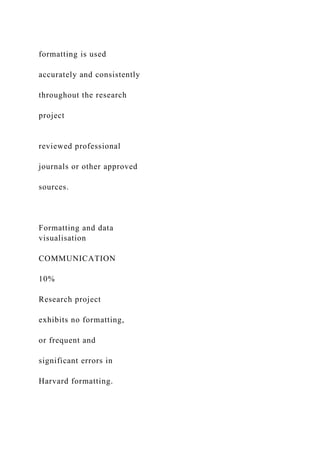
formatting is used
accurately and consistently
throughout the research
project
reviewed professional
journals or other approved
sources.
Formatting and data
visualisation
COMMUNICATION
10%
Research project
exhibits no formatting,
or frequent and
significant errors in
Harvard formatting.
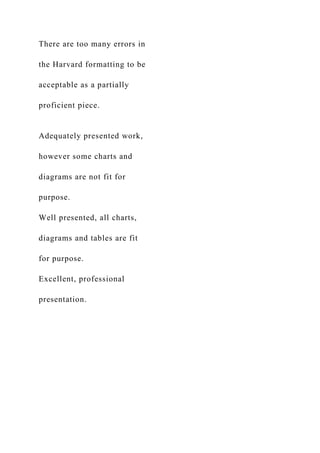
There are too many errors in
the Harvard formatting to be
acceptable as a partially
proficient piece.
Adequately presented work,
however some charts and
diagrams are not fit for
purpose.
Well presented, all charts,
diagrams and tables are fit
for purpose.
Excellent, professional
presentation.
COURSE CODE MCO 105 COURSE NAME Data Analysis for Managers  Ta.docx

COURSE CODE MCO 105 COURSE NAME Data Analysis for Managers Ta.docx

  • 1.
    COURSE CODE MCO105 COURSE NAME Data Analysis for Managers Task brief & rubrics Task • This work can be completed individually or pairs. If done in pairs, the names of both students must be on the cover page of the document, but only one student uploads. You must undertake a quantitative research project into any area of business. You may use any data source and any time period you wish, however, the only condition is that data must include a time series, and that the time series includes year 2021. The aim is to produce a research project that examines a topic, analyses data and provides recommendations to management about the topic studied. The following is an orientation of the points to be covered in the document: Executive summary Overview of problem to be investigated. Impact of the problem.
  • 2.
    Question(s) to beinvestigated. As results emerged, did you consider new questions? If so which? Method: Data: What are the sources? How have you obtained/cleaned/prepared the data? It is imperative that your data sources are clearly stated; if using data obtained from the internet you must include the URL and retrieval date; if you are using internal company data you must state source and date obtained. Analysis: What analytical method will be used? With what variables? Results: Evaluate the results, ensuring you refer back to the original research question. Ensure that the visualization of the results is fit for purpose. Limitations and constraints of the study. Recommendations to managers Conclusion Formalities: • Wordcount: approx 2500
  • 3.
    • Cover, Tableof Contents, References and Appendix are excluded of the total wordcount. • Font: Arial 12 pts. • Text alignment: Justified. • The in-text References and the Bibliography have to be in Harvard’s citation style. Submission: Week 10 – Via Moodle (Turnitin). Sunday 11th of December, 2022, 23.59. Weight: This task is a 100% of your total grade for this subject. It assesses the following learning outcomes: • demonstrate a knowledge of advanced quantitative business methodologies (principles, theories, and methods) and their applicability. • analyze and classify different management problems using a variety of quantitative methods. • apply and use analytical techniques to make recommendations that solve complex business problems. • analyze business data within business decision making and determine its importance to draw conclusions and produce business reports. frame and apply different types of decision-making exercises applying the different quantitative business methodologies.
  • 4.
    Rubrics Learning Descriptors FailBelow 83% Fair 83- 85 % Good 85- 89% Exceptional 90-100% Purpose & Understanding KNOWLEDGE & UNDERSTANDING 35% Very poor coverage of central purpose, goals, research questions or arguments with little relevant information evident. Virtually no evidence of understanding or focus. Minimal understanding of purpose of the study; factual errors evident. Gaps in knowledge and superficial
  • 5.
    understanding. A fewlines of relevant material. Reasonable understanding and clearly identifies the purpose, goals, research questions or argument. Reflect partial achievement of learning outcomes. A sound grasp of, and clearly identifies, the purpose, goals, research questions or argument. Some wider study beyond the classroom content shown. Effectively describes and explains the central purpose, arguments, research questions, or goals of the project; explanation is
  • 6.
    focused, detailed and compelling.Recognition of alternative forms of evidence beyond that supplied in the classroom. Content KNOWLEDGE & UNDERSTANDING 35% Content is unclear, inaccurate and/or incomplete. Brief and irrelevant. Descriptive. Only personal views offered. Unsubstantiated and does not support the purpose, argument or goals of the project. Reader gains no
  • 7.
    insight through thecontent of the project. Limited content that does not really support the purpose of the report. Very poor coverage. Displays only rudimentary knowledge of the content area. Reader gains few if any insights Presents some information that adequately supports the central purpose, arguments, goals, or research questions of the project. Although parts missing, it demonstrates a
  • 8.
    level of partiallyproficient knowledge of the content area. Reader gains some insights. Presents clear and appropriate information that adequately supports the central purpose, arguments, goals or research questions of the project. Demonstrates satisfactory knowledge of the content area. Reader gains proficient insights. Presents balanced, significant and valid information that clearly and convincingly
  • 9.
    supports the centralpurpose, arguments, research questions or goals of the project. Demonstrates in- depth and specialised knowledge of the content area. The reader gains important insights Organization COMMUNICATION 10% Information/content is not logically organized or presented. Topics/paragraphs are frequently disjointed and fail to make sense together.
  • 10.
    Reader cannot identifya line of reasoning and loses interest. Information/content is not, at times, logically organized or presented. Topics/paragraphs are frequently disjointed which makes the content hard to follow. The reader finds it hard to understand the flow of the report. Information/content is presented in a reasonable sequence. Topic/paragraph transition is unclear in places with linkages for the most part.
  • 11.
    Reader can generally understandand follow the line of reasoning, although work needed to be proficiently organized. Information/content is presented in a clear and understandable sequence. Topic/paragraph transition is good with clear linkages between sections and arguments. Reader can understand and follow the line of reasoning. Information/content is presented in a logical, interesting and effective
  • 12.
    sequence. Topics and argumentsflow smoothly and coherently from one to another and are clearly linked. Reader can easily follow the line of reasoning and enjoyed reading the report. Use of References COMMUNICATION 10% Little or no evidence of reference sources in the report. Content not supported and based on unsubstantiated views.
  • 13.
    Most references arefrom sources that are not peer- reviewed or professional, and have uncertain reliability. Few if any appropriate citations are Professionally legitimate references are generally used. Fair citations are presented in most cases. Some of the information/content/evidence Professionally and academically legitimate references are used. Clear and accurate citations are presented in most cases. The majority of the
  • 14.
    Presents compelling evidence fromprofessionally and academically legitimate sources. Attribution is clear and accurate. References are 75% from primarily peer- provided. Reader doubts the validity of much of the material. comes from sources that are reliable, but more academic sources needed to be convincing. information/content/evidenc e comes from sources that are reliable. Harvard
  • 15.
    formatting is used accuratelyand consistently throughout the research project reviewed professional journals or other approved sources. Formatting and data visualisation COMMUNICATION 10% Research project exhibits no formatting, or frequent and significant errors in Harvard formatting.
  • 16.
    There are toomany errors in the Harvard formatting to be acceptable as a partially proficient piece. Adequately presented work, however some charts and diagrams are not fit for purpose. Well presented, all charts, diagrams and tables are fit for purpose. Excellent, professional presentation.