Engine Oil Aeration
Lab Simulation and Correlation to Engine Testing
Ricardo Hein
Conexo Inc.
Atlanta, GA
+1 678-792-4692
rhein@oilpas.com
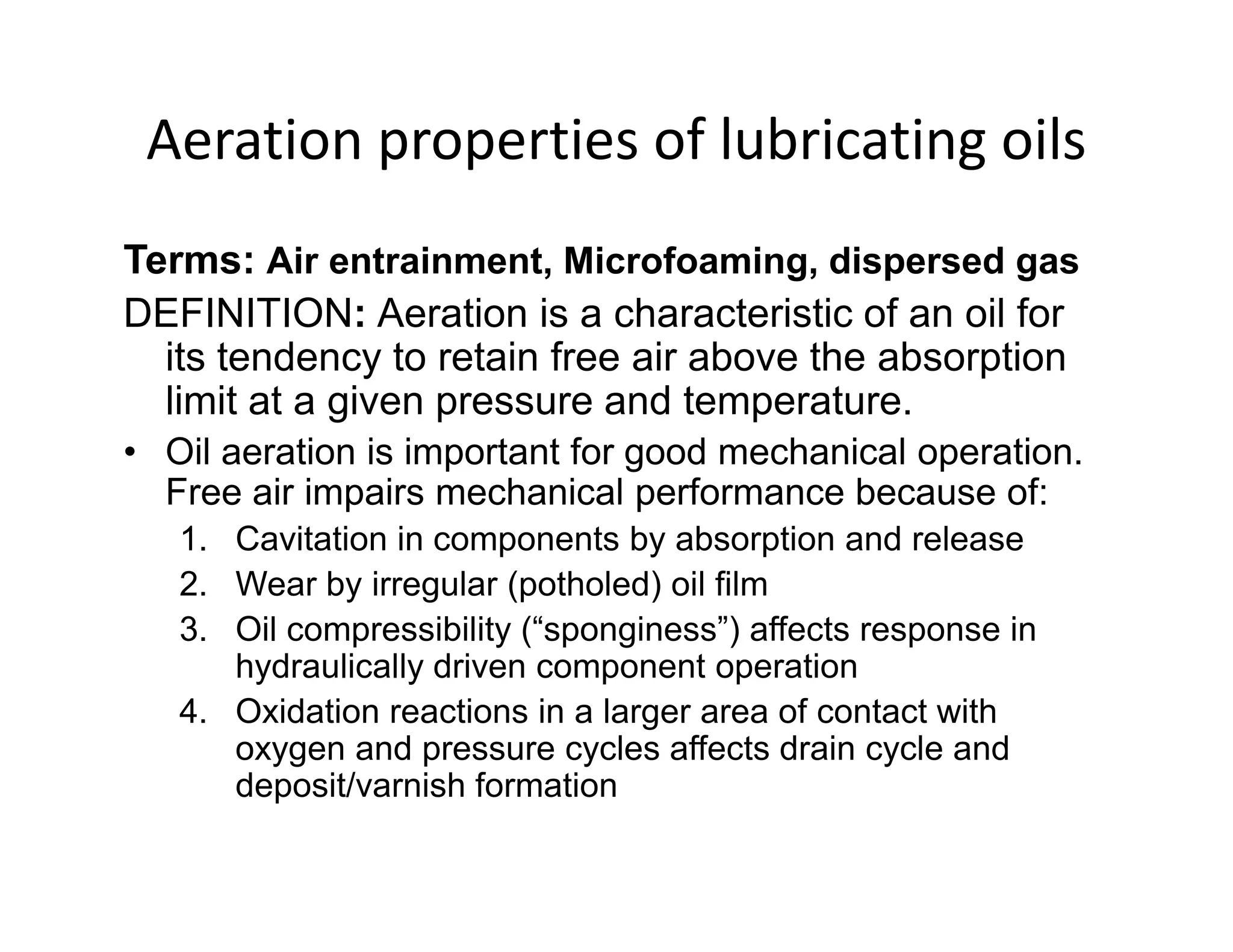
Aeration properties of lubricating oils
Terms: Air entrainment, Microfoaming, dispersed gas
DEFINITION: Aeration is a characteristic of an oil for
its tendency to retain free air above the absorption
limit at a given pressure and temperature.
• Oil aeration is important for good mechanical operation.
Free air impairs mechanical performance because of:Free air impairs mechanical performance because of:
1. Cavitation in components by absorption and release
2. Wear by irregular (potholed) oil film
3. Oil compressibility (“sponginess”) affects response in
hydraulically driven component operation
4. Oxidation reactions in a larger area of contact with
oxygen and pressure cycles affects drain cycle and
deposit/varnish formation
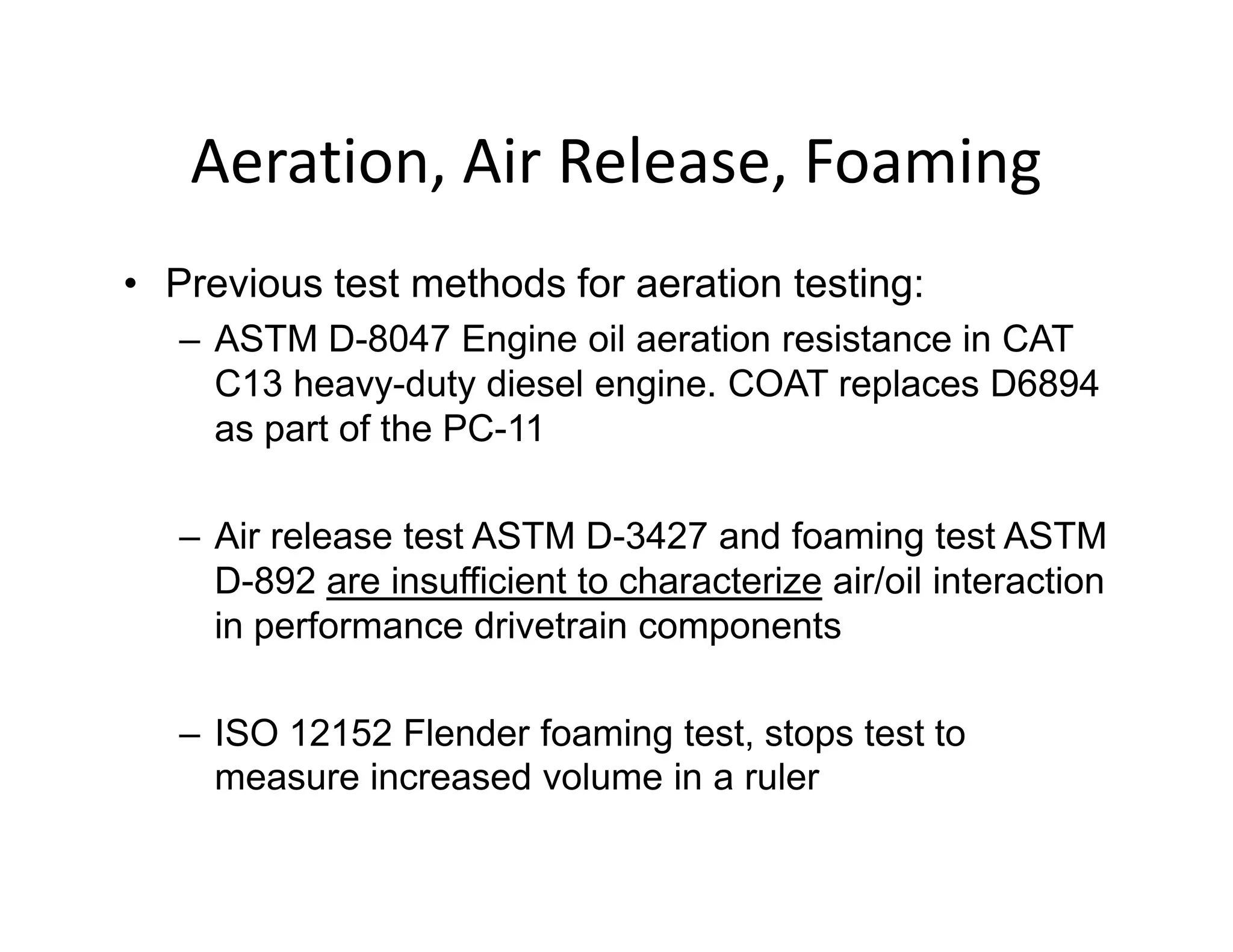
Aeration, Air Release, Foaming
• Previous test methods for aeration testing:
– ASTM D-8047 Engine oil aeration resistance in CAT
C13 heavy-duty diesel engine. COAT replaces D6894
as part of the PC-11
– Air release test ASTM D-3427 and foaming test ASTM
D-892 are insufficient to characterize air/oil interaction
in performance drivetrain components
– ISO 12152 Flender foaming test, stops test to
measure increased volume in a ruler
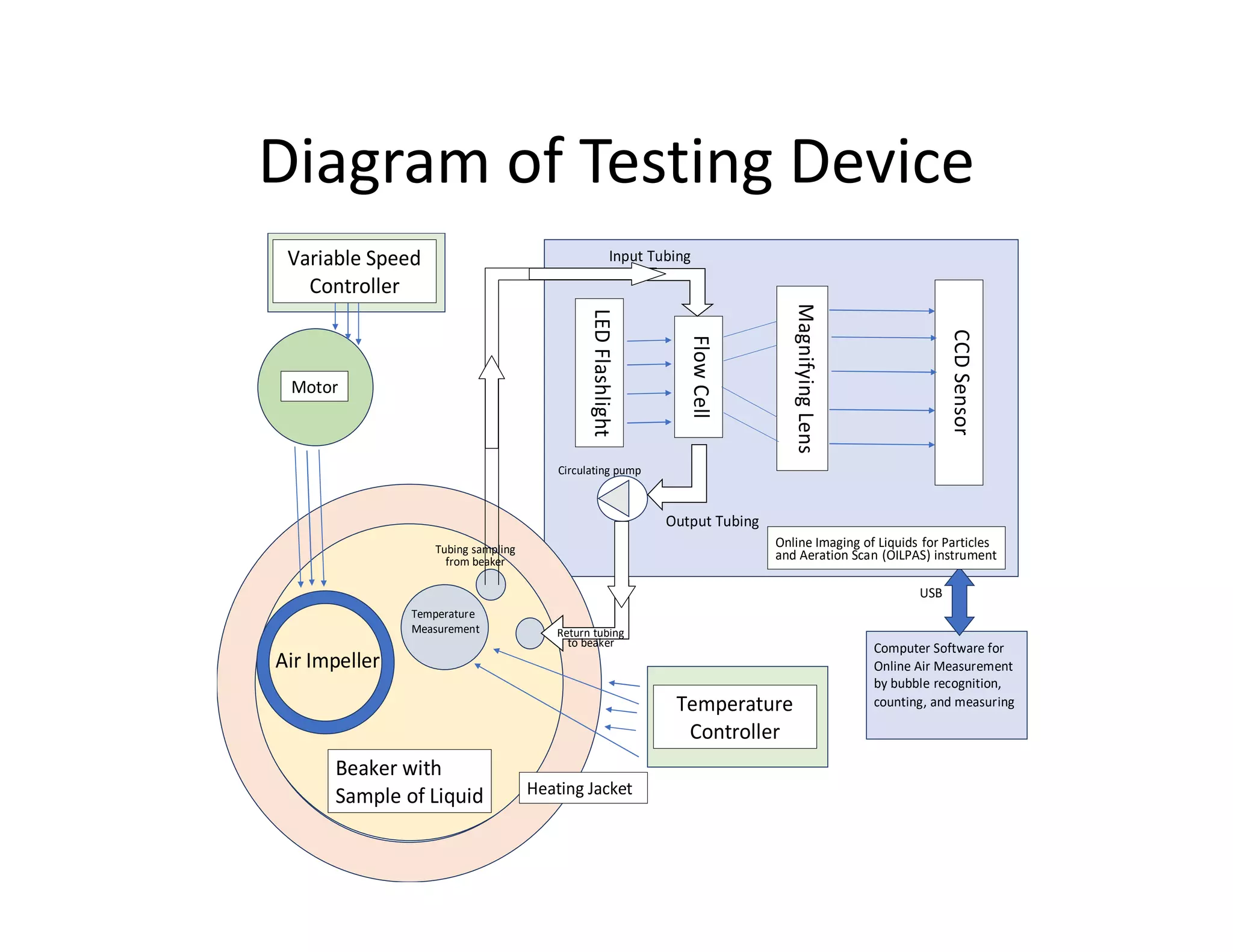
Diagram of Testing Device
Motor
Variable Speed
Controller
Input Tubing
LEDFlashlight
FlowCell
MagnifyingLens
CCDSensor
Circulating pump
USB
Computer Software for
Online Air Measurement
by bubble recognition,
counting, and measuring
Air Impeller
Heating Jacket
Beaker with
Sample of Liquid
Temperature
Measurement
Temperature
Controller
Output Tubing
Online Imaging of Liquids for Particles
and Aeration Scan (OILPAS) instrumentTubing sampling
from beaker
Return tubing
to beaker
Circulating pump
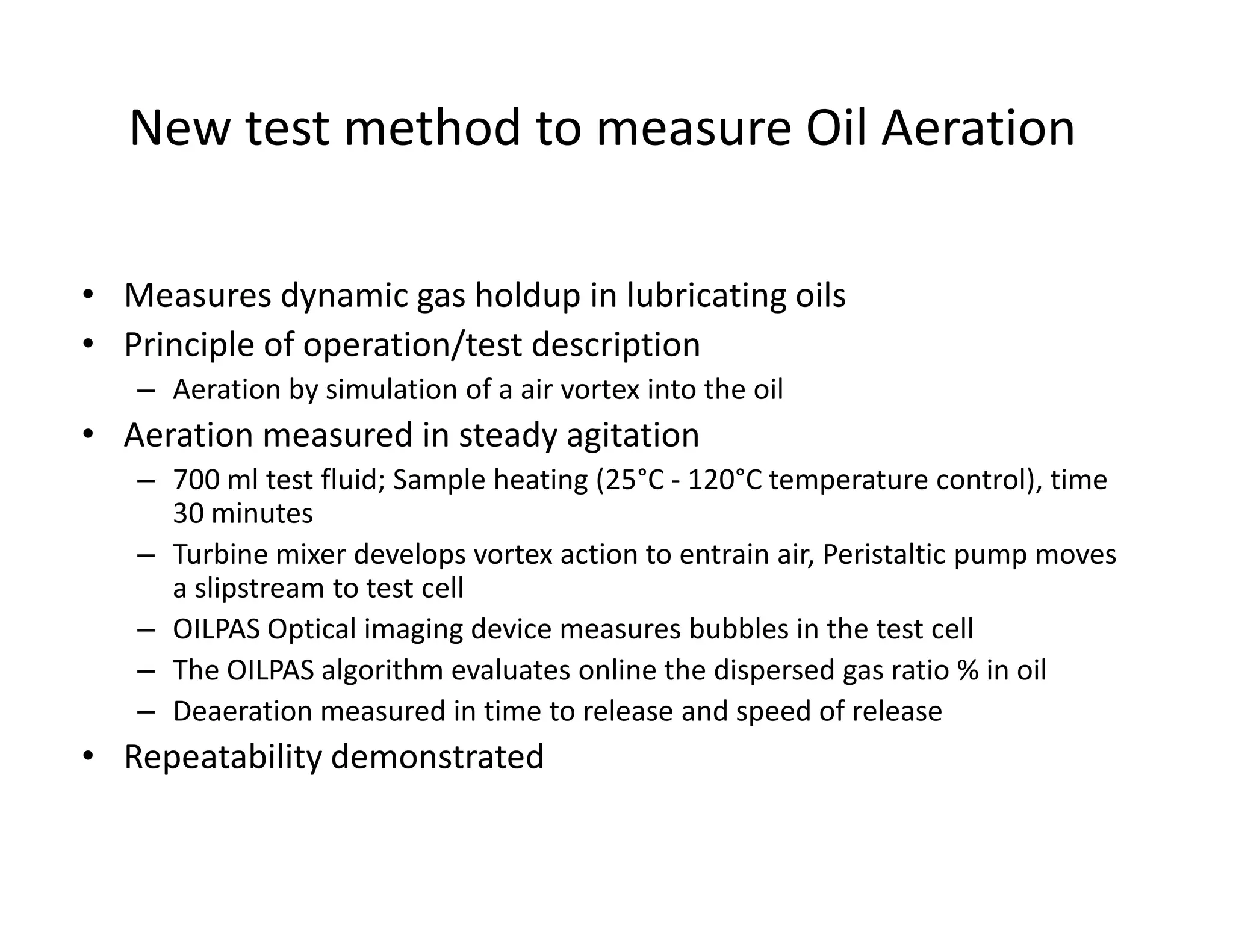
New test method to measure Oil Aeration
• Measures dynamic gas holdup in lubricating oils
• Principle of operation/test description
– Aeration by simulation of a air vortex into the oil
• Aeration measured in steady agitation
– 700 ml test fluid; Sample heating (25°C - 120°C temperature control), time– 700 ml test fluid; Sample heating (25°C - 120°C temperature control), time
30 minutes
– Turbine mixer develops vortex action to entrain air, Peristaltic pump moves
a slipstream to test cell
– OILPAS Optical imaging device measures bubbles in the test cell
– The OILPAS algorithm evaluates online the dispersed gas ratio % in oil
– Deaeration measured in time to release and speed of release
• Repeatability demonstrated
Set-up – Bench Test 2
Calculation the aeration %
based on bubble
measurement
Pump/Test Cell/
Microscope/Ima
ging
Aerator, conditions
control Speed,
Temperature, Gas
can be simulated in
a dynamic cycle
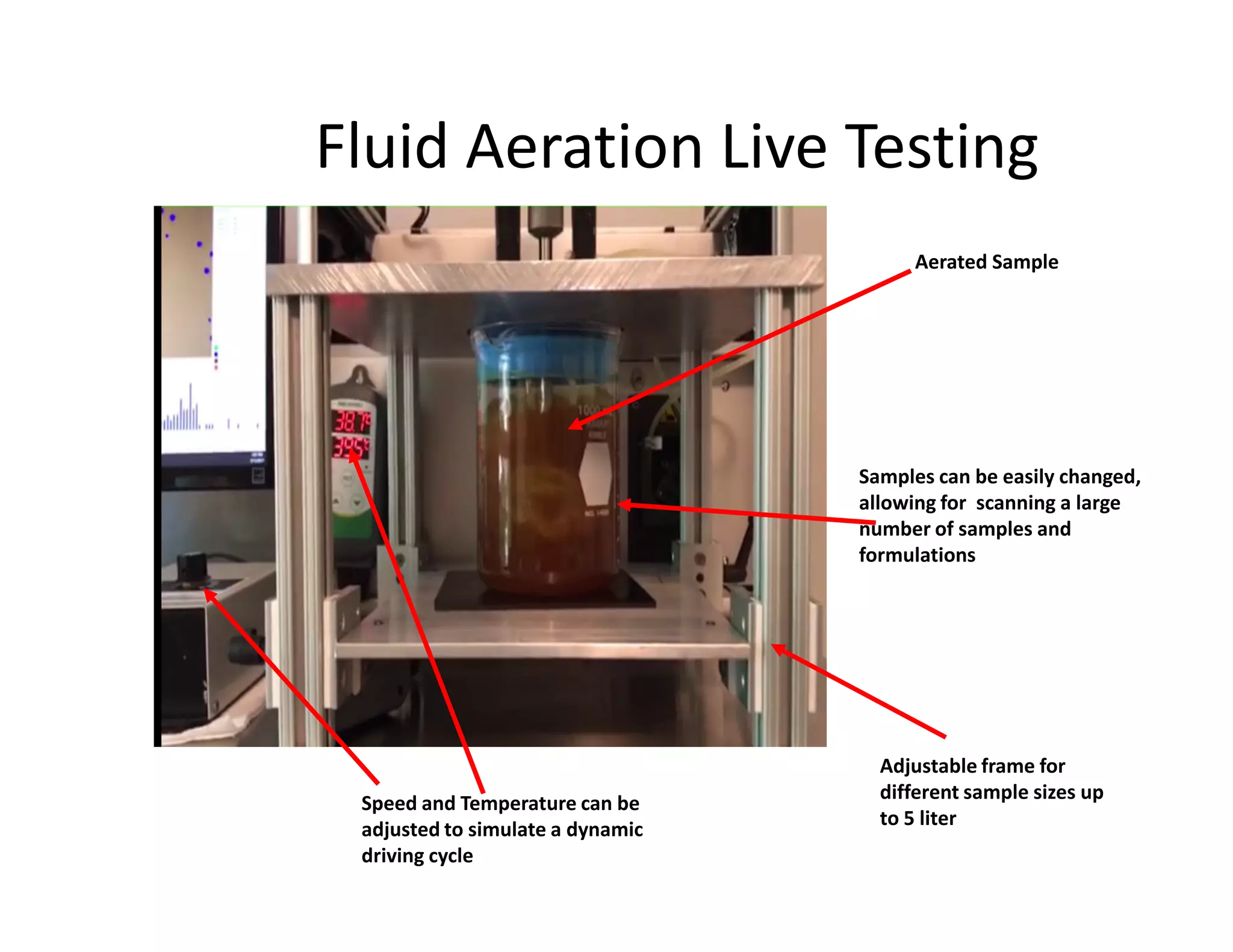
Fluid Aeration Live Testing
Aerated Sample
Samples can be easily changed,
Adjustable frame for
different sample sizes up
to 5 liter
Samples can be easily changed,
allowing for scanning a large
number of samples and
formulations
Speed and Temperature can be
adjusted to simulate a dynamic
driving cycle
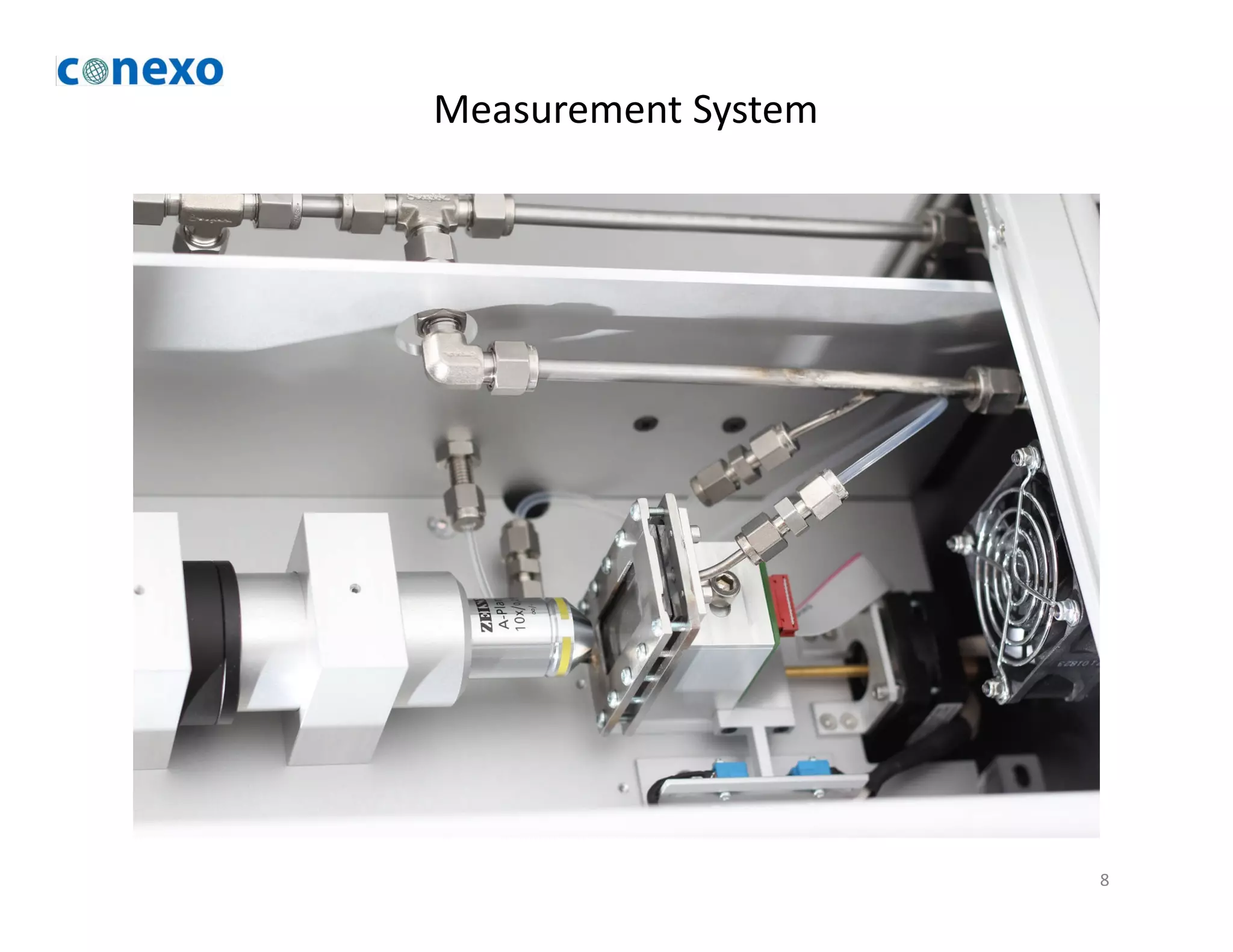
Measurement System
8
Measurement with OILPAS
9
Image Device
LED
Flow Cell
CCD Chip
Volume per Image:
1 mm³
Image
Frequency
1 Hz
10
Image Window
2000 μm x 1500 μm
50-500 μm Thickness
5,6 mm
Image Resolution
4416 x 3312 Pixel ca. 14,6 Mega Pixel
Used with 3456 x 2592 Pixel
Aeration measurement
Gas content measurement
resolution of
Folie 11
resolution of
Original Images:
3456 x 2592 px
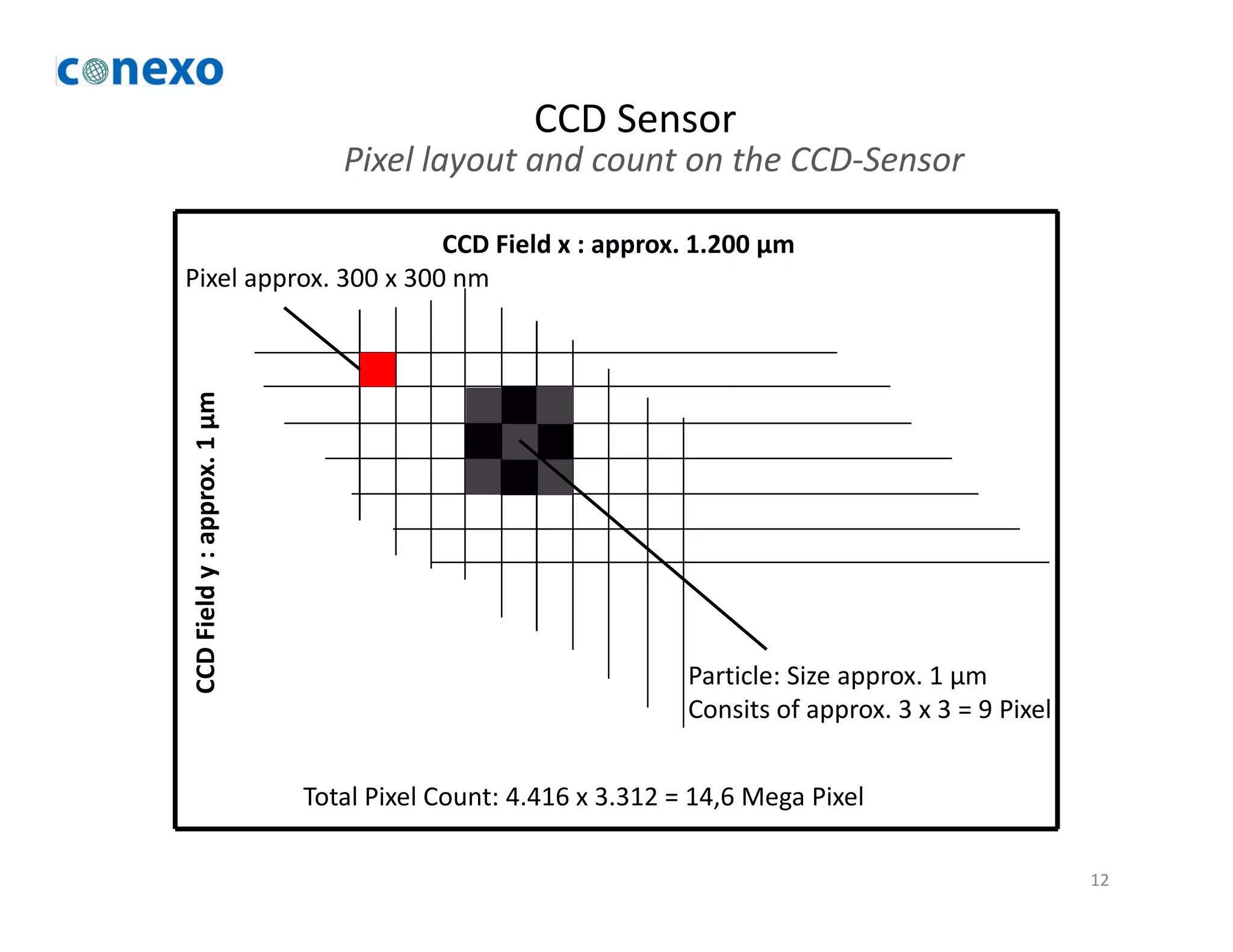
CCD Sensor
Pixel layout and count on the CCD-Sensor
CCD Field x : approx. 1.200 μm
CCDFieldy:approx.1μm
Pixel approx. 300 x 300 nm
12
CCDFieldy:approx.
Total Pixel Count: 4.416 x 3.312 = 14,6 Mega Pixel
Particle: Size approx. 1 μm
Consits of approx. 3 x 3 = 9 Pixel
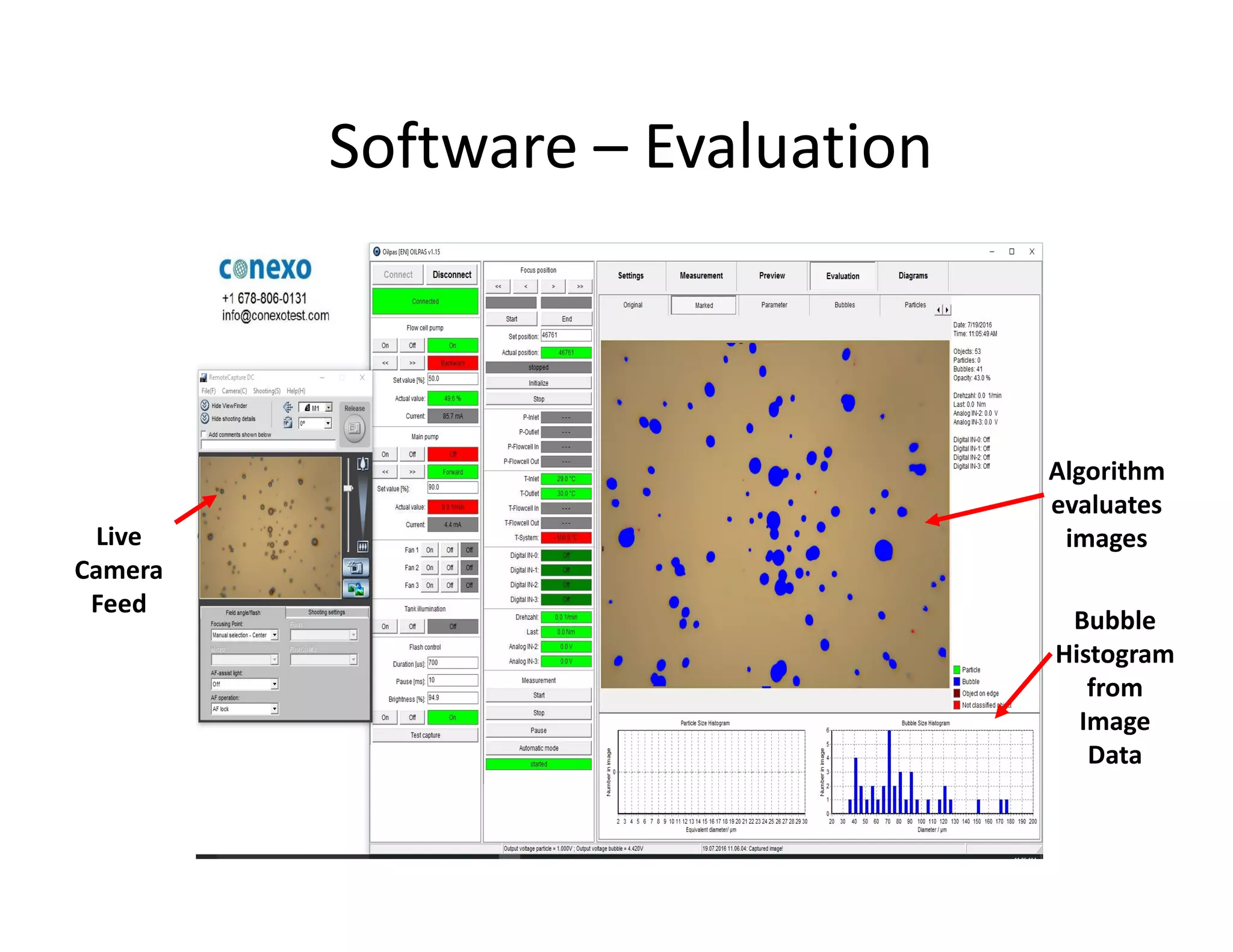
Software – Evaluation
Algorithm
Live
Camera
Feed
Algorithm
evaluates
images
Bubble
Histogram
from
Image
Data
Time-Resolved measured data
schematic representation based on the volume of bubbles
time
Picture n Pic. n+1 Pic. n+2 Pic. n+3 Pic. n+4
bubbles:
evaluation n
bubbles:
evaluation n+1
bubbles:
evaluation n+2
bubbles:
evaluation n+3
bubbles:
evaluation n+4
OILPAS Measurement System 14
bubbles:
number = 10
surf. = 33203µm²
Volume = 1546 pl
bubbles:
number = 3
surf. = 15924 µm²
Volume = 891 pl
bubbles:
number = 6
surf. = 19615 µm²
Volume = 858 pl
bubbles:
number = 5
surf. = 22718 µm²
Volume = 1196 pl
bubbles:
number = 4
surf. = 12370 µm²
Volume = 524 pl
n-1 n n+1 n+2 n+3 n+4
0
500
1000
1500
2000
Blasenvolumen[pl]
From the bubble volume by a constant factor, a concentration can be calculated
and correlated to headspace methods FEV.
Software – Data Diagrams
Gas in oil % is
displayed onlineLife displayed online
Instrument Settings
Life
Feed
Avg. number
of bubbles
4
5
6
Aeration Over Lifetime
Aeration %
Fresh Engine Oil 0.55
Same oil Used 2.45
End of Life, same oil 3.4
Aeration Study of New and Used Oils
-1
0
1
2
3
0 500 1000 1500 2000 2500 3000
GasRatio(%)
Time (Seconds)
New Used End of Life6/20/16
End of Life, same oil 3.4
Aeration Comparison 10 Engine Oils
All Samples are engine oil API SN grade 5W-30
20
Aeration Comparison 10 Engine Oils% Air in
RESULTS
Oil Code AD-FS BD-FS GN-FS HN-SB JN-MIN CD-FS DD-SYN ED-FS KN-MIN FD-FS
Description Dexos 2
Full
Synthetic
Dexos 2
Full
Synthetic
Dexos 2
Full
Synthetic
Non Dexos,
Synthetic
Blend
Non Dexos,
Mineral
Dexos 2
Full
Synthetic
Dexos 2,
Synthetic
Dexos 2
Full
Synthetic
Non Dexos,
Mineral
Dexos 2
Full
Synthetic
Aeration (%)
AVG Tested 5.50 3.86 4.30 5.61 9.87 5.54 4.25 3.30 11.08 4.23
Deaeration
Speed (Min) 2.5 3.3 4.1 2.2 3.3 4.3 2.3 3.6 5.0 3.7
8/11/2018
0
4
8
12
16
20
0 300 600 900 1200 1500 1800 2100
AD-FS BD-FS GN-FS HN-SB JN-MIN
CD-FS DD-SYN ED-FS KN-MIN FD-FS
Time in Seconds
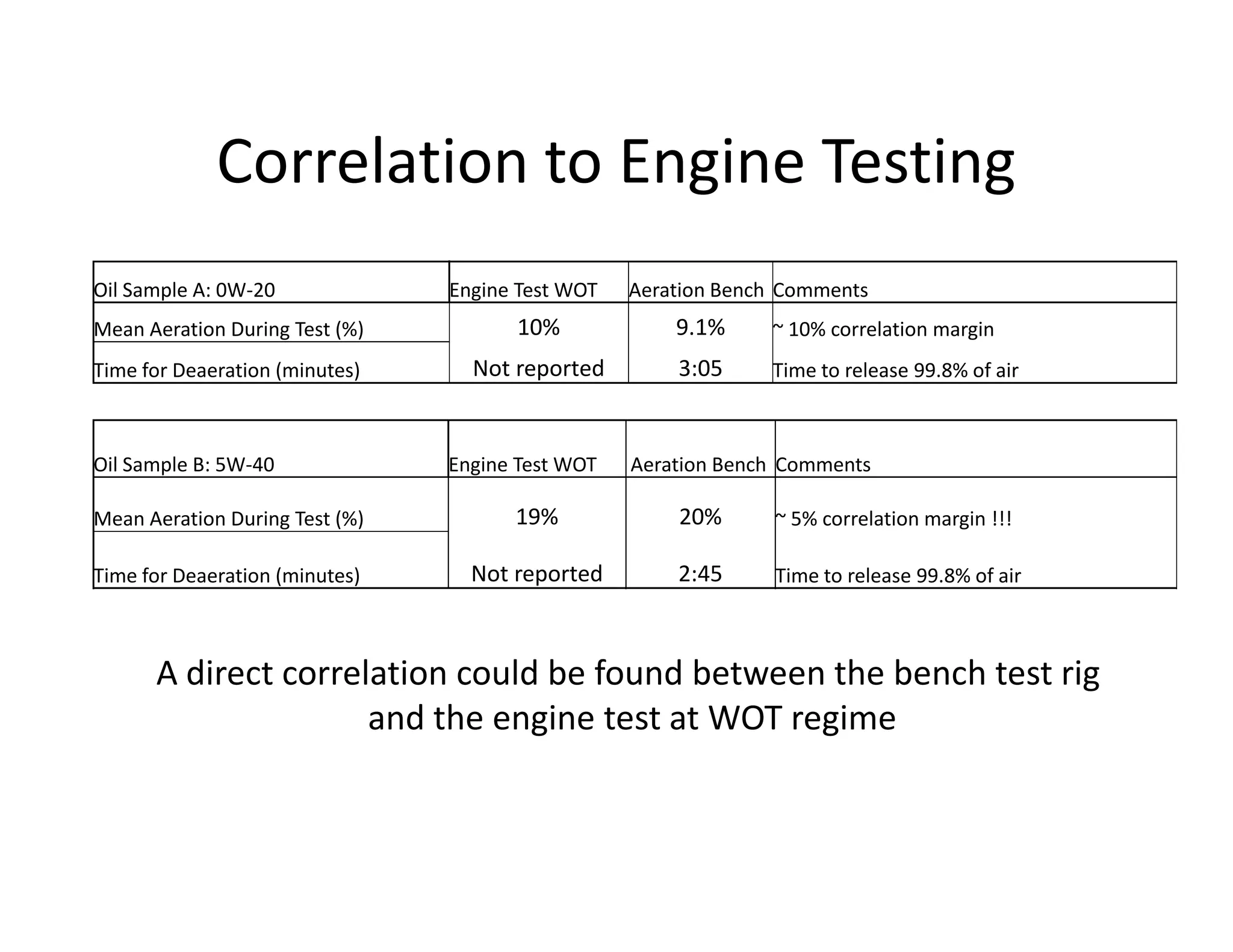
Correlation to Engine Testing
Oil Sample A: 0W-20 Engine Test WOT Aeration Bench Comments
Mean Aeration During Test (%) 10% 9.1% ~ 10% correlation margin
Time for Deaeration (minutes) Not reported 3:05 Time to release 99.8% of air
Oil Sample B: 5W-40 Engine Test WOT Aeration Bench CommentsOil Sample B: 5W-40 Engine Test WOT Aeration Bench Comments
Mean Aeration During Test (%) 19% 20% ~ 5% correlation margin !!!
Time for Deaeration (minutes) Not reported 2:45 Time to release 99.8% of air
A direct correlation could be found between the bench test rig
and the engine test at WOT regime
Conclusions
• Aeration screening in the lab can quickly benchmark the natural
characteristic of an oil to retain free air
• Method was verified at testing a large number of different
lubricating oils, additives and other fluids
• Measures both dynamic gas entrained and air release time
• Air release shows correlation with ASTM D3427 test method• Air release shows correlation with ASTM D3427 test method
• Provides a measure of dynamic gas holdup and bubble size
distribution (not provided by Coriolis sensor), thus adding further
insight into the aeration characteristics of an oil.
• Provides OEMs/Equipment Builders and End Users an alternative
method to test candidate fluids for aeration properties
• Test Method Guides OEM to design components considering the
aeration characteristic of for the oil that is recommended for the
specific application
Thank you for your attention.
Any Questions?
2320 Starr Lake Drive
Acworth, GA 30101
USA
678 792 4692

Oil aeration screening test method

  • 1.
    Engine Oil Aeration LabSimulation and Correlation to Engine Testing Ricardo Hein Conexo Inc. Atlanta, GA +1 678-792-4692 rhein@oilpas.com
  • 2.
    Aeration properties oflubricating oils Terms: Air entrainment, Microfoaming, dispersed gas DEFINITION: Aeration is a characteristic of an oil for its tendency to retain free air above the absorption limit at a given pressure and temperature. • Oil aeration is important for good mechanical operation. Free air impairs mechanical performance because of:Free air impairs mechanical performance because of: 1. Cavitation in components by absorption and release 2. Wear by irregular (potholed) oil film 3. Oil compressibility (“sponginess”) affects response in hydraulically driven component operation 4. Oxidation reactions in a larger area of contact with oxygen and pressure cycles affects drain cycle and deposit/varnish formation
  • 3.
    Aeration, Air Release,Foaming • Previous test methods for aeration testing: – ASTM D-8047 Engine oil aeration resistance in CAT C13 heavy-duty diesel engine. COAT replaces D6894 as part of the PC-11 – Air release test ASTM D-3427 and foaming test ASTM D-892 are insufficient to characterize air/oil interaction in performance drivetrain components – ISO 12152 Flender foaming test, stops test to measure increased volume in a ruler
  • 4.
    Diagram of TestingDevice Motor Variable Speed Controller Input Tubing LEDFlashlight FlowCell MagnifyingLens CCDSensor Circulating pump USB Computer Software for Online Air Measurement by bubble recognition, counting, and measuring Air Impeller Heating Jacket Beaker with Sample of Liquid Temperature Measurement Temperature Controller Output Tubing Online Imaging of Liquids for Particles and Aeration Scan (OILPAS) instrumentTubing sampling from beaker Return tubing to beaker Circulating pump
  • 5.
    New test methodto measure Oil Aeration • Measures dynamic gas holdup in lubricating oils • Principle of operation/test description – Aeration by simulation of a air vortex into the oil • Aeration measured in steady agitation – 700 ml test fluid; Sample heating (25°C - 120°C temperature control), time– 700 ml test fluid; Sample heating (25°C - 120°C temperature control), time 30 minutes – Turbine mixer develops vortex action to entrain air, Peristaltic pump moves a slipstream to test cell – OILPAS Optical imaging device measures bubbles in the test cell – The OILPAS algorithm evaluates online the dispersed gas ratio % in oil – Deaeration measured in time to release and speed of release • Repeatability demonstrated
  • 6.
    Set-up – BenchTest 2 Calculation the aeration % based on bubble measurement Pump/Test Cell/ Microscope/Ima ging Aerator, conditions control Speed, Temperature, Gas can be simulated in a dynamic cycle
  • 7.
    Fluid Aeration LiveTesting Aerated Sample Samples can be easily changed, Adjustable frame for different sample sizes up to 5 liter Samples can be easily changed, allowing for scanning a large number of samples and formulations Speed and Temperature can be adjusted to simulate a dynamic driving cycle
  • 8.
  • 9.
  • 10.
    Image Device LED Flow Cell CCDChip Volume per Image: 1 mm³ Image Frequency 1 Hz 10 Image Window 2000 μm x 1500 μm 50-500 μm Thickness 5,6 mm Image Resolution 4416 x 3312 Pixel ca. 14,6 Mega Pixel Used with 3456 x 2592 Pixel
  • 11.
    Aeration measurement Gas contentmeasurement resolution of Folie 11 resolution of Original Images: 3456 x 2592 px
  • 12.
    CCD Sensor Pixel layoutand count on the CCD-Sensor CCD Field x : approx. 1.200 μm CCDFieldy:approx.1μm Pixel approx. 300 x 300 nm 12 CCDFieldy:approx. Total Pixel Count: 4.416 x 3.312 = 14,6 Mega Pixel Particle: Size approx. 1 μm Consits of approx. 3 x 3 = 9 Pixel
  • 13.
  • 14.
    Time-Resolved measured data schematicrepresentation based on the volume of bubbles time Picture n Pic. n+1 Pic. n+2 Pic. n+3 Pic. n+4 bubbles: evaluation n bubbles: evaluation n+1 bubbles: evaluation n+2 bubbles: evaluation n+3 bubbles: evaluation n+4 OILPAS Measurement System 14 bubbles: number = 10 surf. = 33203µm² Volume = 1546 pl bubbles: number = 3 surf. = 15924 µm² Volume = 891 pl bubbles: number = 6 surf. = 19615 µm² Volume = 858 pl bubbles: number = 5 surf. = 22718 µm² Volume = 1196 pl bubbles: number = 4 surf. = 12370 µm² Volume = 524 pl n-1 n n+1 n+2 n+3 n+4 0 500 1000 1500 2000 Blasenvolumen[pl] From the bubble volume by a constant factor, a concentration can be calculated and correlated to headspace methods FEV.
  • 15.
    Software – DataDiagrams Gas in oil % is displayed onlineLife displayed online Instrument Settings Life Feed Avg. number of bubbles
  • 16.
    4 5 6 Aeration Over Lifetime Aeration% Fresh Engine Oil 0.55 Same oil Used 2.45 End of Life, same oil 3.4 Aeration Study of New and Used Oils -1 0 1 2 3 0 500 1000 1500 2000 2500 3000 GasRatio(%) Time (Seconds) New Used End of Life6/20/16 End of Life, same oil 3.4
  • 17.
    Aeration Comparison 10Engine Oils All Samples are engine oil API SN grade 5W-30 20 Aeration Comparison 10 Engine Oils% Air in RESULTS Oil Code AD-FS BD-FS GN-FS HN-SB JN-MIN CD-FS DD-SYN ED-FS KN-MIN FD-FS Description Dexos 2 Full Synthetic Dexos 2 Full Synthetic Dexos 2 Full Synthetic Non Dexos, Synthetic Blend Non Dexos, Mineral Dexos 2 Full Synthetic Dexos 2, Synthetic Dexos 2 Full Synthetic Non Dexos, Mineral Dexos 2 Full Synthetic Aeration (%) AVG Tested 5.50 3.86 4.30 5.61 9.87 5.54 4.25 3.30 11.08 4.23 Deaeration Speed (Min) 2.5 3.3 4.1 2.2 3.3 4.3 2.3 3.6 5.0 3.7 8/11/2018 0 4 8 12 16 20 0 300 600 900 1200 1500 1800 2100 AD-FS BD-FS GN-FS HN-SB JN-MIN CD-FS DD-SYN ED-FS KN-MIN FD-FS Time in Seconds
  • 18.
    Correlation to EngineTesting Oil Sample A: 0W-20 Engine Test WOT Aeration Bench Comments Mean Aeration During Test (%) 10% 9.1% ~ 10% correlation margin Time for Deaeration (minutes) Not reported 3:05 Time to release 99.8% of air Oil Sample B: 5W-40 Engine Test WOT Aeration Bench CommentsOil Sample B: 5W-40 Engine Test WOT Aeration Bench Comments Mean Aeration During Test (%) 19% 20% ~ 5% correlation margin !!! Time for Deaeration (minutes) Not reported 2:45 Time to release 99.8% of air A direct correlation could be found between the bench test rig and the engine test at WOT regime
  • 19.
    Conclusions • Aeration screeningin the lab can quickly benchmark the natural characteristic of an oil to retain free air • Method was verified at testing a large number of different lubricating oils, additives and other fluids • Measures both dynamic gas entrained and air release time • Air release shows correlation with ASTM D3427 test method• Air release shows correlation with ASTM D3427 test method • Provides a measure of dynamic gas holdup and bubble size distribution (not provided by Coriolis sensor), thus adding further insight into the aeration characteristics of an oil. • Provides OEMs/Equipment Builders and End Users an alternative method to test candidate fluids for aeration properties • Test Method Guides OEM to design components considering the aeration characteristic of for the oil that is recommended for the specific application
  • 20.
    Thank you foryour attention. Any Questions? 2320 Starr Lake Drive Acworth, GA 30101 USA 678 792 4692