Analysis of a Wind-Turbine
Blade
Tofail Ahmed
Advanced Strength of Material
Instructor: Mi Geum Chorzepa
4/27/2018
What’s happening?
A wind-turbine is rotating for a known air velocity
The speed of rotation (aka period) is known
Subject of interest is only one blade
Material properties are known
Objective of analysis
the amount of pressure created on the blade due to the air flow
Whether material strength is enough to withstand loading
Reaction (force, moment) at the joint/support/hub
Whether the deflection, rotation is within acceptable limit
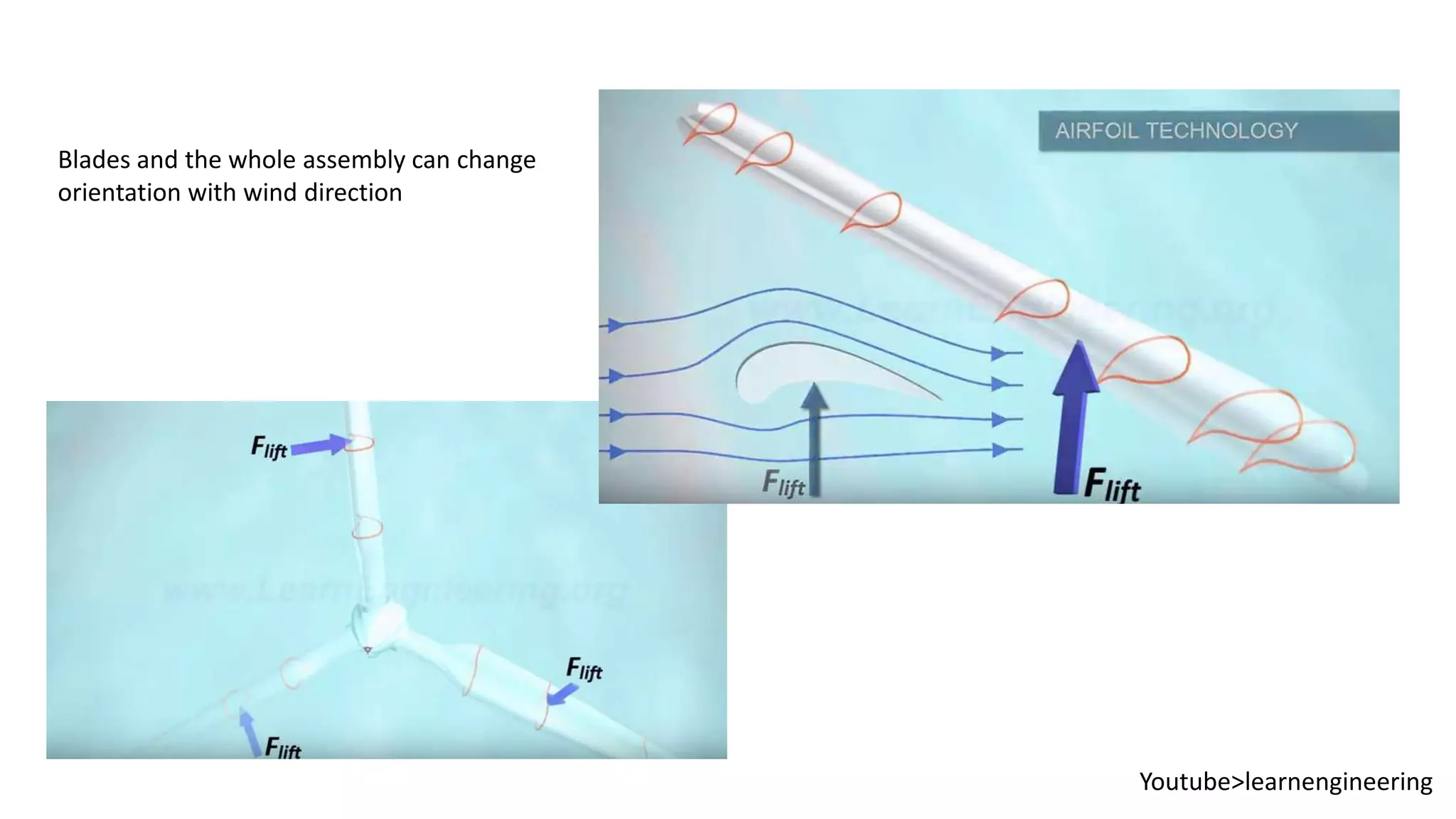
Youtube>learnengineering
Blades and the whole assembly can change
orientation with wind direction
When in a 3D element two of the
three dimensions are much larger
than the third dimension and some
analysis results (e.g. shear normal
to the plane) corresponding to the
third dimension can reasonably be
neglected, ‘Shell’ elements are
used
Why?
Saves time
Coordinate systems
Blade material: composite, orthotropic
Assumption: Homogenous
Strength up to yield point / elastic behavior is considered
(the straight line in the stress-strain curve)
What failure model to use if we were looking
for actual failure instead of elastic limit?
 Von Mises
 Mohr – Coulomb
 Drucker – Prager
 Bresler – Pister
 William – Warnke
 Bigoni – Piccolroaz
 Tsai – Wu
 Cam - Clay
Air velocity 12m/s (a typical wind speed)
Temperature 15 degree Celsius
Air density 1.225 kg/m^3
Air viscosity 1.784e-04 kg/(m8s)
Computational Fluid Dynamics (CFD, don’t ask!) analysis will
give the pressure distribution, and torque on the blade for the
air flow
Boundary condition
remote point and remote displacement
Turning on ‘large deflection’
a blade with a high velocity will act stiffer than a blade with low
velocity; the behavior of these two blades will be different. ‘large
deflection’ will activate this feature.
Hand calculation
Radial Force:
 the outward force that comes from a spinning mass.
 Equal and opposite to the reaction force at the root of the
blade.
 Can also be thought as the mass times the radial
acceleration.
𝐹𝑟 = −𝑚𝑎 𝑟
𝐹𝑟 = −𝑚𝑟𝑤2
𝐹𝑟 = 22473𝑘𝑔 14.323𝑚
2.22𝑟𝑎𝑑
𝑠
2
𝑭 𝒓 = 𝟏𝟓𝟕𝟔. 𝟑𝒌𝑵
m is the total mass of the blade
r is distance from the support/hub to the center of gravity of
the blade
w is the angular velocity
ANSYS Result: 1578.1 kN
Source material
• A hands on Introduction to Engineering Simulation
By Cornell University
• Course Instructor: Rajesh Bhaskaran
• WWW.edx.com
• WWW.simcafe.com
• Author of the modules Sebastian Lachance-Barrett
• Original simulation by Edwin Corona
• This module was integrated into wind power class at Cornell
University
That’s all folks!!
Thank you

Analysis of a wind turbine blade

  • 1.
    Analysis of aWind-Turbine Blade Tofail Ahmed Advanced Strength of Material Instructor: Mi Geum Chorzepa 4/27/2018
  • 4.
    What’s happening? A wind-turbineis rotating for a known air velocity The speed of rotation (aka period) is known Subject of interest is only one blade Material properties are known Objective of analysis the amount of pressure created on the blade due to the air flow Whether material strength is enough to withstand loading Reaction (force, moment) at the joint/support/hub Whether the deflection, rotation is within acceptable limit
  • 5.
    Youtube>learnengineering Blades and thewhole assembly can change orientation with wind direction
  • 6.
    When in a3D element two of the three dimensions are much larger than the third dimension and some analysis results (e.g. shear normal to the plane) corresponding to the third dimension can reasonably be neglected, ‘Shell’ elements are used Why? Saves time
  • 7.
  • 8.
    Blade material: composite,orthotropic Assumption: Homogenous Strength up to yield point / elastic behavior is considered (the straight line in the stress-strain curve)
  • 9.
    What failure modelto use if we were looking for actual failure instead of elastic limit?  Von Mises  Mohr – Coulomb  Drucker – Prager  Bresler – Pister  William – Warnke  Bigoni – Piccolroaz  Tsai – Wu  Cam - Clay
  • 10.
    Air velocity 12m/s(a typical wind speed) Temperature 15 degree Celsius Air density 1.225 kg/m^3 Air viscosity 1.784e-04 kg/(m8s) Computational Fluid Dynamics (CFD, don’t ask!) analysis will give the pressure distribution, and torque on the blade for the air flow
  • 12.
    Boundary condition remote pointand remote displacement
  • 13.
    Turning on ‘largedeflection’ a blade with a high velocity will act stiffer than a blade with low velocity; the behavior of these two blades will be different. ‘large deflection’ will activate this feature.
  • 14.
    Hand calculation Radial Force: the outward force that comes from a spinning mass.  Equal and opposite to the reaction force at the root of the blade.  Can also be thought as the mass times the radial acceleration. 𝐹𝑟 = −𝑚𝑎 𝑟 𝐹𝑟 = −𝑚𝑟𝑤2 𝐹𝑟 = 22473𝑘𝑔 14.323𝑚 2.22𝑟𝑎𝑑 𝑠 2 𝑭 𝒓 = 𝟏𝟓𝟕𝟔. 𝟑𝒌𝑵 m is the total mass of the blade r is distance from the support/hub to the center of gravity of the blade w is the angular velocity ANSYS Result: 1578.1 kN
  • 16.
    Source material • Ahands on Introduction to Engineering Simulation By Cornell University • Course Instructor: Rajesh Bhaskaran • WWW.edx.com • WWW.simcafe.com • Author of the modules Sebastian Lachance-Barrett • Original simulation by Edwin Corona • This module was integrated into wind power class at Cornell University
  • 17.