Bladeless Wind Turbine
DESIGN DEVELOPMENT, ANALYSIS
By
A.A.N.Ganesha (2230813104)
Guided by
Mrs.Anindita Sengupta
Assistant Professor
Mechanical Department GST
Contents
 Introduction
 Objectives and Advantages
 Working
 Design
 Analysis
 Applications
 References
Introduction
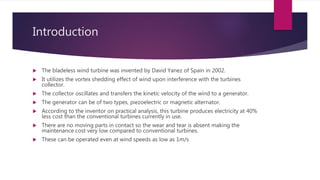
 The bladeless wind turbine was invented by David Yanez of Spain in 2002.
 It utilizes the vortex shedding effect of wind upon interference with the turbines
collector.
 The collector oscillates and transfers the kinetic velocity of the wind to a generator.
 The generator can be of two types, piezoelectric or magnetic alternator.
 According to the inventor on practical analysis, this turbine produces electricity at 40%
less cost than the conventional turbines currently in use.
 There are no moving parts in contact so the wear and tear is absent making the
maintenance cost very low compared to conventional turbines.
 These can be operated even at wind speeds as low as 1m/s
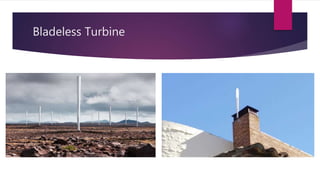
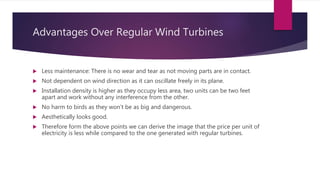
Bladeless Turbine
Objectives
 Creating awareness of the new technology.
 Optimization of the design for our region.
 Improving the manufacturing process.
Advantages Over Regular Wind Turbines
 Less maintenance: There is no wear and tear as not moving parts are in contact.
 Not dependent on wind direction as it can oscillate freely in its plane.
 Installation density is higher as they occupy less area, two units can be two feet
apart and work without any interference from the other.
 No harm to birds as they won’t be as big and dangerous.
 Aesthetically looks good.
 Therefore form the above points we can derive the image that the price per unit of
electricity is less while compared to the one generated with regular turbines.
Working
In fluid dynamics, vortex shedding is an
oscillating flow that takes place when a fluid such
as air or water flows past a bluff (as opposed to
streamlined) body at certain velocities, depending
on the size and shape of the body. In this
flow, vortices are created at the back of the body
and detach periodically from either side of the
body.
Design
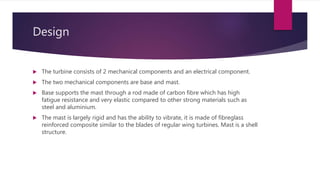
 The turbine consists of 2 mechanical components and an electrical component.
 The two mechanical components are base and mast.
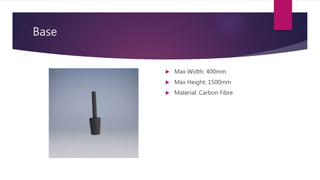
 Base supports the mast through a rod made of carbon fibre which has high
fatigue resistance and very elastic compared to other strong materials such as
steel and aluminium.
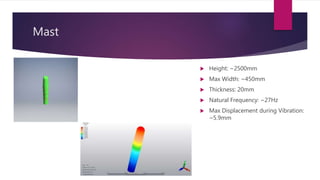
 The mast is largely rigid and has the ability to vibrate, it is made of fibreglass
reinforced composite similar to the blades of regular wing turbines. Mast is a shell
structure.
Base
 Max Width: 400mm
 Max Height: 1500mm
 Material: Carbon Fibre
Mast
 Height: ~2500mm
 Max Width: ~450mm
 Thickness: 20mm
 Natural Frequency: ~27Hz
 Max Displacement during Vibration:
~5.9mm
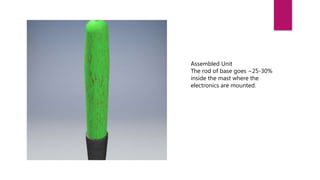
Assembled Unit
The rod of base goes ~25-30%
inside the mast where the
electronics are mounted.
Material Properties
Carbon Fibre (Std. UD) [Base]
Young’s Modulus 135 GPa
Poisson’s Ratio 0.3
Ult. Tensile Strength 1500 MPa
Ult. Comp Strength 1200 MPa
Density 1.6 g/cc
Fibreglass (E Glass Fabric) [Mast]
Young’s Modulus 25 GPa
Poisson’s Ratio 0.2
Ult. Tensile Strength 440 MPa
Ult. Comp Strength 425 MPa
Density 1.9 g/cc
Analysis
 We need to do two kinds of analysis on the turbine,
 Linear Structural: For stresses on the Base
 CFD: For Vortices on the Mast
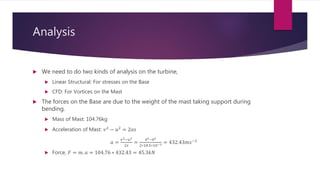
 The forces on the Base are due to the weight of the mast taking support during
bending.
 Mass of Mast: 104.76kg
 Acceleration of Mast: 𝑣2
− 𝑢2
= 2𝑎𝑠
𝑎 =
𝑣2−𝑢2
2𝑠
=
42−02
2∗18.5∗10−3 = 432.43𝑚𝑠−2
 Force, 𝐹 = 𝑚. 𝑎 = 104.76 ∗ 432.43 = 45.3𝑘𝑁
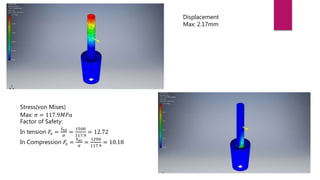
Displacement
Max: 2.17mm
Stress(von Mises)
Max: σ = 117.9𝑀𝑃𝑎
Factor of Safety:
In tension 𝐹𝑠 =
𝑆 𝑢𝑡
𝜎
=
1500
117.9
= 12.72
In Compression 𝐹𝑠 =
𝑆 𝑢𝑐
𝜎
=
1200
117.9
= 10.18
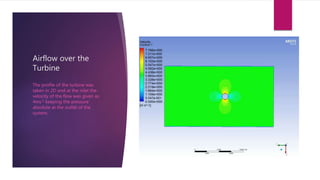
Airflow over the
Turbine
The profile of the turbine was
taken in 2D and at the inlet the
velocity of the flow was given as
4ms-1 keeping the pressure
absolute at the outlet of the
system.
Applications
 Harnessing the wind energy even in places with low wind speeds.
 A simple and portable wind energy solution for residential and small scale
industries.
 Cost effective and space saving for large scale power production.
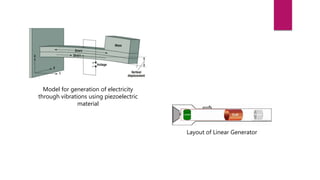
Generation of Electricity
 Electricity can be generated in two ways
 …using piezoelectric material
 …a linear generator
 Piezoelectric material is are those solids which can accumulate electric charge with
respect to applied mechanical stress.
 Linear generator works on the principle of electromagnetic induction, the linear
movement of a magnet inside a coil generates emf in the coil.
Model for generation of electricity
through vibrations using piezoelectric
material
Layout of Linear Generator
Software Used
 Autodesk Inventor 2017
 Autodesk Simulation Mechanical 2017
 Autodesk CFD 2017
 ANSYS Workbench 15
References
 http://www.vortexbladeless.com/
 “Vortex Shedding Patterns, Their Competition, And Chaos In Flowpast Inline
Oscillating Rectangular Cylinders”, Srikanth T, Harish N. Dixit, Rao Tatavarti, and
Rama Govindarajan in Physics of Fluid (July 2011 issue) by American Institute of
Physics
 “Vibration Based Energy Harvesting Using Piezoelectric Material”, M.N. Fakhzan,
Asan G.A.Muthalif, Department of Mechatronics Engineering, International Islamic
University Malaysia, IIUM,Kuala Lumpur, Malaysia

Bladeless Wind Turbine (Vortex Bladeless)

  • 1.
    Bladeless Wind Turbine DESIGNDEVELOPMENT, ANALYSIS By A.A.N.Ganesha (2230813104) Guided by Mrs.Anindita Sengupta Assistant Professor Mechanical Department GST
  • 2.
    Contents  Introduction  Objectivesand Advantages  Working  Design  Analysis  Applications  References
  • 3.
    Introduction  The bladelesswind turbine was invented by David Yanez of Spain in 2002.  It utilizes the vortex shedding effect of wind upon interference with the turbines collector.  The collector oscillates and transfers the kinetic velocity of the wind to a generator.  The generator can be of two types, piezoelectric or magnetic alternator.  According to the inventor on practical analysis, this turbine produces electricity at 40% less cost than the conventional turbines currently in use.  There are no moving parts in contact so the wear and tear is absent making the maintenance cost very low compared to conventional turbines.  These can be operated even at wind speeds as low as 1m/s
  • 4.
  • 5.
    Objectives  Creating awarenessof the new technology.  Optimization of the design for our region.  Improving the manufacturing process.
  • 6.
    Advantages Over RegularWind Turbines  Less maintenance: There is no wear and tear as not moving parts are in contact.  Not dependent on wind direction as it can oscillate freely in its plane.  Installation density is higher as they occupy less area, two units can be two feet apart and work without any interference from the other.  No harm to birds as they won’t be as big and dangerous.  Aesthetically looks good.  Therefore form the above points we can derive the image that the price per unit of electricity is less while compared to the one generated with regular turbines.
  • 7.
    Working In fluid dynamics,vortex shedding is an oscillating flow that takes place when a fluid such as air or water flows past a bluff (as opposed to streamlined) body at certain velocities, depending on the size and shape of the body. In this flow, vortices are created at the back of the body and detach periodically from either side of the body.
  • 8.
    Design  The turbineconsists of 2 mechanical components and an electrical component.  The two mechanical components are base and mast.  Base supports the mast through a rod made of carbon fibre which has high fatigue resistance and very elastic compared to other strong materials such as steel and aluminium.  The mast is largely rigid and has the ability to vibrate, it is made of fibreglass reinforced composite similar to the blades of regular wing turbines. Mast is a shell structure.
  • 9.
    Base  Max Width:400mm  Max Height: 1500mm  Material: Carbon Fibre
  • 10.
    Mast  Height: ~2500mm Max Width: ~450mm  Thickness: 20mm  Natural Frequency: ~27Hz  Max Displacement during Vibration: ~5.9mm
  • 11.
    Assembled Unit The rodof base goes ~25-30% inside the mast where the electronics are mounted.
  • 12.
    Material Properties Carbon Fibre(Std. UD) [Base] Young’s Modulus 135 GPa Poisson’s Ratio 0.3 Ult. Tensile Strength 1500 MPa Ult. Comp Strength 1200 MPa Density 1.6 g/cc Fibreglass (E Glass Fabric) [Mast] Young’s Modulus 25 GPa Poisson’s Ratio 0.2 Ult. Tensile Strength 440 MPa Ult. Comp Strength 425 MPa Density 1.9 g/cc
  • 13.
    Analysis  We needto do two kinds of analysis on the turbine,  Linear Structural: For stresses on the Base  CFD: For Vortices on the Mast  The forces on the Base are due to the weight of the mast taking support during bending.  Mass of Mast: 104.76kg  Acceleration of Mast: 𝑣2 − 𝑢2 = 2𝑎𝑠 𝑎 = 𝑣2−𝑢2 2𝑠 = 42−02 2∗18.5∗10−3 = 432.43𝑚𝑠−2  Force, 𝐹 = 𝑚. 𝑎 = 104.76 ∗ 432.43 = 45.3𝑘𝑁
  • 14.
    Displacement Max: 2.17mm Stress(von Mises) Max:σ = 117.9𝑀𝑃𝑎 Factor of Safety: In tension 𝐹𝑠 = 𝑆 𝑢𝑡 𝜎 = 1500 117.9 = 12.72 In Compression 𝐹𝑠 = 𝑆 𝑢𝑐 𝜎 = 1200 117.9 = 10.18
  • 15.
    Airflow over the Turbine Theprofile of the turbine was taken in 2D and at the inlet the velocity of the flow was given as 4ms-1 keeping the pressure absolute at the outlet of the system.
  • 16.
    Applications  Harnessing thewind energy even in places with low wind speeds.  A simple and portable wind energy solution for residential and small scale industries.  Cost effective and space saving for large scale power production.
  • 17.
    Generation of Electricity Electricity can be generated in two ways  …using piezoelectric material  …a linear generator  Piezoelectric material is are those solids which can accumulate electric charge with respect to applied mechanical stress.  Linear generator works on the principle of electromagnetic induction, the linear movement of a magnet inside a coil generates emf in the coil.
  • 18.
    Model for generationof electricity through vibrations using piezoelectric material Layout of Linear Generator
  • 19.
    Software Used  AutodeskInventor 2017  Autodesk Simulation Mechanical 2017  Autodesk CFD 2017  ANSYS Workbench 15
  • 20.
    References  http://www.vortexbladeless.com/  “VortexShedding Patterns, Their Competition, And Chaos In Flowpast Inline Oscillating Rectangular Cylinders”, Srikanth T, Harish N. Dixit, Rao Tatavarti, and Rama Govindarajan in Physics of Fluid (July 2011 issue) by American Institute of Physics  “Vibration Based Energy Harvesting Using Piezoelectric Material”, M.N. Fakhzan, Asan G.A.Muthalif, Department of Mechatronics Engineering, International Islamic University Malaysia, IIUM,Kuala Lumpur, Malaysia