O ffers and  I nvitations
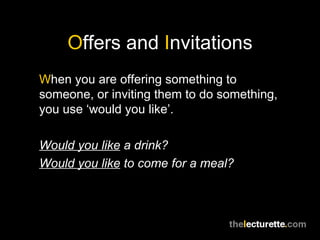
O ffers and  I nvitations W hen you are offering something to someone, or inviting them to do something, you use ‘would you like’. Would you like  a drink? Would you like  to come for a meal?
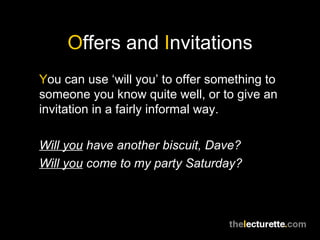
O ffers and  I nvitations Y ou can use ‘will you’ to offer something to someone you know quite well, or to give an invitation in a fairly informal way. Will you  have another biscuit, Dave? Will you  come to my party Saturday?
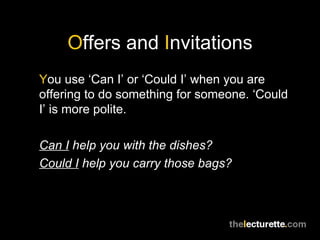
O ffers and  I nvitations Y ou use ‘Can I’ or ‘Could I’ when you are offering to do something for someone. ‘Could I’ is more polite. Can I  help you with the dishes? Could I  help you carry those bags?
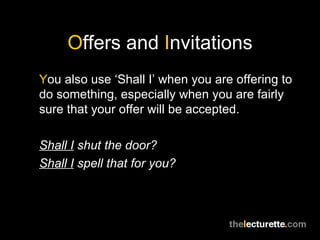
O ffers and  I nvitations Y ou also use ‘Shall I’ when you are offering to do something, especially when you are fairly sure that your offer will be accepted. Shall I  shut the door? Shall I  spell that for you?
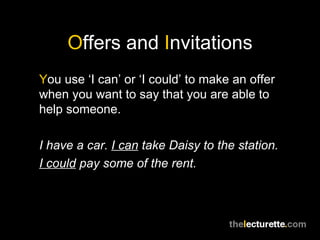
O ffers and  I nvitations Y ou use ‘I can’ or ‘I could’ to make an offer when you want to say that you are able to help someone. I have a car.  I can  take Daisy to the station. I could  pay some of the rent.
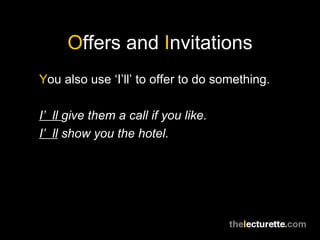
O ffers and  I nvitations Y ou also use ‘I’ll’ to offer to do something. I’ll  give them a call if you like. I’ll  show you the hotel.
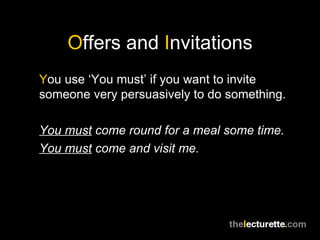
O ffers and  I nvitations Y ou use ‘You must’ if you want to invite someone very persuasively to do something. You must  come round for a meal some time. You must  come and visit me.
O ffers and  I nvitations T here are other ways of making offers and giving invitations without  using modals. For example, you can use ‘Let me’ when offering to help someone. Let me  take you to your room. Let me  drive you to London.
O ffers and  I nvitations Y ou can make an offer or give an invitation in a more informal way by using an imperative sentence, when it is clear that you are not giving an order. Have  a cigar. Come  to my place.
O ffers and  I nvitations Y ou can add emphasis by putting ‘do’ in front of the verb. Do have  a chocolate biscuit. Do help  yourself.
O ffers and  I nvitations Y ou can also give an invitation by using ‘Why don’t you’ or ‘How about’. Why don’t you  come to lunch tomorrow? How about  coming with us to the party?
Q uestions? For more slide presentations visit:

Offers and Invitations

  • 1.
    O ffers and I nvitations
  • 2.
    O ffers and I nvitations W hen you are offering something to someone, or inviting them to do something, you use ‘would you like’. Would you like a drink? Would you like to come for a meal?
  • 3.
    O ffers and I nvitations Y ou can use ‘will you’ to offer something to someone you know quite well, or to give an invitation in a fairly informal way. Will you have another biscuit, Dave? Will you come to my party Saturday?
  • 4.
    O ffers and I nvitations Y ou use ‘Can I’ or ‘Could I’ when you are offering to do something for someone. ‘Could I’ is more polite. Can I help you with the dishes? Could I help you carry those bags?
  • 5.
    O ffers and I nvitations Y ou also use ‘Shall I’ when you are offering to do something, especially when you are fairly sure that your offer will be accepted. Shall I shut the door? Shall I spell that for you?
  • 6.
    O ffers and I nvitations Y ou use ‘I can’ or ‘I could’ to make an offer when you want to say that you are able to help someone. I have a car. I can take Daisy to the station. I could pay some of the rent.
  • 7.
    O ffers and I nvitations Y ou also use ‘I’ll’ to offer to do something. I’ll give them a call if you like. I’ll show you the hotel.
  • 8.
    O ffers and I nvitations Y ou use ‘You must’ if you want to invite someone very persuasively to do something. You must come round for a meal some time. You must come and visit me.
  • 9.
    O ffers and I nvitations T here are other ways of making offers and giving invitations without using modals. For example, you can use ‘Let me’ when offering to help someone. Let me take you to your room. Let me drive you to London.
  • 10.
    O ffers and I nvitations Y ou can make an offer or give an invitation in a more informal way by using an imperative sentence, when it is clear that you are not giving an order. Have a cigar. Come to my place.
  • 11.
    O ffers and I nvitations Y ou can add emphasis by putting ‘do’ in front of the verb. Do have a chocolate biscuit. Do help yourself.
  • 12.
    O ffers and I nvitations Y ou can also give an invitation by using ‘Why don’t you’ or ‘How about’. Why don’t you come to lunch tomorrow? How about coming with us to the party?
  • 13.
    Q uestions? Formore slide presentations visit: