Techno- Economical Analysis of Off-Grid Solar
PV System: Case Study
Presented by:
Dilawez Alam
M. Tech Energy Science & Technology, 3rd Semester
Department of Applied Science & Humanities
Faculty of Engineering & Technology
Abstract
• The thermal power plants generate major part (approximate 58%) of the total energy produced in
India. However, it has become urgent need to switch over from fossil fuel based generation to the
renewable sources based generation considering the environmental aspect and sustainable future.
• Among the renewable generations, the solar energy is most promising but due to the land
availability issue the roof top PV (RTPV) system gained the popularity.
• In this project, the techno economic feasibility study of the off grid RTPV system is analyzed.
• Furthermore, the technical parameters related to the off grid RTPV system are also discussed.
• This study will be helpful to the utility and planners for possible adoption of the off grid solar PV
system in residential as well as commercial building.
Case Study: Roof-top PV System
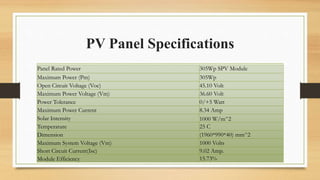
PV Panel Specifications
Panel Rated Power 305Wp SPV Module
Maximum Power (Pm) 305Wp
Open Circuit Voltage (Voc) 45.10 Volt
Maximum Power Voltage (Vm) 36.60 Volt
Power Tolerance 0/+5 Watt
Maximum Power Current 8.34 Amp
Solar Intensity 1000 W/m^2
Temperature 25 C
Dimension (1960*990*40) mm^2
Maximum System Voltage (Vm) 1000 Volts
Short Circuit Current(Isc) 9.02 Amp.
Module Efficiency 15.73%
PV Module Sizing
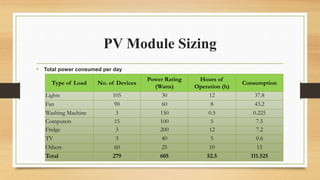
• Total power consumed per day
Type of Load No. of Devices
Power Rating
(Watts)
Hours of
Operation (h)
Consumption
Lights 105 30 12 37.8
Fan 90 60 8 43.2
Washing Machine 3 150 0.5 0.225
Computers 15 100 5 7.5
Fridge 3 200 12 7.2
TV 3 40 5 0.6
Others 60 25 10 15
Total 279 605 52.5 111.525
PV Module Sizing
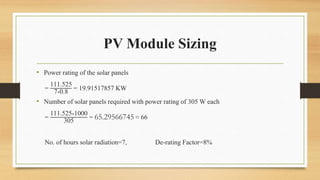
• Power rating of the solar panels
=
111.525
7∗0.8
= 19.91517857 KW
• Number of solar panels required with power rating of 305 W each
=
111.525∗1000
305
= 65.29566745 ≈ 66
No. of hours solar radiation=7, De-rating Factor=8%
Battery Sizing
• Number of Batteries (of rating 12 V, 220 A-h each) required to have backup for 1 days
=
111.525∗1000∗1
12∗220∗0.5
= 84.48863636 ≈ 85
No. of days for which the backup power required = 1 Day
Depth of discharge of the battery = 50%
Inverter Sizing
• Diversity Factor (DF) =
168.795
111.525
= 1.513517149
• Inverter Size =
279∗605
1.513517149
= 111525 Watt = 111.525 KW= 115 KW
Economic Aspect
Equipment's Price(INR) Unit Total Cost(INR)
PV Module 13100 66 864600
Batteries 16000 85 1360000
Inverter 11/Watts 115*1000 1226775
Charge Controller 15200 1 15200
Cgrid 365*111.525*4.50*25 Rs- 4579495.313
Cpv(Without Subsidy) 864600+1360000+1226775+15200 Rs- 3466575
Cpv(With Subsidy) (1-40%)*3466575 Rs- 2079945
Profit(Compare to Grid Cost) 4579495.313-2079945 Rs- 2499550.313
Emission Reduction
111.525*0.82*365*
25
1000
834.4858125 Tons/MWh
Payback Period
• Payback Period =
2079945
111.525∗4.5∗365
= 11.35466279 ≈ 11 Years 4 Month
Year kWh(Unit)Generation Unit Cost in Rs(Punjab) Benefit(Rs) O&M Cost(Rs) Saving(Rs)
1st
23320 3.7 86284 46875 39409
2nd
22780 4.1 93398 46875 46523
3rd
22167 4.9 108618.3 46875 61743.3
4th
21956 5.3 116366.8 46875 69491.8
5th
21746 5.85 127214.1 46875 80339.1
6th
20538 6.25 128362.5 46875 81487.5
7th
20331 6.61 134387.91 46875 87512.91
Saving & Payback Period
Saving
after 1 Yr
Saving
after 2 Yr
Saving
after 3 Yr
Saving after
4 Yr
Saving
after 5 Yr
Saving after
6 Yr
Saving
after 7 Yr
39409 39409 39409 39409 39409 39409 39409
46523 46523 46523 46523 46523 46523
100943.3 100943.3 100943.3 100943.3 100943.3
69491.8 69491.8 69491.8 69491.8
80339.1 80339.1 80339.1
81487.5 81487.5
87512.91
Rs-
39409
Rs-
85932
Rs-
186875.3
Rs-
256367.1
Rs-
336706.2
Rs-
418193.7
Rs-
1323483.3
Observations & Conclusions
From the mathematical model and the illustrative examples, the following interesting observations can
be made:
• For hostel building, the cost of rooftop solar PV system is about Rs. 20.8 Lakh, with a lifetime
profit of Rs. 25 Lakh (in 25 years).
• The payback period is about 12 years
• Reduction in CO2 emissions of 834.5 tons in 25 Years
• Major project in last semester shall continue in analysis of gird connected root top PV, extending
the model for provision of selling power to the grid.
My Suggestions
• If number of days of back-up is consider for 3 days
 Number of batteries required is 254
 Cost of battery is 72.4 % of overall cost
• If number of days of back-up is consider for 1 days
 Cost of batteries is 39.2 % of overall cost
 Number of battery required is 85
• Battery size is important and effects the overall cost. So reducing the number of days of
back-up will reduce the cost and may prove to be more profitable.
References
• https://www.sael.co/solar-energy
• Central Electricity Authority, India, ’All India Installed Capacity of Power Stations.
• CEA, CO2 Baseline Database for the Indian Power Sector.
• http://www. batterybazaar.co.in/
• http://www.solarpowerenergyindia.com/solar-charge-controller/.
• https://www.amazon.in/
• https://ieeexplore.ieee.org/abstract/document/7584208
Off Grid PV System

Off Grid PV System

  • 1.
    Techno- Economical Analysisof Off-Grid Solar PV System: Case Study Presented by: Dilawez Alam M. Tech Energy Science & Technology, 3rd Semester Department of Applied Science & Humanities Faculty of Engineering & Technology
  • 2.
    Abstract • The thermalpower plants generate major part (approximate 58%) of the total energy produced in India. However, it has become urgent need to switch over from fossil fuel based generation to the renewable sources based generation considering the environmental aspect and sustainable future. • Among the renewable generations, the solar energy is most promising but due to the land availability issue the roof top PV (RTPV) system gained the popularity. • In this project, the techno economic feasibility study of the off grid RTPV system is analyzed. • Furthermore, the technical parameters related to the off grid RTPV system are also discussed. • This study will be helpful to the utility and planners for possible adoption of the off grid solar PV system in residential as well as commercial building.
  • 3.
  • 4.
    PV Panel Specifications PanelRated Power 305Wp SPV Module Maximum Power (Pm) 305Wp Open Circuit Voltage (Voc) 45.10 Volt Maximum Power Voltage (Vm) 36.60 Volt Power Tolerance 0/+5 Watt Maximum Power Current 8.34 Amp Solar Intensity 1000 W/m^2 Temperature 25 C Dimension (1960*990*40) mm^2 Maximum System Voltage (Vm) 1000 Volts Short Circuit Current(Isc) 9.02 Amp. Module Efficiency 15.73%
  • 5.
    PV Module Sizing •Total power consumed per day Type of Load No. of Devices Power Rating (Watts) Hours of Operation (h) Consumption Lights 105 30 12 37.8 Fan 90 60 8 43.2 Washing Machine 3 150 0.5 0.225 Computers 15 100 5 7.5 Fridge 3 200 12 7.2 TV 3 40 5 0.6 Others 60 25 10 15 Total 279 605 52.5 111.525
  • 6.
    PV Module Sizing •Power rating of the solar panels = 111.525 7∗0.8 = 19.91517857 KW • Number of solar panels required with power rating of 305 W each = 111.525∗1000 305 = 65.29566745 ≈ 66 No. of hours solar radiation=7, De-rating Factor=8%
  • 7.
    Battery Sizing • Numberof Batteries (of rating 12 V, 220 A-h each) required to have backup for 1 days = 111.525∗1000∗1 12∗220∗0.5 = 84.48863636 ≈ 85 No. of days for which the backup power required = 1 Day Depth of discharge of the battery = 50%
  • 8.
    Inverter Sizing • DiversityFactor (DF) = 168.795 111.525 = 1.513517149 • Inverter Size = 279∗605 1.513517149 = 111525 Watt = 111.525 KW= 115 KW
  • 9.
    Economic Aspect Equipment's Price(INR)Unit Total Cost(INR) PV Module 13100 66 864600 Batteries 16000 85 1360000 Inverter 11/Watts 115*1000 1226775 Charge Controller 15200 1 15200 Cgrid 365*111.525*4.50*25 Rs- 4579495.313 Cpv(Without Subsidy) 864600+1360000+1226775+15200 Rs- 3466575 Cpv(With Subsidy) (1-40%)*3466575 Rs- 2079945 Profit(Compare to Grid Cost) 4579495.313-2079945 Rs- 2499550.313 Emission Reduction 111.525*0.82*365* 25 1000 834.4858125 Tons/MWh
  • 10.
    Payback Period • PaybackPeriod = 2079945 111.525∗4.5∗365 = 11.35466279 ≈ 11 Years 4 Month Year kWh(Unit)Generation Unit Cost in Rs(Punjab) Benefit(Rs) O&M Cost(Rs) Saving(Rs) 1st 23320 3.7 86284 46875 39409 2nd 22780 4.1 93398 46875 46523 3rd 22167 4.9 108618.3 46875 61743.3 4th 21956 5.3 116366.8 46875 69491.8 5th 21746 5.85 127214.1 46875 80339.1 6th 20538 6.25 128362.5 46875 81487.5 7th 20331 6.61 134387.91 46875 87512.91
  • 11.
    Saving & PaybackPeriod Saving after 1 Yr Saving after 2 Yr Saving after 3 Yr Saving after 4 Yr Saving after 5 Yr Saving after 6 Yr Saving after 7 Yr 39409 39409 39409 39409 39409 39409 39409 46523 46523 46523 46523 46523 46523 100943.3 100943.3 100943.3 100943.3 100943.3 69491.8 69491.8 69491.8 69491.8 80339.1 80339.1 80339.1 81487.5 81487.5 87512.91 Rs- 39409 Rs- 85932 Rs- 186875.3 Rs- 256367.1 Rs- 336706.2 Rs- 418193.7 Rs- 1323483.3
  • 12.
    Observations & Conclusions Fromthe mathematical model and the illustrative examples, the following interesting observations can be made: • For hostel building, the cost of rooftop solar PV system is about Rs. 20.8 Lakh, with a lifetime profit of Rs. 25 Lakh (in 25 years). • The payback period is about 12 years • Reduction in CO2 emissions of 834.5 tons in 25 Years • Major project in last semester shall continue in analysis of gird connected root top PV, extending the model for provision of selling power to the grid.
  • 13.
    My Suggestions • Ifnumber of days of back-up is consider for 3 days  Number of batteries required is 254  Cost of battery is 72.4 % of overall cost • If number of days of back-up is consider for 1 days  Cost of batteries is 39.2 % of overall cost  Number of battery required is 85 • Battery size is important and effects the overall cost. So reducing the number of days of back-up will reduce the cost and may prove to be more profitable.
  • 14.
    References • https://www.sael.co/solar-energy • CentralElectricity Authority, India, ’All India Installed Capacity of Power Stations. • CEA, CO2 Baseline Database for the Indian Power Sector. • http://www. batterybazaar.co.in/ • http://www.solarpowerenergyindia.com/solar-charge-controller/. • https://www.amazon.in/ • https://ieeexplore.ieee.org/abstract/document/7584208