UNISA Workshop: Designing a road map for
         OER implementation

                Dr Andreia Inamorato dos Santos
       Fluminense Federal University - OportUnidad Project
                and Mackenzie University (Brazil)
                    ainamorato@gmail.com
              September 4th 2012 – University of South Africa
#UNISAOER12
 @aisantos
Blog: Open Content Online


   aisantos.wordpress.com
What are OER?

OER are teaching, learning and research
materials in any format or media that are in the
public domain or open licensed allowing their
use and adaptation by third parties.
                           (UNESCO, 2002 e COL, 2011)
Who uses OER?
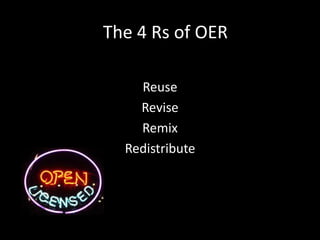
The 4 Rs of OER

    Reuse
    Revise
    Remix
  Redistribute
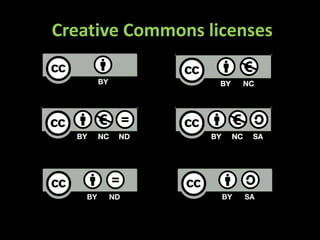
Creative Commons licenses
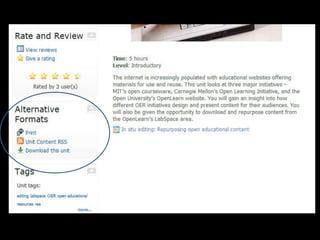
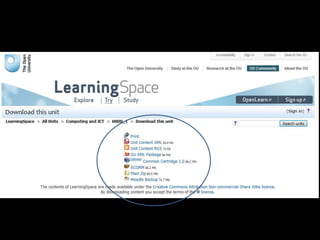
Open format for OER
.doc .docx are proprietary formats and
depend upon commercial software (Microsoft
Office and Mac packages)

.odt is an open format and is downloadable for
free over the Internet: Open Office
OER business models
Adapted from Downes’ categories (2007)
• Donation: funding body or foundation
  provides funding for the production and
  provision of OER (ex. OpenLearn – first 2
  years, Khan Academy)
• Subscription: institutions pay to become
  members of a consortium which manages the
  repository (ex. Connexions)
OER business models
• Contribution: the author of the OER is
  responsible for the costs of the production
  and promotion of the resources (ex. lecturers,
  students, teachers etc)
• Sponsorship: the cost of OER production and
  promotion is covered by a sponsor in
  exchange for visibility and publicity (ex. FGV –
  Brazil)
OER business models
• Institutional: the educational institution
  covers the cost for OER production and
  promotion
• Governmental: resources are created with
  governmental targets in mind, normally fully
  financed by the State
• Commercial : the user pays ( a symbolic
  amount) for parts of the contet, tutoring or
  certification (ex. OUNL, UnisulVirtual)
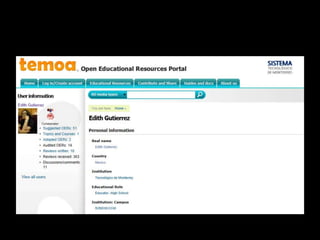
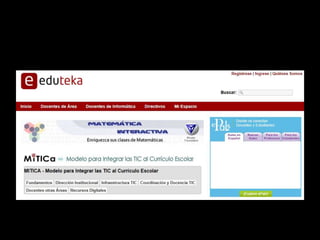
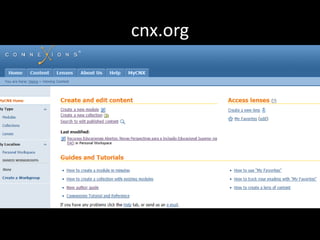
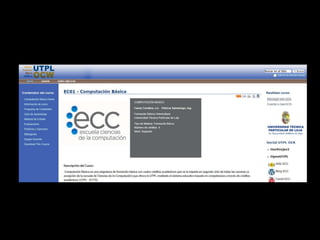
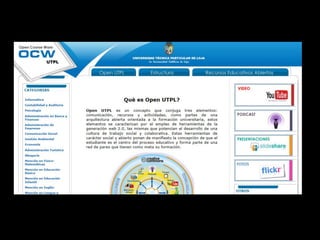
cnx.org
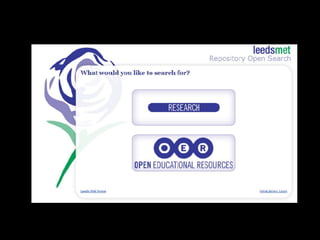
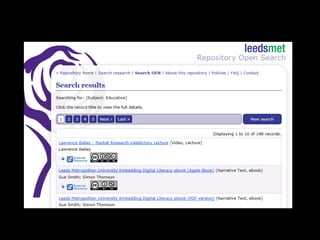
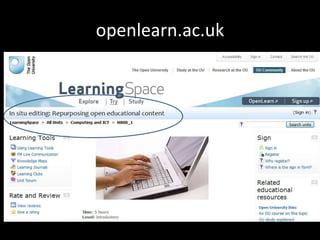
openlearn.ac.uk
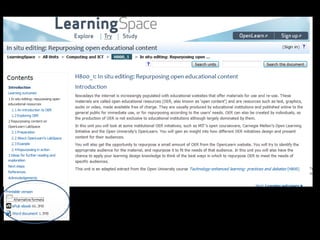
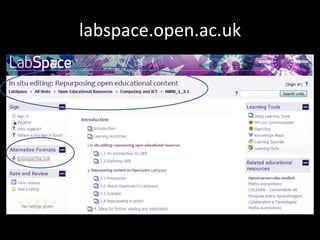
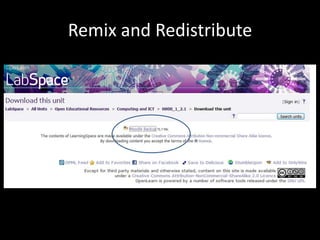
labspace.open.ac.uk
Remix and Redistribute
aisantos.wordpress.com


OER IMPLEMENTATION ROAD MAP TEMPLATE
In pairs please
• Use the template to think of your own context
• Try and fill in the more you can please
• Think of the main challenges
• Think of any existing practices or examples
• Post a question using Twitter or a comment
  using the blog route
• If not connected to the Internet: please write
  it down or speak it up! Thanks 
Thank you!
                      ainamorato@gmail.com
Image credits (Creative Commons licensed)

•   One laptop per child :wwnorm.com
•   Pregnant woman: offbeatmama.com
•   Young woman and retired man: georgecouros.ca
•   Open Licensed: thelicensingglawblog.com
•   Business woman: coachline
•   Handcuffs: muraldosescritores.ning.com
•   Access signal for the disabled: en.wikipedia.org
•   Business meeting: mmc.org

OER workshop unisa

  • 1.
    UNISA Workshop: Designinga road map for OER implementation Dr Andreia Inamorato dos Santos Fluminense Federal University - OportUnidad Project and Mackenzie University (Brazil) ainamorato@gmail.com September 4th 2012 – University of South Africa
  • 2.
  • 3.
    Blog: Open ContentOnline aisantos.wordpress.com
  • 5.
    What are OER? OERare teaching, learning and research materials in any format or media that are in the public domain or open licensed allowing their use and adaptation by third parties. (UNESCO, 2002 e COL, 2011)
  • 6.
  • 14.
    The 4 Rsof OER Reuse Revise Remix Redistribute
  • 15.
  • 16.
    Open format forOER .doc .docx are proprietary formats and depend upon commercial software (Microsoft Office and Mac packages) .odt is an open format and is downloadable for free over the Internet: Open Office
  • 17.
    OER business models Adaptedfrom Downes’ categories (2007) • Donation: funding body or foundation provides funding for the production and provision of OER (ex. OpenLearn – first 2 years, Khan Academy) • Subscription: institutions pay to become members of a consortium which manages the repository (ex. Connexions)
  • 18.
    OER business models •Contribution: the author of the OER is responsible for the costs of the production and promotion of the resources (ex. lecturers, students, teachers etc) • Sponsorship: the cost of OER production and promotion is covered by a sponsor in exchange for visibility and publicity (ex. FGV – Brazil)
  • 19.
    OER business models •Institutional: the educational institution covers the cost for OER production and promotion • Governmental: resources are created with governmental targets in mind, normally fully financed by the State • Commercial : the user pays ( a symbolic amount) for parts of the contet, tutoring or certification (ex. OUNL, UnisulVirtual)
  • 29.
  • 31.
  • 35.
  • 36.
  • 39.
  • 40.
    In pairs please •Use the template to think of your own context • Try and fill in the more you can please • Think of the main challenges • Think of any existing practices or examples • Post a question using Twitter or a comment using the blog route • If not connected to the Internet: please write it down or speak it up! Thanks 
  • 41.
    Thank you! ainamorato@gmail.com Image credits (Creative Commons licensed) • One laptop per child :wwnorm.com • Pregnant woman: offbeatmama.com • Young woman and retired man: georgecouros.ca • Open Licensed: thelicensingglawblog.com • Business woman: coachline • Handcuffs: muraldosescritores.ning.com • Access signal for the disabled: en.wikipedia.org • Business meeting: mmc.org