Openness in Higher Education:
Open Education Resources
Glenda Cox

1
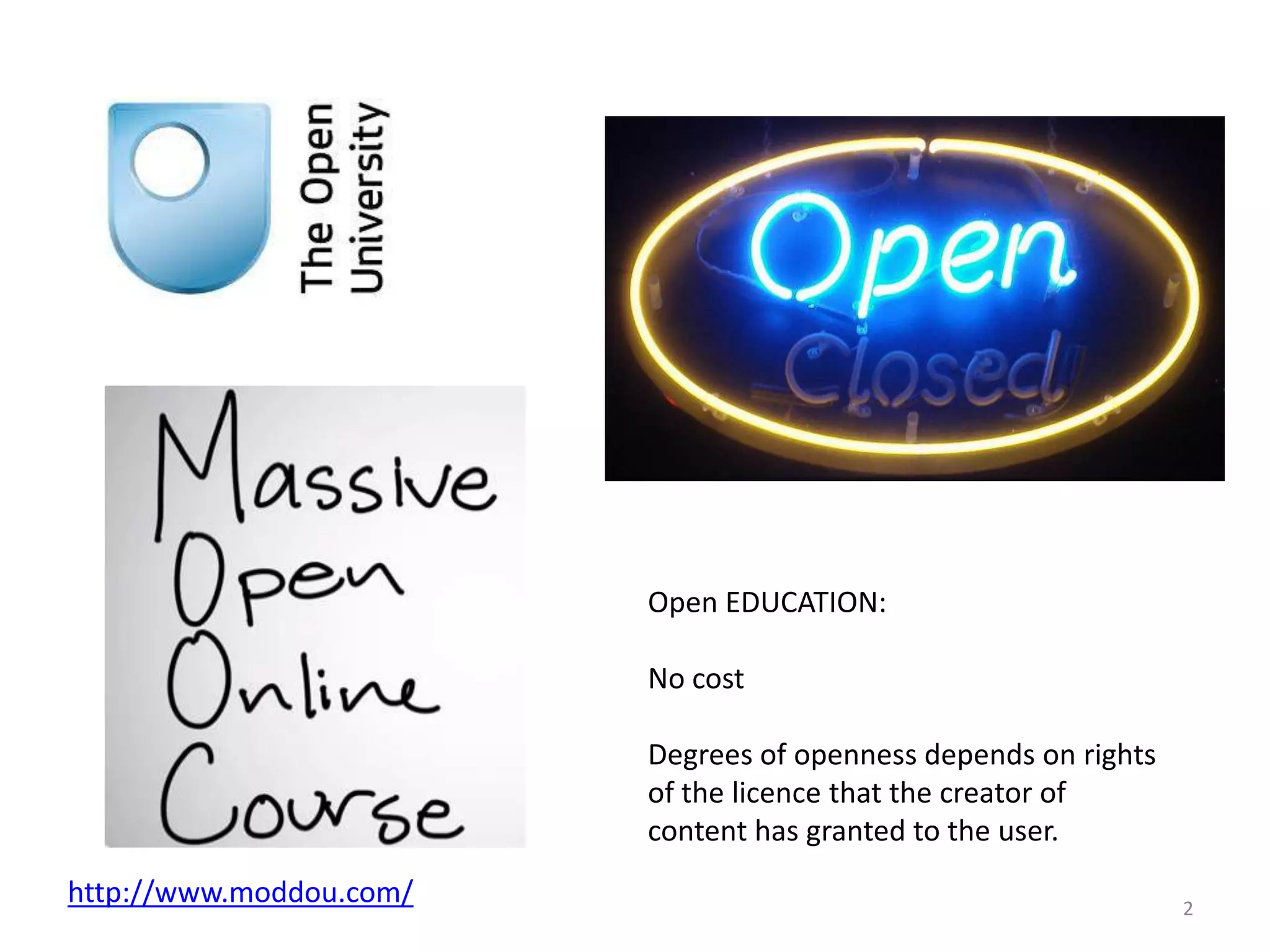
Open EDUCATION:
No cost
Degrees of openness depends on rights
of the licence that the creator of
content has granted to the user.
http://www.moddou.com/

2
Open Educational Resources
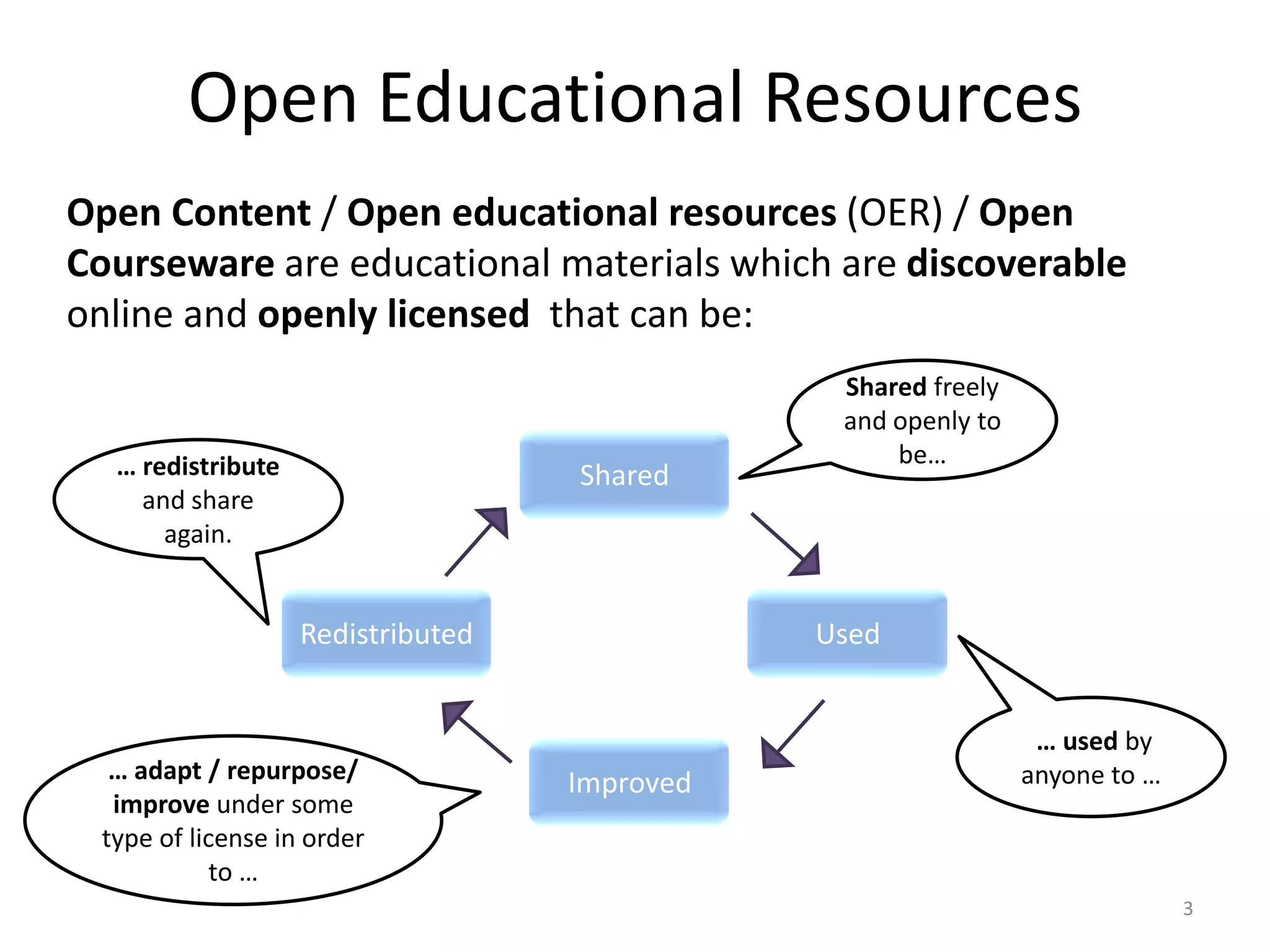
Open Content / Open educational resources (OER) / Open
Courseware are educational materials which are discoverable
online and openly licensed that can be:

… redistribute
and share
again.

Shared

Redistributed

… adapt / repurpose/
improve under some
type of license in order
to …

Shared freely
and openly to
be…

Used

Improved

… used by
anyone to …

3
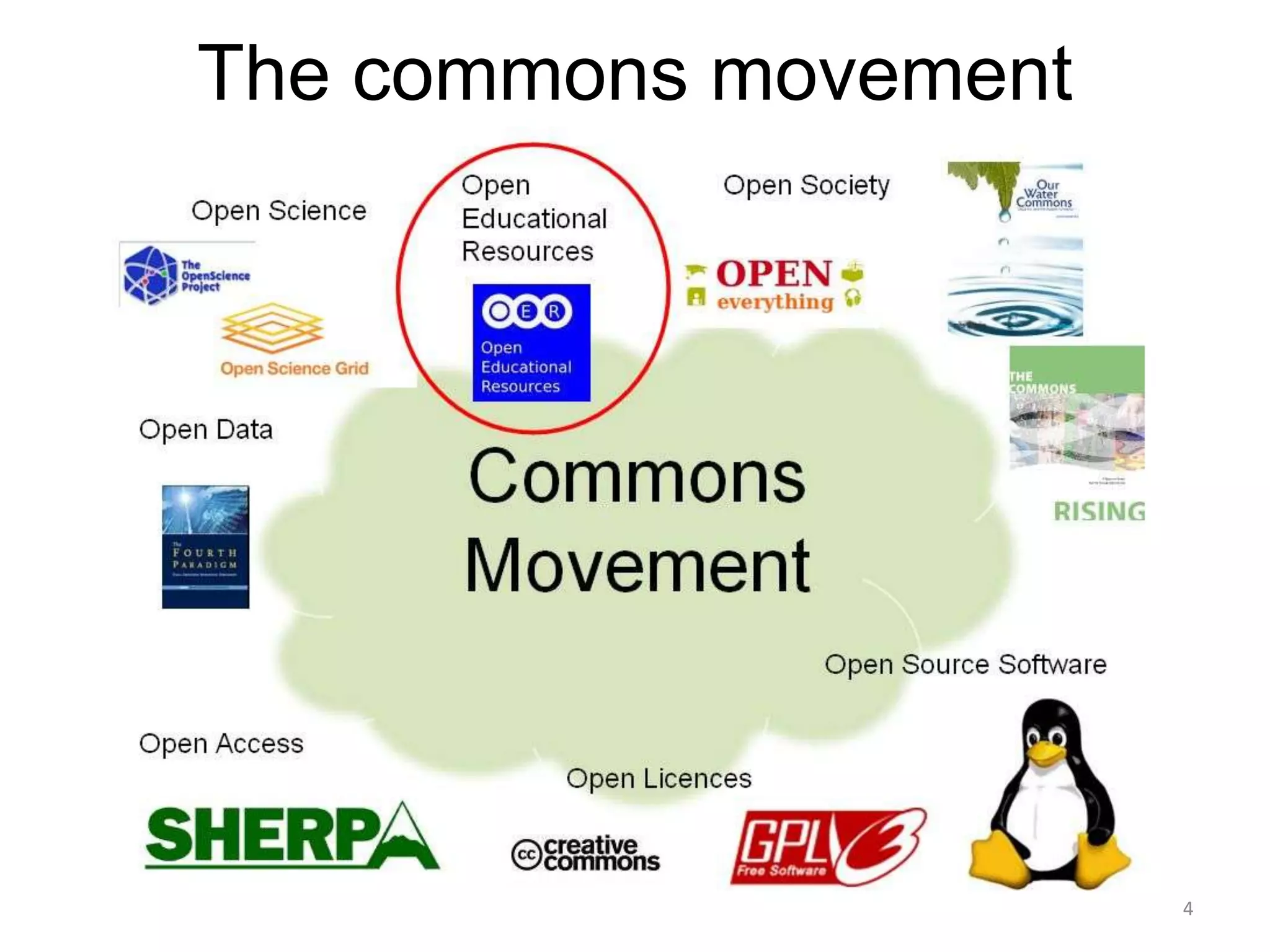
The commons movement

4
OER MOVEMENT
INTERNATIONALLY
5
6
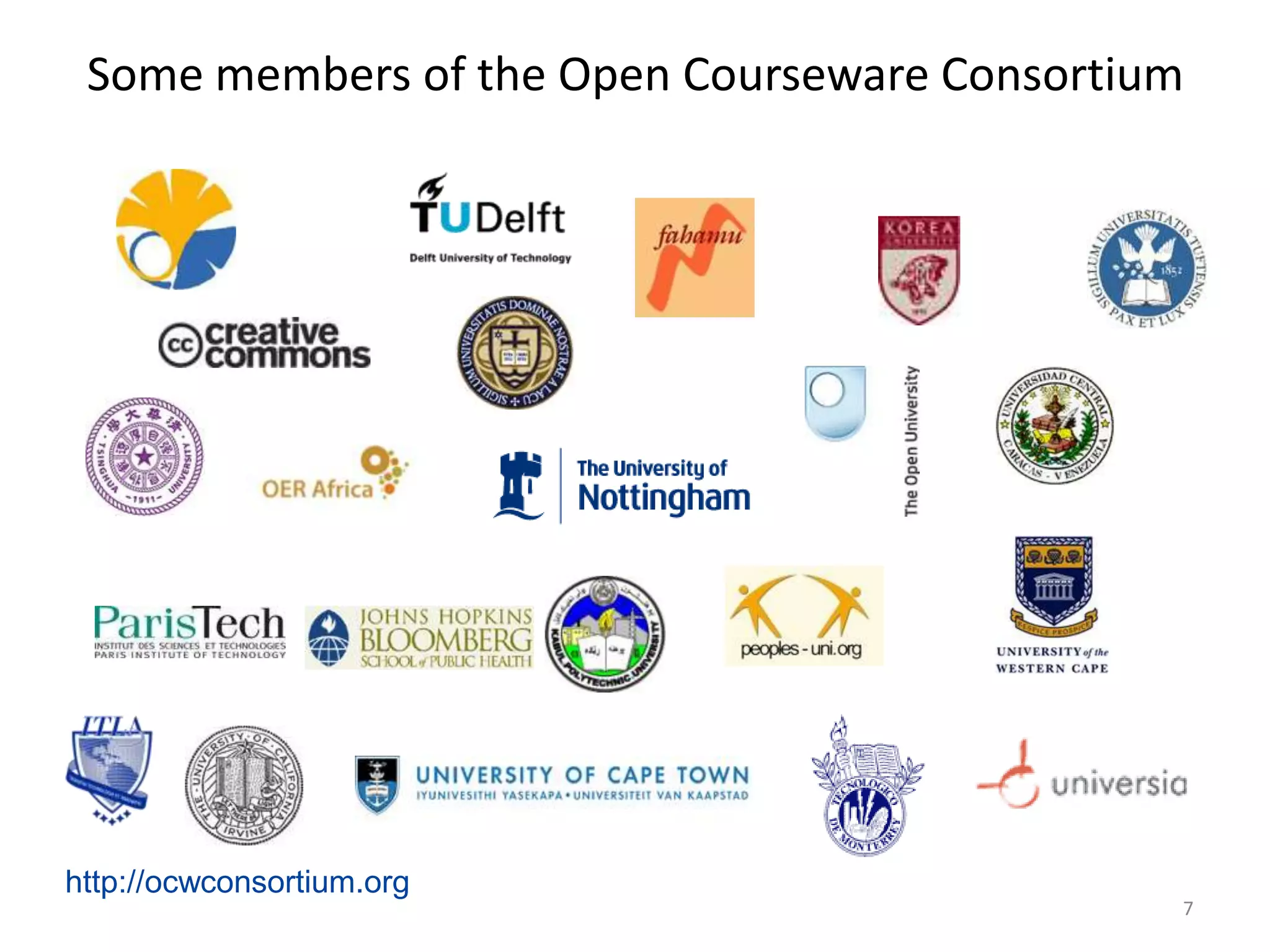
Some members of the Open Courseware Consortium

http://ocwconsortium.org
7
8
9
OER AT UCT

10
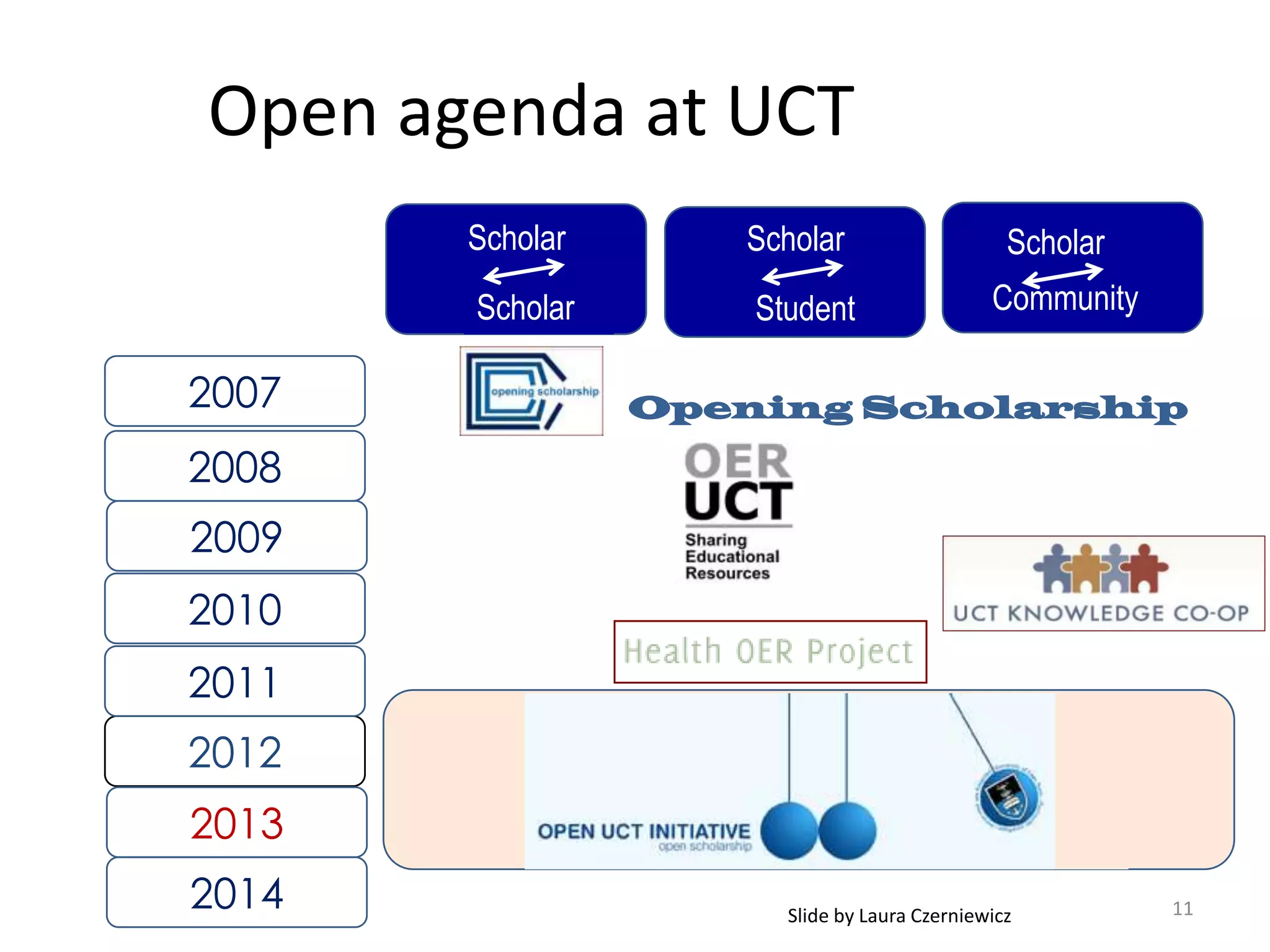
Open agenda at UCT
Scholar

Scholar

Scholar

2007

Scholar
Student

Community

Opening Scholarship

2008
2009
2010
2011
2012
2013
2014

Scholar
Scholar
Slide by Laura Czerniewicz

11
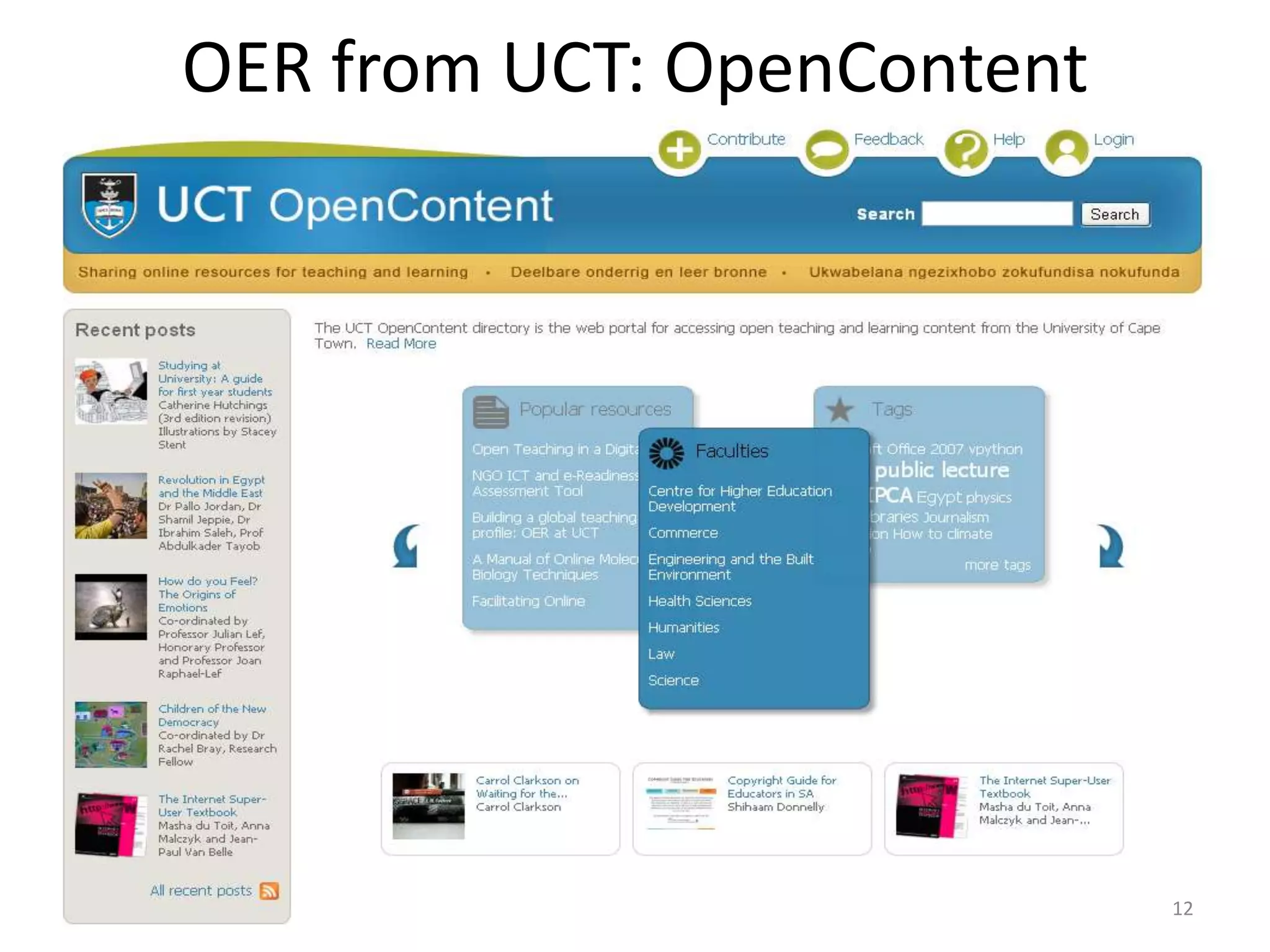
OER from UCT: OpenContent

12
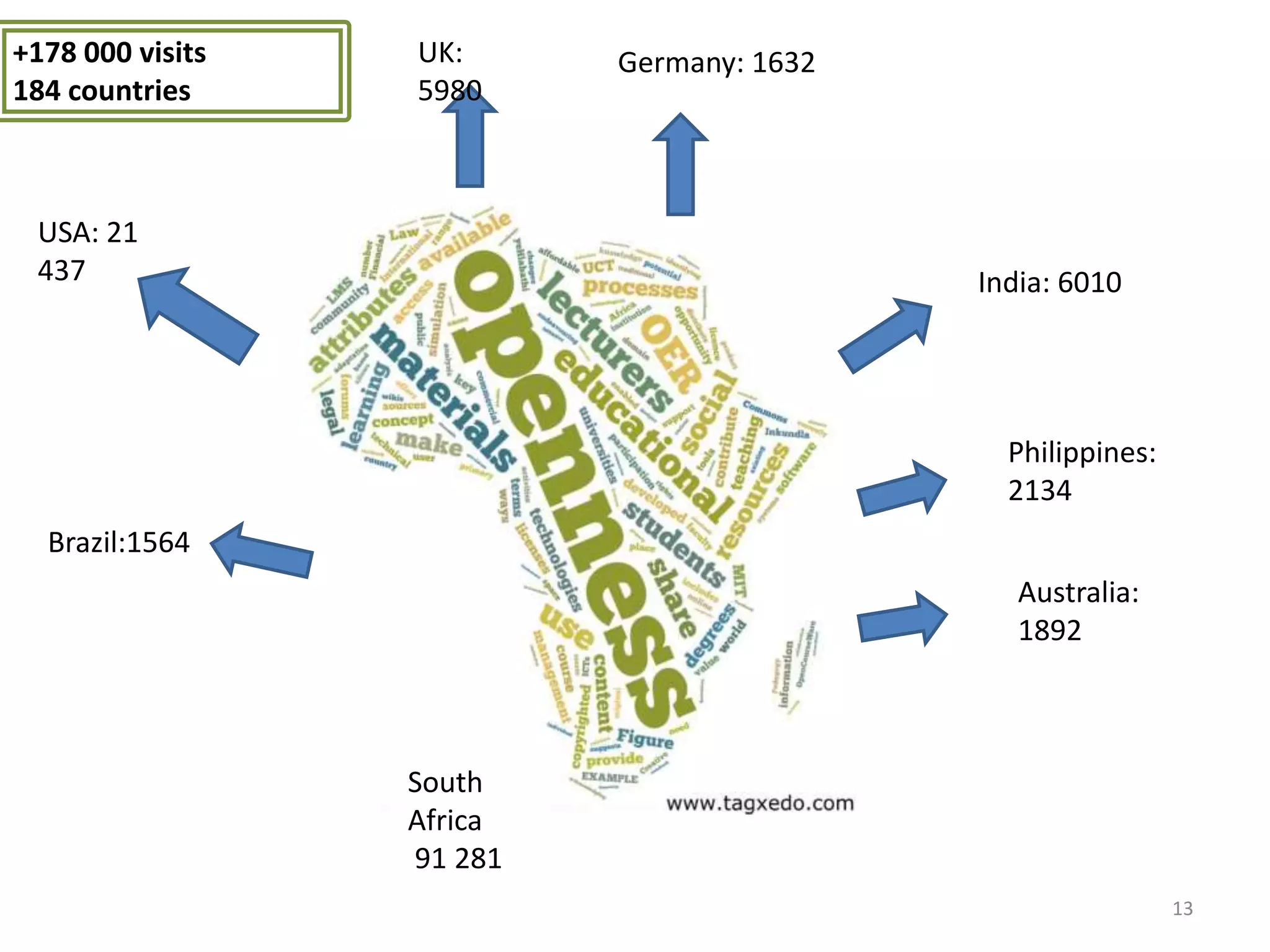
+178 000 visits
184 countries

UK:
5980

USA: 21
437

Germany: 1632

India: 6010

Philippines:
2134

Brazil:1564
Australia:
1892

South
Africa
91 281
13
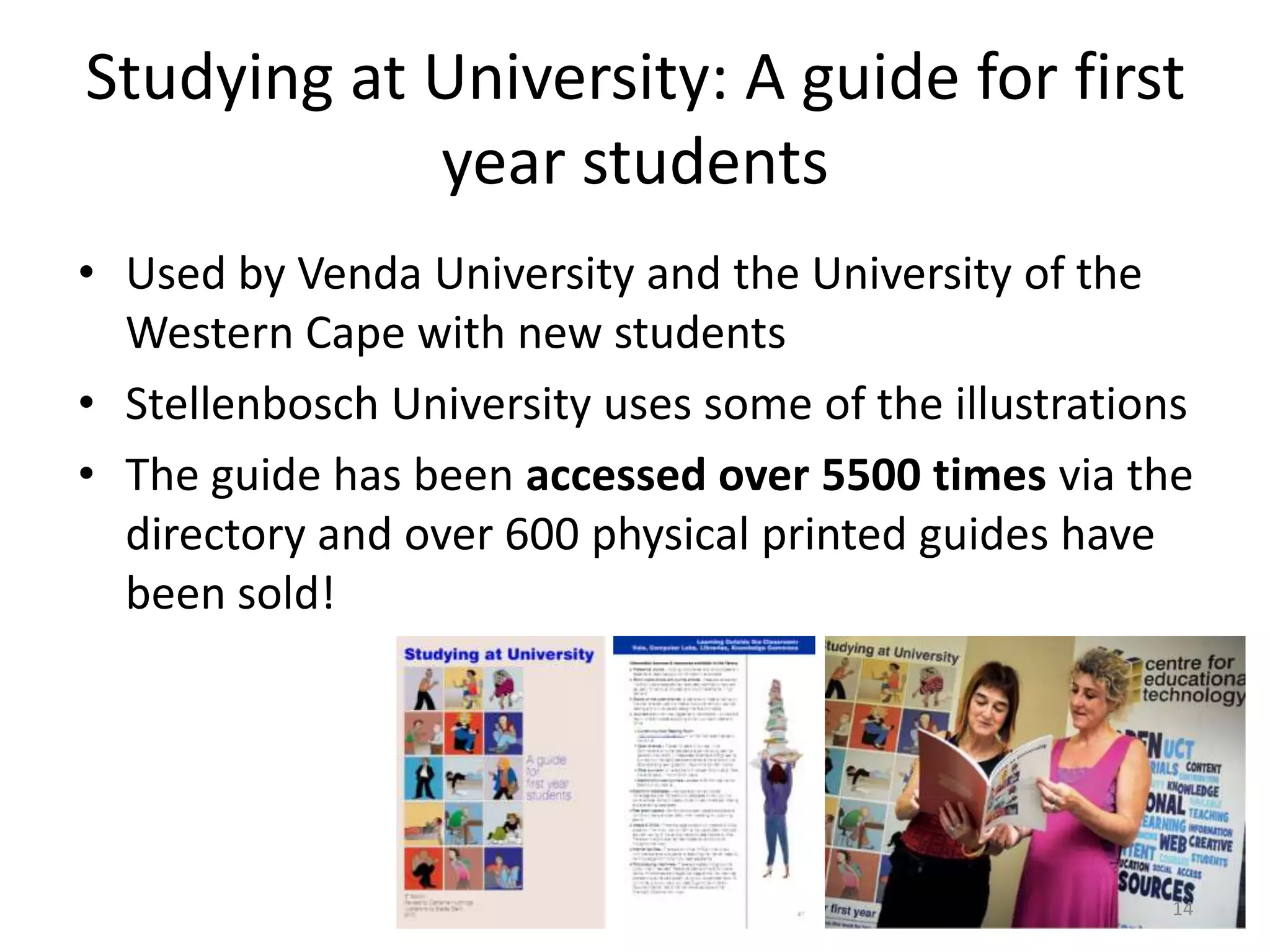
Studying at University: A guide for first
year students
• Used by Venda University and the University of the
Western Cape with new students
• Stellenbosch University uses some of the illustrations
• The guide has been accessed over 5500 times via the
directory and over 600 physical printed guides have
been sold!

14
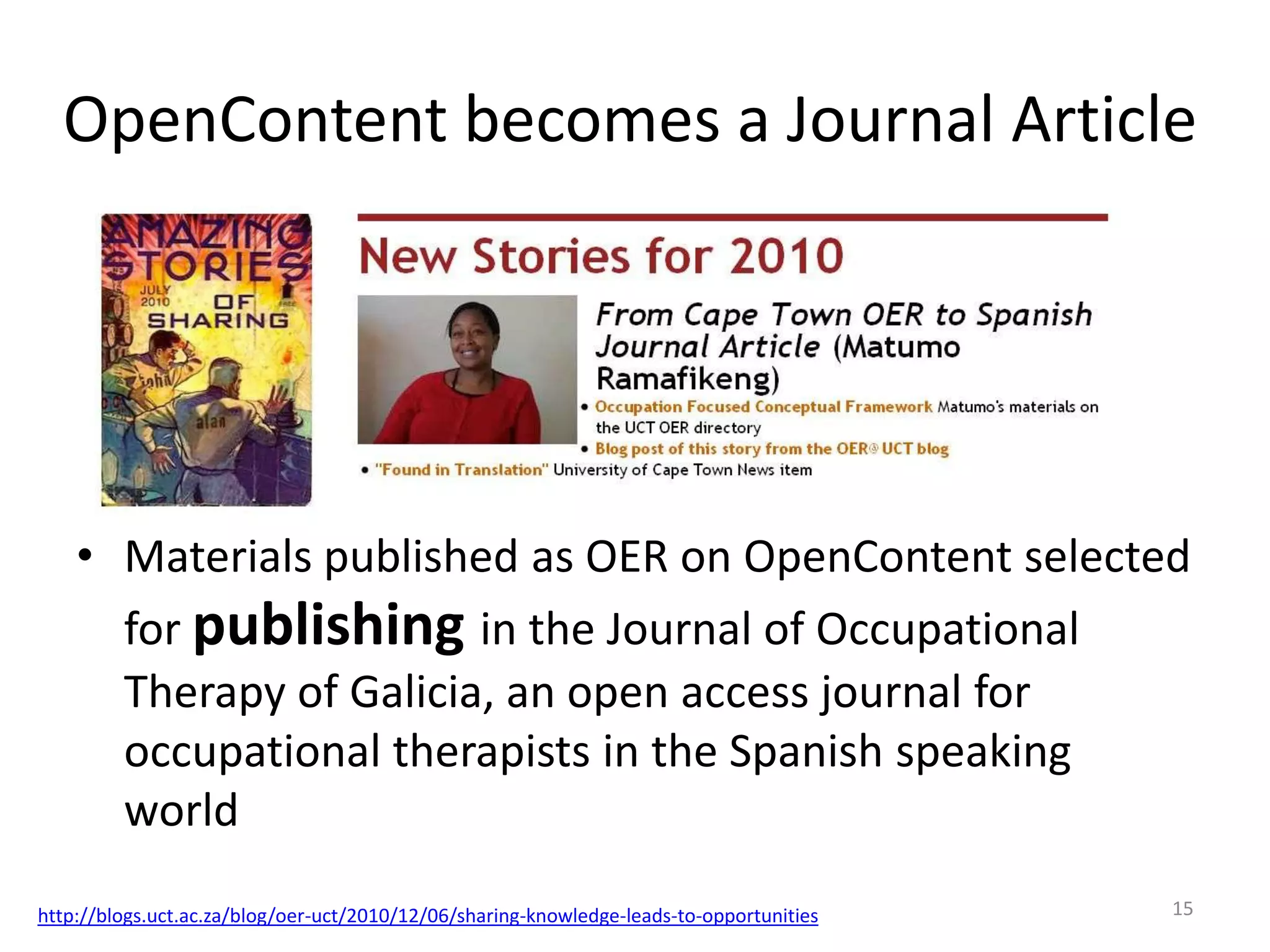
OpenContent becomes a Journal Article

• Materials published as OER on OpenContent selected
for publishing in the Journal of Occupational
Therapy of Galicia, an open access journal for
occupational therapists in the Spanish speaking
world
http://blogs.uct.ac.za/blog/oer-uct/2010/12/06/sharing-knowledge-leads-to-opportunities

15
16
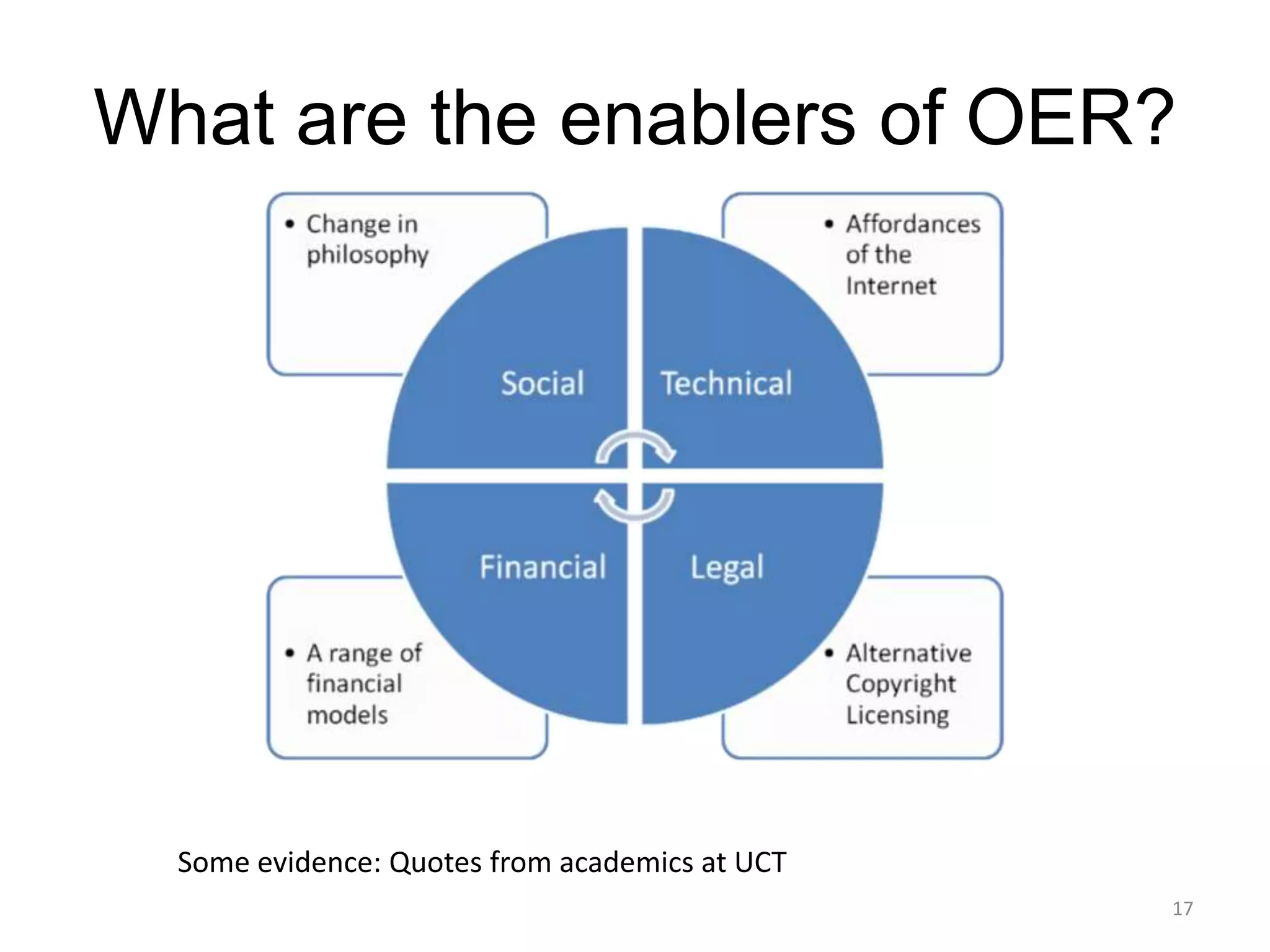
What are the enablers of OER?

Some evidence: Quotes from academics at UCT
17
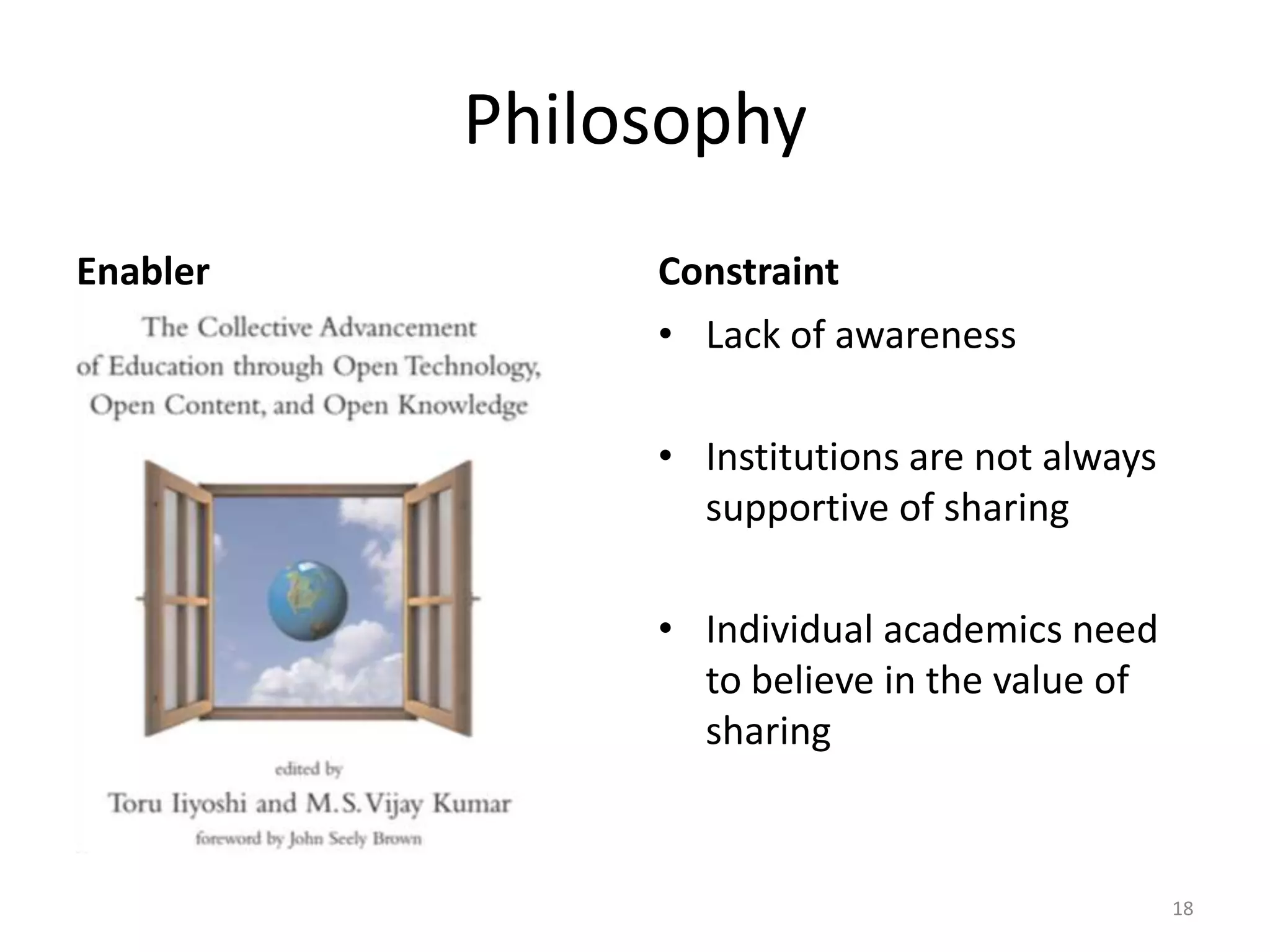
Philosophy
Enabler

Constraint
• Lack of awareness

• Institutions are not always
supportive of sharing
• Individual academics need
to believe in the value of
sharing

18
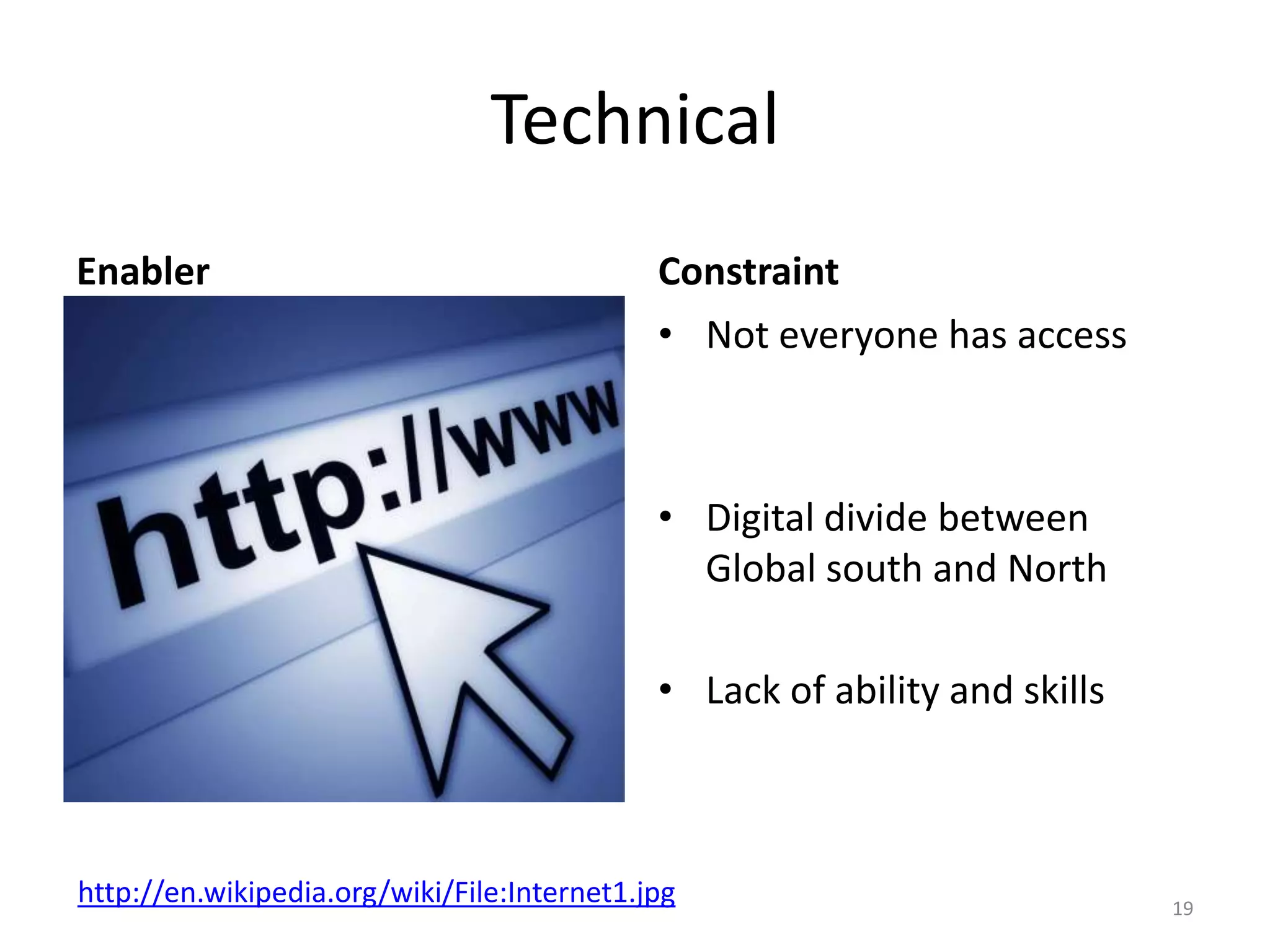
Technical
Enabler

Constraint
• Not everyone has access

• Digital divide between
Global south and North

• Lack of ability and skills

http://en.wikipedia.org/wiki/File:Internet1.jpg

19
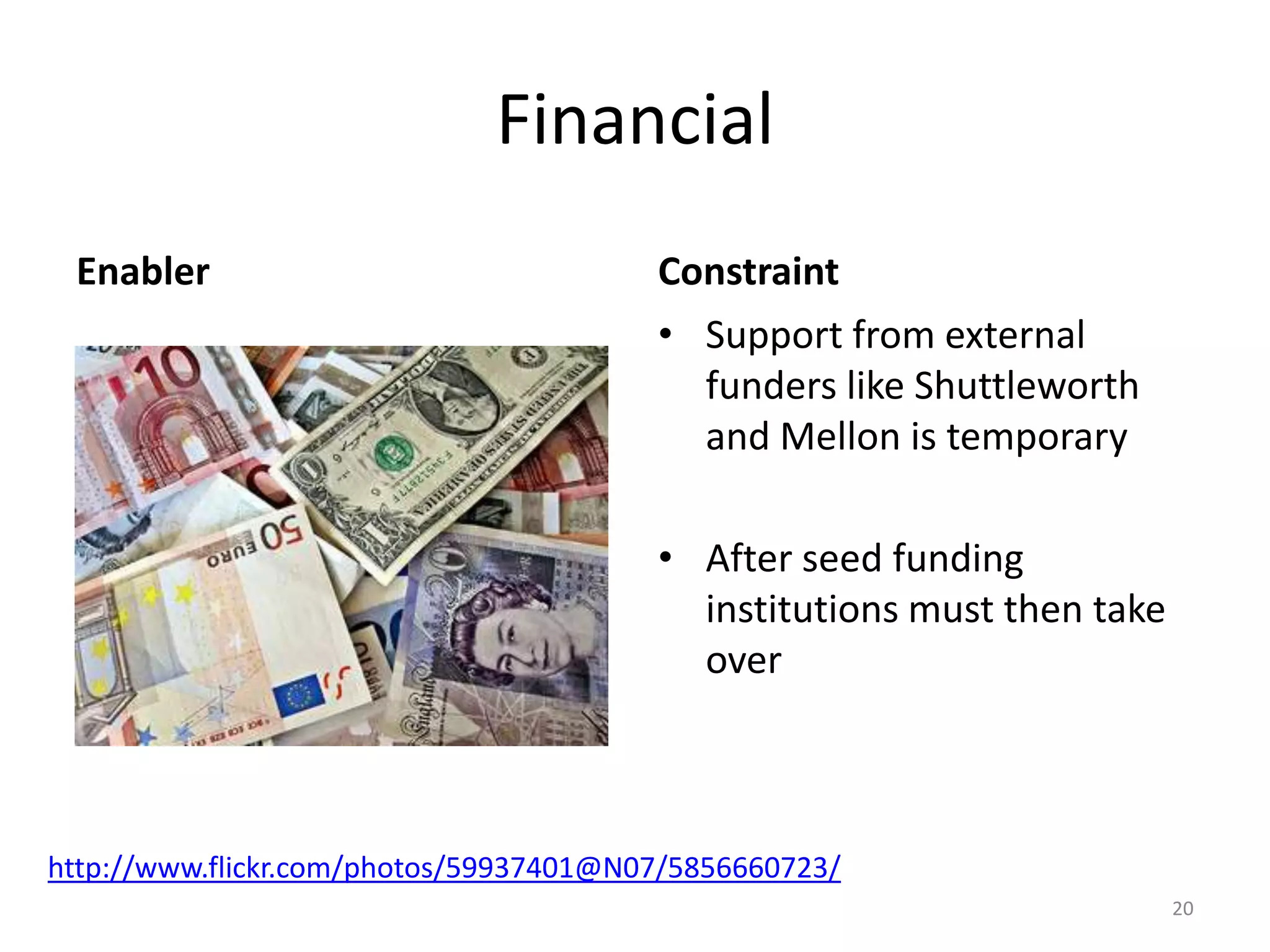
Financial
Enabler

Constraint
• Support from external
funders like Shuttleworth
and Mellon is temporary
• After seed funding
institutions must then take
over

http://www.flickr.com/photos/59937401@N07/5856660723/
20
Legal
Enabler

“So actually I think
you’re more protected
if you make something
legitimately an OER
and then somebody
else uses it.”

Constraint
• Academics are not aware of
Creative Commons or how
Creative Commons works
• They are not that concerned
about their Intellectual
property ( although they do
want attribution) but they
are very concerned about
infringing the copyright of
others
21
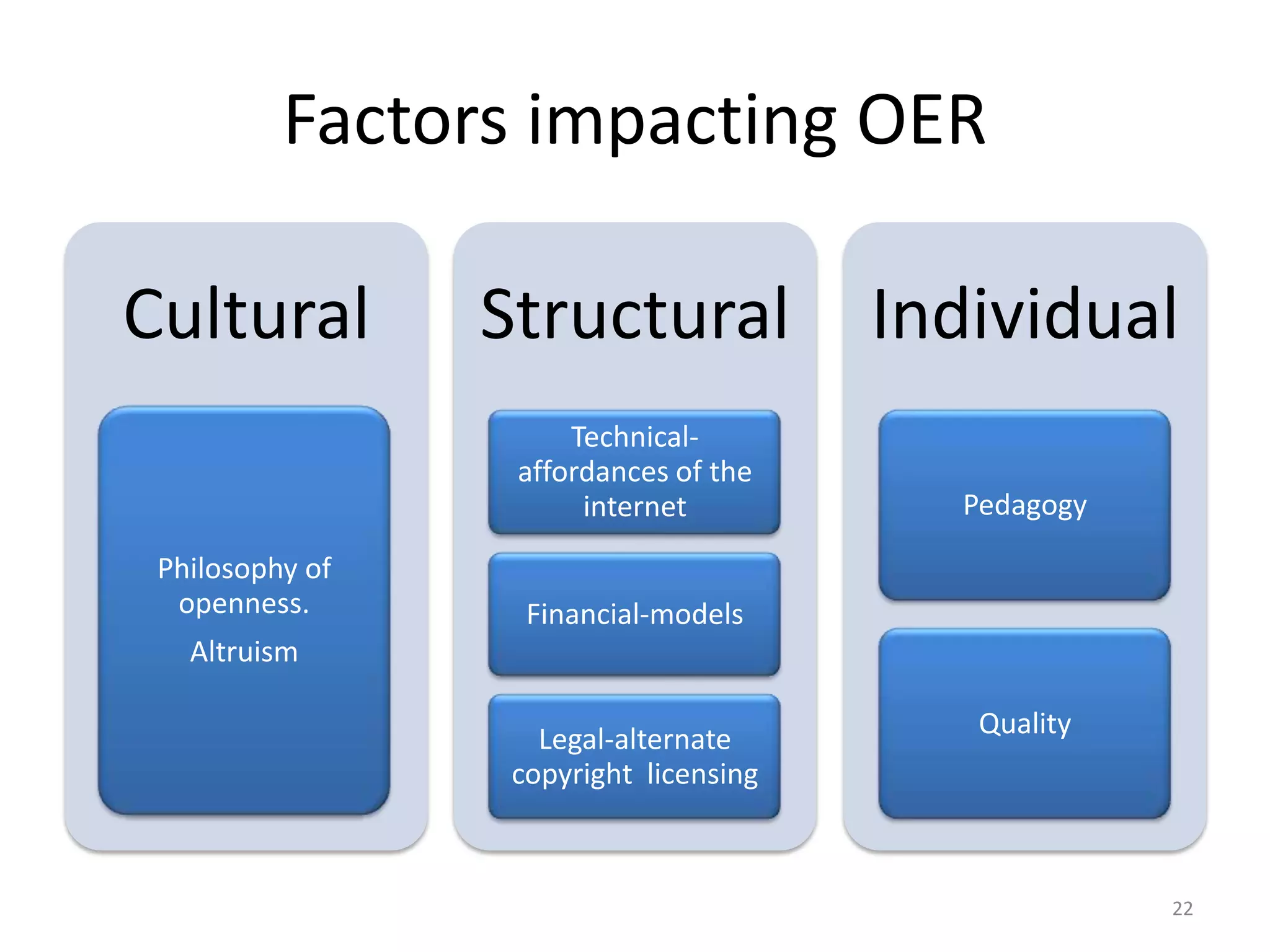
Factors impacting OER
Cultural

Individual

Technicalaffordances of the
internet
Philosophy of
openness.

Structural

Pedagogy

Financial-models

Altruism
Legal-alternate
copyright licensing

Quality

22
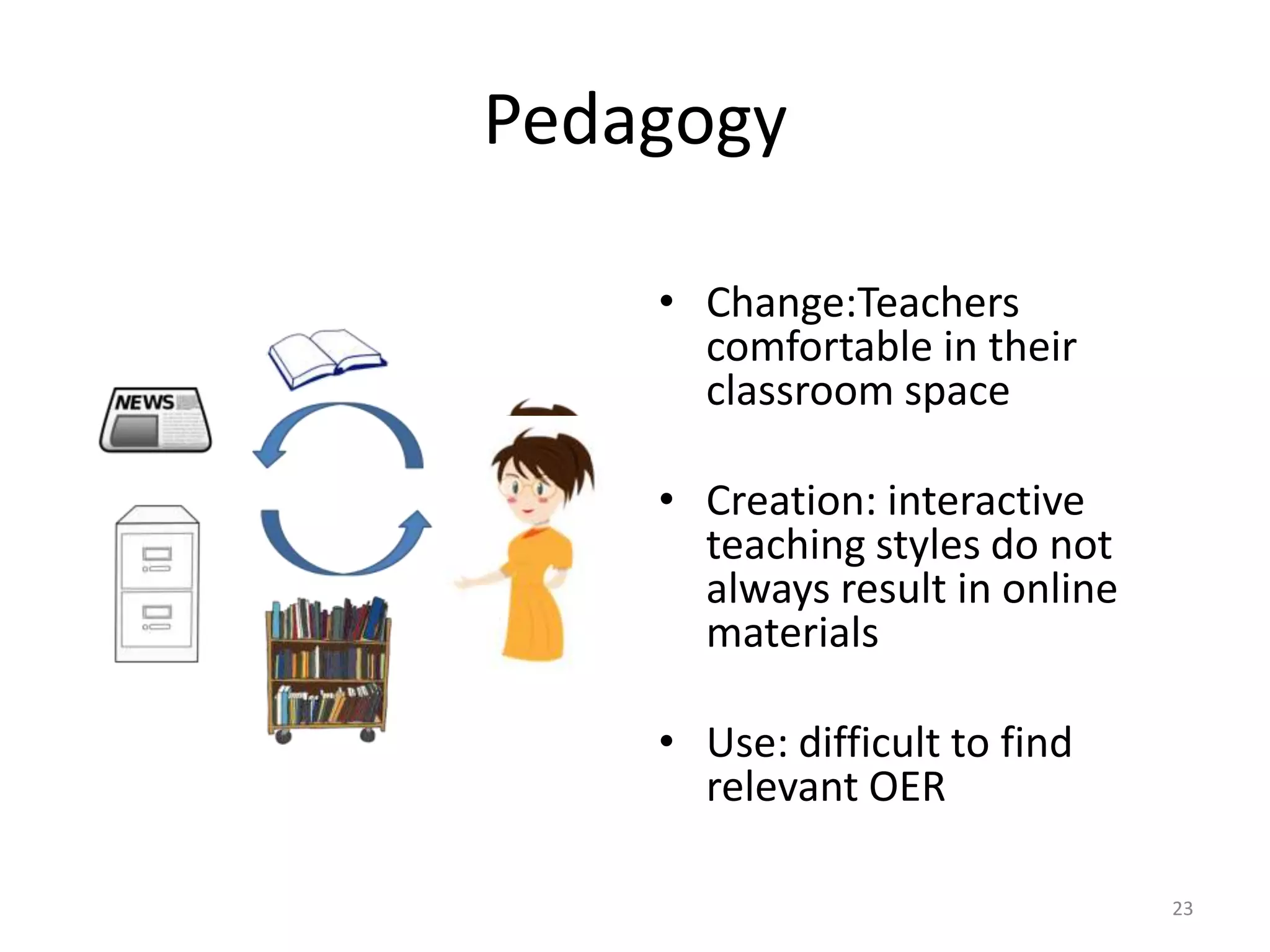
Pedagogy
• Change:Teachers
comfortable in their
classroom space
• Creation: interactive
teaching styles do not
always result in online
materials

• Use: difficult to find
relevant OER
23
Quality
Improve quality
“.. I think it will make everyone go over it
two or three times, ya.”
Readiness of materials:
“If they’re ready for students to
see, then they’re as ready as
they’re going to get.”
Quality check:
“I think that each individual
preparing their materials must
be sure that their material is
substantively correct, sound or
critical.”

 they don’t look good enough
to put out there
 “But I would love to be able to
give what I had to somebody
and say does it… it’s sort of
like is there cohesion, does it
make sense”

24
Complex interplay between factors
impacting OER

Cultural

Individual

Technicalaffordances of the
internet
Philosophy of
openness.

Structural

Pedagogy

Financial-models

Altruism
Legal-alternate
copyright licensing

Quality

25
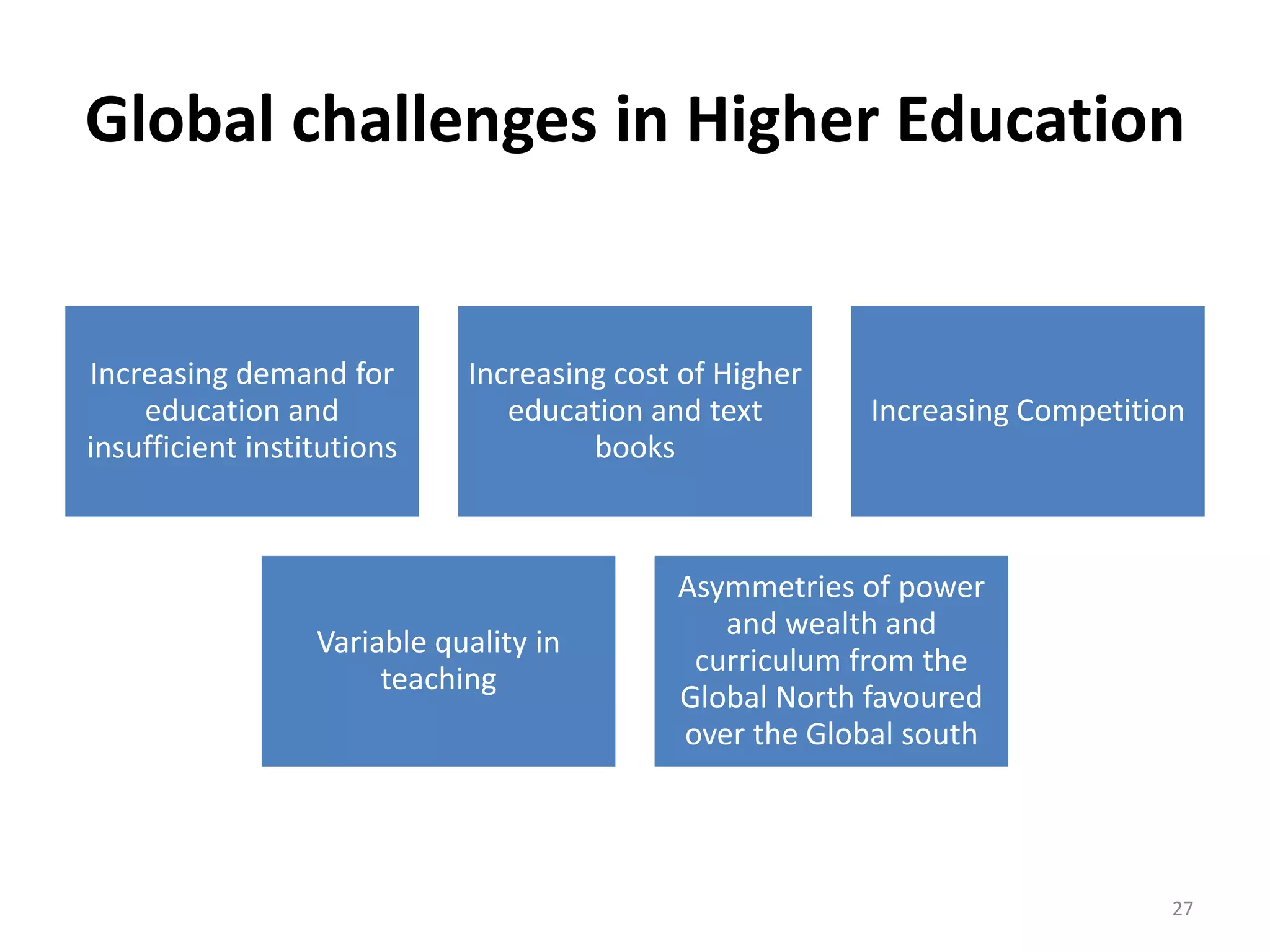
WHY OER? WHAT ARE THE POTENTIAL
BENEFITS OF OER?

26
Global challenges in Higher Education

Increasing demand for
education and
insufficient institutions

Increasing cost of Higher
education and text
books

Variable quality in
teaching

Increasing Competition

Asymmetries of power
and wealth and
curriculum from the
Global North favoured
over the Global south

27
Challenges for South Africa
• Crisis in Basic education
• Skills shortage/’persistent
human Capital gap” (Taylor,
2011)
Higher education: high school
graduates of varied ability
Higher education institutions
quality variable

28
Why now for departments?
• Increase institutional visibility, advancing competitiveness,
attracting students and resources
• Promote effective social responsiveness
• Improve recruitment by helping the right students find the right
programmes
• Enhance teaching coherence across courses
• Ensure better long-term archiving, curation and reuse of teaching
materials
• Attract alumni as life-long learners

29
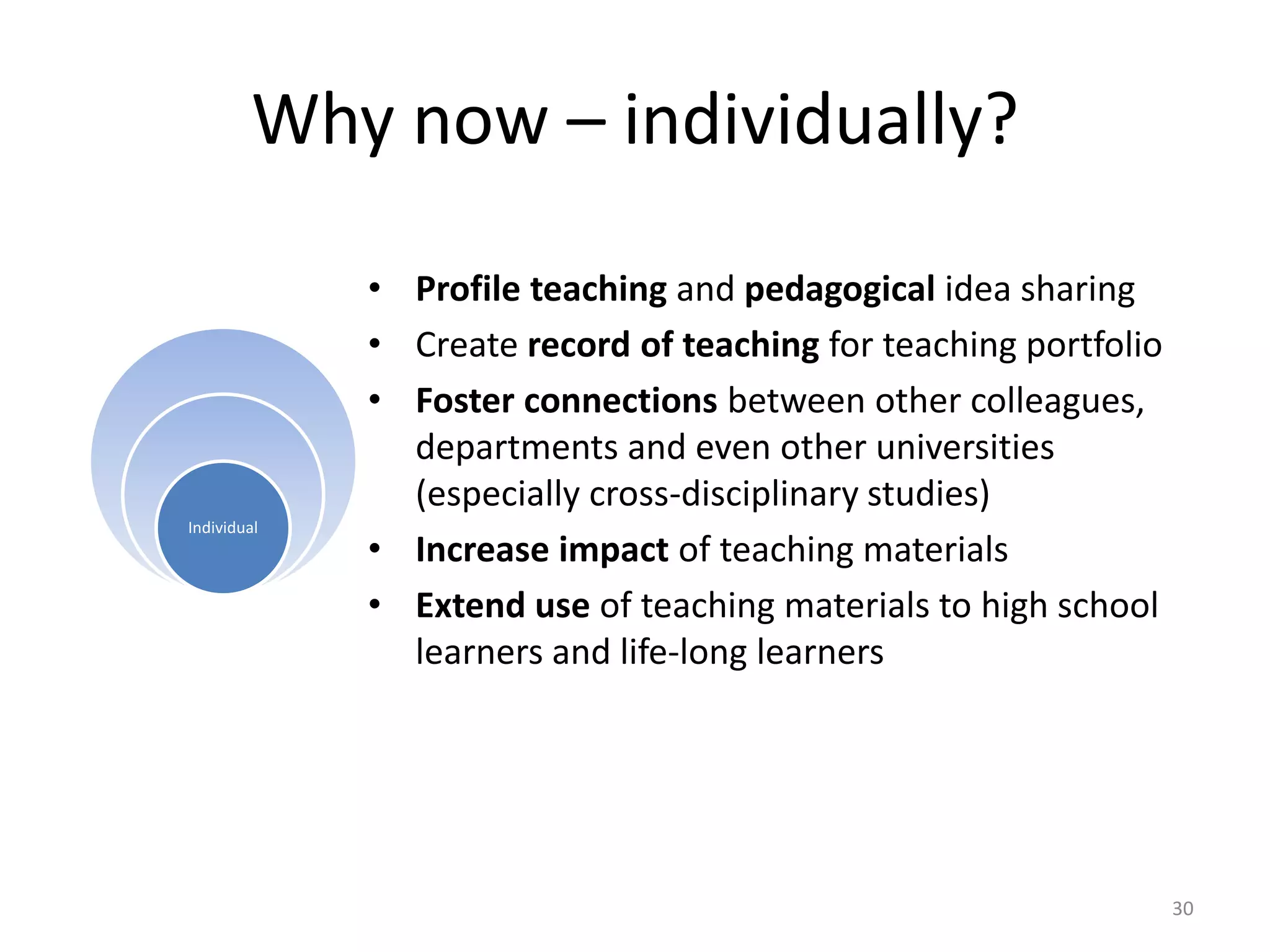
Why now – individually?

Individual

• Profile teaching and pedagogical idea sharing
• Create record of teaching for teaching portfolio
• Foster connections between other colleagues,
departments and even other universities
(especially cross-disciplinary studies)
• Increase impact of teaching materials
• Extend use of teaching materials to high school
learners and life-long learners

30
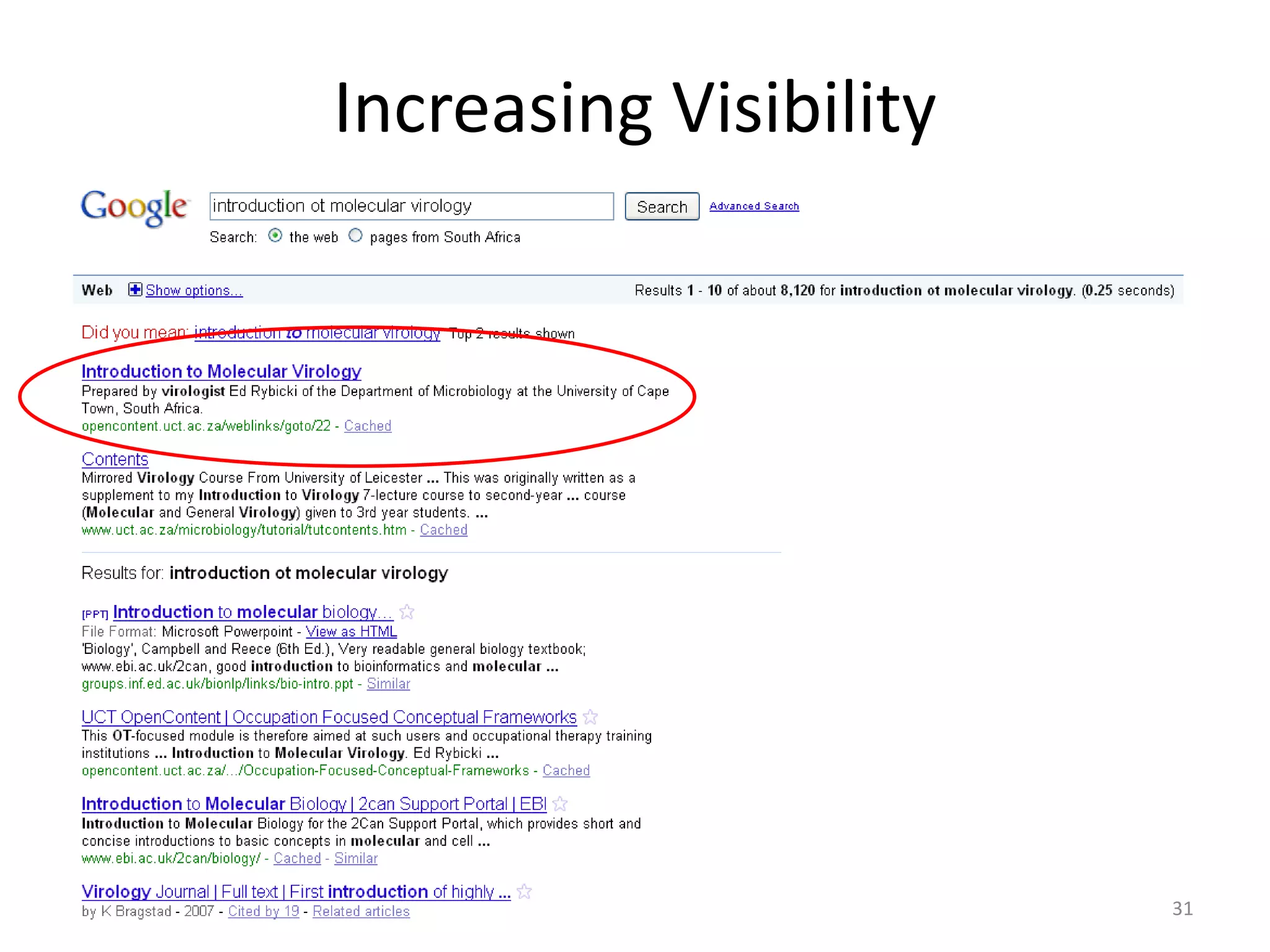
Increasing Visibility

31
MOOC
32
Prepared by: Glenda Cox. Glenda.cox@uct.ac.za
Some of the slides were created by Michael
Paskevicius : mike.vicious@gmail.com

OpenContent Directory:
http://opencontent.uct.ac.za
OER UCT project blog:
http://blogs.uct.ac.za/blog/oer-uct
Follow us: http://twitter.com/openuct

33
This work is licensed under the Creative
Commons Attribution-Share Alike 2.5 South
Africa License. To view a copy of this license,
visit http://creativecommons.org/licenses/bysa/2.5/za/ or send a letter to Creative
Commons, 171 Second Street, Suite 300, San
Francisco, California, 94105, USA.

34

Glenda Cox on Open Educational Resources in Higher Education

  • 1.
    Openness in HigherEducation: Open Education Resources Glenda Cox 1
  • 2.
    Open EDUCATION: No cost Degreesof openness depends on rights of the licence that the creator of content has granted to the user. http://www.moddou.com/ 2
  • 3.
    Open Educational Resources OpenContent / Open educational resources (OER) / Open Courseware are educational materials which are discoverable online and openly licensed that can be: … redistribute and share again. Shared Redistributed … adapt / repurpose/ improve under some type of license in order to … Shared freely and openly to be… Used Improved … used by anyone to … 3
  • 4.
  • 5.
  • 6.
  • 7.
    Some members ofthe Open Courseware Consortium http://ocwconsortium.org 7
  • 8.
  • 9.
  • 10.
  • 11.
    Open agenda atUCT Scholar Scholar Scholar 2007 Scholar Student Community Opening Scholarship 2008 2009 2010 2011 2012 2013 2014 Scholar Scholar Slide by Laura Czerniewicz 11
  • 12.
    OER from UCT:OpenContent 12
  • 13.
    +178 000 visits 184countries UK: 5980 USA: 21 437 Germany: 1632 India: 6010 Philippines: 2134 Brazil:1564 Australia: 1892 South Africa 91 281 13
  • 14.
    Studying at University:A guide for first year students • Used by Venda University and the University of the Western Cape with new students • Stellenbosch University uses some of the illustrations • The guide has been accessed over 5500 times via the directory and over 600 physical printed guides have been sold! 14
  • 15.
    OpenContent becomes aJournal Article • Materials published as OER on OpenContent selected for publishing in the Journal of Occupational Therapy of Galicia, an open access journal for occupational therapists in the Spanish speaking world http://blogs.uct.ac.za/blog/oer-uct/2010/12/06/sharing-knowledge-leads-to-opportunities 15
  • 16.
  • 17.
    What are theenablers of OER? Some evidence: Quotes from academics at UCT 17
  • 18.
    Philosophy Enabler Constraint • Lack ofawareness • Institutions are not always supportive of sharing • Individual academics need to believe in the value of sharing 18
  • 19.
    Technical Enabler Constraint • Not everyonehas access • Digital divide between Global south and North • Lack of ability and skills http://en.wikipedia.org/wiki/File:Internet1.jpg 19
  • 20.
    Financial Enabler Constraint • Support fromexternal funders like Shuttleworth and Mellon is temporary • After seed funding institutions must then take over http://www.flickr.com/photos/59937401@N07/5856660723/ 20
  • 21.
    Legal Enabler “So actually Ithink you’re more protected if you make something legitimately an OER and then somebody else uses it.” Constraint • Academics are not aware of Creative Commons or how Creative Commons works • They are not that concerned about their Intellectual property ( although they do want attribution) but they are very concerned about infringing the copyright of others 21
  • 22.
    Factors impacting OER Cultural Individual Technicalaffordancesof the internet Philosophy of openness. Structural Pedagogy Financial-models Altruism Legal-alternate copyright licensing Quality 22
  • 23.
    Pedagogy • Change:Teachers comfortable intheir classroom space • Creation: interactive teaching styles do not always result in online materials • Use: difficult to find relevant OER 23
  • 24.
    Quality Improve quality “.. Ithink it will make everyone go over it two or three times, ya.” Readiness of materials: “If they’re ready for students to see, then they’re as ready as they’re going to get.” Quality check: “I think that each individual preparing their materials must be sure that their material is substantively correct, sound or critical.”  they don’t look good enough to put out there  “But I would love to be able to give what I had to somebody and say does it… it’s sort of like is there cohesion, does it make sense” 24
  • 25.
    Complex interplay betweenfactors impacting OER Cultural Individual Technicalaffordances of the internet Philosophy of openness. Structural Pedagogy Financial-models Altruism Legal-alternate copyright licensing Quality 25
  • 26.
    WHY OER? WHATARE THE POTENTIAL BENEFITS OF OER? 26
  • 27.
    Global challenges inHigher Education Increasing demand for education and insufficient institutions Increasing cost of Higher education and text books Variable quality in teaching Increasing Competition Asymmetries of power and wealth and curriculum from the Global North favoured over the Global south 27
  • 28.
    Challenges for SouthAfrica • Crisis in Basic education • Skills shortage/’persistent human Capital gap” (Taylor, 2011) Higher education: high school graduates of varied ability Higher education institutions quality variable 28
  • 29.
    Why now fordepartments? • Increase institutional visibility, advancing competitiveness, attracting students and resources • Promote effective social responsiveness • Improve recruitment by helping the right students find the right programmes • Enhance teaching coherence across courses • Ensure better long-term archiving, curation and reuse of teaching materials • Attract alumni as life-long learners 29
  • 30.
    Why now –individually? Individual • Profile teaching and pedagogical idea sharing • Create record of teaching for teaching portfolio • Foster connections between other colleagues, departments and even other universities (especially cross-disciplinary studies) • Increase impact of teaching materials • Extend use of teaching materials to high school learners and life-long learners 30
  • 31.
  • 32.
  • 33.
    Prepared by: GlendaCox. Glenda.cox@uct.ac.za Some of the slides were created by Michael Paskevicius : mike.vicious@gmail.com OpenContent Directory: http://opencontent.uct.ac.za OER UCT project blog: http://blogs.uct.ac.za/blog/oer-uct Follow us: http://twitter.com/openuct 33
  • 34.
    This work islicensed under the Creative Commons Attribution-Share Alike 2.5 South Africa License. To view a copy of this license, visit http://creativecommons.org/licenses/bysa/2.5/za/ or send a letter to Creative Commons, 171 Second Street, Suite 300, San Francisco, California, 94105, USA. 34

Editor's Notes

  • #3 What is the meaning of “open” in education? Open in the sense that there is access to education eg. The Open University in the UK. It is not free but anyone can sign up.Open education and OER are taking this further to mean access and freeMassively open online courses (MOOCs) are accessible to everyone, not always free and many materials are copyrighted and closed
  • #4 The key aspect of an OER is that it is both discoverable online – so that people can find it AND openly licensed - so that people can legally make use of it. OER includes texts, different forms of media, ideas, as well as documented teaching strategies/techniques or practices. Advocates of openness would suggest that the value in OER is in its potential to support learning in many ways and in many contexts.
  • #19 The Open Source Software movement led the way in showcasing the value of openness and the ‘architecture of participation’ (O’Reilly 2003)OER is based on the philosophical view of ‘knowledge as a collective social product and the desirability of making it a social property’ (Prasad & Ambedkar cited in Downes 2007:1)
  • #20 OER is premised on the simple and powerful idea that the world’s knowledge is a public good and that technology in general and the World Wide Web in particular provides an extraordinary opportunity for everyone to share, use, and reuse knowledge’ (Hewlett Foundation)
  • #21 Donor funding – e.g. Hewlett FoundationMarketing budget – e.g. Open UniversityCommission – e.g. MIT and AmazonEndowment – e.g. Stanford Encyclopedia of PhilosophyMembership – e.g. Sakai ConsortiumGovernment – e.g. UK £7.8 million grant
  • #22 Creative CommonsCopyright management solution that clarifies how resources can be used.“So actually I think you’re more protected if you make something legitimately an OER and then somebody else uses it.”
  • #25 There is a general feeling that quality will improve if materials are available for peer scrutinyBut there are concerns about the readiness of materialsThat some materials may be of poor qualityDifferent views on a quality check: one says up to author and user /other says a quality check would protect the institution and the individual
  • #29 Poor performance compared to comparator countries eg. 2007 Sample of Grade 6 reading and maths in the bottom half of 15 African countriesIn terms of equity _gross inequalities with poorer kids receiving inferior schooling. Higher EducationIll prepared first year entrants Poor throughput rates: low graduation rates ( partially influenced by UNISA the largest institution- rate of 9% in 2008. The total undergraduate rate was at 16% in 2009!
  • #31 Lets drill down and talk about what this means to us as academics in the information age. Why is this important?OER allows us to profile and highlight our teaching and pedagogical ideas online (in addition to research) It creates a record of our teaching material and leads to the development of teaching portfolios – essentially building a teaching profile in addition to your research profiles Having our material online may foster connections between other colleagues, departments and even other universities especially cross-disciplinary studies. It can increase the impact of our teaching materials and help us attract the right students by giving them some idea of what we teach at UCTIt may also extend the use of teaching materials to high school and life-long learners
  • #33 Opportunity to share African authored resources across the world across the Global south, North to South but also North to SouthAmazing work globally (eg COL, UNESCO)OER repositories, networks and research continues to growOpportunity to use OER’s in MOOCsGeorge Bernard Shaw wrote: “If you have an apple and i have an apple and we exchange apples, then you and I will still each have an apple. But if you have an idea and I have an idea and we exchange ideas, then each of us will have two ideas”