The Learning Registry: social
networking for open educational
                    resources?


  Phil Barker, and Lorna M Campbell, CETIS
     Sarah Currier and Nick Syrotiuk, Mimas


          #OER13
The Learning Registry: social
networking for open educational
                    resources?


  Phil Barker, and Lorna M Campbell, CETIS
    Sarah Currier and Nick Syrotiuk, Mimas


         #OER13
Introduction
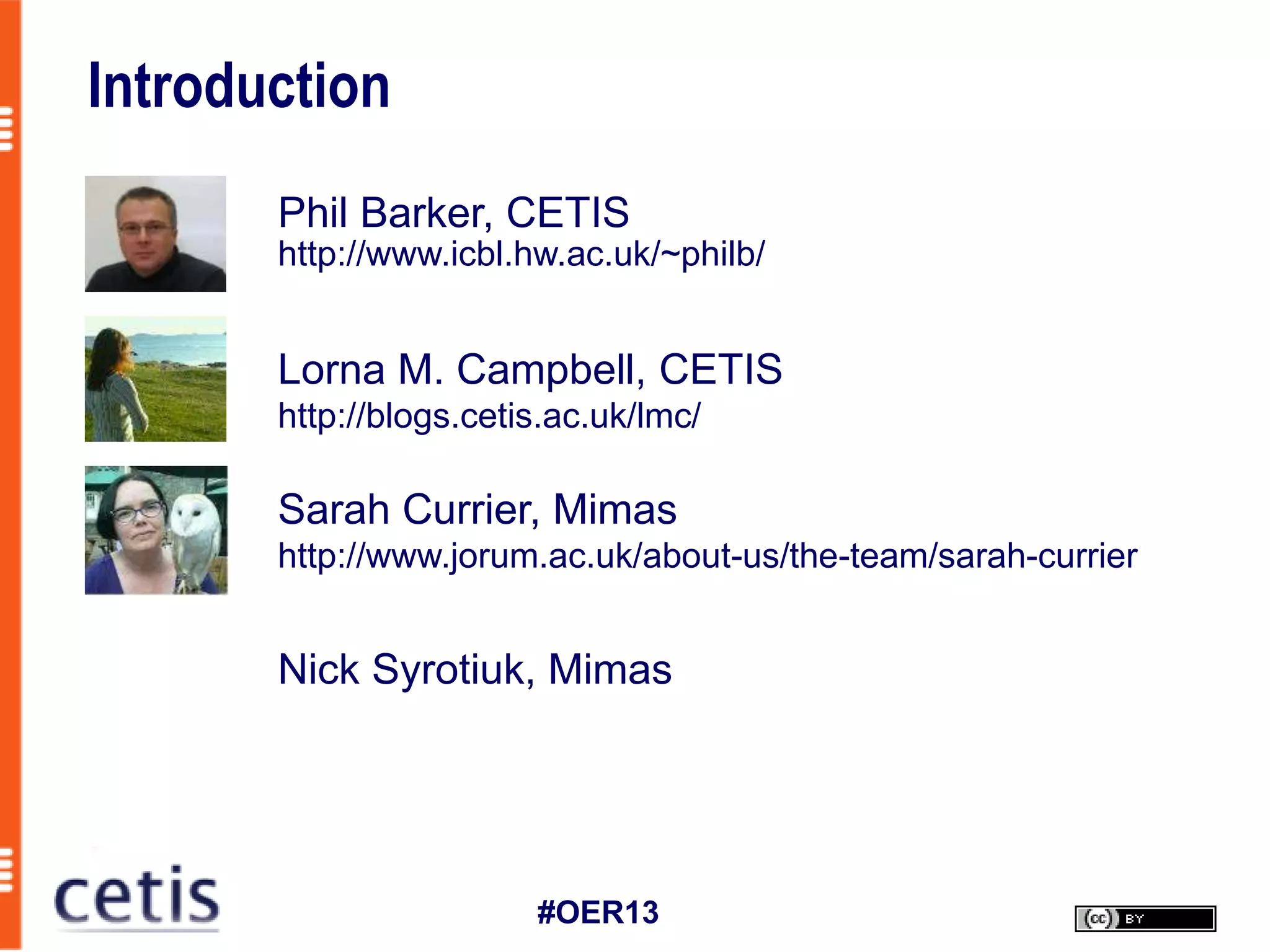
       Phil Barker, CETIS
       http://www.icbl.hw.ac.uk/~philb/


       Lorna M. Campbell, CETIS
       http://blogs.cetis.ac.uk/lmc/

       Sarah Currier, Mimas
       http://www.jorum.ac.uk/about-us/the-team/sarah-currier


       Nick Syrotiuk, Mimas


                        #OER13
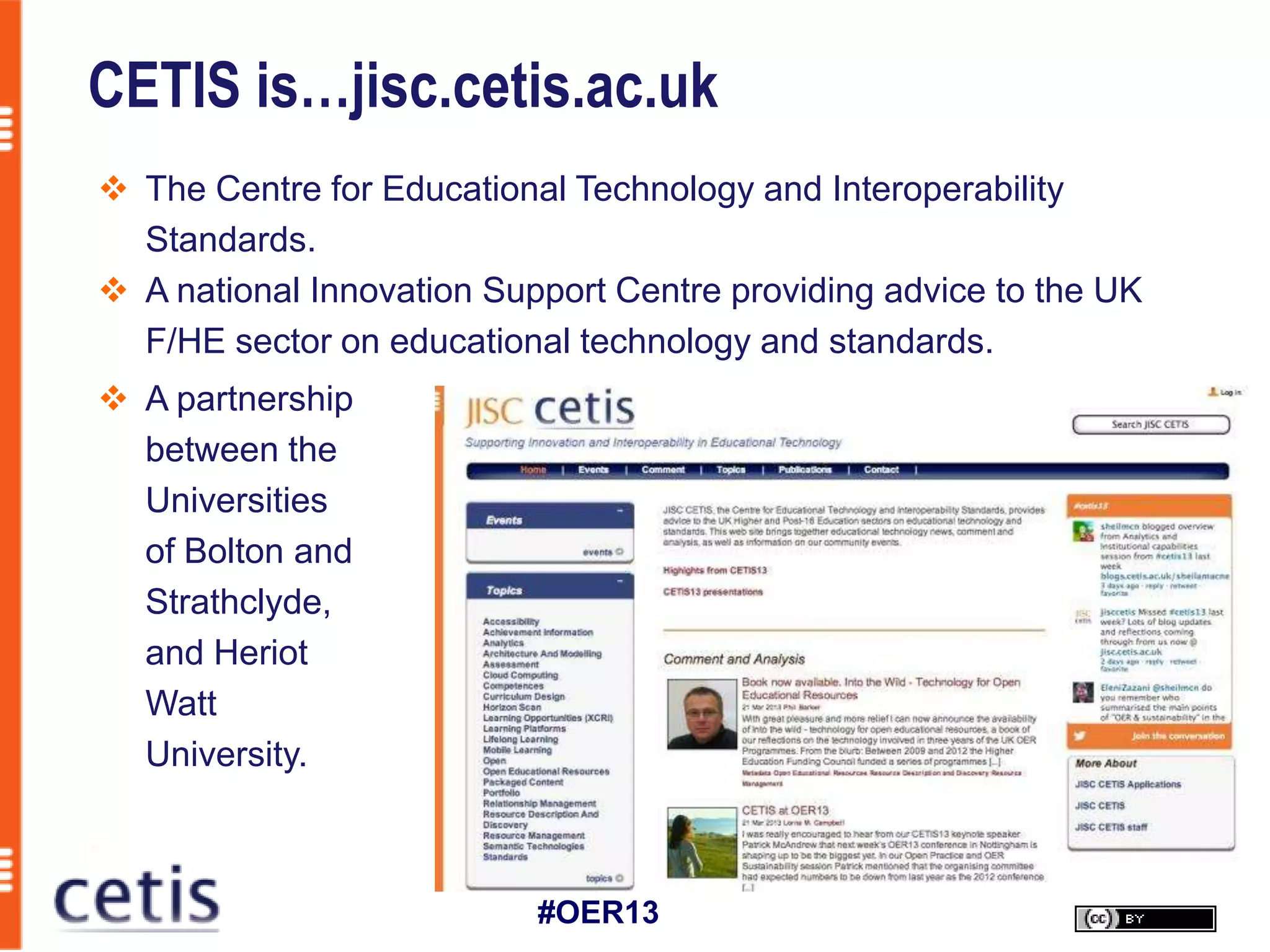
CETIS is…jisc.cetis.ac.uk
 The Centre for Educational Technology and Interoperability
  Standards.
 A national Innovation Support Centre providing advice to the UK
  F/HE sector on educational technology and standards.
 A partnership
  between the
  Universities
  of Bolton and
  Strathclyde,
  and Heriot
  Watt
  University.


                           #OER13
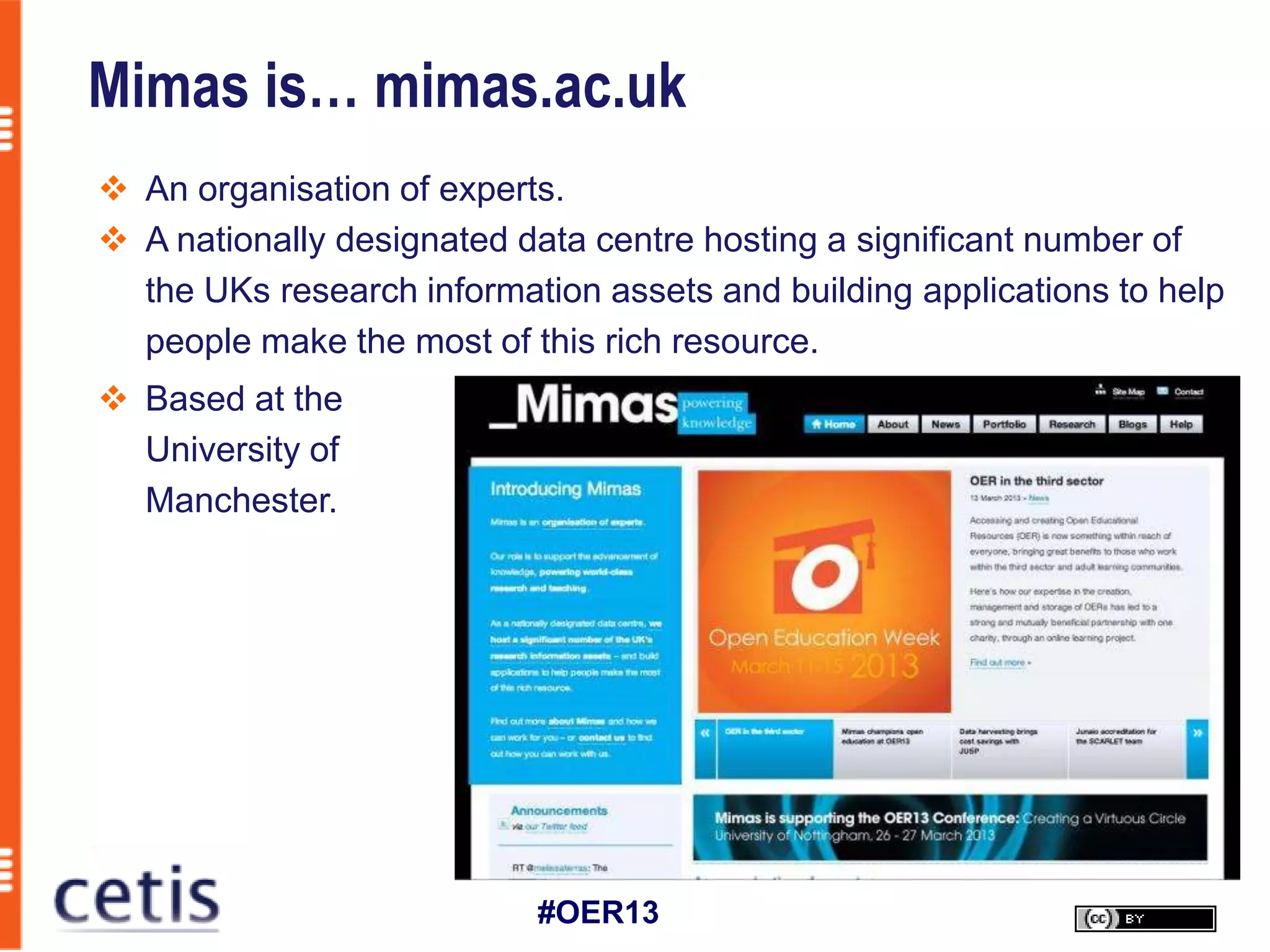
Mimas is… mimas.ac.uk
 An organisation of experts.
 A nationally designated data centre hosting a significant number of
  the UKs research information assets and building applications to help
  people make the most of this rich resource.
 Based at the
  University of
  Manchester.


                           #OER13
What’s the problem?
 It’s good to share educational resources! 
 You need to describe your resources so other people can
  find them and decide whether they want to use them. 
 That means you need metadata to describe the
  educational characteristics of your resources. 
 But learning resources come in all shapes and sizes. 
 Learning resources are used in all sorts of different
  contexts. 
 By all people with all sorts of learning requirements. 
 Describing learning resources is hard. 


                      #OER13
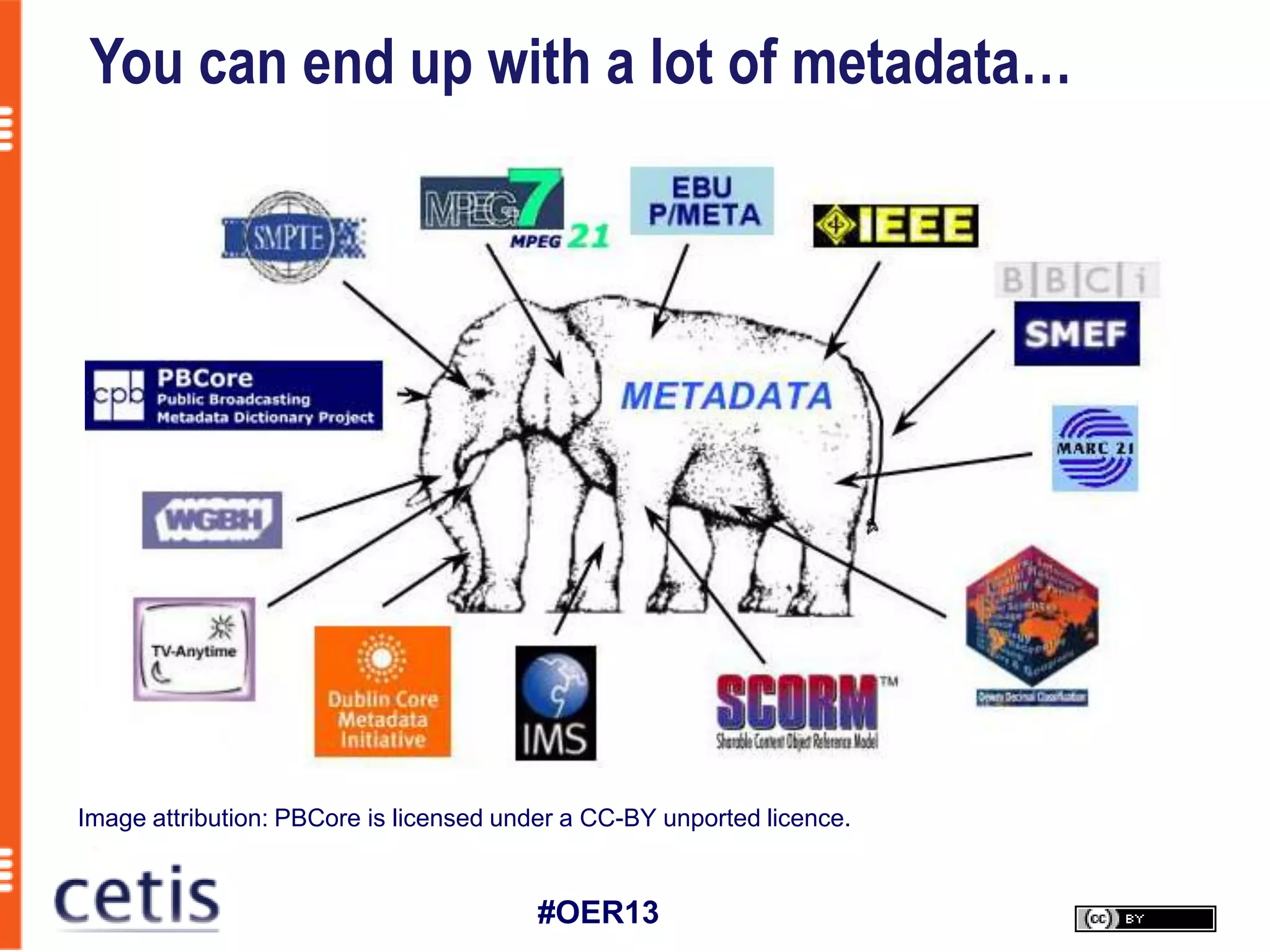
You can end up with a lot of metadata…


    • You can end up with a lot of metadata.


Image attribution: PBCore is licensed under a CC-BY unported licence.


                                         #OER13
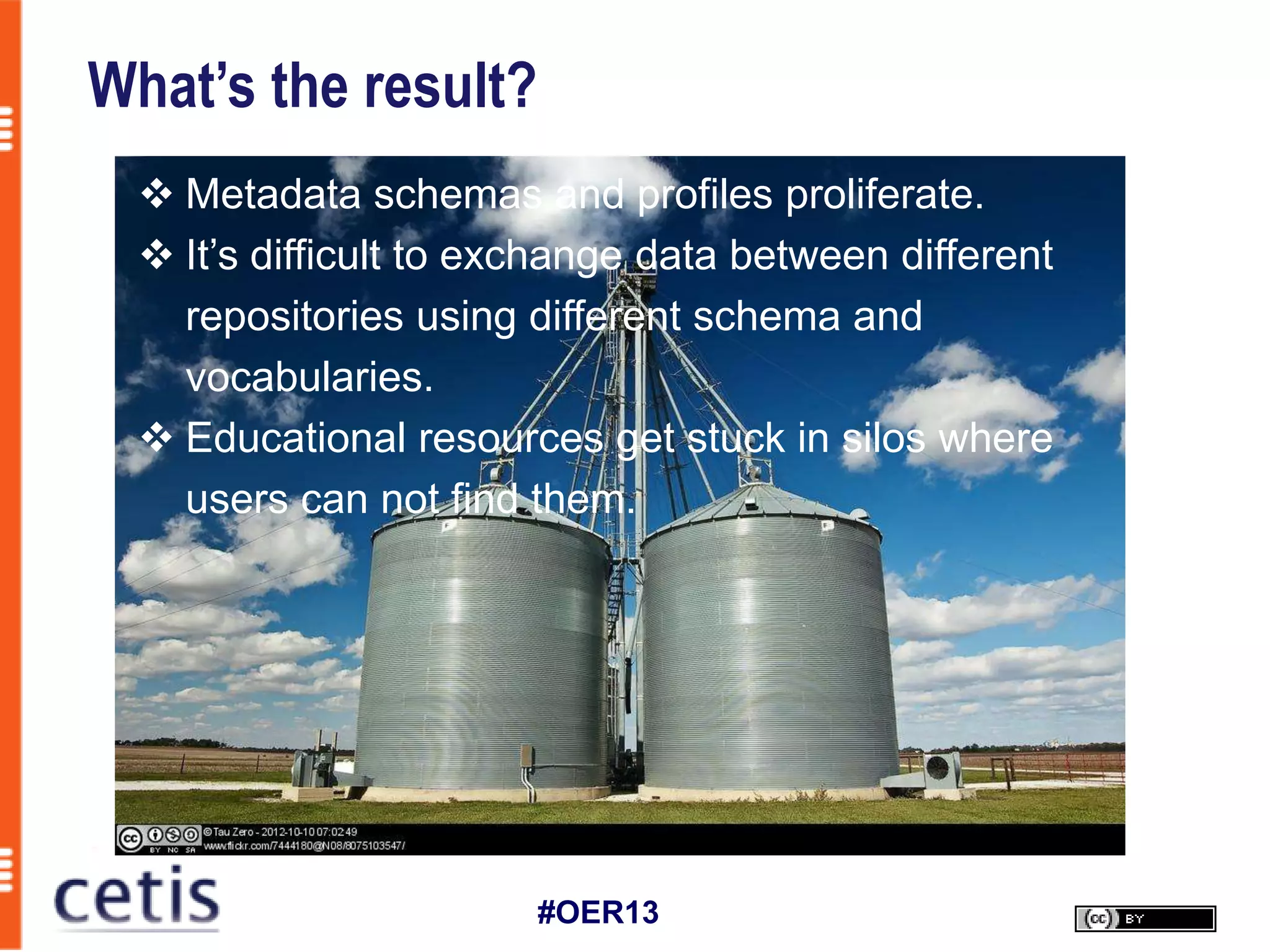
What’s the result?
   Metadata schemas and profiles proliferate.
   It’s difficult to exchange data between different
    repositories using different schema and
    vocabularies.
   Educational resources get stuck in silos where
    users can not find them.


                        #OER13
And another thing…
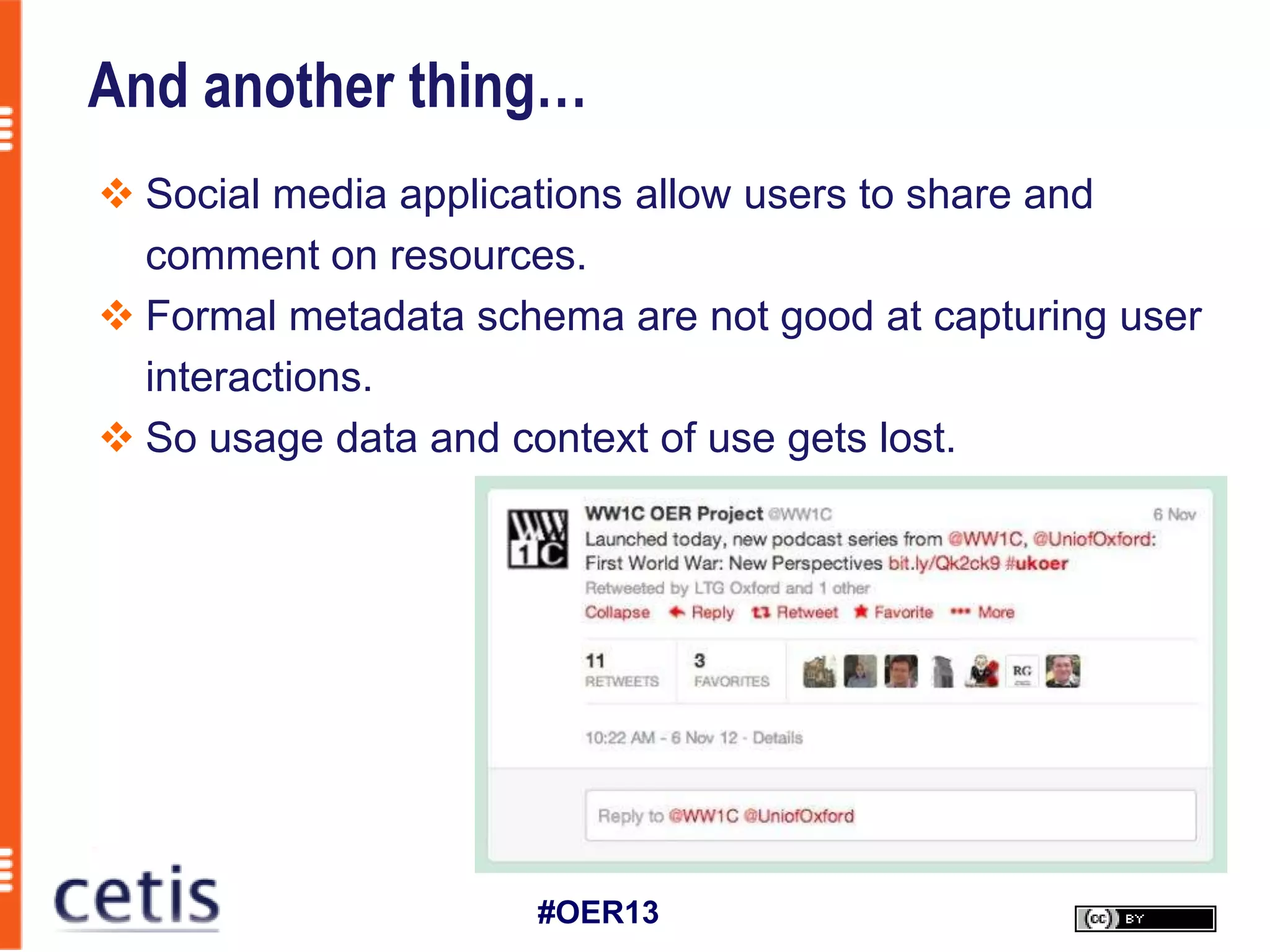
 Social media applications allow users to share and
  comment on resources.
 Formal metadata schema are not good at capturing user
  interactions.
 So usage data and context of use gets lost.


                     #OER13
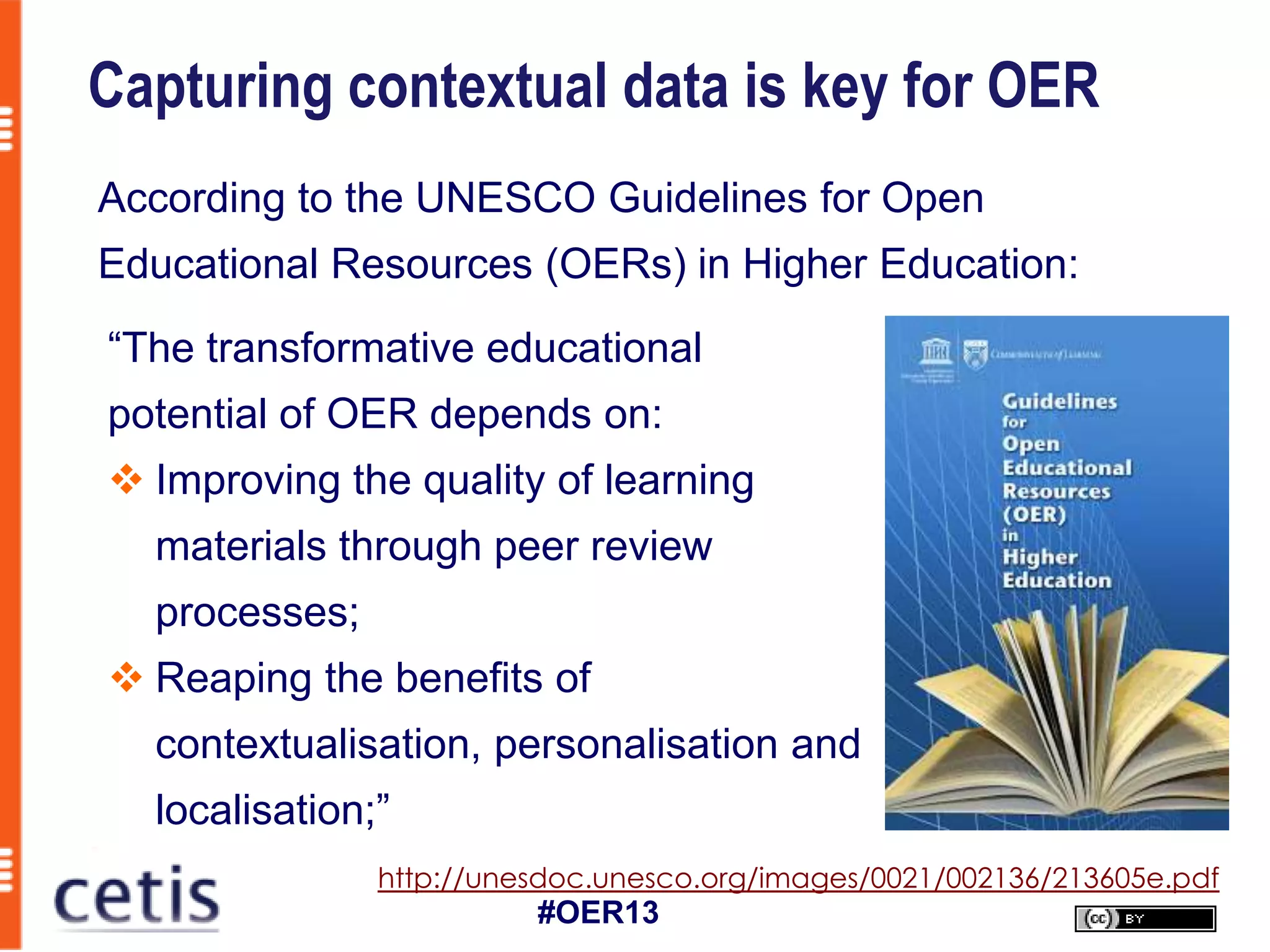
Capturing contextual data is key for OER
According to the UNESCO Guidelines for Open
Educational Resources (OERs) in Higher Education:
“The transformative educational
potential of OER depends on:
 Improving the quality of learning
  materials through peer review
  processes;
 Reaping the benefits of
  contextualisation, personalisation and
  localisation;”
               http://unesdoc.unesco.org/images/0021/002136/213605e.pdf
                         #OER13
The Learning Registry
 A distributed infrastructure for sharing descriptive and
  usage data about learning resources.
 Initiated in 2010.
 An open source community project.
 Funded by the US DoE and DoD.
 Partners include Lockheed Martin, NSDL, ADL, SRI
  International, NSF, Library of Congress, OER Commons,
  Jisc.


                        #OER13
An open approach
 An open project – anyone can participate.
 Open source – Apache 2.0.
 Open documents and standards – Creative Commons.
 Open data – all data about resources is open.
                           But…
 The resources themselves may be proprietary or
  commercial.
 Not just about OER.


                        #OER13
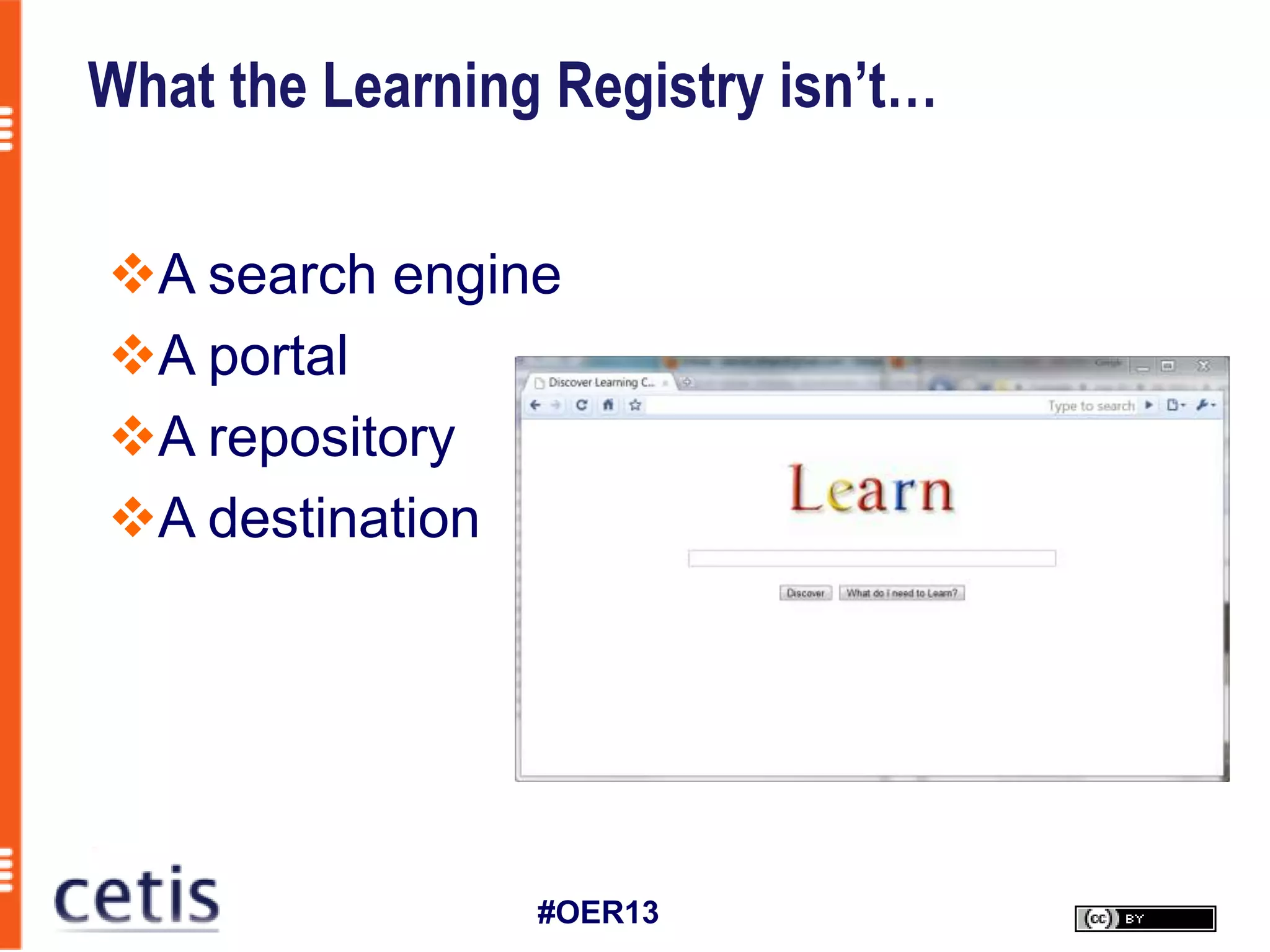
What the Learning Registry isn’t…

A search engine
A portal
A repository
A destination


                 #OER13
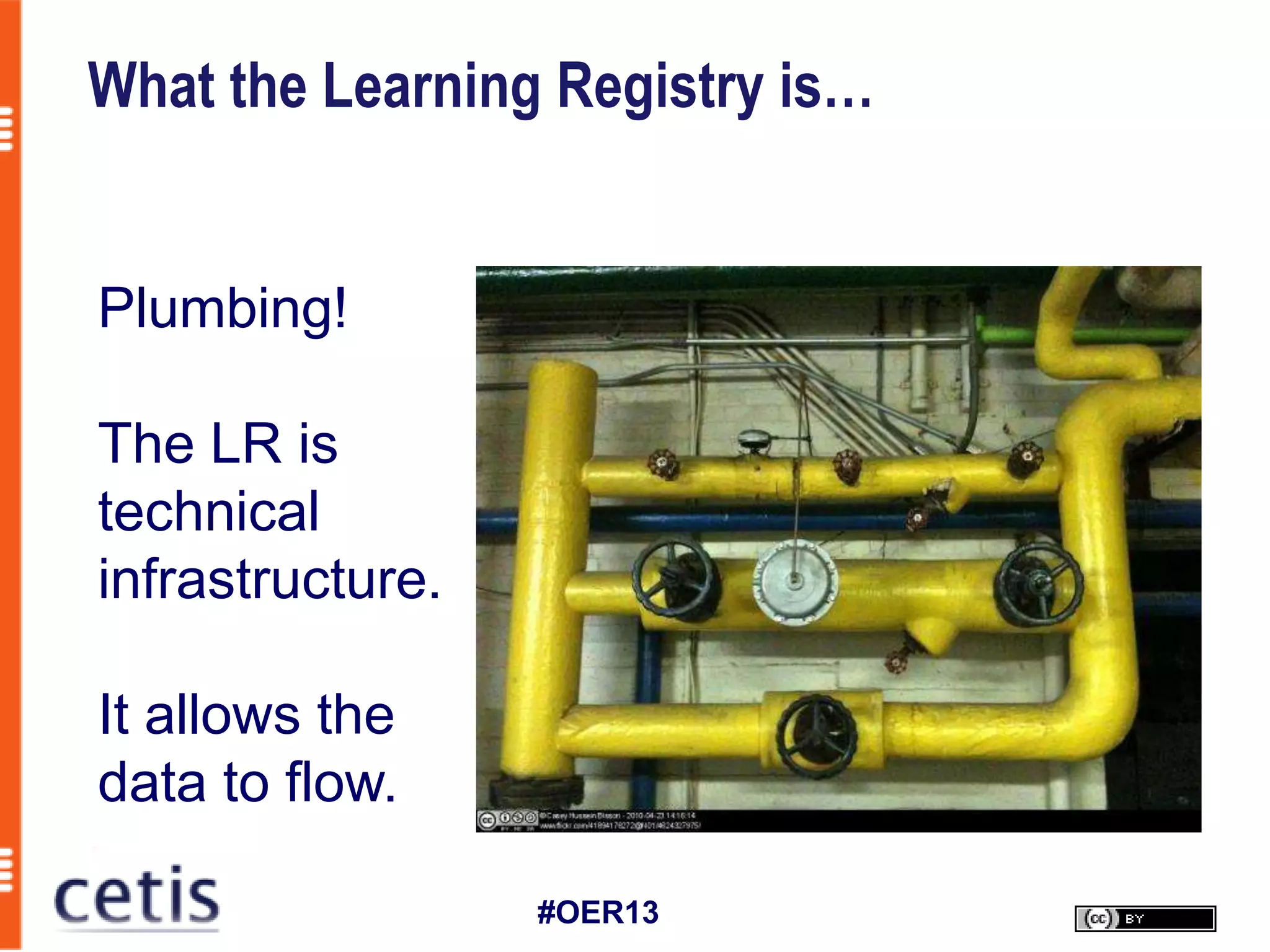
What the Learning Registry is…


Plumbing!

The LR is
technical
infrastructure.

It allows the
data to flow.

                  #OER13
What the Learning Registry is…
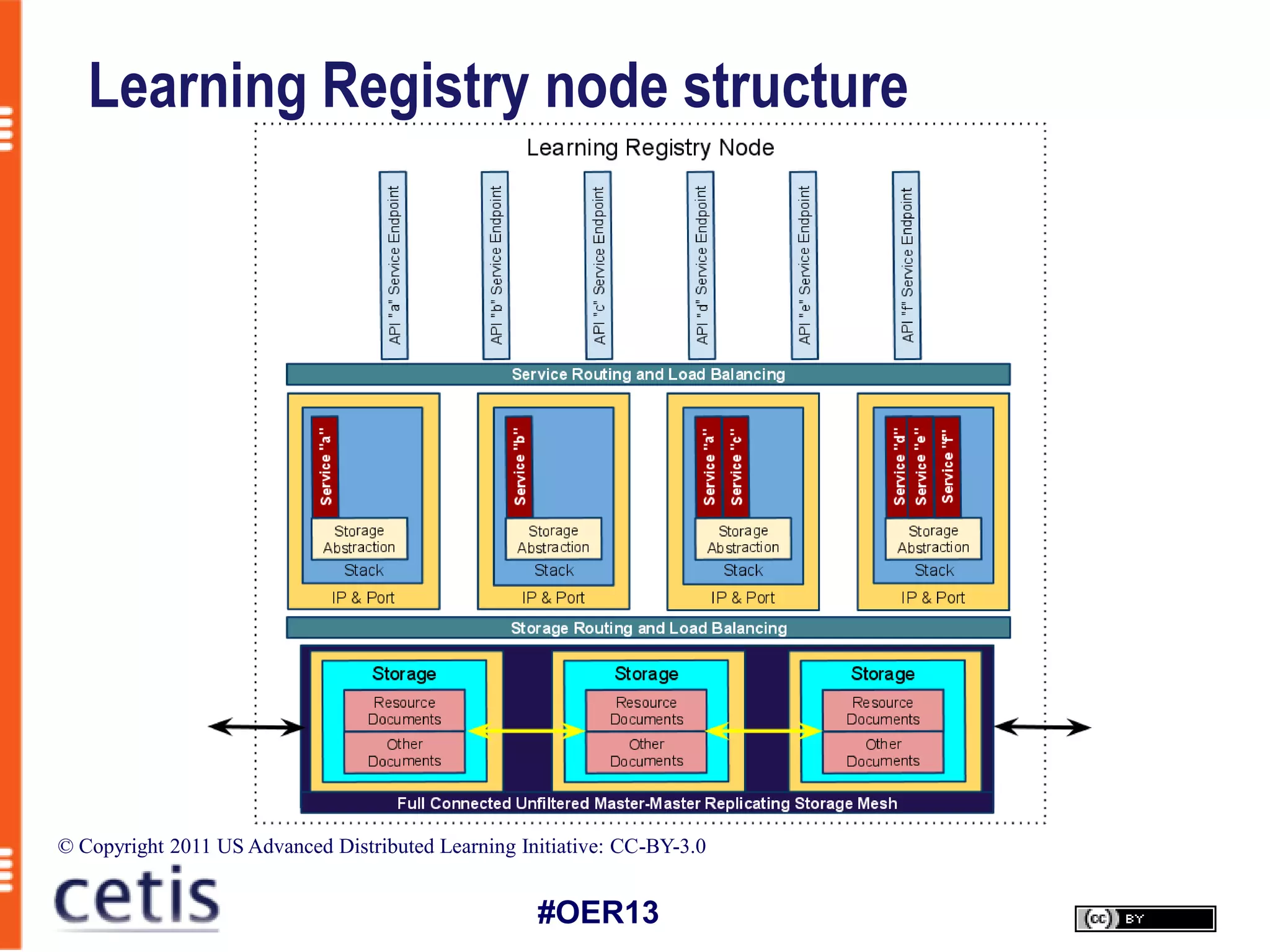
 A large scale network of nodes, no single point of
  control.
 Each node based on schema-free database CouchDB.
 Unlike relational databases, data does not need to
  conform to pre-set schema.
 Documents are stored as a collection of key-value pairs
  in JSON format.
 APIs allow nodes to exchange data with other nodes and
  external services.


                      #OER13
Learning Registry APIs
 Publish (push from user)
    Publish
    SWORD (1.3, 2.0)
    3rd party OAI-PMH Utility (We don’t harvest)
 Access (pull to get data)
    Obtain (by ID, record, by URL)
    Harvest (JSON or OAI-PMH)
    Slice (subset by identity, schema, keyword)
 Distribute (node-to-node, with regex “filtering”)
 Admin (status, discovery, …)
 No Search/Query API! (e.g., use Elastic Search)

                       #OER13
Learning Registry node structure


© Copyright 2011 US Advanced Distributed Learning Initiative: CC-BY-3.0


                                                    #OER13
Metadata and Paradata
The Learning Registry is metadata agnostic.
Metadata is stored in a schema-free database.
Also designed to store paradata - dynamic
 usage data.
Paradata is generated as resources are used,
 reused, adapted, contextualized, favourited,
 tweeted, and shared.
Paradata complements metadata by providing
 an additional layer of contextual information.
Metadata describes what a resource is,
 paradata records how it is being used.

                   #OER13
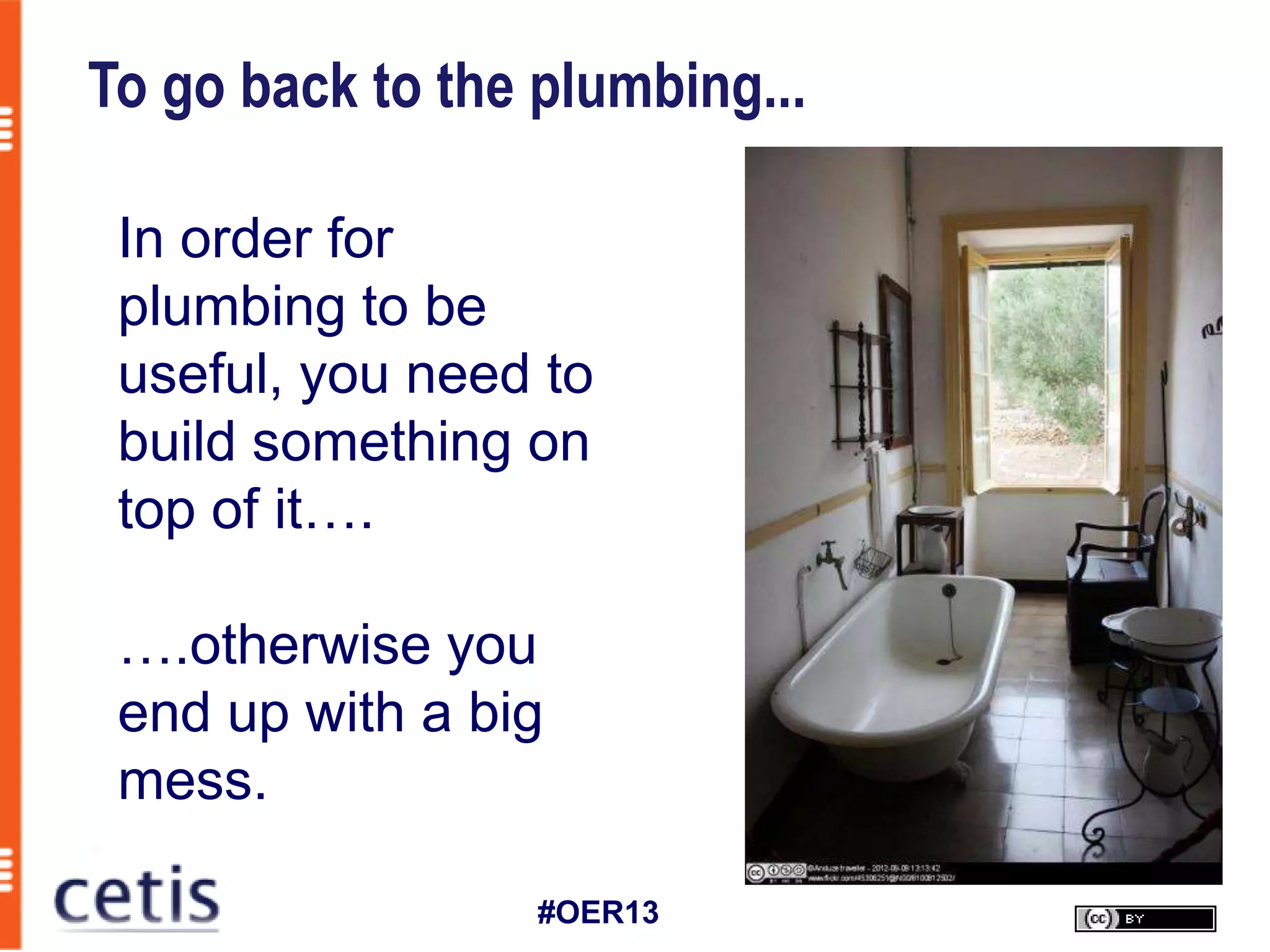
To go back to the plumbing...

 In order for
 plumbing to be
 useful, you need to
 build something on
 top of it….

 ….otherwise you
 end up with a big
 mess.

                  #OER13
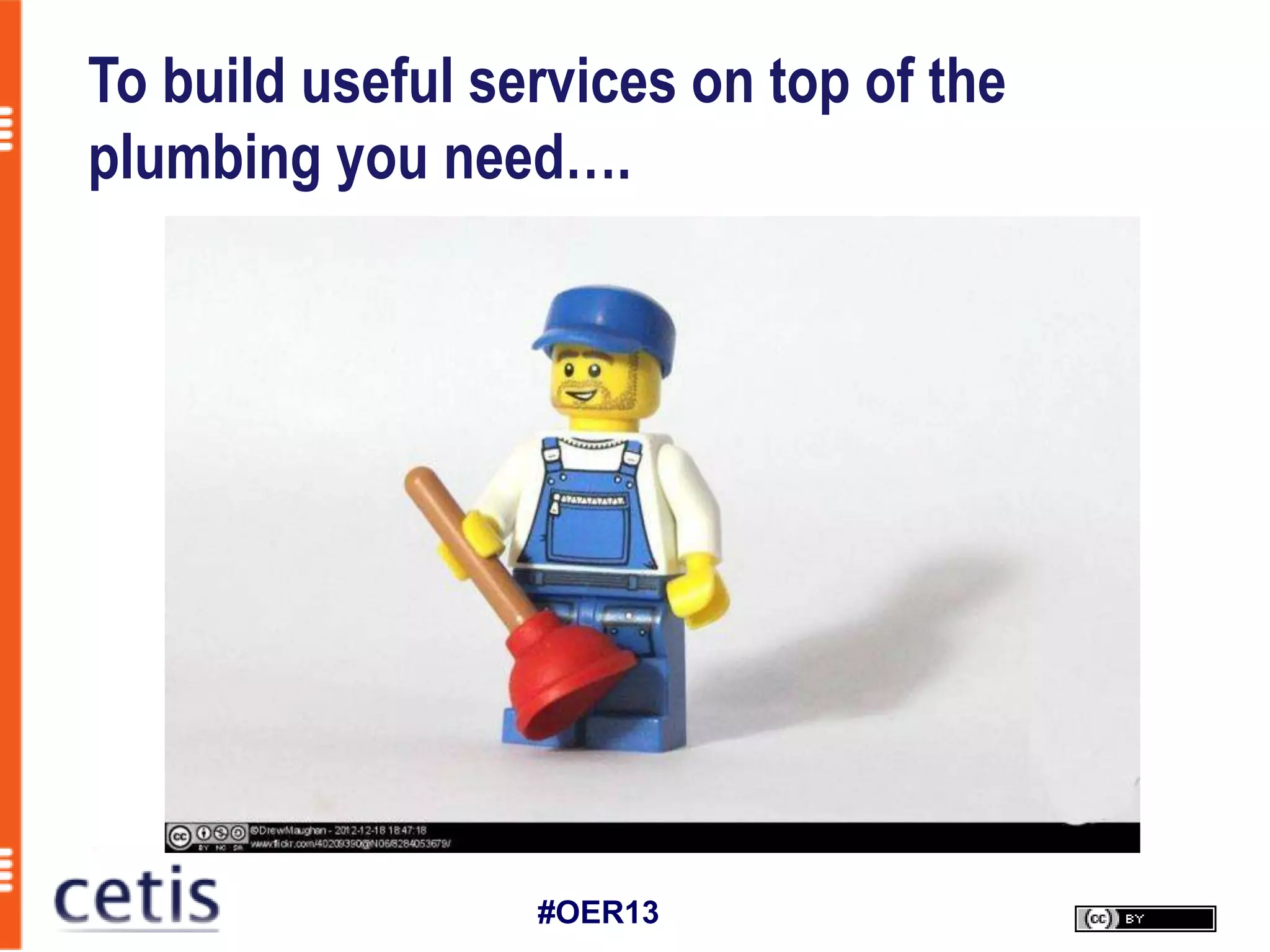
To build useful services on top of the
plumbing you need….


                  #OER13
Plumbers needed
The Learning Registry needs developers to build
 useful services and applications on top of the
 network of nodes.
The data processing overhead, instead of being
 handled by the database, is pushed up to the
 application layer.
Develops are needed to create services to
 process the data to make it useful to educators.
But…this approach is relatively new to the
 education domain.
                   #OER13
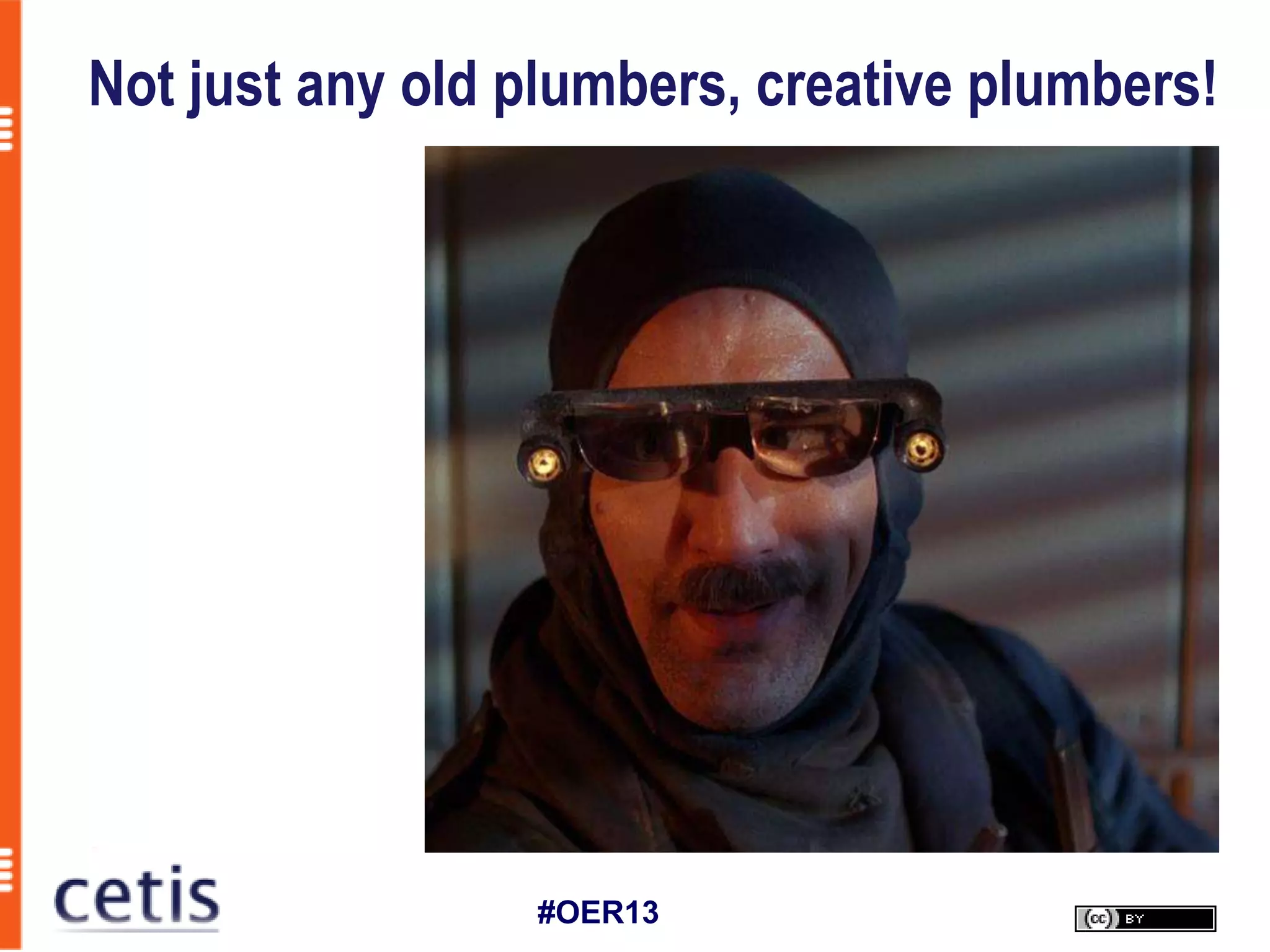
Not just any old plumbers, creative plumbers!


                 #OER13
CETIS, Jisc and Mimas involvement
 CETIS maintained a watching brief on LR since its
  inception in 2010.
 Jisc / CETIS / LR information sharing meeting in UK,
  October 2010.
 CETIS guest blog post by LR Senior Technical Advisor
  Dan Rehak in March 2011.
 DevCSI / CETIS OER Hackday, March 2011.
 Developer Pat Lockley attended LR Plugfest in
  Washington DC, June 2011.
 JISC Learning Registry Node (JLeRN) Experiment
  funded, Nov 2011.
 CETIS conference session “The Learning Registry –
  capturing conversations about learning resources”, Feb
  2012.
                      #OER13
Why all the interest?
 The Learning Registry adopted an innovative approach
  to an old problem.
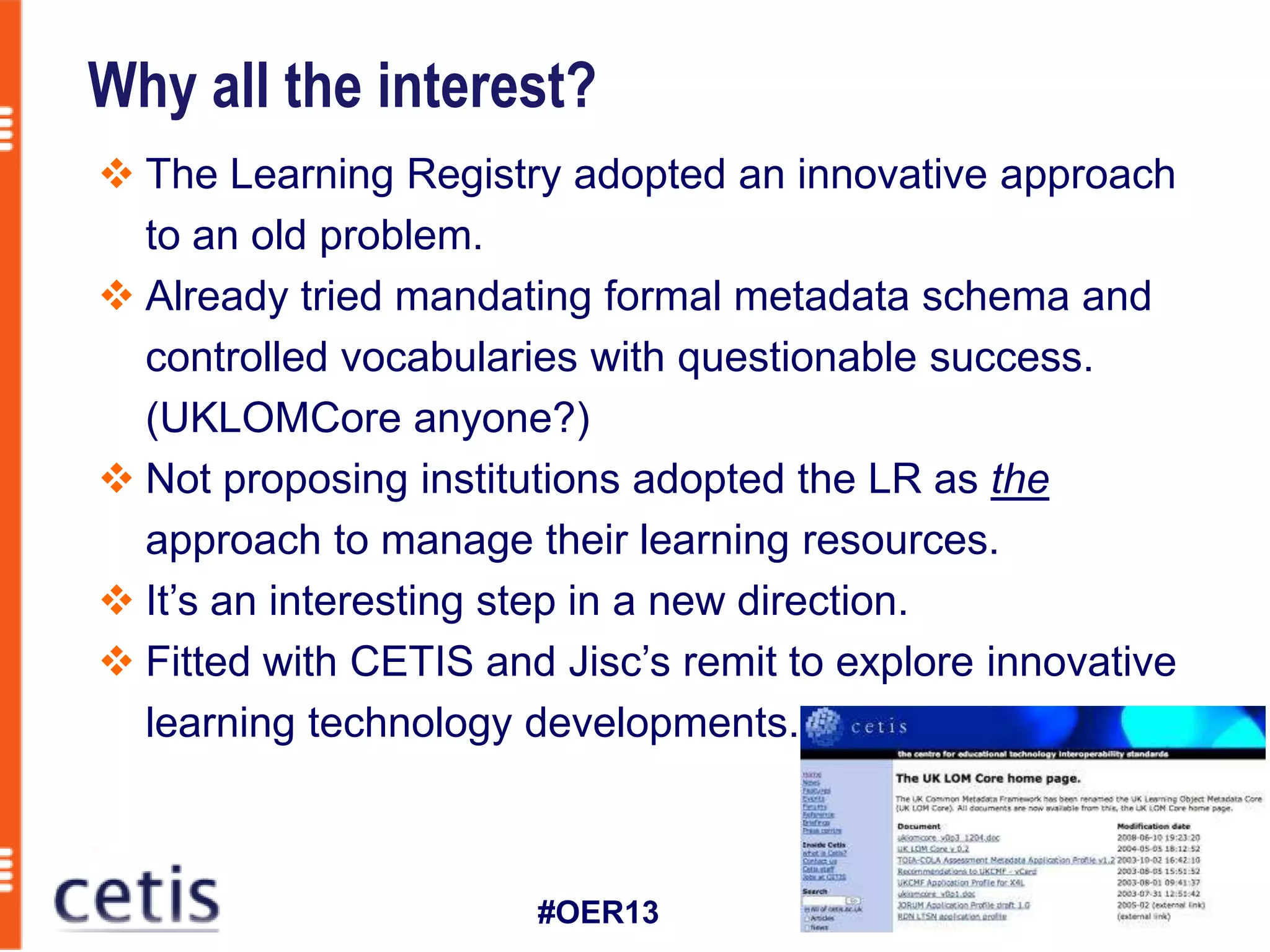
 Already tried mandating formal metadata schema and
  controlled vocabularies with questionable success.
  (UKLOMCore anyone?)
 Not proposing institutions adopted the LR as the
  approach to manage their learning resources.
 It’s an interesting step in a new direction.
 Fitted with CETIS and Jisc’s remit to explore innovative
  learning technology developments.


                       #OER13
The JLeRN Experiment
 Funded by Jisc at Mimas from Dec 2011 – Oct 2012.
 JLeRN Team: Sarah Currier (Manager), Nick Syrotiuk
  and Bharti Gupta (Developers).
 Aimed to build an experimental node.
 Explore feasibility of contributing and analysing data.
 Support development of use cases and applications
  relevant with UK F/HE.
 CETIS helped support UK special interest community.
 Developers liaised directly with LR developers.


                       #OER13
JLeRN Achievements and Outputs
 Successfully built 3 nodes.
 Worked closely with OER Rapid Innovation projects.
 Ingested test data from Jorum via OAI-PMH feed.
 Built JLeRN Node explorer.
 Hosted and participated in a number of community and
  developer events.
 Commissioned use cases, case study and “Wider
  Potential” report from Sero Consulting.
 Actively engaged with community.
 Maintained JLeRN blog: jlernexperiment.wordpress.com


                     #OER13
JLeRN Community Engagement - SPAWS
Sharing Paradata Across Widget Stores
 (SPAWS)
  OER Rapid Innovation Programme
  University of Bolton
  http://scottbw.wordpress.com/2012/10/16/spa
   ws-impact/
  Used the Learning Registry to share usage
   data, e.g. reviews, ratings, and download
   statistics, between web app stores of widgets
   and gadgets for educators.
                   #OER13
JLeRN Community Engagement - RIDLR
 Rapid Innovation Dynamic Learning Maps - Learning
  Registry (RIDLR):
    OER Rapid Innovation Programme.
    University of Newcastle.
    http://www.medev.ac.uk/blog/oer-rapid-innovation-
     ridlr/
    Tested the release of contextually rich paradata via
     the JLeRN node to the Learning Registry and harvest
     back paradata to provide resource discovery linked to
     specific topics displayed within the context of the
     curriculum and personal learning maps.

                      #OER13
JLeRN Community Engagement - ENGrich
ENGrich
 Digitisation and Content Programme.
 University of Liverpool.
 http://engrich.liv.ac.uk/
 Developed a customised search engine for
   visual media relevant to engineering
   education. Information about student ratings
   and recommendations are stored in their own
   LR node and used to enhance customised
   Google searches.
                  #OER13
JLeRN Community Engagement - Pgogy
Pgogy developer Pat Lockley:
 http://www.pgogy.com/
 Developed tools for interacting with Learning
   Registry nodes including:
    Ramanathan - submits information from an
     RSS feed to LR.
    Pliny - submits Google Analytics data to
     the LR.


                  #OER13
Issues – sharing data at network scale
JLeRN did not attempt to share data between
 nodes.
APIs for distributing data between nodes are less
 well tested than the APIs for interfacing with
 services external to the LR.
Projects, e.g. SPAWS, ENGrich, proved stand
 alone nodes do have benefits.
But LR functionality has not been tested at
 network scale.


                   #OER13
Issues – technology lock in
Not clear if there are real benefits to using LR as
 opposed to vanilla schema-free databases such
 as Mongo and CouchDB.
LR provides APIs, documentation and
 community support.
May lock developers in to using CouchDB rather
 than other solutions.


                    #OER13
Issues – semantic technologies
 Why not use semantic technologies e.g. RDF
  triple stores?
 Triple stores have been innovative technology of
  choice for sharing data on a web-wide scale for
  a decade or more.
 But uptake in the education domain has been
  slow.
 Steep learning curve associated with such
  technologies.
 Learning Registry’s open approach to dealing
  with messy educational data seemed to fit the
  ethos of the teaching and learning sector better.
                   #OER13
Conclusions
 JLeRN Experiment was a technical
  success.
 Innovative projects and developers have
  demonstrated that useful tools and service
  can be built on top of LR nodes.
 Overall impact on UK F/HE sector
  negligible.
 Always intended to be a proof of concept
  development, not a supported service.
                 #OER13
Conclusions
 LR technical infrastructure is a genuinely
  innovative approach to the thorny problem
  of managing and sharing learning
  resource descriptions and contextual data.
 Technical approaches, esp. use of
  schema free databases, may have some
  impact on the education technology
  landscape in the longer term.

                 #OER13
Coda - inBloom
 US K-12 initiative.
 “Secure data management service that allows states
  and districts to bring together and manage student and
  school data and connect it to learning tools used in
  classrooms.”
 Funded by Gates Foundation & Carnegie Corporation.
 inBloom index is a dedicated LR node that will connect
  to the LR network.
 Will be interesting to see if the LR works at network
  scale.


                      #OER13
Coda - inBloom
 inBloom data may include children’s name, social
  security number, learning disabilities, test scores,
  attendance record, hobbies, career goals, attitudes
  toward school, homework completion rates.
 Parents associated with American Civil Liberties Union
  and Parent-Teacher Association have raised concerns
  that data will be abused.
 DoEd says schools do not need parental consent to
  share student records with any “school official” who has a
  “legitimate educational interest”.
 inBloom technical infrastructure built by Amplify
  Education, a division of Rupert Murdoch’s News Corps.
                       #OER13
Further information - Learning Registry
@learningreg
#learningreg
http://www.learningregistry.org
learning_registry_collaborate@googlegroups.com
learningreg_dev@googlegroups.com


                   #OER13
Further information – JLeRN Experiment
#jlern
JLeRN blog
  http://jlernexperiment.wordpress.com/
Wider Potential Report:
  http://jlernexperiment.files.wordpress.com/2012/
  11/121109-jlern-wider-potential-report-dk1.pdf


                    #OER13
Further information – CETIS
@jisccetis
http://jisc.cetis.ac.uk/
Lorna’s CETIS blog http://blogs.cetis.ac.uk/lmc/
Phil’s CETIS blog http://blogs.cetis.ac.uk/philb/


                     #OER13
Further information – Mimas
@MimasNews
http://mimas.ac.uk/


                   #OER13
Licence and attribution
             By Lorna M. Campbell<lmc@strath.ac.uk>, JISC
             CETIS <http://jisc.cetis.ac.uk>


This work is licensed under the Creative Commons
Attribution 3.0 Unported licence.

To view a copy of this licence, visit
http://creativecommons.org/licenses/by/3.0/ or send a
letter to Creative Commons, 171 Second Street, Suite
300, San Francisco, California 94105, USA.


                        #OER13

The Learning Registry: Social networking for open educational resources?

  • 1.
    The Learning Registry:social networking for open educational resources? Phil Barker, and Lorna M Campbell, CETIS Sarah Currier and Nick Syrotiuk, Mimas #OER13
  • 2.
    The Learning Registry:social networking for open educational resources? Phil Barker, and Lorna M Campbell, CETIS Sarah Currier and Nick Syrotiuk, Mimas #OER13
  • 3.
    Introduction Phil Barker, CETIS http://www.icbl.hw.ac.uk/~philb/ Lorna M. Campbell, CETIS http://blogs.cetis.ac.uk/lmc/ Sarah Currier, Mimas http://www.jorum.ac.uk/about-us/the-team/sarah-currier Nick Syrotiuk, Mimas #OER13
  • 4.
    CETIS is…jisc.cetis.ac.uk  TheCentre for Educational Technology and Interoperability Standards.  A national Innovation Support Centre providing advice to the UK F/HE sector on educational technology and standards.  A partnership between the Universities of Bolton and Strathclyde, and Heriot Watt University. #OER13
  • 5.
    Mimas is… mimas.ac.uk An organisation of experts.  A nationally designated data centre hosting a significant number of the UKs research information assets and building applications to help people make the most of this rich resource.  Based at the University of Manchester. #OER13
  • 6.
    What’s the problem? It’s good to share educational resources!   You need to describe your resources so other people can find them and decide whether they want to use them.   That means you need metadata to describe the educational characteristics of your resources.   But learning resources come in all shapes and sizes.   Learning resources are used in all sorts of different contexts.   By all people with all sorts of learning requirements.   Describing learning resources is hard.  #OER13
  • 7.
    You can endup with a lot of metadata… • You can end up with a lot of metadata. Image attribution: PBCore is licensed under a CC-BY unported licence. #OER13
  • 8.
    What’s the result?  Metadata schemas and profiles proliferate.  It’s difficult to exchange data between different repositories using different schema and vocabularies.  Educational resources get stuck in silos where users can not find them. #OER13
  • 9.
    And another thing… Social media applications allow users to share and comment on resources.  Formal metadata schema are not good at capturing user interactions.  So usage data and context of use gets lost. #OER13
  • 10.
    Capturing contextual datais key for OER According to the UNESCO Guidelines for Open Educational Resources (OERs) in Higher Education: “The transformative educational potential of OER depends on:  Improving the quality of learning materials through peer review processes;  Reaping the benefits of contextualisation, personalisation and localisation;” http://unesdoc.unesco.org/images/0021/002136/213605e.pdf #OER13
  • 11.
    The Learning Registry A distributed infrastructure for sharing descriptive and usage data about learning resources.  Initiated in 2010.  An open source community project.  Funded by the US DoE and DoD.  Partners include Lockheed Martin, NSDL, ADL, SRI International, NSF, Library of Congress, OER Commons, Jisc. #OER13
  • 12.
    An open approach An open project – anyone can participate.  Open source – Apache 2.0.  Open documents and standards – Creative Commons.  Open data – all data about resources is open. But…  The resources themselves may be proprietary or commercial.  Not just about OER. #OER13
  • 13.
    What the LearningRegistry isn’t… A search engine A portal A repository A destination #OER13
  • 14.
    What the LearningRegistry is… Plumbing! The LR is technical infrastructure. It allows the data to flow. #OER13
  • 15.
    What the LearningRegistry is…  A large scale network of nodes, no single point of control.  Each node based on schema-free database CouchDB.  Unlike relational databases, data does not need to conform to pre-set schema.  Documents are stored as a collection of key-value pairs in JSON format.  APIs allow nodes to exchange data with other nodes and external services. #OER13
  • 16.
    Learning Registry APIs Publish (push from user)  Publish  SWORD (1.3, 2.0)  3rd party OAI-PMH Utility (We don’t harvest)  Access (pull to get data)  Obtain (by ID, record, by URL)  Harvest (JSON or OAI-PMH)  Slice (subset by identity, schema, keyword)  Distribute (node-to-node, with regex “filtering”)  Admin (status, discovery, …)  No Search/Query API! (e.g., use Elastic Search) #OER13
  • 17.
    Learning Registry nodestructure © Copyright 2011 US Advanced Distributed Learning Initiative: CC-BY-3.0 #OER13
  • 18.
    Metadata and Paradata TheLearning Registry is metadata agnostic. Metadata is stored in a schema-free database. Also designed to store paradata - dynamic usage data. Paradata is generated as resources are used, reused, adapted, contextualized, favourited, tweeted, and shared. Paradata complements metadata by providing an additional layer of contextual information. Metadata describes what a resource is, paradata records how it is being used. #OER13
  • 19.
    To go backto the plumbing... In order for plumbing to be useful, you need to build something on top of it…. ….otherwise you end up with a big mess. #OER13
  • 20.
    To build usefulservices on top of the plumbing you need…. #OER13
  • 21.
    Plumbers needed The LearningRegistry needs developers to build useful services and applications on top of the network of nodes. The data processing overhead, instead of being handled by the database, is pushed up to the application layer. Develops are needed to create services to process the data to make it useful to educators. But…this approach is relatively new to the education domain. #OER13
  • 22.
    Not just anyold plumbers, creative plumbers! #OER13
  • 23.
    CETIS, Jisc andMimas involvement  CETIS maintained a watching brief on LR since its inception in 2010.  Jisc / CETIS / LR information sharing meeting in UK, October 2010.  CETIS guest blog post by LR Senior Technical Advisor Dan Rehak in March 2011.  DevCSI / CETIS OER Hackday, March 2011.  Developer Pat Lockley attended LR Plugfest in Washington DC, June 2011.  JISC Learning Registry Node (JLeRN) Experiment funded, Nov 2011.  CETIS conference session “The Learning Registry – capturing conversations about learning resources”, Feb 2012. #OER13
  • 24.
    Why all theinterest?  The Learning Registry adopted an innovative approach to an old problem.  Already tried mandating formal metadata schema and controlled vocabularies with questionable success. (UKLOMCore anyone?)  Not proposing institutions adopted the LR as the approach to manage their learning resources.  It’s an interesting step in a new direction.  Fitted with CETIS and Jisc’s remit to explore innovative learning technology developments. #OER13
  • 25.
    The JLeRN Experiment Funded by Jisc at Mimas from Dec 2011 – Oct 2012.  JLeRN Team: Sarah Currier (Manager), Nick Syrotiuk and Bharti Gupta (Developers).  Aimed to build an experimental node.  Explore feasibility of contributing and analysing data.  Support development of use cases and applications relevant with UK F/HE.  CETIS helped support UK special interest community.  Developers liaised directly with LR developers. #OER13
  • 26.
    JLeRN Achievements andOutputs  Successfully built 3 nodes.  Worked closely with OER Rapid Innovation projects.  Ingested test data from Jorum via OAI-PMH feed.  Built JLeRN Node explorer.  Hosted and participated in a number of community and developer events.  Commissioned use cases, case study and “Wider Potential” report from Sero Consulting.  Actively engaged with community.  Maintained JLeRN blog: jlernexperiment.wordpress.com #OER13
  • 27.
    JLeRN Community Engagement- SPAWS Sharing Paradata Across Widget Stores (SPAWS) OER Rapid Innovation Programme University of Bolton http://scottbw.wordpress.com/2012/10/16/spa ws-impact/ Used the Learning Registry to share usage data, e.g. reviews, ratings, and download statistics, between web app stores of widgets and gadgets for educators. #OER13
  • 28.
    JLeRN Community Engagement- RIDLR  Rapid Innovation Dynamic Learning Maps - Learning Registry (RIDLR):  OER Rapid Innovation Programme.  University of Newcastle.  http://www.medev.ac.uk/blog/oer-rapid-innovation- ridlr/  Tested the release of contextually rich paradata via the JLeRN node to the Learning Registry and harvest back paradata to provide resource discovery linked to specific topics displayed within the context of the curriculum and personal learning maps. #OER13
  • 29.
    JLeRN Community Engagement- ENGrich ENGrich Digitisation and Content Programme. University of Liverpool. http://engrich.liv.ac.uk/ Developed a customised search engine for visual media relevant to engineering education. Information about student ratings and recommendations are stored in their own LR node and used to enhance customised Google searches. #OER13
  • 30.
    JLeRN Community Engagement- Pgogy Pgogy developer Pat Lockley: http://www.pgogy.com/ Developed tools for interacting with Learning Registry nodes including: Ramanathan - submits information from an RSS feed to LR. Pliny - submits Google Analytics data to the LR. #OER13
  • 31.
    Issues – sharingdata at network scale JLeRN did not attempt to share data between nodes. APIs for distributing data between nodes are less well tested than the APIs for interfacing with services external to the LR. Projects, e.g. SPAWS, ENGrich, proved stand alone nodes do have benefits. But LR functionality has not been tested at network scale. #OER13
  • 32.
    Issues – technologylock in Not clear if there are real benefits to using LR as opposed to vanilla schema-free databases such as Mongo and CouchDB. LR provides APIs, documentation and community support. May lock developers in to using CouchDB rather than other solutions. #OER13
  • 33.
    Issues – semantictechnologies  Why not use semantic technologies e.g. RDF triple stores?  Triple stores have been innovative technology of choice for sharing data on a web-wide scale for a decade or more.  But uptake in the education domain has been slow.  Steep learning curve associated with such technologies.  Learning Registry’s open approach to dealing with messy educational data seemed to fit the ethos of the teaching and learning sector better. #OER13
  • 34.
    Conclusions  JLeRN Experimentwas a technical success.  Innovative projects and developers have demonstrated that useful tools and service can be built on top of LR nodes.  Overall impact on UK F/HE sector negligible.  Always intended to be a proof of concept development, not a supported service. #OER13
  • 35.
    Conclusions  LR technicalinfrastructure is a genuinely innovative approach to the thorny problem of managing and sharing learning resource descriptions and contextual data.  Technical approaches, esp. use of schema free databases, may have some impact on the education technology landscape in the longer term. #OER13
  • 36.
    Coda - inBloom US K-12 initiative.  “Secure data management service that allows states and districts to bring together and manage student and school data and connect it to learning tools used in classrooms.”  Funded by Gates Foundation & Carnegie Corporation.  inBloom index is a dedicated LR node that will connect to the LR network.  Will be interesting to see if the LR works at network scale. #OER13
  • 37.
    Coda - inBloom inBloom data may include children’s name, social security number, learning disabilities, test scores, attendance record, hobbies, career goals, attitudes toward school, homework completion rates.  Parents associated with American Civil Liberties Union and Parent-Teacher Association have raised concerns that data will be abused.  DoEd says schools do not need parental consent to share student records with any “school official” who has a “legitimate educational interest”.  inBloom technical infrastructure built by Amplify Education, a division of Rupert Murdoch’s News Corps. #OER13
  • 38.
    Further information -Learning Registry @learningreg #learningreg http://www.learningregistry.org learning_registry_collaborate@googlegroups.com learningreg_dev@googlegroups.com #OER13
  • 39.
    Further information –JLeRN Experiment #jlern JLeRN blog http://jlernexperiment.wordpress.com/ Wider Potential Report: http://jlernexperiment.files.wordpress.com/2012/ 11/121109-jlern-wider-potential-report-dk1.pdf #OER13
  • 40.
    Further information –CETIS @jisccetis http://jisc.cetis.ac.uk/ Lorna’s CETIS blog http://blogs.cetis.ac.uk/lmc/ Phil’s CETIS blog http://blogs.cetis.ac.uk/philb/ #OER13
  • 41.
    Further information –Mimas @MimasNews http://mimas.ac.uk/ #OER13
  • 42.
    Licence and attribution By Lorna M. Campbell<lmc@strath.ac.uk>, JISC CETIS <http://jisc.cetis.ac.uk> This work is licensed under the Creative Commons Attribution 3.0 Unported licence. To view a copy of this licence, visit http://creativecommons.org/licenses/by/3.0/ or send a letter to Creative Commons, 171 Second Street, Suite 300, San Francisco, California 94105, USA. #OER13