UNICollaboration Platform
Sake Jager
University of Groningen
INTENT Partner
INTENT Workshop, 21 March 2013 Padua, Italy
UniCollaboration Platform
Main functions:
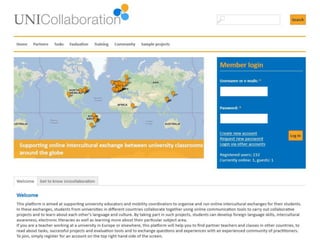
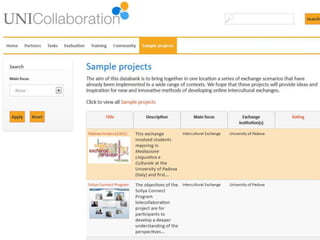
• Interactive platform for Telecollaboration/OIE in HE
• Information resource for teachers, mobility coordinators,
administrators, students:
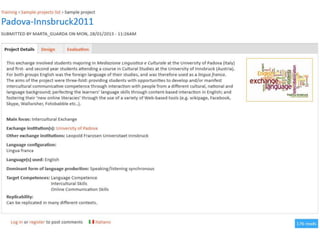
– Sample Projects
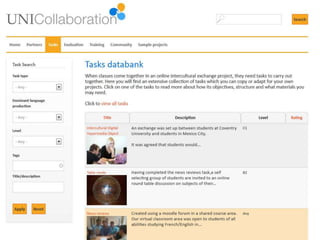
– Tasks, Task sequences
– Practitioners, Institutions, Classes
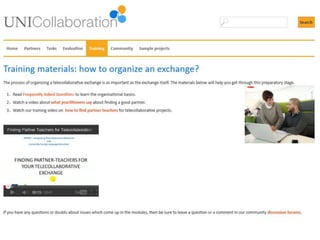
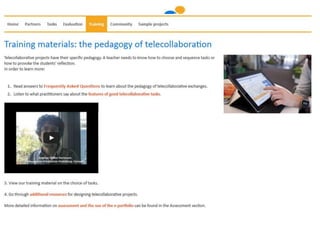
– Training and ‘how to’ materials
• Tools for practitioners: create tasks, describe classes, search
for classes, use ePortfolio
• Social functions: forum, messaging, blogs
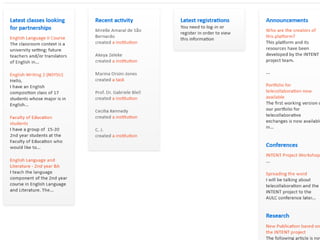
• Announcements and site activities on home page
Development
• Design, programming and hosting: OU,
Knowledge Media Institute (Chris Valentine)
• Functional specs: Lead Groningen (Jager,
Thorne), contributions from all partners
• Site designed in Drupal
• Released to the public: February 2013, still
being improved and extended
• Full version: End 2013
• Case Studies
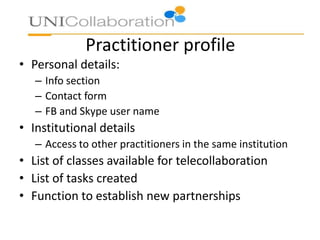
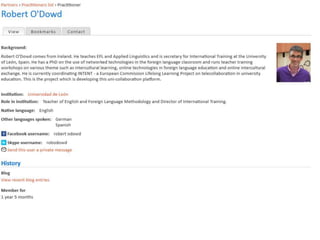
Practitioner profile
• Personal details:
– Info section
– Contact form
– FB and Skype user name
• Institutional details
– Access to other practitioners in the same institution
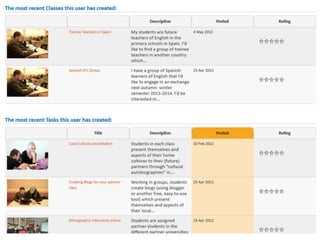
• List of classes available for telecollaboration
• List of tasks created
• Function to establish new partnerships
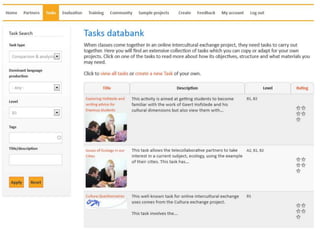
Structure of the task databank
• Stand-alone tasks – the smallest possible units of interaction
between partcipants
• Task sequences –examples how long-term exchanges can be
structured, consist of stand-alone tasks.
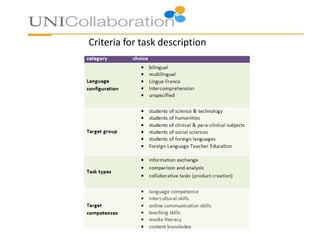
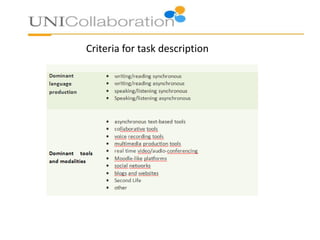
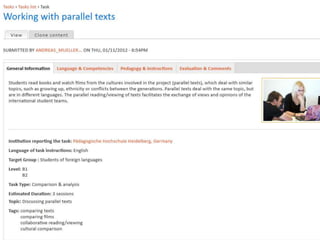
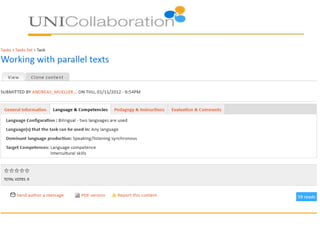
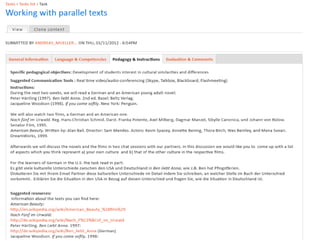
Criteria for task description
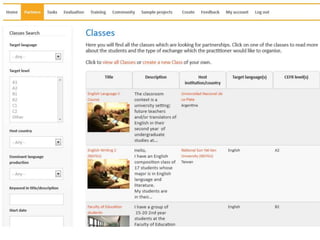
Class search tool
• Tool for finding classes to work with
• Searchable fields include (not finalized yet):
– Target language
– Target level
– Host country
– Dominant language production
– Period
• Possibly map searches in the future
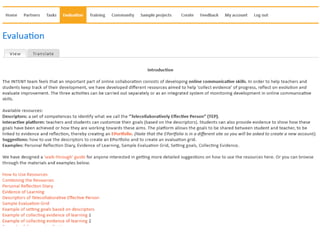
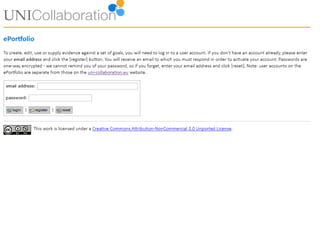
Eportfolio for Telecollaborative Language Learning
• Set of competences to identify the “Telecollaboratively Competent
Person” (TEP)
• Help individuals keep track of their development during an online
exchange
• 3 parts:
– descriptors (also goals for self- and other-directed learning)
– template for Personal Reflection Diary (to link descriptors with
events before, during and after an online exchange)
– sample rubric (criteria based on descriptors for self-progress
reports, peer evaluation/s, formative assessment)
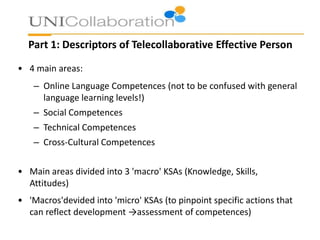
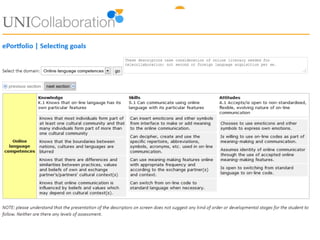
Part 1: Descriptors of Telecollaborative Effective Person
• 4 main areas:
– Online Language Competences (not to be confused with general
language learning levels!)
– Social Competences
– Technical Competences
– Cross-Cultural Competences
• Main areas divided into 3 'macro' KSAs (Knowledge, Skills,
Attitudes)
• 'Macros'devided into 'micro' KSAs (to pinpoint specific actions that
can reflect development →assessment of competences)
Afternoon workshop
• Set up personal profile
• Browse sample projects and tasks
• Design your own task
• Put the task on the platform
Questions and discussion!
Thank you for your attention!
Sake Jager: s.jager@rug.nl

The UniCollaboration Platform

  • 1.
    UNICollaboration Platform Sake Jager Universityof Groningen INTENT Partner INTENT Workshop, 21 March 2013 Padua, Italy
  • 2.
    UniCollaboration Platform Main functions: •Interactive platform for Telecollaboration/OIE in HE • Information resource for teachers, mobility coordinators, administrators, students: – Sample Projects – Tasks, Task sequences – Practitioners, Institutions, Classes – Training and ‘how to’ materials • Tools for practitioners: create tasks, describe classes, search for classes, use ePortfolio • Social functions: forum, messaging, blogs • Announcements and site activities on home page
  • 3.
    Development • Design, programmingand hosting: OU, Knowledge Media Institute (Chris Valentine) • Functional specs: Lead Groningen (Jager, Thorne), contributions from all partners • Site designed in Drupal • Released to the public: February 2013, still being improved and extended • Full version: End 2013
  • 8.
  • 11.
    Practitioner profile • Personaldetails: – Info section – Contact form – FB and Skype user name • Institutional details – Access to other practitioners in the same institution • List of classes available for telecollaboration • List of tasks created • Function to establish new partnerships
  • 14.
    Structure of thetask databank • Stand-alone tasks – the smallest possible units of interaction between partcipants • Task sequences –examples how long-term exchanges can be structured, consist of stand-alone tasks.
  • 15.
    Criteria for taskdescription
  • 16.
    Criteria for taskdescription
  • 21.
    Class search tool •Tool for finding classes to work with • Searchable fields include (not finalized yet): – Target language – Target level – Host country – Dominant language production – Period • Possibly map searches in the future
  • 23.
    Eportfolio for TelecollaborativeLanguage Learning • Set of competences to identify the “Telecollaboratively Competent Person” (TEP) • Help individuals keep track of their development during an online exchange • 3 parts: – descriptors (also goals for self- and other-directed learning) – template for Personal Reflection Diary (to link descriptors with events before, during and after an online exchange) – sample rubric (criteria based on descriptors for self-progress reports, peer evaluation/s, formative assessment)
  • 24.
    Part 1: Descriptorsof Telecollaborative Effective Person • 4 main areas: – Online Language Competences (not to be confused with general language learning levels!) – Social Competences – Technical Competences – Cross-Cultural Competences • Main areas divided into 3 'macro' KSAs (Knowledge, Skills, Attitudes) • 'Macros'devided into 'micro' KSAs (to pinpoint specific actions that can reflect development →assessment of competences)
  • 28.
    Afternoon workshop • Setup personal profile • Browse sample projects and tasks • Design your own task • Put the task on the platform
  • 29.
  • 30.
    Thank you foryour attention! Sake Jager: s.jager@rug.nl