USINGICTWITHINTRANSNATIONAL
COOPERATIONAMONGCLILTEACHERS.
RESULTSOFANERASMUS+KA2STRATEGIC
PARTNERSHIPPROJECT
EMMA ABBATE
LICEO STATALE ALESSANDRO MANZONI- CASERTA
Naples (Italy) 13 OCTOBER -Second International Conference
MOOCs, Language Learning and Mobility
Transnational
exchangeofgoodCLIL
practiceamong
EuropeanEducational
Institutions
Erasmus+
Strategic Partnerships for school
education (KA201)
2015-1-SK01-KA201-008937
Period: 1.9.2015 – 31.8.2017
PARTNERS
INVOLVEDIN
THEPROJECT
 Constantine the Philosopher University, Faculty of
Education in Nitra, Slovakia
 Slovak University of Technology in Bratislava,
Slovakia (Faculty of Materials Science and Technology
in Trnava)
 Daugavpils City Education Department, Latvia
 Vilnius Jonas Basanavicius progimnazija in Vilnius,
Lithuania
 Alströmergymnasiet in Alingsås, Sweden
 Liceo statale Alessandro Manzoni in Caserta, Italy
PROJECT
AIMS
1. Setting up essential components of good CLIL practice in the
classroom by face-to-face observations
2. Preparing Modular e-trainings course for European CLIL teachers
3. Providing countries with none or less CLIL experience with the
essential training and learning opportunities so that they can
commence implementing this approach in their schools
4. Training teachers from the project partner countries on CLIL
5. Setting up an open database of class recordings and other teaching
and methodological materials for CLIL teachers
6. Collecting research data and conducting comparative analysis of
CLIL practice
7. Providing Universities and other public bodies dealing with
educational research the results and main conclusions of this project
as a possible basis for future research on the topic.
PROJECT
MEETINGS
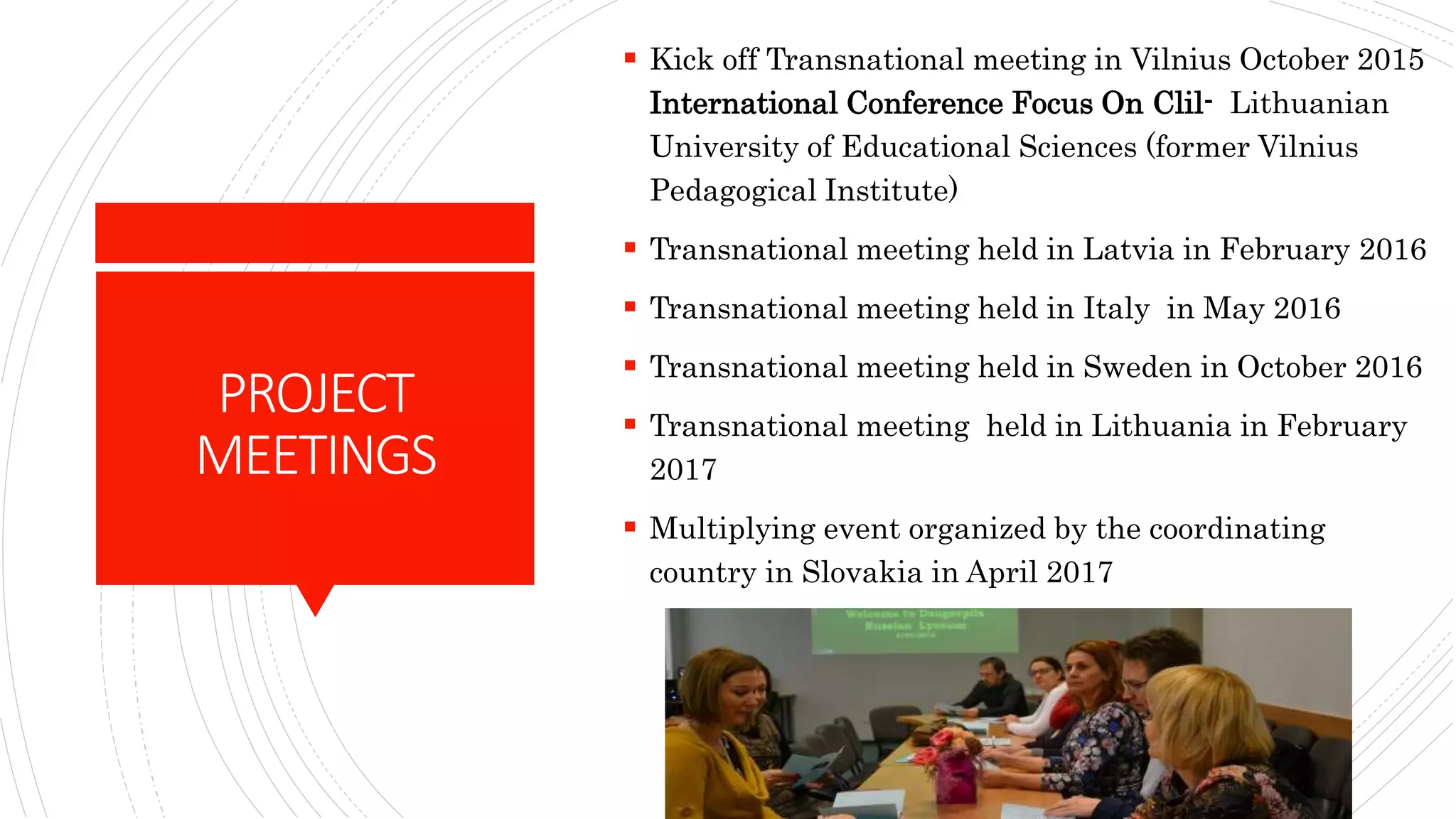
 Kick off Transnational meeting in Vilnius October 2015
International Conference Focus On Clil- Lithuanian
University of Educational Sciences (former Vilnius
Pedagogical Institute)
 Transnational meeting held in Latvia in February 2016
 Transnational meeting held in Italy in May 2016
 Transnational meeting held in Sweden in October 2016
 Transnational meeting held in Lithuania in February
2017
 Multiplying event organized by the coordinating
country in Slovakia in April 2017
FACTORSNEEDED
TOTAKEAN
ACTIVE PARTIN
THEPROJECT
Online access
 Digital skills to
know how to work in
the online learning
environment
the capacity for self-
regulated learning.
TECHNOLOGICAL
SKILLSREQUIRED
 Social media tools and mobiles allowed
projects’ participants to stay tuned to all
the interactions happening during the
project : they could connect to the course
with those devices they feel comfortable
with, according to the social and
professional contexts they operated in.
HOWICTHAVE
BEENUSED
DURING THE
PROJECT
LIFECYCLE?
 PARTNER COOPERATION
 STORAGE OF MATERIALS AND RESOUSES (CLIL
BANK)
 COMUNICATION
 OBSERVATIONS TRANSMISSION AND COLLECTION
 LEARNING ENVIROMENT (MOODLE PLATFORM)
 CLOUD SPACE ACCESSIBLE ONLY TO PARTNERS
WHERE HAVE BEEN UPLOADED ALL THE
MATERIALS (PHOTO, VIDEO LESSON PLAN, ) TO BE
AVALIABLE FOR DISSEMINATION OF PROJECT’S
ACTIVITIES, FINDINGS AND OUTCOME.
CMS
 THE CONTENT MANAGEMENT SYSTEM USED IS
JOMLAA! THE WEB SITE HAS BEEN BUILT USING
THIS MOBILE-READY AND USER-FRIENDLY
SOFTWARE PLATFORM FREE AND OPEN SOURCE
THEPROJECT
WEBSITE
http://www.educlil.eu
TARGETGROUP
FOREDUCLIL
MOOC
 MOOC IS DESIGNED FOR FUTURE
AND CURRENT FOREIGN LANGUAGE
PRACTITIONERS/CLIL TEACHERS. IT
OFFERS AN EASY AND USER-
FRIENDLY WAY OF ENHANCING
TEACHING QUALIFICATIONS VIA
CLIL.
CHALLENGES
 CREATING A COURSE THAT COULD BE SUCCESSFULLY
ATTENDED BY HUNDREDS OF TEACHERS AND WOULD-BE
TEACHERS, THAT PROVIDED TEACHING TRAINING FOR
PROFESSIONAL DEVELOPMENT AND ACADEMIC PURPOSES.
 COOPERATING WITH SEVERAL PARTNERS CAMING FROM
COUNTRIES WITH DIFFERENTE CLIL APPLICATION
FRAMEWORKS.
 HIGH EFFORT TO INTRODUCE NEW METHODOLOGIES AND
PRODUCE NEW HIGH QUALITY CONTENT IN NEW FORMATS
PEDAGOGICAL
APPROACH
APPLIED
 THE PROBLEM BASED APPROACH has
been chosen because it fits professional
development and authentic learning contexts
very well, letting participants come up with
the problems they faced and/or share the
solutions they have adopted.
EDUCLILMOOC
CONTENT
 THE COURSE OFFERS NECESSARY KNOWLEDGE AND
SKILLS RELATED TO CLIL. CONTENT IS DIVIDED INTO:
 CLIL – THEORETICAL KNOWLEDGE (introductory part designed
to build a solid foundation for further study within this clil course)
 COMPETENCES OF CLIL TEACHERS ( difficulties teachers can
experience before and during the implementation of clil into their
lessons).
 DEVELOPMENT OF CLIL MATERIALS
INTERACTIONS
WITHINTHE
EDUCLIL MOOC
 Interactions within Educlil MOOC mostly follow
the transformative approach (“hub and spoke”
model): content is provided by expert to be
consumed, interactions are limited to peer
discussions in forums where participants may
share their own expertise in order to let peers
learn from it.
LEARNING
MATERIALS
 Learning materials are designed for self-study and
are are produced in English even if there are also
several lesson plan and resourses for EMILE (CLIL
in french) approach. The choice to develop the
learning materials in English is due to the
availability of a rich literature on CLIL that allowed
the project team to have a theoretical framework for
rethinking learning paths from the perspective of
open online learning.
VALIDATIONOF
LEARNING
 EDUCLIL GIVES OFFICIAL ACCREDITATION
 Certificate of Achievement when course is completed is avaliable. To
get the Certificate of a CLIL expert participant has to go through
the 3 sections (modules) of the course: Theoretical Knowledge–
Competences of Teachers- Development of CLIL Materials, each of
these course parts is followed by the partial test assessing
knowledge acquired within. Once participant studies all parts and
accomplishes all partial tests, will be entitled to pass the Final test.
On successful completion of the course the learner will be awarded
the Certificate.
BENEFITS
OFFEREDTO
TEACHERSFROM
EDUCLIL MOOC
 INCREASED EXPOSURE TO OPEN EDUCATIONAL
RESOURCES USEFUL TO MAKE BLENDED LEARNING
AND FLIPPED CLASSROOM TYPE EFFORTS MORE
ACCESSIBLE.
 DEVELOPMENT OF UNDERSTANDING FOR MOOCS
AND STUDYING ONLINE THAT CAN BE TRANSFERED
INTO THE CLASSROOM.
 PROVIDES AN EXTENDED NETWORK IN WHICH TO
CREATE A COMMUNITY FOR LEARNING WITH LIKE-
MINDED PEERS: EDUCLIL MOOC’S PARTICIPANTS
HAVE OPPORTUNITIES TO DISCUSS PRINCIPLES OF
CLIL APPROACH IN FORUM. THIS ENHANCES THE
VISION OF EACH PARTICIPANT AS BOTH LEARNER
AND EXPERT.
emmaabb@tin.it

Presentazione move me coonference

  • 1.
    USINGICTWITHINTRANSNATIONAL COOPERATIONAMONGCLILTEACHERS. RESULTSOFANERASMUS+KA2STRATEGIC PARTNERSHIPPROJECT EMMA ABBATE LICEO STATALEALESSANDRO MANZONI- CASERTA Naples (Italy) 13 OCTOBER -Second International Conference MOOCs, Language Learning and Mobility
  • 2.
    Transnational exchangeofgoodCLIL practiceamong EuropeanEducational Institutions Erasmus+ Strategic Partnerships forschool education (KA201) 2015-1-SK01-KA201-008937 Period: 1.9.2015 – 31.8.2017
  • 3.
    PARTNERS INVOLVEDIN THEPROJECT  Constantine thePhilosopher University, Faculty of Education in Nitra, Slovakia  Slovak University of Technology in Bratislava, Slovakia (Faculty of Materials Science and Technology in Trnava)  Daugavpils City Education Department, Latvia  Vilnius Jonas Basanavicius progimnazija in Vilnius, Lithuania  Alströmergymnasiet in Alingsås, Sweden  Liceo statale Alessandro Manzoni in Caserta, Italy
  • 4.
    PROJECT AIMS 1. Setting upessential components of good CLIL practice in the classroom by face-to-face observations 2. Preparing Modular e-trainings course for European CLIL teachers 3. Providing countries with none or less CLIL experience with the essential training and learning opportunities so that they can commence implementing this approach in their schools 4. Training teachers from the project partner countries on CLIL 5. Setting up an open database of class recordings and other teaching and methodological materials for CLIL teachers 6. Collecting research data and conducting comparative analysis of CLIL practice 7. Providing Universities and other public bodies dealing with educational research the results and main conclusions of this project as a possible basis for future research on the topic.
  • 5.
    PROJECT MEETINGS  Kick offTransnational meeting in Vilnius October 2015 International Conference Focus On Clil- Lithuanian University of Educational Sciences (former Vilnius Pedagogical Institute)  Transnational meeting held in Latvia in February 2016  Transnational meeting held in Italy in May 2016  Transnational meeting held in Sweden in October 2016  Transnational meeting held in Lithuania in February 2017  Multiplying event organized by the coordinating country in Slovakia in April 2017
  • 6.
    FACTORSNEEDED TOTAKEAN ACTIVE PARTIN THEPROJECT Online access Digital skills to know how to work in the online learning environment the capacity for self- regulated learning.
  • 7.
    TECHNOLOGICAL SKILLSREQUIRED  Social mediatools and mobiles allowed projects’ participants to stay tuned to all the interactions happening during the project : they could connect to the course with those devices they feel comfortable with, according to the social and professional contexts they operated in.
  • 8.
    HOWICTHAVE BEENUSED DURING THE PROJECT LIFECYCLE?  PARTNERCOOPERATION  STORAGE OF MATERIALS AND RESOUSES (CLIL BANK)  COMUNICATION  OBSERVATIONS TRANSMISSION AND COLLECTION  LEARNING ENVIROMENT (MOODLE PLATFORM)  CLOUD SPACE ACCESSIBLE ONLY TO PARTNERS WHERE HAVE BEEN UPLOADED ALL THE MATERIALS (PHOTO, VIDEO LESSON PLAN, ) TO BE AVALIABLE FOR DISSEMINATION OF PROJECT’S ACTIVITIES, FINDINGS AND OUTCOME.
  • 9.
    CMS  THE CONTENTMANAGEMENT SYSTEM USED IS JOMLAA! THE WEB SITE HAS BEEN BUILT USING THIS MOBILE-READY AND USER-FRIENDLY SOFTWARE PLATFORM FREE AND OPEN SOURCE
  • 10.
  • 11.
    TARGETGROUP FOREDUCLIL MOOC  MOOC ISDESIGNED FOR FUTURE AND CURRENT FOREIGN LANGUAGE PRACTITIONERS/CLIL TEACHERS. IT OFFERS AN EASY AND USER- FRIENDLY WAY OF ENHANCING TEACHING QUALIFICATIONS VIA CLIL.
  • 12.
    CHALLENGES  CREATING ACOURSE THAT COULD BE SUCCESSFULLY ATTENDED BY HUNDREDS OF TEACHERS AND WOULD-BE TEACHERS, THAT PROVIDED TEACHING TRAINING FOR PROFESSIONAL DEVELOPMENT AND ACADEMIC PURPOSES.  COOPERATING WITH SEVERAL PARTNERS CAMING FROM COUNTRIES WITH DIFFERENTE CLIL APPLICATION FRAMEWORKS.  HIGH EFFORT TO INTRODUCE NEW METHODOLOGIES AND PRODUCE NEW HIGH QUALITY CONTENT IN NEW FORMATS
  • 13.
    PEDAGOGICAL APPROACH APPLIED  THE PROBLEMBASED APPROACH has been chosen because it fits professional development and authentic learning contexts very well, letting participants come up with the problems they faced and/or share the solutions they have adopted.
  • 14.
    EDUCLILMOOC CONTENT  THE COURSEOFFERS NECESSARY KNOWLEDGE AND SKILLS RELATED TO CLIL. CONTENT IS DIVIDED INTO:  CLIL – THEORETICAL KNOWLEDGE (introductory part designed to build a solid foundation for further study within this clil course)  COMPETENCES OF CLIL TEACHERS ( difficulties teachers can experience before and during the implementation of clil into their lessons).  DEVELOPMENT OF CLIL MATERIALS
  • 15.
    INTERACTIONS WITHINTHE EDUCLIL MOOC  Interactionswithin Educlil MOOC mostly follow the transformative approach (“hub and spoke” model): content is provided by expert to be consumed, interactions are limited to peer discussions in forums where participants may share their own expertise in order to let peers learn from it.
  • 16.
    LEARNING MATERIALS  Learning materialsare designed for self-study and are are produced in English even if there are also several lesson plan and resourses for EMILE (CLIL in french) approach. The choice to develop the learning materials in English is due to the availability of a rich literature on CLIL that allowed the project team to have a theoretical framework for rethinking learning paths from the perspective of open online learning.
  • 17.
    VALIDATIONOF LEARNING  EDUCLIL GIVESOFFICIAL ACCREDITATION  Certificate of Achievement when course is completed is avaliable. To get the Certificate of a CLIL expert participant has to go through the 3 sections (modules) of the course: Theoretical Knowledge– Competences of Teachers- Development of CLIL Materials, each of these course parts is followed by the partial test assessing knowledge acquired within. Once participant studies all parts and accomplishes all partial tests, will be entitled to pass the Final test. On successful completion of the course the learner will be awarded the Certificate.
  • 18.
    BENEFITS OFFEREDTO TEACHERSFROM EDUCLIL MOOC  INCREASEDEXPOSURE TO OPEN EDUCATIONAL RESOURCES USEFUL TO MAKE BLENDED LEARNING AND FLIPPED CLASSROOM TYPE EFFORTS MORE ACCESSIBLE.  DEVELOPMENT OF UNDERSTANDING FOR MOOCS AND STUDYING ONLINE THAT CAN BE TRANSFERED INTO THE CLASSROOM.  PROVIDES AN EXTENDED NETWORK IN WHICH TO CREATE A COMMUNITY FOR LEARNING WITH LIKE- MINDED PEERS: EDUCLIL MOOC’S PARTICIPANTS HAVE OPPORTUNITIES TO DISCUSS PRINCIPLES OF CLIL APPROACH IN FORUM. THIS ENHANCES THE VISION OF EACH PARTICIPANT AS BOTH LEARNER AND EXPERT.
  • 19.