vmcolab.eu
Presenter Name Event Name
vmcolab.eu
Virtual mobility: what’s in it for
students?
Ilse Op de Beeck, KU Leuven
BEST Academics and Companies Forum Gdansk
3 July 2014, Gdansk
vmcolab.eu
Context and definitions
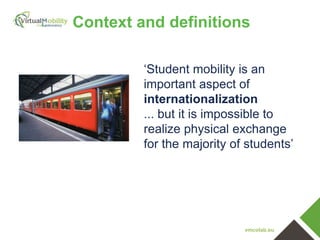
‘Student mobility is an
important aspect of
internationalization
... but it is impossible to
realize physical exchange
for the majority of students’
vmcolab.eu
Context and definitions
‘‘Virtual mobility is
the set of information and
communications technology
supported activities,
organized at institutional
level, that realize or facilitate
international, collaborative
experiences in a context of
teaching and/or learning”
vmcolab.eu
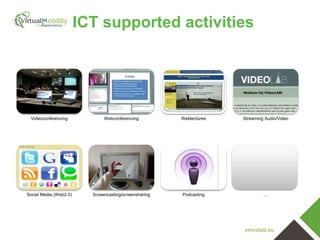
Videoconferencing Webconferencing Weblectures Streaming Audio/Video
Social Media (Web2.0) Screencasting/screensharing Podcasting …
ICT supported activities
vmcolab.eu
Virtual mobility is about
teaching and learning (pedagogical
aspect) and all the activities that support
it, e.g. administrative, organisational,
logistical issues.
Context of teaching and learning
vmcolab.eu
Virtual mobility is specifically about
cross-border activities between
different educational institutions from
different countries. Such activities are
subsequently intercultural in nature.
International
vmcolab.eu
Collaborative
Virtual mobility activities enable
collaborative learning, i.e. learning
from and with each other.
This aspect of virtual mobility is
considered to be essential in relation to
developing intercultural competences
and/or sensitivity.
vmcolab.eu
Virtual mobility
 to facilitate or realise an international exchange
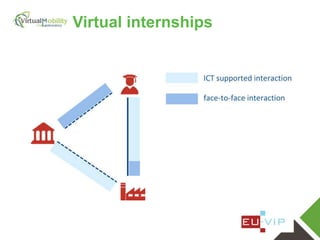
 to facilitate or realise international internships
 as a scenario to internationalise a (part of a)
course (chapter, exercise, task, project),
programme, workshop, seminar,…
scale from blended to fully virtual
student and teacher virtual mobility
Types of virtual mobility
vmcolab.eu
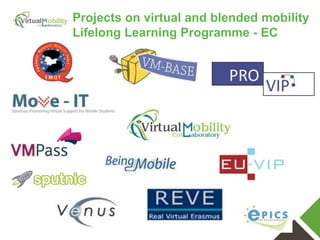
Projects on virtual and blended mobility
Lifelong Learning Programme - EC
vmcolab.eu
Before the exchange
 Orientation modules
 Preparatory courses (language, culture, digital
literacy)
 Pre-selection tools, student selection
During the exchange
 E-coaching
 Communication, support, social networks
After the exchange
 Virtual assessment and evaluation at a distance
 Virtual alumni
ICT as a support for physical mobility
vmcolab.eu
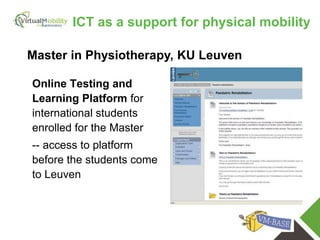
Online Testing and
Learning Platform for
international students
enrolled for the Master
-- access to platform
before the students come
to Leuven
Master in Physiotherapy, KU Leuven
ICT as a support for physical mobility
vmcolab.eu
Aim: equalise the initial level of the
knowledge of statistics of the (international)
students of the Master
 Successful pre-tests allow full participation
 Unsuccessful pre-tests give access to online
learning modules from the KU Leuven Bachelor
degree, followed by new pre-tests
 Expectations for students are more transparent
ICT as a support for physical mobility
vmcolab.eu
Master European Social Security (Faculty
of Law), KU Leuven
 One-year international study programme in
English
 Blends regular with distance learning
 Need for oral examination at a distance
 Set-up of e-assessment through
webconferencing
ICT as a support for physical mobility
vmcolab.eu
Set up of pilot
 Webconferencing through FlashMeeting and Adobe
Connect
 Laptop and webcam on both sides
 Support staff
- Booking of meeting + manual for students
- Students receive link to meeting through e-mail
- Online examination + recording
Reactions…
 Quality similar to face-to-face
 Recordings are added value
 Time consuming
 Connectivity, crucial for timing
ICT as a support for physical mobility
vmcolab.eu
Virtual internships
vmcolab.eu
 University of Turku (FI)
 October 2010 – February 2011
 Master in Political Sciences
 Turku and Southwest Finland European office (BE)
 Student selection via Skype
 Work based on online resources (following
EU news, compiling news for Finnish region,
following online meetings of EC,…)
 Communication, cooperation and feedback
via Skype and Adobe Connect
 Academic mentor @ home
Virtual internships
vmcolab.eu
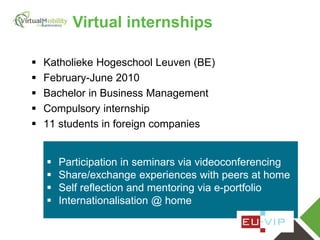
 Katholieke Hogeschool Leuven (BE)
 February-June 2010
 Bachelor in Business Management
 Compulsory internship
 11 students in foreign companies
 Participation in seminars via videoconferencing
 Share/exchange experiences with peers at home
 Self reflection and mentoring via e-portfolio
 Internationalisation @ home
Virtual internships
vmcolab.eu
Virtual internships: Pathway
http://pathway.sekoialearn.com
A tool for supporting and
facilitating international
internships at-a-distance
vmcolab.eu
Virtual internships: Pathway
 Supports matchmaking between students and
companies
 Supports the creation of an internship charter
 Enables a close follow-up of interns from a distance
 Supports online communication and collaboration
 Provides guidelines and advice about the
organization of virtual internships
vmcolab.eu
VMCOLAB
‘European Co-Laboratory for the Integration of Virtual
Mobility in Higher Education Innovation and Modernisation
Strategies’
Duration: 1 October 2012 – 30 September 2014
Partners:
KU Leuven (BE)
EFQUEL (BE)
Coimbra Group (BE)
University of Padova (IT)
University of Porto (PT)
Vytautas Magnus University (LT)
University of Granada (ES)
United Nations University (DE)
University Politehnica of Bucharest (RO)
Funded by the European Commission
under the Lifelong Learning Programme
vmcolab.eu
VMCOLAB – the project
“contribute to the innovation and
internationalisation of European Higher Education
Institutions by exploiting the full potential of ICT
and Virtual Mobility and broadening the access to
an international learning experience for all
European students”
“develop support materials and services for those
wanting to engage in virtual mobility experiences”
vmcolab.eu
VMCOLAB – the objectives
 Develop a Quality Assurance approach for VM
 Develop institutional awareness of VM potential
 Develop students’ awareness on opportunities to
use ICT for intercultural study
 Develop mutual support services for HEIs willing
to pilot VM programmes
 Test a set of mutual support services for HEIs
 Integrate VM in institutional academic contexts
vmcolab.eu
Pilot course OER
From the consortium
 Vytautas Magnus University, Lithuania (coordination, 3 teachers + 1 moderator)
 University of Granada, Spain (3 teachers)
 EFQUEL, Belgium (2 teachers)
Co-organisers from outside the consortium
 University of Pavia, Italy (1 teacher)
 University of Jyvaskyla, Finland (1 teacher)
18 participants/learners
 University of Granada, Spain - 3
 University of Porto, Portugal - 3
 Vytautas Magnus University, Lithuania - 6 (incl. 2 Erasmus students)
 University of Pavia, Italy - 3
 University of Florence, Italy - 2
 Trento University, Italy – 1 (Chinese exchange student)
vmcolab.eu
Pilot course OER
 Focused topic/short time
 Trusted network
 International comparative approach
 Selected/motivated students
 Tools used for high engagement level
 High level of interaction + learner centered
 No final exam
vmcolab.eu
Pilot course OER
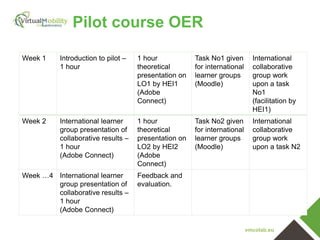
Week 1 Introduction to pilot –
1 hour
1 hour
theoretical
presentation on
LO1 by HEI1
(Adobe
Connect)
Task No1 given
for international
learner groups
(Moodle)
International
collaborative
group work
upon a task
No1
(facilitation by
HEI1)
Week 2 International learner
group presentation of
collaborative results –
1 hour
(Adobe Connect)
1 hour
theoretical
presentation on
LO2 by HEI2
(Adobe
Connect)
Task No2 given
for international
learner groups
(Moodle)
International
collaborative
group work
upon a task N2
Week …4 International learner
group presentation of
collaborative results –
1 hour
(Adobe Connect)
Feedback and
evaluation.
vmcolab.eu
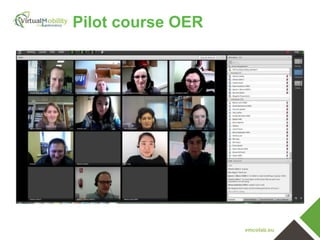
Pilot course OER
vmcolab.eu
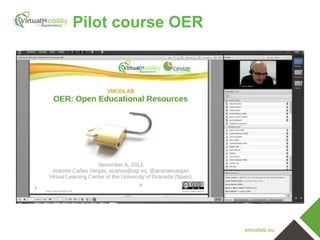
Pilot course OER
vmcolab.eu
Pilot course OER
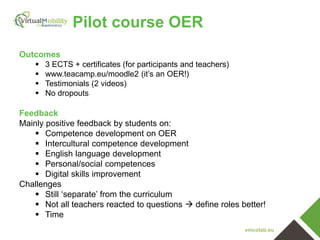
Outcomes
 3 ECTS + certificates (for participants and teachers)
 www.teacamp.eu/moodle2 (it’s an OER!)
 Testimonials (2 videos)
 No dropouts
Feedback
Mainly positive feedback by students on:
 Competence development on OER
 Intercultural competence development
 English language development
 Personal/social competences
 Digital skills improvement
Challenges
 Still ‘separate’ from the curriculum
 Not all teachers reacted to questions  define roles better!
 Time
vmcolab.eu
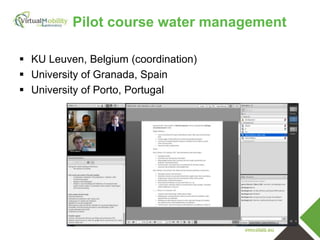
Pilot course water management
 KU Leuven, Belgium (coordination)
 University of Granada, Spain
 University of Porto, Portugal
vmcolab.eu
Sustainable integration of VM in existing courses
 Exchanging ‘modules’ and course materials
 International online group work (comparative
approach)
 MA thesis creation/supervision
Planning
 Preparation since January 2014
 Start in 1st semester of academic year 2014-15
Pilot course water management
vmcolab.eu
VMCOLAB – the results
For higher education institutions
 A Quality Assurance handbook for Virtual Mobility
 A Virtual Mobility Integration Kit
 Institutional Awareness Seminars
For students
 A Students’ Guide to Virtual Mobility
 ‘Virtual4Me’ website: http://virtual4me.vmcolab.eu
For policy makers
 Policy recommendations &
 Policy event
vmcolab.eu
 It facilitates cultural exchanges and interactions for students
who do not have the possibility to travel
 It gives flexibility in accessing learning or placements
(regardless of location, financial situation, personal
circumstances,…)
 It widens options in terms of subjects offered by other
universities and of different learning methodologies
 It lowers the costs of mobility
 It enhances your team work skills
 It develops your intercultural competences and skills through
the collaboration with academic staff and/or peer students
from other countries
 It can create the basis for physical mobility
 It enhances your ICT skills through the use of different
collaboration and communication tools
 …
Benefits of virtual mobility
vmcolab.eu
 Motivation
 Self-responsibility
 Able to plan and organise the own learning process
 Pro-activeness
 Language knowledge
 ICT skills
 Respect for diversity and intercultural differences
 Self-reflection capability
Student characteristics
vmcolab.eu
Testimonals from virtual mobility alumni
http://virtual4me.vmcolab.eu/vm-alumni-testimonials/
 Marta Guarda (University of Padova)
http://virtual4me.vmcolab.eu/vm-alumni-testimonials/university-of-padova-students/
 Vitalija Lyska (Vytautas Magnus University)
http://virtual4me.vmcolab.eu/vm-alumni-testimonials/vitalija-lyska/
Testimonials from students
vmcolab.eu
Technology
 Use the benefits of tools & technologies BUT no technology without
philosophy, vision, strategy
 Technology should be an aid, not a barrier!
Pedagogy
 Choose the right scenario’s & models: student-centred, collaborative
learning,…
 Intercultural skills development: explicate goals and stimulate
reflection (e.g. through peer feedback)
 Explicit attention for the human factor (face-to-face contact, choice
of technology, procedure in case of problems, room for virtual
‘chitchat’)
Organisation
 Virtual mobility requires good organisation, planning, timing: roles of
those involved need to be clear, draw up a communication
protocol,…
Recommendations
vmcolab.eu
Virtual mobility: an alternative for or a
complement to physical mobility?
 No substitution for physical mobility but a
different way of being mobile
 Blended approach
vmcolab.eu
More information?
VMCOLAB project website
www.vmcolab.eu
Virtual4Me website (for students)
virtual4me.vmcolab.eu
vmcolab.eu
More information?
Contact
Ilse Op de Beeck
Leuven Institute for Media and Learning, KU Leuven
ilse.opdebeeck@kuleuven.be

Virtual mobility: what's in it for students?

  • 1.
    vmcolab.eu Presenter Name EventName vmcolab.eu Virtual mobility: what’s in it for students? Ilse Op de Beeck, KU Leuven BEST Academics and Companies Forum Gdansk 3 July 2014, Gdansk
  • 2.
    vmcolab.eu Context and definitions ‘Studentmobility is an important aspect of internationalization ... but it is impossible to realize physical exchange for the majority of students’
  • 3.
    vmcolab.eu Context and definitions ‘‘Virtualmobility is the set of information and communications technology supported activities, organized at institutional level, that realize or facilitate international, collaborative experiences in a context of teaching and/or learning”
  • 4.
    vmcolab.eu Videoconferencing Webconferencing WeblecturesStreaming Audio/Video Social Media (Web2.0) Screencasting/screensharing Podcasting … ICT supported activities
  • 5.
    vmcolab.eu Virtual mobility isabout teaching and learning (pedagogical aspect) and all the activities that support it, e.g. administrative, organisational, logistical issues. Context of teaching and learning
  • 6.
    vmcolab.eu Virtual mobility isspecifically about cross-border activities between different educational institutions from different countries. Such activities are subsequently intercultural in nature. International
  • 7.
    vmcolab.eu Collaborative Virtual mobility activitiesenable collaborative learning, i.e. learning from and with each other. This aspect of virtual mobility is considered to be essential in relation to developing intercultural competences and/or sensitivity.
  • 8.
    vmcolab.eu Virtual mobility  tofacilitate or realise an international exchange  to facilitate or realise international internships  as a scenario to internationalise a (part of a) course (chapter, exercise, task, project), programme, workshop, seminar,… scale from blended to fully virtual student and teacher virtual mobility Types of virtual mobility
  • 9.
    vmcolab.eu Projects on virtualand blended mobility Lifelong Learning Programme - EC
  • 10.
    vmcolab.eu Before the exchange Orientation modules  Preparatory courses (language, culture, digital literacy)  Pre-selection tools, student selection During the exchange  E-coaching  Communication, support, social networks After the exchange  Virtual assessment and evaluation at a distance  Virtual alumni ICT as a support for physical mobility
  • 11.
    vmcolab.eu Online Testing and LearningPlatform for international students enrolled for the Master -- access to platform before the students come to Leuven Master in Physiotherapy, KU Leuven ICT as a support for physical mobility
  • 12.
    vmcolab.eu Aim: equalise theinitial level of the knowledge of statistics of the (international) students of the Master  Successful pre-tests allow full participation  Unsuccessful pre-tests give access to online learning modules from the KU Leuven Bachelor degree, followed by new pre-tests  Expectations for students are more transparent ICT as a support for physical mobility
  • 13.
    vmcolab.eu Master European SocialSecurity (Faculty of Law), KU Leuven  One-year international study programme in English  Blends regular with distance learning  Need for oral examination at a distance  Set-up of e-assessment through webconferencing ICT as a support for physical mobility
  • 14.
    vmcolab.eu Set up ofpilot  Webconferencing through FlashMeeting and Adobe Connect  Laptop and webcam on both sides  Support staff - Booking of meeting + manual for students - Students receive link to meeting through e-mail - Online examination + recording Reactions…  Quality similar to face-to-face  Recordings are added value  Time consuming  Connectivity, crucial for timing ICT as a support for physical mobility
  • 15.
  • 16.
    vmcolab.eu  University ofTurku (FI)  October 2010 – February 2011  Master in Political Sciences  Turku and Southwest Finland European office (BE)  Student selection via Skype  Work based on online resources (following EU news, compiling news for Finnish region, following online meetings of EC,…)  Communication, cooperation and feedback via Skype and Adobe Connect  Academic mentor @ home Virtual internships
  • 17.
    vmcolab.eu  Katholieke HogeschoolLeuven (BE)  February-June 2010  Bachelor in Business Management  Compulsory internship  11 students in foreign companies  Participation in seminars via videoconferencing  Share/exchange experiences with peers at home  Self reflection and mentoring via e-portfolio  Internationalisation @ home Virtual internships
  • 18.
    vmcolab.eu Virtual internships: Pathway http://pathway.sekoialearn.com Atool for supporting and facilitating international internships at-a-distance
  • 19.
    vmcolab.eu Virtual internships: Pathway Supports matchmaking between students and companies  Supports the creation of an internship charter  Enables a close follow-up of interns from a distance  Supports online communication and collaboration  Provides guidelines and advice about the organization of virtual internships
  • 20.
    vmcolab.eu VMCOLAB ‘European Co-Laboratory forthe Integration of Virtual Mobility in Higher Education Innovation and Modernisation Strategies’ Duration: 1 October 2012 – 30 September 2014 Partners: KU Leuven (BE) EFQUEL (BE) Coimbra Group (BE) University of Padova (IT) University of Porto (PT) Vytautas Magnus University (LT) University of Granada (ES) United Nations University (DE) University Politehnica of Bucharest (RO) Funded by the European Commission under the Lifelong Learning Programme
  • 21.
    vmcolab.eu VMCOLAB – theproject “contribute to the innovation and internationalisation of European Higher Education Institutions by exploiting the full potential of ICT and Virtual Mobility and broadening the access to an international learning experience for all European students” “develop support materials and services for those wanting to engage in virtual mobility experiences”
  • 22.
    vmcolab.eu VMCOLAB – theobjectives  Develop a Quality Assurance approach for VM  Develop institutional awareness of VM potential  Develop students’ awareness on opportunities to use ICT for intercultural study  Develop mutual support services for HEIs willing to pilot VM programmes  Test a set of mutual support services for HEIs  Integrate VM in institutional academic contexts
  • 23.
    vmcolab.eu Pilot course OER Fromthe consortium  Vytautas Magnus University, Lithuania (coordination, 3 teachers + 1 moderator)  University of Granada, Spain (3 teachers)  EFQUEL, Belgium (2 teachers) Co-organisers from outside the consortium  University of Pavia, Italy (1 teacher)  University of Jyvaskyla, Finland (1 teacher) 18 participants/learners  University of Granada, Spain - 3  University of Porto, Portugal - 3  Vytautas Magnus University, Lithuania - 6 (incl. 2 Erasmus students)  University of Pavia, Italy - 3  University of Florence, Italy - 2  Trento University, Italy – 1 (Chinese exchange student)
  • 24.
    vmcolab.eu Pilot course OER Focused topic/short time  Trusted network  International comparative approach  Selected/motivated students  Tools used for high engagement level  High level of interaction + learner centered  No final exam
  • 25.
    vmcolab.eu Pilot course OER Week1 Introduction to pilot – 1 hour 1 hour theoretical presentation on LO1 by HEI1 (Adobe Connect) Task No1 given for international learner groups (Moodle) International collaborative group work upon a task No1 (facilitation by HEI1) Week 2 International learner group presentation of collaborative results – 1 hour (Adobe Connect) 1 hour theoretical presentation on LO2 by HEI2 (Adobe Connect) Task No2 given for international learner groups (Moodle) International collaborative group work upon a task N2 Week …4 International learner group presentation of collaborative results – 1 hour (Adobe Connect) Feedback and evaluation.
  • 26.
  • 27.
  • 28.
    vmcolab.eu Pilot course OER Outcomes 3 ECTS + certificates (for participants and teachers)  www.teacamp.eu/moodle2 (it’s an OER!)  Testimonials (2 videos)  No dropouts Feedback Mainly positive feedback by students on:  Competence development on OER  Intercultural competence development  English language development  Personal/social competences  Digital skills improvement Challenges  Still ‘separate’ from the curriculum  Not all teachers reacted to questions  define roles better!  Time
  • 29.
    vmcolab.eu Pilot course watermanagement  KU Leuven, Belgium (coordination)  University of Granada, Spain  University of Porto, Portugal
  • 30.
    vmcolab.eu Sustainable integration ofVM in existing courses  Exchanging ‘modules’ and course materials  International online group work (comparative approach)  MA thesis creation/supervision Planning  Preparation since January 2014  Start in 1st semester of academic year 2014-15 Pilot course water management
  • 31.
    vmcolab.eu VMCOLAB – theresults For higher education institutions  A Quality Assurance handbook for Virtual Mobility  A Virtual Mobility Integration Kit  Institutional Awareness Seminars For students  A Students’ Guide to Virtual Mobility  ‘Virtual4Me’ website: http://virtual4me.vmcolab.eu For policy makers  Policy recommendations &  Policy event
  • 32.
    vmcolab.eu  It facilitatescultural exchanges and interactions for students who do not have the possibility to travel  It gives flexibility in accessing learning or placements (regardless of location, financial situation, personal circumstances,…)  It widens options in terms of subjects offered by other universities and of different learning methodologies  It lowers the costs of mobility  It enhances your team work skills  It develops your intercultural competences and skills through the collaboration with academic staff and/or peer students from other countries  It can create the basis for physical mobility  It enhances your ICT skills through the use of different collaboration and communication tools  … Benefits of virtual mobility
  • 33.
    vmcolab.eu  Motivation  Self-responsibility Able to plan and organise the own learning process  Pro-activeness  Language knowledge  ICT skills  Respect for diversity and intercultural differences  Self-reflection capability Student characteristics
  • 34.
    vmcolab.eu Testimonals from virtualmobility alumni http://virtual4me.vmcolab.eu/vm-alumni-testimonials/  Marta Guarda (University of Padova) http://virtual4me.vmcolab.eu/vm-alumni-testimonials/university-of-padova-students/  Vitalija Lyska (Vytautas Magnus University) http://virtual4me.vmcolab.eu/vm-alumni-testimonials/vitalija-lyska/ Testimonials from students
  • 35.
    vmcolab.eu Technology  Use thebenefits of tools & technologies BUT no technology without philosophy, vision, strategy  Technology should be an aid, not a barrier! Pedagogy  Choose the right scenario’s & models: student-centred, collaborative learning,…  Intercultural skills development: explicate goals and stimulate reflection (e.g. through peer feedback)  Explicit attention for the human factor (face-to-face contact, choice of technology, procedure in case of problems, room for virtual ‘chitchat’) Organisation  Virtual mobility requires good organisation, planning, timing: roles of those involved need to be clear, draw up a communication protocol,… Recommendations
  • 36.
    vmcolab.eu Virtual mobility: analternative for or a complement to physical mobility?  No substitution for physical mobility but a different way of being mobile  Blended approach
  • 37.
    vmcolab.eu More information? VMCOLAB projectwebsite www.vmcolab.eu Virtual4Me website (for students) virtual4me.vmcolab.eu
  • 38.
    vmcolab.eu More information? Contact Ilse Opde Beeck Leuven Institute for Media and Learning, KU Leuven ilse.opdebeeck@kuleuven.be