OPEN EDUCATIONAL RESOURCES
          (OER)

     Ms. Montanez
Presentation Objectives

   Introduce Open Educational Resources (OERs)

   Discuss advantages and limitations of OERs in the

    classroom

   Provide links to OER repositories online

   Evaluate considerations on developing OERs

   Provide links to OER development resources online
Internet – Revolutionizing Education


                     (Online, E. D. 2011)
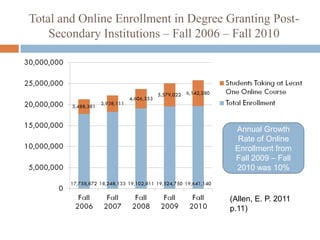
Total and Online Enrollment in Degree Granting Post-
    Secondary Institutions – Fall 2006 – Fall 2010


                                       Annual Growth
                                        Rate of Online
                                       Enrollment from
                                       Fall 2009 – Fall
                                       2010 was 10%


                                      (Allen, E. P. 2011
                                      p.11)
Basic Concepts - OER

   Open Educational Resources (OER) – are materials
    that can be reused for teaching due to open licensing.
   Users can reuse, revise, remix and redistribute content.
   Different licensing options exist to enable authors to
    share their resources and retain some of their rights as
    originators.
Advantages OER

   Free access to educational resources, books and
    courses.
   Customization of free materials to the needs of
    particular audiences.
   Diminishing social inequalities by raising level of
    education.
Limitations OER

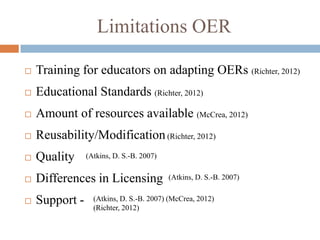
   Training for educators on adapting OERs (Richter, 2012)
   Educational Standards (Richter, 2012)
   Amount of resources available (McCrea, 2012)
   Reusability/Modification (Richter, 2012)
   Quality     (Atkins, D. S.-B. 2007)


   Differences in Licensing              (Atkins, D. S.-B. 2007)


   Support -     (Atkins, D. S.-B. 2007) (McCrea, 2012)
                  (Richter, 2012)
Resources for OER use in the
                 classroom
   OER Commons - http://www.oercommons.org
   Flatworld Knowledge
       http://www.flatworldknowledge.com
   Carnegie Mellon - http://oli.cmu.edu/
   Rice Connexions- http://cnx.org/
   Sun Microsystems – http://www.curriki.org
Websites for creating OERs

   OER Consortium - http://oerconsortium.org/learn-
    about-oer/
   Carnegie Mellon - http://oli.cmu.edu/
   Santa Fe College Open Educational Resources,
    Gainesville, FL -
    http://www.sfcollege.edu/oer/index.php?section=qu
    ick_start
Summary

   OER stands for Open Educational Resource.

   OERs are free materials that have been made available online

    and that can be modified and reused for instruction.

   OERs can help improve the quality of education by improving

    the quality of the resources offered in the classroom.
Summary

   Review OERs for suitability for target audience.

   Review OERs for compliance with local educational

    standards.

   Review terms of use of OERs for compliance.

   Faculty can convert classroom resources to OER.
Summary

   Creative Commons offers a wealth of information in licensing

    OERs for those that would like to create their own.

   Limitations exist on using OERs for the classroom but using

    them can become a means of adding varied activities and tools

    to enhance learning.
References List

Allen, E. P. (2011). Going the Distance - Online Education in the

   United States, 2011. Babson Survey Research Group.

Atkins, D. S.-B. (2007). A Review of the Open Educational

   Resource (OER) Movement: Achievements, Challenges and

   New Opportunities. William and Flora Hewlett Foundation

   Report, 1-83.
References List

bdraprojects. (2010, September 16). Open Educational Resource

   (OER) FAQs. Retrieved from YouTube:

   http://www.youtube.com/watch?v=8wgi_5Bv-3o

blinktower. (2012, July 25). Why Open Education Matters.

   Retrieved from YouTube: http://youtu.be/YtnwAgu4KIw
References List

Commons, C. (ND). About the Licenses. Retrieved from

   CreativeCommons: http://creativecommons.org/licenses/

EmergingEdTech. (2010, December 12). Learning About OER:

   Open Educational Resources. Retrieved from YouTube:

   http://www.youtube.com/watch?v=8kRBS9vtOAw
References List
McCrea, B. (2012, June 26). 4 Challenges for OER in Higher

   Education. Retrieved from Campus Technology:

   http://campustechnology.com/articles/2012/06/26/4-

   challenges-for-oer-in-higher-education.aspx
References List
OERIPRSupport. (2010, November 1). Licensing and IPR for

   OER Projects. Retrieved from YouTube:

   http://www.youtube.com/watch?v=5BWqgVpcHCs

OERIPRSupport. (2012, March 4). Turning a Resource into an

   Open Educational Resource (OER). Retrieved from

   YouTube: http://youtu.be/CUVW5fhQP2k
References List
Online, E. D. (2011, June 10). How the Internet is

   Revolutionizing Education. Retrieved from Education

   Database Online Blog:

   http://www.onlineeducation.net/blog/page/3

Richer, T. a. (2012). Open Educational resources: education for

   the world? Distance Education, 201-219.
References List
vcilt14. (2010, October 28). Sidecap: Challenges in OER

   Integration. Retrieved from Youtube:

   http://www.youtube.com/watch?v=BFaNR1XUw2w

Open Educational Resources

  • 1.
    OPEN EDUCATIONAL RESOURCES (OER) Ms. Montanez
  • 2.
    Presentation Objectives  Introduce Open Educational Resources (OERs)  Discuss advantages and limitations of OERs in the classroom  Provide links to OER repositories online  Evaluate considerations on developing OERs  Provide links to OER development resources online
  • 3.
    Internet – RevolutionizingEducation (Online, E. D. 2011)
  • 4.
    Total and OnlineEnrollment in Degree Granting Post- Secondary Institutions – Fall 2006 – Fall 2010 Annual Growth Rate of Online Enrollment from Fall 2009 – Fall 2010 was 10% (Allen, E. P. 2011 p.11)
  • 5.
    Basic Concepts -OER  Open Educational Resources (OER) – are materials that can be reused for teaching due to open licensing.  Users can reuse, revise, remix and redistribute content.  Different licensing options exist to enable authors to share their resources and retain some of their rights as originators.
  • 6.
    Advantages OER  Free access to educational resources, books and courses.  Customization of free materials to the needs of particular audiences.  Diminishing social inequalities by raising level of education.
  • 7.
    Limitations OER  Training for educators on adapting OERs (Richter, 2012)  Educational Standards (Richter, 2012)  Amount of resources available (McCrea, 2012)  Reusability/Modification (Richter, 2012)  Quality (Atkins, D. S.-B. 2007)  Differences in Licensing (Atkins, D. S.-B. 2007)  Support - (Atkins, D. S.-B. 2007) (McCrea, 2012) (Richter, 2012)
  • 8.
    Resources for OERuse in the classroom  OER Commons - http://www.oercommons.org  Flatworld Knowledge http://www.flatworldknowledge.com  Carnegie Mellon - http://oli.cmu.edu/  Rice Connexions- http://cnx.org/  Sun Microsystems – http://www.curriki.org
  • 9.
    Websites for creatingOERs  OER Consortium - http://oerconsortium.org/learn- about-oer/  Carnegie Mellon - http://oli.cmu.edu/  Santa Fe College Open Educational Resources, Gainesville, FL - http://www.sfcollege.edu/oer/index.php?section=qu ick_start
  • 10.
    Summary  OER stands for Open Educational Resource.  OERs are free materials that have been made available online and that can be modified and reused for instruction.  OERs can help improve the quality of education by improving the quality of the resources offered in the classroom.
  • 11.
    Summary  Review OERs for suitability for target audience.  Review OERs for compliance with local educational standards.  Review terms of use of OERs for compliance.  Faculty can convert classroom resources to OER.
  • 12.
    Summary  Creative Commons offers a wealth of information in licensing OERs for those that would like to create their own.  Limitations exist on using OERs for the classroom but using them can become a means of adding varied activities and tools to enhance learning.
  • 13.
    References List Allen, E.P. (2011). Going the Distance - Online Education in the United States, 2011. Babson Survey Research Group. Atkins, D. S.-B. (2007). A Review of the Open Educational Resource (OER) Movement: Achievements, Challenges and New Opportunities. William and Flora Hewlett Foundation Report, 1-83.
  • 14.
    References List bdraprojects. (2010,September 16). Open Educational Resource (OER) FAQs. Retrieved from YouTube: http://www.youtube.com/watch?v=8wgi_5Bv-3o blinktower. (2012, July 25). Why Open Education Matters. Retrieved from YouTube: http://youtu.be/YtnwAgu4KIw
  • 15.
    References List Commons, C.(ND). About the Licenses. Retrieved from CreativeCommons: http://creativecommons.org/licenses/ EmergingEdTech. (2010, December 12). Learning About OER: Open Educational Resources. Retrieved from YouTube: http://www.youtube.com/watch?v=8kRBS9vtOAw
  • 16.
    References List McCrea, B.(2012, June 26). 4 Challenges for OER in Higher Education. Retrieved from Campus Technology: http://campustechnology.com/articles/2012/06/26/4- challenges-for-oer-in-higher-education.aspx
  • 17.
    References List OERIPRSupport. (2010,November 1). Licensing and IPR for OER Projects. Retrieved from YouTube: http://www.youtube.com/watch?v=5BWqgVpcHCs OERIPRSupport. (2012, March 4). Turning a Resource into an Open Educational Resource (OER). Retrieved from YouTube: http://youtu.be/CUVW5fhQP2k
  • 18.
    References List Online, E.D. (2011, June 10). How the Internet is Revolutionizing Education. Retrieved from Education Database Online Blog: http://www.onlineeducation.net/blog/page/3 Richer, T. a. (2012). Open Educational resources: education for the world? Distance Education, 201-219.
  • 19.
    References List vcilt14. (2010,October 28). Sidecap: Challenges in OER Integration. Retrieved from Youtube: http://www.youtube.com/watch?v=BFaNR1XUw2w

Editor's Notes

  • #2 Merlot logo property of California State UniversityConnexions logo property of Rice UniversityOER Commons logo property of ISKMEMITOPENCOURSEWARE logo property of Massachusetts Institute of TechnologyCommunity College Consortium for Open Education Resources logo property of http://oerconsortium.org/Open Yale courses logo property of Yale UniversityOpen Learning Initiative Logo property of Carnegie Mellon University
  • #4 As Internet access has become available to more people and it has become a means of disseminating information.From tutorials to videos to manuals, it is possible to find different type of contents online.As you can see from the images above, education has been influenced by this new technology. Access to the World Wide Web and improvements in technology have opened the door to e-learning.Community Colleges and Universities have implemented online courses to reach students geographically separated from campus. Online classes and resources have provided a means for the individual to learn at their own pace and their own time. Estimates indicate that the amount of courses available online will increase due to demand.
  • #5 As indicated in the chart, from Fall 2006 – Fall 2010 there has been increase every single year on the amount of students taking courses online. As more courses and materials become available, online enrollment would still be limited to those who can afford it and have the technology to access it. Still, wasn’t the web created in the spirit of free sharing of information for all? Open Educational Resources extends this same spirit to online education.
  • #6 The Creative Commons website has a useful tool to help you determine the best licensing agreement for your work: http://creativecommons.org/choose/
  • #7 MIT, Yale, and other universities are making their courses available on the web for free.Open textbooks online could be used for courses, free of cost to students or at a reduced cost: http://collegeopentextbooks.org/, http://oerconsortium.org/discipline-specific/ among others.Articles on EOR - http://opencontent.org/blog/articles ; http://wiki.creativecommons.org/images/6/67/FreetoLearnGuide.pdfWebsites like www.merlot.org provide teaching resources for instructors.
  • #8 Training is needed to help instructors determine if the educational resources match their audience needs.Educational standards for each country might vary and methods of presenting material as well.Reusability/Modification – Even though some of the material is available for download, some of it can’t be modified: files as pdf and graphics as images are an example of this.Quality is being determined by the source of the resource.Differences in licensing refers to the licenses available from the Commons Licensing and how users should be aware of what each license allows them to do or not, with each particular open educational resource.Support entails who will support the continuing improvement of the resources created, help adapting materials to different cultures/settings (McCrea, 2012)and technical issues (Richter, 2012). Support - Accessibility – Materials might be missing key use requirements for its use of educational material in a particular country - For example, videos from the MIT website are available in YouTube, but not all of them are captioned.
  • #9 This is just a basic list of resources. It is expected that in the future specific databases will be available that will allow users to find resources that they need from multiple sites with fewer search attempts. (Atkins, 2007)
  • #10 These are some of the recognized websites for creating OER, but you could also find access to EOR resources as well