

Integrating Telecollaborative Networks into
      Foreign Language Higher Education:
                       The INTENT project


             Mirjam Hauck, The Open University, UK
             Francesca Helm, University of Padova, Italy
Telecollaboration

The use of online communication tools
to bring together classes of language
learners in geographically distant
locations to develop their

> foreign language skills
      > intercultural competence


        through collaborative tasks
        and project work
The Bologna Process & EHEA
• A clearly defined common goal: to create a
  European space for higher education in order to
  enhance the employability and mobility of citizens
  and to increase the international competitiveness of
  European higher education;
• The European Higher Education Area (EHEA) was
  launched along with the Bologna Process' decade
  anniversary, in March 2010, during the Budapest-
  Vienna Ministerial Conference. It is meant to ensure
  more comparable, compatible and coherent
  systems of higher education in Europe.
Mobility and the EHEA

 Mobility is important for personal development and
 employability, it fosters respect for diversity and a
 capacity to deal with other cultures. It encourages
 linguistic pluralism, thus underpinning the multilingual
 tradition of the European Higher Education Area and it
 increases cooperation and competition between higher
 education institutions


In 2020, at least 20% of those graduating in the
  European Higher Education Area should have
  had a study or training period abroad.

   –   Communiqué of the Conference of
       European Ministers Responsible for Higher Education,
       Leuven and Louvain-la-Neuve, 28-29 April 2009
„Virtual mobility‟
           for the remaining 80%?
Virtual mobility, i.e. the use of the internet and other electronic forms of
information and communication, is often a catalyst for embarking on a
period of physical mobility. Although not a substitute for physical
mobility, it does enable young people to prepare a stay abroad and can
create conditions for future physical mobility by facilitating friendships,
contacts and social networking etc….
    – It can also provide an international dimension to those
      learners who, for different reasons, are not able or
      willing to go abroad. In that context, ICT can be
      used for “electronic twinning” …etc.

                                         Commission of the European Communities:
                       Green paper: promoting the learning mobility of young people.
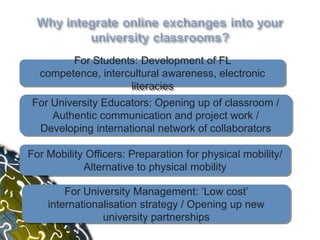
For Students: Development of FL
  competence, intercultural awareness, electronic
                    literacies
For University Educators: Opening up of classroom /
    Authentic communication and project work /
 Developing international network of collaborators

For Mobility Officers: Preparation for physical mobility/
            Alternative to physical mobility

        For University Management: „Low cost‟
    internationalisation strategy / Opening up new
                university partnerships
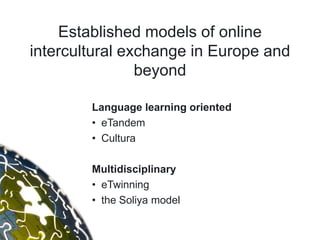
Established models of online
intercultural exchange in Europe and
                beyond

        Language learning oriented
        • eTandem
        • Cultura

        Multidisciplinary
        • eTwinning
        • the Soliya model
Telecollaboration … an 'add-on'
activity in higher education?


> lack of pedagogical training for educators
> fear of extra work-load (lack of support and
resources)
> no long-term stability in partnership with
other universities
> lack of academic credit
INTENT

                 Integrating Telecollaborative Networks
               Into Foreign Language Higher Education


Financed By The European Commission - Lifelong Learning Programme
Co-ordinated by Robert O‟Dowd at the Universidad de Leon, Spain
8 European partners (PH Heidelberg, Grenoble III, Padova, Czestochowa,
Groningen, UA Barcelona)

October 2011-March 2014
Products
1. Survey of HE teachers (practitioners and
   non-practitioners of telecollaboration) and
   learners.
2. A Project Website/Virtual
   Platform, supporting telecollaborative
   practice, for teachers, learner, administrators
   and educational policy makers.
3. A Practitioner Databank, containing case
   studies of telecollaborative exchanges.
4. An E-Portfolio of learner competences
   developed in telecollaborative exchanges.
5. A Databank of telecollaborative
   tasks, with user guidelines
6. A Dissemination strategy and
   programme, including training workshops
   for tutors, presentations at conferences
   and academic publications.
7. An International Conference
   (Leon, 2014)
8. Project evaluation and testing.
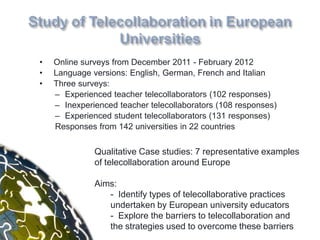
•   Online surveys from December 2011 - February 2012
•   Language versions: English, German, French and Italian
•   Three surveys:
    – Experienced teacher telecollaborators (102 responses)
    – Inexperienced teacher telecollaborators (108 responses)
    – Experienced student telecollaborators (131 responses)
    Responses from 142 universities in 22 countries

              Qualitative Case studies: 7 representative examples
              of telecollaboration around Europe

              Aims:
                 - Identify types of telecollaborative practices
                 undertaken by European university educators
                 - Explore the barriers to telecollaboration and
                 the strategies used to overcome these barriers
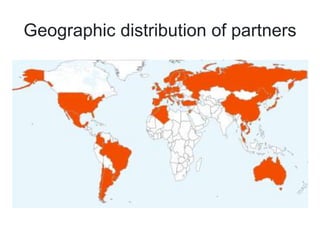
Geographic distribution of partners
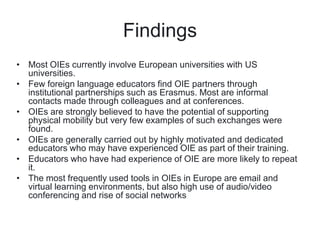
Findings
• Most OIEs currently involve European universities with US
  universities.
• Few foreign language educators find OIE partners through
  institutional partnerships such as Erasmus. Most are informal
  contacts made through colleagues and at conferences.
• OIEs are strongly believed to have the potential of supporting
  physical mobility but very few examples of such exchanges were
  found.
• OIEs are generally carried out by highly motivated and dedicated
  educators who may have experienced OIE as part of their training.
• Educators who have had experience of OIE are more likely to repeat
  it.
• The most frequently used tools in OIEs in Europe are email and
  virtual learning environments, but also high use of audio/video
  conferencing and rise of social networks
• Many students reported that participating in OIE led
  them to become more open to others, accepting and
  understanding of difference and to realise that their
  own points of view are not necessarily “the best or
  only ones”.
• Telecollaboration can also contribute to educators‟
  academic careers, by establishing connections to
  new academic networks and engaging in staff
  mobility visits with other universities etc.
• Telecollaboration is seen as a useful „first step‟ on the
  way to developing physical mobility exchanges
  between institutions.
• Most teachers with experience of OIE believe it is a
  valid alternative to physical mobility for those
  students who cannot participate in mobility
  programmes.
Comments from students
     “je n'ai pas vraiment vécu la télécollaboration sous l'angle d'une
         rencontre inter-culturelle, mais d'une rencontre tout court.”

• Eine gute Idee, aber nur wenn sie sinnvoll geplant und durchgeführt wird.
• Gespräche in Echtzeit fände ich sehr hilfreich und auch spannender für die
  Teilnehmer. Somit hätte man vielleicht eher die Möglichkeit auch persönliche
  Gespräche mit den Austauschpartnern zu führen.
• I encourage all students to participate in a cultural exchange
• I think it was a great idea and experience. I think Skype would be a better way of oral
  communicating.
• I think, it was fine and also, that it would be a necessary part in the degree of people
  who are learning a foreign language.
• I will encourage everyone to participate in exchange programs
• Ich denke, dass interkultureller Onlineaustausch besonders für Studierende, die bisher
  nur wenig interkulturelle Erfahrungen gemacht haben, sinvoll ist.
• Ich glaube, dass IOAes sehr eindrucksvoll sein können, aber leider habe ich es nicht
  erlebt. Ich habe aber Ideen wie ich so eine Onlineaustausch organisieren würde.
• Its a useful too. I think that all the foreign language students should use it to realise
  that studing a language involves more things than studing grammar and phonetics.
• Our University should organise more exchanges.
• Peut-etre Skype pour communiquer de plus.
• Si on organise la télécollaboration je'exigerais comme prof un laps de temps
  obligatoire pour parler (p.ex. les élèves doivent avoir une conversation pendant une
  heure par semaine..)
• They are so useful for students that they should be compulsory for everyone.
•   In your opinion, what are the reasons why telecollaborative
    exchange is not more popular in university education?

•   Time necessary to set up and run exchanges
    – (Mentioned 49/ 98 practitioners)

•   Difficulties in integration & assessment due to institutional
    requirements
    – (Mentioned by 28 / 98 practitioners)

•   Lack of pedagogical knowledge about how to run and integrate
    exchanges
    – (Mentioned by 20/ 98 practitioners)

•   Teachers lack e-literacies/ required technological knowledge
    – (Mentioned by 19 / 98 practitioners)

•   Difficulty in finding appropriate partners
    – (Mentioned by 9/ 98 practitioners)
Recommendations

•Support the establishment of online exchanges between European countries in
much the same way as they have supported physical mobility

•Draw up models of Erasmus agreements specifically for virtual mobility
programmes.

•Establish European grants for virtual mobility to help cover the organizational
costs.

•Support the establishment of OIEs for students prior to their period of physical
mobility. With the training and support of international office and language centre
staff exchanges, these „pre-mobility exchanges‟ could improve the quality of
physical mobility by promoting integration of Erasmus students in host universities.

•Integrate OIE in teacher education programs as this will encourage future
educators to integrate telecollaboration into their practice

•Provide incentives and support for educators embarking on their first experience of
OIE.

•Provide a technical and administrative infrastructure which will support educators in
their telecollaborative activity.

•Find more systems of awarding credits (ECTS) for students‟ participation in OIEs.
Other ways of awarding credit, such as explicit mention of the activity in the
European Diploma Supplement, are also worthy of exploration.
12


10


8


                                     Column 1
6                                    Column 2
                                     Column 3


4


2


0
     Row 1   Row 2   Row 3   Row 4
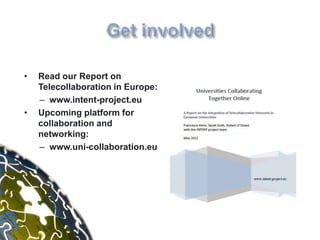
•   Read our Report on
    Telecollaboration in Europe:
    – www.intent-project.eu
•   Upcoming platform for
    collaboration and
    networking:
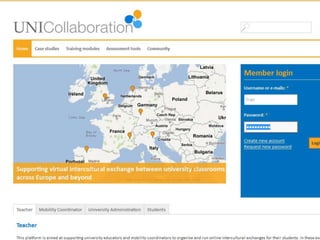
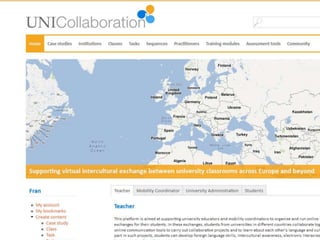
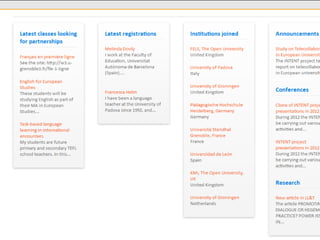
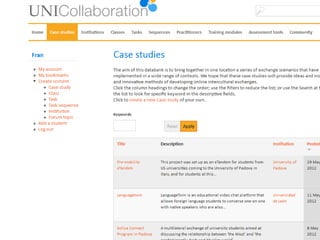
    – www.uni-collaboration.eu
Thank you!

http://www.intent-project.eu
   m.hauck@open.ac.uk
 francesca.helm@unipd.it

The INTENT project

  • 1.
    Integrating Telecollaborative Networksinto Foreign Language Higher Education: The INTENT project Mirjam Hauck, The Open University, UK Francesca Helm, University of Padova, Italy
  • 2.
    Telecollaboration The use ofonline communication tools to bring together classes of language learners in geographically distant locations to develop their > foreign language skills > intercultural competence through collaborative tasks and project work
  • 3.
    The Bologna Process& EHEA • A clearly defined common goal: to create a European space for higher education in order to enhance the employability and mobility of citizens and to increase the international competitiveness of European higher education; • The European Higher Education Area (EHEA) was launched along with the Bologna Process' decade anniversary, in March 2010, during the Budapest- Vienna Ministerial Conference. It is meant to ensure more comparable, compatible and coherent systems of higher education in Europe.
  • 4.
    Mobility and theEHEA Mobility is important for personal development and employability, it fosters respect for diversity and a capacity to deal with other cultures. It encourages linguistic pluralism, thus underpinning the multilingual tradition of the European Higher Education Area and it increases cooperation and competition between higher education institutions In 2020, at least 20% of those graduating in the European Higher Education Area should have had a study or training period abroad. – Communiqué of the Conference of European Ministers Responsible for Higher Education, Leuven and Louvain-la-Neuve, 28-29 April 2009
  • 5.
    „Virtual mobility‟ for the remaining 80%? Virtual mobility, i.e. the use of the internet and other electronic forms of information and communication, is often a catalyst for embarking on a period of physical mobility. Although not a substitute for physical mobility, it does enable young people to prepare a stay abroad and can create conditions for future physical mobility by facilitating friendships, contacts and social networking etc…. – It can also provide an international dimension to those learners who, for different reasons, are not able or willing to go abroad. In that context, ICT can be used for “electronic twinning” …etc. Commission of the European Communities: Green paper: promoting the learning mobility of young people.
  • 6.
    For Students: Developmentof FL competence, intercultural awareness, electronic literacies For University Educators: Opening up of classroom / Authentic communication and project work / Developing international network of collaborators For Mobility Officers: Preparation for physical mobility/ Alternative to physical mobility For University Management: „Low cost‟ internationalisation strategy / Opening up new university partnerships
  • 7.
    Established models ofonline intercultural exchange in Europe and beyond Language learning oriented • eTandem • Cultura Multidisciplinary • eTwinning • the Soliya model
  • 9.
    Telecollaboration … an'add-on' activity in higher education? > lack of pedagogical training for educators > fear of extra work-load (lack of support and resources) > no long-term stability in partnership with other universities > lack of academic credit
  • 10.
    INTENT Integrating Telecollaborative Networks Into Foreign Language Higher Education Financed By The European Commission - Lifelong Learning Programme Co-ordinated by Robert O‟Dowd at the Universidad de Leon, Spain 8 European partners (PH Heidelberg, Grenoble III, Padova, Czestochowa, Groningen, UA Barcelona) October 2011-March 2014
  • 12.
    Products 1. Survey ofHE teachers (practitioners and non-practitioners of telecollaboration) and learners. 2. A Project Website/Virtual Platform, supporting telecollaborative practice, for teachers, learner, administrators and educational policy makers. 3. A Practitioner Databank, containing case studies of telecollaborative exchanges. 4. An E-Portfolio of learner competences developed in telecollaborative exchanges.
  • 13.
    5. A Databankof telecollaborative tasks, with user guidelines 6. A Dissemination strategy and programme, including training workshops for tutors, presentations at conferences and academic publications. 7. An International Conference (Leon, 2014) 8. Project evaluation and testing.
  • 14.
    Online surveys from December 2011 - February 2012 • Language versions: English, German, French and Italian • Three surveys: – Experienced teacher telecollaborators (102 responses) – Inexperienced teacher telecollaborators (108 responses) – Experienced student telecollaborators (131 responses) Responses from 142 universities in 22 countries Qualitative Case studies: 7 representative examples of telecollaboration around Europe Aims: - Identify types of telecollaborative practices undertaken by European university educators - Explore the barriers to telecollaboration and the strategies used to overcome these barriers
  • 15.
  • 17.
    Findings • Most OIEscurrently involve European universities with US universities. • Few foreign language educators find OIE partners through institutional partnerships such as Erasmus. Most are informal contacts made through colleagues and at conferences. • OIEs are strongly believed to have the potential of supporting physical mobility but very few examples of such exchanges were found. • OIEs are generally carried out by highly motivated and dedicated educators who may have experienced OIE as part of their training. • Educators who have had experience of OIE are more likely to repeat it. • The most frequently used tools in OIEs in Europe are email and virtual learning environments, but also high use of audio/video conferencing and rise of social networks
  • 18.
    • Many studentsreported that participating in OIE led them to become more open to others, accepting and understanding of difference and to realise that their own points of view are not necessarily “the best or only ones”. • Telecollaboration can also contribute to educators‟ academic careers, by establishing connections to new academic networks and engaging in staff mobility visits with other universities etc. • Telecollaboration is seen as a useful „first step‟ on the way to developing physical mobility exchanges between institutions. • Most teachers with experience of OIE believe it is a valid alternative to physical mobility for those students who cannot participate in mobility programmes.
  • 19.
    Comments from students “je n'ai pas vraiment vécu la télécollaboration sous l'angle d'une rencontre inter-culturelle, mais d'une rencontre tout court.” • Eine gute Idee, aber nur wenn sie sinnvoll geplant und durchgeführt wird. • Gespräche in Echtzeit fände ich sehr hilfreich und auch spannender für die Teilnehmer. Somit hätte man vielleicht eher die Möglichkeit auch persönliche Gespräche mit den Austauschpartnern zu führen. • I encourage all students to participate in a cultural exchange • I think it was a great idea and experience. I think Skype would be a better way of oral communicating. • I think, it was fine and also, that it would be a necessary part in the degree of people who are learning a foreign language. • I will encourage everyone to participate in exchange programs • Ich denke, dass interkultureller Onlineaustausch besonders für Studierende, die bisher nur wenig interkulturelle Erfahrungen gemacht haben, sinvoll ist. • Ich glaube, dass IOAes sehr eindrucksvoll sein können, aber leider habe ich es nicht erlebt. Ich habe aber Ideen wie ich so eine Onlineaustausch organisieren würde. • Its a useful too. I think that all the foreign language students should use it to realise that studing a language involves more things than studing grammar and phonetics. • Our University should organise more exchanges. • Peut-etre Skype pour communiquer de plus. • Si on organise la télécollaboration je'exigerais comme prof un laps de temps obligatoire pour parler (p.ex. les élèves doivent avoir une conversation pendant une heure par semaine..) • They are so useful for students that they should be compulsory for everyone.
  • 20.
    In your opinion, what are the reasons why telecollaborative exchange is not more popular in university education? • Time necessary to set up and run exchanges – (Mentioned 49/ 98 practitioners) • Difficulties in integration & assessment due to institutional requirements – (Mentioned by 28 / 98 practitioners) • Lack of pedagogical knowledge about how to run and integrate exchanges – (Mentioned by 20/ 98 practitioners) • Teachers lack e-literacies/ required technological knowledge – (Mentioned by 19 / 98 practitioners) • Difficulty in finding appropriate partners – (Mentioned by 9/ 98 practitioners)
  • 21.
    Recommendations •Support the establishmentof online exchanges between European countries in much the same way as they have supported physical mobility •Draw up models of Erasmus agreements specifically for virtual mobility programmes. •Establish European grants for virtual mobility to help cover the organizational costs. •Support the establishment of OIEs for students prior to their period of physical mobility. With the training and support of international office and language centre staff exchanges, these „pre-mobility exchanges‟ could improve the quality of physical mobility by promoting integration of Erasmus students in host universities. •Integrate OIE in teacher education programs as this will encourage future educators to integrate telecollaboration into their practice •Provide incentives and support for educators embarking on their first experience of OIE. •Provide a technical and administrative infrastructure which will support educators in their telecollaborative activity. •Find more systems of awarding credits (ECTS) for students‟ participation in OIEs. Other ways of awarding credit, such as explicit mention of the activity in the European Diploma Supplement, are also worthy of exploration.
  • 25.
    12 10 8 Column 1 6 Column 2 Column 3 4 2 0 Row 1 Row 2 Row 3 Row 4
  • 26.
    Read our Report on Telecollaboration in Europe: – www.intent-project.eu • Upcoming platform for collaboration and networking: – www.uni-collaboration.eu
  • 27.
    Thank you! http://www.intent-project.eu m.hauck@open.ac.uk francesca.helm@unipd.it