ODR and Conflict Transformation Sanjana Hattotuwa Strategic Manager, Info Share UN ODR Conference 5 – 6 July 2004 Melbourne, Australia
Entrée   Dispute Resolution vs. Conflict Transformation Dynamics of Conflict Transformation  ICT and peacebuilding / conflict transformation Challenges for ODR and Conflict Transformation
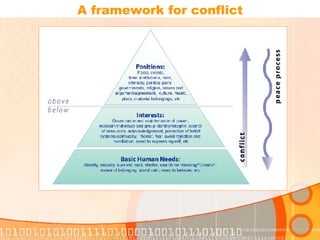
A framework for conflict
Violent Conflict Violent conflict is often not the result of a monocausal event or trigger. Addressing grievances and nurturing reconciliation is a multi-faceted and difficult process. Levels of violence may, perversely, increase (in the short-term to medium term) the closer one is to agreement Agreement itself is no guarantee against the re-emergence of violent conflict.
What is Conflict Transformation? A process of  engaging  with and  transforming  relationships, interests, discourses and, if necessary, the very constitution of society that supports the continuation of violent conflict (Miall, 2003)  CT argues against giving primacy to settlements, stressing the importance of recognising the transformation of conflicts
What is Conflict Transformation? Actors and institutions in a process of conflict transformation interact and co-exist in a vigorous dynamic of interacting interests. Conflict Transformation challenges the perception that dispute resolution rests on an assumption of harmony of interests between actors, and that third party mediators can settle conflicts by appealing to the reason or underlying humanity of the parties’ interests, goals or self-definitions.
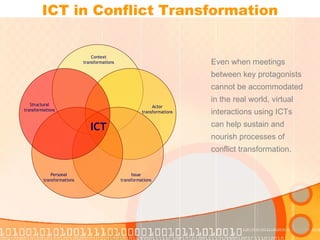
Ways of Transforming Conflict  Miall identifies five key areas by which conflict can be transformed: Context transformations Structural transformation Actor transformations Issue transformations Personal / Elite transformation Transformations = Greater awareness
ICT in Conflict Transformation Even when meetings between key protagonists cannot be accommodated in the real world, virtual interactions using ICTs can help sustain and nourish processes of conflict transformation. Context transformations Actor transformations Issue transformations Personal transformations Structural transformations ICT
Ripe Moment? Ripe moments are not merely the result of historical conditions CT is essentially about the committed and sustained engagement with conflict to  create  ripe moments that in them hold the promise of a stable and just peace, and the transformation of violent armed conflict ICT helps in the creation of ripe moments
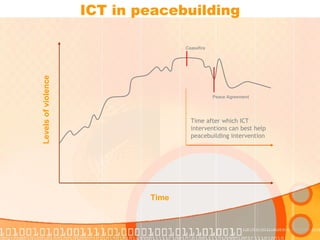
And yet… In Conflict Transformation, the potential for the use of  ICT is augmented  after  a ceasefire agreement or peace agreement when the dynamics on the ground are relatively more receptive on the need for sharing information & collaboration to develop shared solutions.
ICT in peacebuilding Time after which ICT interventions can best help peacebuilding intervention Ceasefire Peace Agreement Levels of violence Time
Just to remind us that… Of the 76 past and online ADR system that were recently analysed by Melissa Conley Tyler and Di Bretherthon Not a single  example / process / system deals with conflict transformation Emphasis on dispute resolution – ODR as online extensions of ADR
Furthermore… ICT and ODR processes within the context of conflict transformation must  nourish the process  of peacebuilding in the search for a just and sustainable peace. The process, and not the final agreement, is the cynosure
Complementarity Online ADR and ICT not a panacea A role limited to complementing interventions by other stakeholders working on the ground to resolve conflict  HOWEVER…
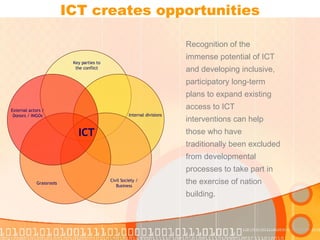
ICT creates opportunities Recognition of the immense potential of ICT and developing inclusive, participatory long-term plans to expand existing access to ICT interventions can help those who have traditionally been excluded from developmental processes to take part in the exercise of nation building. Key parties to the conflict Internal divisions Civil Society / Business Grassroots External actors / Donors / INGOs ICT
Challenges One can identify  five  key challenges for online ODR processes and the use of ICT in Conflict Transformation.
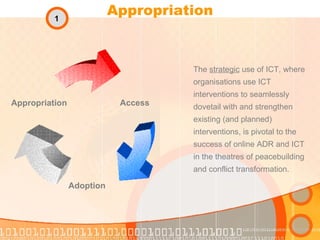
Appropriation The  strategic  use of ICT, where organisations use ICT interventions to seamlessly dovetail with and strengthen existing (and planned) interventions, is pivotal to the success of online ADR and ICT in the theatres of peacebuilding and conflict transformation. Access Adoption Appropriation 1
Uses The emphasis of ICT and ODR should be  self-effacing .  ICT must build social capital, and invest in societal frameworks that empower local communities to grapple with conflict in non-violent ways.  Technology itself should not be the cynosure, but what is achieved through it.  2
Trust As ICT in Conflict Transformation develops, there is a need to develop more effective cultures of collaboration based on  mutually accepted  and  independently verifiable   virtual determinants  of trust. The ability to conduct critical discussions in virtual spaces whilst being assured of the confidentiality of shared content. 3
Funding Models Donors must fully recognise many conflict transformation interventions require  sustained  funding that is independent from and not contingent upon the overall progress of a peace process. It would be severely detrimental to a peace process if ODR processes and systems kept appearing and disappearing overnight. 4
Structural Problems Inadequate vernacular content / interface Lack of Internet connectivity / infrastructure / bandwidth Lack of human resources A pervasive and incipient culture of secrecy, with the abysmal levels of mutual trust  Intricacies of ethno-political conflict 5
One other little problem… The Western liberal mindset. A wondrous creation, but sometimes comprehensively detrimental to Conflict Transformation. ‘ Doing good’ is NOT value neutral !
Info Share www.info-share.org
Overarching Goal Build the capacity of government, political stakeholders and civil society organizations to value and engage all stakeholders in an increasingly unified  peace process effort.
Info Share Overview Multi-Stakeholder Engagement : helping policy makers and political stakeholders building an inclusive peace process  Informed Communication :  Getting concrete information to policy makers on stakeholder concerns and aspirations for the peace process  Developing Capacity : Building a sustainable infrastructure for the exchange of information between stakeholders and policy makers
Final Thoughts At the end of the day, computers and technology don’t create just and lasing peace.  Technology can only augment peacebuilding - we make peace between ourselves and within ourselves.  ICT is at best a powerful catalyst that aids change. People make the difference.
Thank you ! Sanjana Hattotuwa Strategic Manager, Info Share [email_address] +61 - 409636073

ODR and Conflict Transformation

  • 1.
    ODR and ConflictTransformation Sanjana Hattotuwa Strategic Manager, Info Share UN ODR Conference 5 – 6 July 2004 Melbourne, Australia
  • 2.
    Entrée Dispute Resolution vs. Conflict Transformation Dynamics of Conflict Transformation ICT and peacebuilding / conflict transformation Challenges for ODR and Conflict Transformation
  • 3.
  • 4.
    Violent Conflict Violentconflict is often not the result of a monocausal event or trigger. Addressing grievances and nurturing reconciliation is a multi-faceted and difficult process. Levels of violence may, perversely, increase (in the short-term to medium term) the closer one is to agreement Agreement itself is no guarantee against the re-emergence of violent conflict.
  • 5.
    What is ConflictTransformation? A process of engaging with and transforming relationships, interests, discourses and, if necessary, the very constitution of society that supports the continuation of violent conflict (Miall, 2003) CT argues against giving primacy to settlements, stressing the importance of recognising the transformation of conflicts
  • 6.
    What is ConflictTransformation? Actors and institutions in a process of conflict transformation interact and co-exist in a vigorous dynamic of interacting interests. Conflict Transformation challenges the perception that dispute resolution rests on an assumption of harmony of interests between actors, and that third party mediators can settle conflicts by appealing to the reason or underlying humanity of the parties’ interests, goals or self-definitions.
  • 7.
    Ways of TransformingConflict Miall identifies five key areas by which conflict can be transformed: Context transformations Structural transformation Actor transformations Issue transformations Personal / Elite transformation Transformations = Greater awareness
  • 8.
    ICT in ConflictTransformation Even when meetings between key protagonists cannot be accommodated in the real world, virtual interactions using ICTs can help sustain and nourish processes of conflict transformation. Context transformations Actor transformations Issue transformations Personal transformations Structural transformations ICT
  • 9.
    Ripe Moment? Ripemoments are not merely the result of historical conditions CT is essentially about the committed and sustained engagement with conflict to create ripe moments that in them hold the promise of a stable and just peace, and the transformation of violent armed conflict ICT helps in the creation of ripe moments
  • 10.
    And yet… InConflict Transformation, the potential for the use of ICT is augmented after a ceasefire agreement or peace agreement when the dynamics on the ground are relatively more receptive on the need for sharing information & collaboration to develop shared solutions.
  • 11.
    ICT in peacebuildingTime after which ICT interventions can best help peacebuilding intervention Ceasefire Peace Agreement Levels of violence Time
  • 12.
    Just to remindus that… Of the 76 past and online ADR system that were recently analysed by Melissa Conley Tyler and Di Bretherthon Not a single example / process / system deals with conflict transformation Emphasis on dispute resolution – ODR as online extensions of ADR
  • 13.
    Furthermore… ICT andODR processes within the context of conflict transformation must nourish the process of peacebuilding in the search for a just and sustainable peace. The process, and not the final agreement, is the cynosure
  • 14.
    Complementarity Online ADRand ICT not a panacea A role limited to complementing interventions by other stakeholders working on the ground to resolve conflict HOWEVER…
  • 15.
    ICT creates opportunitiesRecognition of the immense potential of ICT and developing inclusive, participatory long-term plans to expand existing access to ICT interventions can help those who have traditionally been excluded from developmental processes to take part in the exercise of nation building. Key parties to the conflict Internal divisions Civil Society / Business Grassroots External actors / Donors / INGOs ICT
  • 16.
    Challenges One canidentify five key challenges for online ODR processes and the use of ICT in Conflict Transformation.
  • 17.
    Appropriation The strategic use of ICT, where organisations use ICT interventions to seamlessly dovetail with and strengthen existing (and planned) interventions, is pivotal to the success of online ADR and ICT in the theatres of peacebuilding and conflict transformation. Access Adoption Appropriation 1
  • 18.
    Uses The emphasisof ICT and ODR should be self-effacing . ICT must build social capital, and invest in societal frameworks that empower local communities to grapple with conflict in non-violent ways. Technology itself should not be the cynosure, but what is achieved through it. 2
  • 19.
    Trust As ICTin Conflict Transformation develops, there is a need to develop more effective cultures of collaboration based on mutually accepted and independently verifiable virtual determinants of trust. The ability to conduct critical discussions in virtual spaces whilst being assured of the confidentiality of shared content. 3
  • 20.
    Funding Models Donorsmust fully recognise many conflict transformation interventions require sustained funding that is independent from and not contingent upon the overall progress of a peace process. It would be severely detrimental to a peace process if ODR processes and systems kept appearing and disappearing overnight. 4
  • 21.
    Structural Problems Inadequatevernacular content / interface Lack of Internet connectivity / infrastructure / bandwidth Lack of human resources A pervasive and incipient culture of secrecy, with the abysmal levels of mutual trust Intricacies of ethno-political conflict 5
  • 22.
    One other littleproblem… The Western liberal mindset. A wondrous creation, but sometimes comprehensively detrimental to Conflict Transformation. ‘ Doing good’ is NOT value neutral !
  • 23.
  • 24.
    Overarching Goal Buildthe capacity of government, political stakeholders and civil society organizations to value and engage all stakeholders in an increasingly unified peace process effort.
  • 25.
    Info Share OverviewMulti-Stakeholder Engagement : helping policy makers and political stakeholders building an inclusive peace process Informed Communication : Getting concrete information to policy makers on stakeholder concerns and aspirations for the peace process Developing Capacity : Building a sustainable infrastructure for the exchange of information between stakeholders and policy makers
  • 26.
    Final Thoughts Atthe end of the day, computers and technology don’t create just and lasing peace. Technology can only augment peacebuilding - we make peace between ourselves and within ourselves. ICT is at best a powerful catalyst that aids change. People make the difference.
  • 27.
    Thank you !Sanjana Hattotuwa Strategic Manager, Info Share [email_address] +61 - 409636073