NATURE ,
EVOLUTION AND
ANALYTICAL VIEW
OF INTERNATIONAL
RELATIONS
AAKRITI VERMA
INTERNATIONAL
RELATIONS
 International Relations was introduced
officially in 1919 and the subject has
changed in the context and nature rapidly.
International Relations gained popularity
and grew rapidly during 19 & 20 Century.
International Relation is a condition as well
as a field of study.
It can be considered as a study of Global
State System, Study of Global conflict,
violence and war, terrorism etc.
NATURE
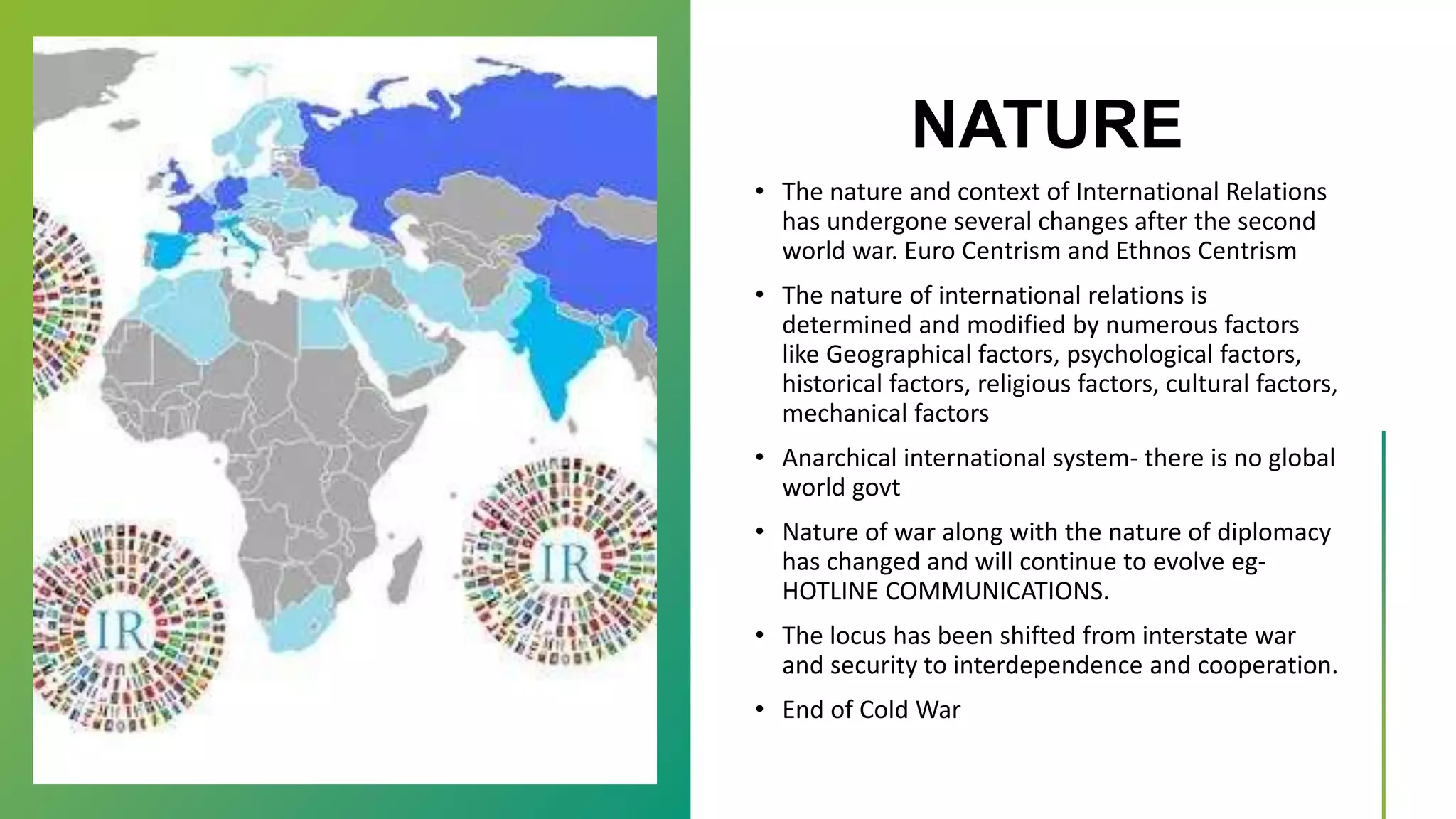
• The nature and context of International Relations
has undergone several changes after the second
world war. Euro Centrism and Ethnos Centrism
• The nature of international relations is
determined and modified by numerous factors
like Geographical factors, psychological factors,
historical factors, religious factors, cultural factors,
mechanical factors
• Anarchical international system- there is no global
world govt
• Nature of war along with the nature of diplomacy
has changed and will continue to evolve eg-
HOTLINE COMMUNICATIONS.
• The locus has been shifted from interstate war
and security to interdependence and cooperation.
• End of Cold War
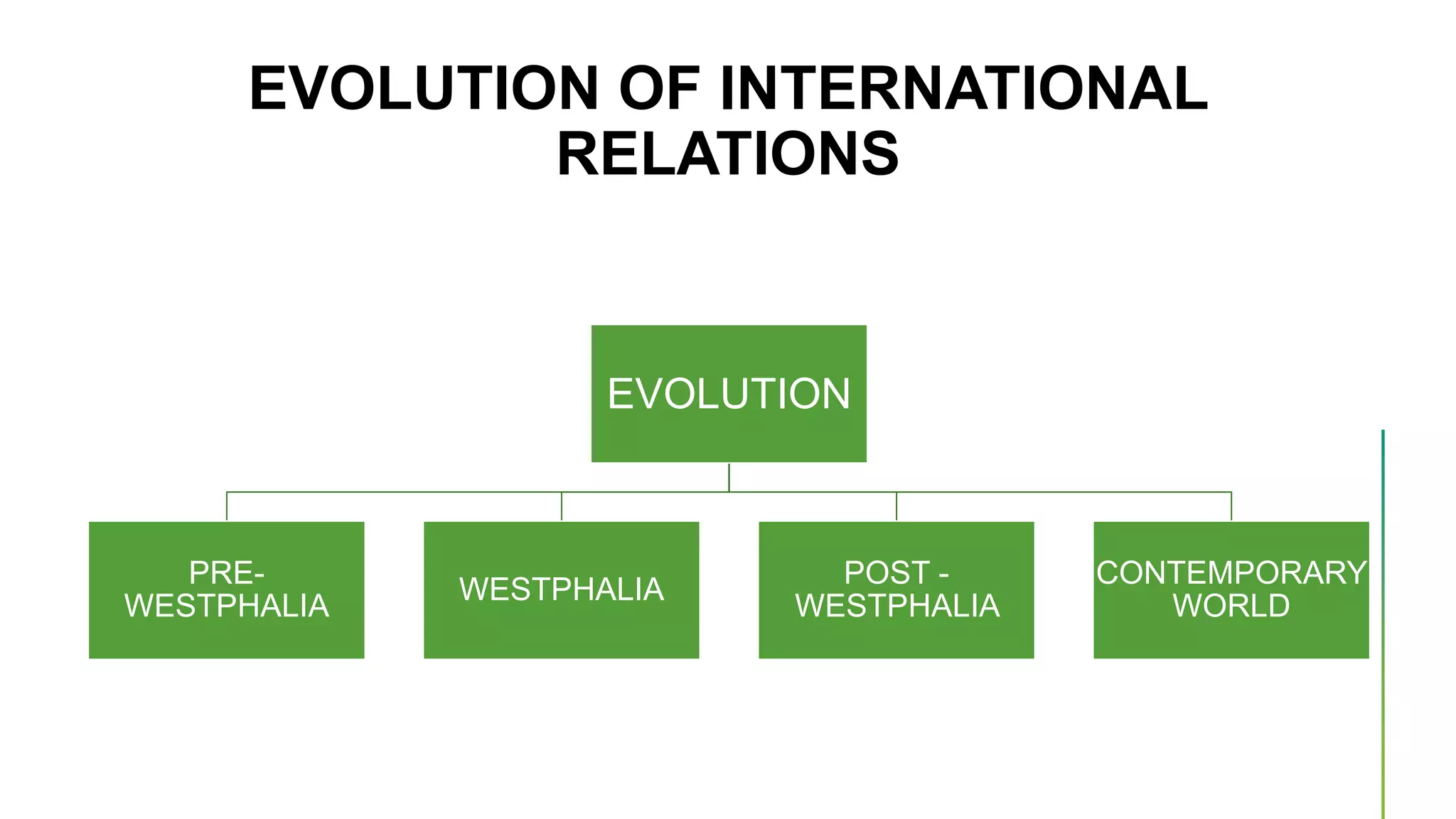
EVOLUTION OF INTERNATIONAL
RELATIONS
EVOLUTION
PRE-
WESTPHALIA
WESTPHALIA
POST -
WESTPHALIA
CONTEMPORARY
WORLD
ANALYTICAL
VIEW
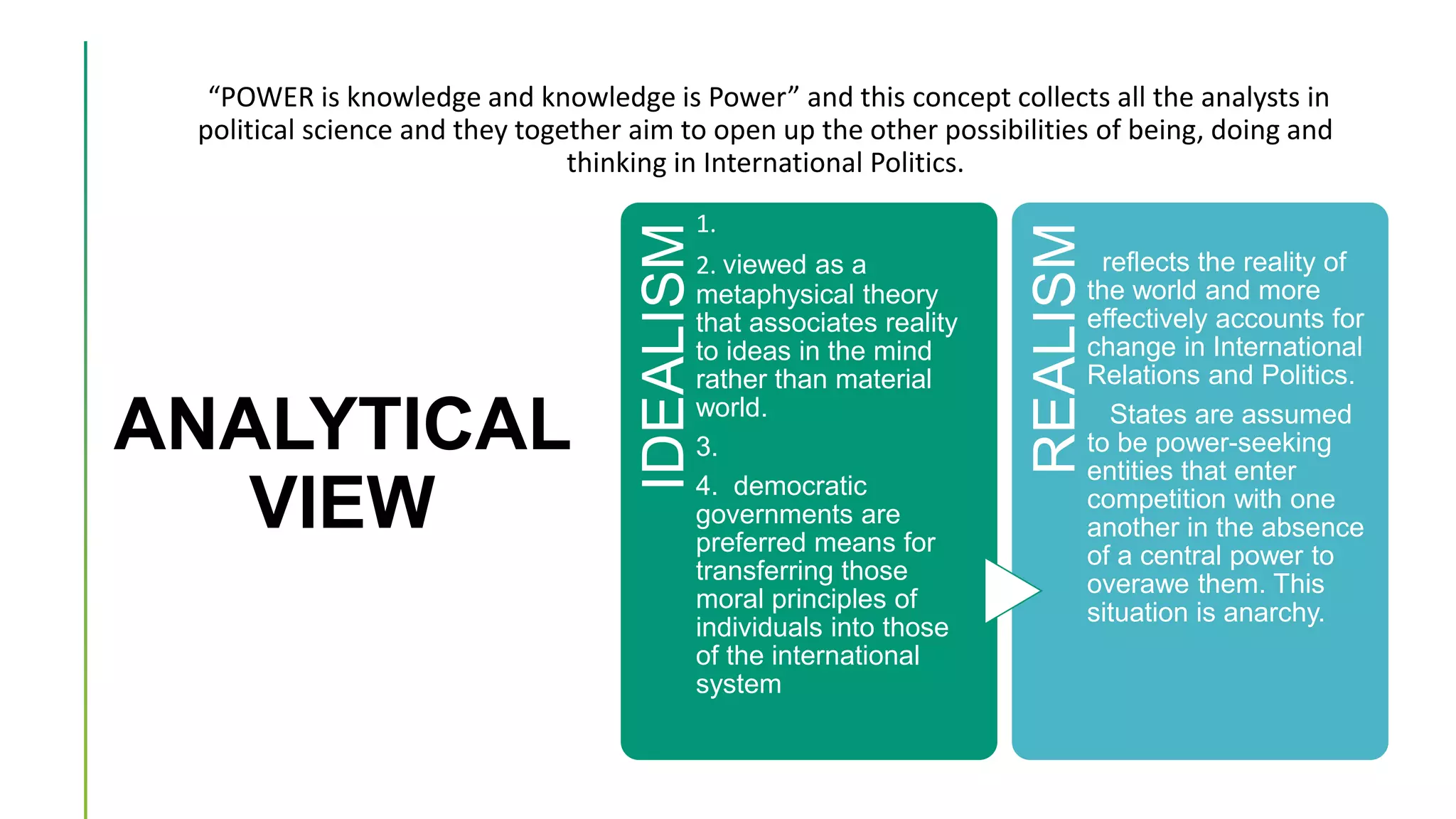
“POWER is knowledge and knowledge is Power” and this concept collects all the analysts in
political science and they together aim to open up the other possibilities of being, doing and
thinking in International Politics.
IDEALISM
1.
2. viewed as a
metaphysical theory
that associates reality
to ideas in the mind
rather than material
world.
3.
4. democratic
governments are
preferred means for
transferring those
moral principles of
individuals into those
of the international
system
REALISM
reflects the reality of
the world and more
effectively accounts for
change in International
Relations and Politics.
States are assumed
to be power-seeking
entities that enter
competition with one
another in the absence
of a central power to
overawe them. This
situation is anarchy.
THANK YOU

Introduction to International Relations.

  • 1.
    NATURE , EVOLUTION AND ANALYTICALVIEW OF INTERNATIONAL RELATIONS AAKRITI VERMA
  • 2.
    INTERNATIONAL RELATIONS  International Relationswas introduced officially in 1919 and the subject has changed in the context and nature rapidly. International Relations gained popularity and grew rapidly during 19 & 20 Century. International Relation is a condition as well as a field of study. It can be considered as a study of Global State System, Study of Global conflict, violence and war, terrorism etc.
  • 3.
    NATURE • The natureand context of International Relations has undergone several changes after the second world war. Euro Centrism and Ethnos Centrism • The nature of international relations is determined and modified by numerous factors like Geographical factors, psychological factors, historical factors, religious factors, cultural factors, mechanical factors • Anarchical international system- there is no global world govt • Nature of war along with the nature of diplomacy has changed and will continue to evolve eg- HOTLINE COMMUNICATIONS. • The locus has been shifted from interstate war and security to interdependence and cooperation. • End of Cold War
  • 4.
  • 5.
    ANALYTICAL VIEW “POWER is knowledgeand knowledge is Power” and this concept collects all the analysts in political science and they together aim to open up the other possibilities of being, doing and thinking in International Politics. IDEALISM 1. 2. viewed as a metaphysical theory that associates reality to ideas in the mind rather than material world. 3. 4. democratic governments are preferred means for transferring those moral principles of individuals into those of the international system REALISM reflects the reality of the world and more effectively accounts for change in International Relations and Politics. States are assumed to be power-seeking entities that enter competition with one another in the absence of a central power to overawe them. This situation is anarchy.
  • 6.