An Institutional Explanation of the
Democratic Peace
Bruce Bueno de Mesquita (1999)
James D.Morrow
Randolph M. Siverson
Alastair Smith
Domestic Politics in International Relations Frederic BlesesKonstanz, 16.01.2012
Frederic Bleses
An Institutional Explanation of the Democratic Peace
Table of Content:
1. Introduction: Democratic Peace and its empirical regularities
2. The Debate: Normative and institutional explanations
3. Game Theoretical Approach
4. Critique and Categorization
Domestic Politics in International Relations Konstanz, 16.01.2012
The Democratic Peace – Theory:
Assumption:
Separation of Powers, Representative Systems
And Rule of Law → Foundations for Peace
Democracies fulfill these requirements the best
→ No War in a Democratic World
Frederic Bleses
An Institutional Explanation of the Democratic Peace
1. Introduction 2. The Debate 3. Game Theoretical Approach 4. Critique
Konstanz, 16.01.2012
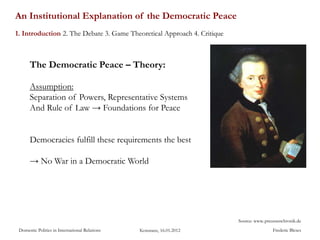
Source: www..preussenchronik.de
Domestic Politics in International Relations
The Democratic Peace – Theory:
Empirical Findings:
1. There is (usually) no war between Democracies
But
2. Democracies fight (almost) as often as Autocracies
→ Democracies are not less hostile in general
Frederic Bleses
An Institutional Explanation of the Democratic Peace
1. Introduction 2. The Debate 3. Game Theoretical Approach 4. Critique
Domestic Politics in International Relations Konstanz, 16.01.2012
The Democratic Peace – Theory: Empirical Regularities
1. Democracies are nearly immune from wars with one another (Maoz/Russet)
2. Democracies are not all immune from fighting wars with nondemocracies
(Maoz, Abdoliali)
3. Democracies win a bigger share of the wars they fight (Lake/Raiter, Stam)
4. Democratic dyads chose more peaceful processes of dispute settlement then
other pairings of states (Brecher, Wilkenfeld/Dixon/Mousseau/Raymond)
5. Democracies are more likely to initiate wars against autocracies than are
autocracies against democracies (Bennett, Stam)
6. Democratic states pay fewer costs in terms of human life and fight shorter than
nondemocratic states (Bennett, Stam/ Siverson)
7. Transitional Democracies are more likely to fight than stable regimes (Mansfiels,
Snyder)
8. Larger Democracies seem more constrained to avoid wars than smaller ones
(Morgan, Campbell)
Frederic Bleses
An Institutional Explanation of the Democratic Peace
1. Introduction 2. The Debate 3. Game Theoretical Approach 4. Critique
Domestic Politics in International Relations Konstanz, 16.01.2012
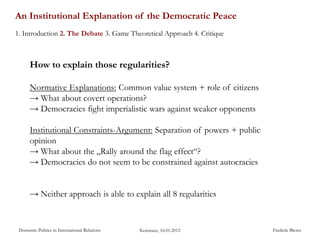
How to explain those regularities?
Normative Explanations: Common value system + role of citizens
→ What about covert operations?
→ Democracies fight imperialistic wars against weaker opponents
Institutional Constraints-Argument: Separation of powers + public
opinion
→ What about the „Rally around the flag effect“?
→ Democracies do not seem to be constrained against autocracies
→ Neither approach is able to explain all 8 regularities
Frederic Bleses
An Institutional Explanation of the Democratic Peace
1. Introduction 2. The Debate 3. Game Theoretical Approach 4. Critique
Domestic Politics in International Relations Konstanz, 16.01.2012
Mesquita's Game: All political leaders desire to remain in office
→ no normative assumptions
→ just different institutional game-sets
A political leader:
- seeks reelection (Output)
- has a limited amount of resources (Input)
The population seeks resources (R) and consists of:
- The selectorate (S)
- The Winning Coalition (W) = part of selectorate which decides
over reelection
Frederic Bleses
An Institutional Explanation of the Democratic Peace
1. Introduction 2. The Debate 3. Game Theoretical Approach 4. Critique
Domestic Politics in International Relations Konstanz, 16.01.2012
Mesquita's Game: What can a leader do?
Spend resources on:
- Public Goods (f.e. Defense spending) → War Resources
- Private Goods (f.e. Benefits for his supporters) → Winning
Coalition
When does he spend it on War?
The share he gives to each member of the Winning Coalition is
R/W
→ the smaller W (Winning Coalition), the bigger the effect of
Private Goods
→ the bigger W, the more important Public Goods get
Frederic Bleses
An Institutional Explanation of the Democratic Peace
1. Introduction 2. The Debate 3. Game Theoretical Approach 4. Critique
Domestic Politics in International Relations Konstanz, 16.01.2012
Mesquita's Game: How do institutions matter?
Democracy: S = large (Voting Population)
W = large (Majority of S)
→ R/W is small → Less spending on Private Goods
→ More spending on Public Goods (Defense)
Autocracy: S can be large or small (rigged elections)
W is always small
→ R/W is large → More spending on Private Goods
→ Less spending on Public Goods
Frederic Bleses
An Institutional Explanation of the Democratic Peace
1. Introduction 2. The Debate 3. Game Theoretical Approach 4. Critique
Domestic Politics in International Relations Konstanz, 16.01.2012
Mesquita's Game: How to stay in office / satisfy the Winning Coalition?
Frederic Bleses
An Institutional Explanation of the Democratic Peace
1. Introduction 2. The Debate 3. Game Theoretical Approach 4. Critique
Democracy Autocracy
Winning Coalition Large Small
Public Goods Large Impact Marginal Impact
Private Goods Marginal Impact Large Impact
→ The larger W, the more important is success in Public Policy (War)
→ Democratic leaders usually do not „survive“ military defeat because
they can not buy their Winning Coalition off (like autocrats)
→ Democratic leaders allocate more resources on war effort in two ways
Domestic Politics in International Relations Konstanz, 16.01.2012
Mesquita's Game: What's the conclusion?
Democratic leaders require large winning coalitions
→ they spend more on Public Goods
→ they try harder in wars → use of all available resources
Democratic leaders can not buy their winning coalition off
→ they have to succeed in Public Policy (War)
→ they only fight if they anticipate victory
→ Democracies chose their wars (and opponents) carefully and
try everything to win
→ „Mechanism of Deterrence“
Frederic Bleses
An Institutional Explanation of the Democratic Peace
1. Introduction 2. The Debate 3. Game Theoretical Approach 4. Critique
Domestic Politics in International Relations Konstanz, 16.01.2012
Mesquita's Game: What's the conclusion?
- War between democracies is not impossible
- The conditions under which a democrat will attack another democrat are
more restrictive than the conditions under which a democrat will attack an
autocrat
- Autocrats always are the more attractive targets
- If a democratic leader has a unsuccessful domestic policy, he is likely to
wage war, also against another democrat („Gambling for Ressurection“)
Frederic Bleses
An Institutional Explanation of the Democratic Peace
1. Introduction 2. The Debate 3. Game Theoretical Approach 4. Critique
Domestic Politics in International Relations Konstanz, 16.01.2012
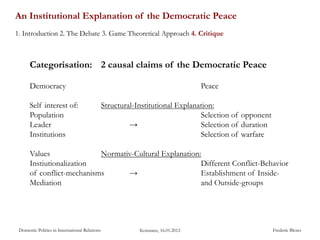
Categorisation: 2 causal claims of the Democratic Peace
Democracy Peace
Self interest of: Structural-Institutional Explanation:
Population Selection of opponent
Leader → Selection of duration
Institutions Selection of warfare
Values Normativ-Cultural Explanation:
Instiutionalization Different Conflict-Behavior
of conflict-mechanisms → Establishment of Inside-
Mediation and Outside-groups
Frederic Bleses
An Institutional Explanation of the Democratic Peace
1. Introduction 2. The Debate 3. Game Theoretical Approach 4. Critique
Domestic Politics in International Relations Konstanz, 16.01.2012
How successful is Mesquita in explaining the empirical
phenomenon?
- no assumption of superior motives or greater civic mindedness of
one kind of leader over another
-the explanation is driven purely by self-interested leaders who seek
to retain in office and face alternative institutional arrangements
- 8 regularities?
Frederic Bleses
An Institutional Explanation of the Democratic Peace
1. Introduction 2. The Debate 3. Game Theoretical Approach 4. Critique
Domestic Politics in International Relations Konstanz, 16.01.2012
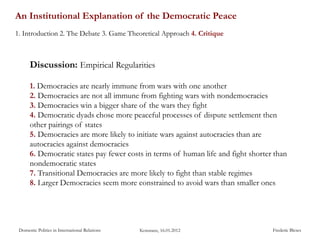
Discussion: Empirical Regularities
1. Democracies are nearly immune from wars with one another
2. Democracies are not all immune from fighting wars with nondemocracies
3. Democracies win a bigger share of the wars they fight
4. Democratic dyads chose more peaceful processes of dispute settlement then
other pairings of states
5. Democracies are more likely to initiate wars against autocracies than are
autocracies against democracies
6. Democratic states pay fewer costs in terms of human life and fight shorter than
nondemocratic states
7. Transitional Democracies are more likely to fight than stable regimes
8. Larger Democracies seem more constrained to avoid wars than smaller ones
Frederic Bleses
An Institutional Explanation of the Democratic Peace
1. Introduction 2. The Debate 3. Game Theoretical Approach 4. Critique
Konstanz, 16.01.2012Domestic Politics in International Relations

Democratic Peace

  • 1.
    An Institutional Explanationof the Democratic Peace Bruce Bueno de Mesquita (1999) James D.Morrow Randolph M. Siverson Alastair Smith Domestic Politics in International Relations Frederic BlesesKonstanz, 16.01.2012
  • 2.
    Frederic Bleses An InstitutionalExplanation of the Democratic Peace Table of Content: 1. Introduction: Democratic Peace and its empirical regularities 2. The Debate: Normative and institutional explanations 3. Game Theoretical Approach 4. Critique and Categorization Domestic Politics in International Relations Konstanz, 16.01.2012
  • 3.
    The Democratic Peace– Theory: Assumption: Separation of Powers, Representative Systems And Rule of Law → Foundations for Peace Democracies fulfill these requirements the best → No War in a Democratic World Frederic Bleses An Institutional Explanation of the Democratic Peace 1. Introduction 2. The Debate 3. Game Theoretical Approach 4. Critique Konstanz, 16.01.2012 Source: www..preussenchronik.de Domestic Politics in International Relations
  • 4.
    The Democratic Peace– Theory: Empirical Findings: 1. There is (usually) no war between Democracies But 2. Democracies fight (almost) as often as Autocracies → Democracies are not less hostile in general Frederic Bleses An Institutional Explanation of the Democratic Peace 1. Introduction 2. The Debate 3. Game Theoretical Approach 4. Critique Domestic Politics in International Relations Konstanz, 16.01.2012
  • 5.
    The Democratic Peace– Theory: Empirical Regularities 1. Democracies are nearly immune from wars with one another (Maoz/Russet) 2. Democracies are not all immune from fighting wars with nondemocracies (Maoz, Abdoliali) 3. Democracies win a bigger share of the wars they fight (Lake/Raiter, Stam) 4. Democratic dyads chose more peaceful processes of dispute settlement then other pairings of states (Brecher, Wilkenfeld/Dixon/Mousseau/Raymond) 5. Democracies are more likely to initiate wars against autocracies than are autocracies against democracies (Bennett, Stam) 6. Democratic states pay fewer costs in terms of human life and fight shorter than nondemocratic states (Bennett, Stam/ Siverson) 7. Transitional Democracies are more likely to fight than stable regimes (Mansfiels, Snyder) 8. Larger Democracies seem more constrained to avoid wars than smaller ones (Morgan, Campbell) Frederic Bleses An Institutional Explanation of the Democratic Peace 1. Introduction 2. The Debate 3. Game Theoretical Approach 4. Critique Domestic Politics in International Relations Konstanz, 16.01.2012
  • 6.
    How to explainthose regularities? Normative Explanations: Common value system + role of citizens → What about covert operations? → Democracies fight imperialistic wars against weaker opponents Institutional Constraints-Argument: Separation of powers + public opinion → What about the „Rally around the flag effect“? → Democracies do not seem to be constrained against autocracies → Neither approach is able to explain all 8 regularities Frederic Bleses An Institutional Explanation of the Democratic Peace 1. Introduction 2. The Debate 3. Game Theoretical Approach 4. Critique Domestic Politics in International Relations Konstanz, 16.01.2012
  • 7.
    Mesquita's Game: Allpolitical leaders desire to remain in office → no normative assumptions → just different institutional game-sets A political leader: - seeks reelection (Output) - has a limited amount of resources (Input) The population seeks resources (R) and consists of: - The selectorate (S) - The Winning Coalition (W) = part of selectorate which decides over reelection Frederic Bleses An Institutional Explanation of the Democratic Peace 1. Introduction 2. The Debate 3. Game Theoretical Approach 4. Critique Domestic Politics in International Relations Konstanz, 16.01.2012
  • 8.
    Mesquita's Game: Whatcan a leader do? Spend resources on: - Public Goods (f.e. Defense spending) → War Resources - Private Goods (f.e. Benefits for his supporters) → Winning Coalition When does he spend it on War? The share he gives to each member of the Winning Coalition is R/W → the smaller W (Winning Coalition), the bigger the effect of Private Goods → the bigger W, the more important Public Goods get Frederic Bleses An Institutional Explanation of the Democratic Peace 1. Introduction 2. The Debate 3. Game Theoretical Approach 4. Critique Domestic Politics in International Relations Konstanz, 16.01.2012
  • 9.
    Mesquita's Game: Howdo institutions matter? Democracy: S = large (Voting Population) W = large (Majority of S) → R/W is small → Less spending on Private Goods → More spending on Public Goods (Defense) Autocracy: S can be large or small (rigged elections) W is always small → R/W is large → More spending on Private Goods → Less spending on Public Goods Frederic Bleses An Institutional Explanation of the Democratic Peace 1. Introduction 2. The Debate 3. Game Theoretical Approach 4. Critique Domestic Politics in International Relations Konstanz, 16.01.2012
  • 10.
    Mesquita's Game: Howto stay in office / satisfy the Winning Coalition? Frederic Bleses An Institutional Explanation of the Democratic Peace 1. Introduction 2. The Debate 3. Game Theoretical Approach 4. Critique Democracy Autocracy Winning Coalition Large Small Public Goods Large Impact Marginal Impact Private Goods Marginal Impact Large Impact → The larger W, the more important is success in Public Policy (War) → Democratic leaders usually do not „survive“ military defeat because they can not buy their Winning Coalition off (like autocrats) → Democratic leaders allocate more resources on war effort in two ways Domestic Politics in International Relations Konstanz, 16.01.2012
  • 11.
    Mesquita's Game: What'sthe conclusion? Democratic leaders require large winning coalitions → they spend more on Public Goods → they try harder in wars → use of all available resources Democratic leaders can not buy their winning coalition off → they have to succeed in Public Policy (War) → they only fight if they anticipate victory → Democracies chose their wars (and opponents) carefully and try everything to win → „Mechanism of Deterrence“ Frederic Bleses An Institutional Explanation of the Democratic Peace 1. Introduction 2. The Debate 3. Game Theoretical Approach 4. Critique Domestic Politics in International Relations Konstanz, 16.01.2012
  • 12.
    Mesquita's Game: What'sthe conclusion? - War between democracies is not impossible - The conditions under which a democrat will attack another democrat are more restrictive than the conditions under which a democrat will attack an autocrat - Autocrats always are the more attractive targets - If a democratic leader has a unsuccessful domestic policy, he is likely to wage war, also against another democrat („Gambling for Ressurection“) Frederic Bleses An Institutional Explanation of the Democratic Peace 1. Introduction 2. The Debate 3. Game Theoretical Approach 4. Critique Domestic Politics in International Relations Konstanz, 16.01.2012
  • 13.
    Categorisation: 2 causalclaims of the Democratic Peace Democracy Peace Self interest of: Structural-Institutional Explanation: Population Selection of opponent Leader → Selection of duration Institutions Selection of warfare Values Normativ-Cultural Explanation: Instiutionalization Different Conflict-Behavior of conflict-mechanisms → Establishment of Inside- Mediation and Outside-groups Frederic Bleses An Institutional Explanation of the Democratic Peace 1. Introduction 2. The Debate 3. Game Theoretical Approach 4. Critique Domestic Politics in International Relations Konstanz, 16.01.2012
  • 14.
    How successful isMesquita in explaining the empirical phenomenon? - no assumption of superior motives or greater civic mindedness of one kind of leader over another -the explanation is driven purely by self-interested leaders who seek to retain in office and face alternative institutional arrangements - 8 regularities? Frederic Bleses An Institutional Explanation of the Democratic Peace 1. Introduction 2. The Debate 3. Game Theoretical Approach 4. Critique Domestic Politics in International Relations Konstanz, 16.01.2012
  • 15.
    Discussion: Empirical Regularities 1.Democracies are nearly immune from wars with one another 2. Democracies are not all immune from fighting wars with nondemocracies 3. Democracies win a bigger share of the wars they fight 4. Democratic dyads chose more peaceful processes of dispute settlement then other pairings of states 5. Democracies are more likely to initiate wars against autocracies than are autocracies against democracies 6. Democratic states pay fewer costs in terms of human life and fight shorter than nondemocratic states 7. Transitional Democracies are more likely to fight than stable regimes 8. Larger Democracies seem more constrained to avoid wars than smaller ones Frederic Bleses An Institutional Explanation of the Democratic Peace 1. Introduction 2. The Debate 3. Game Theoretical Approach 4. Critique Konstanz, 16.01.2012Domestic Politics in International Relations