
Technology for Peacebuilding Sanjana Hattotuwa
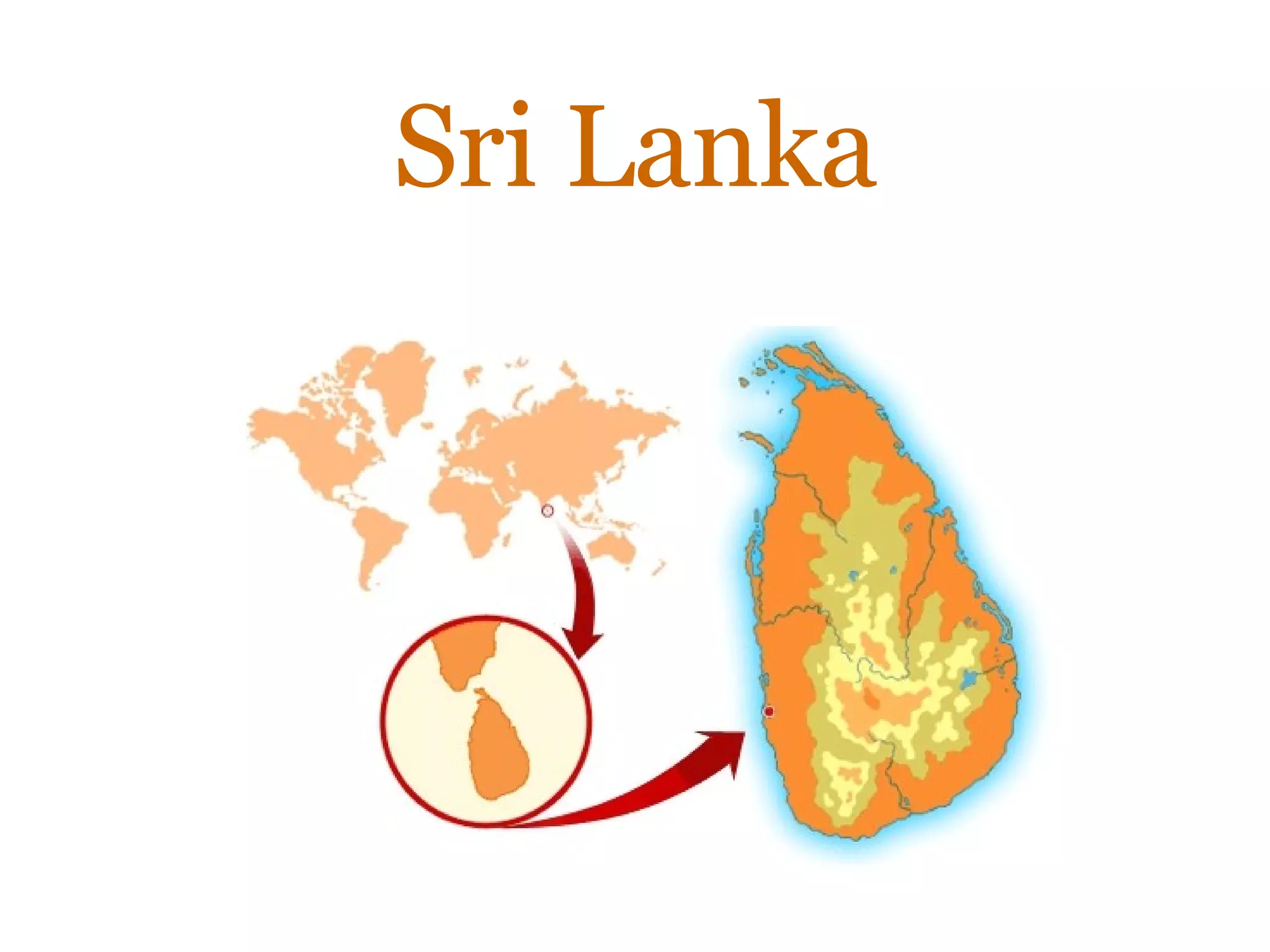
Sri Lanka
Dispute Resolution / Conflict Transformation A process of  engaging with and transforming relationships , interests, discourses and, if necessary, the very constitution of society that supports the continuation of violent conflict CT argues against giving  primacy to settlements Conflict is never resolved, but transformed to the  non-violent negotiation  of differences
 
Challenges One can identify  four  key challenges in the use of ICT for Conflict Transformation.
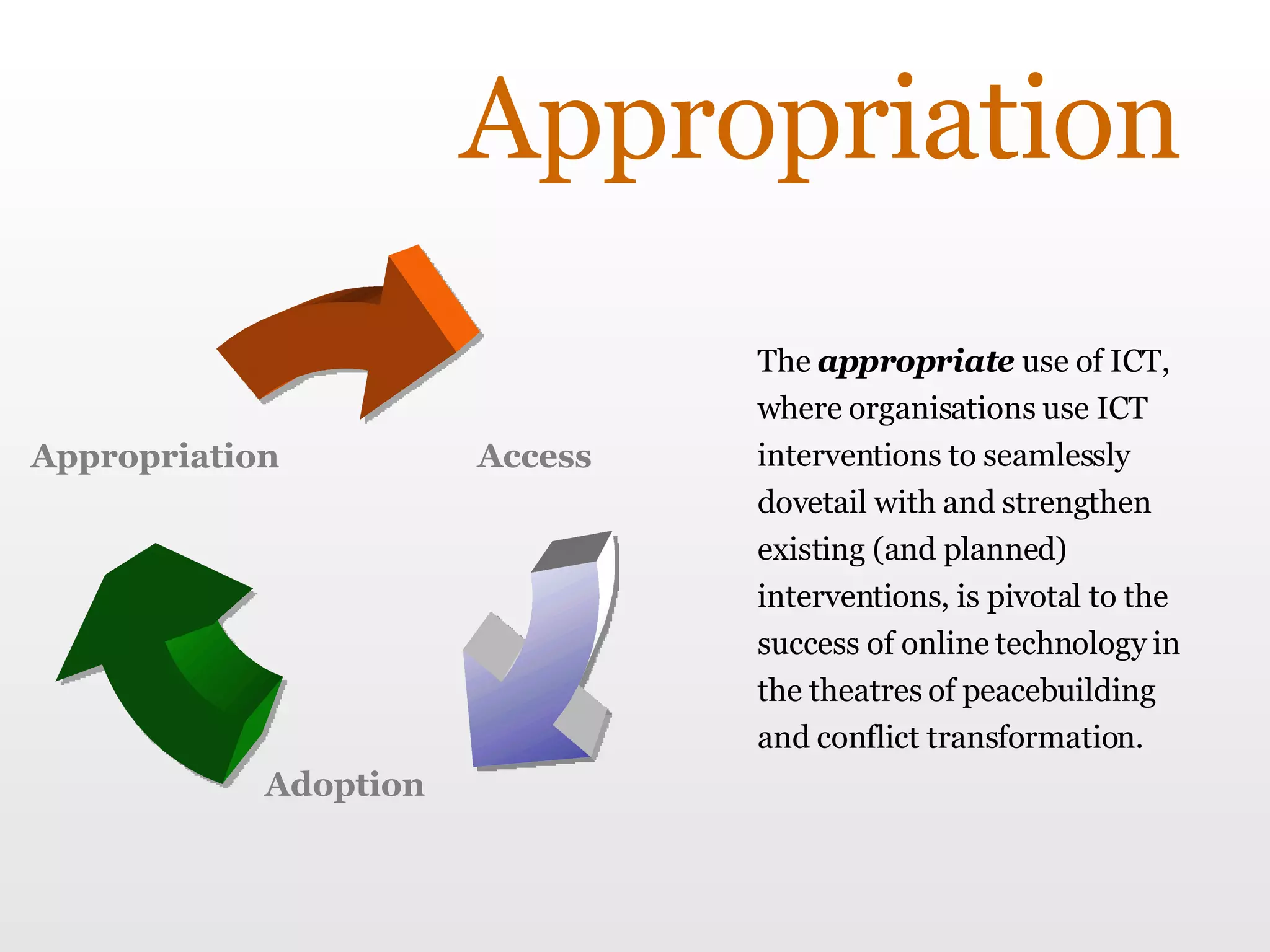
Appropriation The  appropriate  use of ICT, where organisations use ICT interventions to seamlessly dovetail with and strengthen existing (and planned) interventions, is pivotal to the success of online technology in the theatres of peacebuilding and conflict transformation. Access Adoption Appropriation
Uses ICT in peacebuilding needs to be  self-effacing .  ICT must build social capital, and invest in societal frameworks that empower local communities to grapple with conflict in non-violent ways.  Technology itself should not be the cynosure, but what is achieved through it.
Trust As ICT in Conflict Transformation develops, there is a need to develop more effective cultures of collaboration based on  mutually accepted  and  independently verifiable virtual determinants  of trust. The ability to conduct critical discussions in virtual spaces whilst being assured of the confidentiality of shared content.
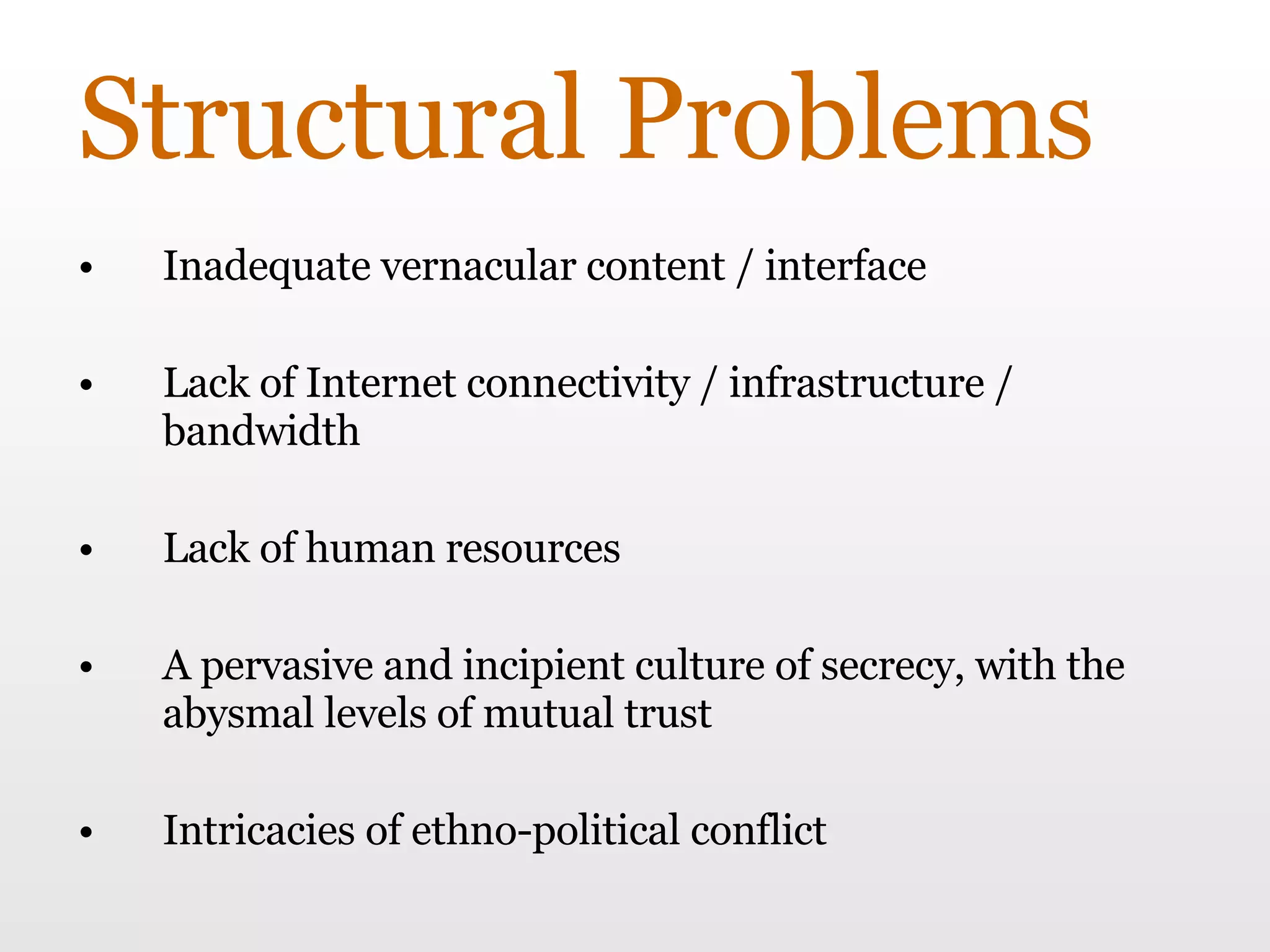
Structural Problems Inadequate vernacular content / interface Lack of Internet connectivity / infrastructure / bandwidth Lack of human resources A pervasive and incipient culture of secrecy, with the abysmal levels of mutual trust  Intricacies of ethno-political conflict
Info Share A basic introduction
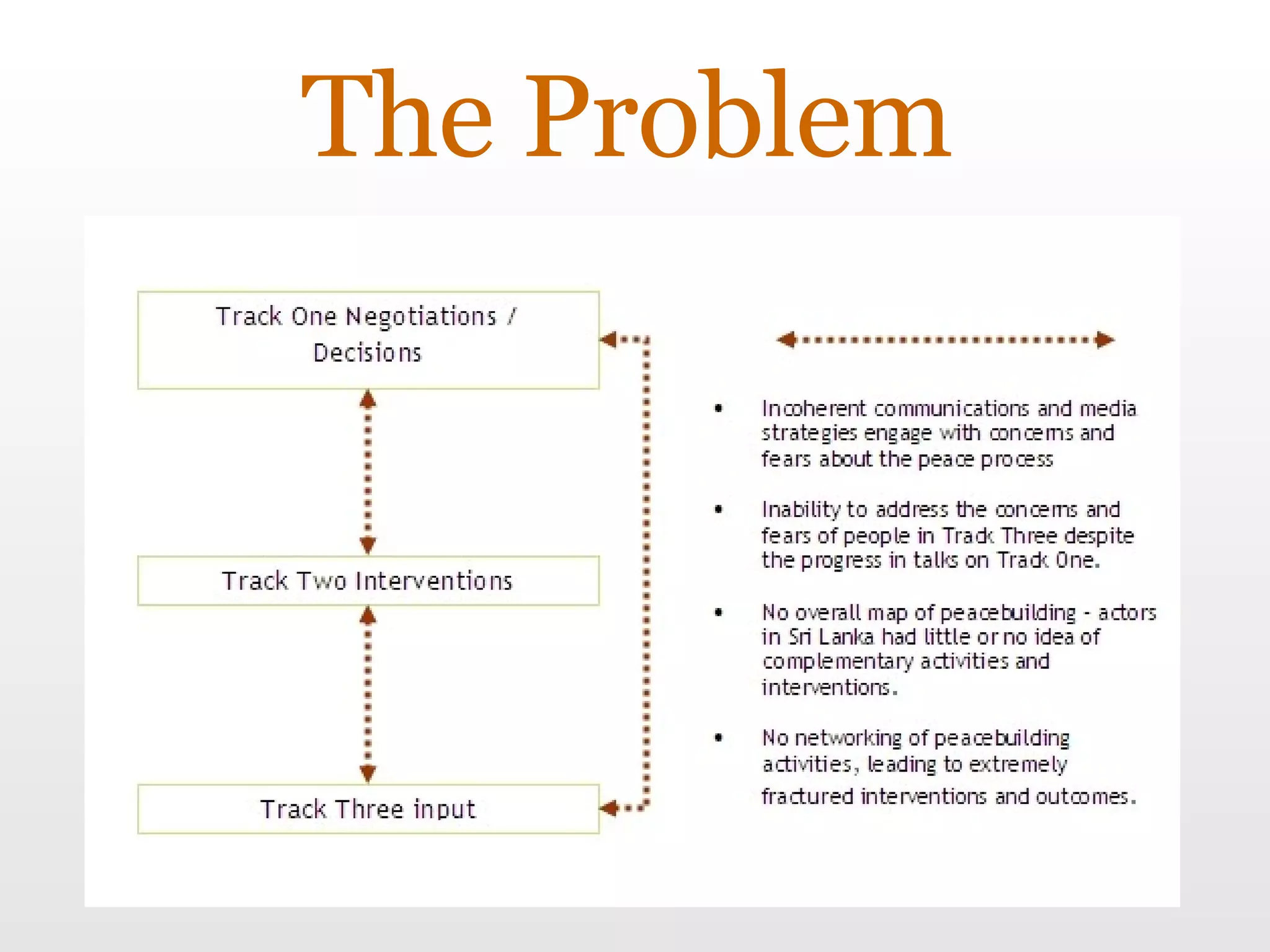
The Problem
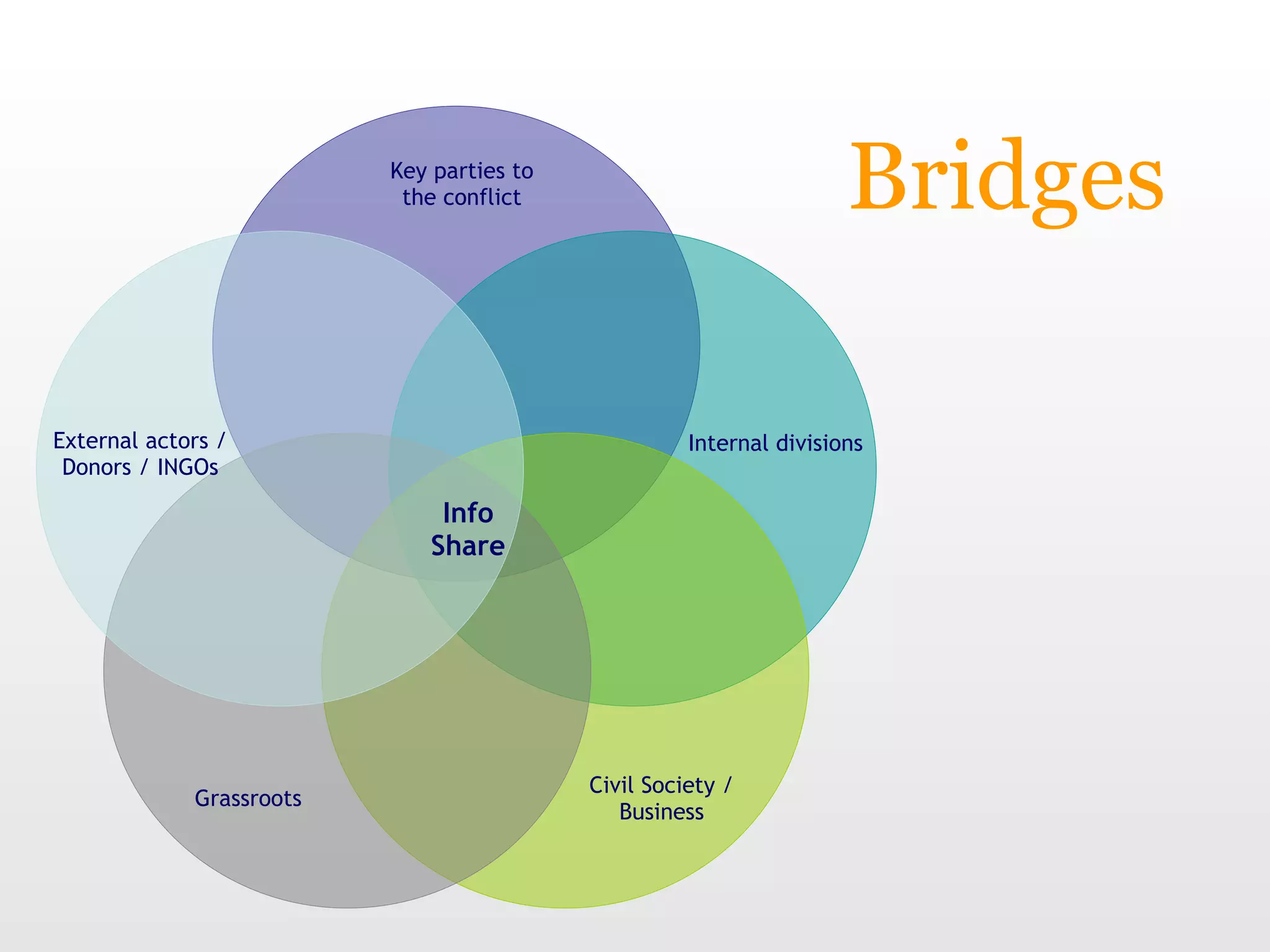
Bridges Key parties to the conflict Internal divisions Civil Society / Business Grassroots External actors / Donors / INGOs Info Share
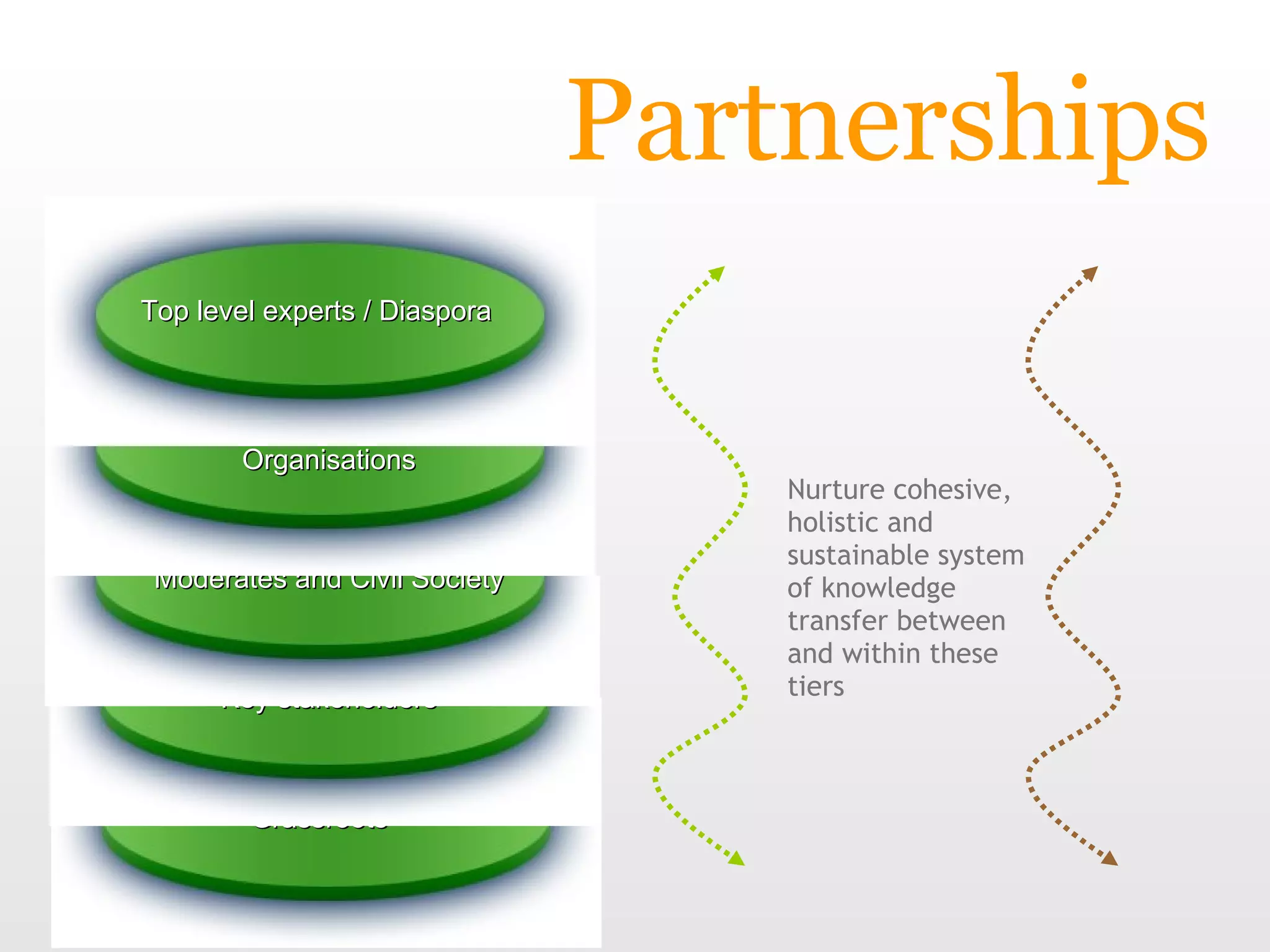
Nurture cohesive, holistic and sustainable system of knowledge transfer between and within these tiers Partnerships Grassroots Key stakeholders Moderates and Civil Society Donors, International Aid Organisations Top level experts / Diaspora
Sri Lanka today Deteriorating peace process Increase of human rights violations, culture of impunity  Over 3,000 dead over the past year 215,000+ displaced Active war in the North - East Attacks against NGOs, activists, journalists A beautiful country, but hell for peace and rights activists
The world today
Can technology help? Is technology a guarantee of a better process? Is technology neutral? How does one determine trust online? How do you create inter-cultural dispute resolution systems? What are the problems of access and publishing content (the Great Wall of China, the Middle East)? How can technology help peace processes?
“ We value the  potential of ICTs to promote peace and to prevent conflict  which,  inter alia , negatively affects achieving development goals. ICTs can be used for identifying conflict situations through early-warning systems preventing conflicts, promoting their peaceful resolution,  supporting humanitarian action , including protection of civilians in armed conflicts, facilitating peacekeeping missions, and  assisting post conflict peace-building  and reconstruction.” Paragraph 36, WSIS Tunis Commitment, 2005  (two years after InfoShare began work)  ICT4Peace
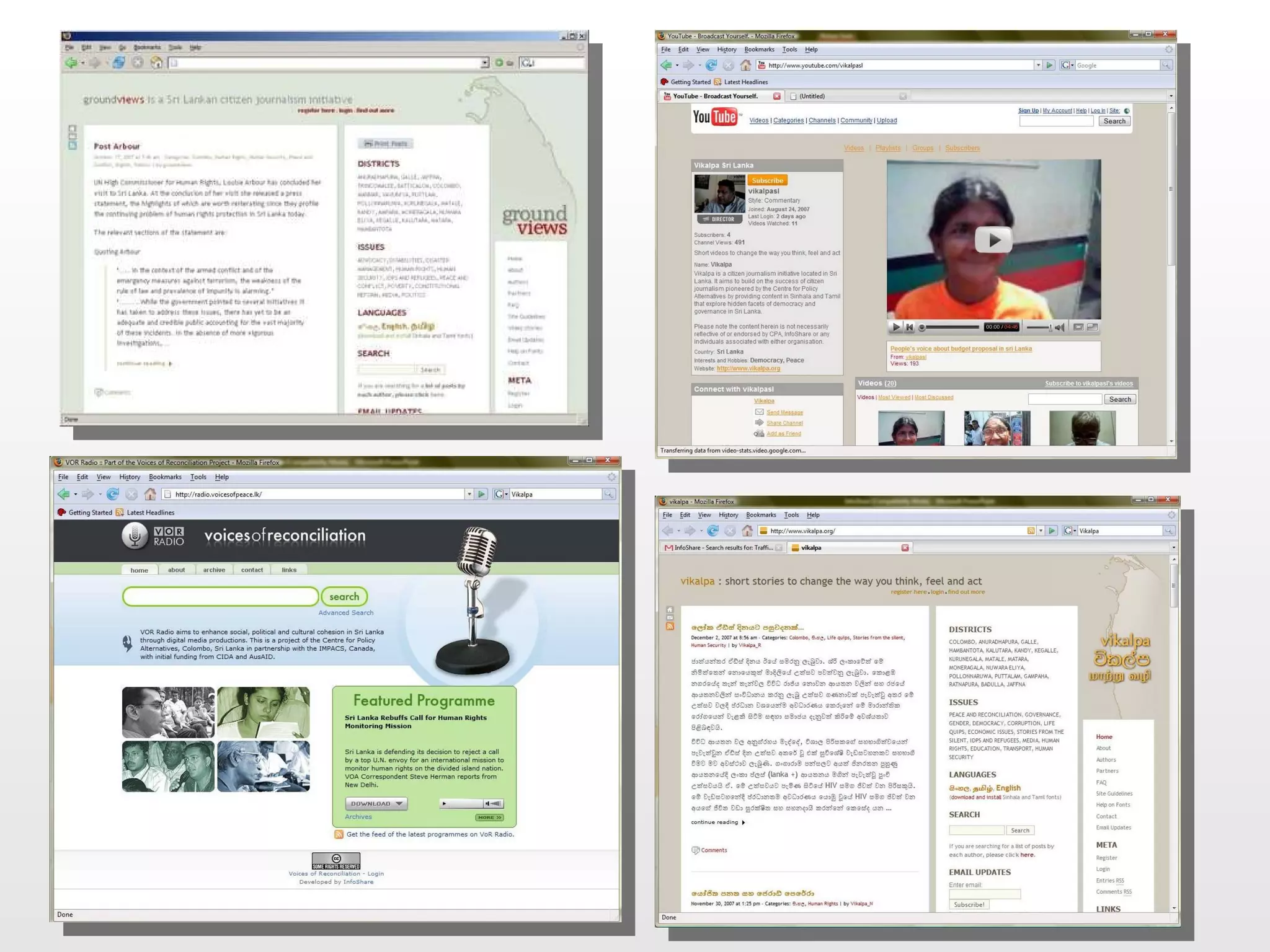
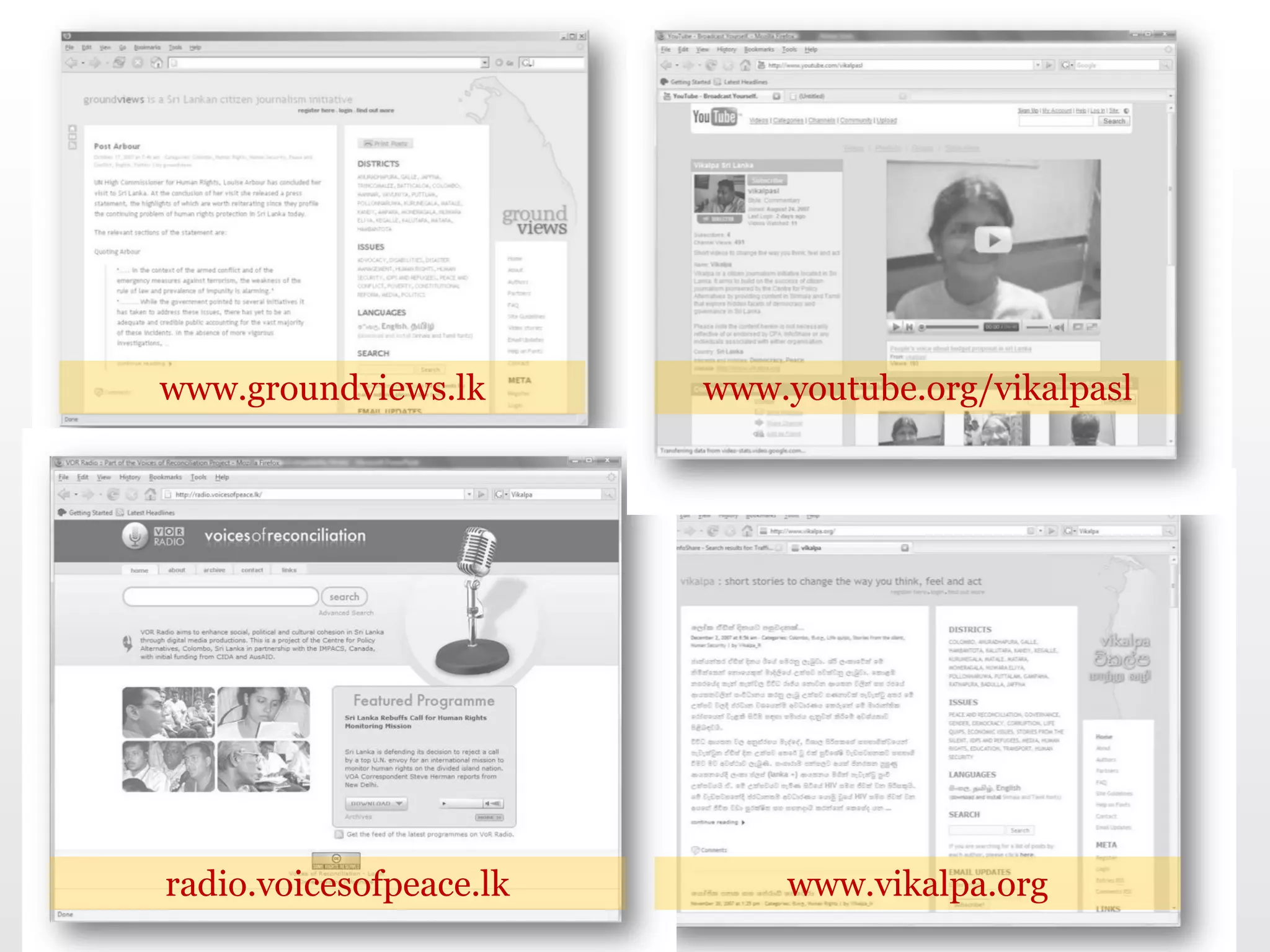
Web and social media
 
www.groundviews.lk www.youtube.org/vikalpasl radio.voicesofpeace.lk www.vikalpa.org
Civil society accountability
Citizen Journalism
Human rights monitoring and reporting
HURIDOCS initial feedback “ Wow, Sanjana, I am really impressed! I think this platform is going to take the human rights world by storm” “ Fabulous news!  Something we have talked about for years!” “ Wonderful, stunning and creative!!!”  “ I am utterly amazed! I'm dying to see the actual product!”
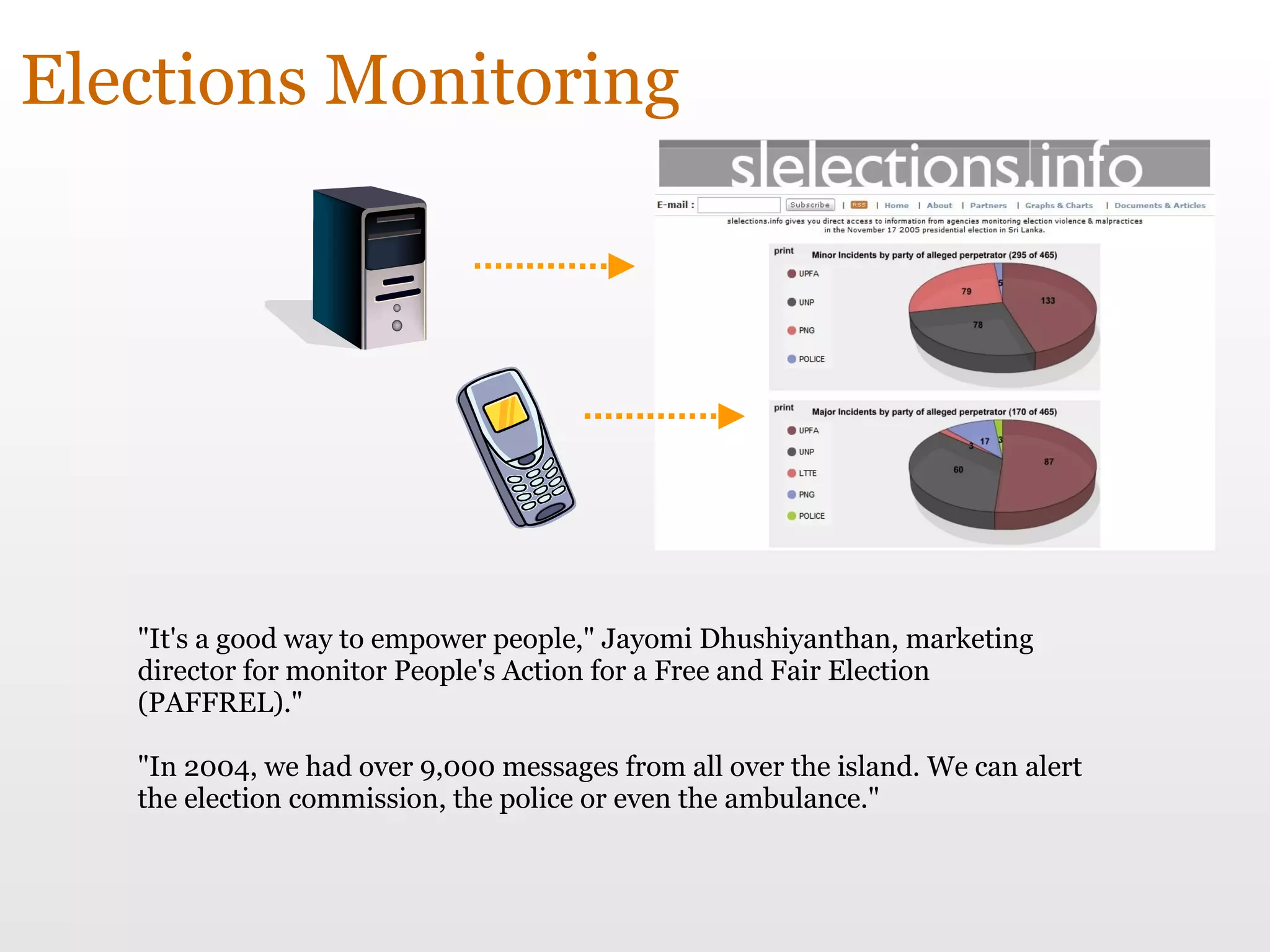
Elections Monitoring "It's a good way to empower people," Jayomi Dhushiyanthan, marketing director for monitor People's Action for a Free and Fair Election (PAFFREL)." "In 2004, we had over 9,000 messages from all over the island. We can alert the election commission, the police or even the ambulance."
Strengthening media
Voices of Reconciliation Radio
Anti-Corruption & Civil Society
 
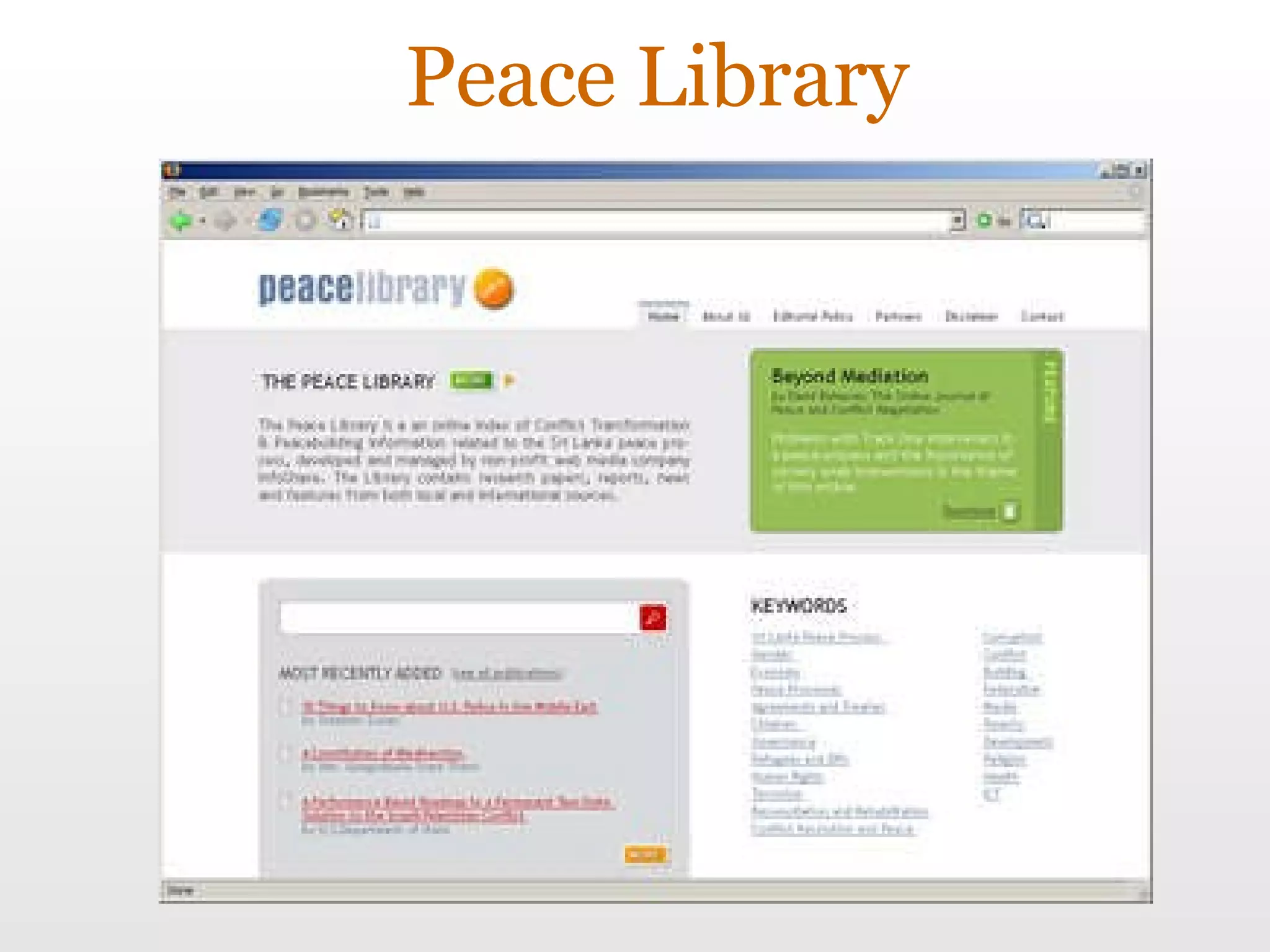
Peace Library
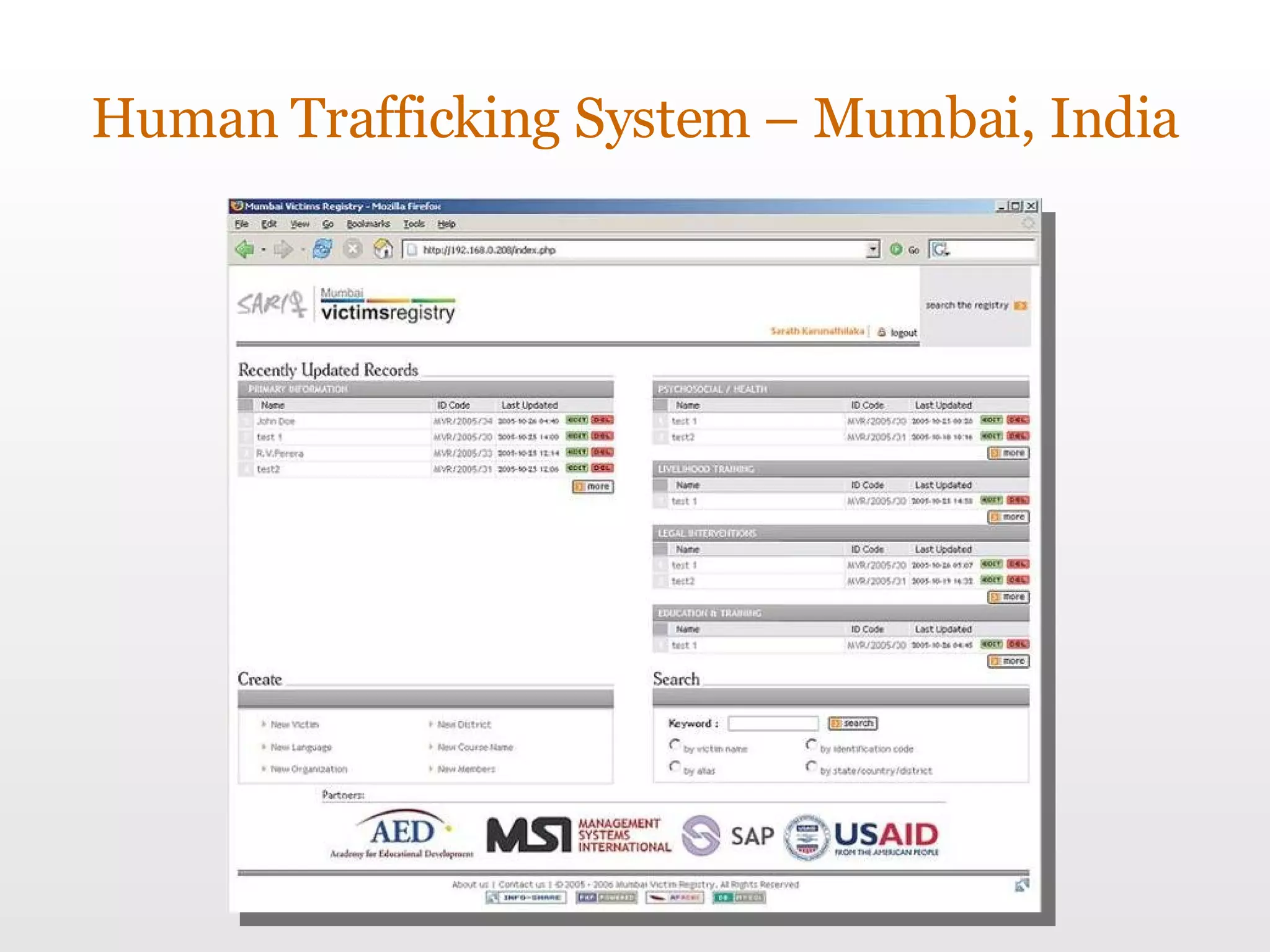
Human Trafficking System – Mumbai, India
2 ideas Web 2.0 Mobile telephones
 
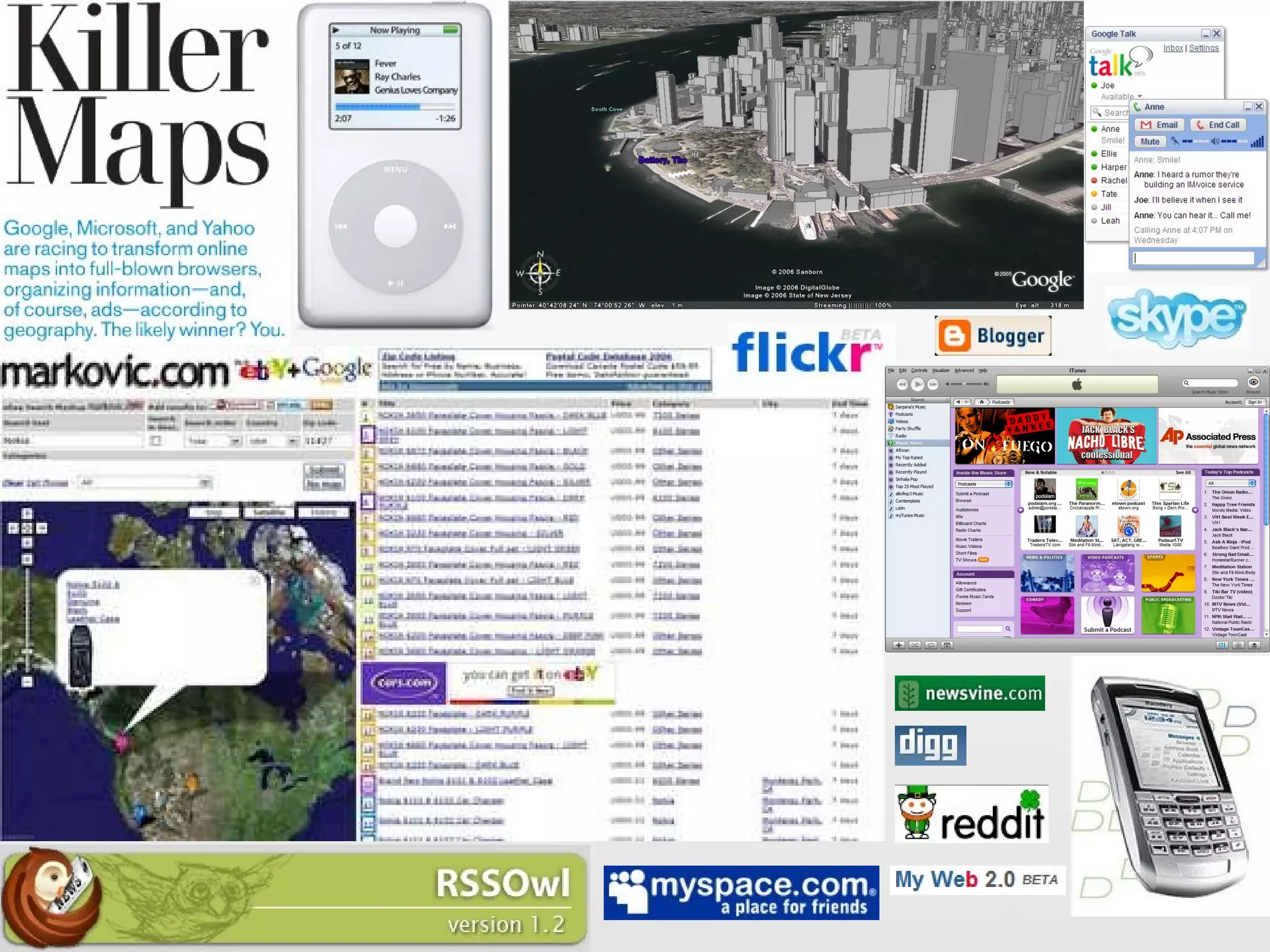
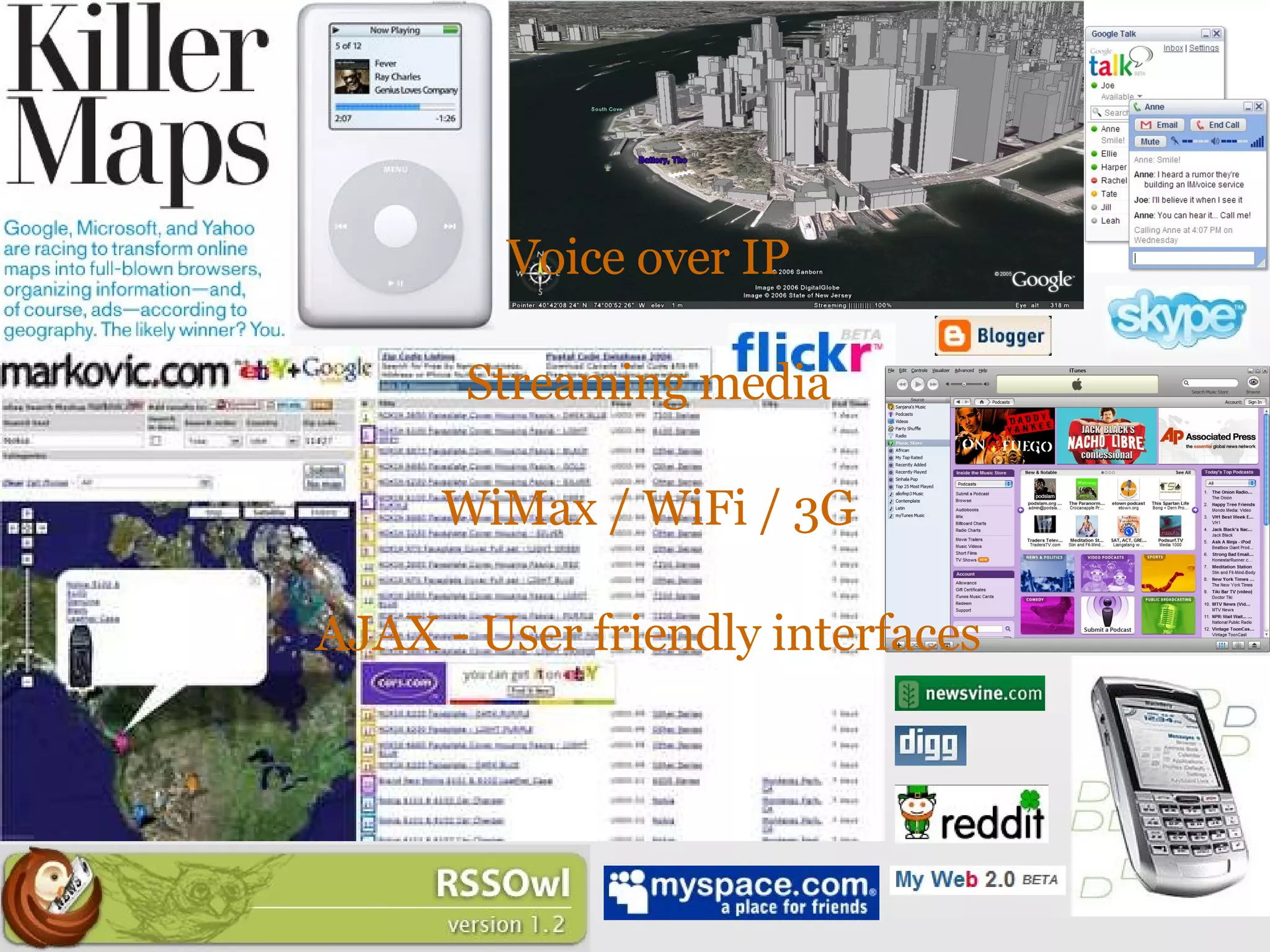
Voice over IP Streaming media WiMax / WiFi / 3G AJAX - User friendly interfaces
Web 2.0 for ODR? Interactive / Multimedia / Intuitive Piggyback on new consumer devices and existing programming Social networking as communities for ODR New technologies that enhance storage, retrieval, comparison, review and reuse of existing information. Create greater awareness of ODR
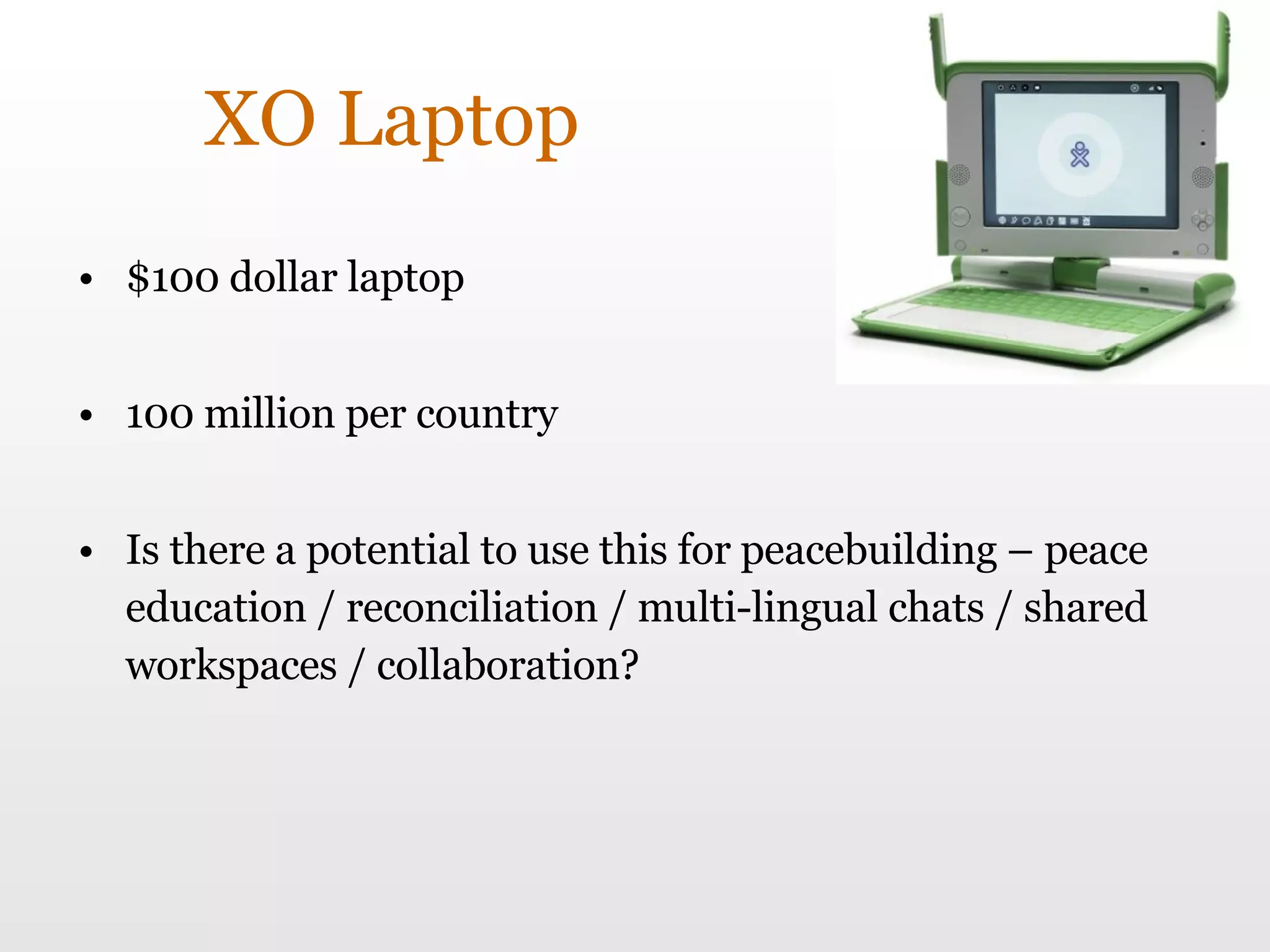
XO Laptop $100 dollar laptop 100 million per country Is there a potential to use this for peacebuilding – peace education / reconciliation / multi-lingual chats / shared workspaces / collaboration?
Mobile growth
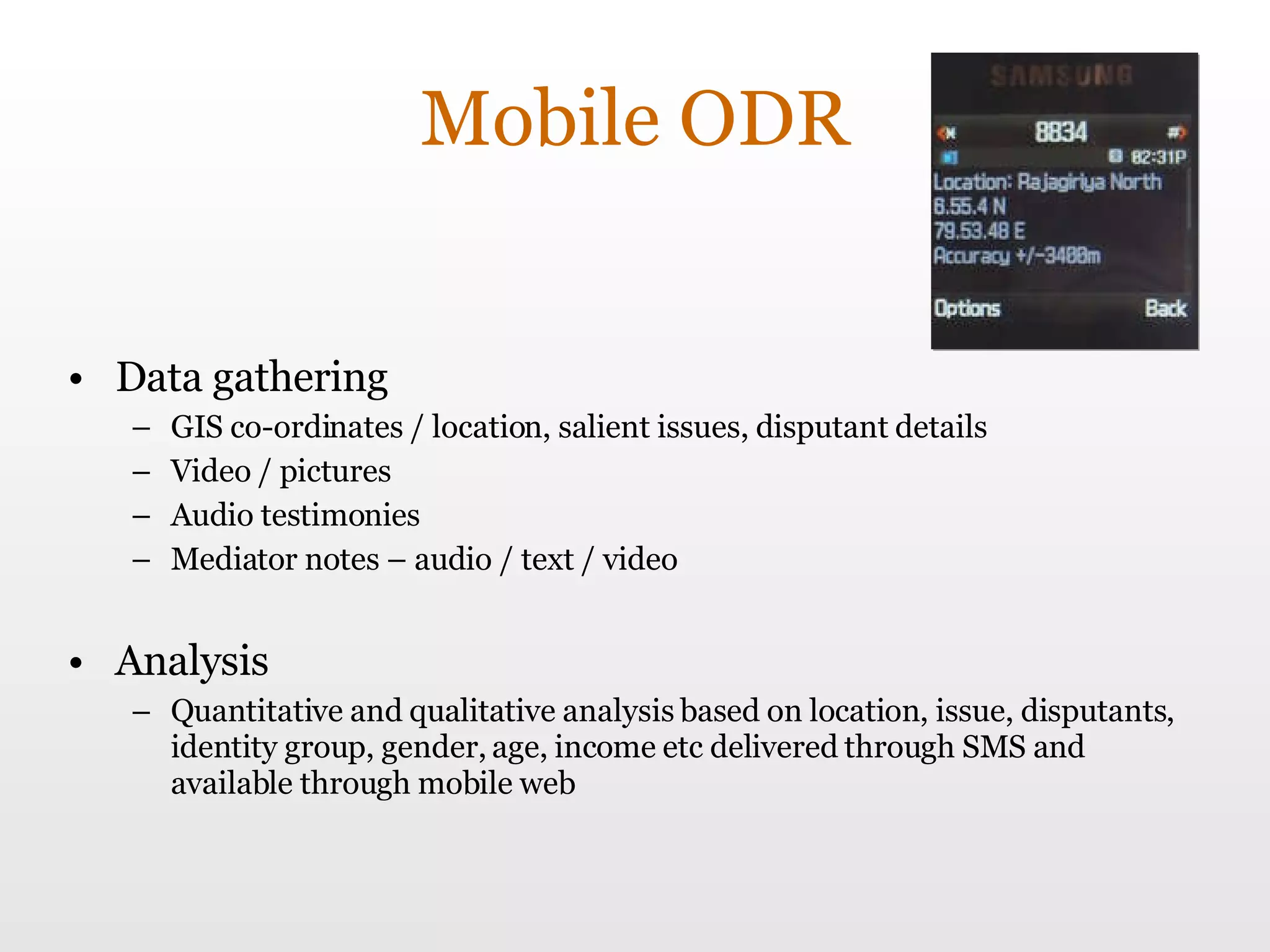
Mobile ODR Data gathering GIS co-ordinates / location, salient issues, disputant details Video / pictures Audio testimonies Mediator notes – audio / text / video Analysis Quantitative and qualitative analysis based on location, issue, disputants, identity group, gender, age, income etc delivered through SMS and available through mobile web
Mobile ODR Dissemination SMS decision notification (in vernacular) Voice mail notification (in vernacular) Voice driven systems that work with illiterate communities (using simple voice recognition) Final outcome ODR outside of air-conditioning, using existing technology, to resolve local disputes Content and market demand to fuel the growth of technology
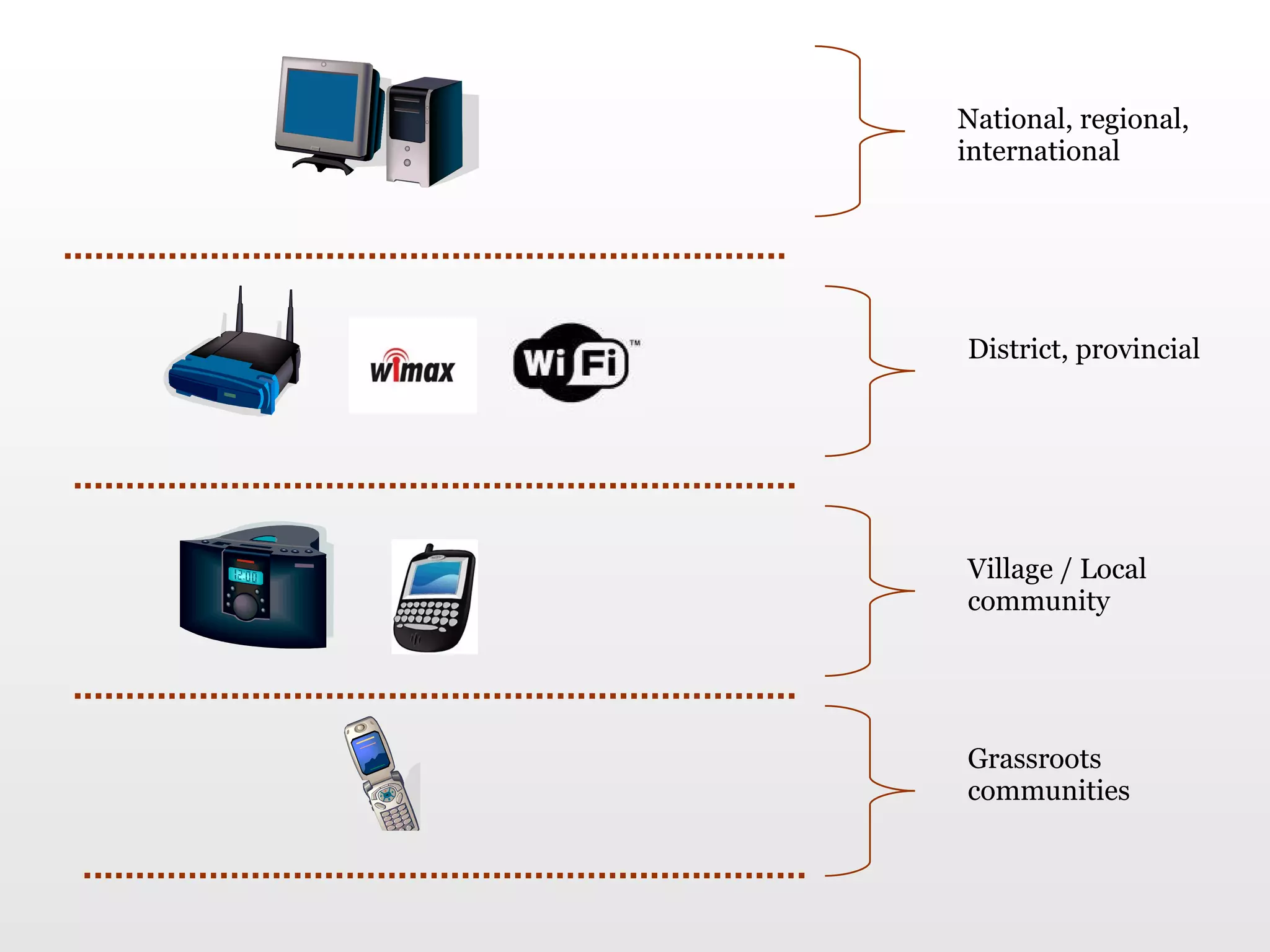
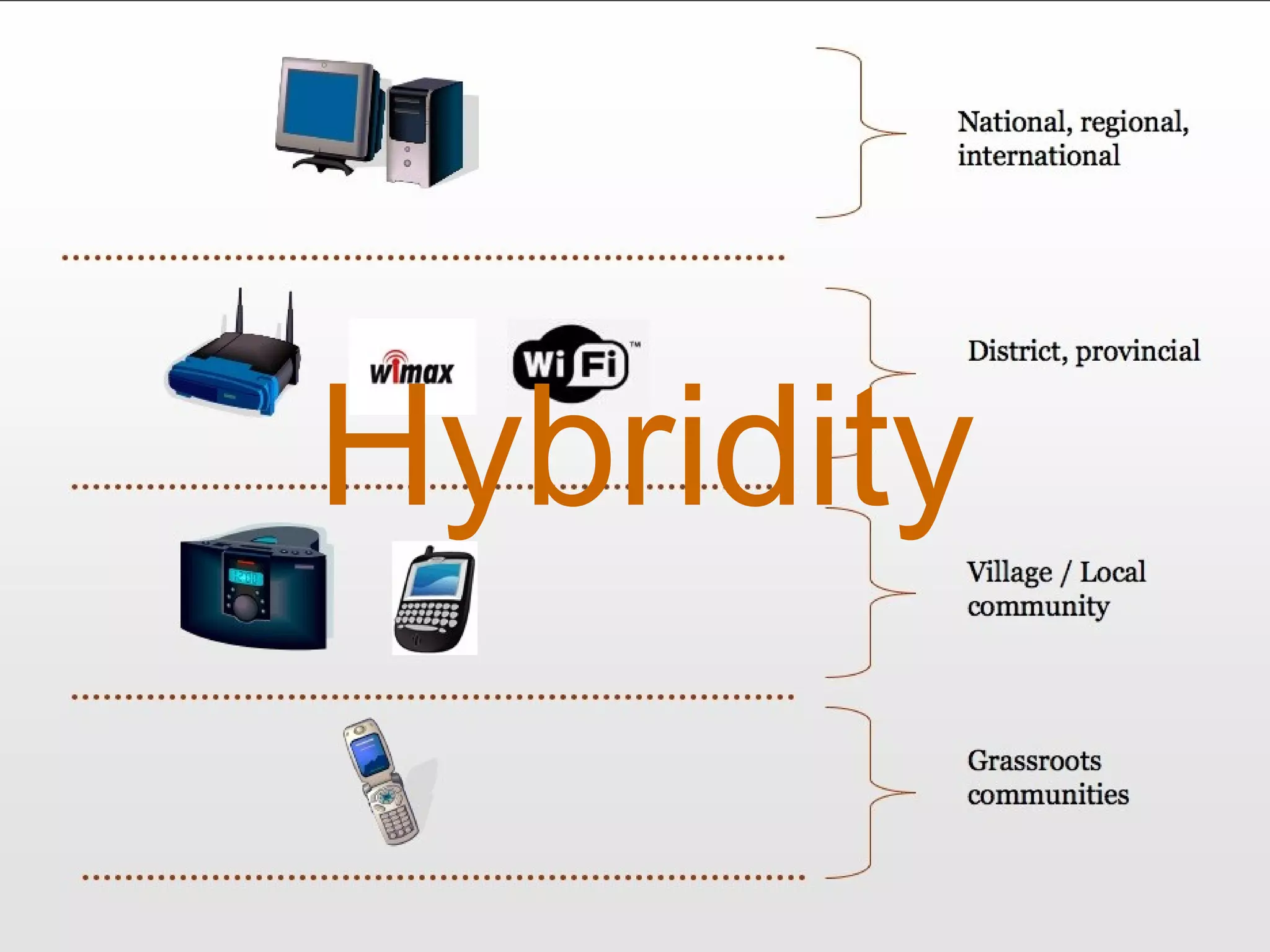
National, regional, international District, provincial Village / Local community  Grassroots communities
Hybridity
 
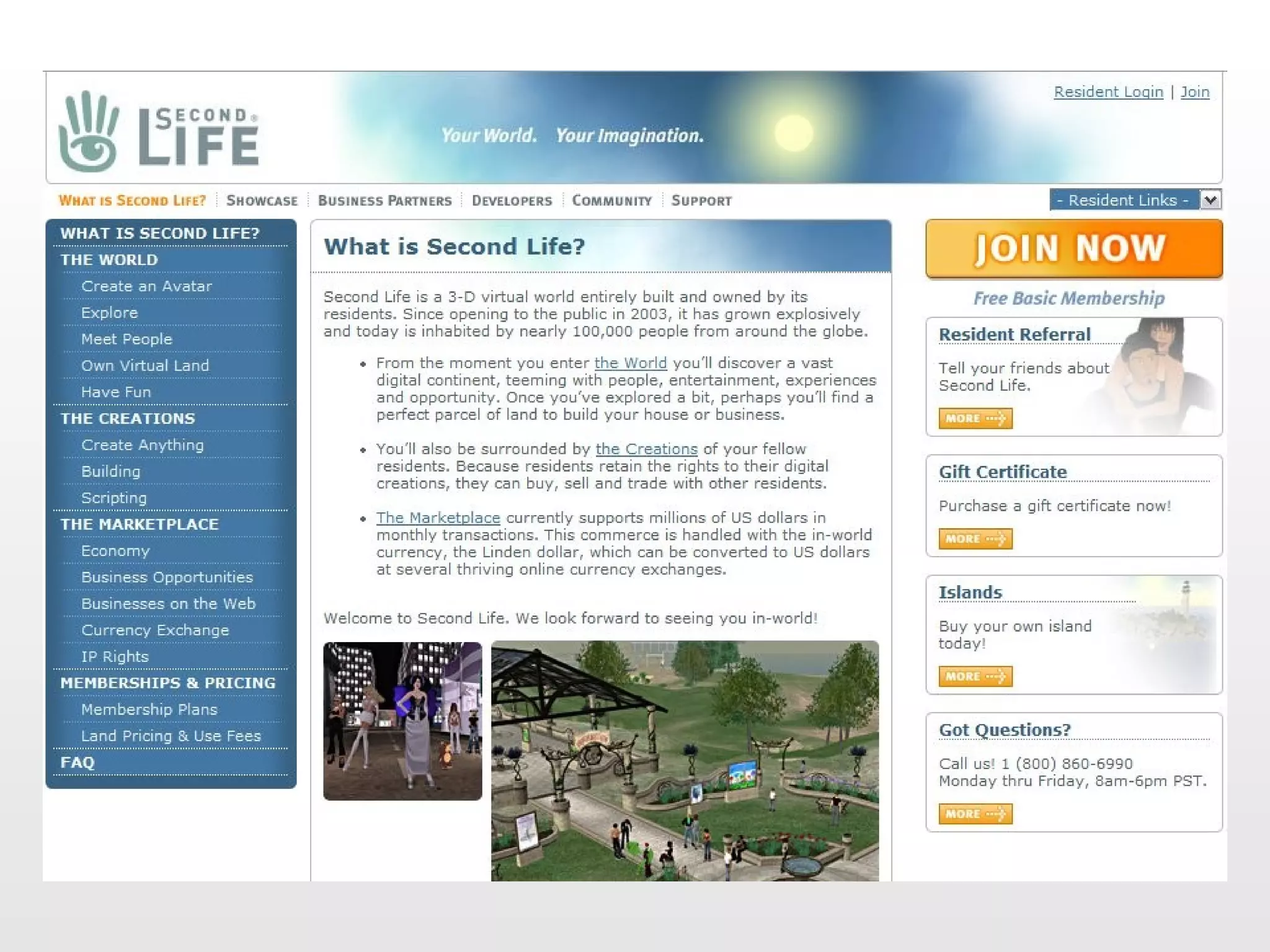
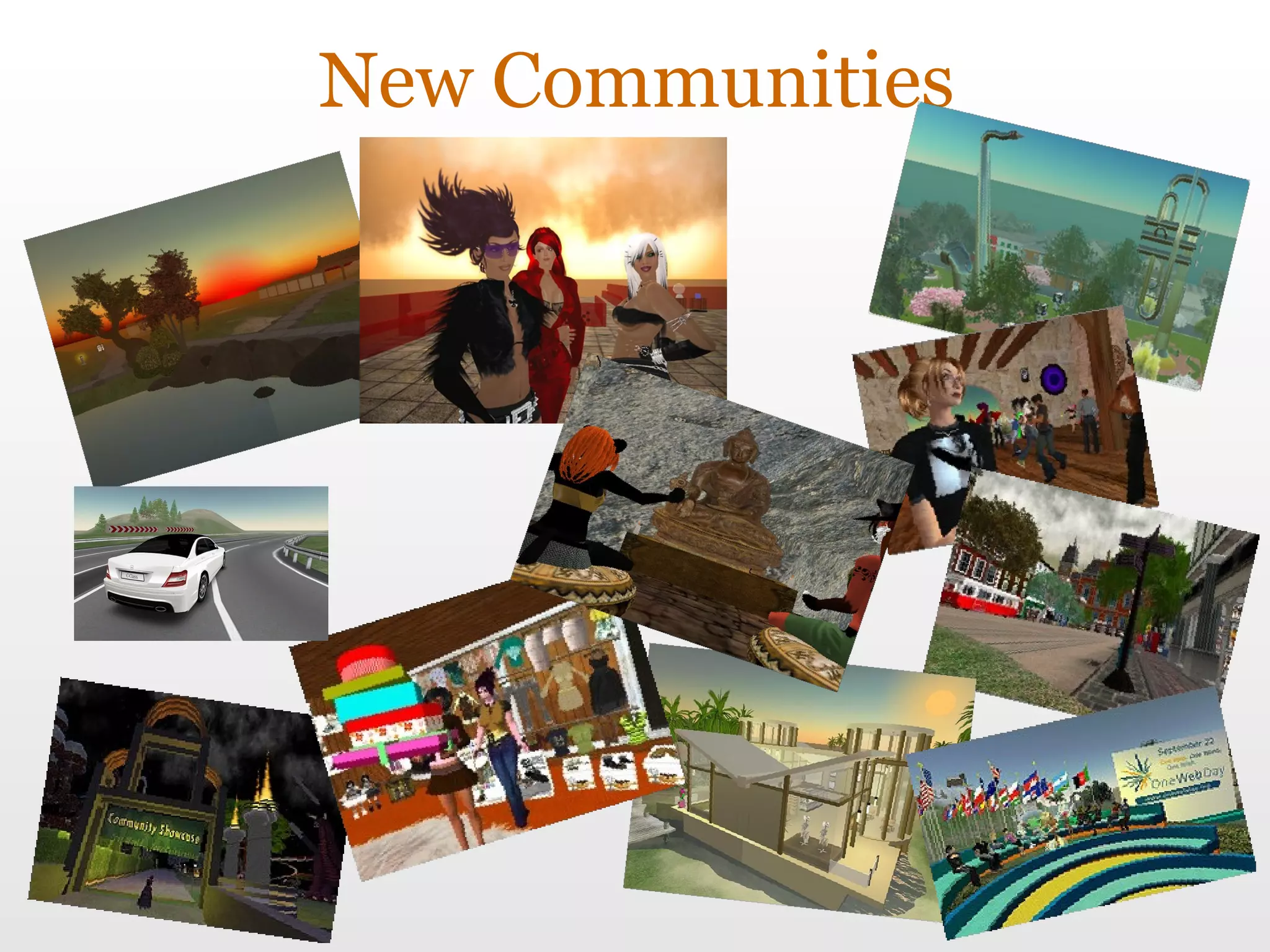
New Communities
Characteristics Neutral Ground Individuals are free to come and go as they please. In online games, players are not obligated to play; joins and quits are not significant events. Leveller An individual’s real world identity (individual or group based) are not always as significant as they are in the real world. Players on online games use a separate avatar often unrelated to their real life person, and social status is rarely invoked. Conversations Depending on the nature of the sim, conversations play a crucial role in communications within Second Life.
Characteristics Accessibility & Accommodation Second Life allows avatars to log on and off at will. There is always somebody online, though the hours of commerce are sometimes determined by the time-zone of the person A Home Away from Home Rootedness, feelings of possession, spiritual regeneration, feelings of being at ease, and warmth.
Community characteristics Social bonding: Bridging  - when individuals connect with those from different backgrounds. The advantage if bridging social capital include gaining access to new information and resources.  Bonding   - when individuals that are already close provide support for each other, making the relationship stronger.  In a sense, bridging provides breadth while bonding provides depth.
Question What if violence in the real world spills over into virtual communities in Second Life, or more disturbingly, vice-versa? Privacy, identity, location, ODR
Qiu Chengwei stabbed Zhu Caoyuan in the chest when he found out he had sold his virtual sword for 7,200 Yuan (£473). June 2005
Other challenges The copybot challenge to copyright The “grey-goo” attack - criminal incarceration? Sex with children (well adults as children) and the imposition of real world morality What is the framework for the imagination? How deviant can we be?
Recap ODR will function from mobile devices – from cell-phones to Microsoft Origami Standards based information / data exchange for open systems Artificial Intelligence and expert systems Voice, video, pictures, animation – interactivity ! Virtual / real-world ODR hybrid processes Redefinitions of trust, confidentiality, participation, identity, culture
Can technology help? Is technology a guarantee of a better process? Is technology neutral? How does one determine trust online? How do you create inter-cultural dispute resolution systems? What are the problems of access and publishing content (the Great Wall of China, the Middle East)? How can technology help peace processes?
Thank You www.info-share.org sanjana@info-share.org

Technology and Peacebuilding (ICT4Peace)

  • 1.
  • 2.
  • 3.
    Dispute Resolution /Conflict Transformation A process of engaging with and transforming relationships , interests, discourses and, if necessary, the very constitution of society that supports the continuation of violent conflict CT argues against giving primacy to settlements Conflict is never resolved, but transformed to the non-violent negotiation of differences
  • 4.
  • 5.
    Challenges One canidentify four key challenges in the use of ICT for Conflict Transformation.
  • 6.
    Appropriation The appropriate use of ICT, where organisations use ICT interventions to seamlessly dovetail with and strengthen existing (and planned) interventions, is pivotal to the success of online technology in the theatres of peacebuilding and conflict transformation. Access Adoption Appropriation
  • 7.
    Uses ICT inpeacebuilding needs to be self-effacing . ICT must build social capital, and invest in societal frameworks that empower local communities to grapple with conflict in non-violent ways. Technology itself should not be the cynosure, but what is achieved through it.
  • 8.
    Trust As ICTin Conflict Transformation develops, there is a need to develop more effective cultures of collaboration based on mutually accepted and independently verifiable virtual determinants of trust. The ability to conduct critical discussions in virtual spaces whilst being assured of the confidentiality of shared content.
  • 9.
    Structural Problems Inadequatevernacular content / interface Lack of Internet connectivity / infrastructure / bandwidth Lack of human resources A pervasive and incipient culture of secrecy, with the abysmal levels of mutual trust Intricacies of ethno-political conflict
  • 10.
    Info Share Abasic introduction
  • 11.
  • 12.
    Bridges Key partiesto the conflict Internal divisions Civil Society / Business Grassroots External actors / Donors / INGOs Info Share
  • 13.
    Nurture cohesive, holisticand sustainable system of knowledge transfer between and within these tiers Partnerships Grassroots Key stakeholders Moderates and Civil Society Donors, International Aid Organisations Top level experts / Diaspora
  • 14.
    Sri Lanka todayDeteriorating peace process Increase of human rights violations, culture of impunity Over 3,000 dead over the past year 215,000+ displaced Active war in the North - East Attacks against NGOs, activists, journalists A beautiful country, but hell for peace and rights activists
  • 15.
  • 16.
    Can technology help?Is technology a guarantee of a better process? Is technology neutral? How does one determine trust online? How do you create inter-cultural dispute resolution systems? What are the problems of access and publishing content (the Great Wall of China, the Middle East)? How can technology help peace processes?
  • 17.
    “ We valuethe potential of ICTs to promote peace and to prevent conflict which, inter alia , negatively affects achieving development goals. ICTs can be used for identifying conflict situations through early-warning systems preventing conflicts, promoting their peaceful resolution, supporting humanitarian action , including protection of civilians in armed conflicts, facilitating peacekeeping missions, and assisting post conflict peace-building and reconstruction.” Paragraph 36, WSIS Tunis Commitment, 2005 (two years after InfoShare began work) ICT4Peace
  • 18.
  • 19.
  • 20.
  • 21.
  • 22.
  • 23.
  • 24.
    HURIDOCS initial feedback“ Wow, Sanjana, I am really impressed! I think this platform is going to take the human rights world by storm” “ Fabulous news! Something we have talked about for years!” “ Wonderful, stunning and creative!!!” “ I am utterly amazed! I'm dying to see the actual product!”
  • 25.
    Elections Monitoring "It'sa good way to empower people," Jayomi Dhushiyanthan, marketing director for monitor People's Action for a Free and Fair Election (PAFFREL)." "In 2004, we had over 9,000 messages from all over the island. We can alert the election commission, the police or even the ambulance."
  • 26.
  • 27.
  • 28.
  • 29.
  • 30.
  • 31.
    Human Trafficking System– Mumbai, India
  • 32.
    2 ideas Web2.0 Mobile telephones
  • 33.
  • 34.
    Voice over IPStreaming media WiMax / WiFi / 3G AJAX - User friendly interfaces
  • 35.
    Web 2.0 forODR? Interactive / Multimedia / Intuitive Piggyback on new consumer devices and existing programming Social networking as communities for ODR New technologies that enhance storage, retrieval, comparison, review and reuse of existing information. Create greater awareness of ODR
  • 36.
    XO Laptop $100dollar laptop 100 million per country Is there a potential to use this for peacebuilding – peace education / reconciliation / multi-lingual chats / shared workspaces / collaboration?
  • 37.
  • 38.
    Mobile ODR Datagathering GIS co-ordinates / location, salient issues, disputant details Video / pictures Audio testimonies Mediator notes – audio / text / video Analysis Quantitative and qualitative analysis based on location, issue, disputants, identity group, gender, age, income etc delivered through SMS and available through mobile web
  • 39.
    Mobile ODR DisseminationSMS decision notification (in vernacular) Voice mail notification (in vernacular) Voice driven systems that work with illiterate communities (using simple voice recognition) Final outcome ODR outside of air-conditioning, using existing technology, to resolve local disputes Content and market demand to fuel the growth of technology
  • 40.
    National, regional, internationalDistrict, provincial Village / Local community Grassroots communities
  • 41.
  • 42.
  • 43.
  • 44.
    Characteristics Neutral GroundIndividuals are free to come and go as they please. In online games, players are not obligated to play; joins and quits are not significant events. Leveller An individual’s real world identity (individual or group based) are not always as significant as they are in the real world. Players on online games use a separate avatar often unrelated to their real life person, and social status is rarely invoked. Conversations Depending on the nature of the sim, conversations play a crucial role in communications within Second Life.
  • 45.
    Characteristics Accessibility &Accommodation Second Life allows avatars to log on and off at will. There is always somebody online, though the hours of commerce are sometimes determined by the time-zone of the person A Home Away from Home Rootedness, feelings of possession, spiritual regeneration, feelings of being at ease, and warmth.
  • 46.
    Community characteristics Socialbonding: Bridging - when individuals connect with those from different backgrounds. The advantage if bridging social capital include gaining access to new information and resources. Bonding - when individuals that are already close provide support for each other, making the relationship stronger. In a sense, bridging provides breadth while bonding provides depth.
  • 47.
    Question What ifviolence in the real world spills over into virtual communities in Second Life, or more disturbingly, vice-versa? Privacy, identity, location, ODR
  • 48.
    Qiu Chengwei stabbedZhu Caoyuan in the chest when he found out he had sold his virtual sword for 7,200 Yuan (£473). June 2005
  • 49.
    Other challenges Thecopybot challenge to copyright The “grey-goo” attack - criminal incarceration? Sex with children (well adults as children) and the imposition of real world morality What is the framework for the imagination? How deviant can we be?
  • 50.
    Recap ODR willfunction from mobile devices – from cell-phones to Microsoft Origami Standards based information / data exchange for open systems Artificial Intelligence and expert systems Voice, video, pictures, animation – interactivity ! Virtual / real-world ODR hybrid processes Redefinitions of trust, confidentiality, participation, identity, culture
  • 51.
    Can technology help?Is technology a guarantee of a better process? Is technology neutral? How does one determine trust online? How do you create inter-cultural dispute resolution systems? What are the problems of access and publishing content (the Great Wall of China, the Middle East)? How can technology help peace processes?
  • 52.
    Thank You www.info-share.orgsanjana@info-share.org