Your interview starts before you walk
into an employer’s door..
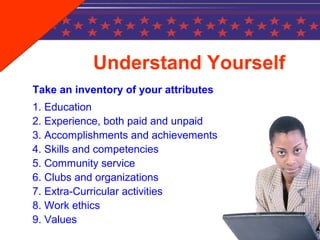
Understand Yourself
1. Education
2. Experience, both paid and unpaid
3. Accomplishments and achievements
4. Skills and competencies
5. Community service
6. Clubs and organizations
7. Extra-Curricular activities
8. Work ethics
9. Values
Take an inventory of your attributes
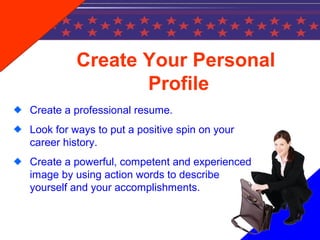
Create Your Personal
Profile
Create a professional resume.
Look for ways to put a positive spin on your
career history.
Create a powerful, competent and experienced
image by using action words to describe
yourself and your accomplishments.
Create Your Personal
Profile
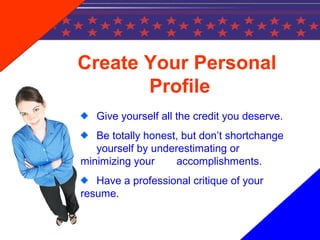
Give yourself all the credit you deserve.
Be totally honest, but don’t shortchange
yourself by underestimating or
minimizing your accomplishments.
Have a professional critique of your
resume.
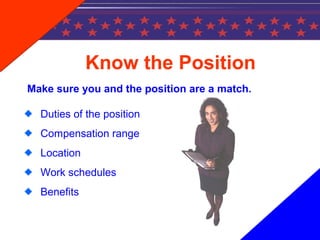
Know the Position
Make sure you and the position are a match.
Duties of the position
Compensation range
Location
Work schedules
Benefits
Know the Organization
Organization’s name
Private or public
What products or services
Key management team
Know the Organization
Where to find organization’s information:
Organization’s website
Search engines like Google or Hoovers
College placement office
Networking
Library and newspaper archives
General Tips
Map your route to the interview site so you’re not late.
Appropriate business attire is a must.
Refer to your achievements often before your
interview date, so they’re fresh in your mind.
Know your answers to probable questions
before you walk in the door.
General Tips
Practice, practice, practice your answers and
your delivery. Ask others to critique you.
If you have access to a video recorder, tape a
mock interview so you can see your nonverbal
communication.
The image you project and how you present
yourself will be either a deal-maker or
deal-breaker.
Think about questions you need to ask.
Write them down to jog your memory.
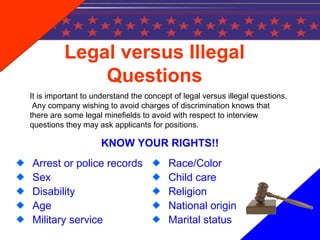
Legal versus Illegal
Questions
KNOW YOUR RIGHTS!!
Arrest or police records
Sex
Disability
Age
Military service
Race/Color
Child care
Religion
National origin
Marital status
It is important to understand the concept of legal versus illegal questions.
Any company wishing to avoid charges of discrimination knows that
there are some legal minefields to avoid with respect to interview
questions they may ask applicants for positions.
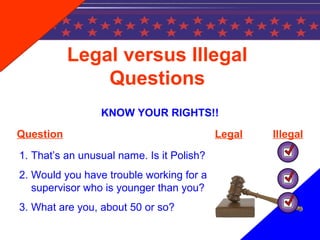
Legal versus Illegal
Questions
KNOW YOUR RIGHTS!!
1. That’s an unusual name. Is it Polish?
2. Would you have trouble working for a
supervisor who is younger than you?
3. What are you, about 50 or so?
Question Legal Illegal
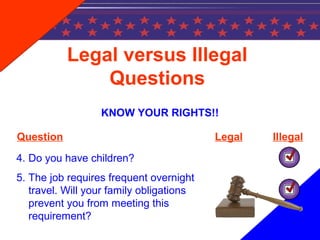
Legal versus Illegal
Questions
KNOW YOUR RIGHTS!!
4. Do you have children?
5. The job requires frequent overnight
travel. Will your family obligations
prevent you from meeting this
requirement?
Question Legal Illegal
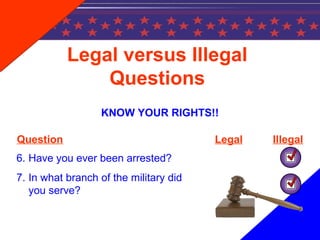
Legal versus Illegal
Questions
KNOW YOUR RIGHTS!!
6. Have you ever been arrested?
7. In what branch of the military did
you serve?
Question Legal Illegal
Legal versus Illegal
Questions
KNOW YOUR RIGHTS!!
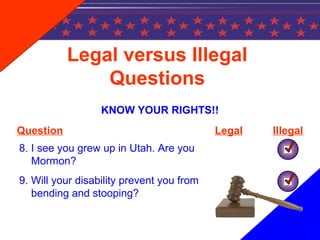
Question Legal Illegal
8. I see you grew up in Utah. Are you
Mormon?
9. Will your disability prevent you from
bending and stooping?
Typical and not so typical
Job Interview Questions
Tell me about yourself. (Don’t ramble. Stay focused on
those things about yourself that make you best qualified
for the job.)
What are your strengths? (Make sure you know what
they are before you get to the interview. Make a list.)
What are your weaknesses? (Careful of this one.
What you say can and will be held against you.)
Typical and not so typical
Job Interview Questions
How would your current (or last) boss describe
you? (Be honest . . . They may be talking to him/her)
Describe the attributes of the worst boss you ever had.
(Treat this like a minefield. A misstep could blow up in
your face. Try to put a positive spin on the negative
attributes.)
Typical and not so typical
Job Interview Questions
Describe a conflict or disagreement you have had at
work and explain how you handled it.
How do you react to criticism? (This is not the time
for ego)
Give an example of a risk you took at work or
school and how it turned out. What did you
learn from the outcome?
Typical and not so typical
Job Interview Questions
What is your managerial style?
Why do you want to leave your current employer?
(Positive, positive. A prospective employer doesn’t
want to hear a litany of grievances against your
current employer.)
What was your most important contribution to
your last (or current) employer?
Typical and not so typical
Job Interview Questions
What accomplishment in your life are you most proud?
Would you hire you for this job? Why?
Why should we hire you over other finalists for this
position? (Of course, you won’t know their
credentials, so focus on your own.)
Typical and not so typical
Job Interview Questions
What motivates you?
How do you motivate others to achieve their
personal best? (Keep in mind that motivation
is internal. You can only “motivate” yourself.)
SKILL: Coping
QUESTION: Describe a high-pressure situation you had to handle at
work or school. What happened, who was involved and what did you
do in terms of resolution?
SKILL: Tolerance of Ambiguity
QUESTION: Give an example of a time when you had to deal
with frequent and unexpected changes. What does this say
about your ability to work in an ambiguous or unstructured
circumstance?
Behavioral Based
Interviewing
Behavioral
SKILL: Versatility
QUESTION: In work situations, as in life, we sometimes have to
compromise to make things happen. Tell me about a time when you
felt it necessary to compromise your own immediate interests in order
to be flexible and tolerant of another’s needs.
Behavioral Based
Interviewing
Behavioral
Behavioral Based
Interviewing
Leadership
SKILL: Energizing
QUESTION: Give an example of a time when your positive attitude
caused others to be motivated or energized into action. Be specific.
SKILL: Team Building
QUESTION: Building a team spirit to get results is often difficult.
Tell me about a time when you had your greatest success in building
a team spirit. What specific results did the team accomplish?
Behavioral Based
Interviewing
Leadership
SKILL: Influence
QUESTION: (1) Give an example when you first used fact and
reason to persuade others to take action. Be specific. (2) Give an
example of a time when your communication skills were powerful
enough to enable you to influence the way others thought or acted,
even in a very difficult situation.
Behavioral Based
Interviewing
Problem Solving
SKILL: Analytical
QUESTION: Give an example where you actively designed several
solutions to a single problem.
SKILL: Creativity
QUESTION: Give an example of a situation where you were
inventive and explored new ways of thinking. What was the
outcome?
Behavioral Based
Interviewing
Problem Solving
SKILL: Decision Making/Decisiveness
QUESTION: (1) Give an example of how you reached a practical
business decision by an organized review of the facts and weighing of
options. (2) Give an example of a situation when you had to stand up
for a decision you made even though it made you unpopular.
Behavioral Based
Interviewing
Personal Work Habits
SKILL: Commitment to Tasks
QUESTION: (1) Describe a time in which you were able to be
very persistent in order to reach goals. (2) Give an example of
any specific time in which you found it necessary to give long
hours to the job.
SKILL: Goal Setting
QUESTION: What has been your experience in defining
long and short-range goals? Tell me what specific goal
was set, how was it set, and how successful you were
in its achievement?
Behavioral Based
Interviewing
Personal Work Habits
SKILL: Organization and Planning
QUESTION: Many positions have well-established, standard
methods to help you do the job. Give an example of a time
when you found a systematic method for solving work problems
to be a good routine to follow. How did your planning help you
deal with the unexpected?
Behavioral Based
Interviewing
Communication
SKILL: Interaction
QUESTION: Being skillful in dealing with others on the job is an
important factor in being productive. Describe a time when you
were successful in dealing with another person because you built
a trusting and harmonious relationship.
Behavioral Based
Interviewing
Communication
SKILL: Spoken Communication
QUESTION: Careful listening and effective communication go
hand in hand. Tell about a specific time when your ability to listen
helped you communicate better. Tell about a specific experience
of yours that illustrates your ability to influence others verbally.
SKILL: Written Communication
QUESTION: In some jobs, it is necessary to document
work thoroughly. Give an example of a project you
completed that required detailed written documentation.
Summary
You know yourself and what you have to offer.
You know you and the position are a match.
You know the organization’s history and the
benefits you would bring to it.
You have prepared a professional resume.
You’ve practiced, practiced, practiced
your delivery.
You’ve selected appropriate attire.
Summary
You know answers to probable questions, including
behavioral-based questions.
You’ve practiced your smile, eye contact,
and firm handshake.
You’ve made it to the interview site on time.
This organization couldn’t live without you.
Interview guide 5stepsv2

Interview guide 5stepsv2

  • 2.
    Your interview startsbefore you walk into an employer’s door..
  • 4.
    Understand Yourself 1. Education 2.Experience, both paid and unpaid 3. Accomplishments and achievements 4. Skills and competencies 5. Community service 6. Clubs and organizations 7. Extra-Curricular activities 8. Work ethics 9. Values Take an inventory of your attributes
  • 6.
    Create Your Personal Profile Createa professional resume. Look for ways to put a positive spin on your career history. Create a powerful, competent and experienced image by using action words to describe yourself and your accomplishments.
  • 7.
    Create Your Personal Profile Giveyourself all the credit you deserve. Be totally honest, but don’t shortchange yourself by underestimating or minimizing your accomplishments. Have a professional critique of your resume.
  • 9.
    Know the Position Makesure you and the position are a match. Duties of the position Compensation range Location Work schedules Benefits
  • 11.
    Know the Organization Organization’sname Private or public What products or services Key management team
  • 12.
    Know the Organization Whereto find organization’s information: Organization’s website Search engines like Google or Hoovers College placement office Networking Library and newspaper archives
  • 14.
    General Tips Map yourroute to the interview site so you’re not late. Appropriate business attire is a must. Refer to your achievements often before your interview date, so they’re fresh in your mind. Know your answers to probable questions before you walk in the door.
  • 15.
    General Tips Practice, practice,practice your answers and your delivery. Ask others to critique you. If you have access to a video recorder, tape a mock interview so you can see your nonverbal communication. The image you project and how you present yourself will be either a deal-maker or deal-breaker. Think about questions you need to ask. Write them down to jog your memory.
  • 16.
    Legal versus Illegal Questions KNOWYOUR RIGHTS!! Arrest or police records Sex Disability Age Military service Race/Color Child care Religion National origin Marital status It is important to understand the concept of legal versus illegal questions. Any company wishing to avoid charges of discrimination knows that there are some legal minefields to avoid with respect to interview questions they may ask applicants for positions.
  • 17.
    Legal versus Illegal Questions KNOWYOUR RIGHTS!! 1. That’s an unusual name. Is it Polish? 2. Would you have trouble working for a supervisor who is younger than you? 3. What are you, about 50 or so? Question Legal Illegal
  • 18.
    Legal versus Illegal Questions KNOWYOUR RIGHTS!! 4. Do you have children? 5. The job requires frequent overnight travel. Will your family obligations prevent you from meeting this requirement? Question Legal Illegal
  • 19.
    Legal versus Illegal Questions KNOWYOUR RIGHTS!! 6. Have you ever been arrested? 7. In what branch of the military did you serve? Question Legal Illegal
  • 20.
    Legal versus Illegal Questions KNOWYOUR RIGHTS!! Question Legal Illegal 8. I see you grew up in Utah. Are you Mormon? 9. Will your disability prevent you from bending and stooping?
  • 21.
    Typical and notso typical Job Interview Questions Tell me about yourself. (Don’t ramble. Stay focused on those things about yourself that make you best qualified for the job.) What are your strengths? (Make sure you know what they are before you get to the interview. Make a list.) What are your weaknesses? (Careful of this one. What you say can and will be held against you.)
  • 22.
    Typical and notso typical Job Interview Questions How would your current (or last) boss describe you? (Be honest . . . They may be talking to him/her) Describe the attributes of the worst boss you ever had. (Treat this like a minefield. A misstep could blow up in your face. Try to put a positive spin on the negative attributes.)
  • 23.
    Typical and notso typical Job Interview Questions Describe a conflict or disagreement you have had at work and explain how you handled it. How do you react to criticism? (This is not the time for ego) Give an example of a risk you took at work or school and how it turned out. What did you learn from the outcome?
  • 24.
    Typical and notso typical Job Interview Questions What is your managerial style? Why do you want to leave your current employer? (Positive, positive. A prospective employer doesn’t want to hear a litany of grievances against your current employer.) What was your most important contribution to your last (or current) employer?
  • 25.
    Typical and notso typical Job Interview Questions What accomplishment in your life are you most proud? Would you hire you for this job? Why? Why should we hire you over other finalists for this position? (Of course, you won’t know their credentials, so focus on your own.)
  • 26.
    Typical and notso typical Job Interview Questions What motivates you? How do you motivate others to achieve their personal best? (Keep in mind that motivation is internal. You can only “motivate” yourself.)
  • 27.
    SKILL: Coping QUESTION: Describea high-pressure situation you had to handle at work or school. What happened, who was involved and what did you do in terms of resolution? SKILL: Tolerance of Ambiguity QUESTION: Give an example of a time when you had to deal with frequent and unexpected changes. What does this say about your ability to work in an ambiguous or unstructured circumstance? Behavioral Based Interviewing Behavioral
  • 28.
    SKILL: Versatility QUESTION: Inwork situations, as in life, we sometimes have to compromise to make things happen. Tell me about a time when you felt it necessary to compromise your own immediate interests in order to be flexible and tolerant of another’s needs. Behavioral Based Interviewing Behavioral
  • 29.
    Behavioral Based Interviewing Leadership SKILL: Energizing QUESTION:Give an example of a time when your positive attitude caused others to be motivated or energized into action. Be specific. SKILL: Team Building QUESTION: Building a team spirit to get results is often difficult. Tell me about a time when you had your greatest success in building a team spirit. What specific results did the team accomplish?
  • 30.
    Behavioral Based Interviewing Leadership SKILL: Influence QUESTION:(1) Give an example when you first used fact and reason to persuade others to take action. Be specific. (2) Give an example of a time when your communication skills were powerful enough to enable you to influence the way others thought or acted, even in a very difficult situation.
  • 31.
    Behavioral Based Interviewing Problem Solving SKILL:Analytical QUESTION: Give an example where you actively designed several solutions to a single problem. SKILL: Creativity QUESTION: Give an example of a situation where you were inventive and explored new ways of thinking. What was the outcome?
  • 32.
    Behavioral Based Interviewing Problem Solving SKILL:Decision Making/Decisiveness QUESTION: (1) Give an example of how you reached a practical business decision by an organized review of the facts and weighing of options. (2) Give an example of a situation when you had to stand up for a decision you made even though it made you unpopular.
  • 33.
    Behavioral Based Interviewing Personal WorkHabits SKILL: Commitment to Tasks QUESTION: (1) Describe a time in which you were able to be very persistent in order to reach goals. (2) Give an example of any specific time in which you found it necessary to give long hours to the job. SKILL: Goal Setting QUESTION: What has been your experience in defining long and short-range goals? Tell me what specific goal was set, how was it set, and how successful you were in its achievement?
  • 34.
    Behavioral Based Interviewing Personal WorkHabits SKILL: Organization and Planning QUESTION: Many positions have well-established, standard methods to help you do the job. Give an example of a time when you found a systematic method for solving work problems to be a good routine to follow. How did your planning help you deal with the unexpected?
  • 35.
    Behavioral Based Interviewing Communication SKILL: Interaction QUESTION:Being skillful in dealing with others on the job is an important factor in being productive. Describe a time when you were successful in dealing with another person because you built a trusting and harmonious relationship.
  • 36.
    Behavioral Based Interviewing Communication SKILL: SpokenCommunication QUESTION: Careful listening and effective communication go hand in hand. Tell about a specific time when your ability to listen helped you communicate better. Tell about a specific experience of yours that illustrates your ability to influence others verbally. SKILL: Written Communication QUESTION: In some jobs, it is necessary to document work thoroughly. Give an example of a project you completed that required detailed written documentation.
  • 37.
    Summary You know yourselfand what you have to offer. You know you and the position are a match. You know the organization’s history and the benefits you would bring to it. You have prepared a professional resume. You’ve practiced, practiced, practiced your delivery. You’ve selected appropriate attire.
  • 38.
    Summary You know answersto probable questions, including behavioral-based questions. You’ve practiced your smile, eye contact, and firm handshake. You’ve made it to the interview site on time. This organization couldn’t live without you.