Interviewing 101    A Glimpse at the Basics What you need to know to stay legal and obtain the info you need to make a sound decision
Discrimination Age Race National origin Religion Gender Disability or health (including work comp claims or job related injuries)
Discrimination cont’d Sexual orientation Marital status Pregnancy
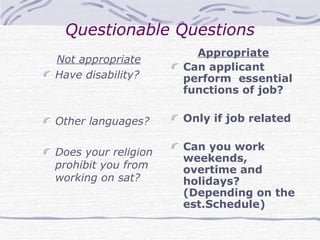
Questionable Questions Not appropriate Have disability? Other languages? Does your religion prohibit you from working on sat? Appropriate Can applicant  perform  essential functions of job? Only if job related Can you work weekends, overtime and holidays? (Depending on the est.Schedule)
If charged with discrimination, we must be able to explain legitimate, non-discriminatory reasons for any non-hire decision.
Negligent Hiring Employers have a duty to protect employees, patients, clients, visitors and the general public from injury caused by employees that the employer knew or should have known posed a risk of harm to others Occurs when hiring an employee who is not qualified or who is unfit for the job injures another person
It is critical that employers check references and properly screen applicants before hiring.
Wrongful Discharge Making a false representation or a promise in order to recruit the applicant for a job, the applicant relies upon it and suffers damages as a result
Wrongful Discharge Exercise care when making statements about the job or the organization in the hiring process Interviewer is especially vulnerable to making statements that may later be used against the employer Never exaggerate or make predictions
ADA and Pre-employment Inquiries Does not interfere with your right to hire the best qualified candidate – simply prohibits you from discriminating against a qualified applicant because of disability The applicant must be qualified for the job by satisfying the essential job requirements – education, experience, skills, training, licenses/certs or other job related qualification standards
ADA Cont’d Cannot  ask weather or to what extent an individual is disabled Should  ask about the ability to perform the essential functions of the job
ADA Cont’d Pre-offer questions on accommodations may be asked when an employer reasonably believes the applicant will need reasonable accommodation because of a hidden disability that the applicant has voluntarily disclosed or when the applicant has voluntarily disclosed the need for accommodation
ADA Cont’d An example: Applicant for receptionist position voluntarily discloses that she will need periodic breaks to take medication.  The employer may ask the applicant questions about the reasonable accommodation such as how often and the duration breaks must be.
ADA cont’d A disability is defined as a physical or mental impairment that substantially limits a major life activity.  Reasonable accommodation is required unless the employer can demonstrate that the accommodation imposes undue hardship on the operation of the business.
Job Qualifications Education Experience Skills Behavioral characteristics
Things to Look for on Apps/Resumes
Things to Look for on Resumes/Apps Have they worked in one of our facilities in the past? Does applicant meet minimum qualifications from job description? Sloppy, unreadable? – May have been created in a hurry or show indifference but be careful to judge, may be a inability to use technology!
Things to Look for on Resumes/Apps If job related – review for spelling & grammar Has experience been acquired in settings comparable to yours?
Things to Look for (cont’d) Are there transferable skills or knowledge that might be applied to your open position? Red flags – month & date should be listed.  Listing only years may be an attempt to lengthen experience or leave out a job.
Things to Look for Cont’d Gaps – are they explained?  Don’t be afraid to ask them to fill in the gaps – doesn’t necessarily mean candidate is incompetent or an inability to hold a job – gaps can occur for numerous reasons – downsizing, temporary employment, sabbaticals, family responsibilities.
Things to Look for Cont’d Frequent job changes – reasons for leaving – is there a pattern? Salary history – how does it compare to salary range of the job? Criminal convictions – leave this to the HR department.  We will consider the type of crime, seriousness and date.  If unrelated to the job, should not be considered.
Why Interviews Fail: Not enough info collected Don’t fully understand requirements Don’t fully evaluate the resume Settle for superficial, canned answers Hooked on skill fit – don’t consider other issues Don’t document interview
Plan the Interview Determine essential job functions from job description Define experience level, education, training, certs/licenses or other qualifications
Plan the Interview cont’d Determine general conditions of work environment, work schedule and potential for overtime Review resume & prepare questions beforehand
Plan Interview Cont’d Make list of questions (on a separate sheet of paper) identifying areas you want to inquire about  Look for gaps in employment Identify experience or knowledge that you want the candidate to expand on Create comfortable, relaxed interview environment without interruptions – give yourself enough time to conduct it
Plan Interview Cont’d Ask only job related questions Use rapport building questions Treat all applicants the same – ask same questions of all candidates to ensure consistency & comparability
Types of Questions Direct Open ended Situational or Behavioral Problem-solving Reflective
Direct Questions Valuable for focusing on particular issues  Can you work this schedule? Can you perform the essential functions of this position? What are your salary requirements?
Open Ended Questions Invite an expression of opinion or explanation How would you describe your present responsibilities and duties? What are the accomplishments you are most proud of in your career? What is most important to you in choosing your next position?
Behavioral Questions These questions ask the applicant to describe the previous situations that are relevant to the current position How have you handled a situation in the past that required taking care of an irate customer?  What was the situation?  What did you do and what was the outcome?
Problem-Solving Questions Ask the applicant to respond to hypothetical, job related problems which can provide insight into the candidate’s motivation, resourcefulness, ability to work with others or other behavioral traits important for success in the job
Example of Problem Solving Questions There are three telephone lines that you have placed on hold, you are talking with a person on another line and there are two people at your desk to see the manager.  How would you handle this situation?
Reflective Questions These arise during the interview and depend on what is said by the applicant.  These questions probe for further information when the applicant’s response was vague or incomplete. You said you are a “people person”.  What do you mean by that?
Reflective Questions cont’d You mentioned you had a conflict with another employee.  What happened and what did you do to resolve the problem? Why did you say you like to work in a team?
When developing questions : Be brief Make sure the questions relate to the qualifications necessary to perform the functions of the job Ask questions one at a time – avoid multiple questions Do not ask leading questions where the applicant can anticipate the answer you want
Focus on Exploring an Applicants: Ability to perform physical job requirements Ability to work job schedule Ability to handle job pressure Ability to perform essential job functions Prior job experience Reasons for leaving former employers
Structure of an Interview Ice breaker – take a moment to establish rapport, ensure they are comfortable so they’ll share necessary information! Let candidate know how you are going to structure your meeting Tell applicant up front that you will be taking notes (communicates to candidate that you are gathering as much info as possible)
Structure (Cont’d) Allow silence and sufficient time for applicant to answer  Use proactive listening skills – listen to and be interested in what your applicant is saying, maintain eye contact, open body language, use head nods and follow up questions/reflective questions Uncover skills, knowledge, motivation, attitude & fit into organization
Structure Cont’d Take control of interview and turn overly talkative applicants back on interview track Don’t make promises or commitments you can’t keep regarding increases in pay, promotions or scheduling –talk in terms of possibilities or potentials
Structure Cont’d Indicate to candidate that you have all of the info you need and give them opportunity to ask questions (be prepared to answer them!)
Structure Cont’d Tell how & when they will be informed of selection decision Leave candidate with a good impression of the organization, your unit or department and yourself regardless of how well (or not) the interview went
Structure Cont’d Complete form/notes immediately after interview – good interview notes are a great defense if hiring practices are investigated Base decisions solely on job related issues
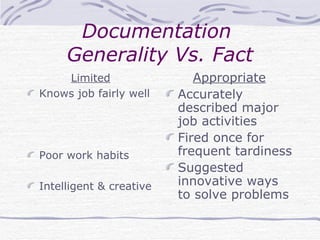
Documentation  Generality Vs. Fact Limited Knows job fairly well Poor work habits Intelligent & creative Appropriate Accurately described major job activities Fired once for frequent tardiness Suggested innovative ways to solve problems
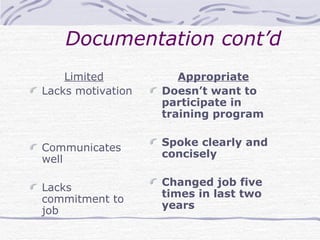
Documentation cont’d Limited Lacks motivation Communicates well Lacks commitment to job Appropriate Doesn’t want to participate in training program Spoke clearly and concisely Changed job five times in last two years
Making the Decision Look at the total picture of matching experience, skills, training and interest to the job Focus on track record – on accomplishments and performance Don’t try to force the fit Don’t settle for second best!

Interviewing 101

  • 1.
    Interviewing 101 A Glimpse at the Basics What you need to know to stay legal and obtain the info you need to make a sound decision
  • 2.
    Discrimination Age RaceNational origin Religion Gender Disability or health (including work comp claims or job related injuries)
  • 3.
    Discrimination cont’d Sexualorientation Marital status Pregnancy
  • 4.
    Questionable Questions Notappropriate Have disability? Other languages? Does your religion prohibit you from working on sat? Appropriate Can applicant perform essential functions of job? Only if job related Can you work weekends, overtime and holidays? (Depending on the est.Schedule)
  • 5.
    If charged withdiscrimination, we must be able to explain legitimate, non-discriminatory reasons for any non-hire decision.
  • 6.
    Negligent Hiring Employershave a duty to protect employees, patients, clients, visitors and the general public from injury caused by employees that the employer knew or should have known posed a risk of harm to others Occurs when hiring an employee who is not qualified or who is unfit for the job injures another person
  • 7.
    It is criticalthat employers check references and properly screen applicants before hiring.
  • 8.
    Wrongful Discharge Makinga false representation or a promise in order to recruit the applicant for a job, the applicant relies upon it and suffers damages as a result
  • 9.
    Wrongful Discharge Exercisecare when making statements about the job or the organization in the hiring process Interviewer is especially vulnerable to making statements that may later be used against the employer Never exaggerate or make predictions
  • 10.
    ADA and Pre-employmentInquiries Does not interfere with your right to hire the best qualified candidate – simply prohibits you from discriminating against a qualified applicant because of disability The applicant must be qualified for the job by satisfying the essential job requirements – education, experience, skills, training, licenses/certs or other job related qualification standards
  • 11.
    ADA Cont’d Cannot ask weather or to what extent an individual is disabled Should ask about the ability to perform the essential functions of the job
  • 12.
    ADA Cont’d Pre-offerquestions on accommodations may be asked when an employer reasonably believes the applicant will need reasonable accommodation because of a hidden disability that the applicant has voluntarily disclosed or when the applicant has voluntarily disclosed the need for accommodation
  • 13.
    ADA Cont’d Anexample: Applicant for receptionist position voluntarily discloses that she will need periodic breaks to take medication. The employer may ask the applicant questions about the reasonable accommodation such as how often and the duration breaks must be.
  • 14.
    ADA cont’d Adisability is defined as a physical or mental impairment that substantially limits a major life activity. Reasonable accommodation is required unless the employer can demonstrate that the accommodation imposes undue hardship on the operation of the business.
  • 15.
    Job Qualifications EducationExperience Skills Behavioral characteristics
  • 16.
    Things to Lookfor on Apps/Resumes
  • 17.
    Things to Lookfor on Resumes/Apps Have they worked in one of our facilities in the past? Does applicant meet minimum qualifications from job description? Sloppy, unreadable? – May have been created in a hurry or show indifference but be careful to judge, may be a inability to use technology!
  • 18.
    Things to Lookfor on Resumes/Apps If job related – review for spelling & grammar Has experience been acquired in settings comparable to yours?
  • 19.
    Things to Lookfor (cont’d) Are there transferable skills or knowledge that might be applied to your open position? Red flags – month & date should be listed. Listing only years may be an attempt to lengthen experience or leave out a job.
  • 20.
    Things to Lookfor Cont’d Gaps – are they explained? Don’t be afraid to ask them to fill in the gaps – doesn’t necessarily mean candidate is incompetent or an inability to hold a job – gaps can occur for numerous reasons – downsizing, temporary employment, sabbaticals, family responsibilities.
  • 21.
    Things to Lookfor Cont’d Frequent job changes – reasons for leaving – is there a pattern? Salary history – how does it compare to salary range of the job? Criminal convictions – leave this to the HR department. We will consider the type of crime, seriousness and date. If unrelated to the job, should not be considered.
  • 22.
    Why Interviews Fail:Not enough info collected Don’t fully understand requirements Don’t fully evaluate the resume Settle for superficial, canned answers Hooked on skill fit – don’t consider other issues Don’t document interview
  • 23.
    Plan the InterviewDetermine essential job functions from job description Define experience level, education, training, certs/licenses or other qualifications
  • 24.
    Plan the Interviewcont’d Determine general conditions of work environment, work schedule and potential for overtime Review resume & prepare questions beforehand
  • 25.
    Plan Interview Cont’dMake list of questions (on a separate sheet of paper) identifying areas you want to inquire about Look for gaps in employment Identify experience or knowledge that you want the candidate to expand on Create comfortable, relaxed interview environment without interruptions – give yourself enough time to conduct it
  • 26.
    Plan Interview Cont’dAsk only job related questions Use rapport building questions Treat all applicants the same – ask same questions of all candidates to ensure consistency & comparability
  • 27.
    Types of QuestionsDirect Open ended Situational or Behavioral Problem-solving Reflective
  • 28.
    Direct Questions Valuablefor focusing on particular issues Can you work this schedule? Can you perform the essential functions of this position? What are your salary requirements?
  • 29.
    Open Ended QuestionsInvite an expression of opinion or explanation How would you describe your present responsibilities and duties? What are the accomplishments you are most proud of in your career? What is most important to you in choosing your next position?
  • 30.
    Behavioral Questions Thesequestions ask the applicant to describe the previous situations that are relevant to the current position How have you handled a situation in the past that required taking care of an irate customer? What was the situation? What did you do and what was the outcome?
  • 31.
    Problem-Solving Questions Askthe applicant to respond to hypothetical, job related problems which can provide insight into the candidate’s motivation, resourcefulness, ability to work with others or other behavioral traits important for success in the job
  • 32.
    Example of ProblemSolving Questions There are three telephone lines that you have placed on hold, you are talking with a person on another line and there are two people at your desk to see the manager. How would you handle this situation?
  • 33.
    Reflective Questions Thesearise during the interview and depend on what is said by the applicant. These questions probe for further information when the applicant’s response was vague or incomplete. You said you are a “people person”. What do you mean by that?
  • 34.
    Reflective Questions cont’dYou mentioned you had a conflict with another employee. What happened and what did you do to resolve the problem? Why did you say you like to work in a team?
  • 35.
    When developing questions: Be brief Make sure the questions relate to the qualifications necessary to perform the functions of the job Ask questions one at a time – avoid multiple questions Do not ask leading questions where the applicant can anticipate the answer you want
  • 36.
    Focus on Exploringan Applicants: Ability to perform physical job requirements Ability to work job schedule Ability to handle job pressure Ability to perform essential job functions Prior job experience Reasons for leaving former employers
  • 37.
    Structure of anInterview Ice breaker – take a moment to establish rapport, ensure they are comfortable so they’ll share necessary information! Let candidate know how you are going to structure your meeting Tell applicant up front that you will be taking notes (communicates to candidate that you are gathering as much info as possible)
  • 38.
    Structure (Cont’d) Allowsilence and sufficient time for applicant to answer Use proactive listening skills – listen to and be interested in what your applicant is saying, maintain eye contact, open body language, use head nods and follow up questions/reflective questions Uncover skills, knowledge, motivation, attitude & fit into organization
  • 39.
    Structure Cont’d Takecontrol of interview and turn overly talkative applicants back on interview track Don’t make promises or commitments you can’t keep regarding increases in pay, promotions or scheduling –talk in terms of possibilities or potentials
  • 40.
    Structure Cont’d Indicateto candidate that you have all of the info you need and give them opportunity to ask questions (be prepared to answer them!)
  • 41.
    Structure Cont’d Tellhow & when they will be informed of selection decision Leave candidate with a good impression of the organization, your unit or department and yourself regardless of how well (or not) the interview went
  • 42.
    Structure Cont’d Completeform/notes immediately after interview – good interview notes are a great defense if hiring practices are investigated Base decisions solely on job related issues
  • 43.
    Documentation GeneralityVs. Fact Limited Knows job fairly well Poor work habits Intelligent & creative Appropriate Accurately described major job activities Fired once for frequent tardiness Suggested innovative ways to solve problems
  • 44.
    Documentation cont’d LimitedLacks motivation Communicates well Lacks commitment to job Appropriate Doesn’t want to participate in training program Spoke clearly and concisely Changed job five times in last two years
  • 45.
    Making the DecisionLook at the total picture of matching experience, skills, training and interest to the job Focus on track record – on accomplishments and performance Don’t try to force the fit Don’t settle for second best!

Editor's Notes

  • #4 Sexual Orientation – self explanatory Marital Status – do not ask if they plan to start a family soon or what their spouse does for a living? Child care arrangements – stick to the schedule requirements