Ocean Passage Planning
Publications
- AMN Volumes I – IV
- FLOO’s
- FOS
- Admiralty Distance Tables
- Ocean Passages for the World
- Routeing Charts
- RNCP9
- PLAGO’s
- Distance between ports of arrival and departure
- Tidal Information
- Recommendation from sailing directions
- Traffic Separation Schemes
- Forecast weather
- Sunrise / Sunset
- Fixing methods available
- Range and visibility of lights
- Navigation Work Book
Details Of Departure
ETD ETA
Tidal Data Tidal Data
Sunrise / Sunset Sunrise / Sunset
Notes on Entry
Passage Details
Distances / Routes
Charts Required
Sunrise / Sunset
Tidal Stream
Standard Calculations
Ocean Currents
Ports Working Hours
Factors
ETD / ETA
Tidal Restrictions
Ports Working Hours
Administration Details i.e. Store Ship
Weather en route
Fog / low visibility (slow speeds)
Prevailing Wind (Flying ops)
Effect on speed of rough weather
Choice of route
Traffic Separation Scheme
Shipping
- Fishing
- Traffic bottlenecks
- Land on starboard side
- Narrow channels
- Canals
- Areas of heavy traffic
Operations / Exercises en route
- RAS / RV’s
- Firings
- Power trials
- MOBEX
- OOW Manoeuvres
- Machinery Breakdowns
Territorial Limits
- Detailed in Annual Summary of Notices to Mariners
- DIPCLEAR
- Right of innocent passage
Fuel
- Fuel Demands (FLOOs)
- Economical Speeds
- Consumption data
- Fuel allocation in FOS
Gash disposal
- MARPOL regulations
- Special areas
Distance off dangers
- Minimise risk of grounding
- Close enough to ID shore marks
- Under keel clearance
Routeing Charts
- Routes and charts between ports
- Ocean currents
- Wind roses
- Ice limits
- Air / dew point / sea temperatures
- Barometric pressure
- Incidence of fog / gales / storms
Great circle / composite track
Plan on one small scale chart then transfer to the largest usable chart.
Indicate:
- DTR (Distance to run)
- Time of course alterations
- Tidal stream currents
- RV’s
- Sunrise / Sunset
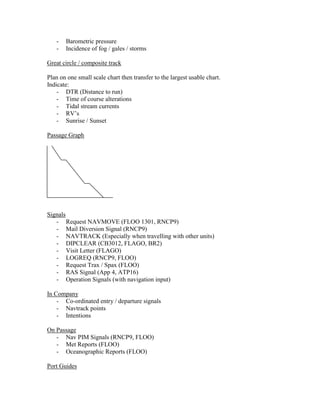
Passage Graph
Signals
- Request NAVMOVE (FLOO 1301, RNCP9)
- Mail Diversion Signal (RNCP9)
- NAVTRACK (Especially when travelling with other units)
- DIPCLEAR (CB3012, FLAGO, BR2)
- Visit Letter (FLAGO)
- LOGREQ (RNCP9, FLOO)
- Request Trax / Spax (FLOO)
- RAS Signal (App 4, ATP16)
- Operation Signals (with navigation input)
In Company
- Co-ordinated entry / departure signals
- Navtrack points
- Intentions
On Passage
- Nav PIM Signals (RNCP9, FLOO)
- Met Reports (FLOO)
- Oceanographic Reports (FLOO)
Port Guides

Ocean passage planning

  • 1.
    Ocean Passage Planning Publications -AMN Volumes I – IV - FLOO’s - FOS - Admiralty Distance Tables - Ocean Passages for the World - Routeing Charts - RNCP9 - PLAGO’s - Distance between ports of arrival and departure - Tidal Information - Recommendation from sailing directions - Traffic Separation Schemes - Forecast weather - Sunrise / Sunset - Fixing methods available - Range and visibility of lights - Navigation Work Book Details Of Departure ETD ETA Tidal Data Tidal Data Sunrise / Sunset Sunrise / Sunset Notes on Entry Passage Details Distances / Routes Charts Required Sunrise / Sunset Tidal Stream Standard Calculations Ocean Currents Ports Working Hours Factors ETD / ETA Tidal Restrictions Ports Working Hours Administration Details i.e. Store Ship Weather en route Fog / low visibility (slow speeds) Prevailing Wind (Flying ops)
  • 2.
    Effect on speedof rough weather Choice of route Traffic Separation Scheme Shipping - Fishing - Traffic bottlenecks - Land on starboard side - Narrow channels - Canals - Areas of heavy traffic Operations / Exercises en route - RAS / RV’s - Firings - Power trials - MOBEX - OOW Manoeuvres - Machinery Breakdowns Territorial Limits - Detailed in Annual Summary of Notices to Mariners - DIPCLEAR - Right of innocent passage Fuel - Fuel Demands (FLOOs) - Economical Speeds - Consumption data - Fuel allocation in FOS Gash disposal - MARPOL regulations - Special areas Distance off dangers - Minimise risk of grounding - Close enough to ID shore marks - Under keel clearance Routeing Charts - Routes and charts between ports - Ocean currents - Wind roses - Ice limits - Air / dew point / sea temperatures
  • 3.
    - Barometric pressure -Incidence of fog / gales / storms Great circle / composite track Plan on one small scale chart then transfer to the largest usable chart. Indicate: - DTR (Distance to run) - Time of course alterations - Tidal stream currents - RV’s - Sunrise / Sunset Passage Graph Signals - Request NAVMOVE (FLOO 1301, RNCP9) - Mail Diversion Signal (RNCP9) - NAVTRACK (Especially when travelling with other units) - DIPCLEAR (CB3012, FLAGO, BR2) - Visit Letter (FLAGO) - LOGREQ (RNCP9, FLOO) - Request Trax / Spax (FLOO) - RAS Signal (App 4, ATP16) - Operation Signals (with navigation input) In Company - Co-ordinated entry / departure signals - Navtrack points - Intentions On Passage - Nav PIM Signals (RNCP9, FLOO) - Met Reports (FLOO) - Oceanographic Reports (FLOO) Port Guides